Four-part structure and the writing process

Over the course of writing Gunslinger to the Stars, I’ve learned some interesting new things about my writing process, as well as being reminded of some of the basic lessons I learned back when I was getting started. These lessons have helped me to have some fantastic writing days, like today, where I hit 2200 WPH at one point and knocked off 1.7k words before lunch.

Just a week ago, though, I was struggling to write anything, which was strange considering how well the story had been coming along up to that point. The realization that helped me to get through that and get back to writing strong was that my difficulty was a function of story structure, and that different parts of the story require a different process.

What follows are my personal conclusions about my own writing process, which may or may not be similar to your own. Every writer is different, so what works for me may not work for you. At the same time, there are enough similarities that I hope my own process may provide some insight into your own.

Four-Part Story Structure

First of all, let’s talk about story structure. There are a lot of different possible structures, but the most common one in the West is the three-act structure. This often echoes the hero’s journey, which goes something like this:
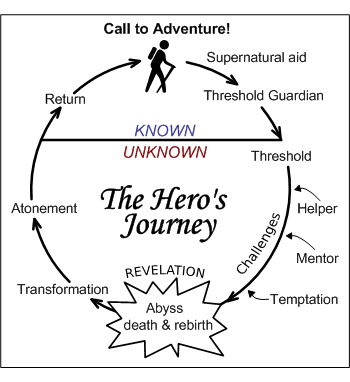
heros_journeyFor purposes of this blog post, I’ll assume you’re already familiar with both the three-act structure and the hero’s journey. If not, there are plenty of other resources where you can learn about them in-depth.

I prefer to think in terms of four-part structure, however, where act two is divided into two halves. In typical three-act structure, the hero hits his lowest point at the midpoint of act two. This is also the midpoint of the story itself, where the hero reaches the nadir of the hero’s journey. In four-part structure, that midpoint is just treated like a plot point, dividing part two from part three. Everything else is the same.

Thus, when you frame a particular story in four-part structure, it looks like this:

  1. The Call to Adventure
  2. Tests, Allies, and Enemies
  3. The Darkest Hour
  4. The Final Battle

Part One: The Call to Adventure

The first part of the story typically starts in the ordinary world, until the inciting incident somewhere around the middle of part one calls the hero to adventure. He then either refuses the call (which usually leads to bad things because the call knows where you live), or he accepts it and has to fight off some threshold guardians to get into the realm of adventure (sometimes, he refuses it and has to fight the guardians). Typically around this point, he meets a mentor to help him on his way.

Prewriting: To get off to a good start, I have found that the key is to know (or at least have a good idea) how the story is going to end before I begin to write it. That way, I know that I’m starting in the right part and I have a general idea where I’m going. I don’t know how I’m going to get there yet, but that doesn’t really matter yet.

Writing: The hardest part about writing this part is the first scene. After that, it usually comes quite easily. It helps to do a bit of world building, or to outline the characters and their backstories, but it isn’t always necessary. Personally, I’ve found that I can discovery-write these things pretty well (and yes, if you haven’t guessed already, I’m a pantser).

Revising: This is usually the part that needs the most revising. It’s also the part that can get me into the most trouble if I don’t do it well. I’m a chronological writer, and if something in the story is seriously off, I have to go back and fix it before I can proceed to the end. I’ve forced myself to finish even when I knew that things were broken, and it only made the writing process worse. So for me, the beginning usually gets the most revision work, whether I plan on it or not.

Part Two: Tests, Allies, and Enemies

Part two is where the adventure really begins. The hero crosses the threshold into the unfamiliar world, and everything is new and exciting. This is also the part where things start to become truly dangerous. Not everyone is who they seem in this part, and the hero may fall into some traps. But the mentor is usually still there to help him get back up.

Prewriting: In my experience, this is the part that needs the least pre-writing. It’s almost always pure discovery. With the ending clearly in mind but still distant enough not to worry about, I can afford to let the story meander a little and take me to some unexpected places.

Writing: This is usually the easiest part of the story to write, for the same reasons as above. I can afford to do almost 100% discovery writing at this part, and it usually feels quite effortless. When the writing does get blocked, it’s usually because something in part one is totally broken.

Revising: Most of the revision process for part two consists of making sure that later events are properly foreshadowed. I usually don’t add enough foreshadowing when I write the first draft, so it’s essential to go back and add it later. Thankfully, this can usually be accomplished by a couple of tweaks, or adding a couple extra paragraphs to an already extant scene.

Part Three: The Darkest Hour

This is where the story gets real. The hero falls into a much larger trap than any of the others, and the mentor can no longer help him (usually because he’s dead). Alone, the hero has to find his own way out, usually hitting rock bottom along the way. Just when it looks like all is lost, some new twist sends the hero in a different direction, setting things up for the final act.

Prewriting: This is where prewriting goes from being unimportant to absolutely essential. Whereas in part two, I can afford to let the story meander a little bit, in part three I absolutely need direction. It’s not enough just to know how the story will ultimately end: at this point, I’ve found that I really need to map my way there.

Writing: This is also typically the most difficult part for me to write. However, when the prewriting is done well and the plot is set up properly, it’s actually not that bad. But it’s important to go really hard on your characters—to make life truly miserable for them. There can be no easy way outs for them, otherwise the entire story will suffer.

Revising: For part three, revising usually consists of putting scenes in the proper order, not in rewriting them completely from scratch. If the foundational elements of the previous two parts were set up correctly, then everything in part three will usually come out well too, but they’re almost always in the wrong order. Transitions then are the part that usually need the most cleanup.

Part Four: The Final Battle

At this point, the hero has a clear direction and a knowledge of how to get there. In climbing up from his lowest point, he finds the boon that will save the world, makes peace with the higher power, and comes back stronger than ever before. But the forces of evil have never been stronger either, and the clash marks the climax of the entire story. There may be a big damn hero moment, or a last minute rescue from the cavalry. There may also be a standoff with no apparent solution, or some truly complex power plays. Inevitably, though, there is a resolution, followed by a return (even if only to the world of adventure). The hero saves the world, gets the girl, and rides off into the sunset. Curtains, applause, and lights.

Prewriting: By this point, most of the prewriting has already been done. The important thing is to have the flexibility to change and adjust, because this is the point where the story often surprises me. It is also the point where discovery-writing is often the most satisfying.

Writing: At this point, I’m usually tearing it up in a white-hot heat of creative energy. It’s extremely rare that I’ll get blocked at this point, but if I do, the key is almost always to just write through it. Often, I’ll make notes of things to change in revision and just barrel ahead—and it works, because there’s no need to set anything up for later. This is the moment of truth, where everything comes together.

Revising: Most of the revision at this point of the story has to do with tying up loose ends. That’s usually not a problem for me, though, because I tend to write very clean. If there is a loose end, it’s usually something that I’ve made a note to fix earlier in the story. For me, the ending is usually the part that needs revising the least.

So there you have it. The biggest lesson I’ve learned just recently is how important it is not to neglect the prewriting aspect of the creative process, especially around part-three. When everything is in place, it makes the story flow so much better.

What are your thoughts? Any plotters or outliners out there with a different take on the process? Everyone is different, but we’re all basically trying to do the same thing, so it’s interesting to see what works for different people!


Novella woes and farmers markets

Today I wrote about 2.6 words in my current WIP (Sons of the Starfarers), which didn’t really feel like it because I was constantly getting distracted.  Still, 2.6 words is pretty solid–it’s about mid-range for me.  If I can hit that every day from here on out (which is doubtful, but hey), the rough draft should be finished before the end of the month.

The crazy thing is that I just hit the inciting incident at the end of today’s writing session, after passing the 6k word mark.  For a mid-sized novella, that’s pretty late.  In the classic three act structure, the inciting incident usually hits between the 12%-15% mark, but this one is well past 20% for a 30k word novella–and just barely at 16% for a 40k.

So in layman’s terms, how long is this book going to be?  Probably longer than any of the Star Wanderers stories, but not quite as long as Genesis Earth.  It probably won’t turn into a full-fledged novel, since there’s only one viewpoint character, but I can already tell that it’s going to flirt with the line between novella and novel.

We’ll see how it turns out.  I’m still really excited about this story, and even though I don’t have a clear idea how to write the ending, I do know exactly how it’s going to end, if that makes any sense.  I’ve got a clear idea of the series arc that this book is going to set up, but I don’t yet have a clear idea of the book’s self-contained arc.  Once I figure that out, maybe I’ll be able to trim it down to a 30k novella after all.

============================================================

I visited the Stadium Farmer’s Market in Provo for the first time today.  It was pretty neat–lots of great produce, a nice community atmosphere, and a few quirky things like Jalapeno Jelly and tie died baby jumpers that you can’t really find in a mainstream grocery store.  I came away with some excellent peaches and a hankering to come back next week for more.

Anyhow, the trip got me thinking how indie publishing is kind of like a farmer’s market.  You’ve got everything from the guys who sell their produce out of unmarked paint buckets (writers who toss their books up to amazon with hardly a thought) to the local farm operations with pretty banners, pretty baskets, and laminated fact sheets drilling down on every possible difference between Elberta and Briscoe peaches (writers who go to great lengths to organize their own small presses and become Facebook/Twitter/Blogging personalities).

Almost everyone gives away free samples, which actually does a lot to drive sales.  In a similar way, most indie writers either have a couple of perma-free titles or free-pulse their books.  Everyone at the farmer’s market tries to be friendly and reach out to the customers (kind of like authors on Facebook and Twitter), but for me personally this kind of drives me away.  A good entertaining sales pitch, though, can be quite interesting.  I listened to the guy selling honey for almost twenty minutes, going on and on about his wares.  It’s clear he’s in a business that he loves.

Even though the fruit in the farmer’s market tends to have more blemishes than the stuff you find in the mainstream store, it is WAAAY more fresh and delicious.  Similarly, the stuff from the mainstream presses might be a lot more edited and polished, but the true innovation and formula-breaking stuff is happening in the world of self-publishing.  Publishers want things to be more predictable and formulaic so that they can have a better idea how something is going to sell, but indies are free to try almost anything.

Those aren’t the only parallels, either.  The more I think about it, the more it seems that being a self-published indie writer (or “author-publisher,” a newer term that I think I actually prefer) is a lot like being a local small farmer.  I’m sure there are differences, but the similarities are quite striking.

And now I’m really wishing I’d bought some of that honey.

Trope Tuesday: The Call to Adventure

One of the first (and most important) stages of the hero’s journey is the call to adventure.  It happens when the hero first confronts something outside the experience of his ordinary world that beacons him to leave it.  It overlaps closely with the inciting incident, and marks the point at which the hero’s journey begins.

However, it is not typically where the story begins.  In order for the hero to leave the ordinary world, he must first start out there, so we know what’s at stake and what he’s leaving behind.  This is why Luke Skywalker starts out on his uncle’s homestead, and why Neo starts out as a bored and lonely employee of Metacortex.  Events outside the hero’s experience may have already put him on a trajectory to leave on the adventure, but he won’t know it until the call comes.

The hero may start out in a quiet, peaceful village, far removed from any sort of conflict–or he may start out in the middle of a crapsack world, as is the case with dystopian fiction.  The important thing is that it’s the world he’s always known–that he hasn’t ever really made an effort to leave or change it.

How he feels about his world largely determines how he chooses to respond to the call.  In older literature, the hero typically refuses it.  The advantage of this is that it gives the reader a sense of scope–that this adventure is not a small or a trivial thing.  It also sets up an immediate minor conflict that gives some motion to the opening chapters.

In modern stories, though, it’s more common for the hero (or his friends) to jump at the call.  There are also many advantages to this.  In Lord of the Rings, it gives Frodo an immediate band of sidekicks.  In Harry Potter, it plays up the sense of wonder at the magical world.  In the Chronicles of Prydain, it highlights the impulsiveness and naivete of Terran, as he realizes later on in the story just how stupid of him it was.

The call itself can take many forms.  It can come as a fateful visitation from a supernatural messenger, a mysterious request from a dying stranger, or a sacred trust from a dying friend.  It can also be more internal, such as an important moment of decision, or a desire to find some greater purpose in life.  Whatever the case, the one thing the hero cannot do is ignore it–at least, not forever.  One way or another, the hero sets out, and the adventure begins.

plot vs. PLOT and an interesting serial publishing idea

Back in English 318 at BYU, Brandon Sanderson used to tell us that there was a big difference between “little-p plot” and “big-p Plot.” The first applies mostly to chapters and scenes, which he said he could teach us.  The second refers to the overall story structure, which he couldn’t teach in a classroom setting and said we’d have to discover on our own.

I’ve been thinking a lot about this recently, because it seems that my books are starting to fall into a recognizable pattern–and that pattern has some interesting potential for serials and other alternate forms of publication.  Each book is divided into 3-4 parts, each part is divided into 3-6 chapters (typically 5), and each chapter is divided into 3-5 scenes.  Here’s how it works:

Chapter 1: Setup for the basic story arc.  Introduction of the characters and setting, the prominent theme or premise, and a little foreshadowing of the coming conflict.
Chapter 2: The inciting incident, a discovery or event that starts the plot rolling and puts the characters in motion and conflict.
Chapter 3: Complications arise, the problem gets worse, the first attempt at a solution fails, generally leaving the characters at a loss.
Chapter 4: Setup for the resolution.  The characters discover or build something that will help them to settle the conflict.  They stop reacting and start to be more assertive.
Chapter 5: The resolution.  The characters either succeed or fail, but the arc comes to a close either way.  The story question is answered, the thematic elements come full circle, and the story either closes or moves on to the next part.

Basically, it’s the 3-act format divided into five chapters.  When I wrote Heart of the Nebula, all four parts fell into this pattern, and now that I’m writing Star Wanderers, I’m finding myself  falling into the exact same pattern again.  Stars of Blood and Glory is a little bit different; there are three parts instead of four, and each part is divided into six chapters instead of five.  But still, it’s all very structured.

In short, Brandon was right.  It took me a few books to really learn “big-p Plot,” but now that I’ve found a story structure that works for me, it’s starting to come quite naturally.

The cool thing about this particular structure is that it’s very conducive to serialization.  Each chapter is between maybe 3,000 to 5,000 words, so each complete sub-arc is between about 15,000 to 25,000.  That’s the length of a short novella, and it takes me only a month or two to write (sometimes three, depending on how much revision it needs).

The only reason I haven’t done more with serialization up to this point is because I’ve found that sharing my work while it’s still unfinished tends to throw a wrench in my creative process.  The idea of publishing a work in progress on a chapter-by-chapter basis scares me, because if one of the story arcs has a flawed beginning, I wouldn’t be able to fix it.

However, by following a five-chapter arc format (with bits and pieces here and there to hint at a larger overarching structure), I can see myself publishing a novel or epic in a serial format.  It would be something like the Perry Rhodan series, which follows an arc structure of 25 to 100 issues (each a small novella) per cycle.

So here’s how I’m thinking of doing it:

  1. Publish the first installment and price it at free while writing the second one.
  2. Publish the second installment and price it at free, raise the price of the first installment to $.99 and write the third one.
  3. Publish the third installment and price it at free, raise the price of the second installment to $.99 and write the fourth one.
  4. Publish the fourth installment for $.99, drop the price of the first installment to free and publish the completed novel for $2.99.

So what do you think?  Does it seem like a good way to publish a book?  It gives the reader a reason to keep coming back, and rewards those who got in early by charging them less for the completed work.  By selling the novel in shorter chunks, I would be able to put more work out and hopefully gain more visibility, especially by making a portion of it free at any given time.

I’m seriously thinking about publishing Star Wanderers this way, once I hear back from Writers of the Future.  I’ve already finished the rough draft for the second part; it probably needs a good revision or two before it’s ready, but since it’s shorter, it shouldn’t take more than a few weeks to get feedback from some first readers and finish the next draft.  And if the third part is already finished by then…

So many awesome possibilities! 🙂 What do you think?

13,837 words in a day?

Yeah, that’s right.  Believe it or not, I barreled through about 13,837 words today.  That’s thirteen THOUSAND, not thirteen hundred.

Now, only about a thousand of that was new stuff  that I was writing.  Most of the rest of it was rearranging scenes that I’d already written, touching them up only a tiny bit.  I did merge a couple of scenes, delete or tone down some stuff, etc.

So really, about 90% of my work today was just revision, and not even really hardcore revision at that.  I’m still treating this version of my story as a rough draft; I’m not taking the time to polish things up and fix the known minor problems.  Really, I’m just running through what I’ve already written to make sure I have what I need to get past the roadblock I hit back in April.

The biggest thing I’m doing right now is rearranging scenes into entirely new chapter arrangements.  This seems to be a problem everytime I write a story with multiple viewpoints: I never seem to get the prelude-rising-falling-resolution-cliffhanger action that good chapters have.  I write scenes as they come to me, in a progression that seems natural at the time, but once I take a step back, I find that things work better on the macro-level if I complete rearrange which scenes come where in the narrative.

Part of that is that sometimes I just need to write a few paragraphs (or even a few scenes) just for me to figure out what’s going on, plotwise or settingwise.  What I’m finding with Bringing Stella Home is that I’m taking scenes from James and Danica’s viewpoints and moving them up a chapter or two, cutting out the filler in the middle.

I’ve got a long way to go before I master the art of good chapter structure.  Or perhaps it’s something that I do better when I’m revising, not drafting.  After all, I think I’m more of a discovery writer than a firm outliner.  Perhaps I write in a sort of puzzled up everywhere kind of way, and then do best when I don’t put all the pieces together until after I’ve vomited them all on the page.

I am getting more excited about this story, though.  Taking a step back and looking at things from a more global perspective has really re-energized me.  I can see the major turning points, and that helps me to build up for them much better.

I’m only worried that the “midpoint” is going to be somewhere around the 3/5ths mark, not the halfway mark as it should be.  One of my goals with this book is to see if I can hold to the three act structure and whether that makes my story any stronger.  But, according to the website, the midpoint occurs “approximately” at the halfway point, so I guess I can fudge it.

Also, the midpoint is supposed to be where the main character hits rock bottom.  Hee hee hee…oh, he will.  He will.  Bwahahahaha!!!

In the meantime, you owe it to yourself to listen to this:

New directions

This past week, I’ve been going through Bringing Stella Home at quite a good clip.  I’m going through the rough draft as I had it at the end of April, making some major revisions that hopefully are going to make it easier to write the middle section.  

I’ve been going along at a good clip, getting through as many as seven thousand words a day (it helps that I’m not taking classes or working right now), but today I hit something of a wall and realized I couldn’t go forward if I didn’t have some serious  backstory worked out.  So, instead of writing much in the book itself, I went through each of the characters in this mercenary unit and wrote out ALL of their backstories.

It was fun, and took a lot more time than I was expecting.  It also surprised me how much it fleshed them out, made them all real people.  I could go through and write a prequel to this novel now, where the viewpoint alternates between all of these characters and tells how they got together and formed the unit that they are now.  I won’t do that, since it would take too much time, but now I can do it, and that’s going to help out a ton in figuring out what has to happen next.

For this project, one of my goals is to experiment with the three act structure and see if I can strengthen my writing by strictly following that story format.  Well…when I say strictly, I don’t mean that I’ll make the characters do stupid things just to move the plot where it needs to go.  At least, I’m going to try not to end up doing that–we’ll see how it ends up.  The first draft is probably going to be horrendous.

Speaking of horrendous, I’ve been surprisingly discouraged with this story in the past few days.  I mean, it’s probably just me, but it seems that this novel is really just a piece of crap.  Of course, it’s a rough draft, so it’s supposed to be crap, but it’s just frustrating.  Then again, my writing group in English 318 seemed to be really into this story–sometimes, it seemed that they struggled to find things to critique about it–but I wonder if a lot of the positive stuff they said wasn’t just because they were being nice.

Meh.  It doesn’t matter.  Of course this draft is going to need a lot of work–it’s a rough draft, for crying out loud.  If I didn’t think it needed some serious work, something would be wrong with me.

The cool thing is that part I ends at about the 30k mark–right smack at 25%, assuming this novel ends up being about 120k.  That’s exactly where it should be, according to the three act structure.  Encouraging!

I mapped things out on my calendar, and I’ve figured that if I do 3,00 words a day, I can finish this draft by the 15th of June.  3,000 words a day shouldn’t be too hard to manage–I’ve got another 40k of stuff from the previous unfinished draft, and while much of that needs some deep revisions, I can probably recycle at least two thirds of it without making too many changes.  I’ve got a couple of conventions coming up here–CONduit and BYU Writers for Young Readers–but I think I can still make things average out quite nicely.

15th of June.  It’s a good target.  It also gives me practically the entire summer to revise and re-revise my other novels, perhaps even start a completely new project.  Huzzah!

(image courtesy photo researchers)

Ugghhhhh…

Man, I am sick.  It sucks.

I’m also at a low spot in writing this novel.  That sucks too.

When you get towards the last third of the book you’re writing, you start to have doubts about the whole project.  Is this really any go0d?  Is the story really holding out?  Things slow down a lot, and you lose most of the enthusiasm that carried you through the first half.  The daily drudgery of writing becomes harder and harder, and pretty soon you can’t see beyond the chapter you’re presently writing.  It’s not a whole lot of fun.

Then, as you get into the final stretch, the ending comes into sight and you start to regain a little bit of the enthusiasm.  Your goal isn’t too distant, and you start to see how things wrap up to bring you to that final climax and ending.  You find yourself believing in the story again, and excited to see it to the grand finale.

Of course, the actual writing gets harder and harder, exponentially, right up until the last page, but you’ve regained the motivation and you have at least a portion of the drive.

Right now, I’m kind of at the low point.  It doesn’t help that school is starting to get busier, too.  It certainly doesn’t help to be sick, even if it does give me more time around the house (man, I need to get out…I need to get out…).  But I’m almost at the end of the second act–one climactic battle, one huge and tragic development, one major try-fail cycle, and then I’m on the final stretch.  I’m currently at 64,250 words, so I should wrap up part two by about 68k and finish up the novel at around 100k.  Perhaps a little longer, but I don’t think part three is going to be much longer than part two.

One of the major doubts I have about this novel is that it’s too predictable.  All of my readers from English 318 have been making their predictions, and…really, most of them are correct.  In fact, they’re correctly predicting stuff that happens WAY later, stuff from part three that I haven’t written yet.  If this story doesn’t have any surprises, I worry that it might not be as good.

On the other hand, it has some ideas and concepts that are really drawing in my alpha readers, particularly with the Hameji.  Over and over again, that’s the comment I get–they want to find out more about the Hameji.  This is something that might help me to carry the book, even if it is a bit predictable: show this barbarian spacefaring culture at their most brutal, make them the key antagonists, and then slowly humanize them until the readers understand exactly why they do what they do, and even come to agree with them.  That is pretty fun.

So we’ll see how that goes.  In the meantime, I’m going to go to bed early–9:30 or 10:00.  This sickness is just killing me, and I don’t know of anything more effective at curing it than sleep.  G’night.

Almost at part 3

Wow, writing this novel is going a lot faster than I had thought. At the same time, though, I sometimes worry that I’m not going fast enough.

I broke the 50k mark this week, and I haven’t even gotten to any of the major climaxes yet. This thing could easily go to 90k words before the end. With only 6 1/2 weeks left in the semester, can I finish it in time?

At the same time, I have NO IDEA what I’m doing this summer. Really. I have a lot of possibilities, but no concrete plans. With the semester coming to a close in a little more than a month and my housing contract with the FLSR coming to an end, that is a little bit unnerving.

Whatever I do, I want to devote some serious time to revising and rewriting these novels, getting them polished. Finding a spring/summer contact isn’t that hard in Provo; the question is whether I can find a job. I also want to go to the Middle East for a while, and if I go home to Massachusetts in August (which I would like to do) another possibility is Worldcon 2009 up in Montreal.

As far as how Bringing Estella Home is coming, it’s coming along very well. I have all of the key climaxes mapped out in my head, and the one that ends part 2 and begins part 3 is only two chapters from where I am now. I don’t normally keep a detailed outline of the whole novel, but I can usually see at least one chapter ahead. Kind of like the faith-promoting story of how a train conductor only has to see as far as his headlights, except that with novel writing, getting derailed is a very real possibility. I know I’ve crashed and burned in my novel attempts before. Fortunately, this one seems to be right on track.

This semester hasn’t been too hard, but last week was somewhat harder than usual. However, it seems like things are starting to calm down into another lull (knock on wood), so I think I can shoot a little higher as to where I want to be at the end of this week (in terms of my novel). I’ve found that I can do about one viewpoint scene per day, one chapter per week. This week, I’m going to shoot for two chapters by Monday. It seems a bit tough, but since I’ve already written the first scene in chapter 9, I think I can do it.

Also, as an experiment, I’m going to try to wake up early and get in a solid hour of writing before I start my day. I found a random website the other day (lost the link, sorry) that showed the routines of several famous, successful writers. Almost all of them woke up early in the morning and did most of their work before noon. Right now, I write almost everything between eleven at night and three in the morning, so I’d like to see if I can change that. I may fail miserably, but what the heck. Now is the time in my life to figure out what works and what doesn’t.

Worldbuilding

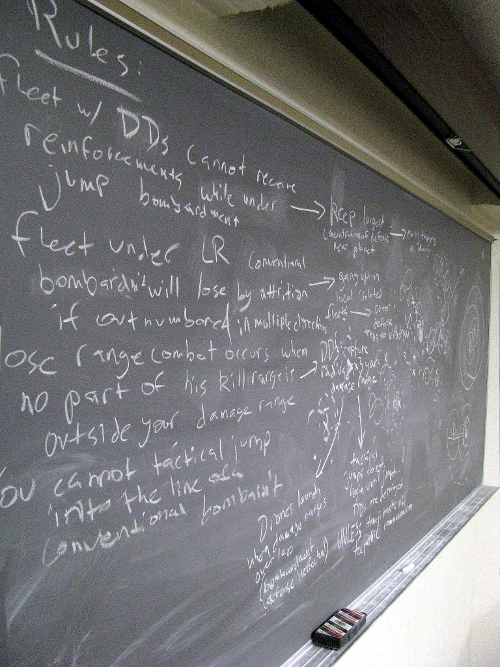
This is what I was doing the other day.  The FLSR (Foreign Language Student Residence) at BYU has chalkboards in the common rooms, and I just discovered that those can be WAY useful for diagramming your story.

On this occasion, I drew out a couple of space battles, according to how they’d play out with the FTL technology I’ve been thinking up and a few other things.  I worked things out logically and figured out a few basic rules of combat–some basic strategies that you can expect people to follow.  I then took what I know about the Hameji, the main antagonists in my novel, and figured out how they would use their special abilities to counter these tactics.

Pretty fun.  Now, when I go back and rewrite the beginning, I can make the opening space battles feel a lot more vivid, immediate, and engaging.

I finished part 1 of my story last week, and now I’m at the beginning of part 2.  I’ve got the novel roughly outlined out in my head, and it’s following fairly closely to the three act structure.  Not exactly, but pretty close.

According to Brandon Sanderson (and several other people), act 2 is the most difficult part of the story.  It’s where  you need to do the “blue collar work” of simply sludging through and writing the thing.  It’s where things get complicated enough that you can get lost if you don’t know how to plot things out.  Considering the fact that I’ve only gotten this far with two other novels I’ve written, I’m expecting this part to be really difficult.

Only 599 words today, and none on Sunday (more because I was feeling sick than anything else).  It really is getting easier to get hung up on a single scene; even if I know where I want to be three or four chapters from now, if the scene right in front of me isn’t working out, it’s almost impossible to move past it and get things to work.

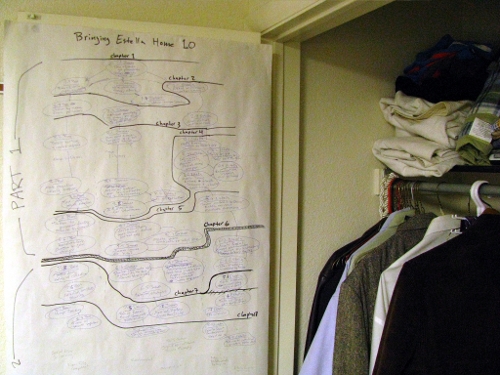
Today I took a big piece of butcher paper from upstairs and drew a diagram of everything I’ve written so far, scene by scene.  That was immensely helpful.  Now I know what this chapter is about, what I need to do to bring it to a natural close and leave a hook for the next few chapters, and how to develop my characters and what they’re doing.

While taking a shower, I figured out what Estella needs to do next, and how to take her story over to the end of act 2 and carry her to act 3.  That’s something of a breakthrough.  I’m excited.

And…it’s late.  I’d better get some sleep.