So I really enjoyed the first two seasons of Extra Sci-Fi, and since they’ve just started up with season three, I’d like to do a blog series where I react to the episodes.
From the first episode, it looks like the main focus of this season is on Lord of the Rings and Dune, two SF&F classics which I’ve read twice. While I have read The Silmarillion as well, I have to admit that I haven’t read any of the Dune sequels yet. Ah, the woes of a horribly massive TBR list.
In any case, the discussion of intentionality in world-building is quite interesting. The way they contrast it with the pulps got me to thinking about the direction science fiction and fantasy are headed in right now.
With the advent of indie publishing, the era we are living in right now is much more akin to the age of the pulps. The way most indies make a living is by following Kevin J. Anderson’s advice to be prolific—really, really prolific. That doesn’t mean that all books published these days lack the intentionality and depth of the great classics of the genre, but the pendulum seems to have swung in the other direction.
Here’s the problem: I’m sure there are books that are just as finely crafted as Lord of the Rings that are sitting on someone’s hard drive right now, or perhaps hanging out somewhere above the 500,000 ranking on Amazon. Perhaps some of these books are even more masterfully crafted, with greater intentionality and even more depth. Why aren’t they selling?
Lots of reasons. Perhaps the author hasn’t yet mastered the craft of writing. Perhaps the story isn’t compelling enough—the equivalent of a 50 cc engine in the body of a Harley.
Or perhaps it has nothing to do with the quality of the writing or storytelling, but the author’s lack of marketing acumen. The greatest product in the world is worth nothing if nobody knows it exists. Likewise, the worst product is worth at least something if everyone knows about it.
Harsh truths, but that’s the world we live in. I’m not so cynical that I believe that writing is a zero-sum game, but there is a lot of competition, especially with how many books are being published these days. That’s why I say that the pendulum has swung back in favor of pulp-style writing: because the writer who can put out a book a month and put it out to an email list of 10k or more has a decisive advantage over the writer who painstakingly crafts a magnificent epic over the course of an entire lifetime, as Tolkien did.
When will the pendulum swing back? I don’t know, but it’s actually not as daunting of an issue as the guys at Extra Credits make it seem.
The first time I read Dune, I was in high school. The second time, I was in college, where I’d already studied Arabic for a couple of years and become somewhat proficient at it. Studying Arabic pulled back the curtain a bit, and made me realize that Herbert’s world-building wasn’t quite as intentional as it seems at first glance.
There was still a lot of depth and intentionality in the major stuff, like the Bene Gesserit, the mentats and Orange Catholic Bible, and of course the ecology of Arakkis and the Spacing Guild. However, on some of the minor details, he occasionally cribbed or made up stuff, he just did a really good job of disguising it. Even the wider arcs of his world-building have borrowed heavily from the real world, such as the rise of the Fremen (which is basically the Rashidun Caliphate in space) and the politics and economics of the spice trade (which is basically a sci-fi version of the petrodollar).
This is why I’m not too worried. A masterful writer can produce on the level of the pulps, and still write with depth and intentionality—or at least, fake it so well that it feels that way. Writing that well requires skill, but once you’ve figured out all the levers behind the curtain, you really can pull off some truly amazing stuff.
I’m not quite there yet, but I’ve seen behind the curtain, and I’m figuring out how it works. Until now, I’ve leaned more toward the pulp-style of writing, just to get my writing career off the ground, but I hope to get to the level of Herbert and Tolkien before too long. It’s definitely possible, but can it be profitable too? That’s the tricky part.
I’m subscribed to six or seven short story podcasts, and I’ve noticed a trend on them recently. Before they start the story, they introduce the author by first listing all of the intersectional minority identities that the author qualifies for, like “queer,” “transgender,” “immigrant,” “disabled,” “person of color,” etc.
Whenever story starts off like this, I immediately delete it form my podcast.
I’m a busy guy. I’m subscribed to far too many podcasts to listen to every episode. There’s just not enough time. If I have a reason to skip it, I will.
When the first thing you tell me about the author of a story is where he/she/ze/your majesty falls on the intersectional victimhood stack, that tells me a couple of things. First, it tells me that the editors subscribe to this bullshit idea that victimhood makes you virtuous. It doesn’t.
Second, it tells me that the editors didn’t think that the story could stand on its own. Instead of giving a typical author bio, with a few incidental facts and a cute aside about the author’s wife/kids/pets/plans for world domination, the editors decided to lead with the author’s victimhood status. Because that’s why I should listen to the story. Because victimhood is virtuous, and if you don’t listen to this story after learning just how much of a victim the author is, that makes you a racist sexist transphobic Nazi fascist.
Fuck that.
I’m sure this post will generate outrage among some circles. There was a time when I would try to respond genuinely to such outrage, apologizing for causing offense and vowing to try better to understand, sympathize, and accept the experiences of…
Fuck that.
If it offends you that I automatically delete these sorts of podcasts, go fuck yourself. Seriously. Call yourself an autosexual and see where that put you on the intersectional victimhood stack. I don’t give a shit about your outrage. I couldn’t care less about how triggered you are right now. If that makes me a fascist, so be it. To paraphrase Syndrome from the Incredibles, when everyone’s a fascist, no one’s a fascist. (Which is very convenient for actual fascists.)
By the way, I’m not actually opposed to stories written by immigrants, or lesbians, or transgenders, or people of color. I’ve listened to quite a few good ones. “And Then There Were N – 1” from Escape Pod was really fun. So was “Octo-Heist in Progress” from Clarkesworld a couple of months back. Neither of which were introduced by describing just how many oppressed victimhood classes the author qualified for.
If there’s one thing we’ve learned from the Trump era, it’s that when people call you a racist sexist transphobic Nazi fascist, they really just want to bully you into silence. But all bullies are cowards at heart. If they want to silence you, it’s because they know that they’re wrong.
Can we please return to the time when everyone acknowledged that stories should stand or fall on their own merits, not on the merits of the author? Mur Lafferty did quite a few ISBW epidodes on this, and she’s hardly a right-wing type. By all means, let’s bring all the queers and wierdos along. Science fiction wouldn’t be the same without them. But let’s not use a double standard when it comes to their stories.
So the March for Life happened recently, and Ben Shapiro did a live show where he used a thought experiment about going back in a time machine to kill baby Hitler to make a pro-life argument. His argument was that you shouldn’t kill baby Hitler; instead, you should raise baby Hitler in a more loving home so that he doesn’t grow up to be Hitler. In other words, you shouldn’t kill baby Hitler because babies are always innocent, and killing babies is wrong. Fair enough.
But the left immediately went crazy over this argument, calling Shapiro a nazi for defending Hitler, or just making fun of him for coming up with such a ridiculous idea. Never mind that it’s a thought experiment. Never mind that it raises valid moral and ethical questions, which those on the far left refuses to address.
Everything you need to know about this controversy is basically summed up in the video above, where Sargon of Akkad does a point-by-point critique of The Young Turk’s cringeworthy reaction. At this point, Sargon’s video has more views than TYT’s original video, and YouTube is deleting downvotes on the original.
I think Sargon is right. I think that Ben really hit a sore spot on the left, because they’d all kill baby Hitler if given a chance, and they don’t want to admit it. Not only is it bad optics, but it also points out the lack of moral foundation or principles on the far left. After all, if they’d go so far as to kill a baby, simply because of what that baby might turn out to be, what else are they going to do?
For the left, Nazis aren’t merely on the extreme end of the scale of good and evil; they are the scale. This is what gets to me. Black Pigeon Speaks put out a video on YouTube that has since been taken down, because it is true, and because it gets to the heart of this issue. Civilizations always have founding myths, which accomplish three things:
they tell the civilization’s origin story,
they define, in cultural terms, the difference between good and evil, and
they describe what the civilization holds to be sacred.
For example, traditionally in the United States, our founding myth has to do with the founding fathers, the Constitution, and the Revolutionary War. Our civilization was founded by pilgrims and pioneers, who lived under British rule until the King became tyrannical and we rose up to declare our independence. In cultural terms, good and evil are set out clearly in the Declaration of Independence, the Constitution, and the Bill of Rights. The thing we hold most sacred is our liberty.
You can also see this reflected in our coinage:
E Pluribus Unum — “from one, many,” harkening back to the Revolutionary War and our civilization’s origin story.
In God We Trust — recognizing the Judeo-Christian values that informed our founding documents, including the Constitution and Bill of Rights.
Liberty — the thing that American civilization holds most sacred.
In the Black Pigeon Speaks video which has since been taken down, he argues that Western civilization adopted a new founding myth after World War II, and that this new founding myth is responsible for much of the cultural and moral decay we’ve experienced in subsequent decades. In this new myth:
our civilization was born out of the horror and devastation of the world wars,
Nazism became the definition of evil, and
the Holocaust became the most sacred aspect of our civilization.
The Nazis were clearly evil. I’m not disputing that, or the reality of the holocaust. Killing six million Jews, Roma, Jehovah’s Witnesses, political dissidents, and mentally and physically handicapped in gas chambers designed specifically as engines of mass genocide is incredibly heinous, on a scale that is difficult to comprehend. There is no downplaying or excusing that kind of horror.
But without defending the Nazis in the slightest, that doesn’t make them the most evil regime in history, or even the most evil regime of the 20th century. Stalin was just as genocidal, possibly even more so, and I would argue that he was worse than Hitler. Mao was arguably worse than both of them.
Hitler wasn’t just a monster: he was a man, like any of us. Jordan Peterson is right: we should never make the mistake of thinking that we’re morally superior to the Nazis, because if we were in similar circumstances, we’d probably make similar choices. That’s simply the reality. Hitler isn’t the boogeyman, and the Nazis are not the definition of evil. They fall on an extreme end of the scale of good and evil, but we should never mistake the Nazis for the scale.
Which brings us back full circle to the pro-life argument. How do we know that we aren’t more evil than the Nazis? The Nazis exterminated the Jews out of fear and hatred, but we’re killing our own babies in many cases out of nothing more than apathy. The Nazis at least believed that the Jews were behind the collapse of German civilization, and used that argument to justify their argument that Jews were non-people. What argument do we use to justify treating the unborn as non-people? Certainly not a scientific argument. And we’ve aborted ten times as many victims of the Holocaust, so it’s not like the Nazis were worse in terms of scale.
I genuinely believe that future generations will look back on us with the same horror and revulsion that we look back on the Nazis. And honestly, I can’t say they’ll be wrong.
So would you kill baby Hitler? It’s a valid question that raises some very important points. Not only would I not kill baby Hitler, but I wrote a short story about a time traveler who stopped Hitler not by killing him, but by altering the course of history in a very different way. If you haven’t already, you should check it out: “Killing Mister Wilson.”
Anyways, those are my thoughts on the subject. Also, TYT has hit a new low for cringe. I suppose that’s par for the course when your network is named after a genocidal regime.
This is going to be a rather long post. I’ll preface it with some demographic trends among my generation, then tie that in with my situation and how I got here. From there, we’ll see where it goes.
I was born in the early 80s, which technically makes me a Millennial, though it doesn’t always feel that way. Millennials get maligned for a lot of things, which is pretty typical of all generations as they rise, from what I can tell. Civilization is constantly under attack by barbarians, most of whom we call “children,” which is really just another way of saying this:
So how is my generation currently reinventing the world?
Thus far, not very well. The Great Recession hit us just as we were coming of age, and it shows. We were much more likely to move back in with our parents than previous generations. We’re putting off marriage and home ownership, some because we’re more focused on our careers, others because we just can’t seem to launch.
At the same time, not all of this is bad. In spite of the fact that most of us were never taught home economics or personal finance in high school (thanks, Baby Boomers, for all the participation trophies), we are rapidly learning more responsibility than our parents. Where six out of ten Americans would have to beg, borrow, or steal to cover a $500 emergency expense, nearly half of us Millennials have $15,000 or more in savings.
And yet, the problems we’ve inherited are truly daunting. Our national debt is $21 trillion and counting, and without facing a recession, war, or other emergency event, our deficit is still set to exceed $1 trillion per year for the forseeable future. Just this month, we learned that Medicare is set to run out of money in eight years, and Social Security is not far behind that. And don’t even get me started on the house of cards that is our national pension system.
Up until the 60s, previous generations saved and invested so that their children could be better off than they were. The Baby Boomers not only squandered this wealth, but they stole their children’s and grandchildren’s inheritance as well. History teaches us that there will be a terrible price to be paid for all of this. Our parents have proven themselves incapable of doing anything other than kicking the can down the road to oblivion.
That probably sounds more bitter than I intended it to be. Unfortunately, it’s the truth. Our parents just don’t understand the world that we’re living in. We’ve come of age in a world with far less opportunity than they did.
I had a conversation with my mother last year that demonstrates this. My mother likes to make cascarones for special events, like Easter or birthdays. To make them, however, you need a hollowed-out eggshell, which requires removing the yolk and whites in a very particular way. If you’re accumulating shells through normal consumption, it can get to be rather tedious.
One day, I came into the kitchen to find my mother blowing out eggshells and dumping the whites and yolks down the sink. She’d bought a whole bunch of them for 35¢ a dozen, and decided to just make the cascarones all at once instead of accumulating the shells over time. When I saw this, I was horrified.
“How could you waste all those eggs?” I asked.
“It’s not a waste,” she said. “They were 35¢ a dozen.”
“Yes, but we could have eaten them. That’s perfectly good food you’re dumping down the drain.”
She shrugged, as if it didn’t really matter. But I pressed her a bit further, until I came to a disturbing realization:
My mother has never been as poor as I am.
When I pointed this out to her, her answer was even more disturbing. With anger in her voice, she snapped “that’s because you choose to be poor.”
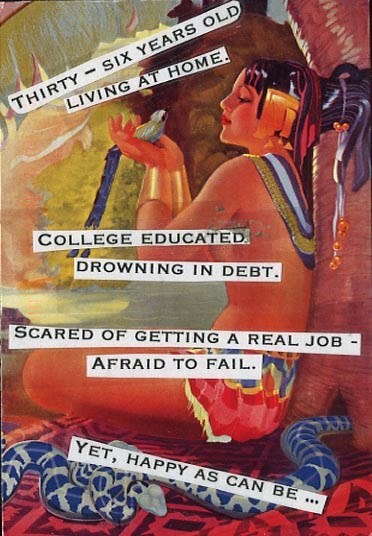
Is that true? Am I, a Millennial, poor because I choose to be poor? Perhaps. I’m not so irresponsible that I won’t own up to my life decisions, which have brought me to this place. But I think there’s this perception in the minds of our parents and grandparents that Millennials are generally like the person who wrote this postsecret above. Drowning in debt, living at home, so afraid to fail that we’ve utterly failed to launch, and yet blissfully oblivious to all of it. Perhaps that’s true for some of us, but not for those who will reinvent the world after our parents are gone.
To be clear, I love my mother and father. I don’t hold any of this against them personally, or anyone else of my parents’ generation (except the politicians who sold our Constitutional birthright, but that’s another rant altogether). Unfortunately, hard truths do not become softer because we choose to ignore them. And hard truth is this:
Hard men make good times.
Good times make soft men.
Soft men make bad times.
Bad times make hard men.
I graduated college in 2010. Through a combination of scholarship money, campus jobs, and (yes) generous parents, I was fortunate enough to graduate without any student debt. At the same time, it was the height of the Great Recession, and jobs were nearly impossible to come by. I can’t tell you how many of my writing friends put their dreams on hold, or abandoned them altogether. Almost all of them.
As a side note, I agree with Mike Rowe that “follow your passion” is bullshit advice. It ranks right up there with “be yourself,” and “you can be anything if you put your mind to it.” Don’t follow your passion. Follow opportunity, and take your passion with you.
But in 2010, I had an opportunity. Without any debt, and without any dependents or other obligations, I decided to pursue a writing career. And unbeknownst to me at the time, the industry was undergoing a revolution that would open the doors to make that possible.
I indie published my first short story, Memoirs of a Snowflake, in March 2011 and never looked back. Since then, I’ve published dozens of novels, novellas, short stories, and other works. It’s been an exhilarating journey. At the same time, it’s been the most difficult struggle of my life. And that is why I must now confront one of my most crippling fears.
Unlike the girl in the postsecret, I am not crippled by the fear of failure. If I were, I would never have published that first story, let alone all the others that followed. Instead, I have a fear of admitting failure, both publicly and to myself. It feels too much like an admission of defeat.
It’s an important distinction to make, though. The Romans admitted failure often and early—it’s how they learned from their defeats, ultimately going on to build one of the most powerful militaries in the ancient world. But they never admitted defeat. Even after Cannae, when Hannibal threatened the republic with utter extinction, the Romans refused to be defeated. And so, while Carthage fell into decline and decadence, the Romans endured until Scipio finally gave them victory at Zama, paving the way for the rise of Western Civilization.
I haven’t had a personal Cannae moment yet, but I do feel like I’ve been fighting a war of attrition. In 2014, the market shifted with the launch of Kindle Unlimited, and I failed to adapt. At that point, I was just on the cusp of going full-time with my writing, though looking back I can see that I didn’t yet have the foundation for a lasting career. Still, to have that dream snatched away when I was just on the verge of catching it, you can understand why I kept plugging along, believing that I was just a month or two from turning things around.
That’s basically what I’ve been doing for the last four years: writing full-time even though the writing doesn’t pay full-time wages. Maybe my mother is right. Maybe I have chosen to be poor.
And yet, while I now believe that I do have the foundation for a lasting career, I need to confront the fact that it may be ten years or more before I achieve it. Should I continue, like so many of my peers, to delay major life decisions until my career reaches that point? Is it worth it to put off marriage, family, and home ownership until my forties or fifties, if that’s what it takes? Or is it time to admit failure so that I can leave this dead end and find another way?
Back in 2010, I had no plan B. It was the Great Recession. I didn’t have a day job because I couldn’t find one—hardly anyone could. And from 2013 to 2014, writing paid well enough that I didn’t need one. Things were looking up, and I was just a couple months away from a sustainable long-term career.
Well, it’s time to admit that that line of thinking has turned out to be a trap. I’m approaching my mid-thirties and I’m still single and poor. I need some kind of long-term backup, because I can’t count on the writing career to take off like I need it to, at least not anytime soon.
So I’ve moved my writing onto a part-time footing. I’m limiting the number of words I write each day, leaving time for other pursuits. And I’m looking for a day job, preferably one that teaches me something useful and pays well enough to make ends meet.
I haven’t been defeated yet, though. Failure is not final until you decide to give up. I have not given up, and will continue to write, even if only on a part-time basis. And when I am making enough to go full-time, I have the foundations in place to do so.
In the meantime, though, I’m not going to put my life on hold for a dream.
With the rise of #MeToo, I thought it would be interesting to revisit this old post from my time in the Republic of Georgia. Here in the US, we seem to be in the process of completely reworking the societal norms for how men and woman interact in the public sphere. On one extreme, we have serial predators getting ousted from power in industries that enabled their abuses for years. On the other extreme, we have the perpetually outraged calling for blood because someone greeted a woman in public with an unwanted hug. False and anonymous accusations abound, while clear and obvious abusers like the Clintons have gotten off scot-free. In short, it’s a mess.
Changes this drastic always produce unintended consequences. One of the unintended consequences of #MeToo may be the blurring of the lines of consent. After all, if a woman can call it rape because she decided afterward that she regretted it, is positive consent worth anything in the first place? In eastern Europe and central Asia, consent has also been blurred, which is part of the reason why bridenapping is still a thing. In Georgia, I came face to face with this reality.
Let me make it clear that I do not condone bridenapping in any form. Cultures are not equal, and some cultures (or some aspects of a culture) are better than others. A culture that condones the kidnapping and forced marriage of women is much worse than a culture that ennobles and empowers women to be agents of their own destiny.
With that in mind, here’s the updated post.
მოტაცება (pronounced motatseba) is the Georgian word for bride kidnapping, as opposed to regular kidnapping, which takes a different word. It’s an ancient practice in the Caucasus region that still occasionally happens, especially in the rural areas. Today, most Georgians condemn it, but there’s still a whole slew of lingering cultural subtexts that can be very difficult for a Westerner like me to understand and navigate.
This is how it works: boy meets girl. Boy decides to marry girl. Boy gets his friends together and kidnaps the girl, with or without her consent, holding her captive overnight. The next morning, boy contacts girl’s parents to ask for girl’s hand in marriage.
Since the girl has been held overnight, the implication is that she’s been raped (which may or may not be true). Therefore, to avoid a scandal which could tarnish the family’s reputation, the parents will usually marry their daughter off as quickly as possible. However, if the girl can escape, or the girl’s brothers can rescue her before nightfall, the crisis can be averted.
Basically, it’s capture the flag with sex.
I first heard about motatseba from this post on Georgia On My Mind, back when I was looking into teaching English. It disturbed me, but not enough to dissuade me from coming to Georgia. A couple of weeks ago, however, I learned that that was how my host parents got married.
Here’s the thing, though: they both seem to remember it fondly. In fact, when my host mom saw a comedy skit on the subject, she couldn’t stop laughing. Her mom lives with them now, and from time to time they go out to visit his family in the village, so it looks like everyone’s on pretty good terms.
So what the heck happened?
Here’s the story, as best as I can piece it together. They were introduced by his sister, who was her coworker at the hospital. He liked her, but was too poor to afford a dowry, having just gotten out of the Red Army. After a month, he got together with some friends and tricked her into coming out to his family’s house out in the village. She was surprised and upset at first, of course, but her parents gave their consent, probably because she was starting to get into old maid territory (she was 29 at the time). They were married the next day by a magistrate. Now, they’ve got four kids—a huge family, by Georgian standards—and seem to be happy together.
As a Westerner, it blows my mind that a strong, healthy family can come out of something as violent as an act of kidnapping. Indeed, I have yet to be convinced that that’s a normal outcome. However, after asking around and doing some research, I’ve come to realize that motatseba isn’t a black and white issue: there are all sorts of cultural subtexts that make it much more complicated.
The key to understanding how all this works is the following proverb, which underscores Georgian concepts of gender roles and the differences between men and women:
If a woman says no, she means maybe. If she says maybe, she means yes. If she says yes, she is not a woman.
From this, two things follow:
Men should be more assertive
As a man in Georgia, I get this all the time. All three of my co-teachers are women, and all of them constantly defer to me, even though they have far more teaching experience than I do. When I had some pretty serious differences over teaching methodologies with one of them, she suggested that I take over the next lesson and teach it without her interference, so that she could get a better idea that way. This isn’t the case with the female volunteers. Many of them complain about how hard it is to get anyone to take their suggestions seriously.
A woman can never say no—or yes
If “no” is constantly interpreted as “maybe,” then it follows that no one is going to believe that a woman is even capable of saying “no.” On the other hand, if a real woman can never say “yes,” then the man ultimately has to take matters into his own hands. This turns the whole concept of rape into a nebulous gray area, which is why motatseba isn’t universally considered to be a horrible thing.
This is not to say that in Georgian culture, women are doormats or property (even though that’s what some TLGers claim). Women have a number of support networks, such as family, friends, and other women, and can use these networks to ward off unwanted attention. When I asked my host sister if she’s worried that she would ever be kidnapped, she said no, because if she was, her brothers would kick some serious ass.
On top of all this, Georgians have no real concept of casual dating. If a girl and a guy are seeing each other, they’re either married or about to be married. This shows up in the way they use Facebook and other social networks: instead of listing themselves as “in a relationship,” the girl will give her password to the guy she’s dating. And they don’t just do it because the guy demands it—when my host sister was seeing someone, he asked her if she wanted to give her password to him, as if that was the natural next step in their relationship. From the way she told me, she seemed to be worried that she’d made a mistake by telling him no.
Combine all of these together, and you should start to get a clearer picture of some of the subtext surrounding motatseba.
When I asked my first co-teacher about it, she said it was only an ancient practice and absolutely didn’t happen anymore. When I brought up rape and asked if that was also a part of it, she was horrified and didn’t want to talk about it. However, when I asked if it’s possible for a happy marriage to come of it, she kind of smiled a little and said that if the woman likes it, then why not?
My second co-teacher was much more straightforward with me. Yes, it happens occasionally, though it was a lot more “fashionable” about twenty or thirty years ago. No, it’s not romantic. Yes, a lot of the marriages aren’t very happy, which is why so many of them end in divorce. She told me that one of her friends from college was married through motatseba, and that she knows of at least one case in our school where an 8th grader was kidnapped and married. However, motatseba is now considered a serious crime, so it’s not as common as it used to be.
My third co-teacher’s answer was a lot sketchier. The first time I asked about it was in passing, as she walked in on the conversation I was having with my first co-teacher. When I asked her about rape, she laughed and said “well yes, of course it happens!” as if that wasn’t a big deal. Later, however, she sat me down and said quite seriously that motatseba is a horrible thing, that it’s a criminal act, that it doesn’t happen anymore, etc etc.
However—and this was perhaps the most illuminating thing—she said that sometimes, when a guy and a girl are in love, but she’s being wishy-washy and non-committal, he’ll sweep her off her feet and carry her off. In fact, that was what happened with her: her boyfriend wanted to marry her, but she kept putting it off, so one day he tricked her into getting in the car and told her “all right, enough is enough—we’re getting married this weekend.” And they did.
When I asked her if that was motatseba, she said no, but the subtext was clearly similar. A real man knows how to assert himself and take what he wants. Since a real woman will never say yes, sometimes you just have to man up and tell her how it’s going to be. And don’t worry if she says no—she just doesn’t know yet that she wants it. She’ll come around eventually. They always do.
It sounds pretty horrible, but that seems to be how it works. And really, there are gradations of it. Most Georgians will agree that it’s wrong for a guy to kidnap a girl he doesn’t know so that he can rape her. But if the guy and the girl know each other, and are already pretty serious, and he wants to speed things up—or, alternately, if she knows her parents would never say yes otherwise—that’s when everyone starts to wink and nod.
And really, can we say that our culture’s problems are any less abhorrent? What about teenage pregnancy? Secret abortions? Date rape? At least with motatseba, the guy is trying to marry the girl, not just sleep with her and walk away. If it’s just sex that the guy is after, there are plenty of other options for that.
Either way, learning about motatseba firsthand has certainly been an interesting anthropological experience.
It is rare that I see something that truly makes me outraged. As trendy as it is these days to raise your fist and shout at the world, that’s something I generally try to avoid. But recently, I saw something that I just cannot let fly without addressing it directly.
It’s this:
The Good
Extra Credits gets it right that modern politics (in particular, American politics) is a winner-take-all game for the independent vote. On that point, they’re spot on. Elections are indeed won on the marginal voters, exactly as they state.
Approaching political systems from a game design perspective is actually quite brilliant, and they do a good job of laying out the basic rules. Players start with a limited number of action points, and a (relatively) fixed number of victory points. The key to winning is to use your action points to grab the victory points that are in play—or to prevent your opponent from doing so.
My problem with this video isn’t with the concepts they lay out. It’s with the concepts they miss—and how those concepts completely overturn the examples that they give.
The Bad
First, they completely miss how the game board actually works. There isn’t a single game board on which both sides play. Rather, each side has their own game board, which may or may not accurately represent reality. Information shortfalls cause players to draw up an inaccurate gameboard, and thus waste action points by spending them poorly.
That’s exactly what’s wrong with the example at 7:51. President Trump didn’t win by “growing the previously tiny fear of refugees circle,” he won by recognizing that the Washington establishment was completely ignoring a large cohort of marginal voters. They didn’t even show up on the game boards. Over time, Democrats and Republicans became so far removed from their voting base that their politicking ceased to represent reality.
It all goes back to the Tea Party. Actually, it all goes back to Woodrow Wilson, with significant turning points at FDR, Social Security, Clinton, and NAFTA, but the Tea Party is a good place to start.
As our first black president, Obama was considered sacrosanct. He received a Nobel Peace Prize before he set foot in the White House, which is highly ironic considering how he went on to become the first US president to be at war every day of his presidency. But I digress. The point is, he was held above reproach. Anyone who criticized him was immediately branded as a racist. After all, how could you possibly attack our first black president??
As a side note, this is why the quip at 10:20 is so damned infuriating:
Luckily, elections aren’t the only battlefield in politics. The United States of America isn’t a “sit down and shut up, you lost” kind of democracy.
Obama’s response to the Great Recession was a massive increase in government spending, and an explosion of the national debt. When the Tea Party organized to protest this, they were painted by their political enemies as racists. This scored the Democrats a cheap victory, but it also distorted their game board. By deliberately mischaracterizing the opposition, they failed to account for them and began to suffer from information shortfall.
The establishment Republicans thought they could win by playing on a game board that matched the one the Democrats were using. Normally, this is a winning strategy. When the political landscape shifts, you don’t want to be stuck playing on yesterday’s board—you want to keep up with the times.
But the Democrats had deliberately distorted their board so that it no longer represented reality. In other words, they began to believe their own lies. The more the opposition pushed back, the more they doubled down, and the more distorted the boards became.
This is where political capital comes in, and it’s something that Extra Credits completely missed. Players don’t just have action points, they also have a certain amount of political capital that acts as a sort of multiplier for their action points. This capital is basically the good will and trust built up with the other side. It takes a long, long time to gain this capital, and once it’s spent, it’s gone.
Obama spent all his political capital in his first term, mostly on the Affordable Care Act. At that point, our politics became deadlocked. Combined with the fact that his game board no longer represented reality, Obama suddenly found himself in a position where he couldn’t get anything done.
The Republicans saw this, and decided to save their political capital instead of spending it. If only they could win a few more seats—if only they could win both the House and Senate—then they could defeat the Democrats. Until then, they’d just have to play along, building their capital until the time came to spend it.
In Obama’s second term, he doubled down on identity politics, playing the race card at Ferguson. This won him some quick victory points, but it also set race relactions in the United States back almost forty years and further distorted the playing board. He also played fast and loose with foreign policy, pandering to the Iranian Mullahs, the Cuban Communists, the Japanese Imperialists, etc. The reason President Trump was able to back out of the Iran deal so easily was because Obama completely bypassed the Senate, which is the only body with the constitutional power to ratify treaties with foreign governments.
All of this combined to create a perfect storm that President Trump rode to victory in 2016. There was a massive reserve of marginal voters who hadn’t had a voice for years, and were completely unaccounted for on the Washington establishment’s game board. By playing identity politics, the Democrats had completely ignored them, and now they were desperate for a champion. That champion was Donald Trump, who—unlike the establishment Democrats and Republicans—was playing on a game board that actually represented the political reality. Furthermore, he had a massive reserve of political capital to draw on—capital that the Republicans had been hoarding for years. The Democrats had already spent all of theirs, not only with Obama, but with the DNC’s primary rigging and betrayal of Bernie Sanders. Suddenly, a bunch of the “gimmie” points slipped out of their hands.
The Ugly
And here we come to the worst part about the Extra Credits video—the part that really gets under my skin. The view of American politics that they present is so distorted by their own ideological possession that it completely lacks all self-awareness. It’s precisely this ideological dogmatism that pushed Donald Trump to victory in 2016, and will most likely push him to victory again. As someone who voted for Obama in 2008, I’ve already decided to vote for Trump in 2020.
Consider the animation. All of the political symbols are blatantly pushing left-wing causes, from the rainbow flag and the neon pink hair to the guns and the female symbols. Why not throw in a Gadsden Flag, just to round things out a bit? Even the thumbnail shows a “person of color” (I really hate that term) in liberal blue scheming against two conservative reds.
If that was all it was, though, I’d roll my eyes and ignore it. But it goes much deeper. Much, much deeper.
Civil rights is the fight for equal treatment under the law and in daily life. Sometimes it’s a defensive battle to ensure that people keep the rights they have, and sometimes it’s a proactive battle, like fighting for people who do not currently enjoy equal status.
Those are two completely separate things. The first is a negative right, the second is a positive right—or in other words, the first is a right from government overreach, the second is a right to government intervention.
The civil rights movement of the 60s was all about tearing down Jim Crow laws on the state and federal levels. These laws enforced segregation and made black second-class citizens. It was not about forcing Christian bakers to bake cakes for gay weddings. Those are two totally separate and incompatible things.
The American Revolution gave us the Bill of Rights, which is essentially a list of things the government is not allowed to do. In contrast, the French Revolution gave us the Declaration of the Rights of Man, which is a list of things that the government is obligated to do. The American Revolution succeeded, while the French Revolution failed. The American Revolution gave us the most powerful and prosperous nation in the modern era, while the French Revolution gave us the guillotine, the Reign of Terror, and two centuries of catastrophic European wars.
But never mind all that. Let’s just throw out these two separate and incompatible things under the same issue banner, and paint everyone who disagrees as opposing “civil rights” entirely:
But what if you’re a conservative candidate? At first, you might look at this and think: “Yikes, barely any marginal votes and the Liberals have this circle on lock! Not even worth trying.” What if you were to spend a few action points here by, say, taking an opposing stance to a current civil rights movement, whether you do that directly by, say, supporting a bathroom bill or indirectly through dog whistle tactics? You might manage to shock the liberal majority of gimmies in that circle, who will then demand a liberal response.
What about the Overton window? The Left has been using it to gaslight conservatives and libertarians for years. Case in point, this video by Freedom Tunes:
If calling the Left on their bullshit is “dog whistle tactics,” then we aren’t even living in the same country anymore—and that’s what makes this so dangerous.
For a democracy to work, both sides need to be able to talk with each other in constructive way, where both sides genuinely hear each other. When that becomes impossible, we fall back to political tribalism, which grows like a cancer, tearing our society apart with political violence and, ultimately, civil war.
If you are so locked into your own worldview and beliefs—so entrenched in your own echo chamber—that you cannot acknowledge what the other side believes about themselves, then we’re done. The United States is over. Our republic has ceased to function. Democracy dies in darkness—not the darkness of bad journalism, but the darkness of ideological possession, which blinds us from seeing each other as we really are.
And this is why Extra Credits’ conclusion is so deeply, horribly wrong:
We are in this 24/7. Even outside the election cycle, a civil rights activist can always push whoever is in office to take action. Exactly how to go about this will probably require a few more episodes to cover.
No. That is NOT the solution. Doubling down will only make things worse—much worse. The only way out of this cycle is to genuinely listen to what the other side is saying, not to force everyone else to listen to you.
We’ve entered a very dark time in American politics, and not because President Trump is a Nazi. The fact that so many people can legitimately believe something so ridiculous is symptomatic of the underlying problem. If identity politics and political tribalism prevail, then the United States will break apart. Whether by secession, insurgency, or some other form of civil war, the American experiment will end, and we will revert back to the cycle of tyranny and chaos that has defined human history since the invention of the sword.
Guns, gold, and food storage. If ye are prepared, ye shall not fear.
…the MPDG “exists solely in the fevered imaginations of sensitive writer–directors to teach broodingly soulful young men to embrace life and its infinite mysteries and adventures.” MPDGs are said to help their men without pursuing their own happiness, and such characters never grow up; thus, their men never grow up.
You know how the term “space opera” was originally a derogatory term for crappy science fiction? I’m going to go out on a lark, invoke tropes are tools, and argue that Wikipedia is wrong and there’s nothing inherently bad about this trope.
Anita Sarkeesian is not a huge fan of the manic pixie dream girl. In fact, it was the first trope she deconstructed way back 2011, before her scammy kickstarter. I’m not a huge fan of Anita Sarkeesian, but it’s worth rewatching her take on it:
In particular:
The manic pixie perpetuates the myth of women as caregivers at our very core—that we can go fix these lonely, sad men, so that they can go fix the world.
Here’s the thing, though: when you study the men who have fixed the world, you almost always find a strong, caregiving woman behind them. This is portrayed very well in The Darkest Hour, with Winston Churchill’s wife, Clementine:
Granted, Clementine Churchill is no manic pixie, but she did provide critical support to her husband, and was one of the key influences that shaped him into the great man of history that he ultimately proved to be.
Here’s the thing: men need women, just as women need men. All the feminist eye-rolling in the world doesn’t make that untrue. And for men who are lonely, depressed, or overly introspective, a perky outgoing woman can really have a positive impact.
The key to doing this trope well is to make the MPDG a complete character in her own right. Critics rightly point out that something is wrong when she exists solely for the benefit of the male protagonist. That’s not a feature of this trope, though: that’s just bad writing in general.
The best example of a MPDG in my own work is probably Deirdre from Heart of the Nebula. The rest of this post is going to be full of spoilers, so if it’s on your TBR list, you should probably skip to the end now.
Deirdre is very much a character in her own right. She’s the ship’s historian of the Chiran Spirit, a generation ship that James liberates from pirates before going into cryosleep. In spite of her perky, cheerful demeanor, she has experienced deep pain in her life. She immediately latches onto James, but over time this transforms from an interest in a living historical figure to genuine attraction and love.
James and Deirdre round off each others’ rough edges. She helps him to recover his optimism and self-respect, while he helps her to understand herself better and decide what she truly wants. They both help each other to reconcile with difficult baggage from each of their pasts, and though they both go through a period of disillusionment, they ultimately come out stronger for it on the other side.
Here’s the thing, though: if Deirdre was anything but a manic pixie dream girl, she wouldn’t have been able to help James through his darkest hour. It’s her bouncy enthusiasm, clumsy excitement, and unfailing optimism that draws him out of his callused shell. Without those characteristics, the story—and her character—wouldn’t have worked.
In short, I believe that the manic pixie dream girl trope very much has a place, and isn’t inherently sexist or mysoginistic at all. It can be, if done poorly, but when done well it points to the reality that men need women just as women need men, and that’s actually a good thing, no matter what the feminists say.
When I started writing back in college, the prevailing advice was to write every day. And to be fair, at the time, that was very good advice. I was just getting started on my writing career and had a lot of learning to do. My writing improved by leaps and bounds as I strived to make progress on my WIPs every day.
Now, though, I’m not so sure that writing every day is the best thing to strive for.
It’s not that I’m against the idea of practice. Writing is one of those rare creative professions where people don’t think you get better the more you do it. Of course, that’s flat-out wrong. The best musicians put in hours and hours of practice, as do the best chess players, or the best soldiers, or the best sports stars. Writing is no different. If you don’t put in the time and effort, you won’t get the results.
At the same time, there’s a tendency among aspiring and even journeyman writers to become consumed with guilt because they missed their writing goal for the day. This is counterproductive. Goals don’t exist to give you satisfaction or guilt, but to give you direction. Satisfaction comes from what you achieve in pursuit of a goal, not in the goal itself.
So that’s one aspect of it. But there’s another aspect, and that’s how effective it is (or isn’t) to write every day.
Between high school and college, I worked as a gofer on a masonry crew. One of the things my boss used to say was “work smarter, not harder.” He often said it rather tongue-in-cheek, but it’s still an important concept. It doesn’t matter how hard you work if you’re doing it wrong.
This applies to writing as well. What does it matter that you write every day, if you’re just going to throw out most of it anyway? Is that really the best use of your time and energy? If by taking a week to establish things like plot, character, world-building, etc, you could write a much cleaner and better first draft, does it matter that you technically weren’t writing every day during that week?
Write smarter, not harder.
Now, I’m very glad that I did write every day back when I was starting out. My first (and possibly my second) million words were mostly crap, so it was better to put in the time and get through it as quickly as possible, just for the learning and growth.
But now that I’m an established journeyman writer, I find that the results are much better if I take the time to do some basic prewriting before I attack the first page. My first drafts are cleaner. The story comes together easier, with fewer problems. I don’t have to do “triage” revisions, where I’m throwing out characters, subplots, or even major plot points simply because they don’t work.
In Brandon Sanderson’s writing class, I once asked what I needed to change so that I could write my WIPs straight through without getting stuck in the middle. Brandon asked me if I was still finishing them, and when I said yes, he basically said don’t worry about it. That was good advice then, but it isn’t anymore. I’ve reached the point where writing smarter is more important than writing harder.
Anyway, those are my thoughts at the moment. Things change a lot when you’ve been writing for 10+ years, and unlike all the resources available for aspiring writers, there isn’t a whole lot of stuff out there to help guide you through the later phases. I’m basically figuring it out as I go.
January is a time for making forecasts and predictions, and Mark Coker of Smashwords certainly did not disappoint. I have a lot of respect for Mark Coker, not only for being one of the pioneers of indie publishing, but for continuing to share his data and insights with us over the years.
That said, I have many much opinions.
Mark gets a lot of flak from authors for his anti-Amazon stance, which is nowhere crystalized quite so perfectly as his 2018 publishing industry predictions. Seriously, half the post is a massive litany against Amazon’s publishing practices that systematically recounts just about everything he sees wrong. It’s quite impressive.
Perhaps the most inflammatory thing he says is this:
Authors who now derive 100% of their sales from Amazon are no longer indie authors. They’re dependent authors. I suppose we have indie authors and de-authors now.
Here’s the thing, though: he isn’t wrong.
Back in 2010, when self-publishing was still considered by many to be the “kiss of death,” I read a post on a writing blog (I think it was Writer Beware) that said, basically: “if you’re taking the indie publishing route instead of traditional publishing, that makes you self-published. So call yourself a self-published author, because you are one.”
At first, I was really pissed off at that blogger. Couldn’t she see that there was a huge gulf between indie publishing and self-publishing? A year or two later, though, I had to concede that she had a point. I was bringing my own baggage to the table by insisting that indie publishing was separate and distinct from the dreaded “self-published” label. Today, I don’t give a damn whether or not a book is self-published, and I don’t think most readers do either.
It’s the same thing with Mark Coker’s “indie authors” and “de-authors.”
The truth is, if you depend on only one publisher or publishing platform for all of your writing income, then by definition you are dependent. It doesn’t make a difference whether that’s a traditional publisher or Amazon. If you want to be independent, then you have to cultivate multiple income streams from multiple sources. It’s that simple.
You’re still a self-published author, whether you do savvy ebooks and print-on-demand editions. or whether you did a 5,000 book print run with a vanity press that sits in your basement from now to eternity. You’re still a dependent author, whether you’re making a killing on Kindle Unlimited or whether you sold your copyright to a Big 5 publisher for a mess of pottage.
However, while I agree with Mark on that much, I disagree quite strongly on his conclusion that the government needs to break Amazon up. Oh, no. Hell no. It’s not different this time, Mark. The Luddites are still wrong.
The biggest publishing story of 2017 was that Amazon’s biggest enemy is… Amazon. Because it turns out that when you stop paying authors for single-book sales and instead pay them shares out of a massive fixed pot, it incentivizes scammers to find all sorts of interesting ways to game your system. And if your business model depends on automating as much of your website backend and customer service as possible, you can’t fix the scamming problem without pissing off indie (and not-so-indie) writers everywhere.
It’s going to take a while for all this to shake out, but I do believe that indie writers will come out on top—so long as Amazon’s competitors in the publishing world step up and actually compete.
Stop whining about Amazon, Mark, and bring your damn website out of the late 90s.
With that out of the way, here are Mark’s predictions, with my thoughts.
1. 2018 will be another challenging year for the book industry
Has there ever been a year in which this hasn’t been the case? Long before KDP, Smashwords, or any other epublishing platform was invented, all of the best books have been up on the internet for free. Movies, TV, video games—we’ve always competed with these things for reader attention, and always will. I don’t see anything that makes 2018 different in that regard.
In fact, I’m going to go out on a limb and predict that the book industry will stabilize and grow—not as measured by traditional metrics like Nielsen Bookscan, but in non-traditional metrics like the Author Earnings Report. Why? Because books are counter-cyclical, and we’re already overdue for the next recession. The stock market is melting up, the yield curve is flattening, inflation is already hitting real estate, healthcare, and education, and the geopolitical situation is a nest of potential black swans.
I don’t think 2018 will be the year when shit hits the fan—I expect that will happen in Trump’s second term, sometime around 2021 or 2022. If nothing else, the tax cuts have applied palliative care to our economy. But the debt will continue to grow, the deficits will get worse, and inflation is going to hit the average consumer in a massive way this year.
All of this bodes well for books.
2. The glut of high-quality low-cost ebooks will get worse
Please, Mark. The Tsunami of crap was never a problem to begin with. Like I said above, long before epublishing was a thing, the best books ever written in the history of the world were already available, for free, through sites like Project Gutenberg.
There’s still plenty of opportunity for new authors. The Childlike Empress still needs a new name. The Nothing is not going to swallow Fantastica. If you know how to swim, you can still swim just as well, whether the water’s ten or ten thousand feet deep.
3. Barnes & Noble is sick and will get sicker
I can see this happening. I haven’t been following Barnes & Noble too closely, but they failed pretty hard with the Nook and their corporate troubles haven’t been good for the bottom line. At this point, though, Barnes & Noble is dead wood that needs to burn in order for something else to come up in its place.
4. Kobo’s sales will falter
I don’t think they will. Kobo is much bigger in the international markets than Amazon, and the economic problems are worse overseas than they are here in the States (which means that conditions are better for books). I think Kobo will do just fine, though I’m not sure that Smashwords books on Kobo will do as well.
Kobo is still innovating, with things like Kobo Plus and the promotions tab on KWL. Mark Lefebvre had a good run, but I think it’s a good thing that they’ve got some new blood coming in. I predict that Kobo will do just fine.
5. Devaluation pressures will persist
Again, I completely disagree with Mark Coker on this one. Ebook prices for indie books have actually stabilized over the past few years, and with increasing inflation, I predict they will tend to rise in 2018, though not in a dramatic way.
Once you get below a certain price point, competing on price really doesn’t make much of a difference, and I think a lot of successful indies understand this. Also, books are not fungible. When I make time to read, I don’t want just any book—I want that book. So long as it costs me less than a good meal, price be damned.
There is, of course, an argument to be made that all else being equal, power readers are drawn to lower-priced books. It’s probably an exaggeration to say that these power readers are king makers, but it’s not too far from the truth. That said, the way to get around this is to run periodic sales and promotions, just like any other industry.
Come on, Mark. Just because your book is $5.99 doesn’t mean you can’t mark it down to free or 99¢ every once and a while.
6. Single-copy ebook sales will decline
On Smashwords, perhaps. I’m not convinced that they will generally.
For the entertainment value, it’s a hell of a lot cheaper to buy a book (especially an indie book) than it is to buy a video game or a movie. Because of that, books tend to be counter-cyclical. The real economy is not doing as well as the official numbers say: households are still under massive pressure, with debt at unprecedented levels and wages shrinking as adjusted for price inflation. I predict that this trend will continue in 2018.
I haven’t seen the data on this, but if I had to speculate, I would say that power readers tend toward subscription models for books, whereas casual readers tend toward single-copy book sales. I would also speculate that power readers are less responsive to economic shocks than casual readers—they’re going to read whether or not their pocketbook is getting squeezed. Again, I haven’t seen the data for this, but if I had to plant a flag, that is where I’d plant it.
Are single-copy sales cannibalized by book subscriptions? To an extent, yes, but I think we’ve already hit something of a floor. If the economic pressures on the middle class worsen and we see an influx of casual readers into the market, I think single-copy sales will start to bounce back. As I see it, there’s a lot more room on the upside than the downside.
7. Romance authors will feel the most pain from KU
Can’t speak to that, as I’m not a romance author. But based on Amazon’s missteps in 2017, I think KU will actually see a decline as authors continue to flee and scammers continue to dominate. Again, I don’t see much more room on the downside for things to fall.
8. Large traditional publishers will reduce commitment to romance
And large traditional publishers will continue to shove their heads up their backsides, so no one in the indie publishing world will care. Kris Rusch wrote a much more lengthy analysis where she says as much.
9. Email list fatigue
Totally disagree. The guys over at the Science Fiction and Fantasy Marketing Podcast discussed this recently, and the conclusion they came to is that authors who claim that email lists don’t work as well as they used to are doing it wrong.
That said, I could see a bit of a shakeout as readers who have signed up for every author’s list go through and cull their inboxes. And I could also see a stabilization and/or decline in sites like InstaFreebie that offer free books in exchange for signing up for an author’s list. But I don’t think this will translate into declining effectiveness of email lists generally.
In contrast, I predict that email lists will continue to be the most effective marketing tool for the vast majority of authors, myself included. My list has never been larger, and never been more effective at selling books.
10. Pressure will build to drop author royalties
I could see this happening. That said, the pessimists in the industry have been predicting this for years, and I don’t see why it would happen now. In fact, if it did happen now, it would create a great opportunity for competing publishing platforms.
Amazon may be the big dog in the publishing industry, but they don’t have their house in order. The KU scamming scandals of 2017 demonstrated this quite clearly. If Amazon were to cut author royalties, it would hurt KU authors the most, and really bite Amazon in the ass long-term.
It’s not a bad idea to have contingency plans in place, in case something like this happens. That said, I don’t think Amazon’s position is strong enough to pull it off.
11. Audiobooks will be a big story in 2018
This, I can see happening. From what I can tell, audiobooks are experiencing explosive growth, which will continue as more competitors like Findaway Voices find a place in the market, and more indie books come out of their exclusivity agreements with Audible. I really need to figure out how to put out audiobook versions of all my books.
12. Audible will face increased competition
This is already happening, and I believe it will continue. Perhaps we will see more pressure to raise author royalties for audiobooks than we will see pressure to lower author royalties for ebooks.
13. Readers will still pay for books worth reading
Yes, indeed. In other news, the sun will continue to rise in the east, people will continue to grow old, and teenagers will continue to believe that they are the very first ones to discover human sexuality.
14. New subscription services will be introduced
I’m very interested in this one. Mark is in a much better position to see these things coming than I am, and if he’s right, that would be very big news indeed.
Will it be a game changer? I don’t think so, but I half expect to be wrong. Right now, my books are on Scribd and Kobo Plus, and I haven’t seen much of an effect, but subscription services tend to shake up every industry where they take root, and ebooks aren’t an exception.
That said, I don’t think that any new book subscription services will dramatically change my own indie publishing business in 2018. I hope to be proven wrong.
15. Calls will grow in the US for antitrust action against Amazon
Fat chance, Mark. If anything, Walmart and Home Depot are going to eat Amazon’s lunch. The “Amazon effect” has been greatly exaggerated: truth is, the retail sector is just full of dead wood after a decade of easy credit, stock buybacks, and government bailouts.
Trump is going to defy expectations and win a second term. The Republicans may lose the House in 2018, but I don’t think they will. As for the Senate, almost all of the seats up for election are currently held by Democrats. The Russiagate narrative is coming apart, the Clinton Foundation is once again under investigation, tax cuts are coming, and #MeToo is causing the Left to eat their own. I think the Republicans are going to have a good year.
If calls for anti-trust action against Amazon grow, they will fall on increasingly deaf ears. Thank goodness.
16. Indies will reassert control over platform
More to the point, Twitter and Facebook will generally decline, while sites like Steemit and Weme will pick up the slack.
If indies do take control of their own platforms, it will be through things like blogs and email lists, which runs contrary to Mark’s prediction in #9. However, I half expect a shakeup in social media to lead to a mass migration of authors to some new site, once the first movers experience huge success.
I’m not sure of this one. It could go either way. Barring the rise of the next Facebook, I think Mark may be right. But I consider it just as likely that we see Facebook go the way of MySpace as something else takes over.
17. Indie authors will take a closer look at podcasting to reach new readers
Not a bad idea. I doubt it will take off generally, but a few authors will certainly find new opportunities here—especially authors who are also invested in producing their own audiobooks. Could shake things up a bit.
Overall, while I tend to disagree with Mark’s 2018 predictions, he raises some interesting points to consider. Here are some predictions of my own:
I will continue to write new books.
I will continue to publish new books.
A lot of new readers will discover my books.
My email list will more than double.
I will fall behind on this blog more than I should.
So Larry Correia wrote an awesome rant the other day about fan entitlement and writing professionalism. The thing that set him off was a discussion on his author Facebook page where a bunch of readers were castigating Patrick Rothfuss for taking 6+ years to write his next book. A bunch of them started arguing that authors have a moral obligation to their readers to finish their books, and Larry called bullshit.
Do I have opinions? Why, yes, thank you for asking.
For the most part, I think Larry is spot on, especially about how free market capitalism is the best solution to this problem. Basically, books are just a product—nothing more, nothing less. Readers buy the product, and authors create it. When a reader buys a book, that’s all they’re buying. When an author writes a book, that’s all they’re creating. The free market works things out. The problems only arise when readers think they’re entitled to something more than what they’ve bought, or when authors think they’re entitled to more than what they’ve earned.
As a libertarian sci-fi writer, I could go on and on about the virtues of the free market and how capitalism is the best and most righteous economic system ever invented by man, but for now I’ll save that zeal for my fiction. In particular, there’s a short story recently I wrote for a $12,000 writing contest that is sure to lose because it shows just how evil and destructive a universal basic income would actually be. But I digress.
I know people mean well. I know people think they are helping. I know that you think it is a compliment. Maybe the first couple hundred times, but then after that it becomes a continual droning whine.
If a writer still bothers to post on social media to interact with their fans, and they post about them doing anything, literally anything other than writing, somebody inevitably is going to jump in and say “YOU SHOULD BE WRITING!”
…
The really sad part you helpful entitled types don’t get is that other stuff non-writing stuff is a vital part of the creative process. Since most of what authors do is in their heads, they never really stop working. So when I’m shooting guns, or painting minis, that is the activity that I do to uncork my brain, so that I can go put in another day of creating imaginary stuff tomorrow.
Authors either have a life outside of writing, or they burn out. Or, alternatively, they just check out and don’t interact with their fans anymore. Because even though there are a hundred cool fans for every entitled whiny douche, the entitled whiny douche is the one that sticks out.
Yes, yes, a thousand times yes. I’m not at a point in my career yet where I have thousands of rabid-at-the-mouth fans screaming at me constantly to get back to work, but I can definitely see how it gets old.
Also, writers genuinely do need to refill the creative well from time to time. To an outside observer, it might look like we’re dicking around, but in reality we’re noodling out our next story, so that when we do sit down to write, the words actually come.
If you think that writing is as easy as sitting down at a keyboard and mashing out words, you might as well kidnap your favorite author, break his legs, and chain him to a typewriter in your basement.
To My Fellow Authors
Get your shit together.
Seriously, act like a professional. In any other job in the world, if you wasted all your time fucking around and didn’t get any work done, you’d get fired. Writer’s Block is a filthy lie. I couldn’t have Accountant’s Block. Oh, woe is me, I can’t make these spreadsheets because I’m just not feeling it today—FIRED.
But if you’re honestly working, and you’re doing the best you can with what you’ve got, you don’t have to take shit off of entitled douches.
The trouble with writing is that it isn’t always clear when the work is done. I’ve had multiple award-winning author friends tell me at conventions that they’re impressed with how prolific I am, and yet I never—NEVER—feel like my work is done.
I totally agree with Larry that if you want to write professionally, you have to treat it like an actual profession. Right now, I’m retooling my writing process so that I can put out two or three times as many books. “Writer’s block” is not an entitlement or a badge of honor. It’s a disease.
This YouTube video is the best take I’ve seen on the subject. I watch it over and over again, sometimes every day. Whenever I don’t think I can meet my next deadline. Whenever I feel like there’s something repelling me from sitting down to write. Rewatching this video gives me a burning desire to finish my WIP, look that resistance in the face, and scream “rest in peace, motherfucker!” I swear, I should get that woodburned on a plaque and hang it over my desk. Best motivation ever.
Screw writer’s block. Screw all that artsy fartsy crap. There’s nothing quite so awesome as looking at your name on a book cover and thinking “yeah, I wrote that.” It never gets old.
I remember a couple years ago when I ran into a really successful author, dude was on top of the world, just got home from a successful book tour, latest book was a huge hit… and he was bummed. I’m talking super depressed. Why? Because Lone Douche in the Wilderness had just ripped him apart on Facebook, and that negativity was enough to screw up all his previous happiness.
Do not give douchebags power over you. Don’t ever let people impose their arbitrary and capricious rules onto you.
To be frankly honest, this is one of the reasons why I don’t do social media anymore. Not because I have a thin skin or can’t take criticism. Not because of a specific instance where someone was a douchebag to me, either. Rather, it was more of a recognition that if I didn’t change course, I would become that douchebag—if indeed I hadn’t already.
There’s something about our current iterations of social media that seems to bring out the worst in people. Twitter in particular is insanely toxic. Future historians (and historical fiction writers) are going to have a heyday writing about all of the online meltdowns of our most prominent cultural and political figures, right up to President Trump himself. It’s a daily occurance at this point, sadly. And yet, the more I look at it, the more it seems that the only winning move in social media is not to play.
Which is not to say that I don’t want to keep in touch with my fans. That’s what this blog and my email list are for. But speaking as a reader for a moment, when I buy a book, I’m not trying to strike up a friendship with the guy who wrote it. I’m just buying a book. Neither am I particularly interested in hearing about whatever social or political cause set them off on a rant today. I just want to read the damn book.
It’s called free market capitalism, and it makes everything so much simpler. If a book looks interesting, I’ll buy it. If I like it, I’ll buy more from the same author. It’s cool and all to feel like we have a connection, but at the end of the day, it’s just books. And readers. And the free market.
Anyways. That’s my take on Larry’s epic rant. Writers and readers, be excellent to each other. That is all.
 მოტაცება (pronounced motatseba) is the Georgian word for