Fisking 1-star reviews bashing AI

They say that authors should never respond to one-star reviews. That’s generally good advice, and for most of my career, I’ve studiously kept it. However, I’ve recently begun to get a new kind of one-star review that baffles me—reviews that essentially say: “the book was good, but it was written with AI so I hate it.”

Here’s an example:

This book is written with AI. Incredibly disappointing as a reader to give a book/author a chance and then to get to the end of the book only for the “author” to then announce the AI card. If I could give zero stars, I would for this alone. I also didn’t appreciate that this use of AI was not announced until the ending Author’s Note. If “authors” are going to cut corners and put their name to computer-generated mush, they should be willing to put that information on the front cover. The book struggled to find its pace, and some parts read as though they were written for a child’s short story competition while others felt as though the writer was snorting crushed up DVDs of Pirates of the Caribbean as they wrote.

Let’s break it down:

This book is written with AI. Incredibly disappointing as a reader to give a book/author a chance and then to get to the end of the book only for the “author” to then announce the AI card.

Yes… but I can’t help but notice that you got to the end of it. In other words, you finished the book. Also, from the way you tell it, it seems that you didn’t realize the book was written with AI until you got to the very end. So based on your own behavior, it doesn’t seem that quality was the issue.

I also didn’t appreciate that this use of AI was not announced until the ending Author’s Note. If “authors” are going to cut corners and put their name to computer-generated mush, they should be willing to put that information on the front cover.

Okay… but if my book was just “computer-generated mush,” why did you finish it? And why were you surprised when you learned that it was written with AI-assistance?

I can understand the objection to books that were written solely with AI, with little to no human input. But that’s not how I write my AI-assisted books. Instead, I outline them thoroughly beforehand, write and refine a series of meticulously detailed prompts (usually using Sudowrite), and generate multiple drafts, combining the best parts of them to make a passable AI draft. And then I rewrite the whole thing in my own words, using the AI draft as a loose guide with no copy-pasting.

Why would I go through so much trouble? Because of how the AI drafting stage gives me a bird’s eye view of the book, allowing me to identify and fix major story issues before they metastasize and give me writer’s block. Before AI, that’s where 80% of my writer’s block came from, and it often derailed my projects for months, so that it took me well over a year to write a full-length novel. But with AI, I’m no longer so focused on the page that I lose sight of the forest for the trees. So even though generating and revising a solid AI draft adds a couple more steps to the process, it’s worth it for the time and trouble that it saves.

That’s the way I use generative AI in my writing process. But there are many other ways—and I hate to break it to you, but most authors use AI in one way or another. If an author uses Grammarly to fix their spelling and grammar, should they disclose that on the cover? If they use MS Word? What if they used a chatbot to brainstorm story ideas, but went on to write it entirely themselves? Should that also be disclosed?

The book struggled to find its pace, and some parts read as though they were written for a child’s short story competition while others felt as though the writer was snorting crushed up DVDs of Pirates of the Caribbean as they wrote.

Yes… but again, I can’t help but notice that you finished the book. And after you finished it, you were surprised to learn that it was written with AI. So with all due respect, I’m going to call BS on your objections here. I think you only decided you hated the book after you learned it was written with AI, and you came up with these objections after the fact. Whatever.

I think a lot of the people who object to AI are really just scared and angry. They claim to have principled, ethical objections to the technology, but few of them follow through to implement that principled stance into every area of their lives. After all, if you use Grammarly, Google Docs, or MS Word, you are using generative AI just as surely as I am using ChatGPT and Sudowrite. For most people, the ethical objections are just a smokescreen for their general fear of change. They’re fine with embracing the convenience the technology offers them in their own personal lives, but they insist that everyone else—including me—live according to their principles, no matter how inconvenient or difficult it may be.

As an example of that, check out this one-star review:

The arts! Whether visual, performance, or literary—my haloed experience has been the act of creating and sharing a connection to the profound or sublime. Why, then, would any artist—musician, dancer, sculptor, painter, or author—offload (abdicate) the act of creation to AI? Process versus product. Mr. Vasicek included an afterword for this volume, describing his workflow and the efficiency of collaboration with AI: a 6,624-word day! another volume completed! Mr. Vasicek obviously owns the skills to weave rich character development and scenes. Perhaps Mr. Vasicek’s AI collaboration explains why these characters, the plot, the narrative—and subsequently, the entire story— are so flat and undeveloped. Although his lead male shows some undeveloped promise, the mother’s too-oft used “dear” and “my love,” and the daughter’s clutching at her mother’s apron are cringe-inducing. Perhaps Mr. Vasicek might eschew AI-assisted writing, seeking a future of quality over quantity.

Let’s break it down:

The arts! Whether visual, performance, or literary—my haloed experience has been the act of creating and sharing a connection to the profound or sublime. Why, then, would any artist—musician, dancer, sculptor, painter, or author—offload (abdicate) the act of creation to AI?

Because for some of us, writing is more than a “haloed experience”—it’s an actual job. It’s what we do for a living. And if you want to do your best work, you need to use the best tools. We used to build houses with plaster and lath and wrought-iron nails, using hand tools and locally-sourced lumber. But today, you’d be a fool not to use power tools and materials sourced from a building supply store, or your local Home Depot. If that makes your building experience less profound or sublime, so be it.

Process versus product. Mr. Vasicek included an afterword for this volume, describing his workflow and the efficiency of collaboration with AI: a 6,624-word day! another volume completed!

I’m not gonna lie: there is a certain degree of tension between art-as-product and art-for-art’s-sake. But the two are not mutually exclusive. A house can still be a beautiful work of art, without taking as long as a cathedral to build it. Likewise, a book can still be a beautiful work of art, without taking as long as Tolkien’s Lord of the Rings.

Again, you’re trying to pidgeon-hole me into your “haloed” idea of what a “true artist” should be. Which would make it absolutely impossible for me to make a living at this craft. If all of us writers followed that path, there are a lot of wonderful books that would never get written. And I doubt that the overall quality of the books that do get written would rise.

Mr. Vasicek obviously owns the skills to weave rich character development and scenes.

Now we get to the interesting part. I checked this reviewer’s history, and this was the only review they’ve written for any of my books. Therefore, I can only assume that this is the only book of mine that they’ve read. But if that’s the case, how do they know that I have “the skills to weave rich character development and scenes”? If the book I wrote with AI was pure trash, why would they say that I obviously have some skill?

Once again, we’ve got a case of “I enjoyed this book, but it’s written with AI so I hate it.” In other words, it’s not the book itself that you hate, so much as the way I wrote it. You object to the idea of authors using AI, not to what they actually write with AI.

Perhaps Mr. Vasicek’s AI collaboration explains why these characters, the plot, the narrative—and subsequently, the entire story— are so flat and undeveloped. Although his lead male shows some undeveloped promise, the mother’s too-oft used “dear” and “my love,” and the daughter’s clutching at her mother’s apron are cringe-inducing.

Finally, some specific and legitimate criticism. And while I do think there’s a degree of retroactively looking for faults after enjoying the book, I’m totally willing to own that these criticisms are valid. This particular book (The Widow’s Child) was one of my first AI-assisted books, and I was still learning to use these AI tools as I was writing it. I did the best I could at the time, but if I were to write it today, I could probably do a lot better, smoothing out the annoying AI-isms that you’ve pointed out here.

But the book is currently sitting at 4.4 stars on Amazon (4.1 on Goodreads). And the other readers do not share your objections. Here is another review, pulled from the same book:

Since waiting a year or more to read the next book in a sequel is hard on my stress levels, I’m liking this AI. It means talented authors like Joe Vasicek can churn out an outline faster. Then he can bring in his talented ideas, such as the content of this heart-stopping adventure of The Widow’s Child, to fill out the nitty gritty in record time.

Clearly, it’s not the case that all (or even most) readers feel the same way about AI as you do.

Perhaps Mr. Vasicek might eschew AI-assisted writing, seeking a future of quality over quantity.

Why can’t we have both? Why can’t we have quantity with quality? Why can’t AI make us more creative, instead of replacing our human creativity?

This is all giving me flashbacks to the big debate between tradition vs. indie publishing, back in the early 2010s. Back then, the debate was between purists who said that indie publishing would destroy literature by flooding the market with crappy books. Indies argued that removing the industry middlemen would create a more dynamic market that would give readers more choices and allow more writers to make a living. Both were right to some degree, and both were also wrong about some things. In the end, we reached a middle ground where “hybrid publishing” became the norm.

The same kind of debate is happening right now between human-only purists and AI-assisted writers. The biggest difference is dead internet theory. In the early 2010s, the ratio of bots to humans on the internet was still low enough to allow for a lively debate. Today, there’s so much bot-driven outrage on the internet that most of us are just quietly doing our own thing and avoiding the debate.

That same bot- and algorithm-driven outrage is driving a lot of peole to be irrationally angry or afraid of AI. With that said, I can understand why so many people are upset. And I do think there are a lot of valid criticisms about this new technology, including its environmental impact, copyright considerations, how the models were trained, and the societal impact it’s already starting to have. But if we don’t have an honest and good-faith debate about these issues, we can’t solve any of them. And we can’t have a good-faith debate if one side is coming at it from a place of irrational anger or fear.

In any case, I find it super annoying when readers who clearly found some value or enjoyment in my books turn around and give it a one-star review merely because they don’t like how I used AI. And at the risk of going viral and soliciting more one-star anti-AI reviews, I think its worth voicing my views on the subject and opening that debate. So what are your thoughts on the subject? How do you feel about using AI as a tool to help write books? Can we have quantity with quality? Can AI help us to be more creative, not just more productive? What has been your experience?
Thoughts on Sudowrite’s new Muse 1.5 model

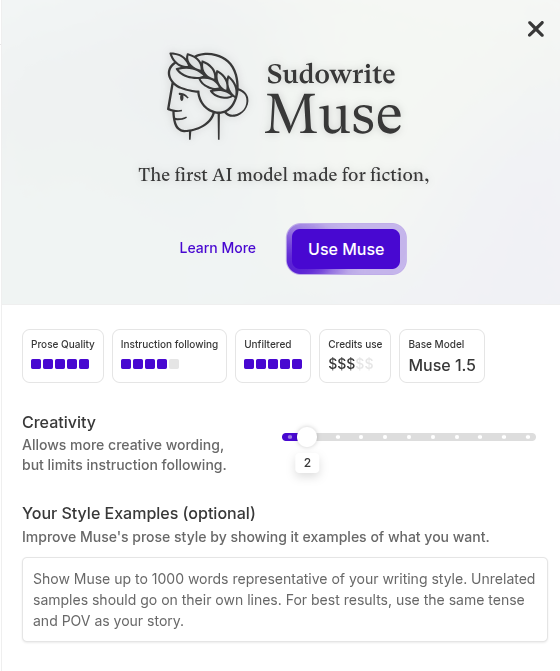
Sudowrite just released their new, updated version of Muse, their in-house generative AI model that’s optimized for writing fiction. It’s very similar to Muse 1.0, where you select a “creativity” setting from 1 to 11, optionally add some prose for it to work from, and then let it go. To allow their subscribers to experiment with it, they made it free to use today—but honestly, it doesn’t use a ton of credits anyway, so unless you’re on the cheapest plan (or generating a +1M word tome) it’s not going to break the bank.

I happened to be working on the rough AI draft of Captive of the Falconstar, so I decided to try it out. I wasn’t too impressed with the earlier version of muse, since I found that it didn’t have much internal consistency and felt a bit like it had just thrown my whole story bible into a blender. But perhaps the main problem was that I was setting the creativity too high. With Muse 1.5, I still ran into those problems on the higher range, but when I set creativity down to 1 or 2, it actually was fairly coherent (though the dialogue was still a bit like “let’s throw these characters in a blender and see what happens!”)

I think it might be that the way I’m writing my scene beats works better for the more reliable version of Muse. I tend to write very detailed scene beats, running in the 200 to 500 word range. I suspect that Muse would work much better if I were “discovery writing” my AI draft, instead of outlining it rigorously and generating multiple iterations of each chapter to pick out the best parts of each one. When you crank up things on the creative end, it can get pretty wild, especially on the 11 setting.

But while the internal consistency of the writing isn’t nearly as good with Muse as it is with Claude, the prose is definitely better. So what I’m probably going to do in the future is generate the first iteration of each chapter in Claude 4 Sonnet (or Opus, if I have enough credits for it—Opus is a monster of a credit spender, but the results are quite excellent! I really hope Sudowrite builds a “delux” model based on Claude 4 Opus.) After that, I’ll generate a couple of other iterations using Muse, then go through it line by line to copy-paste the best parts of the Muse iterations into the master version.

It’s a lot more work, but I think this way I can get the best aspects of both models, and produce a really clean AI draft. And the cleaner the AI draft is, the faster and easier it is to write the human draft—and likely with better results too.

The rough AI draft of The Soulbond and the Sling is complete!

So I just finished the rough AI draft of The Soulbond and the Sling, after nine days of outlining and prewriting, and five days of working with Sudowrite to generate it. The rough draft clocks in at 18 chapters (plus a prologue and an epilogue), 80 scenes, and 153,254 words. I used about 770,000 AI credits from start to finish, including for generating all of the characters and worldbuilding in addition to the text of the draft itself.

I have to say, I am really impressed with the incremental improvements over at Sudowrite, and with Claude 3.7, which was the AI model that I used to generate most of this book. I did try out Sudowrite’s new Muse model, but I wasn’t too impressed with it, at least for generating new chapters. For the in-chapter tools, such as guided write, expand, or rewrite, it’s probably fantastic, but with generating new chapters from my outline it just felt too much like it threw all my worldbuilding into a blender. Most likely I either had the creative setting set too high, or I gave it too many prompts.

But when I switched to Claude 3.7 (Sudowrite’s “Excellent” model), the results were amazing. I seriously felt less like I was writing the novel and more like I was reading it for the first time. There’s still a lot of work to be done, especially in the second half of the book, where many of the scenes strayed from the overall story structure, either forgetting things that had already happened or assuming things that hadn’t yet. There’s also quite a bit of worldbuilding that I would like to add in, and a handful of small hallucinations that need to be cut out, as well as a major change that I made in one of the characters and need to smooth out in other scenes… but overall, I found myself really enjoying this book, and was frankly surprised at how well it fleshed out the setting and characters, making them really stand out. It also added some really great dialogue that is probably going to make it to the final draft.

I was originally planning to lay this WIP aside while I switch to another project, but I think now the best course will be to work on the AI draft until I make it as good as I can. That way, I can tinker with the AI prompts while they are still fresh in my mind. Once I’ve gotten the AI draft as good as I can make it, I’ll lay it aside for awhile to let my subconscious work on the story, so that when I pick it up again, I’ll be better able to do an awesome human draft.

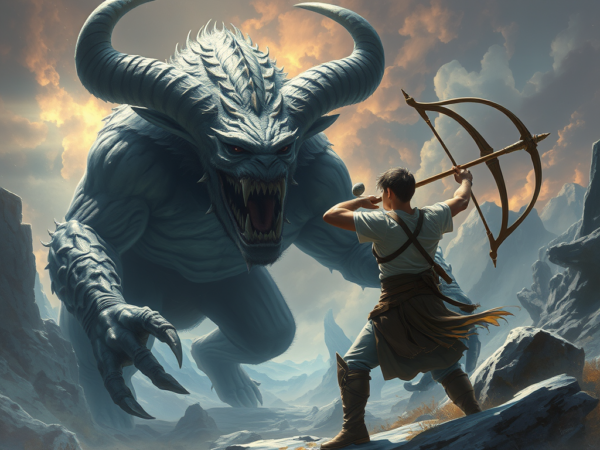
I would have added a mock-up for the book cover, but you would not believe how hard it is to get an AI image generator to give you a picture of David and Goliath that doesn’t have David holding a bow and arrow! Seriously—every time I prompt it for a fantasy illustration of David and Goliath, where Goliath is a giant horned monster, it shows David with a bow and arrow instead of a sling. It’s almost as bad as the strawberry problem! But let’s see if WordPress can do it…

Nope. Yet another AI image fail. I even specifically said he was wielding a balearic sling. Sigh.

Five things I did at work last week

I’ve been so busy, I almost forgot to do one of these posts! Here are my five bullets from last week, feel free to add your own in the comments:

  • Wrote a detailed scene map for The Soulbond and the Sling. I estimate the novel will be 20 chapters, 80 scenes, and 110,000 words, though the word count estimate is probably low.
  • Wrote seven-point outlines for the other six books in the series.
  • Generated all of the characters and worldbuilding cards for The Soulbond and the Sling on Sudowrite.
  • Wrote and sent an email newsletter.
  • Conducted a monthly planning session.

Up and Back from Denver

My uncle just got remarried, after losing his wife of some 40+ years to dimentia. The wedding was Saturday, so I flew up there in the early morning with my two sisters who live here in Utah. And then, because my four year-old daughter had her first primary program in church this Sunday, I flew back that night around midnight.

With all of that said, though, I still managed to get 2k words of writing in while on the plane or in the airport (mostly on the plane). This was all human writing, taking the stuff that I’d previously generated with AI and using it as a detailed outline (or sometimes as a loose suggestion) while I rewrote it in my own words. Which goes to show how AI-assisted writing can be super useful, especially for those in-between moments where it’s impossible to get a more sustained focus. If not for what I had previously generated, I wouldn’t have gotten more than a couple of hundred words in, if that much. And of course, I didn’t get any writing in during the wedding or any of the family stuff before and after.

Needless to say, after waking up at 5am to fly out, and not going to sleep until 2am the following morning, I was pretty hashed all Sunday. But the primary program went really well. My daughter remembered her part, and all but swallowed the microphone as she shouted it so we could all hear: “I love Jesus! Jesus is the Prince of Peace and the King of Kings!” It was hilarious, and very cute.

Sudowrite just rolled out a new outlining feature in their Story Bible, which replaces the old outline field. I tried it out this morning, and two things strike me about it:

First, it’s really nice that there’s no longer a word limit on the novel outline. I did have a little trouble getting my chapters to link with the outline, so there are probably still some things on the backend that need to be smoothed out, but I did get it to work in the end.

Second, it is SUPER convenient to be able to have the AI generate the individual chapter descriptions. After playing around with it, I found that the best way to generate them was simply to copy and paste all of the plot points from the spreadsheet that I use to map out the whole book, not even bothering to format it for the weird table breaks and tabs. The AI takes all of that input as-is and spits out a super accurate chapter description every time! Very nice, and hopefully it translates to better chapter beats too.

So for today and tomorrow, I’m going to work on the outline for Lizzie-99XT. After that, I’ll go back to writing out the rough human draft for The Road to New Jerusalem, and probably just focus on human writing for the rest of the month.

WIP Excerpt: Captive of the Falconstar, Chapter 5 (AI generated)

I’ve been experimenting a lot with AI-assisted writing, and I think I’m starting to produce some decently good work with it. Of course, in six months I’ll probably look back on what I’m producing now and feel utterly embarrassed by how bad it is, but still, it’s measurably better than the stuff I was producing six months ago.

Here is an excerpt from chapter 5 of my current WIP, Captive of the Falconstar. This scene is taken from the AI revised draft, and is 100% AI generated. It contains some mild spoilers, but nothing too major for the book or the series.

In the next draft, I will make a bunch of human revisions based on my notes, such as later events I need to forshadow, worldbuilding elements that I need to fix, or adjustments to the character’s motivations and growth arc—in other words, things that the AI doesn’t do as well. And in the draft after that, I’ll throw everything out and rewrite the scene completely from scratch, using the previous AI draft as little more than a guide or reference.

In other words, this AI generated version of the chapter is merely supposed to simulate the version of this chapter that I will actually write. It’s not intended to replace my own writing, or to be revised into the final published version. It’s a crappy first draft, in other words, and the reason I’m generating it with AI is so that I can iron out any potential wrinkles with the overall story arc, and fix them before they grow into huge creative blocks for me later on in the writing process. Generating the crappy first draft with AI is great, because 1) it’s super fast, and 2) it sucks up less of my mental energy, allowing me to focus on the broader story issues and not lose sight of the forest for the trees.

Anyhow, here is the AI version of scene 5.6 (Zenoba) before performing any human revisions. My process was that I generated three or four different versions of the chapter using Sudowrite, stitched together the parts I wanted to keep, and used Sudowrite’s AI revision tools to touch it up. Enjoy!


Zenoba moved through the austere corridors of the Falconstar, her gait measured but her mind a turbulent sea. She navigated the ship with an urgency that belied her usual composure, her thoughts a tempest of strategy and emotion. Her hands, usually so steady, now betrayed her with their tremble as she approached the door to Lady Nari’s quarters.

She hesitated at the entrance to Lady Nari’s quarters, steeling herself for the confrontation ahead. 

“Enter,” came the matriarch’s voice from within, a command more than an invitation.

The door slid open with a soft hiss, and Zenoba stepped inside, her tall frame stiff with determination. The room was dimly lit, the walls adorned with tapestries depicting the Valdamar clan’s storied past. Lady Nari sat on a plush chair, her silver hair reflecting the light from the hologram projector that cast ghostly images of distant stars across the ceiling.

“Lady Nari,” Zenoba began, her voice steady despite the turmoil within, “I come seeking counsel.”

“Sit, Zenoba.” Lady Nari gestured to a seat opposite her, her brown eyes locking onto Zenoba’s with an intensity that could bend steel. “You refer to the marriage alliance with the Naimal clan, I presume?”

“News has reached me of Khasan’s intent to take another wife,” Zenoba said, each word measured, betraying none of the desperation clawing at her insides.

“Indeed,” Lady Nari said, finally turning to face her daughter-in-law. Her eyes held the wisdom of years and the unyielding strength of the matriarch she was. “It is a favorable alliance for our clan.”

“Is it truly wise?” Zenoba asked, desperation seeping into her tone. “Khasan already has a loyal wife who bears his child. This could divide our clan and create conflict within our own ranks.”

“Conflict?” Lady Nari scoffed. “Polygamous marriages have been part of our traditions for centuries. You knew this when you married my son.”

Zenoba clenched her fists, her nails digging into her palms. “Yes, I am aware of our traditions, but I never imagined that Khasan would consider such a move without even consulting me. I cannot help but feel betrayed.”

“Betrayed?” Lady Nari’s voice hardened, her eyes narrowing. “You are not the one making sacrifices for the good of our people. You should know your place and humbly submit to your husband’s decisions.”

Zenoba was taken aback by the harshness of the woman’s words. She had always looked up to her as a mother figure and expected support, not rejection. As she processed the sting of her words, Zenoba couldn’t deny that her own pride and fear were also at play. She didn’t want to lose Khasan’s love, but she also didn’t want to give in to tradition and loyalty without a fight. It was a constant inner battle between what was expected of her and what she truly wanted for herself.

Zenoba took a breath, willing her voice not to falter. “But it undermines my position, and what of the child I carry? Their future could be jeopardized by this—”

“Your position?” Lady Nari’s tone was reproachful. “Or your pride? You speak as if you are the only one affected by this. You forget your place, Zenoba.”

“Forgive me, but my place—as you say—is at Khasan’s side, in command of the Falconstar. If he were to marry again—”

“Then you will welcome Lady Tsarnai as you should,” Lady Nari interjected, her rebuke sharp. “Khasan’s choice honors the Valdamar name. It secures our future.”

As Zenoba stood before Lady Nari, the coldness of the room seemed to seep into her bones. Her pleading eyes searched for any sign of compassion in the ruler’s face, but found only a stern and unyielding expression. It was as if Lady Nari had been molded from the ice that covered the outer systems.

“Is this truly what he desires?” Zenoba’s voice trembled with emotion as she pleaded for understanding.

Lady Nari’s gaze remained unflinching. “His heart belongs to you, but his duty is to our clan. Your duty is to support him as his queen and make decisions for the benefit of our people.”

As the words hit Zenoba, she felt her whole body stiffen in shock. For so long, she had believed that her cleverness and manipulation would secure her future, but now, that certainty was crumbling beneath her feet. The once unbreakable bond between herself and her husband now seemed fragile and uncertain. She couldn’t help but feel a pang of fear as she realized that perhaps her control wasn’t as absolute as she thought it was.

“Khasan knows what must be done for the greater good,” Lady Nari continued, her gaze unwavering. “This alliance with the Naimal clan will secure our future. It is bigger than any one person’s pride or fear.”

Pride or fear—the words echoed in Zenoba’s mind. Was it pride that made her want to hold her place at Khasan’s side, or fear of being replaced, diminished? She swallowed hard, the contemplative silence stretching between them.

“Consider this a lesson in humility,” Lady Nari concluded, her voice softening just slightly. “A true leader knows when to yield for the greater good.”

Zenoba rose, her movements automatic. “I understand,” she lied, her voice hollow. She did not look back as she left Lady Nari’s quarters, the weight of the older woman’s expectations pressing down on her like the gravity of a collapsed star.

As she turned to leave, her mind was already racing, plotting her next move in the intricate dance of power that surrounded them. But beneath the veneer of calculation, there lay a fissure in her resolve, a vulnerability she dared not show.

As the door clicked shut, Lady Zenoba Valdamar, queen of the Falconstar, was left alone with her inner turmoil. In the silence and stillness of the corridor, she couldn’t help but doubt herself and her abilities. A lone tear escaped her eye before she quickly wiped it away, reminding herself that weakness was not an option in the days ahead. She needed to be cunning and resilient, but she couldn’t shake off the fear and uncertainty that consumed her.

How Not To Write An AI-Assisted Novel

The worst way to write a novel with generative AI is to make the AI do all the work.

In fact, thinking of it in terms of “how much of the work can I get the AI to do?” is pretty much guaranteed to give you a really crappy book by the end of it. The AI’s job isn’t to “do the work,” any more than a power tool’s job is to build a house. You do the work. AI is just a tool to multiply your efforts.

But let’s take a step back. Who am I to talk about all of this? My name is Joe Vasicek, and I’m an indie author who’s been writing and publishing regularly since 2011. At this point, I have several dozen novels under my belt, including about half a dozen AI-assisted novels, the first of which is published under my Joe Vasicek pen here on this blog. Also, my wife is a PhD student and research assistant who works with generative AI and large language models. Her thesis is on using generative AI to create interactive cross references for any body of text, customized to the user. We talk a lot about generative AI and share what we’ve learned, so we’re both fairly knowledgeable on the subject.

At this point, it’s still very much the wild west of writing with AI-assistance. The technology is new enough that there really are no experts on the subject, though I expect that that will change rapidly over the next few years. And while I can’t (yet) say that I’ve made gazillions of $$$$ from my AI writing methods, I can say that I’m one of the first professional writers to develop a method for writing with AI-assistance.

And that’s not a boast. Whenever I get together with other writers, I wish there were more of them (really, any of them) that I could talk with about this stuff. There are some online communities that come at it more from the AI side than the professional writing side, and I probably ought to spend more time in those, because it’s probably only a matter of time before one of them has a runaway bestseller and shakes up the publishing industry in the same way that Amanda Hocking shook things up when the indie publishing revolution was just getting underway.

Maybe that someone will be you. Who knows? We’re still very much in the wild west of AI writing, and probably will be for a while.

It’s that very loneliness that makes me want to blog about AI-assisted writing—that, and the fact that I’m still trying to figure it out for myself, so I would love to hear what’s working for other writers. But one thing that I’ve learned from my own experience is that the worst way to write an AI-assisted novel is to dump all the work on the AI and expect anything good to come out.

The main reason for this is that LLMs and generative AI do not think—at least, not in any meaningful way that’s similar to the way you and I think. Instead, these models analyze human language for patterns, and replicate those patterns according to the parameters and instructions give by the user. It’s much closer to how your phone is able to predict your next word when you go to write a text, except that instead of writing the next word, ChatGPT or Sudowrite or whatever LLM you happen to be using is instead predicting the next 5-10 paragraphs.

So really, it’s not very useful to think of an AI as being able to “write” anything. Instead, it’s much more useful to think of it as “simulating” the thing that you’ve told it to write, or producing a simulation of the kind of work that a human would produce, given your parameters and instructions. The AI isn’t “doing the work” for you, it’s merely simulating the end product of that work. You still have to make it your own.

And how do you make it your own? Personally, I’ve found that the best way to do that is to open up a new document on my second monitor and type it all out by hand, occasionally referring to the AI-generated text when I don’t know what to write next, but largely trusting in myself to create the real, non-simulated draft. No copy-pasting! The mental exercise of writing it all out, word for word, stimulates something in the creative mind, and in most cases I end up writing something completely different, using the simulated version of the novel merely as a stepping stone.

So why do I go through all the trouble of generating a whole novel, when I’m probably going to throw out most of that text anyway? That’s a very good question—so good, in fact, that it needs to be the subject of its own post.

The Sudowrite draft of The Riches of Xulthar is finished!

It only took about a month, but it would have been much faster if I’d used Story Engine. Honestly, I probably could have generated the text in a week if I’d used that tool, or perhaps even an afternoon. Instead, I outlined the project myself, wrote the first couple of paragraphs for each individual scene, and wrote / generated the rest.

Most of what I used Sudowrite for was on a sentence and paragraph level for this draft. Typically, I would write a bit, get to a point where I wasn’t sure what to write next, generate some text, and then either 1) use it as-is, 2) use it, but run it through a couple of rewrite filters first, 3) use it, but tweak it myself, or 4) throw it out entirely and keep writing. Because the AI didn’t have an outline to work with, it often took the story off in weird and non-useful directions, but there were a couple of times where it surprised me in a good way, and I decided to keep it in.

One of the things I found was that Sudowrite is terrible for magic systems, world-building, character arcs, foreshadowing, unresolved sexual tension, or anything else that happens on a macroscopic scale, especially if that story element changes over the course of the novel. For example, he AI engine wanted every scene involving both my male and female leads to culminate in the climax of their romantic subplot. Likewise, it was very difficult to get the AI to hit the right beats for their character growth; that was something where I really had to babysit it.

But for those microscopic, word / sentence / paragraph level story elements, I was pleasantly surprised with how Sudowrite performed. It felt a bit like I was riding in the front of a tandem bicycle, instead of writing alone. When I hit stretches that required a lot of uphill effort, I could rely on the AI engine to do most of the work while I steered. Of course, riding a tandem is no fun unless both people are pedaling, so I still had to do my part, but the hills and the rocky parts felt a lot easier, which was nice.

This Sudowrite draft isn’t anywhere near publishable, but that wasn’t what I was going for. Instead, the goal was to get it good enough to use as a starting point to rewrite the entire thing myself. Rough drafts are pretty hard for me, but rewriting and revising comes much easier after I have something to work with. Even if I end up throwing out every word, I expect that I can power through this “humanized” draft in a fraction of the time it would take me to write the novel from scratch. I may even finish it this week!

But perhaps the area where the Sudowrite draft did the most was with helping me to be productive even when my attention was being pulled in multiple directions by small children. A significant chunk of this book was written in the BYU Library’s family study room, with one eye on my three year-old daughter as she played with the other kids. Even after I had to step in to referee a bit, or to take her for a snack or a potty break, the AI tools enabled me to jump right back in and keep writing.

The amount of focus it takes to write with AI tools is much, much less than what it takes to write without them. At least, that has been my experience. Granted, my goal with this draft was not to make it publishable, but to make it good enough for the next phase, which is more like 95% human effort and 5% AI, as opposed to 40% human effort and 60% AI, which I used for this draft.

But I doubt there are any AI tools right now that can get a book into a published state with minimal human effort. In general, I’ve found that these AI-assisted writing tools are great for getting a book from terrible to passable, but not as useful for getting a book from passable to genuinely good—and as for getting a book from good to genuinely great, you can forget it with our current set of AI tools. Much better to rely on human efforts for that.

To use another analogy, it’s kind of like using a two stage rocket to get to orbit, where the booster rocket is the Sudowrite draft and the second stage rocket is the humanized draft. The booster won’t get you to orbit on its own, but it will get you through max Q and send you high enough that the second stage can finish the job. And since you’re going up in two stages instead of just one, it doesn’t take nearly as much fuel to get there.

Another advantage of doing it this way is that the final draft will be almost 100% human-written. There’s no copying or pasting in the humanized draft—every sentence and every word is typed out by hand, and while some of it may come verbatim from the Sudowrite draft, most of it is going to be changed in some way, sometimes quite substantially. For example, today I “humanized” a scene that was about 750 words in the Sudowrite draft, but ended up at around 1500 words.

What I’ll probably do is pick a few scenes from this novel and post the before and after, to show how substantially it’s changed. But even the Sudowrite draft isn’t totally AI generated, at least with the way I’ve been using these tools. Like I said above, it’s much closer to 60/40.

The Sudowrite draft of The Riches of Xulthar clocks in at about 33.2k words. That still falls short of the 40k word minimum threshold for a novel, but it will get longer with the next draft, and I expect it to end up somewhere between 40k and 45k words. With luck, I’ll finish the humanized draft by the end of this week, and the revisions before the end of this month.

Riches of Xulthar update

So it’s the 25th of the month, which is also the 25th day of the billing period for Sudowrite, and used up all of my AI words. The Riches of Xulthar, my first AI-assisted novel, is currently a little over 27k, which means I have 13k words to go (I’m shooting for the minimum novel word count for this project, though I’ll probably go 1-2k over).

I could buy some extra AI words to round out the month, but I’m going to just wait until the next billing period on June 1st. That means no more generative AI writing, but there’s still a lot of work to be done, not only for this project, but for all those practice short stories that I wrote with Sudowrite at the beginning of the month.

I’ve been vacillating between whether The Riches of Xulthar is any good, and whether I ought to just trunk it. Part of the problem may be that I got caught up in Laria’s story, which isn’t very typical for the sword & sorcery genre.

But more than that, the writing process has just been really choppy: it started as a short story attempt with ChatGPT, with the prompt “let’s write a fantasy adventure story in the style of Robert E. Howard.” But it quickly morphed into something much longer than a short story—and because ChatGPT has a short memory, I started running into problems because of that.

My early attempts to “humanize” it by typing out (not copy-pasting) the AI output into a separate document made it even messier, since I kept trying to feed those humanized bits back into ChatGPT. When it started to feel like I was wrestling with the AI to pull the story in the right direction, that was when I needed to try another AI writing tool.

Sudowrite has been great in some ways, and a struggle in others. Most of the struggle is to be expected, given that the program has quite a steep learning curve, but it does make me wonder if this first novel is any good. Most of the time, I feel like the best I can do is to get it about 80% there, and finish the rest of it myself.

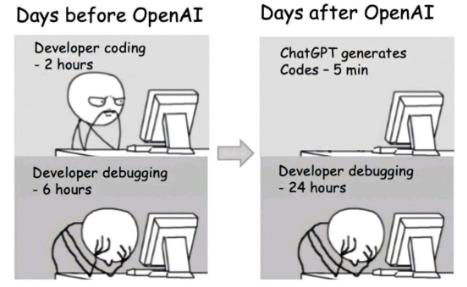
And that may be the best I can do with these AI tools at all. Most of the time, it feels like I’m only getting it 50% or 60% finished, so getting it 80% of the way to a publishable quality book may actually be optimistic. It may turn out that AI-assisted writing is a lot like the coder meme above.

So for this next week, I’m going to set the AI writing aside and focus on the “debugging” phase, which I’m calling the “human filter.” It involves retyping the story word for word into a new document, and tweaking or revising it along the way. It will be interesting to see how that goes.

More early thoughts on AI-assisted writing

It’s become something of a cliche that true writers write because they can’t not write, but as with so many other stereotypes and cliches, there’s a kernel of truth in it. I’ve been writing on and off since the 8th grade, and even during periods of my life when I wasn’t able to focus on writing, the writing itch would still come for me, and I would have to sit down and sketch out something, even if I never did anything with it.

Over the years, I’ve gotten pretty good at telling whether I’ve done enough to satisfy that creative urge that drives me to write, and whether that urge has been left unsatisfied. Yesterday, I realized that something felt off because that creative urge had not been satisfied—which is strange, because after only two weeks of working on this AI-assisted novel project, I’m already halfway done with the first draft. Indeed, yesterday I “wrote” (if that’s the right word for it) a little over 4.5k AI-assisted words.

Now, this should go without saying, but the point of writing professionally is not how good the creative process makes you feel, but how well and how quickly you produce a quality finished product. But I do think there’s a correlation between the two: that you are more likely to create a quality finished work the better your creative process satisfies your creative urges.

In the last three months of writing with AI, I’ve had some writing days that were better than almost any I’ve had in years. I’ve also had some very meh days, which is to be expected… but what isn’t so expected is this feeling of being creatively unsatisfied, which I usually don’t feel unless it’s been two or three weeks since I’ve done any writing. Something weird is going on.

How much of this feeling of creative dissatisfaction is due to the fact that I’m outsourcing a significant portion of the creative work to an AI, and how much of it is simply to be expected from trying to master a new and unfamiliar skill, which has kept me from satisfying that urge in the same way as I have in the past? At this point, it’s difficult to say. Probably a little of both.

Having worked on this for a while now, though, I think that the writers (and other creative types) who are going to succeed the most with AI-assisted creative work are the ones who figure out how to integrate the human element of their process with the AI element of their process, such that each one complements and enhances the other. Right now, everyone’s talking about how AI will replace us, but that’s really the wrong way to think about it if you want to learn how to master these tools.

I suspect that the way to master AI-assisted writing is not to try to get the AI to “do the hard stuff,” or replace some aspect of the creative process, but to integrate it within your creative process such that it enhances and magnifies your own, very human efforts. For that reason, I’m changing the way that I count my daily words so that I no longer make a distinction between words that I “write” myself, and words that the AI “writes” or generates, because the AI can’t generate words unless I give it enough to work with. Often, that means that I write a little, then generate a little, then tweak what the AI generates and write a little more. When the process is working well, it’s very difficult to say which parts were purely AI “written,” and which parts were purely human “written.”

But it’s still going to take a while to figure out exactly how to integrate AI into my writing process. As I continue to do that, I’m going to pay close attention to how it satisfies—or fails to satisfy—my creative urge to write, not because that is the end goal, but because I suspect that if my creative urge is not being satisfied, the AI-assisted stuff that I’m producing probably isn’t very good. It may not be very good even if my creative urges are satisfied, but if something about the process is missing, then something about the final product probably is missing as well.

Anyhow, those are some more of my random thoughts as I continue to experiment with AI-assisted writing. I was hoping to finish the rough/AI draft of The Riches of Xulthar before the end of the month, but I’m almost out of AI words for this billing cycle, so I’ll probably move on to the “humanizing” phase for what I’ve already written, which is where I retype the AI-generated stuff in order to pass it through what I like to call “the human filter.” Hopefully that helps to give the story a little more of my personal voice and style, and not read like something that could have been AI generated by anyone. But I’m still working out and experimenting with that part of the process, just like all the others.