Interview with Slava Heretz

I met Slava Heretz online shortly after I started publishing my books.  He’s another indie writer who specializes in science fiction and space opera.  I’m reading his short story / novelette series Outer Pendulum right now, and it’s pretty good.  If you like a good space adventure, I think you’ll like his stuff.

Anyhow, we decided it would be fun to interview each other on our blogs, so here he is.

Tell us a little bit about your books.

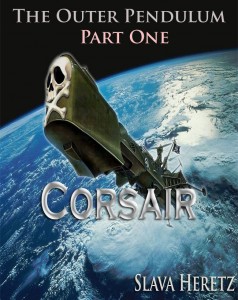
The Outer Pendulum is a space opera which I am releasing in monthly 10,000 word installments. The story is set in a galaxy where humans are the unwanted newcomers, escaping an oppressive life back in the Milky Way, only to find themselves facing another kind of tyranny: the seemingly endless stream of piracy and corruption in their new land. Our hero is Captain Eli Saffinger, a former New Alliance Navy captain turned mercenary fleet commander. His mission, which he accepts reluctantly, is to escort a freighter carrying extremely valuable mining equipment to the only allies of the weakening colonial state. So his journey begins in Corsair (Outer Pendulum, Book 1), where he must immediately confront the most ruthless and dangerous privateer in the galactic region.

How long have you been a writer, and what got you started?

I started serious work on a near-future technothriller back in late 2007. I think that’s really when I began to consider myself a writer. As opposed to earlier dabbles with fiction back in my youth, I actually spent a very large portion of my days dedicated to this project — and to be perfectly honest, I’m still not exactly sure why. I just suddenly had a story to tell. It came to me one day in the shower and I said to myself, “Hey, Slava, let’s write a novel.” So when the idea for The Outer Pendulum popped into my head this past spring, I had the wisdom and experience from my many many mistakes to give this story more life, energy and passion.

What draws you to space opera and science fiction?

As an only child I had a lot of time to just sit there by myself and dream up wildly imaginative tales of space travel and cool technology. Some of these ideas were good, some not so much. But I always marveled (and still do) at the things which I have no hope of ever accomplishing. Theoretically I could be a rock star. I have no talent for it, but at least the occupation exists. But no matter how hard I work at, there is no way in my lifetime, save a true miracle, that I will ever travel to another solar system. And because of that, the possibilities of the imagination are endless. I love that.

Who are some of your favorite authors?

Dan Simmons for his wonderful characters and settings. Iain M. Banks for that touch of witty humor we all love and need. And M. John Harrison for anytime I want a truly warped, weird, yet poetic reading experience — he’s kind of the Stanley Kubrick of sci-fi noir.

Why did you decide to self publish?

I had submitted several pieces of fiction to traditional publishers in the past. Many of them flat out ignored me. Others, however, sent very positive rejection letters. That’s when a light bulb appeared over my head. I asked myself: why am I waiting for months to have one person tell me I write well, when I could let the world of hungry readers decide for themselves? It wasn’t long before I discovered Amazon Kindle Direct Publishing and Smashwords. I soon realized what a revolutionary idea it was to allow authors to simply create and let the market speak for itself.

What have you learned from your indie publishing experience thus far?

I’ve actually learned quite a bit about readers of indie literature as a whole. I’ve heard the complete spectrum of praise and criticism about my series. Some have absolutely loved the story. Some have vehemently hated it. But if I were to pick out some things that they all had in common they would be a) a seemingly insatiable appetite for reading within the genre b) that MOST of them actually do read samples and/or product descriptions before buying and c) that this growing community of open-minded folks is truly willing to ignore the stigma of indie publishing and seek out works by self-published authors. I can’t say that for them it’s an easy job. But they try, and I thank each and every one that contacts me — because it seems in the end, the reward of finding a few self-published diamonds far outweighs the possible tedium of sifting through the ever-growing rough.

What are your goals and plans for the future?

First and foremost, I have to finish The Outer Pendulum. I envision eight or ten installments culminating into a complete saga by summer of 2012. There is also an audiobook/podcast in the works. There will even be a multiplayer online card game based on the universe within the story. I mean, I have a ton of other ideas kicking around in the ol’ noggin — such as books in other genres. But this will certainly keep me busy for the next several months. It’s really been a lot of fun writing the series.

If all of us have at least one impossible dream, what is yours?

I would love to meet a sentient alien. I can’t say with 100% certainty that they exist, but I really hope so. If I may quote one of my favorite TV shows — “I want to believe”

Slava lives in Brookline, MA with his beautiful wife Alyssa, his neurotic dog Duke and his passive aggressive cat Chester.
Trope Tuesday: Recycled IN SPACE!

Or, as my friends at Leading Edge would say, IN SPAAACE!!!

The basic idea behind this trope is that setting a story in space makes it cool and different.  The tvtropes article focuses mainly on how this trope is used in children’s cartoons, but it actually goes much wider.  In fact, most space stories are actually based on stories from other genres, or even from history.

For example, Asimov’s Federation series is based on Edward Gibbon’s Decline and Fall of the Roman Empire, David Drake’s Lieutenant Leary series is based on Patrick Obrian’s Master and Commander series, and Frank Herbert’s Dune is based on the rise of Islam.  Westerns are especially prone to get the space treatment (Firefly, anyone?), which is where we get “wagon train to the stars.”

At its worst, this trope is nothing more than a pointless gimmick.  At its best, however, it can produce some extremely good work.  The key, as always, is to work within the limitations of the setting.

One of the best examples of this is Dune.  Frank Herbert didn’t merely lift 7th century Arabia into space and call it Arrakis; he created a distinctly alien world with its own history, culture, biology, and role within the galactic empire.  For example, Herbert solved the FTL problem by linking interstellar travel to the spice, tying his space-Arabs to the politics and economics of the rest of the galaxy.

Interestingly, your space physics don’t have to be perfect for this trope to work; they just have to be believable.  For things like artificial gravity and faster than light travel, most people will accept a little hand-waving, provided that you do it well.  The important thing, as always, is the story.

Story Notebook #5 (part 2)

For those of you who don’t know (or can’t remember, since it’s been so long), I’ve been doing this ongoing thing where I go through my old story notebooks.  Last time, we covered my last semester of classes at BYU; this time, we’ll cover my time in Washington DC, when I was trapped in an internship from hell.

Now, you may be wondering: “why is this guy just giving away his ideas for free?” Well, last week at dinner group, the conversation turned to story ideas, so I pulled out my current story notebook and started going down the list.  This quickly turned into a game of “name that tune,” where we managed to show that EVERY SINGLE IDEA had already been done. 

And you know what?  That’s perfectly okay!  There are no original ideas anymore, just new ways of executing them, and maybe a handful of combinations that haven’t yet been tried.  The purpose of keeping a story notebook with you at all times isn’t to come up with something new, it’s to keep track of the stuff that really turns you on.

Enough with that.  On to the notebook.

In a spacefaring culture, the custom will be for the males to leave the station and depart in search of a wife at another port, either to capture or win over in some way.  The women will tend more to running off with the travelers.  This preserves genetic diversity.

This is actually something I want to talk about in a longer post.  The problem of inbreeding in a space-based society is something that many science fiction authors have wrestled with, from Robert Heinlein to C. J. Cherryh.  Their solutions are quite inventive, but while I was in Washington DC working on To Search the Starry Sea (my escapist retreat from a hellish internship), I managed to come up with a few of my own, and used them in Star Wanderers.  More on that later.

What if one of the founders was a time traveler, sent on a mission to ensure that the US constitution made it through?

Hehe…in other words: James Madison, Time Traveler.  It has a certain ring to it, no?

The human mind is like a congress–so many people at extreme odds, arguing constantly but holding together somehow.

Oh boy.  If that were true, the US congress today would be like a paranoid schizophrenic.

A subway haunted by patrons from the past–maybe you will become one when it goes back in time.

Who hasn’t been creeped out by the subway at some point or another?  Except the New York subway system is way creepier than the Washington DC Metro–I swear, some of those rats are man-killers.

A magic system where the cost is your unborn children.  If you don’t have children within a certain period of time, you die.

Sounds like some of the Arab short stories I’ve read.  Families and children are much more important to them than to us in the West.

When the Developed World develops instantaneous transportation devices, it will essentially merge into one super country, while the developing world will be left out.  The only sense of distance will be in the developing world, and terrorism will be an issue.

Kind of like Larry Niven meets dependency theory.

A government where the Supreme Court is a super-intelligent robot.

Hopefully this would rid the country of activist judges…or would it??

A character who believes, at his core, that there is no such thing as a genuine surprise, simply a lack of information–and that if we had perfect information, there would be no surprises.

Sounds a lot like the platonic 19th century ideal of a scientist.  What with quantum physics and such, there aren’t a whole lot of those left.

There are two kinds of shame: shame from loss of honor, and shame from not following the herd.  Don’t mistake the one for the other.

This one isn’t so much a story idea as an observation.  I learned a lot in my hellish Washington DC internship, most of which had very little to do with my area of study and everything to do with the less-than-honorable ways in which the world works.  And on that note:

____ always felt that the world around him was somehow less than real; an illusion.  While staring out the window of the train, he wondered if the window wasn’t just a video screen, like the car windows of old movies–or when looking out at the view of the mountains beyond his house, with the picturesque clouds and too-blue sky, if it wasn’t just an elaborate painting on a wall at the end of the world.  In moments like these, ____ longed to peel back the video screens–to break down the pretty painted wall at the end of the world–and see what lay on the other side of reality.

If my hellish internship on K street taught me anything, it taught me that I would rather be a writer than have all the connections or political influence in the world.  I got out of Washington DC as fast as I could, and haven’t looked back since.

Bringing Stella Home is now up on Amazon!

That’s right–after a whole lot of work, my novel is now up on Amazon for $3.95.  Check it out!
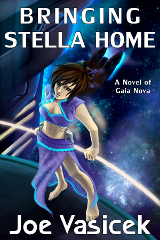
This novel is the first of a much larger series that I have planned.  It’s not a series like Ender’s Game or Song of Ice and Fire, though; all of the novels are supposed to stand alone, though they share the same setting and feature recurring characters.  In that sense, it’s more like Gemmell’s Drenai series.

Even though the series is space opera, I tried to keep the science plausible at least on a high school level.  So while there’s “magic” like FTL and artificial gravity, I’ve tried to bend rather than break the laws of physics.

At its core, the story is more about the characters than the setting or even the plot.  It follows a young boy who is determined, at all costs, to save his brother and sister, even as his world quite literally falls to pieces all around him.  Along the way, he meets up with a mercenary captain who is running from some demons of her own.  The way they help each other overcome their personal challenges is a major driving force throughout the book.

Anyhow, I suppose that’s enough.  I could ramble on forever, but I don’t want to get in the way too much.  Thanks so much, and I hope you enjoy it!

T minus 24 hours and counting…

That’s right!  After much wrangling, I formatted it this morning and published it to Amazon this afternoon.  In less than 24h hours, it should be up for sale!

In many ways, Bringing Stella Home is a lot different from Genesis Earth.  For one, the scope is much larger, with the rise and fall of galactic empires and a war leaving billions dead in its wake.

At the same time, however, the stakes are very personal.  It’s not about turning the tide of human history or saving millions of lives; it’s about one boy who doesn’t want his world to fall apart, and will do anything to save the people he loves.

I put a content warning in the description because there’s a lot of darkness in this book.  It’s not for everyone; I know that some of my friends would find it shocking and offensive.  However, it isn’t my intention to glorify evil or celebrate immorality; rather, by portraying it honestly, I hope to make the struggle against it that much more meaningful.  There is, after all, an opposition in all things.

Writing this book was a watershed moment for me.  Not only is it the first book in a series which I hope to continue across many books, but it marked a shift in my writing.  Before the rise of indie publishing, I thought this would be the one that finally broke through the iron gates of the publishing industry and made my debut.  Perhaps that was why I was so reluctant to send it out; I didn’t want to experience the crushing blow of rejections from agents who didn’t think they could sell it, or editors who think that science fiction is dead.

But now, I don’t have to break through those iron gates; now, I can send this story out into the world and let the readers decide whether it’s any good.  And that’s exactly what I intend to do.

For all those of you who have helped bring this project up to this point, I want to sincerely thank you by giving you a free copy of this ebook.  I’ll be sending it out tomorrow, most likely; if for some reason I miss you, please email me and I’ll correct the mistake.  They say that writing is a solitary art, but this day and age, that’s no longer true.  So once again, thank you.

It’s been an exciting journey thus far, and something tells me that it’s only getting started.  I can hardly wait to see what the future will bring!

Blurb for Bringing Stella Home and thoughts on Borders

One of the essential elements for a successful in epublishing is a killer book description, and I think I’ve got a pretty decent one for Bringing Stella Home.  However, I could use some feedback, so if you could read it and tell me what you think, that would be great. Here it is:

It is a dark time for the galactic empire. Rebellions at Tajjur and the New Pleiades sap the empire’s strength from within, while hordes of spacefaring Hamiji warriors from the outer reaches sweep ever closer to the Imperial capitol, slagging entire worlds in their wake.

When the Hameji forces conquer his homeworld, young James McCoy runs away to rescue his older brother and sister, Ben and Stella, from their grasp. Though he faces an enemy undefeated in battle and feared throughout all of inhabited space, James will stop at nothing–not even death–to get his brother and sister back.

Things start to look up when he meets Danica Nova, a Tajji mercenary captain who takes him in and becomes his mentor. James reminds Danica of her own brother, whom she failed to protect when the empire slaughtered her family years ago. Now, she hopes to find some redemption from her demons by saving James from his own.

Unfortunately, neither of them realizes that Stella has become a concubine to the main Hameji overlord–and that Ben has been brainwashed and made into an elite shock trooper in the empath squadron sent to hunt them down.

So what do you think?  Too long, too confusing, too cliche, or too boring?  The genre (if you can’t tell) is space opera / space adventure, so I’m hoping it will appeal to fans of Orson Scott Card, C. J. Cherryh, Lois McMaster Bujold, Star Wars & Star Trek, etc.  It’s also got a slight military science fiction bent to it, though I wouldn’t presume to be qualified to write true military sf.

In unrelated news, I recently did an interview with Charlie of Playground51, which appears to be down for some reason (the link is on my Blog Tour page above).  Topics discussed include how I got the idea for Genesis Earth, which parts were inspired by real life, and thoughts on book promotion.  Hopefully the site will be up again soon!

Also, I’m thinking it’s time to do a major overhaul of my blog template.  As much as I love the current one with the purple stars and nebulae, I need something with two sidebars so that my books don’t push everything else to the bottom.  If you have some ideas for a good WordPress template that still keeps the sci-fi feel of this one, please let me know!  I’m very much open to suggestions.

Finally, since the Borders liquidation is all over the news, I thought I’d share my $.02.  It’s sad, certainly, but I don’t think that the fallout will be nearly as gloomy as Joshua Bilmes claims.

Corporate-run big box stores are certainly on the way out, but there will always be a market for good stories, and in many ways the new ebook technology is causing that market to expand at a wonderful rate.  So while the predictions of the print death spiral appear to be coming true (David Gaughran did a great post recently on that), new models will emerge–indeed, are already emerging–which will fill the vacuum.

The thing that gives me great reason to hope is that these new business models give so much power back to writers.  Instead of relying on the mercies of large media corporations to build a viable career, we can now make a living by publishing independently or going with any number of small independent presses.  Readers have more choices and writers have more options.  It’s glorious.

If anything, the Borders bankruptcy has confirmed to me that I’ve made the right choice to go indie, rather than wait for New York to anoint me before launching my career.  Will I ever go with a traditional publisher?  I’d like to someday, but I no longer feel dependent on the old system to accomplish my dreams.  Instead, it’s my readers who will decide my fate, and that’s exactly as it should be.

So thanks for reading!

More thoughts on indie publishing

Since my last post on indie publishing, I’ve been thinking a lot about this subject.  I haven’t decided to take the plunge into self published ebooks yet, but I have decided to make some changes in my writing and my career strategy, in order to position myself more favorably if/when I choose to do so.

Basically, my new strategy is something like Japan or Saudi Arabia’s approach to nuclear weapons: they don’t have an explicit nuclear program (since that would violate the nuclear non-proliferation treaty), but they have gathered the equipment, resources, and expertise together so that if they decided to go nuclear, they could do it in a year or less.

First, though, I attended Brandon Sanderson’s class lecture this Thursday, in which he had some very interesting things to say about ebooks and the publishing industry.  This was part I of his “how to get published” lecture, and here are some of the more interesting points he made:

  • Almost all the indie writers who are making it big have at least one loss leader ($.99 or less) on their list.
  • No one really knows whether indie publishing will be viable for large numbers of writers, or whether authors like Amanda Hocking and Joe Konrath are outliers.
  • Successful indie published books are typically:
    1) short (70k to 80k words)
    2) written in a pulp genre (thriller, romance, paranormal, sword & sorcery, etc)
    3) promoted very well through social networking
  • We have not yet seen any indie successes in epic fantasy, young adult / middle grade, historical fiction, or non-fiction.
  • The produce model vs. unlimited shelf space argument for going indie doesn’t apply as much to science fiction & fantasy as other genres, because:
    1) sf&f stays on the shelves in bookstores longer than other genres
    2) sf&f series grow better with a big push on the first book
    3) sf&f makes a lot of money on hardcover, unlike other genres

A lot of these points tend to mesh with what I’m hearing from my other sources–and Brandon really represents the last of the successful writers to make it big on the old model, before the ebook revolution began to take off.  He doesn’t make as big a deal on the current 25/75 split on net ebook sales as I would make, but then again, he’s making most of his money through print.

So anyways, here is what I plan to change about what I’m doing in order to better position myself to best take the ebook plunge, if/when I decide to do so:

1) Write at least 2 polished novels per year

Kris Rusch and Dean Wesley Smith make very good arguments about how being able to write well quickly is a huge asset for a writer these days.

There are many good reasons for this:

1) Writing faster gives you more practice with craft, which tends to improve quality.
2) The best way to promote  your books is to constantly write new books.
3) The limited shelf space argument against writing quickly is now moot with ebooks.

In particular, I want to increase my writing speed in order that I can have a larger list to put out if/when I decide to go with indie publishing.  It’s much harder to be successful if you’ve only got one book available for sale; if/when I decide to take the plunge, I want to have at least three.

So far this year, I’ve finished one (Bringing Stella Home), but that’s because it was already sitting in the queue and only needed a quick touch up.  I would like to get Worlds Away from Home polished before the end of the year, and possibly one other project, such as Edenfall.

2) Reduce production time to as close to one year as possible

Right now, it takes me on average about two years to write a polished, salable novel.  That’s not a problem, because I have a lot of projects in the queue, but it’s not as fast as I would like.  I wrote Genesis Earth and Bringing Stella Home while I was still a journeyman writer, figuring out my craft.  I should be able to produce a lot faster.

Towards that end, I’m going to try to get Edenfall finished and polished within a year.  Since it’s already March, that might mean getting it polished by February of next year, but I still want to try.

My biggest weakness is first drafts; I always tend to get stuck midway and drop the project for a while before I feel ready to finish it.  That’s something I would like to change.  Then again, that might just be part of my writing process, and shouldn’t be forced.  However, I certainly could go through my revisions much faster.

3) Write out the direct sequels while the first book is still unpublished

Previously, I thought it was a bad idea to write out all the books in a series or trilogy before the first one is ever picked up.  After all, a rejection from a publisher on the first book is a rejection on all the other books in the series as well.  Using this reasoning, it was much better to write the first book of another trilogy, in order to maximize how much I could submit at any given time.

With indie publishing, however, it’s much better to release the whole trilogy all at once, so that readers who finish the first book can immediately pick up the others.  Again, the paradigm here is that the best way to sell books is with other books; if they loved the one, they’ll buy the others, especially to find out what happens next.

Of course, the best model is probably to have an open series with several indirect sequels with recurring characters in the same world.  With the Gaia Nova books, that’s exactly what I plan to do: Worlds Away from Home is set in the same universe as Bringing Stella Home, but with different characters and different story arcs.

However, Genesis Earth has serious trilogy potential, and with Edenfall I’ve decided to actually write the other books.  If/when I decide to take the plunge, I want to be able to release at least the first two books in that trilogy at the same time.  In fact, Genesis Earth is perhaps the biggest reason why I’m thinking so seriously about going indie, but that’s a subject for a whole other post.

4) Experiment with pulp genres such as space adventure stories

When Brandon said that the pulp genres tend to do better, I wasn’t sure whether that includes what I write.  I write primarily science fiction, but not the kind of stories you’d read only for entertainment and promptly forget once you’re finished.  If anything, I want to write more like Ursula K. Le Guin, whose stories are so meaningful they stick with you long after you’ve finished them.

Then again, there tends to be a lot of overlap in science fiction between the thoughtful, meaningful stuff and the pulps.  Ender’s Game and Starship Troopers immediately come to mind as awesome, entertaining stories that also have a lot of depth.  In his lecture, Brandon made it clear that “pulp” does not necessarily conflict with high art–just that the primary purpose of the story is to entertain.

I can live with that–and I actually have several story ideas that would translate well with the pulp mentality.  I’d like to do a novel (or a series of novels) with Danica from BSH and her mercenary team, perhaps as a sort of origin story for Roman, Anya, Artyom, and the others.  I’d like to revisit the Hameji as well, with a sort of “Ain Jalut in space” involving Sholpan’s son (BSH was basically the Mongol conquest of Baghdad in space).  I’ve already started an “Odyssey in space,” as told from a female Telemachus character–that’s To Search the Starry Sea.  All of these are, at their core, space adventure stories, and might translate well as pulps.

5) Commit to releasing one book every 6 months if/when I take the plunge

This is related to the first strategy on the list, but it’s more of a business plan than a personal writing goal.  Basically, if/when I take the plunge, I want to:

1) have at least 3 finished, polished books to put out at first,
2) know that I can put out one book every six months at least.

This not only means developing a backlist, it means doing some soul searching as a writer to find out how difficult it is to keep up with this pace–and adjusting my writing habits accordingly.  I’m optimistic that I can, but it’s something of a paradigm shift, and I want to make sure I’ve made that shift before I take the leap.

Anyhow, these are my thoughts on how to alter my current writing strategy.  I haven’t yet decided to go indie, but when the time comes, I think that these things will help me to maximize my potential if/when I decide to do so.

Of course, what do any of us really know?

Merchanter’s Luck by C. J. Cherryh

He was a down and out merchanter, the captain, crew, and sole proprietor of a run-down bucket of bolts spacecraft.  She was a daughter of one of the finest starfaring clans, with seven hundred cousins standing between her and the one thing she wanted more than anything else: command of a starship.

They met at Pell during the height of the Company War–the key strategic point on the border between Union and Earth.  Their fateful meeting would affect not only the outcome of the war, but the course of their own lives–for the starship Lucy of Wyatt’s Combine was not at all what she seemed to be.

Before I review this book, I need to issue a disclaimer: you probably aren’t going to enjoy it very much unless you’ve already read Downbelow Station.  Cherryh isn’t the best at easing her readers into her worlds, and without the background on Union, Alliance, and the Company War, you’ll probably be hopelessly lost.

That said, I absolutely loved this book.

The premise is so awesome.  Space adventure hardcore, with a beautiful love story set amidst an epic interstellar war, where alliances are constantly broken and no one can be trusted…oh man, I LOVED this book!

While the premise seems pretty standard, C. J. Cherryh transcends the well-worn tropes and cliches of her genre by intimately developing her characters and working their motivations into the story until they are the ones driving the plot, and not the other way around.

Every character is unique, and though they act in ways that may seem strange to our modern sensibilities, there are always reasons for everything they do, cultural or otherwise.  As windows into their far-future spacefaring culture, they give the reader a wonderful view of Cherryh’s unique and marvelously constructed universe.

The thing that surprised me the most, however, was the sharp contrast between this book and Downbelow Station. While Downbelow Station traces the epic arc of the Company War through the viewpoints of a large cast of characters, much like Tolkien or Dune, Merchanter’s Luck focuses more on the characters themselves, in much the same way as David Gemmell or Ursula K. Le Guin.  In other words, while Downbelow Station is comparable to “high” or epic fantasy, Merchanter’s Luck would fall closer to “low” fantasy or sword & sorcery.

The interesting self-realization I took from the book was that I’m much more interested in the intimately personal stories than the sweeping epic tale of the Rise and Fall of cultures and civilizations.  I suppose that’s why I’m more of a David Gemmell nut than a Tolkien fanatic, and perhaps why I’m more into space opera and military sf than epic fantasy.  In all of my novels, the focus is always on the individual characters and their personal conflicts, and whenever I get sidetracked and focus too much on the overworld story, it always falls apart. 

Merchanter’s Luck definitely doesn’t get sidetracked, and that’s why I loved it so much.  I fell in love with the characters almost from the very first page–from the blurb on the back cover, even.  And most of all, I fell hopelessly in love with the starship Lucy:

You know you’re doing science fiction right when your readers bemoan the fact that they weren’t born in the 26th century, when they could command their own spaceship.  C. J. Cherryh is an amazing writer, and if I had the chance, I would teleport into her Union-Alliance universe in a heartbeat.

If you love well-crafted far-future worlds and stories about the people that live in them, check out Downbelow Station (or really, just the first chapter–that’s all you need for a solid grounding) and read this book!

DAFT PUUUNK!!

So a few days ago I discovered this French techno group called Daft Punk.  They are freaking amazing!  I’ve been listening to them nonstop ever since–and when I say non-stop, I mean it quite literally.  Their music is so awesome, it blows my mind!

Take the stuff they’re doing for the new Tron movie, for example.  When I listened to Derezzed for the first time, I was like “whoa.” I’m not really all that into techno, but that track really grabbed me (I actually prefer this edit, which is even more epic than the original).  The highly compressed quality of the sound, the awesome industrial tone, the intensity and power behind it–immediately, I was like “this is good stuff.”

So then I looked a little more into Daft Punk, and I discovered some interesting things.  Probably the most interesting is their image: as you can see from the picture, they wear these crazy robot helmets every time they’re in public.  I guess it started because the two guys are kind of shy, or maybe because they wanted to distance their personal lives from their public persona–either way, you’ve got to admit, the concept is just freaking awesome.  Robot DJs in leather and chrome FTW!

The more I found out about them, the awesomer it got.  For example, did you know that they released a feature length anime to go along with one of their albums?  That’s right–a feature length film, set to nothing but music.  And what’s more, it’s science fiction! 

Interstella 5555 is just about the cheesiest, awesomest sci fi you can get–it’s like it’s taken right out of the 70s, when Star Wars was the big new thing and space was still this magical place that everyone felt we were destined to go some day.

But the music–man, this isn’t the throbbing powerhouse kind of stuff they’re doing for Tron.  This music has depth and emotion; it’s much more innocent, and resonates on a more personal level with me than their hardcore techno stuff–which, don’t get me wrong, I still like.  It’s just that with their Discovery album (which became the basis for Interstella), I feel that I can listen to any song no matter what mood I’m in, and by the end of the track I’ll be smiling.

In short, Daft Punk is AMAZING.  What more can I say?  Squeeee! You should totally give their stuff a try.  Maybe it’s not for you, but who knows–maybe you’ll be surprised.  At least check out Interstella 5555, because it is awesome.

Man, I’ve watched and/or listened to this film maybe half a dozen times in the past four days, and it just doesn’t get old.  Like so many other things, it makes me wish I’d grown up in the 70s and 80s, when science fiction was good. Even though it came out in 2003, Interstella 5555 just seems to channel the spirit of that time.

Anyhow, I’d better wrap this up before I get all fanboy crazy and start slathering at the mouth.  But if you want to be the most amazing person on the planet, please!!! get me Interstella 5555 for Christmas!  Are you reading this, Mom?  And as for the rest of you, don’t worry–I’d be totally happy with any of their other albums, hint hint.

🙂 🙂 🙂

World Fantasy 2010: Day 2

Wow, what a tiring day.  I feel drained, mentally and physically, and I didn’t even spend all that much time at the parties tonight.

I got started a bit early, prowling around the book-swap table, where I was rewarded with some books that look really good.  If you know what you’re doing, you can totally get the price of your admission ticket in free books (and then some).  I packed super light for that exact reason.

The convention started out with an awesome panel titled “Fantasy Gun Control,” where the panelists discussed why fantasy tends to favor swords over guns, even though guns have existed since the 1300s.  Funniest quote from the panel: Walter Jon Williams asked what if Samuel L. Jackson was one of the Defense Against the Dark Arts teachers from Harry Potter, and Charles Gannon quipped “do I have to get magical on your ass?”

The other panel I attended was “The Tension Between Art & Commerce,” an excellent panel which very quickly evolved into a cage fight between Nancy Kress and her publisher, Tom Doherty.  It basically went something like this:

Tom: I don’t think there is any tension; the best art always sells the best.

Nancy: No way!  Just look at Danielle Steele: her writing is CRAP, yet she sells like crazy–and that’s the norm!

Tom: But true art endures beyond its time and sells much better over the long run.  After all, just look at Homer and the Iliad.

Nancy: Homer? Are you serious? He’s been dead, what–2,000 years?

Tom: Yeah…but my point is, if you’re a writer, you need to write what’s in your heart and not chase the market.  If you do try to chase the market, your writing will be crap, AND it won’t sell.

Nancy: True, but what about my apocalyptic novel about a plague that turns domestic dogs feral?  I got four rejections that all said: “this book is great, but it would offend dog lovers so much that we can’t publish it.”

Tom: Well, those were just stupid editors.

Nancy: Uh, Tom…one of those was from your publishing house!

Of course, those aren’t exact quotes, and Nancy was very quick to make it known that she loves Tom and appreciates him for publishing so much of her work, but that was more or less how it went.  It was hilarious.

At the  same time, the panel was quite useful as well.  Everyone mentioned how a writer’s willingness and ability to learn the craft and accept criticism is key–especially after getting an editor.  Without this capacity to learn, aspiring writers will almost never succeed, whereas those who have it have a chance.

The rest of the time I spent hanging out and shmoozing with various people.  I interviewed both Dan Wells and Peter Ahlstrom for the Mormon Artist article on BYU’s “class that wouldn’t die,” and those interviews went very well.  Those two guys are seriously awesome–way down to earth and easy to talk with.

I also pitched to a couple agents, and I think it went very well.  For one of them, I thought I saw her eyes light up as I described the characters in my novel from last year, Genesis Earth.  It might just be wishful thinking, but her response was enough to convince me that I need to give that story a thorough revision and send it out to her before the end of next month.

I worry, though, that there’s not as much demand for the kind of fiction I write.  My writing falls very solidly into science fiction (space opera, to be more specific), but everything I see here at the con is fantasy–epic fantasy, urban fantasy, paranormal, steampunk.  No science fiction, except from a couple small presses.  Just fantasy.

In the art vs. commerce panel, Ginger Buchanan claimed that science fiction was never a popular genre–that the popularity was all due to a handful of specific writers and a handful of specific works.  I’m not sure I agree with that, but it is a bit discouraging.  Speculative fiction is a fairly niche corner of the publishing world to begin it, and to see and hear people within that niche treating science fiction as ANOTHER niche…it doesn’t bode well for someone who wants to make a full time living writing it.

But then again, maybe my stuff is good enough that it’ll find a home anyways–and not just a home in a small press, but with a big enough publisher that I can actually be a full time writer.  I don’t hold any illusions about my books making me fabulously rich and famous or somehow spawning a new sub-genre unto itself, but I do think my writing is good enough that I can shoot big and hope to get somewhere–perhaps even expect it.  I don’t know, but I feel that the hope is justified, at least.

Anyhow, that’s probably more angst than you cared to read.  World Fantasy is going great, and I’m exhausted, so I’m going to hit the sack.  Good night.