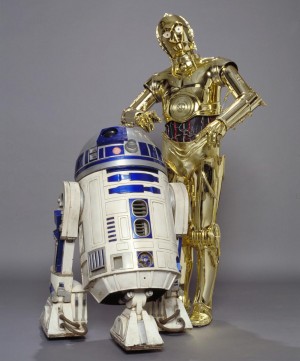
 Some of the best-loved characters in science fiction don’t even have a heartbeat. Why? They’re robots, that’s why!
Unlike the mechanical “slaves” (the original meaning of the Czech root robota) that built your car or enable your GPS devices, these robots are a lot more human. In fact, the word “droid” is short for “android,” which comes from the Greek root for “man” (andr-) and means “manlike.”
In other words, the thing that defines these robots is that they blur the line between machine and man. And ever since they made their first appearance in some of the earliest works of science fiction (Frankenstein by Mary Shelley was arguably the first), that’s exactly what they’ve been doing.
Star Trek loves to play with this trope, from Data in The Next Generation to the doctor in Voyager. But where the droids in Star Trek tend to be angsty and existential, the ones who populate Star Wars already know their place and don’t have any qualms filling it.
My first exposure to droids was when I saw the original Star Wars trilogy as a little boy. An image of C3PO with his golden humanoid body wandering across the dune wastes of Tatooine will probably be stamped on my subconscious forever. That, and the little traveling flea market the Jawas ran from their sand crawler.
One of the neat things about droids is that you can go either direction with them. If you want to get all existential about the nature of humanity and whatnot, you can use them to explore those questions since they’re almost human but not quite. On the other hand, if you just want an exciting space romp with some unique and interesting characters, you can bring them out as regular characters.
An advantage that droids have over humans is that they’re harder to kill and easier to bring back to life. Star Wars leaned on this a lot, especially in episodes IV and V. When R2D2 got shot in the battle of Yavin IV, right before Luke blew up the Death Star, I just about died. And yet, they brought him back easily enough for the throne room scene because he’s a robot–all they had to say was “we’ll fix him up” and you knew that everything would be better.
So yeah, droids. I haven’t done much with droids yet in my own writing, mostly because I’m a bit conflicted in my thoughts about the upper limits of AI (which I explored somewhat in Genesis Earth). Most of my robots are actually cyborgs, and that’s something completely different. Still, I can see myself playing with this trope at some point in the future, probably when/if I introduce some aliens or start a new series.
 Ana was a washed-up zoologist turned programmer looking for work; Derek was an avatar designer for the Data Earth virtual reality platform. The thing that brought them together: Blue Gamma Inc., manufacturer of autonomous self-aware AI pets known as digients.