Pulling along

Just a quick post, because it’s 3:30 am and I’ve got a TON of stuff to do tomorrow, such as:

1) cleaning checks
2) replace the air filter in my car
3) go running with my bro in law
4) finish Genesis Earth 5.0
5) band practice
6) watch Inception with a bunch of friends at the dollar theater

Yeah, tons of stuff.  So anyways…

I’m amazed at how quickly I’m pulling through Genesis Earth.  Yesterday I revised through 11.7k words, and today I did about 14.1k.

At this point, most of the work is sentence and paragraph level, and has more to do with voice and rhythm than actual story.  There were a few science issues, mostly having to do with distances and velocities, but thanks to Logan I think I’ve caught most of those.  Thanks so much!

I’m also finding out that this story is much better than I used to think it was.  With all the form rejections I’ve been getting for it, I wondered for a while whether I should put it back in the trunk and let it quietly die.  Now, however, I can see that it has a lot more promise than I’d previously thought.  Even if it isn’t published as my first novel, I really do believe that this story deserves a home.

At the same time, though, I’ve noticed some major differences between my writing in this piece and my writing in the stuff I’ve written more recently.  I’m not sure exactly how to put it, but I think it has something to do with voice.  I don’t want to say that Genesis Earth is more choppy, but it does seem a lot more…matter of fact, if that makes sense.  There are also a lot more rhetorical questions, but I think that’s an artifact of the 1st person perspective.

But even if the voice in this piece is different from my voice now, it’s different in a good way.  It feels more…YA?  I’m not exactly sure, but it seems to work.  The sequels, if/when I write them, will probably be in 3rd person (ala Spin and Axis by Robert Charles Wilson), and that’s going to create a much different feel than this book.

It worked for Axis, though, so I think I can pull it off–that is, if/when Genesis Earth gets picked up by a publisher.  I don’t want to write the other two books in this trilogy until I know the first one is sold.

In unrelated news, I had a job interview today.  It was with a wilderness therapy company, the same that wait listed me for the January training.  I really hope I get in–more than anything at this point in my life, I feel that I need to gain some major life experience.  Probably the biggest stumper question was “what three words would you use to describe yourself in your last job, and what three words would your supervisor use to describe you?” A difficult question, particularly when all your recent jobs have been temp jobs.  I think I did alright, though–now, we just need to wait and see.

In other unrelated news, I threw an awesome movie night tonight.  We watched Scott Pilgrim vs. The World, and maybe fifteen people showed up–most of them from Quark, but a couple of friends from some other places too.  Man, that Scott Pilgrim movie is epic. So hilarious, so entertaining, and at the same time, so true.  And then, we went to Dairy Queen and hung out until midnight hanging out.  It was great.

In still other unrelated news, I recently ordered the anime series Planetes on DVD.  It was at a good price, and I knew I’d buy it eventually, so I allowed myself to splurge.  I am so happy I did, because the science fiction elements are done surprisingly well.  All the little details, from the zero gravity handholds in the walls to the way the stations spin, are surprisingly true to real life, and the show’s vision of 2075 is not beyond the realm of our own possible future.  In other words, Planetes is quite possibly the best rocketpunk anime show out there, and a great source for inspiration.

Well, that’s enough for now.  Tomorrow, I will finish this novel and send it out to the agent who requested it.  In the meantime, though, it’s 4:00 am and I must sleep.
Falling back into the groove

Today I surprised myself and wrote nearly 4k words, some of which might actually be good enough to keep.  Huzzah!

The novel is coming along very nicely, and I’m starting to get really excited with where it’s going.  That’s huge, because up to this point, the nagging “this is crap, what are you doing with your life?” voices have been getting me down.  Yeah, the draft I’m writing will need a lot of work, but the story’s got potential, and I can see it.  That’s the most important part.

The interesting thing was that after pounding out the first thousand words, the writing started to really flow.  The right words and phrases started coming quite naturally, almost on their own, instead of waiting for me to mercilessly hunt them down.

An example:

The weather was perfect–sunny, clear, and neither too hot nor too cold. Upset by the sound of their engines, flocks of pretty white birds took to the air, filling the sky around the green banks like noisy, low-flying clouds. Down in the cabin, Kariym began to sing a lilting ballad about a young boy in love with his brother’s betrothed. His deep bass voice bellowed over the roar of the engine, lifting Jalil’s spirits. It was a very good day to be alive.

They rode upstream over the river for the next hour. Almost immediately they left the main body of the convoy far behind, taking the reconnaissance position for the advance guard. Occasionally, they passed a town or a bridge–magnificent works of steel and stone that soared over their heads, spanning the entire vast width of the river. Mostly, however, the banks were empty and unsettled–nothing but long, straight stretches of thick green bush, with the occasionally rocky outcropping to break the monotony.

Of course, the writing’s not perfect–I’ll be the first to say that it needs considerable work–but at least it’s decent.  Decent for a rough draft.

One of the most annoying things about writing is when I unconsciously break into alliteration.  I’ll write a sentence, only to realize that I can’t let it stand as it is because every noun, verb, and adjective starts with the same sound.  Like that last phrase: “starts with the same sound.” Augh!

I’m finding, though, that when used in moderation, that tendency towards alliteration can be somewhat helpful.  There’s nothing quite as pleasurable as reading a good story with delicious, flowing prose, like Ursula K. Le Guin’s The Dispossessed or Robert Charles Wilson’s Spin. Excellent books.  I’d be more than happy if I could write as beautifully as them someday.

In the meantime, though, I’m just plugging away, trying to make the next chapter, scene, paragraph, and sentence better than the last.  Fortunately, now that I’m excited about the story again, things are going very nicely.

Oh, and happy fourth on the fifth.  I spent most of the day with family (not writing), bouncing around Provo and doing various stuff.  I’ve got a ton of chores to do tomorrow, though, so I’d better get to bed.  Night!

Old story notebook, part 3

Alright, it’s time to finish up with the old story notebook I discovered a couple of weeks ago.  These ideas were written down back in 2007, when I was writing the first draft of Ashes of the Starry Sea. Without further ado:

In the future, people live in arcologies, and wars are fought outside by robots. It will be a new system of feudalism: arcologies are like castles or walled towns, and people won’t die in the wars, just change sides.

I’m not sure I knew very much about feudalism as an economic system back then, but the basic idea, I think, was that life would be localized in the arcologies and nationalism as a unifying principle would die out.

In the Middle Ages, warfare was basically a contest between nobles, and though it certainly disrupted the lives of the peasants, they didn’t really care which side they were on because it didn’t make a difference. Napoleon revolutionized the world because he galvanized the peasants through the new concept of nationalism and made them actually care about the outcome of the wars.

An AI falls in love with a CS major, but the CS major loves a real girl.

The Little Mermaid, with a modern twist. And the mermaid AI commits suicide by uploading herself to a trashy old computer that’s on the verge of crashing. The final scene shows the wrecked computer somewhere in rural China, being scrapped for the metal parts in a vat of toxic chemicals. Awesome.

A character who’s an android and sees the world in terms of numbers.

The story should revolve around the question: if math is a language, how do you say “I love you” in numbers?

An election where people can scientifically predict best and worst case scenarios, based on each candidate’s qualities and the world situation.

Political science may not be a hard science, but it is awesome for science fiction.

Voter preferences are normally distributed around a common mean, but parties choose opposing points of view because of an information shortfall about the nature of that mean. What if the information problem were solved?

We would have exactly two parties that are identical in every meaningful way…wait a minute…

Someone discovers a language that is intuitive in all humans and overcomes many barriers of language in describing the world.

Linguistics is good for sf&f, too.

What if galaxies themselves were sentient?

Sounds like something out of a Robert Charles Wilson novel. I love it!

A space colony that, due to information technology, is a pure democracy.

I’m using this idea right now in Mercenary Savior. When I first started planning the novel, I wanted to do a story about the Mongols in space, but I knew it would need more than that, so I thought “what if one of the places they invaded was this pure democracy?” As soon as I combined the two ideas, BAM! I had a story.

An advanced society without public education or health care.

Uggggh, don’t even want to go there. Not until Obama’s out of office.

The Mormon pioneer exodus in space.

I tried to use this idea with Hero in Exile, but for some reason it didn’t work. It was as if the story wanted to go in a completely different direction. Oh well–you win some, you lose some. Besides, it’s not a total loss; it’s always possible to recycle.

A kingdom that will be cursed if ruled by anyone other than a direct heir. What if the direct heir is a child?

An attempt to brainstorm some fantasy.

Robot prostitutes–one who has no feeling or emotion, but develops artificial intelligence. This is what will fuel the development of androids.

Sad, but true.

A spaceship so massive that it generates tides when it enters orbit.

Sounds like something out of Arthur C. Clarke.

A tomagachi becomes sentient and uploads itself to the internet. OR…an AI disguises itself as a tomagachi.

Tomagachis! Whatever happened to them? They were so trendy…for like six months in the 90s.

What if our most deeply held beliefs had the power, under the right circumstances, to turn into monsters–real, literal, fantastic beings of awesome power?

Now there’s an idea with some interesting potential. We could build battle arenas and watch our beliefs duke it out, literally. Which ones would win?

A society that values myths more than facts.

I’m sure that societies like this have actually existed–or may still exist today.

American suicide bombers.

Hey! It could happen.

Ghosts on a spaceship.

Nowhere to run, nowhere to hide…

A culture where kissing (or any other public display of romantic affection) initiates marriage.

Now THIS I would like to see, or maybe even use someday. It could be interesting.

And that concludes the old story notebook, bringing us to the end of 2008 when I finished Ashes of the Starry Sea and left for the 2008 BYU Jordan study abroad.

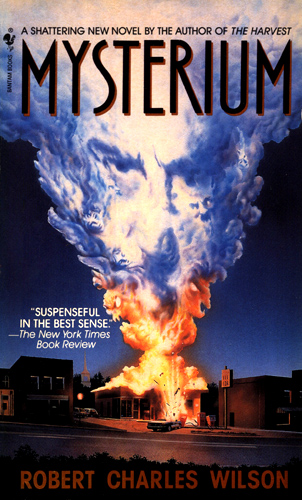
Mysterium by Robert Charles Wilson

Nobody knows why the government chose the small town of Two Rivers, Michigan, as the site for a top secret military project.  Even most of the people involved in the project don’t know what it’s really about.  That’s alright, because most of the denizens of this backwoods community are used to minding their own business.  But after a mysterious explosion bathes the entire city in light, that becomes impossible.

On the outskirts of town, all the roads and power lines dead end in ancient virgin forest.  It’s as if a perfect circle has been drawn around the town on the map, and everything within the circle has been transported to a parallel world.

A very unfriendly parallel world.

Robert Charles Wilson’s writing is awesome.  I could eat up his prose all day.  It not only flows beautifully, it’s clear and transparent, to the point where I forget that I’m reading and feel as if I’m there.  He always uses the right expression, the right metaphor, and yet his prose never attracts so much attention to itself that it distracts from the story.

I noticed several similarities between Mysterium and Wilson’s other novels that I’ve read.  All of them start in our modern world and move into a mysterious, unfamiliar milieu.  All of them involve strange religions and religious conflicts.  All of them involve male and female characters struggling to face personal relationship problems and eventually coming together.  In these ways, this story felt very much like Spin.

At the same time, I can definitely tell that this is one of Wilson’s earlier works.  The story flows like a thriller, but lags in certain points.  After the town is transported into the parallel dimension, the story seems to meander without any clear direction.  For several chapters, I lost the sense of progress that usually accompanies a good plot.  The resolution receives very little foreshadowing–the “surprising yet inevitable” element was only “inevitable” three or four chapters from the end.  If it weren’t for Wilson’s beautiful writing, I would have put this book down in the middle.

<spoiler alert>

Unlike Spin, I found the milieu of this story somewhat depressing–not necessarily because of the setting itself (though it’s not the kind of alternate present that I’d want to live in), but because the people of Two Rivers never go back.

According to Card, there are two basic types of milieu stories: stories where the protagonist returns profoundly changed, or stories where the protagonist “goes native” and becomes assimilated.  But…if the new world isn’t the kind of place you’d want to live in–in other words, if it’s dystopian (and Wilson’s alternate world in Mysterium is fairly dystopian)–then there’s this tension of “will the protagonist make it back?  Will they return?” And if they don’t return, the story is emotionally disappointing.  That was the case for me with Mysterium.

</spoiler alert>

From this review, it probably sounds like I hated this book.  That wasn’t the case–not at all!  This was a good story, and I enjoyed it.  I finished the last hundred pages at a sprint at 1:30 in the morning–it was definitely that kind of a book.  I couldn’t put it down.  And at the same time, it was thoughtful and profound (as you can tell from my previous post, “Why I love Robert Charles Wilson“).

I’ve probably said enough.  If you like thrilling, parallel world adventure stories with a contemplative, thoughtful “what if?” element, read this book.  Even with all the misgivings I’ve mentioned here, it’s good SF.  Very good.

Why I love Robert Charles Wilson

From Mysterium, which I plan to review here soon:

“Do you ever wonder, Howard, about the questions we can’t ask?
“Can’t answer, you mean?
“No. Can’t ask.
“I don’t understand.”
Stern leaned back in his deck chair and folded his hands over his gaunt, ascetic frame. His glasses were opaque in the porch light. The crickets seemed suddenly loud.
“Think about a dog,” he said. “Think about your dog–what’s his name?”
“Albert.”
“Yes. Think about Albert. He’s a healthy dog, is he not?”
“Yes.”
“Intelligent?”
“Sure.”
“He functions in every way normally, then, within the parameters of dogness. He’s an exemplar of his species. And he has the ability to learn, yes? He can do tricks? Learn from his experience? And he’s awarer of his surroundings; he can distinguish between you and your mother, for instance? H’es not unconscious or impaired?”
“Right.”
“But despite all that, there’s a limit on his understanding. Obviously so. If we talk about gravitons or Fourier transforms, he can’t follow the conversation. We’re speaking a language he doesn’t know and cannot know. The concepts can’t be translated; his mental universe simply won’t contain them.”
“Granted,” Howard said. “Am I missing the point?”
“We’re sitting here,” Stern said, “asking spectacular questions, you and I. About the universe and how it began. About everything that exists. And if we can ask a question, probably, sooner or later, we can answer it. So we assume there’s no limit to knowledge. But maybe your dog makes the same mistake! He doesn’t know what lies beyond the neighborhood, but if he found himself in a strange place he would approach it with the tools of comprehension available to him, and soon he would understand it–dog-fashion, by sight and smell and so on. There are no limits to his comprehensions, Howard, except the limits he does not and cannot ever experience.
“So how different are we? We’re mammals within the same broad compass of evolution, after all. Our forebrains are bigger, but the difference amounts to a few ounces. We can ask many, many more questions than your dog. And we can answer them. But if there are real limits on our comprehension, they would be as invisible to us as they are to Albert. So: Is there anything in the universe we simply cannot know? Is there a question we can’t ask? And would we ever encounter some hint of it, some intimation of the mystery? Or is it permanently beyond our grasp?”

This is the kind of science fiction that I love: the kind that brings me right up to the limits of human knowledge and makes me feel naked in the face of the unknown. The kind where the aliens truly feel alien, not like an unusually bizarre race of human beings. I want the aliens to surprise me–I want to feel that there’s something about them that is completely beyond my comprehension. Something sublime, something romantic.

In all of his books that I’ve read, Robert Charles Wilson captures this feeling spectacularly. So does Arthur C. Clarke, C. J. Cherryh, and Orson Scott Card. Larry Niven, Jerry Pournelle, John Scalzi and Alastair Reynolds are excellent writers, and I’ve genuinely enjoyed their books, but their aliens are too…understandable. Too clear cut, too defined. After a while, you don’t feel that there’s anything left to surprise you, anything that is so alien it’s beyond your grasp.

In some ways, I think this boils down to the author’s worldview. Those with a more positivist worldview believe that the world is fundamentally understandable, and that every phenomenon can be modeled and predicted, provided that we have a sophisticated enough understanding of natural law. The interpretivist worldview, on the other hand, posits that while truth may exist, there are limits to our understanding–that some things are inherently unpredictable and impossible to model.

I used to think that I was a positivist. Then I took Poli Sci 310 with Goodliffe, and it turned my world upside down. Genesis Earth is, in some ways, a product of that personal worldview shift. I don’t think I’m anywhere near on par with my aliens as Wilson, Clarke, and Card are with theirs, but I hope I’m on my way.

Six weeks to World Fantasy

Holy cow!  How is September halfway over?  It seems like school started just a week ago.  Only six and a half weeks before World Fantasy convention in San Jose, and I think I’m going to have to readjust some of my goals.

I’d wanted to finish Bringing Stella Home 2.0 by the 11th of October, but the way school and work is looking, I probably won’t be able to write 2k words every day in order to meet that goal.  Besides, the story has several major issues that can only be fixed with a major overhaul, so there’s no way this novel is going to be ready for submission in time for the convention.

However, Genesis Earth is looking pretty good.  So far as story issues go, I was very satisfied with the third draft–I think I fixed all the major issues and wrote something that’s pretty close to salable.  Before the convention, I want to go through and make one final revision, one where I polish up the prose and fix the readability issues.  That shouldn’t be too hard–I can probably do that in two to three weeks.

So here’s what I’m going to do in the next six weeks.  I’m going to check out all of Robert Charles Wilson’s books and immerse myself in his prose–not to copy it, but to hopefully boost the quality of my own prose.  The quality of his writing is fantastic, a beautiful mesh of literary prose and thriller pacing and rhythm.  While I’m doing that, I’ll start the 4.0 draft of Genesis Earth and work hard at it, until I’ve polished that work as much as I can.  That’s the work that I’ll try to sell when I’m at World Fantasy.

I’m a little worried, because I submitted the full manuscript to Krista Marino back in June and haven’t heard back.  At the BYU Writers and Illustrators for Young Readers conference, she said she had a response time of 4 months, but I’m worried I won’t hear back from her before World Fantasy.  Is it appropriate to send a polite note asking her to get back to me before the convention?  I don’t want to shoot myself in the foot by sending out simultaneous submissions, and if an editor asks to see my ms, I want to be able to send it to them ASAP.  Then again, I suppose I could just tell them that the full is currently with someone else, and that would demonstrate some professionalism…but I want to be able to send it if/when they ask for it.

Which reminds me: I need to do some HEAVY agent/editor research before this convention.  I want to go to World Fantasy with a list of people to look for, so I know where to go to network, which panels to attend, who to look out for in the hallways and parties.  I want to be very professional about this, and get the most out of those two/three days that I can.

As for Bringing Stella Home, my current WIP, I’m going to do my best to finish it before World Fantasy so that I can start November with something new.  I need to finish that book before I can set it aside and let it percolate in my mind for the next revision.  Besides, it’s been too long since I’ve worked on something completely new.  After October, I’ll need to take a break from all these revisions.

So that’s the plan: Finish Genesis Earth 4.0 and Bringing Stella Home 3.0 before World Fantasy.  Research all the editors and agents to look out for at the convention.  Oh, and hold down 14 credit hours and 2 on-campus jobs at the same time, with some time left over for a dating/social life (INSHALLAH).

Hehe…these next six weeks are going to be packed!

Spin by Robert Charles Wilson

What would you do if you knew that the world was going to end in the next thirty years? That one day, before the end of your natural lifespan, the oceans will boil and the forests burst into flames, and life on this planet will come to an end? That you, your children, and even humanity itself have no future–that everything will end with you?

When the mysterious beings known as the Hypotheticals encase Earth in a temporal warp field that causes years to pass outside for every second on Earth, that is the uncomfortable question that all of mankind must confront. In five billion years–less than forty years on Earth–the sun will burn up its hydrogen and expand into a red giant star. When that happens, the sun will swallow the Earth and every living thing will die.

Some people turn to religion for answers.  Some turn to Science.  Some put off the question, living their lives as if the end will not come.  But as the years pass and the unavoidable apocalypse looms nearer, humanity begins to spiral out of control, and civilization itself looms on the verge of collapse.

The year the stars fell from the sky, thirteen year old Tyler Dupree discovers that he is in love with his best friend (Jason Lawton)’s sister, Diane.  The dynamics of the friendship between the three, however, make it impossible for Tyler to express his true feelings–and, in any case, Diane doesn’t seem interested in being anything more than a friend.

When the Spin hits, all three of them find themselves on radically different and sometimes conflicting paths.  Diane turns to evangelical Christianity and the frenzied religious outporing the Spin inspires.  Through his father, Jason rises to become one of the most influential scientists and directors in the Perihelion Foundation, the premier aerospace agency and Spin-related policy forming body in the US.  

Tyler, however, pursues the same middle class life he probably would have followed anyway–medical school, followed by a career as a doctor.  Still, his undiminished feelings for Diane and his frienship with Jason draw him into the center of the Spin hysteria and behind the scenes in the circuitous Spin-era politics.

Diane, now married to a fervent believer in a free love fundamentalist cult, comes to rely on Tyler as her only link to the outside world.  Meanwhile, Jason Lawton pursues perhaps the most grandiose and ambitious project mankind has ever attempted; the terraformation of Mars. 

With the temporal distortion of the Spin, millions of years of evolution turn Mars into a verdant green world in only one Earth year.  When Jason launches the first manned mission to the planet, barely a week passes before the the first Martian-born human returns to mankinds ancestral home–a descendant of a civilization millenia older than our own.  This small, dark-skinned, wrinkled man comes with a tantalizing message that may prove the key to finally understanding the Hypotheticals and the Spin itself.

But all of this may be too late, because the Spin membrane is finally beginning to show distressing signs of failure, and the sun has already grown hot enough to boil the oceans and scorch the planet.

I loved this book.  Honestly, I have to say it is one of the best science fiction books I have ever read.  Better even than Ender’s Game, better even than Foundation or any of the other classics.  No other book that I’ve read has done everything that I believe a good science fiction book should do.  I would highly recommend this book to anyone and everyone.

Like Clarke and a lot of the older classics in the science fiction tradition, Spin addresses some of the grand questions with which science and humanity have always wrestled.  What is the ultimate end of mankind?  The ultimate end of evolution?  Are we unique in this universe?  What is our place in the cosmos?  What is transcendence, and can we as a mortal species achieve it?

Unlike much of the older works, however, Spin addresses these questions through solid, developed, rich characters and a human drama that is as engaging as anything in any other genre.  When I read this book, I felt connected with these characters.  I genuinely cared about them.  They were real, distinct people who changed and grew based on their choices and experiences.  Furthermore, their struggles and conflicts echoed my own.  It felt true.  Tyler’s unrequited love was not only utterly believable, it kept me just as engaged as the grand ideas and the science fiction elements.

As science fiction, the ideas in this book were some of the most original and eye-popping ideas I’ve ever seen.  There was definitely a sense of wonder, as thick and beautiful as Clarke or Heinlein or Asimov.  The thing that made these ideas so great, however, was the eminent believability that accompanied them.  Robert Charles Wilson thought out the implications of everything, and showed them through concrete, human details.  His Martian landscapes were as real and believable as his picture of the New England countryside.  I not only felt that I was there, I felt that I was in this world, where the end-of-everything panic had set in, causing all sorts of bizarre, almost post-apocalyptic (pre-apocalyptic?) social changes.  It was truly fascinating.

But it wasn’t just the storytelling that engaged me: Robert Charles Wilson’s prose is among some of the best that I’ve ever read.  Reading this book really was like eating cheesecake.  The writing not only flowed, it shined, yet in a way that illuminated the meaning behind the words rather than drawing attention to the words themselves.  Wilson’s metaphors were not only rich and beautiful, they expressed the meaning behind the text so clearly that in each case, I don’t think he could have gotten across that particular impression, that feeling, in any other way.  Everything was calculated, and I would read pages and pages of text without even realizing how far I’d come.  Incredible.

I did have one issue with my first readthrough, back in July of last year: the Martian civilization, while grand, didn’t feel grand enough.  I mean, in 0nly four thousand years of history, look how far we’ve come here on Earth–all of our religions, all of our science, all of our discoveries and everything else.  We can hardly even remember what it was like, four thousand years ago–yet in Spin, the Martians know all about the reasons why Earth spawned their civilization, all of the questions that the Earthers have been asking about the Hypotheticals, etc.  I almost think that the Martians would have a more mystical view of Earth; that their understanding of us would be steeped in legend, and that they would have forgotten who we really are.

In my second readthrough, however, this was less of an issue to me.  Wilson really does make the Martians seem alien, a separate, distinct culture with a long, rich tradition.  His Martian citizen is very distinct from any of the Earthers, and notices some very small things that we always take for granted.  So, even though there could be more of a feeling of grandeur, Wilson already paints a very believable, very grand view of the Martian civilization he invents.

I am not exaggerating one bit when I say that this is probably the best science fiction book I have ever read.  I would recommend it above and beyond anything else I’ve reviewed here on this website.  If you haven’t already, pick up this book and read it.