Summer recap and new goals

So back in June I made a to do list of things I wanted to accomplish this summer.  I’ve only got a week left before I go overseas again, and I’m happy to say I’m on track to finish most of them.  A couple of them (such as doing a blog tour and submitting aggressively to book bloggers) I decided weren’t worth my time, and dropped them, but these are the major things I’ve accomplished:

  • Release print-on-demand editions of Genesis Earth, Bringing Stella Home, and Desert Stars through CreateSpace.
  • Redo cover art for Bringing Stella Home.
  • Redo blurb/description for all titles.
  • Put proper copyright page in all titles.
  • Publish all titles on Kobo Writing Life.
  • Find a better way to build an ebook and reformat all titles.
  • Finish the second draft of Stars of Blood and Glory.
  • Finish and publish parts I and II of Star Wanderers.

The only major thing I haven’t accomplished is figuring out how to sell ebooks directly from my website.  I figure I can set that up later, though, when I’ve got a large enough readership to justify it.  If it’s all online, I can probably do it from anywhere.

While I was vacationing with my family on Cape Cod, I had a chance to step back and take a long look at what I’m doing with my life, which helped me to set some new goals and get a renewed sense of direction.  I stopped tracking my daily writing word counts in July, which threw off my productivity a lot more than I thought it would.  After setting some long-term goals, though, I think I can find a better way to structure my writing.

In ten years (2022), I want to…

  • have 25+ published novels.
  • earn a solid middle-class income through my writing.
  • be married and have kids.
  • own a house.
  • live in the United States.

My lifetime goal is to publish 100+ novels, which is actually a lot more doable than it sounds.  It means writing a minimum of two novels a year, though, so I’m going to have to follow Heinlein’s rules a lot closer than I have been in the past.  That’s the trouble with keeping a daily word count: it made me look a lot more productive when I was in revisions, so I spent more time doing that than writing new work.

In three years (2015), I want to…

  • have at least 10 published novels.
  • make enough with my writing not to need another job.
  • be married or engaged.
  • have lived for at least three months in 3+ countries (not including USA).

I want to settle back down in the States eventually, but before that I want to get around and see the world a bit.  The absolute coolest thing would be to marry another world traveler and make enough on the writing to have a bunch of adventures together.  I’m not sure if I’ll find her in Georgia, but I’ll be sure to keep my eyes open.

As for short-term goals, I’m still trying to work them out.  Here’s what I have so far:

Quarterly Goals:

  • Start at least 2 new projects.
  • Finish at least 2 first drafts.
  • Publish at least 2 titles (print and ebook counts as two).

I think this is enough to stretch me while still being doable.  By my count, in the first quarter of this year I did 2-2-1, in the second quarter I did 2-2-0, and in the current quarter, I’m at 2-0-5 so far.  Of course, this includes all the Star Wanderers novelettes and novellas, which I hope to expand in the future.

I’m not going to count revisions as progress, except as part of the publishing stage.  Some stuff needs a lot of revision, other stuff, not so much.  What I really want to do is train myself to produce high quality work on the first or second write-through.  Of course, I’ll still use test readers to gauge my work before publishing anything.

Monthly Goals:

  • Finish at least 2 projects (first draft or revision).
  • Write at least 15k words of new material.

I can write a lot more than 15k words in a month, of course, but I figure this is a good starting point.  The key is that this is for new material.  When I looked back at my word counts, I found that months of revision would go by before I actually worked on something new.  I want to change that, but I still need to allow for longer projects that might require several weeks of revision (while emphasizing the need to produce new material, of course).

Weekly/Daily Goals:

  • Keep all project deadlines.
  • Start each day with writing.

I’ve found that if I don’t start off each day with writing, I keep putting it off until I’ve spent more time and energy angsting about it than actually doing it.  For a short period of time this summer, I put my butt in the chair and my hands on the keyboard first thing after waking up (even before getting dressed).  It was amazing how much of a difference that made.

Beyond that, I’m not really sure what other goals to set.  I want to plan things out on a project to project basis, but beyond that I haven’t yet figured out what kind of a daily structure I need to build.

It’s probably a good idea to keep things flexible at this point, though, since I have no idea what my schedule is going to be like once I’m in Georgia.  I do know a little bit about my next placement–more on that later–but for the first half of September, I’m going to be all over the place.  Ani, Tusheti, Kars, Akhaltsikhe, Tbilisi, Baghdati, and Istanbul–it’s going to be crazy!

For this next week, my goal is to finish the revisions for Star Wanderers: Sacrifice (Part III) and send that out to my beta readers.  I’ve been struggling with it all month, but I think I’ve got a pretty good idea of where I need to go with it.  I’m going to finish chapter 3 tomorrow, then rewrite chapters 4 and 5 from scratch.

After that…another Caucasian adventure! 🙂
New print proof and an update on Star Wanderers

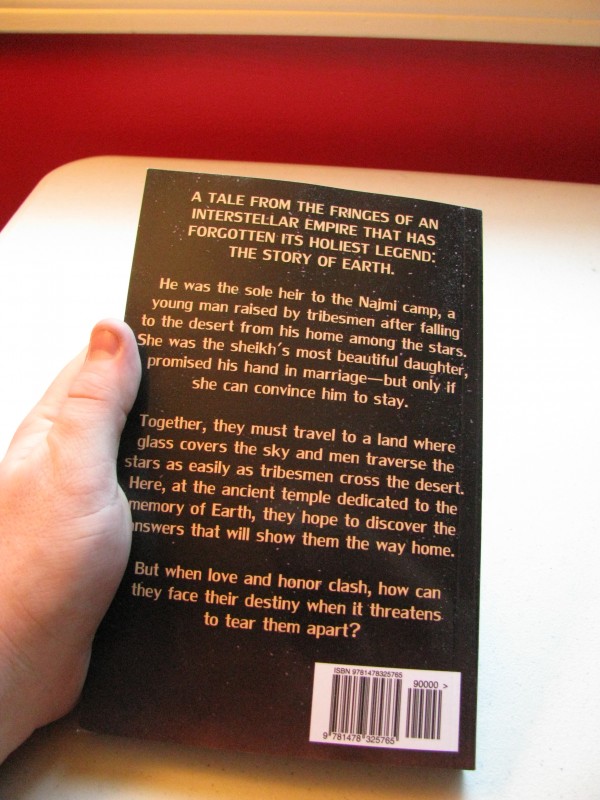
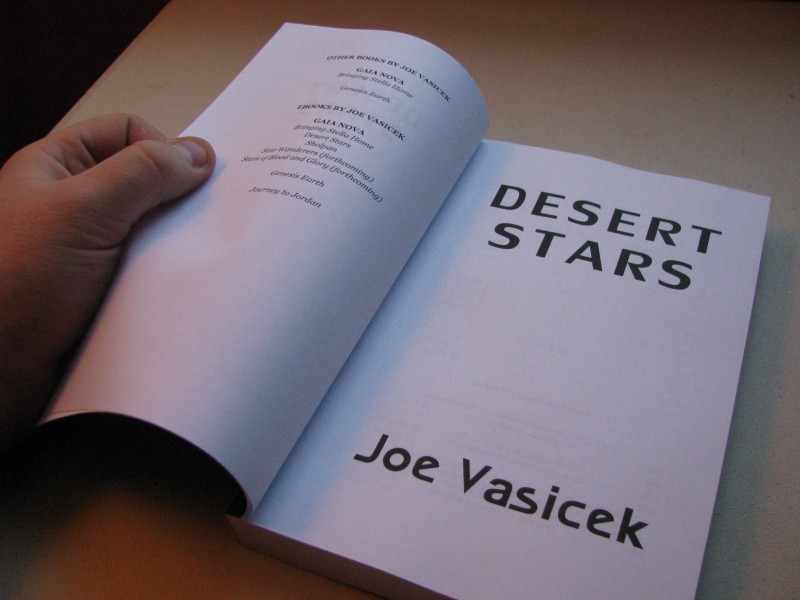
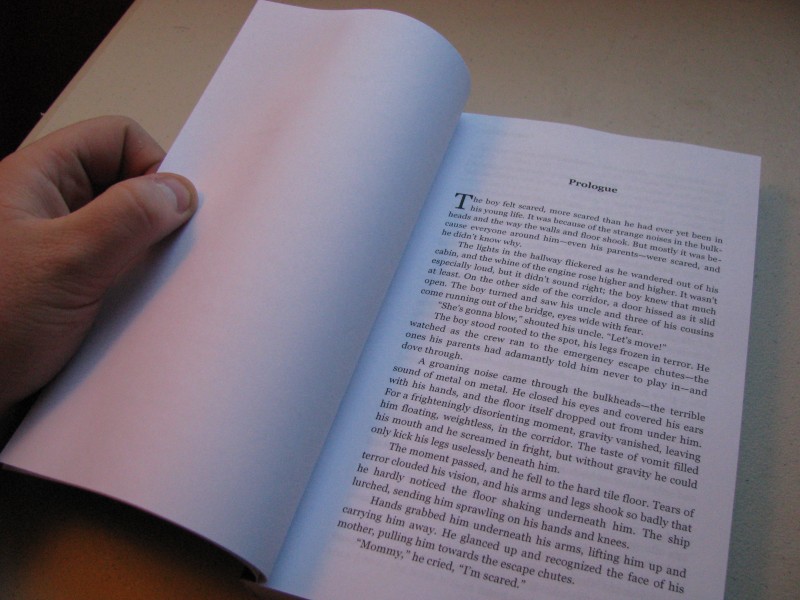
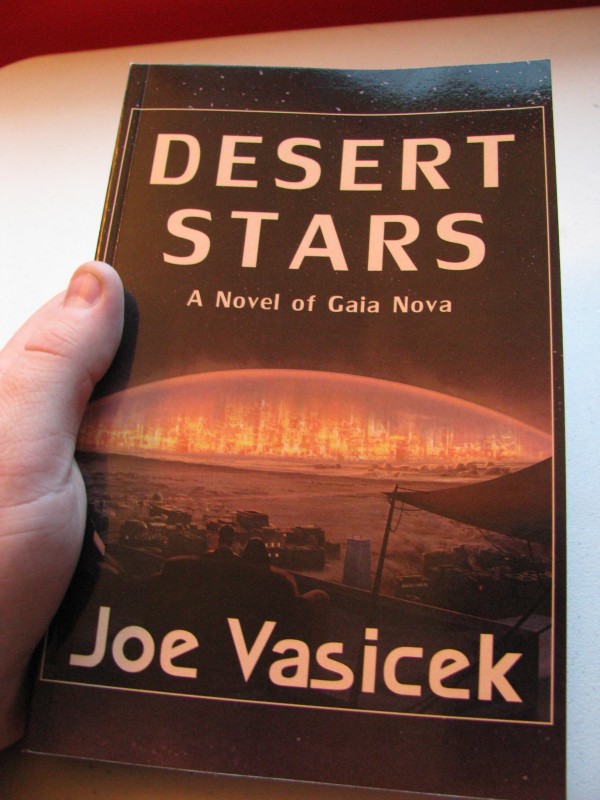
So the proof for Desert Stars came in the mail today, and it looks great!

The front cover.
The back cover.
Title page.
First page.
No matter how much I do this, it never gets old. 🙂

It’s available now from CreateSpace, if you want to pick up a copy.  If you’d rather buy it on Amazon, it should go live there in a few days.  And if you want to buy an autographed copy of this one or Genesis Earth, let me know ASAP: I can order author copies and ship them wherever you want me to, but I’m leaving again for Georgia at the end of August, so I can only do that for the next two or three weeks.

As for Star Wanderers: Part II, I finished the major revisions just yesterday, and plan to go through it again this next week before publishing, mostly to fix typos and get it ready for publication.  There weren’t too many story issues, but my first readers helped me to see a couple of areas where things were unclear (especially Laura–thanks for the awesome feedback!).

After going through this latest draft, I’ve got to say I am way excited to finish Part III and Part IV.  It’s going to take a little more work, and it’ll definitely need some feedback before publishing, but I think I can have the first round of revisions done before the end of August.  A couple of scenes are missing, and there are some key elments I need to change, but I definitely know where this story is going and I’m excited to tell it!

That’s about it for now.  I’ve gotten some initial feedback from my first readers on Stars of Blood and Glory, and so far it’s been surprisingly positive.  I may post the prologue here for you guys, or release it as an extra through the newsletter.  The unpublished prologue for Bringing Stella Home would also make good newsletter content too, come to think of it…

Electronic publishing is like playing a really awesome video game.  Once things get going and you really start getting into it, you just don’t want to stop!

Stars of Blood and Glory 2.0 is finished!

On Tuesday, I finished the second draft of my latest writing project, Stars of Blood and Glory!  Here are the basic stats:

words: 78,746
pages: 372
chapters: 20, epilogue, and prologue
start date: 3 July 2012
end date: 24 July 2012

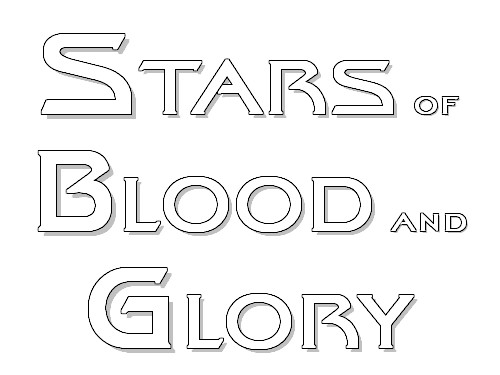
Also, this is probably really dorky, but I made a logo for the title:

They say to use only Courier or Times New Roman in your manuscript, but whatever.  I think it looks pretty cool.

This was a lightning-fast revision, compared with the ones I did for Bringing Stella Home and Desert Stars.  Part of that is because I want to try and follow Heinlein’s rules more closely.  I recently looked back at how I’ve spent my writing time over the past three years, and found out that as much as 3/4ths of it was tied up in revisions, not in producing new material.  Yeah…that’s something that needs to change.

For this draft, I resisted the urge to do a line-by-line edit, and instead focused on rearranging the scenes in their proper order and inserting new ones that were essential to the story but missing from the first draft.  That’s probably why it only took three weeks to finish.

I don’t think there are any glaring holes in the story, but if my first readers find any, I’ll probably do another scene rearranging draft much like this one.  If they give me the green light, though, I’ll do a quick pass to fix any errors and send it off to my editor to start the publication process.

Two things about Stars of Blood and Glory have really surprised me: first, how little time it’s taken to write it (two months for the first draft, a little less than one for this one), and second, how short it is.  Even with five viewpoint characters, it’s less than 80k (Bringing Stella Home was 110k).  The pacing feels right, though, so that’s probably its natural length–it’s just that I seem to be writing shorter and shorter novels lately instead of longer ones.  Maybe it has something to do with all those David Gemmell novels I love to read.

There’s more I could say, but I don’t want to bore you guys too much.  Besides, you probably want me to move on to the next one.

My next writing project is Star Wanderers: Part II, which should take me about a week to revise and another week or two to finalize and publish.  If any of you want to help me proofread the final draft, let me know–I’m willing to exchange services and/or give you a free copy.

In the meantime, I’d better get back to writing.

New blurbs and an interview

First of all, I recently did an interview with Elizabeth Baxter on her blog, Small Blonde Hippy. In it, I discuss Star Wanderers, Stars of Blood and Glory, and a bit about my path to becoming an indie author.  You can find it here–go check it out!

Second, in preparation for the new ebook versions of my novels which I plan to release soon, I’ve been going over some of the old blurbs and updating them.  It’s harder than you might expect!  I think the new ones are getting better, but I’d appreciate some feedback before I post them.  What do you think?

For Genesis Earth:

A BOY AND A GIRL ON A VOYAGE TO AN ALIEN STAR.

Michael Anderson never thought he would set foot on a world like Earth. He only studied planetology to satisfy his parents, two of humanity’s most brilliant scientists. But when they open a wormhole to an alien planet—one emitting a signal that can only be a sign of intelligent life—he soon becomes caught up in the mission to explore it.

His sole mission partner, Terra, doesn’t care nearly as much about the science as he does, though. The child of a bitter divorce, she sees the mission as a chance to escape from the expectations of others.

Before they can work out their differences, a mysterious alien ship begins to hunt them down. Alone, twenty light-years from the nearest human being, they must learn to open up and trust each other—but how can they do that when they can’t even agree why they’re there?

As Michael struggles to keep the mission from falling apart, he is forced to reexamine his deepest, most unquestioned beliefs about the universe—and about what it means to be human.

For Bringing Stella Home:

HE’LL GO TO THE ENDS OF THE GALAXY TO SAVE HIS BROTHER AND SISTER.

The New Gaian Empire is crumbling. An undefeatable enemy from the outer reaches of space is sweeping across the frontier stars, slagging worlds and sowing chaos. No one dares to stand up to them—no one, that is, except James McCoy.

As the youngest son of a merchanter family, James never thought he would get caught up in the Imperial wars. But when his home world falls to the barbarian Hameji, his brother and sister, Ben and Stella, are taken away as prisoners and slaves. With the rest of the galaxy thrown into chaos, only James has the determination to rescue them—even if it means losing everything in the process.

For Sholpan:

SHE’D RATHER DIE THAN BE A SLAVE TO THE CONQUERORS OF HER HOME WORLD.

Stella McCoy never thought she’d fall prisoner to the barbarian Hameji. The oldest daughter of a working class family, all she wanted was to finish her apprenticeship and start a career an astrogator. But when the Hameji conquer her home world with their starfaring battle fleets, she is forced against her will to become a concubine to one of their highest ranking warlords.

Stella would rather die than spend the rest of her life as a concubine. Fortunately, as she looks for a chance to escape, she starts to make friends in high places. But in the dangerous world of harem politics, with new friends come new enemies—ones that have the power to destroy her.

One of the changes I plan to make is to insert the blurb immediately before the first chapter.  I’ve heard that a lot of ebook readers are downloading so many free books and samples that it often takes months before they get around to reading them. This parallels my own experience, so I figure it’s a good idea to have something in the beginning to remind readers what the book is and why they picked it up.

Other than that, no big changes except fixing typos and formatting errors.  I’m not the kind of writer who makes sweeping changes to a published story based on reviews, one-star or otherwise.

In other news, I’m almost finished with the second draft of Stars of Blood and Glory.  This has been a surprisingly fast revision, but then again, that might be because I haven’t sent it out yet to my first readers.  Based on their feedback, I’ll probably do another draft before putting it in the publishing queue.

Star Wanderers is going to be my main focus until the end of the year, though.  I’ve gotten a lot of excellent feedback on Part II, and should start the revisions in the next couple of days.  With luck, I’ll have it published by mid-July.  Part III is going to take a little more time, but I’m pretty confident I’ll have it up by October at the latest.

For that to happen, though, I need to get back to writing.  So long!

No more word counts and other paradigm shifts

This August, it will be five years since I decided to start writing on a professional level.  A lot of things have changed since then, and in some ways they’re changing even faster now.

For example, in May 2009 I started a spreadsheet to keep track of my daily word counts.  I’ve been keeping it diligently ever since then, with graphs and everything.  But just recently, I’ve decided to stop doing that.  Word count is a very shallow indicator of progress: it only measures quantity, and often leads to unnecessary angst or diverts attention from more important things.

Instead, I’m going to focus more on deadlines and work to develop some other, better indicators.  Number of books published per year is probably a key one, as well as number of manuscripts finished.  But deadlines are probably going to be the most important drivers from here on out: publishing deadlines as well as writing deadlines.

Another thing that’s shifting is my revision process.  I know that a lot of beginning writers hate Heinlein’s rules, but almost all the long-term professionals swear by them–especially the ones with careers that I would like to emulate.  This makes me think that I need to scale back on the revisions and develop more trust in my creative voice.

Just as a point of reference, Heinlein’s rules are:

  1. You must write.
  2. You must finish what you write.
  3. You must refrain from rewriting, except to editorial order.
  4. You must put the work on the market.
  5. You must keep the work on the market until it has sold.

I’m currently on the second draft of Stars of Blood and Glory, and what I’ve found so far is that the overall story is actually pretty good.  Some of the scenes are a little out of order, and some of the plot-lines are missing elements that need to be added in, but aside from a few chapters where I got lost for a couple of pages, not a lot needs to be changed.

Of course, I could spend a draft or two tweaking every other sentence, tossing out most of what I wrote in the heat of my creative passion–but would that really make the story any better?  I recently had Kindal’s writing group critique my first chapter–the one that I revised pretty heavily in April–and they found all sorts of problems that weren’t in the original draft, as I wrote it back in December.

Don’t get me wrong–I do think there is an important place for revision.  But I think it’s best epitomized by Tracy Hickman in this episode of Writing Excuses:

We write from the heat of our passion, but we edit to see the fire through the smoke.

And even Tracy only does three drafts.

The other thing that’s changing is how I look at alpha reading.  I used to have different tiers of alpha and beta readers–most of whom were writers in other genres, and not really fans of  science fiction.  I asked them to give me as much feedback as they could, and bugged them for weeks or months at a time asking if they’d read my story.  I then compiled all their line-by-line comments into one giant master-file, which I kept open on the left side of my screen as I made the changes to my manuscript on the right.

Well, I’ve started to realize that there’s a huge difference between reading for criticism and reading for enjoyment.  Because of that, a lot of the things my alpha and beta readers pointed out were things that most regular readers probably wouldn’t have noticed.  Towards the end, I started to get wise on this, and only followed about a third of the criticism that I received.

Don’t get me wrong–I do appreciate the feedback.  A lot of it helped me to see and fix problems that I’d otherwise missed.  But a lot of it came out in casual conversations with my readers after they’d finished the story–not in the line-by-line comments on the original draft.

For those reasons, I think I’m going to change the way I ask for feedback.  Instead of alpha and beta readers, I’m going to go with a handful of “test readers”–readers who enjoy the kind of science fiction I like to write, but who may or may not be writers themselves.  Instead of asking for a detailed, line-by-line critique, I’m going to ask them three things:

  1. Did you enjoy the story?
  2. If you stopped reading it, where did you stop?
  3. Did you enjoy it enough to pay for it?

I’ll ask them to give it three chances, and if they still can’t finish, that’s okay–just let me know where the hangups were.  And if they do finish it, I might have some questions for them–but then again, I might not.  It all depends on the story.

Compared to where I was when I started out–or even where I was three months ago–those are some pretty huge paradigm shifts.  I have no idea how it’s going to turn out.  I’ve grown a lot as a writer recently, and I hope that this is moving me in the right direction, but I won’t really know until I’ve tried it out for a while.

In any case, this post is long enough.  I’d better get back to writing.

Up to my elbows in book surgery

That’s probably the best term for what I’m doing with Heart of the Nebula right now.  Basically, I let some of my darlings live, and they grew some extra limbs and started drooling acid without my realizing it.  But now, I’ve put enough distance between myself and the first draft that I have no qualms about grabbing the axe and chopping off heads.

Don’t worry; this is all a normal part of my creative process.  Maybe someday, stories will burst fully formed from my head like Athena from the brow of Zeus, but for now, my ideas are a lot more like baby turtles–if I’m lucky, one or two out of a dozen will actually reach the water and survive.  Protip: don’t follow the lights.

Speaking of ancient mythology, I’m reading the Argonautica right now, and I can’t help but notice that it would make a really, really, REALLY awesome science fiction story.  No, seriously–think about it.  A group of legendary heroes sets out on an epic voyage in search of some applied phlebotinum macguffin, have all sorts of adventures on strange and distant planets, get the girl to fall in love with the captain, and bring her back with them to their homeworld.  It would also work well as a heroic fantasy, but space is so much more awesome.

Incidently, Kutaisi was the capital of ancient Colchis, where Jason and the Argonauts came seeking the golden fleece.  People still speak of Medea as if she were a real person–generally, they think she was a dirty traitor who sold out her own people.  But people still enjoy the love story, and if you keep your eyes open you can see restaurants and hotels named after her.

So yeah.  Ancient Greek mythology + science fiction = win.  You can definitely expect to see some more of that in my own writing in the future.

In other news, I recently did an interview on fellow indie author Ty Johnston’s blog.  In it, I talk a little about my travel writing, what draws me to speculative fiction, my favorite number (hint: it’s 12), and my insights into the ancient Mayan calendar and the 2012 apocalypse.  It was a lot of fun–you should definitely check it out.

If you would like to host me for an interview on your blog, shoot me an email!  I’m always up for stuff like that.  Otherwise, I’d better roll up my sleeves and get back to hacking up operating on my book.

Managing time and mental space in a foreign country

Some of you asked for a writing update, so I figure I might as well do a quick post on my current projects and where they are.  I’ve also been experimenting with my daily schedule a bit, so it would probably be good to blog about that as well.

Right now, the main project taking up all of my attention is the 3.0 draft of Heart of the Nebula.  It’s a direct sequel to Bringing Stella Home, and continues the story from James McCoy’s point of view, five years later.  I’m making a lot of changes, toning down the romantic subplot and emphasizing the more interesting social and ethical issues.  When I’m through, I think it will be completely different from the first couple of drafts, but in a way that’s truer to the spirit of the first book.

I’ve only been managing about 500 to 1,500 words per day, though, which is abysmally low compared to my usual word count.  Part of that is because I’m throwing out entire sections and drafting new ones from scratch, but the more significant part is that I don’t have as much mental space for writing as I did back in the States.

Basically, moving to a foreign country and starting a new career has taken a lot more out of me than I thought it would.  I teach 18 lessons per week, some with as many as 30 or 35 kids, across grades 1 through 12.  Culturally, everything is completely different too.  So far, the shock hasn’t been too bad–I really love it out here in Georgia–but it’s made the writing a little bit more difficult than I’d expected.

I have a lot of free time, though, so that’s not a problem: the problem is clearing my mind and keeping the creative juices fresh.  Here’s how I’m going to do it:

  1. Limit internet time.  As tempting as it is to turn to the familiarity of the internet, it’s a huge time-suck and doesn’t really do anything for the culture shock.  A much better thing for that would be to spend more time reading.  From now on, I’m going to limit myself to one internet session per day, no longer than 2 hours (more if there’s something I actually need to do).
  2. Get out more.  I get cabin fever very easily, and it’s only gotten worse now that I’m in a foreign culture.  Fortunately, there are tons of places to explore, and in my local neighborhood I’m kind of a celebrity (hey look, it’s the American!  Let’s chase him and shout ‘hello’!).  The prime time for this is the late afternoon, when everyone’s out and things are still open.  If I check the internet right after school and get out immediately after, I think that will help me better to focus.
  3. Get up early to write in the morning.  I tried this last week, and it was a great way to get focused and build more momentum.  Even if I only manage a couple hundred word, it gets me thinking about the story for the rest of the day, which makes it easier to pick up in the afternoon and evening.

So that’s the plan for now.  My goal is to finish Heart of the Nebula before the end of May, which is going to require a significant change of pace.  It should be pretty straightforward, though, and after this draft it shouldn’t need too many more revisions before it’s ready to publish.  If all goes well, I foresee a publishing date sometime in the fall or winter.

Do you have any other ideas for ways to manage creativity in a totally foreign culture?  If so, I’d love to hear it–that’s my biggest struggle right now.

Getting settled in the land of the Kartulis

About three weeks have passed since I came to Georgia, and I’m starting to feel comfortably settled in this new place.  I like it a lot out here: my host family is great, I get along really well with everyone at the school where I work, the kids are so crazy eager to learn it’s awesome…really, I couldn’t ask for more.

Of all the places in Georgia where TLG volunteers are placed, Kutaisi seems like one of the best.  It’s the second largest city in the country, so it has access to several amenities such as markets, hospitals, restaurants, parks, and basically anything else you’d  expect in an urban center.  However, it’s about 200 km from Tbilisi and has very little exposure to the West, so culturally it’s very authentically Georgian.  It’s also much less crowded, and (in my opinion) much more beautiful.

My host family is great; I get along with them real well and already feel like a member of the family.   My youngest host brother, Kako, is 9 years old; I showed him Star Control II over the weekend, and he’s been addicted to it ever since.  We also play chess, and I’ve kind of taken him under my wing to teach him the basics of good strategy.  He’s getting steadily better!

Gura and Kati are the two teenage kids; they also speak English, so we’ve had some fun discussions.  Besides Facebook and her cell phone, Kati is really into books; I showed her my Kindle, and she wants me to help her persuade her father to get her one!  Gura is into Call of Duty and spends a lot of time hanging out with his friends; he lacks confidence when it comes to English, but he knows it better than he thinks he does.

The parents don’t speak much English, but they are really good people.  It’s a working class family; the dad works as a welder, and the mom is a nurse part-time and a home-maker full time.  They spend an amazing amount of time and energy on their kids, which is pretty typical for this part of the world.  They’re both non-smokers, and they’re very respectful of the fact that I don’t drink coffee, tea, or alcohol.  Some of the extended family keeps trying to push wine on me, but in the land known as the cradle of wine, that’s to be expected.

We basically spend all of our time in the family room when we aren’t sleeping; it’s where the heater is, so despite the relatively cramped space it’s the most comfortable room in the apartment.  Furniture consists of a couch, a computer desk and office chair, a bucket seat from an old van, a folding table, several small wooden chairs and a stool.  The TV isn’t quite a member of the family, but when the power isn’t out, it’s usually on.

The neighborhood is this bizarre mix of urban and rural elements.  The roads are super muddy and free-range chickens wander everywhere at will, but everyone lives in 9-story apartments that were built back in the Soviet days, when Kutaisi was a major center for the auto industry.  The school was built 50 years ago this year and has barely been renovated since, but it’s just starting to get some much-needed attention, with a computer center and a resource room for special needs students.  When the weather clears up, I’ll bring my camera to school and take some pictures so you can see what the classes are like.

I’ll have to do a post later on Georgian culture; there are some really bizarre and paradoxical juxtapositions, such as the way they mix religion and alcohol, or their strong belief in the nuclear family with their easy-going acceptance of bride-napping as a “Georgian tradition.” I have yet to really get a handle on all this stuff.  However, as a culture, they have a great respect for literature; when people ask my profession and I tell them I’m a writer, their eyes light up, and they show me a degree of deference that I never would have gotten back in the States.

Partly to have something to talk with them about, I’m reading War and Peace by Leo Tolstoy right now.  I just finished Book III, where Napoleon smashes the Russians and Austrians in the Battle of Three Emperors.  Everyone says that it’s the best novel ever written, and now that I’m in the thick of it, I’m starting to agree with them.  There’s a lot of really good storytelling here, as well as passion and depth.  I have the feeling that I’m going to be on a Russian literature trip for a while, though I should probably pick up some Rustaveli and Kurban Said as well.

As far as writing goes, I’ve had some difficulty settling down into a solid routine, not because of lack of time so much as trouble with my current WIPs.  Star Wanderers has more or less stalled; I ran into another wall midway through part III, and I’m still not quite sure how to get past it.  I’ve decided to take a break for a while, but I think my experiences here with the Georgian language are going to give me what I need to really make this novel come together.

In the meantime, I’m working on the 2.0 draft of Stars of Blood and Glory.  I’ve decided to try something new: revising not by chapter, but by viewpoint character.  Isolating each of the five viewpoints is helping me to see which ones work, and which ones are missing something.  I’ve also been using Dan Well’s 7-point outlining method, which is helping out a ton.

It feels like I could be writing more, but I’m not pushing myself too hard at this point.  I’m still adjusting to life in this totally new culture, and I’m also spending a lot of energy getting my TEFL career off on the right foot.  It’s paying off; I’m having a great time teaching, more than I thought I would.  Pretty soon, though, I’m going to start putting more energy into my writing.  I just hope that I’ll have enough mental space left over to really immerse myself and make it work.

Heart of the Nebula 2.0 is finished!

That’s right: the second draft of Heart of the Nebula, direct sequel to Bringing Stella Home, is now finished.  Here are the stats:

words: 90,081
chapters: 20
ms pages: 426
start date: 7 Nov 2011
end date: 4 Dec 2011

And the word splash:

Wordle: Heart of the Nebula 2.0

This was just a quick draft to fix some of the known problems before sending it off to my first readers.  I’d thought that it was missing a whole bunch of stuff, but I ended up taking out more than I’d put in.  Still, it feels like it’s missing something, and I’m not sure what.  Hopefully, my readers will be able to help me figure it out.

I’m starting to notice a pattern with my writing.  The first draft is always the hardest, fraught with all sorts of frustrations and setbacks.  In contrast, the second draft is usually pretty quick, and involves fixing the problems without making any drastic changes.  The third draft is where the story really comes to life, as I start to make connections and tap the latent possibilities.  This may continue in the fourth draft, but anything after that is usually just a matter of polishing the prose.

For those of you who’ve read Bringing Stella Home, this novel takes place five years after and centers around James McCoy and Lars Stewart.  Stella/Sholpan makes a brief appearance, but Danica and the Tajji mercenaries do not; I plan on writing more about them (a LOT more about them) in Stars of Blood and Glory.

I’m going to send this draft out to my first readers and let it settle for a couple of months.  Once I’ve gotten their feedback, I’ll undertake a thorough revision, possibly with some drastic changes to the story.  I don’t want to commit myself to  a specific date, but if all goes well, I may publish it sometime next summer.

In the meantime, if you’re interested in beta reading Heart of the Nebula, shoot me an email–but please, only ask if we know each other IRL.  My next big project is Star Wanderers, which should hopefully be finished by mid-January.  And of course, there’s Desert Stars–I’m in the process of getting the cover art, so it shouldn’t be more than a couple of weeks before it’s up!

So much going on…it’s good to get something finished.

Heinlein’s rules for the digital age

I’ve been thinking a lot about Heinlein’s rules and how they apply to my own writing career.  While a lot of newer writers like to debate Heinlein, all of the long-time professionals tend to agree with him.  For that reason, I think it’s worth taking a serious look at his rules and doing my best to follow them.

The trouble is that Heinlein formulated his rules before the digital age, when self-publishing was non-viable and writers sold to editors, not to readers.  While I wouldn’t go so far as to say his rules are outdated, I do think that they need to be tweaked a little in order to apply to today’s aspiring professionals.

As a disclaimer, I should say that I’m only a beginning writer without much authority or experience.  However, my goal is not to debate Heinlein, but to explore ways in which his advice can be adapted to myself and writers in my position.  If any of you have any thoughts or input, I would very much like to hear it.

So anyhow, here we go:

Rule One: You Must Write.

Pretty straightforward: if you want to write for a living, then the bulk of your time should be spent writing.  Too many indie writers spend all their time and energy promoting their one book when they should be writing others.  If promotion gets in the way of writing, then you should stop promoting and just go write.

Personally, I could probably spend a lot more time writing new material as opposed to revising stuff I’ve previously written (yes, that’s the infamous third rule; I’ll get to it in a minute).  I tend to spend a month writing something new, then take a couple of months to revise old works without producing new material.  If I want to be strict about following Heinlein’s rules, I should probably change that.

Rule Two: You Must Finish What You Write.

Another straightforward rule, but you’d be surprised how hard it is when you know you can publish whatever you write.  Kris Rusch calls these ideas “popcorn kittens,” after a popular youtube video that embodies what goes on in our minds when we have the freedom to create anything.  The problem with too much freedom is that it’s a struggle not to flit from one idea to another, dabbling in all of them but carrying none to completion.

I myself had this problem over the summer, and to some extent I’m struggling with it now.  The key is just to buckle down and have the discipline to finish what you start.  Pretty straightforward.

Rule Three: You Must Refrain From Rewriting, Except to Editorial Order. 

This is Heinlein’s most controversial rule, especially for new writers.  However, I think he has a good point.  If a story is fundamentally broken, revising it is no more effective than stirring around a pile of crap; and if the story works, revising it without first getting a trusted second opinion could actually make it worse.  After all, writers are often the worst judges of their own work.

The key question, then, is where to go for that second opinion.  In the old days, money flowed from the editors to the writers (or at least from the publishers, who employed the editors), but in the new world of publishing, it’s exactly the opposite.  Most of us can’t afford to hire editors for extensive developmental edits, especially when we’re just starting out, and while it’s possible to publish a rough draft, for most of us it’s probably not a good idea.

My approach is to share my unpolished work with a network of trusted first readers, and use their feedback to guide me in the revision process.  I don’t always adopt all of their suggestions, but I carefully consider each one.  Most of the time, I use them to see where the problems are, then use my creative mind to come up with a solution, sometimes taking the book in an entirely new direction.  And if something works well for some but doesn’t for others, I figure it’s not a problem but a judgment call that requires my attention.

Using this method, it currently takes me about four or five drafts before I feel confident enough to publish something.  If I really wanted to follow Heinlein’s rules, I would probably try harder to nail it on the first draft, but I’ve found that my creative process works better in revision mode than while writing new material.  So long as I can revise efficiently enough to produce at least two novels each year, I think I’ll be in good shape.

Rule Four: You Must Put Your Story on the Market.

In the old days, this meant submitting your manuscript to contests, magazines, and publishing houses, not self-publishing.  For short stories, contests and magazines are probably still the best place to start.  However, with novels, indie publishing is generally much better.

The trouble is that publishing your own work is as scary as hell, especially when it’s close to your heart.  This is probably the main thing keeping most new writers from going indie: the need for external validation which grows out of a lack of much needed self-confidence.

The key, I believe, is to get some emotional distance between yourself and your work.  As a rule, I don’t respond to reviews, good or bad.  As for external validation, I don’t seek it at all.  I only publish the stories that I believe in, and even if I’m nervous about sending them out into the world, I figure it’s better to suck it up and do it anyway.  It was the same with writing queries; the only difference is that the market is now the readers, not the editors.

Rule Five: You Must Keep It On The Market Until It Has Sold.

This is especially challenging for indie writers.  When weeks go by without a single sale, it’s easy to believe that your work is crap and that you should just take it down.  It’s even worse when your book isn’t selling and you get a bad review.

Just like with queries, however, the key is to keep your work out there until it finds its natural audience.  With indie publishing, you have all the time in the world, provided you don’t lose confidence.

The key question in my mind is whether to take down your old, crappy stuff as your writing improves, or to leave it up alongside your newer, better work.  Personally, I think it should come down to the readers; if the old stuff is consistently getting bad reviews, it’s probably better to take it down, but if not, might as well keep it up.

So there you have it.  From Heinlein’s rules, I’ve more or less crystalized the following approach:

  1. Always make time to write, even at the expense of promotion.
  2. Only chase new ideas if you know you can finish what you start.
  3. Don’t revise without first getting feedback from trusted readers.
  4. Don’t wait for external validation before you publish.
  5. Keep your work up, even if it doesn’t sell.

Not quite as pithy as Heinlein’s rules, but they seem pretty reasonable.  I don’t have the experience to say whether they follow his, however, so if you have any comments or suggestions, please chime in.