Just finished my last short story

So I just finished writing what may be the last short story I ever write, at least for the forseeable future. Years from now, I may scribble out a quick short for a charity anthology or something, but unless someone actually commissions me to write one, I’m done for now. Instead, I’m going to focus all of my attention on writing novels, since that’s where all the money (and readers) are.

This last one was fun: a post-apocalyptic tale in a wintry wilderness, where the scout of a tribe of survivors comes across the “Ark Facility” built by a bunch of wealthy elites to freeze themselves in stasis while their workers maintain the facility, and wake them once civilization has been restored. But of course, the plan goes to hell, and the only person left is the daughter of the last caretaker, all the other workers having abandoned the aging facility rather than trying to maintain it. So the scout convinces the girl to come with him, and to leave the facility in the care of the elites after waking them up. That’s when the drama begins.

I wrote the rough draft of this story with AI, back when I was just starting to climb the learning curve for AI-assisted short stories. Because of that, it was rather frustrating in parts, and I ended up throwing out almost everything that I generated. It still turned into a +8k word novelette, though I may be able to cut it down to 7.5k or lower with a couple of revision passes.

But frankly, I don’t much care whether it ends up as a novelette or a short story, because I’m not going to bother submitting it anywhere. I’ve come to the conclusion that none of the short story markets for science fiction or fantasy are worth submitting to, because they are all commercially non-viable and exist primarily as (typically short-lived) passion projects, stepping stones for people trying to carve out a career in the book world, or as vehicles for clout-seeking authors and editors to get their names on the ballots for the Hugos and the Nebulas.

Also, I’m a straight white male conservative, which automatically makes me anathema to every (and I do mean every) pro-paying science fiction short story market. The 1,000+ rejections that I’ve accumulated over the course of my career give me authority to say that—specifically, 1,062 rejections out of 1,255 submissions, according to my lifetime stats on The Submission Grinder (and most of those 193 non-rejections were submissions that never received a response). Thank God for self-publishing.

Since I’m not yet at the point where I can consistently write and publish a novel each month, I will continue to republish some of my old short story singles on the off-months when I don’t have a novel. I was doing the novel-a-month thing for the first few months of 2024, but needed to take a break after the third Sea Mage Cycle book to recuperate, re-evaluate, and rework my writing process. Starting in 2025, I will probably start publishing a novel every other month, and ramp up the process until I’m doing a novel every month. At that point, I’ll retire the free short story singles for good.

It’s been a good run. I’ve written and published about 60 short stories, some of them with semiprozines and anthologies, but most of them indie. I do think it’s a good way to get started when you don’t have much of a following, and I attribute a sizeable chunk of my own following to my consistency in putting out new content for my readers each month. But the money is all in writing novels, since that’s what readers are actually willing to pay for—and given the current state of short fiction, I can’t say I blame them.

Navigating Woke SF, Part 3: Toward a New Short Story Strategy

So I really love how China Mike Glyer cherry-picked the excerpts that he quoted from my last blog post, leaving out how I said that it’s important to give people the benefit of the doubt, or how you can’t take diversity statements at face value because of all the elitist signalling language. But the thing that I especially love is the way he characterized all of what I said as an “opportunity to learn from a professional why he’s self-rejecting from these short fiction markets.”

No, That’s Not Self-Rejection

There are so many things wrong with the phrase “self-rejection.” On its face, it sounds empowering, but the underlying assumption is that submitting your short stories to the traditional markets is your best/only option, and therefore you’d be a fool not to follow that path. Is that really an empowering message? Or is it actually more empowering—not to mention, straightforward—to say that it’s not you rejecting yourself, but you rejecting them?

For a long time, though, I really did believe that choosing not to submit a story to a high-paying market was tantamount to rejecting my own story. Even as an indie author, I still believed that for a short story to be successful, it had to be traditionally published first.

That was the thinking that informed my old short story strategy. Submit to the traditional markets first, and don’t self-publish until all of the high-paying professional markets have been exhausted, or (hopefully) until the exclusivity period of your contract wears off. You might spend years sending your story out to the markets, only to find that self-publishing is the only way to get it out into the world, but at least you have the moral victory of knowing you didn’t “self-reject.” Except, in a world where it’s possible to be your own publisher, you did reject your own story all those years, simply by choosing to keep it on submission instead of publishing it yourself!

To be fair, when it comes to short stories, self-publishing and traditional publishing are not mutually exclusive. And years of experience with self-publishing short stories has taught me that it’s very difficult to earn significant money with them. As I put it a couple of months ago:

…short stories can be useful to do just about every other thing except make money selling them directly. If you price the singles at $2.99, you might sell as many as one or two per year, making less than $5. If you price them at 99¢, you may sell as many as a dozen per year, if you’re lucky—again, making less than $5. I didn’t have much luck getting bundles of 3-5 to sell, but larger collections of 10 to 12 stories do occasionally sell, and at a decent enough rate that I’m earning more on those stories than I would if I’d sold them individually as singles. But short story collections don’t sell anywhere near as well as novels.

So if you can expect to sell a short story to a high-paying market in a reasonable period of time, it certainly makes sense to put it out on submission instead of self-publishing it first. But as I’ve established in the last two posts, when most of the high-paying markets have gone totally woke, that changes the equation—especially if you are a straight white male who refuses to bend the knee.

To review, here are the potential benefits of submitting to the traditional short story markets first:

  • The pay.
  • Marketing.
  • Prestige and reputation.
  • Networking.
  • Awards and SFWA membership, if you care about that. I don’t.

And here are the potential drawbacks:

  • Lost time.
  • Lost time in exclusivity.
  • Lost time in submission.
  • Lost time not submitting simultaneously.
  • Lost time running out of open markets.

In short, the biggest potential drawback is all of that lost time where you could have self-published that story, but didn’t. Tell me again how that isn’t self-rejection?

Costs and Benefits of Self-Publishing (and How Wokeness Changes the Equation)

So if you can’t really expect to make any money self-publishing short stories, what good are they anyway?

In my previous post, I compared short stories to pawns in the game of chess. The pawn is the weakest piece in the game, but many chess masters still consider it the “soul of the game,” not because of what each piece individually can do, but what they can accomplish when taken together. A strong pawn structure is key to both openings and midgame strategy, and in the endgame, pawns become critically important as they threaten to advance to the final rank, where they can be queened.

Short stories are similar to pawns in this way. Taken individually, they’re not particularly significant, and if you’ve only written or published one or two of them, they’re probably not going to have a huge impact on your career. But when you have a bunch of them and get them to work together, they can build your career (not to mention, help you develop your craft) quite effectively. And there’s always the chance that you can get one optioned for film, just like advancing a pawn to the back rank.

About a year ago, I did something very unconventional and made all of my short story singles free. Here was my thinking behind that decision:

As a short story reader, I’m already used to paying for anthologies—and I’m more likely than other readers to buy them, since I’m the kind of reader who seeks out short stories. So if I pick up a handful of free short stories from an author and come to really enjoy her work, I’m already primed to buy her collections when I finish each story—and that makes the backmatter of each free single the best place for her to advertise her collections.

It’s a bit like first-in-series free, except instead of the one free book pointing to the rest of the series, there’s a bunch of free short stories all pointing to the same one (or two or three) collections. The typical reader is probably going to need to read a few of an author’s short stories anyways to really become a fan, so making all of the stories free could really be the way to go.

Of course, the big downside to this as an author is that you probably can’t sell reprint rights to the stories that are available as free singles. Why would an editor buy your story for their publication if it’s already available for free? So you would have to make the singles free for a limited time, if selling the stories to the reprint markets is part of your strategy.

But if you’re going to eventually bundle those stories into a collection, that’s not really a problem. Publish them as free singles as soon as the rights revert back to you, and then take down the singles when you have enough of them to put into a collection.

In the past several months since embarking on this experiment, I’m happy to report that it’s been a success! Not only have these free short story singles brought in new readers by giving them a wider sample of my work, but they’ve also been quite effective at building engagement among my newsletter subscribers and driving sales of my other works.

So here are the benefits I’ve seen by publishing free short story singles:

  • Marketing. The free short story singles are great marketing tools because the cost to try them out is minimal, not only in terms of price but in terms of time.
  • Discoverability. Nothing is quite as good at getting your name out there as a free story.
  • Name recognition. They say the average person has to see your brand at least seven times before it starts to stick. By putting a bunch of short stories out there that readers can pick up for free, it helps my name to stick with them.
  • Engagement. My short story singles are some of my most—and best—reviewed ebooks. This is something I genuinely didn’t expect, but it’s helped to boost the effectiveness of everything else.
  • Converting casual readers into fans. This has also been a pleasant surprise. Every time I send out a newsletter plugging one of my free short story singles—even one that’s been out for a while—I see an uptick in sales of my other books, as well as an uptick in fanmail from readers who credit the short stories for really turning them onto my work.
  • Regularly putting out new work. This is potentially huge. At the end of the day, nothing else is as good at selling your books as publishing the next book. Ideally, all those books would be novels, but since I’m not the kind of writer who can put out a new novel every month, short stories can pick up the slack—especially if they’re free.

There are still a lot of things that I still want to tweak, both to drive organic newsletter subscribers and to drive sales of my short story collections, but in terms of overall strategy I think I’ve got the self-publishing end down pretty good. So what are the drawbacks?

Because most of the high-paying short story markets only purchase first publication rights, the cost is that you give up what you could have gotten by going with the traditional markets first. But if all of those markets have gone too far woke, that changes the equation considerably:

  • The Pay. If all but a handful of the higher paying markets have gone woke and are therefore off the table, it doesn’t make sense to hold out for the money—nor does it make sense to make pay rates the deciding factor in whether or not to submit. If you have the time on your publishing schedule to send it out, great! Go for it! But don’t let the hope of a couple hundred bucks keep you from putting it out yourself.
  • Marketing. If a market has gone woke, then it’s reasonable to assume that its readers and supporters have also gone woke. Since that’s not my target audience, it doesn’t make sense to hold out for getting published, no matter how large their readership or subscriber base. In fact, publication with a woke market may actually hurt me by turning off the very non-woke readers that I’m hoping to reach.
  • Prestige and reputation. Same as above. If a market has gone woke, their reputation precedes them for both good and ill. Better to know my target audience and stay true to them than to seek honors from those who insist I bend the knee.
  • Networking. If my predictions are correct and the culture is starting to shift decisively against everything woke, then the writers and editors I ought to be networking with are largely working on passion projects and semi-pro startups, not the established markets.

Revised Short Story Strategy

With all of that in mind, here is my new short story strategy:

Stage Zero: Put the Story on the Self-Publishing Schedule

The goal here is to publish something new consistently every month. Every time I write a short story, I immediately put it on the publishing schedule for a month where I don’t have a novel or a bundle already scheduled.

At a minimum, I should have enough stories to fill out the publishing schedule for at least the next six months. That way, if one of them sells to a traditional market, I can bump all the other ones forward, or have time to write something new. And ideally, I should fill out the schedule for the next 12 to 18 months, in order to have more time to put new stories on submission.

But unlike before, I’m not going to wait until a story exhausts all the potential markets before I self-publish it. If the story hasn’t sold yet to a traditional market and it’s slotted to be self-published next month, self-publishing takes precedence.

Stage One: Submit to the Traditional Markets

Before, my plan was to submit to all of the available markets that paid at least 5¢ per word, starting at the highest paying ones and working my way down until all of them were exhausted. But since most of those markets have gone incurably woke and it no longer makes sense to hold out for the pay, I’m now willing to submit to any market that pays at least 1¢ per word.

Since time is the key factor here—and the most relevant cost—instead of starting with the highest paying markets and working my way down, I’ll prioritize markets that allow simultaneous submissions and hit them all up at about the same time. Of course, if the story sells, I’ll promptly inform all of the other markets and withdraw my story. The same holds true if the story is still out for submission when I self-publish it.

For markets that allow simultaneous submissions, I’ll submit to any market that has an average wait time of 90 days or less, but for markets that do not allow simultaneous submissions, I’ll only send my story to them if their average wait time is 45 days or less. Again, time is the key factor here, and the most relevant cost. If a market can’t turn around my submission in less than six weeks, and still demands that I give them the exclusive right to consider my story, free of charge, I’m probably better off submitting elsewhere.

Stage Two: Self-Publish as a Free Short Story Single

This part of the plan remains exactly the same as before. But since ideally I’m turning around stories faster, that means I can put out short story collections faster as well. I’m not sure when I should decide to keep the short story single up while it’s also bundled in a collection, but that’s a publishing decision that has little to do with navigating the woke SF markets, so I’ll mull it over for now.

Stage Three: Bundle in Collections and Submit to the Reprint Markets

Again, this part of the plan is largely unchanged, with the caveat that I won’t be submitting my stories to any market that’s gone totally woke. Because of this, there may be times when my previously published stories aren’t on submission at all, but since that’s already the case, I’m not too worried about it. Besides, submitting to the reprint markets isn’t a high priority.

Conclusions

Thank goodness we live in a time when independent publishing is a viable option! If not, there’s a very good chance that none of my stories would have an avenue for getting out into the world, simply because I’m a straight white male who refuses to bend the knee to the woke establishment’s lies. In spite of all the insanity—and in spite of the fact that most of the major SF&F short story markets have gone completely woke—this is still the best time in history to be a writer and a reader.
Quick update and a funny thing

SW-VII Reproach (thumb)First, just a quick update on my latest writing projects.  I got the feedback from my second round of test readers for Star Wanderers: Reproach (Part VII), and while I think the story still needs work, it’s getting closer. I probably won’t be able to get it out by the end of September, but first or second week of October it should be ready.

It’s funny–I sent it to a guy and a girl, and while the guy thought it didn’t need any changes (and he’s studying to be an editor), the girl pointed out a few things that need a little more reinforcement and development.  It’s mostly just minor changes I think, getting more into Noemi’s viewpoint and figuring out exactly what she’s going through, and making that clear to the reader.  So yeah, it shouldn’t be too hard.

In some ways, writing this book has been like writing myself out of a corner.  The story in Reproach runs parallel with the events of Sacrifice, and some of the stuff that happens there is pretty complicated.  For example, it’s got a sixteen year old girl who feels like her only hope at happiness is to convince her best friend to share her husband, and the best friend actually kind of comes around to it by the end, though the whole ordeal is almost unbearable for her.

Writing about monogamous relationships is hard enough when you’ve always been single–it’s doubly hard when you’re writing about polygamy.  But I’m actually fairly pleased with the way it’s come out so far–even though it’s not quite ready to be published, everyone who’s read it has really gotten into it, even the readers who haven’t yet read the earlier books in the series.  It’s been a challenging book to write, but it’s been a gratifying one, and I think you guys are going to enjoy it.

Of course, all of this is yanking me away from Sons of the Starfarers, which is really kind of aggravating.  On an interview I listened to recently, Jim Butcher said that writers are either writing, thinking about what they’re writing, or thinking about what they’ve written.  The way my brain is wired, I can only really do one of those things at a time, and I’d much rather write or think about what I’m writing than think about what I’ve written.  But yeah, Reproach is more important, so after finishing the current chapter I’ll put Sons of the Starfarers on hold for a couple weeks.

Also, I’m working to get print editions out for all of my Star Wanderers books before Christmas.  Part of this is because of the new Matchbook program from Amazon, but mostly it’s just because … well, why not?  For those of you who want paperback versions of these novellas, that will soon be an option.  I’m having a little trouble figuring out the cover art (RBG vs. CMYK, getting the covers to print attractively instead of turning out way too dark, etc), but that shouldn’t take longer than a few weeks to iron out.  Expect to see parts I-IV out by November.

Finally, a funny thing happened to me at Leading Edge.  For those of you who don’t know, it’s a student-run science fiction & fantasy magazine where student volunteers read every story submission and write a critique for the author.  Well, while sitting in the slushpile, one of the editors came in and showed me a story that I’d critiqued … twice!  The first time, I’d given it a rejection.  The second time, I’d actually recommended that the editors buy it!

Well, I racked my brain a little bit to figure out what had happened, and as close as I can tell the only real difference was in how distracted I’d been when I’d read it.  The first time, it had been fairly noisy and there’d been a lot of distractions.  The story had some good parts to it, which I mentioned in the letter, but I didn’t really pick up on the character motivations well, so I rejected it based on that.  The second time, though, it had been quiet enough for me to really pay attention to the story, enough to really get what was going on.  I finished it, and the ending moved me so much that I knew I’d have to recommend that we publish it.

The editor wanted to keep the rejection sheet anyway, but I tossed it in the garbage since really it wasn’t all that helpful anyway.  And the moral, if there is one, is to pick up every story with the idea firmly in mind that you’ve got a potential gem in your hands.  Too often, I think we read stuff flippantly, as if we already know that it’s not worth our time and attention.  Well, don’t do that!  Who knows but what you’ve got your new favorite story of all time sitting right in front of you?  Give it a chance!

And on that note, I leave you with this:

See you guys around!

Form rejection and WOTF closure

So I finally got an email from the Writers of the Future contest.  It reads:

Dear Entrant,

Your story has now been judged and did not win or place in the 1st quarter. Even though you have never had to wait for results in order to submit for the next quarter, this hopefully gives you incentive to submit again. The more often you enter, the better chance you have of winning, and improving  your skills.

I do urge you to join our forum if you have not already, or subscribe to our judge, David Farland’s newsletter. Lots of great tips at both locations to help you.

I do hope you are already working on that next story and do let me know that you did get this e-mail.

Best regards,

Joni Labaqui

I’m not going to lie: it’s a pretty disappointing way to end an 8+ month wait.  But when you’re a writer, rejection is just a normal part of the business.  I was hoping to get at least an honorable mention, but oh well.

Stories are fundamentally subjective: what might work really well for one reader might not for another.   The important thing is to write the best stories that you can, and to send them out into the world until they grow into their audience.  I still feel confident that Star Wanderers represents some of my best work to date, so I plan to make it available as soon as I can.

I’m flying back to the States on Friday, but Part I is already edited and formatted, so I’ll probably publish it over the weekend.  In the meantime, I’ll finish the first draft of the complete novel somewhere between Tbilisi and New York.  That’s one good thing about the long wait–it helped me to finish the story and work out some of the kinks before publishing it.

So yeah, the WOTF rejection is a bit of a setback, but at the same time, it’s also quite liberating.  All I really wanted was to get this story out to the readers, and now I can finally do that!  If you like my other stories, I think this is one you’re really going to enjoy.

Expect to hear more about it soon!

T minus 24 hours and counting…

That’s right!  After much wrangling, I formatted it this morning and published it to Amazon this afternoon.  In less than 24h hours, it should be up for sale!

In many ways, Bringing Stella Home is a lot different from Genesis Earth.  For one, the scope is much larger, with the rise and fall of galactic empires and a war leaving billions dead in its wake.

At the same time, however, the stakes are very personal.  It’s not about turning the tide of human history or saving millions of lives; it’s about one boy who doesn’t want his world to fall apart, and will do anything to save the people he loves.

I put a content warning in the description because there’s a lot of darkness in this book.  It’s not for everyone; I know that some of my friends would find it shocking and offensive.  However, it isn’t my intention to glorify evil or celebrate immorality; rather, by portraying it honestly, I hope to make the struggle against it that much more meaningful.  There is, after all, an opposition in all things.

Writing this book was a watershed moment for me.  Not only is it the first book in a series which I hope to continue across many books, but it marked a shift in my writing.  Before the rise of indie publishing, I thought this would be the one that finally broke through the iron gates of the publishing industry and made my debut.  Perhaps that was why I was so reluctant to send it out; I didn’t want to experience the crushing blow of rejections from agents who didn’t think they could sell it, or editors who think that science fiction is dead.

But now, I don’t have to break through those iron gates; now, I can send this story out into the world and let the readers decide whether it’s any good.  And that’s exactly what I intend to do.

For all those of you who have helped bring this project up to this point, I want to sincerely thank you by giving you a free copy of this ebook.  I’ll be sending it out tomorrow, most likely; if for some reason I miss you, please email me and I’ll correct the mistake.  They say that writing is a solitary art, but this day and age, that’s no longer true.  So once again, thank you.

It’s been an exciting journey thus far, and something tells me that it’s only getting started.  I can hardly wait to see what the future will bring!

Thoughts on traditional vs. indie publishing

In case you didn’t know, the publishing industry is in the throes of a major revolution.  With the growing popularity of e-books and the collapse of distribution channels and chain bookstores such as Borders, traditional business models are proving simply untenable.

I’ve been perusing several internet sources to make sense of all the craziness, among them Joe Konrath’s blog (a midlister who is now making six figures via ebooks), Writer Beware (which still emphasizes caution with self-publishing), the Adventures in Sci Fi Publishing podcast (which has recently started interviewing several successful indie authors), Dean Wesley Smith’s blog, and his wife Kristine Rusch’s series on the changing business of publishing (which I highly recommend–seriously, if you read nothing else, read this).

Some of these people predict the imminent collapse of the big publishers, and have selected (ironically enough) 2012 as the predicted date of the collapse.  Others agree that many traditional publishers will collapse, but believe that most will survive and evolve into something different (the “dinosaurs evolved into birds” theory vs. the giant meteor).  All of them agree, however, that whatever new form the publishing industry takes, ebooks will dominate.

For someone in my position–a budding author looking to break in in the next few years–all of this is simultaneously thrilling and unnerving.  Should I venture into indie publishing and risk having my work lost in the flood?  Or should I spend the next five years toiling endlessly to break into traditional publishing, only to see my rights get tied up in a bankruptcy?

Thus far, my strategy has been to a reputable agent, or a new agent at a reputable agency.  I’ve been holding back from submitting directly to publishers, out of fear that getting rejected from publishers would make it difficult for an agent to do her job.

That was the orthodox model under the traditional system, when the big six (HBGUSA, HarperCollins, McMillan, Penguin, Random House, and Simon & Schuster) dominated the industry.  For the time being, they still dominate, but I’m wondering whether it’s such a good idea to go with them.

The big six have been swallowing up independent presses and imprints for years, and as a result, they’re now major corporations.  As such, they aren’t looking for moderate midlisters who sell consistently–those kinds of writers would drive them bankrupt.  No, in order to support their corporate expenses (like multimillion dollar office space and executive bonuses), they need bestsellers like Stephen King or J.K. Rowling.

Trouble is, they often lose when they gamble on new writers, which means that the next bestseller needs to be even more spectacular than the first.  And with the ebook revolution underway, they’re getting desperate.

Agent Kristin Nelson recently lambasted McMillan for claiming rights to all “derivative works” in their new boilerplate (a bad faith move comparable, IMO, with the worst scams on Writer Beware), while Kristine Rusch recently noted how the big publishers are becoming increasing hostile to new writers.  Advances as low as $1,500, or single book only contracts, or nebulous clauses that ensure publishers keep ebook rights for decades, even with the author barely making $20 per year on royalties?

How am I ever going to make it full time in a business like this?

Well, according to Joe Konrath, every day my books aren’t up as indie published ebooks, I’m losing big money.  His views are pretty extreme, but he makes a very compelling argument, especially for someone in my position.  Yes, there will be a flood of crap, but good stuff inevitably rises to the top.  Yes, sales start out slow, but that’s simply part of the new model–and they build over time.  For a minimal investment of time and money, I could launch my books and start earning an income from them now.

But money (such as I may or may not make as an indie) isn’t everything in this business.  At this point in my career, gaining prestige and making a name for myself is just as much if not more important than income.  Granted, I can build some prestige through indie publishing if my books sell enough, but I don’t want to have to depend on that, especially if it takes years for sales to build.

For the science fiction and fantasy genres, the professional standard is set by SFWA, or the Science Fiction & Fantasy Writers of America.  In order to become a member, you have to have your work published in one of their approved markets.

Last night, I did some research on those publishers.  Of those that specialize specifically in science fiction and fantasy, seven of them are affiliated with the big six (Tor, Ace, Baen, Bantam Spectra, Roc, Del Ray, and Orbit).  Thirteen others are independent presses that might conceivably be interested in my work.

Now, just because a science fiction and fantasy imprint is affiliated with the big six doesn’t mean it’s a bad idea to submit to them.  Tor, after all, is the undisputed king of the genre–the company has won the Hugo for “best publisher” every year since 1988.  I also tend to think (though I have no data to support it) that the bad contracts are more common with mainstream fiction.  Science fiction, after all, has always been small potatoes to the rest of the publishing world.

But precisely because science fiction is so small, I’m starting to wonder if it’s a bad idea to submit to agents first.  Agents go where the money is–in LDS publishing, virtually every author is unagented.  While there’s still a national market for science fiction, it’s definitely a small one, and all the agents I’ve found always tend to list it as an afterthought, focusing instead on YA/MG, thrillers, romance, or the ubiquitous “commercial fiction.”

In other words, I think that part of the reason agents have been so reluctant to pick me up, even after showing some interest, is that they just don’t see enough money to justify taking a risk on me.  Granted, it may also be the quality of my work, but the bulk of the rejections I’ve accrued seem to point more to subjective factors, like the agent’s personal tastes (the ubiquitous “I don’t feel I’m the right agent for this work”).

Which is not to say that I don’t think it’s a good idea to get agent–not at all.  Even Amanda Hocking, who has turned down several big publishing deals, has an agent.

No, what I’m saying is that in today’s market, it might be easier for a science fiction writer to attract an agent by getting picked up by a publisher, rather than attract a publisher by getting picked up by an agent.

And, of course, the only big reason to do any of this is to make a name for myself.  At some point, I will go indie, even if only with a few of my works.  The revolution has arrived, and I’d be a fool not to capitalize on it–the only question is when, and how.

(images from Postsecret)

If it kills me

I will finish this novel if it kills me. At the rate things are going, it just might.

Things are kind of tough for me right now.  I desperately need a new job–the one I’ve got is slowly sucking away my soul without even paying enough to get by–and job rejections are way worse than rejections from publishers (I’ve been getting a lot of both, by the way.  Not that I’m looking for pity, but yeah.).

As if that weren’t bad enough, my current novel, Worlds Away from Home, is turning out to be a train wreck.  There are all sorts of problems with character motivations, improper foreshadowing and plot set up, etc etc.  That makes it REALLY hard to get motivated to write each day.  Yesterday, I wrote only 245 words (youch).  Today, I did about 2.2k, but that’s still way less than I need to be doing.

The thing that worries me the most is the thought that the audience for this particular story may be slim to nonexistent.  It’s solid space opera, but with a romantic element that challenges a lot of the mores of our modern, sex-saturated society, as well as many of the conventions of romance within science fiction.

The main female protagonist is something of a pushover–but she has to be, in order for her growth arc to have any umph.  The main male protagonist is an orphan on a quest to discover his own origins, kind of like a cross between Mogli and Pip.  His quest, combined with her parents’ manipulative attempts to get them physically intimate too soon, are the main things keeping them apart.

But in a genre where physical intimacy usually marks the romantic climax, how do you make it out to be the obstacle against that climax?  Will science fiction readers go for that, or will they hurl my book across the room because of it?

Well, if they hurled my current draft, I wouldn’t blame them one single bit.  So many plot holes and awkwardly written scenes–ugh.  I’ve got to seriously rethink so much about this story.  But a later draft?  I don’t know–maybe it would work.  It would probably need other hooks to keep them engaged, such as cool world building elements, but I think I could make those work.

Anyway, I suppose it’s nothing unusual.  For every book I’ve written, I’ve come to a point in the rough draft where I thought the story was completely unworkable and should be scrapped.  It’s a tortuous, masochistic process, but I suppose it’s normal.  That’s some comfort, at least.

My goal is to finish this abomination by August 15th, then move on to polish Mercenary Savior and make it really shine.

Another goal is to get a decently paying job (at least $8/hr at +25 hours per week) in order to afford to go to DragonCon in September.  Another goal is to reteach myself algebra and calculus through the math books my dad (who is a geometry teacher) is letting me borrow.  Another goal is to actually get a social life.  BLARG.

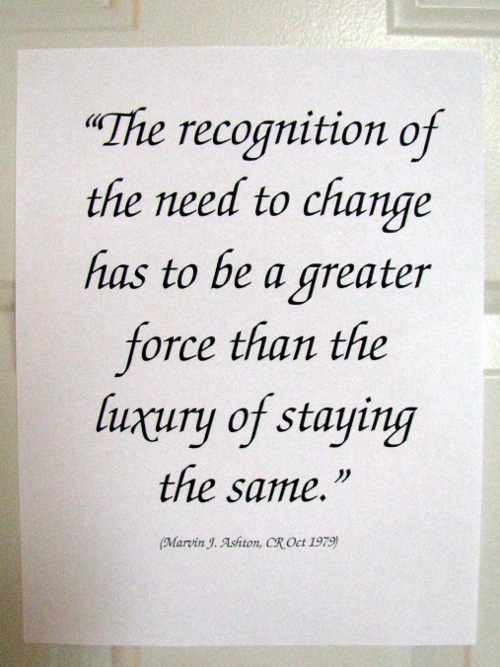
The need to change

I picked up this sign at institute last Wednesday. The lesson was on our desires; specifically, how the thing that we truly desire deep down is often the thing that we get.

The main reason I posted this sign on the door was to motivate me to get a better job than my current one.  However, it applies to so many other things as well.

Take writing, for example: if I’m going to actually turn this writing thing into a full time career, I’ve got to bust my butt to make it happen.  Writing a paltry 250 words each day on a novel you’ve been working on for the past twenty years just isn’t going to cut it.

I got two form rejections today, and that made me realize that I need to be more serious about submitting my work.  So instead of working of working on Worlds Away From Home, I researched a slew of agents, rewrote my query letter for Genesis Earth, and sent out four carefully prepared and researched submissions.  I don’t want to spend any more time bouncing around from job to job than I have to–I want to break in and make this writing career take off.

So far, I’ve gotten approximately 14 rejections for Genesis Earth: ten form rejections, one personalized rejection, one rejection after the partial was requested, and two that I haven’t heard back on but have been out for so long they’ve probably been rejected.  Interestingly enough, rejection itself is not that hard for me to deal with: it’s building the motivation and nerve to submit to the next place that’s tough.

But I’ve got to do it.  I feel kind of like Hachimaki from the anime series Planetes, who quits his job without taking the severance package when he applies for the Jupiter mission.  If he has the safety net, he knows that he’ll get lazy, so breaks goes out on his own, even sleeping on the streets for a while during the initial tryouts.

I haven’t quite fallen that low yet–I’ve got an apartment, a bike, and a job, even if it’s only a subsistence level one.  But when it comes to long term careers, I’m putting everything into my writing right now–there isn’t anything else.

It’s still discouraging to get rejected, but I’m still very optimistic that things will work out.  Even if everyone rejects Genesis Earth, I’ll have Mercenary Savior ready to submit before the end of the year.  It’s just a matter of time–I just hope it happens soon.

In the meantime, here’s the opening sequence from Planetes.  Such an awesome series–I’d take a job with Debris Section in an instant!  Even garbage collecting is cool when it’s IN SPAAACE!!

Book Festival and other updates

So last Friday, there was a book fair at the Provo Library.  I only heard about it the night before from Facebook, but there were almost twenty authors on the guest list, so I figured it would be a good place to go to meet other writers.  I wasn’t mistaken!
I biked up to the library just as Brandon Sanderson was walking in.  We chatted for a while, caught up on stuff since the last time I took his class.  I almost got to walk into the author’s only lounge with him, but one of the staff stopped me.  One of these days, though…one of these days!

I also ran into Dan Wells, who remembered me from World Fantasy and gave me a very nice compliment: he said I was very good at approaching people, especially at conventions.  Talked about the different cons this year; according to Dan,  Dragoncon is going to be huge this year, since Worldcon is in Australia and World Fantasy is in Ohio.  I have a friend in Atlanta–I’ll have to look into attending that.

Brandon Sanderson, Clint Johnson, Mette Ivie Harrison, and J. Scott Savage did a panel on writing fantasy.  Fortunately, I had my mp3 player on me and was able to record it.  If you would like to listen to it, you can find it here:

Fantasy Panel, Provo Children’s Book Festival (15 May 2010)

Clint had some interesting advice for me after the panel; he asked about the books I’ve written and said I should submit them to YA agents/editors as well as mainstream adult agents/editors.  Apparently, Genesis Earth and Mercenary Savior could work as YA, since 1) they’re about (relatively) young protagonists having coming-of-age experiences and learning how they want to live their lives, and 2) they don’t have the sense of nostalgia that adults often have when they think about their childhood.

So that was the Provo Children’s Book Festival.  Let me just say, this is one of the reasons why I love Utah: the writing scene for fantasy/sf/YA is HUGE.  Tons of writers, tons of readers, local writing events all the time–it’s great.

In other updates, I got a personalized rejection from Orson Scott Card’s Intergalactic Medicine Show! It was a pretty long one, too.  The assistant editor said the writing was pretty good, but it felt too much like a novel.  Hehe…confession, it was part of a novel.  But that’s awesome that he thought the writing was good!

Besides that, he gave a lot of suggestions as to formatting, referring me to this site for detailed ms instructions.  I didn’t think most editors would mind Times New Roman, but if it’s an issue even for a few of them, I should probably just switch to Courier–no editor is going to fault me for using Courier.

Besides all that, I’m well on my way to finishing Mercenary Savior 3.0 before CONduit.  My goal right now is to finish it next Tuesday and spend Wednesday and Thursday sending it out.  After CONduit, I plan on starting Hero in Exile (except the name will change), and I have a TON of great ideas for it.  Funny how sometimes in order to finish a book, you need to write another one first.

Quarterly report

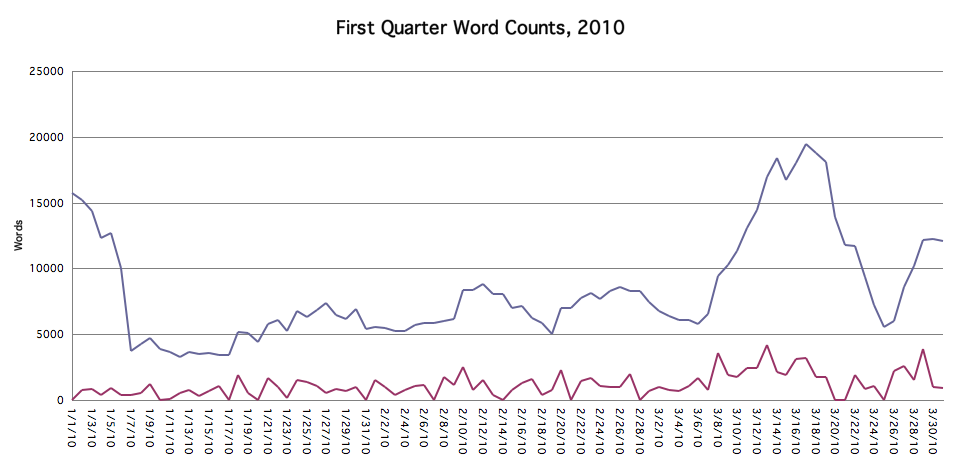
So I figure that since I want to write professionally, it would be a good idea to keep track of my writing and do quarterly updates on my blog.  Here’s the first one for this year:

The red line shows my daily writing word count, the blue line a running seven day total.  The graph starts January 1st and goes to March 31st.

For the first part of January, the seven day total was high for a week because I’d just finished Bringing Stella Home 2.0. It dropped down way low for a while because I was busy moving into the Barlow center, starting my internship, and starting a new novel at the same time.  Combining all three of those things at the same time made for very little progress, until about the middle part of the month.

Things progressed at a moderate rate (about 1k words per day) from the middle of January until snowmageddon, which hit us in the second week of February.  I got a lot of writing done while snowed in, and my work in progress at the time, To Search the Starry Sea 1.0, got a lot of momentum behind it.

That momentum started to taper off, as I realized that the story I was writing was different than the story I had in my head.  I swear, this happens EVERY time I try to write a novel.  I tried to stick with the story in my head, but the gap got wider and wider until I realized the story just wasn’t working.

At the end of February, I decided to put it on the back burner and let my ideas simmer for a while.  I’ll probably pick it up again at some point in the future, but not in the short term–I need to put it away for a while.  I’m sure I’ll finish it someday, though.

So then, in the beginning of March, I went through all the comments I’d received on Bringing Stella Home.  The HUGE spike you see right around the middle of the month represents all the revision notes I put together for the 3.0 draft.  I read through the entire manuscript in about a week and a half, made a detailed scene by scene outline, and figured out my strategy for the revision.

Things dropped off again pretty sharply the last couple weeks of March because that was right around when I was fired from my internship.  That was one hell of a stressful week.  They picked up pretty quick after that, though, because 1) I had a lot more free time, and 2) I’m REALLY excited about this project.

Looking ahead, I think if I push myself, I can finish Bringing Stella Home 3.0 by the end of April.  It will be difficult because I’ll be looking for an apartment and a job at the same time, but after next week I won’t have to worry about schoolwork anymore (potentially for the rest of my life…whoa).  Definitely, I’ll have it done in time for CONduit 2010.

One thing I need to work on a lot more is submitting.  I’ve got a list of agents to submit Genesis Earth to, I just haven’t got around to sending it to them all.  The responses I’ve received have been generally encouraging: all rejections, but about half form rejections, half personalized in some way.  I do think this book will find it’s way in print, though it may not be my first to be published.

Even though Bringing Stella Home will probably need at least one more major revision before the full manuscript is ready to be sent out to editors/agents, I can probably polish the first three chapters enough to shop it around sometime in May.  I’m not sure if that’s what I’ll do, but it’s an option.  It depends on whether I jump right in to the 4.0 revision after finishing the current draft, which I probably won’t do; better to let it sit for a while.

Instead, I think I’ll jump right in to finishing that novel I started in late 2008, Hero in Exile.  The title will have to change (as always), but I’ve got a lot of fresh ideas for it, plus the enthusiasm to pull it off.  In many ways, Hero in Exile is a non-linear sequel to Bringing Stella Home, so if I get a deal with the one, I can always pitch the other as the next in the series.  That’s a huge plus–and a major reason why I’ll be enthusiastic about the project, since the two novels build off of each other.

Anyway, that’s what things are looking like from here.  Somewhere in the middle of all that, I’ll read a couple of friends’ novels (I haven’t forgotten about you, Jakeson and Drek!), graduate, get an apartment, get a job (inshallah), write an article for Mormon Artist, go to a con or two, and maybe even get a girlfriend and/or figure out what to do with my life.