Snowmageddon! Hooray!

So for the past week, a series of crazy snowstorms has been pelting the Mid-Atlantic.  President Obama has dubbed it “snowmageddon,” and it’s so bad that all federal government offices have been closed since Friday.  With another storm hitting us tonight, it looks like we’re going to have the whole week off! Yay!!!

So, for the past couple of days, I’ve been hanging out around the Barlow Center, watching movies, doing random stuff with my friends here in the program, taking naps in the middle of the day, and writing.  Lots of writing!  It’s awesome–I haven’t had this much free time since Christmas (which wasn’t all that long ago, but still…)!

Today I didn’t write quite as much.  I got in about 1.1k words, a decent amount, but if I’d pushed myself I could have finished the current chapter.  Monday went much better, because I sat down and forced myself to write in the morning.  Once those initial hundred or so words were out, the rest came much easier.

On the first day of snowmageddon, when we were snowed in at Valley Forge, I got in over 1,000 words before noon.  It was rough going, though–nothing was flowing, and everything took a lot of effort.  I hate it when that happens–blegh.

But I think it was necessary, because now, the scenes are flying by pretty easy.  Sometimes, when I’m struggling with momentum, I find it helps if I take a day to focus and push myself through it.  Get rid of all distractions, put my butt in the chair, close all internet browsers, and just write, no matter how difficult.

My next novel, To Search the Starry Sea, is going to be a lot of fun.  It starts out almost exactly like Homer’s Odyssey, with the same basic conflict and setup.  Beyond that, however, I have nothing solid planned–I’m just following where the story takes me.  And boy, is it taking me to some crazy places!

For example, one of the first places Katriona (the Telemachus character) goes is a nearby world, ruled by a friend of her father’s.  To liven things up, I decided to have him live on a giant rotating space station, where the inside is covered by forests and jungles–scenery that Katriona has never seen.

This got me wondering, however: how did the jungle get there?  The answer: thousands of years ago, before superluminal space travel, a group of colonists set out for this world, freezing themselves in cryo.  When they got there, they found that a solar flare-up had rendered the planet uninhabitable, so instead they built this massive station, hoping that it would serve as a second ark for humanity.

Instead, a raiding party of space barbarians took them over, enslaved the colonists, and built their palace in the midst of the carefully maintained artificial biosphere.

This opened up a series of new possibilities for subplots, which shapes my protagonists interactions with the people here, which points her in new directions for the main plot–the next few places that she’s going to go.

This is discovery writing at its best.  Even though I have no clue where she’s going to go next, things are unfolding very nicely, and I’m excited to find out!

How Avatar should have ended

Before I came out to Washington DC, I saw Avatar in the theaters.  AWESOME movie.  Loved the concept, loved the characters, LOVED the science fiction elements and how well they were woven into the story.

However, like much of the stuff that comes out of Hollywood, I was disappointed with the ending.  It felt too cheap–kind of like Matrix: Revolutions.

ONCE AND FUTURE SPOILER WARNING!  MAJOR SPOILERS AHEAD!

The ending of the story didn’t really solve the initial problem–it only put off the inevitable defeat of the good guys.  Do you REALLY think that the corporations of Earth are going to let a band of primitive aliens keep them from exploiting the natural resources of Pandora?  No way–they’ll be back, and with much bigger guns than before.  The ending solves nothing.

What they should have done was created an interstellar authority that the corporation needed to answer to–a weak, toothless one, at least initially, but one that becomes more important as the movie progresses.  This is because the real bad guy was the CEO, not the colonel–the colonel always answered back to the guy running the company.  HE was the one who made all the real decisions for the bad guys.

Things started to get cheesy once the rogue pilot sprung Jake, Norm, and Dr. Grace from the holding cell.  She should have hidden the trailer for the outpost, then sprung them out, since the only place they would go after leaving the base was the remote outpost. Where else could they go to access the avatars?

Moreover, Jake and his allies wouldn’t want to hide the trailer near the alien holy place.  That’s one of the last places they’d want to go–the aliens would just kill them, after the destruction of the mother tree.

Capturing the red and yellow dragon bird was a good way to get the legitimacy Jake needed to lead the aliens, but would the young prince really cave in so easily? I think not–especially after Jake stole his betrothed.

And summoning all the other alien tribes from across the planet? This was when I thought things had gone too far–no way was a coalition of bow and arrow wielding blue people take down the human armada.

This is where the interstellar authority comes in.  Without any oversight, the corporation can do whatever it wants.  Even if the aliens drive them off the planet, they or someone else will just come back.  Instead, the authority should have played the key role in defeating the evil corporate bad guys.

The scientists working for the corporation should have been in connection with scientists back at Earth from the very beginning.  Once the corporation pulled the plug on the science operation, it would have created discontent back home–only among the scientific elite at first, but as knowledge of Pandoran biology and its secrets begins to spread, public sympathy for the alien’s cause would grow–and with it, political capital that the scientists could leverage to stop the corporation.

Knowing this, the CEO would do everything in his power to keep the alien sympathizers from sharing their full discoveries with the scientists back on Earth.  To counter this, the good guys would have to either use their spy or covertly break into the facility to transmit the information to the people who can leverage it.

This sets up a “time bomb,” so that the goal of the good guys is no longer to defeat the bad guys in one last spectacular battle (which, let’s face it, they never could have realistically won), but instead to hold out until the cavalry arrives to save them.

There’d be a show down with the colonel, and a big epic battle to save the holy place, but the REAL victory would come when the interstellar authority comes in, arrests the CEO and his staff, freezes their operations, and slaps a whole host of regulations on the corporation, effectively saving Pandora–FOR GOOD.

That’s the way I think it should have ended.  I look forward to seeing how the guys at How It Should Have Ended.com handle it.

In the meantime, check out their take on Twilight:

I agree 110%!

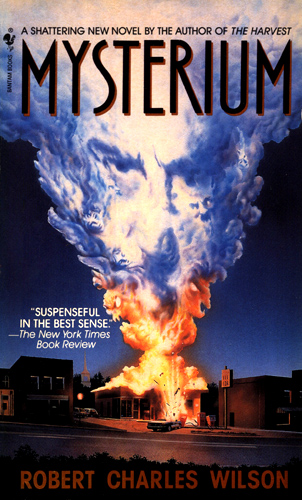
Mysterium by Robert Charles Wilson

Nobody knows why the government chose the small town of Two Rivers, Michigan, as the site for a top secret military project.  Even most of the people involved in the project don’t know what it’s really about.  That’s alright, because most of the denizens of this backwoods community are used to minding their own business.  But after a mysterious explosion bathes the entire city in light, that becomes impossible.

On the outskirts of town, all the roads and power lines dead end in ancient virgin forest.  It’s as if a perfect circle has been drawn around the town on the map, and everything within the circle has been transported to a parallel world.

A very unfriendly parallel world.

Robert Charles Wilson’s writing is awesome.  I could eat up his prose all day.  It not only flows beautifully, it’s clear and transparent, to the point where I forget that I’m reading and feel as if I’m there.  He always uses the right expression, the right metaphor, and yet his prose never attracts so much attention to itself that it distracts from the story.

I noticed several similarities between Mysterium and Wilson’s other novels that I’ve read.  All of them start in our modern world and move into a mysterious, unfamiliar milieu.  All of them involve strange religions and religious conflicts.  All of them involve male and female characters struggling to face personal relationship problems and eventually coming together.  In these ways, this story felt very much like Spin.

At the same time, I can definitely tell that this is one of Wilson’s earlier works.  The story flows like a thriller, but lags in certain points.  After the town is transported into the parallel dimension, the story seems to meander without any clear direction.  For several chapters, I lost the sense of progress that usually accompanies a good plot.  The resolution receives very little foreshadowing–the “surprising yet inevitable” element was only “inevitable” three or four chapters from the end.  If it weren’t for Wilson’s beautiful writing, I would have put this book down in the middle.

<spoiler alert>

Unlike Spin, I found the milieu of this story somewhat depressing–not necessarily because of the setting itself (though it’s not the kind of alternate present that I’d want to live in), but because the people of Two Rivers never go back.

According to Card, there are two basic types of milieu stories: stories where the protagonist returns profoundly changed, or stories where the protagonist “goes native” and becomes assimilated.  But…if the new world isn’t the kind of place you’d want to live in–in other words, if it’s dystopian (and Wilson’s alternate world in Mysterium is fairly dystopian)–then there’s this tension of “will the protagonist make it back?  Will they return?” And if they don’t return, the story is emotionally disappointing.  That was the case for me with Mysterium.

</spoiler alert>

From this review, it probably sounds like I hated this book.  That wasn’t the case–not at all!  This was a good story, and I enjoyed it.  I finished the last hundred pages at a sprint at 1:30 in the morning–it was definitely that kind of a book.  I couldn’t put it down.  And at the same time, it was thoughtful and profound (as you can tell from my previous post, “Why I love Robert Charles Wilson“).

I’ve probably said enough.  If you like thrilling, parallel world adventure stories with a contemplative, thoughtful “what if?” element, read this book.  Even with all the misgivings I’ve mentioned here, it’s good SF.  Very good.

Revelation Space by Alastair Reynolds

Hundreds of thousands of years ago, an ancient race of sentient aliens known as the Amarantin went extinct just as their civilization experienced a golden age.  No one knows why, but archeologist Dan Sylveste is determined to find out.  Unlike the other colonists on the remote planet of Resurgam, he believes that the answer may be important.

He has no idea how right he is.

Just as he’s on the verge of a major breakthrough, a team of rebels takes over the administration of the colony.  Sylveste becomes a prisoner of war, and his research comes to a frustrating halt.

Meanwhile, on Yellowstone (the nearest human-inhabited planet to Resurgam), a mysterious entity known as The Mademoiselle hires assassin Ana Khouri for a special mission: kill Dan Sylveste.

The only ship headed in that direction, however, is an ancient warship commanded by a rouge crew of Ultras, genetically modified transhumans.  They seek Sylveste in order to heal their captain, who suffers from a plague that melds human biology with advanced technology.  The de facto leader, Illia Volyova,  hires Khouri to replace the ship’s gunner, who went mad and mysteriously died.

But neither Khouri nor Volyova realize that the thing that drove the gunner mad still resides deep in the ship’s systems.  It is neither human nor AI–and it knows what killed off the Amarantin nine hundred thousand years ago.

Revelation Space is a space opera unlike any other that I’ve read, with the possible exception of Dune. The far-future universe Alastair Reynolds created for this book is incredibly complex and expansive, almost completely unrecognizable from our own, with technology bordering on godlike, posthuman and transhuman races that are all but commonplace, and nothing but a blurry, indistinct line dividing the human and the machine.  On every page, I felt as if I had left the real world behind for something completely (and often disturbingly) alien.

Setting, by far, is the strongest point of this book.  In fact, as an aspiring writer, I found it  somewhat intimidating.  Reynold’s Revelation Space universe was completely alien, but in ways that made perfect sense for the far future in which it was set.  From this, I’ve learned that to make a far future setting believable, you have to make it…well, as alien and complex as Reynolds makes it.  It shouldn’t be an exact copy of Reynold’s mold, of course, but if it’s 500 years in the future and everyday life still feels exactly like our own–well, there had better be a reason for that.

As for character and plot, I did not feel that those were particular strong points of this book.  It’s not that they were done poorly,  it’s just that they weren’t done well enough, in my opinion.

The characters in Revelation Space did not particular engage me at first; I found that I had to force myself to keep reading, rather than read because I had to find out what happened to them.  Later on, as the story progressed, they grew on me, but I never felt that I intimately knew them.

As for plot, I felt that every fifty or one hundred pages, Reynolds would pause the story and throw something in from left field, simply because he had to foreshadow something coming up.  In this way, the book seemed a little choppy–like a debut novel (and, in Reynold’s defense, this is his debut novel).

Even with these issues, however, this was an incredible book, and it’s stuck with me even months after finishing it.  Reynolds pulled off an amazing ending–very satisfying, with a twist that I had not foreseen but that made good sense.  The final scene, and the last two sentences of the final scene in particular, were just awesome.  They made me want to clap my hands and say “bravo.”

If I could describe Revelation Space in terms of other works, I would say that it’s a cross between Neuromancer and Stargate the movie. While it’s solid space opera, it has a dark and gritty feel that borders on Cyberpunk / post-Cyberpunk.  It’s not exactly the kind of stuff I want to write, it comes pretty darn close.

something

So…I figure it’s been a week and I should probably post something on this blog.

Wow.

Well, work is underway on Ashes of the Starry Sea, and I’m starting to have a love-hate relationship with it.  Most writers say you first novel isn’t that good, and you just need to get it out of your system so you can write the real stuff.

Well, this is my first finished novel…but it’s not my first novel attempt.  My first novel attempt was in 8th grade, and I am happy to report that it no longer exists.  Anywhere.  No, seriously, I lost (or destroyed) it after my mission, and I am perfectly happy with that.

My second novel attempt was in ninth grade, and I still have a copy of it, though I haven’t looked at it in a while.  Somewhere around page one hundred (single spaced) I realized that the story wasn’t going anywhere, and I got all angsty and depressed about it.  Then, midway through tenth grade, I realized that the problems were fixable, and stopped being angsty and depressed.

And then I got bored and moved onto other things.

For the next two years, I started all sorts of projects but never really got anywhere with them.  This was when I came up with my “great golden idea” that I wanted to hide from the world until I had the skill to turn it into my masterpiece.

I’ll tell you what the idea was right now: a high school kid learns how to control his dreams and realizes that the dream world is just as “real” as the waking world.  An amazonian dream mage named Lachoneus takes him on as his apprentice and he saves the world from demons while struggling to turn his dream-world relationship with his hs crush into a reality in the waking world.

It’s got potential, but if this is the best idea I ever come up with, I’m going to be very disappointed.  Fortunately, I kept writing through this phase.

My next project that got past page ten happened my senior year.  I created an island fantasy world with a Greek aesthetic and started what I thought was a character study on my sister.  If she ever read it, she probably wouldn’t see any similarities between Sareli and herself, but she was kind of distant from all of  us in those years.

Then my mission happened.  Not much time for writing there, but even so, I had this one idea that was so good that I spent a handful of p-days in my second area writing it out longhand.  It was supposed to be this incredbly poignant allegory based around Lehi’s dream.  I got about two chapters in it before things got too busy for me.

When I came home, I picked up a story that I’d started before the mission and got pretty far with it…word-wise, at least.  The pre-mission version was based on this game I used to play with my Zaks building blocks.  When I got back, I renamed it Planet New America and envisioned it as Jesus’ second coming as experienced by American colonists on another planet, under Chinese occupation.

Sound pretty bad?  Yeah…about 60k words in I realized it had no plot and put it on the “back burner.” I haven’t picked it up since.

Sophomore year went by, and I wrote a short story and an undeveloped novel that I thought was a short story.  Decision LZ150207 was the short story, and it’s getting published!!! in The Leading Edge.  I signed the contract yesterday (woot!).  The Clearest Vision was the undersized novel, and…it was pretty bad.  Cheesy, sentimental, poorly written–but some of the ideas were cool.  Too bad it probably isn’t marketable.

Then, in the summer of 2007, I decided I was going to start another novel!  This one was going to be…<drumroll please> a Final Fantasy 6 fanfic (huh?!).  Thankfully, I had a much more original idea in gestation, and Aneeka convinced me to run with it.

Thus began the rough draft version of Ashes of the Starry Sea, my first finished novel and my current primary project.

So, yeah, they say to throw out your first novel…but I wrote at least five significant partial drafts before I got to Ashes. I think that’s enough to justify my assessment that this story’s going potential.  I still worry about it, though…I’m only in chapter 4 and I’m already struggling with the same angsty doubts that don’t usually hit until about halfway through.

The other day, though, I sent out my first three chapters to Charlie, who read them at work and gave me her assessment.  I thought that the main character, Ian, was weak and boring, that the first chapter didn’t have enough of a hook, that it took too long to get into the action, etc.  To my surprise, this is what she said:

Charlie: “Charlie is the coolest person I know”
say it.
me: charlie is the coolest person I know
Charlie: thank you.
me: because she read my first three chapters
Charlie: I just sent them to you
me: oh, nice
Charlie: 😀
me: they kick my other characters’ trash?
Charlie: yes
me: really?
how so?
Charlie: I like them
I can see their dinstinct characteristics very well
they’re developed subtly and efficiently
me: yeah?
Ian isn’t boring?
Charlie: no
I like him more than michael
me: ???
how?
Charlie: because he has definite character
me: he does?
Charlie: I totally understand how he thinks and his motivations after three chapters
yeah. He’s a passive weenie of a guy, but I like him
me: he’s a passive weenie and he isn’t boring?
Charlie: nope
I like him
me: you like him even though he’s a pansy?
Charlie: yeah
I like him because he’s a pansy
me: really?
huh
I don’t understand
Charlie: I’m sorry?
I like that you don’t have a complacent protagonist
me: Ian isn’t complicated?
sorry for all the questions
I’m just trying to understand
Charlie: no
me: so you like him because you get him
Charlie: that’s part of it, yeah
me: but if he’s weak and doesn’t start being proactive for very long, you’re going to stop liking him
is that right?
Charlie: I am expecting him to grow, yes
me: ah, so it’s the potential for growth that hooks you
Charlie: yeah

Like any first novel, Ashes of the Starry Sea has some serious plot issues, against which I’m currently banging my head.  However, despite the voices inside and outside of my head, it’s probably got potential.  Now I just need to convince myself of that.  Hopefully, as the story progresses, the story itself will do the convincing.  And you know what?  If I shut up and listen to it, it just might do that.

Outlining for a discovery writer

I’m almost finished with the rough draft of Bringing Stella Home, but I can’t shake the feeling that this draft really sucks and is full of holes.  

Part of that is probably that I wrote the whole thing  out of the top of my head.  The only part that I really took the time to outline was the back histories of the mercenaries–and that gave me material to make the story a LOT stronger.  This probably means that I need to do more outlining in the future.

I think I know now what to do and not to do.  Here’s my list of do’s and don’ts for someone like me who is more of a “discovery writer”:

Do’s:

  1. Keep a list of brief explanations for setting elements (history, cultures, traditions, technologies, magics, etc).  These do not need to be full length articles, but they should have enough information to trigger your knowledge and/or record the things that you are likely to forget.
  2. Keep profiles of all the major/viewpoint characters.  These should:
    –Briefly explain their backstory, including parents/family/origin, childhood, education/training, major formative events, etc.  This part should be fairly extensive, and will help you discover even more things about your character as you write your story;
    –Explain, in some detail, their motivations–not just their desires, but the basis behind their desires.  These usually grow out of the backstory;
    –List some basic stats: age, height, distinctive physical characteristics–basically, the stuff someone is going to get on a first impression;
    –List their important strengths.  This part can be sparse, but you should at least be aware of the things in which they are competent;
    –List their important flaws/handicaps.  This part can also be sparse, but it should be extensive enough to at least make you aware of and/or get you to think about the potential conflicts that will arise;
    –Explain why this character is sympathetic–why the reader is going to like this character.  You MUST make a conscious effort to think this out.  As the writer, you will love your characters simply because you created them, but the reader will not share in this euphoria.  Write this section like a pitch, as if you’re addressing the reader (I haven’t tried that yet, but it sounds like a good idea and I’m going to try it on my next project).
  3. Keep an ongoing list of all the major plot conflicts, with a checklist for each one of things that must/should happen in order to make the conflict as juicy and story-rich as possible.  These lists should be sparse: one sentence to explain the conflict (character vs. character), and each point of the checklist should also be one line.  You will flesh out each of these points as you go along, and you may even add new conflicts and get rid of old ones as your story takes shape.

Tip: None of these sections needs to be extensive.  Sometimes, it will work better if you simply cut and past excerpts from your novel in the appropriate places in your outline.  This may be especially helpful for setting elements and minor characters.

Tip: Not all of your outlining has to be done before you start writing.  The outline should be an organic document that expands and changes with your draft, and your best ideas will come as you write the story, not as you write the outline. The outline exists to serve the story, not the other way around. 

Don’ts:

  1. Don’t feel that you have to write encyclopedia-style articles on all of your setting/worldbuilding elements.  You are the only one who will see these, so you don’t have to extensively edit or proofread these sections.
  2. Don’t try to explain every detail of your characters’ personalities.  When you have a clear backstory, these will come out naturally.  To write believable characters, figure out the basics and then GET OUT OF THE WAY and let them take over.
  3. Don’t outline the plot; outline the major plot conficts with their necessary events, but expect these to change as you write.  This should be the most flexible part of your outline.
  4. NEVER feel that you have to fit your story to the outline.  The outline exists to serve the draft, not the other way around.  Use it as a reference and a set of guidelines, not a set of rules.  You will discover your story as you write and daydream about it, not as you write your outline.
  5. Don’t worry if your outline is spotty and full of holes.  You’re not writing this to an uninformed audience; you’re writing this to your future self, who can fill in the holes quite well.  In fact, your outline only exists to fill in the holes in your future self’s head and point him in a clear direction.
  6. Don’t worry if your story gets ahead of your outline on the rough draft.  For discover writers, outlines are more of an after-the-fact thing anyway, and your outline will continue to grow and expand in the rewrite.  In fact, you may find it more productive to write the rough draft in a burst of frenzied creative energy, leaving 90% of your outlining for the rewrite.

These are a few of the things that work for me, as a discovery writer.  I haven’t tried out everything on the do’s list, but looking back, I can see that they would have helped tremendously if I’d done them while writing Bringing Stella Home.  

Just because you’re a discovery writer, that doesn’t mean that you shouldn’t keep an outline.  It just means that you need to keep a different kind of outline, one that will enhance your discovery writing process rather than constrain it.

13,837 words in a day?

Yeah, that’s right.  Believe it or not, I barreled through about 13,837 words today.  That’s thirteen THOUSAND, not thirteen hundred.

Now, only about a thousand of that was new stuff  that I was writing.  Most of the rest of it was rearranging scenes that I’d already written, touching them up only a tiny bit.  I did merge a couple of scenes, delete or tone down some stuff, etc.

So really, about 90% of my work today was just revision, and not even really hardcore revision at that.  I’m still treating this version of my story as a rough draft; I’m not taking the time to polish things up and fix the known minor problems.  Really, I’m just running through what I’ve already written to make sure I have what I need to get past the roadblock I hit back in April.

The biggest thing I’m doing right now is rearranging scenes into entirely new chapter arrangements.  This seems to be a problem everytime I write a story with multiple viewpoints: I never seem to get the prelude-rising-falling-resolution-cliffhanger action that good chapters have.  I write scenes as they come to me, in a progression that seems natural at the time, but once I take a step back, I find that things work better on the macro-level if I complete rearrange which scenes come where in the narrative.

Part of that is that sometimes I just need to write a few paragraphs (or even a few scenes) just for me to figure out what’s going on, plotwise or settingwise.  What I’m finding with Bringing Stella Home is that I’m taking scenes from James and Danica’s viewpoints and moving them up a chapter or two, cutting out the filler in the middle.

I’ve got a long way to go before I master the art of good chapter structure.  Or perhaps it’s something that I do better when I’m revising, not drafting.  After all, I think I’m more of a discovery writer than a firm outliner.  Perhaps I write in a sort of puzzled up everywhere kind of way, and then do best when I don’t put all the pieces together until after I’ve vomited them all on the page.

I am getting more excited about this story, though.  Taking a step back and looking at things from a more global perspective has really re-energized me.  I can see the major turning points, and that helps me to build up for them much better.

I’m only worried that the “midpoint” is going to be somewhere around the 3/5ths mark, not the halfway mark as it should be.  One of my goals with this book is to see if I can hold to the three act structure and whether that makes my story any stronger.  But, according to the website, the midpoint occurs “approximately” at the halfway point, so I guess I can fudge it.

Also, the midpoint is supposed to be where the main character hits rock bottom.  Hee hee hee…oh, he will.  He will.  Bwahahahaha!!!

In the meantime, you owe it to yourself to listen to this:

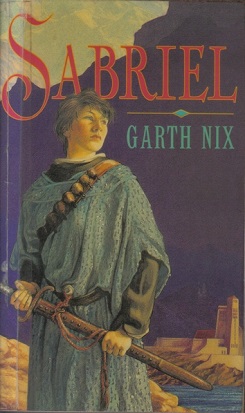
Sabriel by Garth Nix

Sabriel doesn’t know it, but her father is more than just a powerful necromancer; he is a key in the political intrigue of the Old Kingdom–the land beyond the wall. When he interrupts her class at Wyverly college by sending a hand–an enslaved spirit–from beyond the fourth gate of Death to drop off his sword and magic bells, Sabriel knows that something is wrong.

Something is holding her father hostage in Death, and Sabriel is determined to find him and rescue him. When she crosses over the wall, however, into the world of magic, both free and charter, she discovers just how little she knows about the history of the world, and the conflict in which her father was intimately involved. On this side of the wall, the world nearly ended two hundred years ago, and something that should have passed beyond the ninth gate of Death has come back to finish what it started and claim the world as its own…

I read this book for English 318 this year; we discussed it in class a couple of weeks ago. I ended up reading the book in about 48 hours, and as far as required reading goes, it wasn’t bad. Not bad at all. In fact, I really enjoyed it.

Garth Nix creates a fascinating world in this book, with magic that feels wondrous and otherworldly and places that feel fantastic. His conception of Death as a river with nine gates–nine waterfalls–is extremely fascinating, and the use of the bells to cast spells is really well done. The first hundred pages of this book felt a little bit like the beginning of The Dark Is Rising: it felt really dark and spooky, like being lost in the woods and knowing that something ancient and dangerous was out there with you.

The characters were also interesting and likeable. Sabriel is a necromancer who, in some ways, is afraid of facing death–the fact that everyone has to go at sometime. This is a YA book, so she was basically a young adult thrown in way over her head, tossed back and forth from crisis to crisis. At the same time, she takes charge often enough that she is definitely not just a weak character, driven passively from place to place. When the love interest enters the story, she’s basically the “prince” that rescues him from the “dragon,” repeatedly.

The biggest issue I had with this book was its predictability. It seemed that I could see every plot development and big reveal at least fifty pages before it happened. That said, the main thing driving me through the book wasn’t the plot–it was the setting and the characters. Sabriel has to learn some difficult lessons in order to succeed, and the magic she uses is just really freaking cool. Charter symbols, free magic, the five great seals of the charter, the nine gates of Death and the voices of the bells–cool stuff. That was enough to keep me interested, despite the relatively straightforward and unsurprising plot.

Overall, this was definitely a good fantasy. Garth Nix does a great job creating a sense of wonder, and his characters were interesting too. If you like fantasy and haven’t yet heard of this one, I’d definitely recommend it.

White Wolf by David Gemmell

Skilgannon the Damned is one of the mightiest warriors in the world, yet every day the memory of the innocents he has killed haunt him.  He seeks solace in becoming a monk, but as alliances break down and wars sweep the land, mob violence comes to the monastery and Skilgannon once again takes up the swords of Night and Day.  The swords, however, are cursed with an enchantment that corrupts the soul of the one who wields them, and the old witch who gave Skilgannon the swords–and who cursed them–is behind the political machinations that threaten to drive Skilgannon into the hands of his greatest enemy: his old lover, the queen of Naashan.

I’d heard about the Heroic Fantasy subgenre from English 318 last year, and thought I’d try it out.  I’d heard a lot of good things about David Gemmell, both from Brandon Sanderson and Orson Scott Card, so I kept an eye out for his books at the used bookstore and found this one.

White Wolf was an enjoyable read.  I particularly enjoyed the moral and ethical questions that Gemmell raised, both during the fight scenes and between the fight scenes in the dialogue between the characters.  Gemmell will often come right out and have his characters directly address issues like bravery and cowardice, death and sacrifice.  Far from sounding strained or pedantic, these were my favorite parts of the novel, mostly because the characters were struggling with these issues themselves.  Druss and Skilgannon, of course, have a little more experience and know the answers to these things, but the boy Rabalyn, a recently orphaned boy who has nowhere to go but follow the warriors and become one of them, goes through a very interesting growth cycle.

Gemmell also did a very good job creating an evil villain and raising the stakes.  As Skilgannon’s adventure winds in and out, he finds himself on a mission to save a girl who has been tortured to the point where she may lose her very humanity.  However, the villains are not all black and white.  Technically, Skilgannon himself is a villain, or maybe a post-villain, and the queen of Naashan is a similarly complicated character.  Gemmell’s world is populated with uber-heroes and uber-villains, but there are plent of people who fall in the middle as well.

The biggest issue I had with this novel was the plot.  It seemed to follow a loose quest structure, but it had a weak beginning and middle.  Skilgannon is supposedly onthis quest to resurrect this girl he once loved, but prior to this he’s been living the monastic lifestyle, trying to escape the world.  There is no clear moment where he says “I’m going to resurrect this girl,” yet supposedly this is supposed to drive him to travel hundreds of miles to get somewhere and do something.

The middle is littered with flashbacks–they are everywhere.  While the flashbacks are interesting and engaging, they interrupt the action in the present of the narrative, which often gave me the sense that nothing notable was really happening.  I started to lose motivation to read the book somewhere in the middle, just because I had lost that sense of plot progress.  If it weren’t for the characters and the conflict, I probably would have given up on it altogether.

However, I really enjoyed this book.  The last third was really good, and the epilogue was fantastic!  Probably the best epilogue I’ve ever read.  I wish I could say more, but it would give out major spoilers.  It was just a very well written, very well done epilogue.

I’d definitely be interested in reading some more Gemmell, though he’s not on the top of my list right now.  When I do pick him up again, I’d like to start with Legend, the novel that launched him into the big time.  I hear that’s a good one.

Progress!

I’m sludging through the middle of Bringing Estella Home.  I’ve heard people call this the “blue collar work” of writing, all the parts between the beginning chapters and climactic ending chapters.  I believe it.

In particular, I was having some difficulty with chapter 7 last week.  I have, basically, three separate plot threads tied up in four viewpoints.  Sometimes, it can be frustrating to give them all equal time while putting the scenes together in such a way that they contrast and build off of each other.  In particular, it’s difficult to get the chapters right.

I’ve heard that each chapter is supposed to be its own distinct sub-story, with its rising action, a mini-climax, and a falling action of some kind.  I’m fairly confident that I can do this intuitively over one or two viewpoints, but over four viewpoints, with three different plot lines?  It’s tough.  Last time I tried was with my first novel, and when I went back for the rewrite I had to reorder several of the chapters, especially the first three ones.

The way I’m doing it for Bringing Estella Home is picking one of the plot lines to be the main subject, if you will, of the chapter.  I build on the other plot lines as well, but the big climax, the big reveal, comes in the plot line that I’ve designated for that chapter.  Typically, I’ll start each chapter with a viewpoint from the plot line that is central to the rising and falling action of that chapter–or, if I don’t start it with the viewpoint, I start it with the characters talking about the idea that is central to the climax of the chapter.

Originally, I thought that the climax / central aspect of chapter 7 would be the brainwashing / mind-altering procedures that Ben undergoes in becoming a soldier for the Hameji.  I started with James discussing the Hameji with the other mercenaries on the ship and talking about various legends they’ve heard of mind-altering drugs that give the Hameji special powers.  The next scene was Ben forced to take some of those drugs.

However, I really hadn’t figured out Ben’s part of the story at this point.  I knew he’d take the drug, and I knew how it would change him, but I didn’t know what happened next.  As a result, the rest of the chapter just felt like a chore, one that I accomplished over several late nights (probably to the detriment of the quality of the writing :P)

It wasn’t working.  The chapter just didn’t feel like it held together.

Then, I had a genius idea–why not make the last scene of chapter 6 the first scene of chapter 7?  The viewpoint was from Estella, meeting the jealous head wife of the Hameji overlord.  That scene set up the conflict for the next two chapters of Estella’s story–in retrospect, why didn’t I make it an opening scene for that reason alone?

I don’t know.  But it worked out wonderfully well!  Once I shifted the central focus of the story to Estella, EVERYTHING fell into place!  Her conflict at this point really was a lot more interesting than anything else in the chapter.

So now, with chapter 7 under my belt, I am WAY excited for chapter 8!  While I was walking back from school one day, I figured out exactly what needs to happen next in his story, and it is amazing!  Brutal, violent, and torturous, but it is amazing!  And this is the perfect chapter to insert James’s philosophical discussion with Danica, the one that I wrote down nearly a month ago just because I had to get it out!  I’m excited.  Maybe I’ll even finish it before Saturday.

Anyways, it is 2:30 am, and I am way tired.  Time to get some sleep.  Thank goodness my first class doesn’t start until noon! 🙂