New permafree first-in-series: Rescuer’s Reward

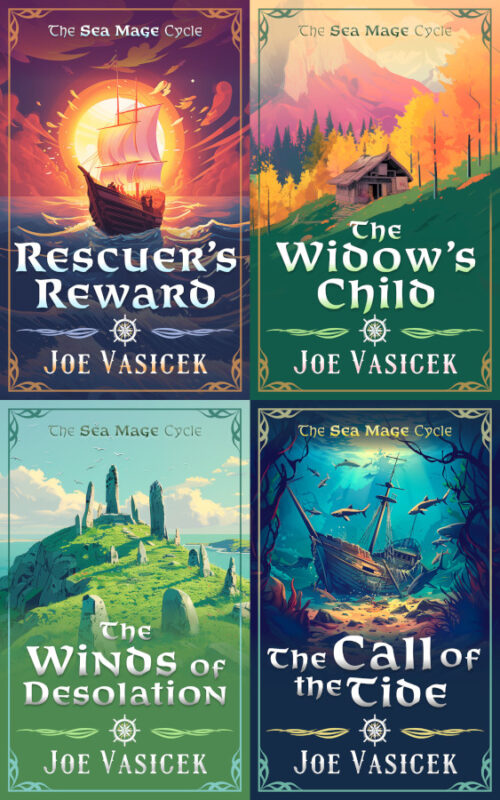
I have decided to make Rescuer’s Reward the permafree book for my Sea Mage Cycle fantasy series. If you haven’t yet read any of these books, this is a great place to start. It’s not the first book chronologically, but it is the first book that I published in the series, and since the Sea Mage Cycle is really just a series of interconnected standalones (kind of like most of Louis L’Amour’s westerns), you won’t miss anything by starting here.

Rescuer’s Reward

Rescuer’s Reward

A captain in debt, a princess in peril, and a fate that neither can foresee.

All Jason ever wanted was to sail the Azure Sea as a merchant ship's captain. But money problems have him up to his eyeballs in debt, and if he doesn't return to port with the gold, his dreams will be dashed forever. So when the princess of a far-off kingdom is kidnapped by pirates en route to her wedding, Jason merrily takes up the chase, staking his future on the reward for her safe return.

Yet the competition for the princess proves fierce, and Jason soon learns that there are far more powerful forces behind her kidnapping than any of them realize. And though Princess Julietta has no qualms about marrying for political advantage, the last thing she wants is to be a mere trophy in a different sort of game.

As duty, desire, and destiny clash, only one thing is certain: they both must risk everything to earn the ultimate reward.

Order Now!
About the Book
Details
Author: Joe Vasicek
Series: Sea Mage Cycle
Genres: Action & Adventure, Action & Adventure, Fantasy, Fantasy, FICTION, Romance, Sea Stories
Tag: 2024 Release
Publisher: Joe Vasicek
Publication Year: April 2024
ASIN: B0CTFVNKFL
List Price: $13.99
eBook Price: free!
Audiobook Price: free!
Joe Vasicek

Joe Vasicek fell in love with science fiction and fantasy when he read The Neverending Story as a child. He is the author of more than twenty books, including Genesis Earth, Gunslinger to the Stars, The Sword Keeper, and the Sons of the Starfarers series. As a young man, he studied Arabic at Brigham Young University and traveled across the Middle East and the Caucasus Mountains. He lives in Utah with his wife and two apple trees.

Preview
Some of the links in the page above are "affiliate links." This means if you click on the link and purchase the item, I will receive an affiliate commission. You will not receive any additional charge. As an Amazon Associate I earn from qualifying purchases.

Independence Day update

Happy 4th of July, everyone! It’s Independence Day here in America, when we celebrate our nation’s birthday by doing all of the most American things possible: fly our flags, eat lots of meat, and blow things up. God bless America!

It’s been a busy month so far, with family visiting from out of town all last week, and lots of kids all over the place. Great for our kids, who got to play with their cousins, but not the best for writing. Oh well. It looks like things are going to settle down for the rest of the month, which is really good, especially for my wife, who is racing to finish her PhD before she starts her new teaching job. So I will definitely be helping her with that.

On the writing and publishing side of things, I am actually going to take advantage of this time to catch up on all of the non-writing things, like publishing tasks, that I’ve fallen behind on. When August rolls around, things are going to get really crazy, with our move back to Orem as my wife starts her new job, so I want things to be set up really well for that.

I will continue writing, though: just at a slower pace. If I plan to do about an hour a day, and make that a consistent thing, I think I can keep that up through the crazy times that are coming. Not only are we moving and starting a new job, but we also have a new baby due to be born very shortly after all of that. So I fully anticipate that it’s going to be a crazy year.

(still not the final cover)

My plan right now is to keep plugging away at The Soulbond and the Sling, slowly but surely, until the AI draft is complete. At the rate that I plan to go, however, it probably won’t be finished until August or September.

I’ll also be working on the human draft of The Road to New Jerusalem, but since my plan is to submit that to the Ark Press contest in October, I’m not too worried about rushing that one. Besides, it’s a much shorter novel, so it shouldn’t be that hard. A part of me wonders if I’ll finish that one before The Soulbond and the Sling.

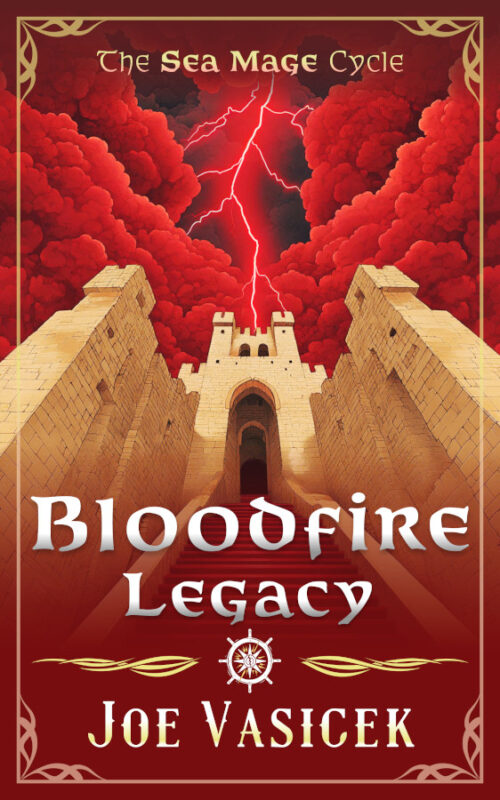
In the meantime, I plan to publish Bloodfire Legacy in paperback, ebook, and audiobook as soon as I go through the edits and get it formatted! In fact, that’s the next big thing I plan to work on in the next two weeks. With luck, it should be out very soon.

So those are the big things that I’m working on right now. I’m also going to try and finish all the blog posts for Fantasy from A to Z before the end of the month, though they will probably run through the first half of August or so. And once Fantasy from A to Z is done, I will turn that into an ebook exclusive for my newsletter list, and make my current newsletter exclusive, Science Fiction from A to Z, available as a regular ebook (and maybe audiobook and paperback as well).

All of this is part of my plan to pivot toward being more of a fantasy author. Right now, I’m a science fiction author who occasionally writes fantasy. In the future, I want to be known as a fantasy author who occasionally writes science fiction. Most of my science fiction leans heavily into fantasy tropes anyway, so it shouldn’t be too difficult to make the change. Hopefully most of my readers follow me over as I make the transition.

Toward that end, I’m happy to report that Rescuer’s Reward, the first novel in the Sea Mage Cycle, is now available as a permafree book! If you like fun quick fantasy adventures with a touch of romance, I think this will be right up your alley. All of the Sea Mage Cycle books are pretty short, and they all stand alone, though they often have recurring characters. Check it out and give it a read!

Taking Bringing Stella Home off of Permafree

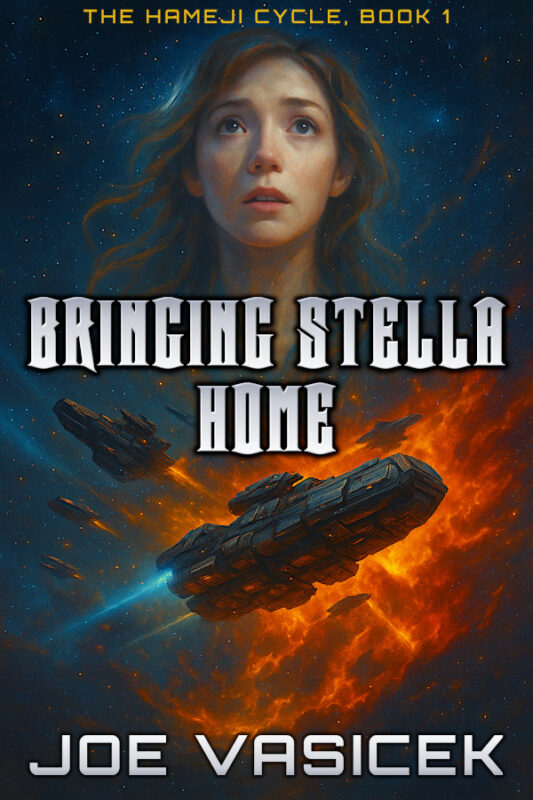
Bringing Stella Home

Bringing Stella Home

$14.99eBook: $2.99

When a ruthless Hameji battle fleet kidnaps his sister, James McCoy—a young merchant starfarer untested by war—vows to bring her home. But to save her, he must give up everything he has and become something he never thought he could be.

More info →

I have a lot of free and permafree books. Most of them are short, though: short stories under 10k words, with one novelette between 10k and 20k words and one novella between 20k and 40k words. Until now, I had only one permafree full-length novel: Bringing Stella Home at just under 100k words.

(As a side note, it makes very little sense to me why 7,500 words should be the cutoff length for a short story. Why not 10k words? It doesn’t take that much longer to read a 10k word story than a 7.5k word story. And if the concern is being able to read it comfortably in a single sitting, or in a single podcast episode, then it makes more sense to make 5k words the cutoff. There is a huge difference in the reading experience between a 4k story and a 7k story, but a 7k story and a 10k story? Not so much. Same with the 15k word cutoff for novelettes; 20k words makes much more sense to me.)

It’s been about nine months since I made Bringing Stella Home one of my permafrees, and to make a long story short, I’ve found that it really doesn’t move the needle. Part of this may be due to the fact that all of the Gaia Nova books are technically standalones, with a few recurring characters. Bringing Stella Home doesn’t lead directly into another book (though Heart of the Nebula is a direct sequel).

But another reason, I suspect, is because when readers download a free book, they aren’t expecting to get a full-length novel. They’re expecting to get something short that they can read in a couple of sittings, without having to make a major time commitment. When they find that they’ve downloaded something that might take them ten hours or more to read, it puts them off, especially if it’s from an unknown author.

Since the whole reason for giving away free books is to introduce my books to new readers, if they aren’t actually reading those free books because they are too long, why should I keep giving them away for free? Better to give away a bunch of shorter books that readers will actually read.

So in the next couple of weeks, I’m going to revert Bringing Stella Home back to $4.99. At some point in 2023, perhaps in February or March, I will release a boxed set of the Gaia Nova novels and focus my promotional efforts on that, rather than trying to do the first-in-series free thing (which doesn’t actually work for this series, since there technically is no first book).

So if you haven’t already picked up the ebook edition of Bringing Stella Home, now is a good time to do that.

Rethinking free

I recently read an interesting blog post on Dean Wesley Smith’s blog, about how, how not, and whether to make your books free. The conclusion he comes to is this:

Free is short time, limited supply, and never on the major bookstore shelves.

In other words, no permafree, no free pulsing, and no publishing free online content on sites like InstaFreebie unless it’s for a limited time.

Three or four years ago, I probably would have pushed back pretty hard against this advice. There are still points of it that I disagree with, such as the idea that giving anything away for free devalues all your other work. Perhaps that’s true for physical product, but for digital content I think there’s a solid argument to be made that the rules have changed.

That said, a lot has happened in the last three or four years. Permafree worked really great until about the middle of 2014, at which point I noticed that it was a lot harder to generate any kind of interest in my free books. I switched to a free pulsing strategy in 2015, which was a lot more effective at giving away free books, but that didn’t always translate into more sales.

In fact, there’s a passage from Dean’s blog that sums it up real well:

A customer walks through your door and you have a wall of twenty pies in glass cases, all the smaller short story pies in a case in the center, and some specials near the cash register.

And there on your wall are three pies that say, “Free.”

And a bunch of short stories that are “Free.”

The customer can take an entire pie for free or buy one. As a customer, what would you do? Duh. You take the free pie and leave.

And pretty soon your customers start to change. The only people who come through the door are people who only want the free stuff. They would never buy something under any circumstances, but you are giving your pies away for free, so they take one.

Pretty soon there would be lines out the door to get your free pies and you would make nothing. The free takers would crowd out and devalue the pies you are trying to sell.

Now, I don’t entirely agree with Dean here. My 90-day sales chart on Amazon shows a predictable uptick in sales every time I set a book free and send out an email to my list. Most of my subscribers signed up through InstaFreebie, which means they’re probably not quite fans yet (and probably signed up for a bunch of authors’ lists).

But my long-term data tends to agree with Dean. Back in 2012 and 2013, there was a very clear correlation between free downloads and royalties / paid sales. Then, in 2014, that correlation started to become fuzzy. Over the next several months, it got progressively fuzzier (even though I was giving away more books), until today there’s really no correlation at all.

Obviously, YMMV and I can only speak for my own books. But there have been a lot of major shifts in the ebook market over the last five years. Kindle Unlimited has had a huge impact on the effectiveness of permafree, or any kind of free book strategy for that matter.

Point is, it may be personally useful to rethink my free strategy. I’m not going to stop doing the free book thing altogether, since I do think there’s still value to it (if for no other reason than that little sales bump, plus the handful of “thank you!” responses I get from my email subscribers each month). But instead of free pulsing two books each month, usually including a first-in-series novel, it may be better to do a 99¢ novel and a free short story.

The two biggest mistakes I’ve made so far in my writing career have been 1. underpricing my books, and 2. unpublishing books that were still selling. (I still can’t believe how stupid I was) Holding onto a free books strategy that isn’t working could easily become a close third. I’m not going to throw the bus into reverse while it’s barrelling down the highway at 70 mph, but some experimentation and a course correction may be in order.

Thoughts on series and perma-free

For the last five years, the conventional wisdom among most indie writers has been to write short books in sequential series and make the first book permanently free. It’s a strategy that works, to a certain extent. It’s what got me from making pizza money on my book sales to making a humble living at this gig. However, I’m starting to question that wisdom.

I have two books available for free this month: Genesis Earth and Star Wanderers: Outworlder (Part I). Genesis Earth was my first indie published novel, a “standalone with series potential” (specifically, a trilogy) written according to the conventional wisdom for breaking into traditional publishing. Outworlder is a very different book: the first in an eight-book novella series, strong enough to stand alone but short enough to leave the reader wanting more. And for several years, it was perma-free.

Outworlder was the first of my books to make it big. It’s gotten tens of thousands of free downloads and driven thousands of sales (I don’t have the exact numbers because I haven’t yet collated all of my sales reports from the past five years, but that’s something I plan to do). It was largely on the success of Outworlder and the Star Wanderers series that I built my early career.

But over time, downloads of Outworlder slowed to a bare trickle, and sales did as well. I could give it a short-term boost by running a few strategically placed ads, but it would always fall back down to a baseline that was simply unacceptable.

Also, when you have a book that’s permanently free, it tends to accumulate a lot of negative reviews. It’s strange, but some people seem to feel more entitled to XYZ when they get it for free, as opposed to paying for it. Or maybe these are the people who try to go through life without actually paying for anything? Who hoard everything, even the stuff that they hate, so long as they can get it for free? I don’t know.

Certainly, that’s not true of everyone who reads free books. But when you have a perma-free book, it tends to accumulate more of the barely-coherent “dis buk sux” kinds of reviews from people who probably weren’t in the target audience to begin with. And over time, that tends to weigh the book’s overall rating down, which unfortunately can be a turn-off for people who are in the book’s audience.

Contrast that with Genesis Earth. I launched it at full price with a blog tour (which I put together myself, among writer friends whom I knew personally and who had readers who would probably enjoy the book). It sold about a hundred copies in the first ninety days, then slowed to a very low trickle—maybe one or two sales each month, if that. Things continued like this for several years.

Then, back in December, I made it free for one month. Downloads immediately shot up, and continued strong throughout the entire month. Even without any advertising, I was still getting maybe 50 downloads per day on Amazon, plus a constant trickle on the other platforms. For the next couple of months, sales of all my other books grew as well

For April, I decided to make it free again, just to see if I could duplicate that kind of success. I haven’t done any paid advertising for it, but I have submitted it to various sites and newsletters that will promote free books. The result? Thousands of downloads, with a baseline rate of more than a hundred downloads per day.

Genesis Earth has never been perma-free, but every time I set it free for a limited time, it’s like I’ve released the pent-up flood waters. In contrast, Outworlder struggles to get any downloads at all, even when it’s free for only a limited time.

Part of this may have to do with the reviews. Genesis Earth has a much better overall book rating, simply because most of the people who read it over the years were the ones willing to pay full price. This also means that the book has grown into its own niche organically, since the people who have bought Genesis Earth also tend to buy other books similar to it. Retailers like Amazon take note of this, and tend to associate these books with each other in things like also-bought recommendations.

This is all just speculation, but when all of this comes together, it seems to result not only in a higher download rate when the book is free, but more downloads from people who are in the book’s targeted audience.

The mos fascinating result of this is that when the book goes back to full price, sales get a small but long-lasting boost. I’ve seen this with Bringing Stella Home, which was free in March. It’s not a huge boost—maybe only five or six books a month—but it boosts all of the other books in the series as well, and lasts for a couple of months. It’s not just Amazon where this is happening, either—in fact, it may be boosting sales on the non-Amazon platforms even more.

Bringing Stella Home is different, though, because it’s a full-length novel (about 110k words, or +300 pages) in a series that can be read out of order just fine. In other words, more of the “stand-alone with series potential” that was the convential wisdom in the old tradpub world. Like Genesis Earth, it has never been perma-free.

So what’s the takeaway?

That maybe the convential wisdom among indies is all wrong. That perma-free actually taints books and makes it harder for them to stick in the rankings, or to grow into their natural audience. That longer stand-alone books with recurring characters set in the same universe may be better for gaining long-term traction than shorter, more episodic books. Also, that the more books you give away for free—not just first in series—the better that all of your books will sell.

My experience is purely anecdotal, and there’s a lot more analysis I need to do before I can say anything for sure. From what I can tell, though, it seems that the best strategy is to write longer, fuller books that satisfy more than they entice, and to use free as a marketing strategy for only a limited time.

In other words, the collective wisdom of KBoards is completely off the mark, and Kris Rusch (who regularly gets vilified on KBoards) actually knows what she’s talking about most of the time.

Like I said, this is all anecdotal and more analysis is required. But I’m very curious now to make some of my non- first-in-series books free for a month, just to see if it has a similar boost. With Bringing Stella Home, for example, a lot of readers seem to be jumping over books 2 and 3 to read Heart of the Nebula, the direct sequel (but book 4 in the Gaia Nova series order). It would be very interesting to see if Desert Stars has an awesome free run as well, resulting in more sales after it reverts back to full price.

Lots of interesting stuff to consider. It’s definitely going to inform my writing and marketing efforts in the future.

D is for Discoverability

If there’s one thing that indie writers like to talk about when they talk shop, it’s “discoverability”–how to make their books stand out so that readers can discover them. You don’t have to spend much time on author blogs or writing forums to find some pretty intense discussions about this topic. For those of us trying to make a living at this gig, it’s something we constantly obsess about.

So what’s the best way to boost your discoverability? What works, and what doesn’t? If I had the answers to those questions, I could probably make a lot more money writing “how-to” books! However, here are a couple of books I’ve found that do an excellent job answering this question.

The Secrets to Ebook Publishing Success is an excellent resource for ebook marketing ideas that won’t cost you an arm and a leg. The book won’t cost you, either–it’s available on Smashwords for free. The author, Mark Coker, is the founder and CEO of Smashwords, and he wrote this book to help Smashwords authors succeed. Definitely worth giving a read.

Let’s Get Visible is the other book on discoverability that I’d recommend. For this book, David Gaughran collaborated with a number of other indie writers from KBoards to figure out the best ways to work with Amazon’s algorithms. It’s an excellent book that explains some of the best practices for free giveaways, price pulsing, and choosing keywords and categories.

Those are the two books I’d recommend. There are other good ones I’m sure, but there are also a lot of scammy marketing books that are just out there to take your money. These ones aren’t scam books at all. Without getting any benefit from the authors of these books for saying it, I can vouch from experience that their advice is pretty solid.

So what’s worked for me personally? I can point to a few things:

  • Writing in a series. If your books are grouped together by series, then readers who enjoy one of those books are more likely to try out another. They’re less likely to read one book and forget about it because all of the books are connected. In this way, each of your books helps readers to discover the others.
  • Give some books away. Readers love free books. They’re a lot more likely to try out a book by an unknown writer if it’s free than if it costs any money at all–even as little as $.99. I know a lot of writers don’t like giving away their books for free, but if you’ve got ten other books that readers go on to buy after reading the first one, it’s worth a lot more than having eleven full-price books that no one ever buys.
  • Make the first book in a series permanently free. That’s what I did for Star Wanderers, and the strategy has worked extremely well. Before that, I had a couple of short stories and non-series books that were perma-free, but none of them gave my other books much traction. But with Star Wanderers, it’s easy to see that the first book leads to the second book, the second book leads to the third book, etc.
  • Don’t let your price become an obstacle to new readers. The principle behind perma-free + series that makes it work is the sales funnel, where you try to spread some of your books as widely as you can in order to funnel people to your other books. But if your first book is free and all the other books are priced so high that price becomes an obstacle, readers are bound to get irked and drop out. I’ll say more about this in P is for Pricing, but one thing I’ve learned is that it really helps if you’ve got a lot of low-priced books that readers can move on to after picking up your free stuff and before moving on to the higher priced stuff.
  • Write and publish lots of books. It wasn’t until I had maybe fifteen books out that I started to notice that my entire catalog was working together. When my Star Wanderers books sold well, I saw more sales of my other books too. When you have enough books out, they work together to sell each other. I wouldn’t be surprised to find that on average, one person with fifteen books out sells more than fifteen people with one book each.
  • Book blurb, cover, metadata. That’s the trifecta–if you don’t hit all three of those, nothing else you do may ultimately matter.

And of course, there’s the most important thing of all: write a damn good book. If your book sucks, all the discoverability in the world isn’t going to save it.

When you’re an indie writer, it often feels as if publishing a book is like tossing a message in a bottle out into a churning sea. You have no idea where your book is going to end up, and the marketplace is as wide and as menacing as a stormy ocean. Lots of books sink to the bottom of that ocean, where no one ever finds them. But plenty of other books stay afloat, selling a copy here or a copy there–just enough to stay up at the surface. And eventually, the winds of the marketplace cast it up on a distant shore, where it’s discovered by a fan.

But here, the analogy breaks down. Because unlike a beachcomber who finds a message in a bottle, a fan doesn’t have to wait for your next book to come to them–they can go out and find them directly. So the more books you have out there, the greater the likelihood that they’ll eventually be discovered. And if they’re out in the marketplace for long enough–out where the potential fans can discover them–then eventually they will grow into their natural audience.

That’s been my experience, at least. There are a lot of other things that I’m experimenting with now, but these are the things that I know work for sure–at least for me.

Things I’ve learned from STAR WANDERERS

Star Wanderers I (thumb)Star Wanderers II (thumb)Star Wanderers III (thumb)Star Wanderers IV (thumb)SW-V Dreamweaver (thumb)SW-VI (thumb)SW-VII Reproach (thumb)

When I published the first couple installments of Star Wanderers, it represented both an experiment with a new publishing format and a departure from the more long-form styles that I was used to.  Now, a little over a year later, I can say it’s been a success.  The series isn’t finished, and I’m still learning as I go, but here are some of the big lessons that I’ve picked up:

Novellas are surprisingly well-suited to series. They read fairly quickly, contain enough focus to sustain an episode of a larger story, and yet at the same time contain enough space to develop a wider arc.  Plus, they are a lot quicker to write than novels and generally don’t require as much editing, since it’s easier to get the story right on the first pass.  This means that you can put out novellas faster and more regularly than long-form novels, maintaining good momentum for the series as a whole.

It’s hard to write anything shorter than a novella without leaving readers unsatisfied.  By far the biggest criticism I’ve received for Outworlder (which is really more of a novelette than a novella) is that the story feels too short.  If the novella (17,500 to 40,000 words, or 80 to 150 pages) has all the benefits of the novel and the short story, then it seems that the novelette (7,500 to 17,500 words, or 30 to 80 pages) has all of the drawbacks.  Then again, it could just be that I have yet to master the form.

The satisfying element in a series is at least as important as the returnable element.  Every successful episodic story has some sort of returnable element–something about the story that makes the audience ravenous for more.  Often, this takes the form of a cliffhanger, leaving something unresolved.  However, it’s not enough just to string readers along, holding back whatever your story has promised them.  In every installment, you have to deliver.

It’s a delicate balance, to be sure, but the advantage of erring on the side of satisfaction is that the satisfaction can actually become a major hook in itself.  If readers know that they’re going to be satisfied whenever they pick up one of your books, you don’t have to ratchet up the tension to eleven in order to keep them coming back.  Several Star Wanderers reviews mention that it’s more relaxing and not as fast paced as other space opera, but sales of parts III through VI are almost 1:1.

Readers love to revisit a good story from another character’s point of view.  Some of the most glowing reviews I’ve received for this series are for Dreamweaver, which is basically a parallel novella to Outworlder but from Noemi’s point of view.  In Outworlder’s Amazon also-boughts, it sometimes even appears ahead of Homeworld, which actually comes before it in the series order.  This tells me that readers love to revisit a story, or to hear the same story again but from a different point of view.  Head-hopping from episode to episode can be a great way to add variety and depth.

Plenty of readers are willing to pay $2.99 per book for a series they enjoy.  When I published the omnibus for Star Wanderers I-IV, I wondered if sales of the individual novellas would taper off since I priced the omnibus much lower than their sum.  To my surprise, sales for both the omnibus and the individual installments have actually remained about even.  Since the omnibus clearly shows up on Amazon’s recommendations, this tells me that $2.99 is not too high of a price, even for a novella.

Perma-free works; however, free and $.99 attract some bad apples.  Do not underestimate the power of free, especially perma-free for the first book in a series.  I credit that strategy for at least 90% of the Star Wanderers sales, since the series itself has boosted my total sales numbers by more than an order of magnitude.  However, there are people out there who never fail to find something to complain about.  These are usually the same people who don’t like to pay for anything, and when they realize that the rest of my series is not free, they tend to leave unhelpful and/or incomprehensible reviews.

I priced Fidelity at $.99 to try to give readers more of a hook from part I to part II, but the sales ratio between part II (Fidelity) and part III is about 2.5:1–in other words, pretty bad.  Judging from some of the reviews, it seems that a fair number of the people who are dropping out are the bad apples.  I haven’t decided whether to raise the price, but if things keep going the way they have been, I probably will.

Series don’t usually take off until the third or fourth installment.  Do you know how many sales Outworlder had in the month when I first published it?  About 10–and that was actually a surprise.  When I published Fidelity, I had even fewer, and Sacrifice hardly sold anything until Outworlder went perma-free.  When it did, sales of the other two novellas picked up, but it wasn’t until after I’d published Dreamweaver that the sales of Fidelity started hitting triple digits.  The lesson to me is clear: it takes time for a series to pick up steam, so don’t be like Fox.  Give it a chance to grow.

Nothing sells a book like writing and publishing more books.  This is probably the main driving factor behind the last point.  I’ve done almost no promotion for Star Wanderers, other than putting out new books on a fairly consistent basis.  Amazon’s algorithms have probably done their part (sales on other outlets haven’t been growing nearly as much), but at the end of the day, there is no substitute to writing more and better books.  Any sort of promotional or marketing activity that takes away from my writing time is just not worth it–not when I’ve got stories to tell.

Right now, I’m getting ready to start a new spin-off series, which hopefully will be even more successful.  I’ll to try out a few new things (mostly along the lines of better covers and meatier novellas), but mostly, I’m going to try to replicate the success I’ve achieved with Star Wanderers by keeping these lessons in mind.  I have no idea how this new series is going to go, but I figure I know enough about the publishing side now that I can focus my attention on writing an awesome story, which is the most important thing after all.