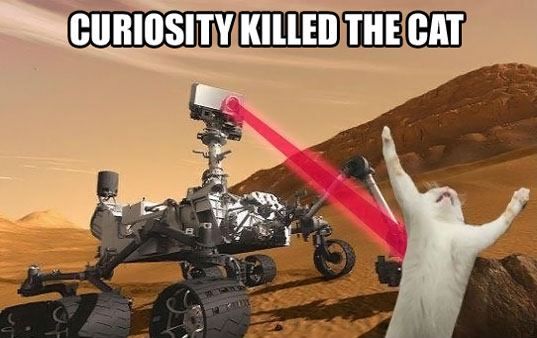
Trope Tuesday: Curiosity is a Crapshoot

curiosity
Is there life on Mars? NOT ANYMORE!

Is curiosity a bad thing?  Well, it depends how genre savvy you are.  It seemed to work out pretty well for Alice, but not quite so well for Pandora (or the rest of the ancient Greek world, for that matter).  Curious monkeys seem to come out all right, and their constantly curious counterparts also seem to do okay in the end, but anytime you run into schmuck bait you know that things aren’t going to turn out well.

The truth is, for just about every stock Aesop warning about the perils of being overly nosy, you can find another one exalting it as a virtue.  In fact, you could say that curiosity is a crapshoot.

But what is curiosity exactly?  The Merriam-Webster dictionary defines it as “desire to know,” and “interest leading to inquiry.” As you can imagine, there are situations where this could be good or bad.  Thus, what a story says about curiosity often changes depending on its genre.

For example, in most horror stories, curiosity and nosiness are usually bad, leading the protagonists to go places where they shouldn’t and uncover things that should never have been uncovered.  At the same time, a lack of curiosity can also be fatal … in fact, a lot of things can be fatal in a horror story.

In mythology and folklore, curiosity is often even worse.  From Pandora to Eve, Psyche to the proverbial cat, curiosity leads to Very Bad Things.  Perhaps this is because these kinds of stories are mostly tales of warning, passed on from generation to generation as a way to preserve our collective knowledge about the dangers of the world, rather than inspire us to go out and face them.

(As a side note, there are a few exceptions in the realm of folklore.  In the Bluebeard myth, curiosity killed off all of Bluebeard’s previous wives, but combined with cleverness, faith, and friendship, it saved the last one’s life.)

In fantasy, curiosity is often a mixed box bag.  For example, take the hobbits: most of them are perfectly content to live out their lives in the shire, but the few who are inquisitive enough to venture outside end up saving the world in a way that the elves, dwarves, and humans never could.  At the same time, it puts them through a great deal of pain, even after the world is saved–neither Bilbo nor Frodo are ever able to be content in the shire again.

Curiosity, in other words, is complicated.  It’s not just a quirk or a character flaw–it’s an underlying quality of the hero’s journey.  Without curiosity, either of the world around him or the internal struggles within, the hero would be content to live out an unremarkable life.  Certainly he wouldn’t have the capacity for the cleverness, guile, wisdom, and sensitivity that he needs in order to descend into the darkest dungeon, face his own nadir, and return with the elixir of life.  Curiosity may lead to sorrow, pain, or even death, but it also leads to adventure.

As a subgenre of fantasy, many of these issues carry over into the realm of science fiction.  And yet, as a genre unto itself, science fiction has a distinctly positive view of curiosity compared to other genres.  Science is nothing if not the primary process of human inquiry, where curiosity is not only a virtue but the virtue, one of the most important aspects of humanity.  Consider these words from Adam Steltzner, one of the leading engineers of the NASA Mars Curiosity mission:

Likewise, curiosity is a staple of science fiction.  In Star Trek, it’s the basis of the entire mission: “to explore strange new worlds, to seek out new life and new civilizations, to boldly go where no one has gone before.” In Doctor Who, it’s how the Doctor finds his companions.  In Babylon 5, it’s Delenn’s curiosity about the humans that ultimately saves all the alien races.  And in 2001: A Space Odyssey, it’s the gift from the black monolith that helps monkeys to turn bones into space stations (well, not literally, but you get the idea).

Curiosity isn’t a central theme in most of my books, but it is a major part of Genesis Earth.  If anything, that book is about the importance of balancing curiosity about our universe with curiosity about ourselves and what it means to be human.  In Star Wanderers, Noemi’s curiosity is a huge part of her story, helping her to turn around a horrible (not to mention awkward) situation.  In Desert Stars, curiosity is complicated; it leads Jalil far away from home and puts a schism between him and the girl who loves him, but it also leads him to discover the truth about who he is, giving him the strength to return.

In general, I suppose it all comes down not only to genre, but to the underlying worldview of the author of the story.  Since I have a very positive and enthusiastic view of curiosity, it usually works out for the best in the stories that I write. Then again, perhaps that’s why I’m drawn to science fiction … how about you?
Random thoughts on creativity and a cover preview

I’ve noticed that I tend to go through at least two revisions on most of my stories.  The first one generally identifies the problems in the rough draft and eliminates them, while the second one adds anything that’s missing and smooths the story over so that it works as a whole.  They both use different parts of my brain: one critical, the other creative.  Since both are important, I can’t easily skip either of them, and combining them into one mega-revision doesn’t really work because it’s hard to switch from one mode to the other.

I’m currently in the second revision for Star Wanderers: Dreamweaver, and it’s coming along really well so far.  Now that I’m in creative mode, it’s a lot easier to add stuff that was missing from the first draft and tidy up some other parts that seem a little disjointed.  With luck, this revision should be finished in a day or two.  It’s really only one chapter that needs the bulk of the work–according to my first readers, everything else is pretty good.  Far be it from me to fix something that isn’t broken.

###

The other day, an old friend of mine emailed me with a question about the world building / plotting process I followed for Star Wanderers.  I wrote a fairly lengthy response, and while most of it was a more detailed explanation of the stuff I’ve already included in the various author’s notes, I came up with some advice that surprised me:

If I had to give any advice, I’d say that the most important thing is to just feed your creativity.  You can’t force your imagination, just like you can’t get any more golden eggs by killing the goose that lays them.  However, you can organize your life and your environment in such a way that bursts of creativity are longer and more frequent.  A huge and important part of it is learning to turn off your internal critic, especially on the rough draft.  Sometimes, if I spend too much time thinking about writing, it paralyzes me so that I can’t actually write–but if I trick myself into opening my WIP without really thinking about it, then ten minutes later I’m plugging away and the ideas are flowing.  And just as bad habits can be very harmful, good habits can be very helpful.

I think a lot of us creative types tend to force ourselves a little too much, especially when we’re first getting started.  We want to be productive, we want to have something that we can show for ourselves in order to feel validated, especially with so many people raising eyebrows at our dreams and creative pursuits.  But productivity goals, while important, are really only a means to an end–and they’re not even the most important means most of the time.

If you want your work to ring with authenticity, or to reflect the truth and beauty you see in the universe, you have to be in touch with that kind of stuff.  And once you get back in touch with the stuff that drove you to create in the first place, there’s nothing that you want to do more.

This morning, I wrote for three hours in one sitting, and I wasn’t tempted by any distractions at all.  I only produced about 1.3k words, but they were good words that added both to the story and my understanding of the story.  I got back in touch with the spark that drove me to write it in the first place, and hopefully that spark will carry through to the readers.  I think that it will.

So yeah–it’s not about productivity goals, or reworking our creative process to be more like someone else’s, or any number of other writerly insecurities.  It’s all about story, and everything that drives us to tell them.

###

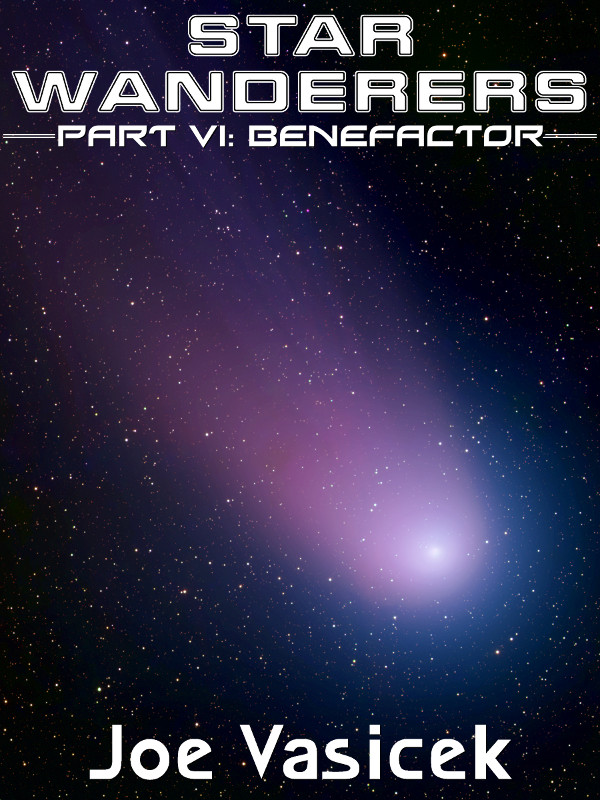
All right, if you’re still reading (or even if you cheated and skipped ahead), I have a treat for you.  I just found the AWESOMEST image for the cover of Star Wanderers: Benefactor, which I hope to finish up later this week after finalizing the revisions for Dreamweaver.  Here’s the cover:

SW-VI Benefactor (cover)

Pretty cool, eh? I <3 NASA. 😀

The picture is of Comet C/2001 Q4 (NEAT), taken by the WIYN 0.9-meter telescope at Kitt Peak National Observatory near Tucson, Arizona.  It was taken on 7 May 2004, and covers an area roughly five times the size of the moon.  As with all NASA images, it’s in the public domain.

The inspiration actually came from comet PANSTARRS, which is visible in the sky right now.  I tried to catch a glimpse of it tonight from the Y Mountain trail head, but there were too many clouds on the horizon to see it clearly.  Hopefully, the skies will be clearer tomorrow.

In related news, comet ISON later this year is expected to put on a really incredible show.  Astronomers think that for a brief time, it may even shine brighter than the moon, making it visible even during the day!  If that happens, it’s going to be AWESOME.  Mark it on your calendars for November–it’s going to be great!

That’s just about it for now.  I’d better get back to forming those good habits I mentioned earlier–like actually getting to bed at a reasonable hour. Later!

Worldcon 2011: Saturday

Alright, I should just write this up and finish my convention report before life sweeps me away completely.

Saturday was the main day of the con.  To be honest, I forgot all the panels I went to, except this really awesome one by a guy at NASA on near Earth objects (NEOs).  Holyfreakingcow there are thousands of these objects AND WE ARE SENDING MISSIONS TO THEM!!!  So cool!

I went to a kaffeklatsch with Nancy Kress, which turned out to be quite an interesting experience.  She’s an extremely gracious person, much like Tracy Hickman, and gave some excellent career advice: 1) no matter the obstacles or difficulties, always find a way to keep writing, and 2) always be true to the story.

Had dinner with some other Utah writers, and I wish I could say it was pleasant, but for some reason it got very antagonistic.  I know it takes two to tango, but I honestly don’t know what I did to make it that way.  Perhaps stress levels were running high, or people misread my tone, but the conversation at our table completely fell apart at least twice.  It was very wierd.

Part of it might have to do with the fact that I’ve become something of a trailblazer for indie publishing within the SLC / Utah Valley writing community.  Which brings me to another side note: everyone talks about how militant and polarizing self publishers are, when in my experience it’s the advocates of traditional publishing who tend to adopt an us vs. them attitude.  To be sure, there are plenty of desperate to be published writers who take the indie path just to “stick it to the man,” but those people tend to fade away once they realize it isn’t a silver bullet.

Anyway, the Hugo Awards in the evening were great!  Robert Silverberg presented the award for Best Novella, and for fifteen minutes he was my favorite person in the world.  So hilarious!  I’ve tried to find a video, but there doesn’t seem to be one up yet.  Utah writers were nominated in six categories, and even though none of them won, the competition was pretty dang good, so I don’t feel so bad about losing.

All in all, it was a great convention!  I had a lot of fun, even if I did feel a little exhausted by the end of it.  I’m not sure if I’ll be attending future worldcons in my current capacity as a beginning writer, but I most likely will buy supporting memberships in order to vote in the Hugos (and download the voting packet).  It’s a good community, and I’m glad to be a part of it.

Thanksgiving report from Texas

So for Thanksgiving this year, I drove down with my sister and brother in law to have Thanksgiving in Houston with my other sister’s family.  It’s Friday night, and I’m about to hit the sack to get prepped for the long 24+ hour drive back to Utah, but let me say, this vacation has been great!

It’s so good to spend time with family, especially when you live across the country and can’t see each other very often.  My niece has grown so much in the past year, and she is so freaking cute it’s unbelievable.  Earlier tonight, we were watching slide shows on my sister’s projector and playing around with my niece: “Where’s Aunt Dot?  Where’s Oopah?  Where’s Uncle Joe?” Heh, Uncle Joe.  I will do my best to live up to the awesomeness of that title.

Thanksgiving dinner was AMAZING.  Holy freaking crap, my sisters can cook.  They put together a traditional dinner from scratch, and everything was perfect.  I’m so glad they’re sending a bunch of leftovers with us on the drive tomorrow, because I would much rather subsist on that than random junk food from gas stations.

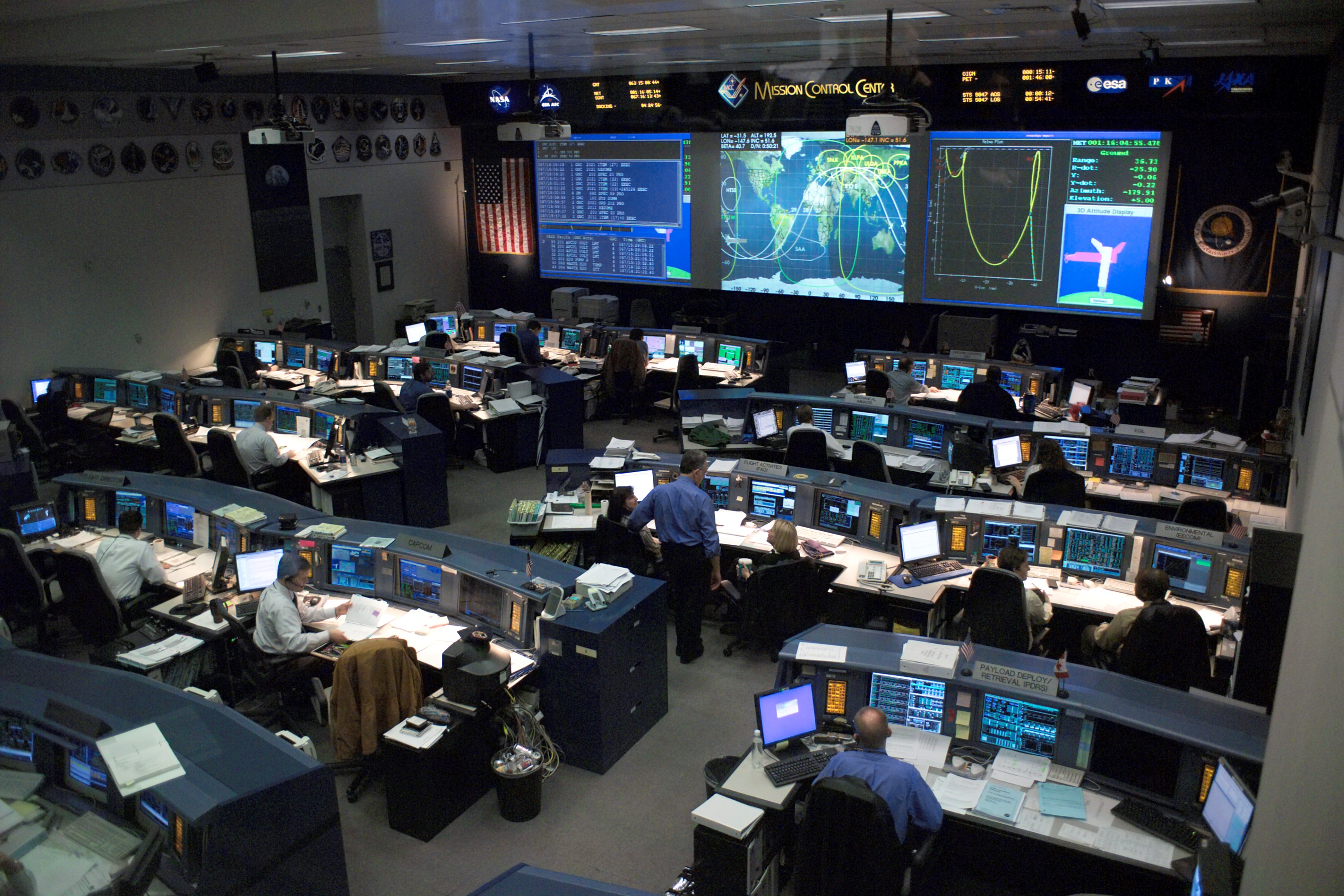
Besides family, though, one of the coolest parts of the vacation was visiting the Houston Space Center and seeing mission control and one of the original Saturn V rockets.  That’s right–see that room in the picture?  I was there.

Which immediately begged the question: Why am I not in space right now?  Seriously, I would do just about anything to go up in space.  Thinking about the Pilgrims made me think about colonizing other planets, and how the difficulties may be similar and yet different.  It also made me think about my latest novel, Into the Nebulous Deep, which (I’m hoping) is a colonization story set in space, and how I can use some of the stuff from the Pilgrims in my own work.

Speaking of which, the writing has been going very slow recently.  A lot of it has to do with interruptions from the vacation (which frankly are more important), but it also has to do with my growing frustrations with the current project.  I’m about 15k in the rough draft of ITND, and…it just doesn’t seem as good as my other work.  Of course, it’s just a mental thing–none of my rough drafts has ever been any good–but man, it’s tough to get through.

To complicate things, I’m going to have to find a job for the Christmas season, at least to tide me over.  I’m really hoping to get that wilderness job, but the training starts January 13th, and I don’t have the funds to spend all my time writing, like I have this past month.

I’ll know for sure the first week of December whether I’ve been invited to the training–and if I am, it’s going to throw a real kink in my writing routine.  Each job shift lasts a full week, during which time I’ll be completely unplugged, living in the wilderness.  I might get some time to work on poetry or short stories, but no novels.

The upside is that I get six days off completely free to do whatever I want, but I’m worried that it’ll be difficult, at least at first, to regain sufficient momentum in that short time.  I’m sure I can get used to it eventually, but for the first few months, it will probably be tough.

For that reason, I want to get as far in ITND as I can before January 13th, perhaps even finish it (HAHAHAHA!!!  As if that’s going to happen).  So the fact that I haven’t progressed from this one scene for like a week is really killing me.  Throw in a temporary job for the Christmas season, and I’ll probably go crazy.

That’s what my writing angst says, anyways.  In other words, everything is fine and life is great.  Now I’m going to get some sleep before driving across the freaking country all day tomorrow and Sunday.  Night!