Fantasy from A to Z: S is for Sanderson

Brandon Sanderson is, without a doubt, the most popular fantasy writer currently living and writing today. He is also one of the classiest and most gracious authors you will ever meet, in any genre. I’ve also got a personal connection to him, from taking his writing class at BYU.

Brandon decided to become a writer when he was very young. The way he explains it, the bug really bit him when he read Dragonsbane by Barbara Hambly. Depression runs in his family, and growing up, he always felt emotionally monotone and distant—until he read that book. From then on, he became obsessed with fantasy, both with reading and with writing it.

The way I heard Brandon explain it, that emotional monotone has been both a personal struggle and a great asset. It’s part of the reason he’s able to write so much, since where other writers tend to have huge emotional swings that affect their ability to write, Brandon is able to just sit down and do the work, day after day after day. It’s also part of what gives him an even keel that makes him such a gracious and generous person. Where other writers tend to get worked up on social media or join outrage mobs, Brandon avoids all of that. I don’t think I’ve ever seen or heard of him becoming outraged about anything.

Brandon was one of the last major authors to break into book publishing before the indie revolution began turning everything upside down. He broke in by researching agents and editors, attending all the important conferences, and networking with everyone who’s anyone in the genre. He also wrote a lot of really good books—as well as a lot of crappy ones. I believe that Elantris, his debut novel, was actually the sixth novel he wrote, and Mistborn: The Final Empire was something like the 13th. He landed his agent, Joshua Bilmes, from attending World Fantasy, and his agent eventually got him his publisher, Moshe, at Tor.

Elantris and Mistborn were good, but not immediate bestsellers. In fact, Brandon was on track to be an average mid-list fantasy author with a relatively unremarkable career, until Robert Jordan died, leaving the Wheel of Time unfinished. By that point, a lot of readers felt frustrated with the series and used his death as an opportunity to write scathing screeds about how it had gone off of the rails and grown far too bloated and large. But Brandon was much more classy and gracious than that, and wrote a tribute to the man instead, praising his work and the impact it had had on his life. When Robert Jordan’s widow read Brandon’s post, she decided that he was the one who should finish the Wheel of Time.

Personally, I’m not a huge Wheel of Time fan. I read the first three books and enjoyed them, but I got lost midway through the fourth book. My wife read them all and feels like the series is overrated, and I generally trust her judgment. But I can appreciate how a lot of people really love the series—and really, there is a lot to love. Just because it isn’t to my personal taste doesn’t mean that it isn’t good. 

My friends who are Wheel of Time fans tell me that Brandon not only finished the series—he rescued it. Apparently, the last three books rejuvenated the series, wrapping things up in an incredibly satisfying way. Of course, Brandon would defer and say that it wasn’t his genius that turned the series around, but Robert Jordan’s original vision and the detailed notes and outlines that Brandon followed. But there’s no denying that Brandon really stuck the landing.

It was around this point in the story that I met Brandon. I was a student at BYU at the time, and I had an opportunity to take his writing class. From the time when I was eight, I had wanted to be a writer, but I didn’t think I would ever turn it into a career. Brandon’s writing class changed all that, and helped me to see that I could pursue writing as a career. He also taught me the nuts and bolts of writing fiction, vastly improving my writing skills. I had started several novels in high school, but never finished anything until I took his class. And while my first finished novel was a disaster that I promptly locked in the trunk, my second novel attempt (which I started writing in Brandon’s class) ultimately became my debut, Genesis Earth.

(As a side note, my wife was also in that ‘08 class with Brandon Sanderson, though we didn’t actually meet each other until almost a decade later when we matched on Mutual. She also started a writing group with her college roommate, who won the Writers of the Future and married into Brandon Sanderson’s writing group. Our writing group has also got one of Brandon’s college roommates.)

Brandon’s success with Wheel of Time was what catapulted Brandon from a midlist author to a bestselling phenomenon. But even then, if he wrote at the same slow pace as most other fantasy authors, he would have forever been known as “the guy who finished Wheel of Time.” Instead, he became famous for writing and publishing massive +300k word doorstopper tomes at an unprecedented rate, leading fans to joke about his writing super powers. Then the pandemic happened, and he wrote four “secret” novels with all of the extra time he had from not traveling anywhere. The fans went crazy, and his kickstarter blew everything out of the water.

I haven’t read all of Brandon’s books. I really loved the Mistborn era I books, and the first Stormlight Archive book was good, but my favorite is Emperor’s Soul, because I think that Brandon is at his best when he writes shorter novels rather than the massive +300k word doorstopper tomes. In my experience, Brandon is a 3-star author who writes 5-star endings. His writing tends to meander, especially in the early middle, but around the 3/4ths mark there’s usually a twist that brings things together, and the conflict escalates consistently until it builds into a really satisfying ending.

Brandon is also known for his hard magic systems, which have become a signature trait of his books. Some readers feel that clearly explaining the rules of magic defeats the sense of wonder that a fantasy novel should have, but that’s not been my experience with his books. When I read a Brandon Sanderson novel, I feel almost like I’m reading a video game. Knowing the ins and outs of the magic helps me to see the possibilities for the characters to use it, and Brandon is usually really good at adding an unexpected twist, exploiting the rules of magic in a surprising yet inevitable way. This creates its own sense of wonder that really adds to his books.

Brandon also is known for how all of his books are tied together into the same transdimensional “cosmere” multiverse, though I actually think this is the least remarkable thing that makes his books so distinctive. For one thing, he’s not the first one to do it—David Gemmell also discretely linked all of his books, which blew my mind when I discovered that particular easter egg. For another thing, Brandon has turned his cosmere from a delightfully hidden easter egg and nod to the fans to the grand key that you must possess in order to understand and appreciate his later books. As a result, the cosmere is becoming an obstacle to new readers, even as his most ardent fans all swoon over the cosmere connections.

I think Brandon’s ultimate goal is to turn his books into a massive cinematic universe, kind of like the MCU. From what I understand, he was really close to signing a Hollywood deal, but it fell through at the last minute, leaving him back at square one (I don’t know all the details, though Jon Del Arroz did some interesting reporting on that). This is also probably why his books have become more woke in recent years. 

I’ve already written at length about that subject, so I won’t belabor the point here. But I really do feel that this represents a betrayal of his more conservative fans, many of whom turned to Brandon precisely because his books tend to be free of all of the gratuitous language and sexual content of most modern fantasy. Also, one of Brandon’s really great strengths during the gamergate and puppygate fannish controversies of the 2010s was his strict neutrality. While the culture wars were raging all around them, he continued to be his classy and gracious self, refraining from picking sides or wading into the mudfest. With the LGBTQ romantic subplot in Wind and Truth, that appears to have changed.

I hope he turns away from all of that. What the world really needs right now are books that transcend the whole woke vs. anti-woke divide, bringing us together and healing the artificial (and in many cases subversive) divisions that pit us against each other. Maybe Brandon will surprise me, and accomplish exactly that, just from the left side of the aisle. But as of Wind and Truth, I can’t help but wonder if we’ve reached peak Sanderson. Only time will tell.

Regardless, I will always be grateful to Brandon Sanderson for the things he taught me, and for all of his graciousness and generosity that he showed in his writing class. Without that experience, I probably would have pursued a different career, and not written nearly so many books. I also probably would not have married my wife, since one of the big things that drew her to me was my love and dedication to my writing craft. 
Fantasy from A to Z: M is for Magic

Magic! What would fantasy be without it? About the same place as science fiction if you took out the science. Speculative fiction is all about the sense of wonder that it makes you feel, and the main way that fantasy does that is through magic.

In Brandon Sanderson’s writing class (which he has generously made available to the public, by videotaping and podcasting his lectures), Sanderson divides magic into two broad types: hard magic and soft magic. And while some fantasy readers take issue with the way that Sanderson leans more toward hard magic in his own books, the division he draws between hard and soft magic is still quite useful.

Soft magic is the kind of magic that isn’t fully explained, and is mostly left up to the reader’s imagination. Magical things happen, and we don’t know how or why, but it helps to instill a feeling that the world is vast and wondrous. As such, soft magic is primarily used as a way to enhance the setting.

In Tolkien’s Lord of the Rings, a good example of this is the elves. We know that they are immortal and that they are far more glorious than most other races, but we never really know the full extent of their capabilities. Gandalf is another example of this. Just what was he doing with the Balrog, and how did defeating that ancient beast in a marathon spelunking-hiking-wrestling match? Who knows!

And that’s the biggest criticism of soft magic: if you don’t know how the magic works, how do you know that the heroes won’t just pull a rabbit out of their hat to save them at the last possible moment? Or summon the eagles, which amounts to the same thing. For that matter, if the eagles are so awesome, why don’t the heroes just fly on their backs all the way to Mount Doom? I mean, can you believe what it would have been like if they had to walk the entire way? Somebody might have died!

Hard magic, on the other hand, is the kind of magic where everything is explained. It’s not just magic, but a whole magic system, which operates by rules in the same way that our physical universe works according to rules. In essence, it is the fantasy inverse of Clarke’s third law, where any sufficiently explained magic is indistinguishable from science. The reader might not know all of the rules, but the writer does, and he drops enough hints throughout to make the reader confident that there are rules.

In Lord of the Rings, a good example of hard magic is the ring of power itself. What does it do? It makes you invisible if you put it on (though it makes you shine like a beacon to Sauron and his ringwraiths), and it tempts you with false promises of power, with the goal of leading you back into the clutches of Sauron. If Sauron ever gets the ring, it’s game over, because he will regain all of his powers. Oh, and it also stretches out your lifespan, at the cost of your quality of life (and quite possibly your sanity).

Because we know the rules the govern the magic of the one ring, we aren’t upset when Tolkien uses that magic to advance the plot of the book. Indeed, that is the biggest strength of hard magic: that it can be used in all sorts of interesting and creative ways to advance the plot.

“But hold on!” the advocates of soft magic will say. “If you reduce your magic into a fancy plot device, it kills the sense of wonder that comes with the best magic systems.” After all, there’s a reason why Tom Bombadil is in the book. There are two big things that happen when the hobbits make their detour to his house: first, Tom Bombadil puts on the ring and shows that it has absolutely no effect on him; and second, when Frodo puts on the ring and goes invisible, Tom Bombadil demonstrates that he can still see Frodo. 

It’s subtle, but it’s there—and believe it or not, it’s there for a reason. By demonstrating that there are higher or more powerful forces that can supersede the laws of magic surrounding the one ring, Tolkien preserves that sense of vastness and wonder that more rules-based magic systems tend to lose.

There is a rejoinder to that point, however. When hard magic is done well, it creates its own sense of wonder, more akin to what we feel when we’re playing a good video game. It’s the wonder that comes from imagining what it would be like to exercise the kind of magical powers that we see the characters exercise. Brandon Sanderson is a master of this, and my favorite example is from his novella The Emperor’s Soul. By the end of that book, I couldn’t help but daydream what I would do if I had my own set of soulstamps. One of them would make me an awesome writer, the other an awesome marketer, and the third an awesome publisher. How cool would that be? (Okay, maybe you have to be an indie author yourself to fully get it… but still!)

As you can probably guess, though, the best fantasy novels feature a blend of hard and soft magic—and Sanderson says as much in his lectures. There’s a reason why he draws from Lord of the Rings for examples of each, much as I’ve done here. And ultimately, it’s less of a binary and more of a spectrum. The important thing is to know when to lean more toward the soft side, and when to lean more to the hard side. The best authors can play to the strengths of both to capture that magical sense of wonder that makes fantasy such a pleasure to read.

Midichlorians vs. the Philotic Web, or a new dimension to Brandon Sanderson’s first rule of magic

I got into an interesting discussion today with my brother-in-law about science fiction & fantasy, specifically about whether explaining something too much takes away from the sense of wonder that is so critical to those genres.  It started out with a discussion of Star Wars I: The Phantom Menace, which (surprisingly) he actually kind of likes, and eventually got on to Brandon Sanderson’s first law of magic.

I was trying to explain why The Phantom Menace was so broken, and after hemming and hawing over various things came to the midichlorians.  That, more than anything else, threw me out of the story.  By explaining the Force in such a banal, insipid way, it undid all the magic of the previous trilogy and completely sterilized it.  There was no sense of wonder after that point–explaining the Force completely killed it, just like over-explaining any magic system always kills that sense of wonder.

… or does it?  Because there are quite a few wonder-inducing magic systems that get explained in great detail.  Take the Philotic Web, for example.  In Xenocide, Orson Scott Card explains, in great detail, how the physics behind the ansible system works.  And yet, by doing so, he increases that sense of wonder to the point where Xenocide is one of my favorite of his books.  Why?  Because it introduces a bunch of implications that lead to even more questions, more mysteries.

With The Phantom Menace, of course, that isn’t the case–the midichlorian thing is basically a clumsy ass pull that fails in the magic department just as hard as Jar-Jar Binks does at comic relief.  But it doesn’t fail because it over-explains things, it fails because it explains the magic in a way that doesn’t allow room to explore the implications.  As much as I hate to admit it, Lucas could have pulled off the midichlorian thing if the implications had been relevant to more things in the story than just a simple plot point.

This is where Sanderson’s first law comes in.  Basically, Sanderson’s first law states that there’s an inverse relationship to how well the magic can induce wonder versus how well the magic can advance the plot.  In order to advance the plot through magic, you have to explain how the magic works to some degree, and that’s going to take away from the sense of wonder.

But as we’ve just shown, that isn’t always the case.  Sometimes the sense of wonder gets even stronger the more the magic gets explained.  This is especially true in science fiction that follows the one big lie approach, where one thing (wormholes, reactionless drives, time travel) is truly fantastic and everything else more or less follows the laws of physics as we understand them; in order to maintain the suspension of disbelief, the story is basically forced to explore all the implications of the magic, often to great detail.

In other words, explaining the magic isn’t always like building a wall–sometimes, it’s like building a door.  Yes, it lays down a boundary that closes off the imaginative spaciousness that a story really needs to convey that sense of wonder, but if the explanation leads to new questions–new mysteries–then that sense of wonder can be maintained.  Instead of walling the reader in, it throws the reader into a maze with countless secret chambers to explore.

The relationship between plot-based magic and wonder-based magic is not linear, as Brandon Sanderson’s first law implies.  Rather, there’s a second dimension that has very little to do with his law, and learning how to traverse that dimension is key to maintaining the sense of wonder in any story.

I haven’t figured out a pithy way to explain all this yet, but I’m going to, hopefully within the next few days.  If you guys have any thoughts on the subject, please feel free to share.  I’m definitely interested in hearing your perspectives on it.

The Dying Earth by Jack Vance

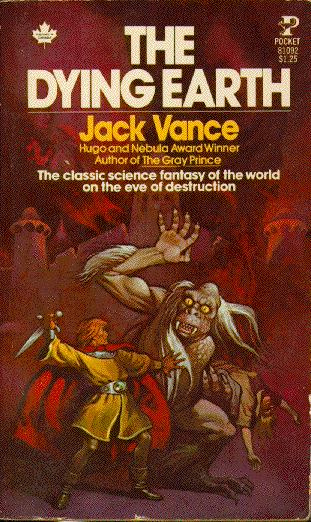
the_dying_earthDo you remember those creepy-weird montages from those old 60s and 70s era Disney movies?  The ones like Dumbo, or The Three Caballeros–or heck, the entire thing of Fantasia–where all these weird kaleidoscopic shapes and psychedelic colors just move in and out of each other in twisted, convulsing ways?  Well, guess what?  Jack Vance’s The Dying Earth is like one of those montages in written form, and I loved it.
I picked up this book in order to familiarize myself a little better with the Sword & Planet subgenre, which I’d like to write in (as you may remember … my WIP is currently on hold, but I’d like to pick it up again soon).  This one is a lot different from the Princess of Mars series, with an eerie apocalyptic feel, arcane magic and forbidden knowledge, weird, monstrous creatures, and above all else, a decidedly un-Disney fairy-tale feel that pervades the book with doom and danger.

If you’re looking for straight-up Science Fiction, you’re better off looking elsewhere.  This book is even more fantastic than Ray Bradbury’s stuff, and while there’s a little bit of a sci-fi dressing thrown in, there really is no scientific justification for anything.  The basic premise is that the Earth is dying, meaning that the sun is growing dimmer and dimmer and will soon go completely out.  The last few people eking out an existence on this planet are mostly wizards and witches, each one intent on building their own little empire and cheating or stealing from everyone else.  There are a few pure-hearted souls, but the world is completely lawless, and the only way to survive is through magic or brute force.

The chapters are really more like interconnected short stories, where each one stands on its own, and yet may feature a recurring character, or be set in the same place as another.  There were only six chapters in the version I read (the 1977 Pocket Book edition), which makes me wonder if I missed any.  If I did, I would definitely like to read them, because the stories were absolutely mesmerizing!

Because I read this book to get a feel for the sub-genre, I’m going to list some of the things I really enjoyed about it.  Here they are:

  • The fairy-tale story structure.  None of the chapters started out with “there once was a …” but it certainly felt like they did.  Each character started off with a quest or dilemma, and then went on a journey of some sort where they faced trials, made friends, and defeated enemies in order to attain some sort of boon at the end.
  • Lots and lots of world-breaking magic.  Seriously.  One of the guys sets out on his journey with a spell that basically keeps him from any danger whatsoever, so long as he stays on “the path.” Since he really has no idea where he’s going, “the path” is basically any path he chooses to travel.  Since all the rest of the magic is just as world-breaking, you have no idea what could happen next.  There’s always a sense that anything could happen.
  • An elevated sense of diction.  The characters don’t speak like we do, they speak like people from the 18th or 19th centuries, with words like “thus,” “whence,” “wherefore,” and grammatical structures like “I know not,” and “half yet remains.” It’s not just the characters, either–the whole book is like that.  It really adds to the fantastic, otherworldly feel.
  • Lots of contrasting extremes.  The demons are truly perverse and sadistic, with death and brutality on every other page.  At the same time, though, the moments of beauty and love are just as great.  My favorite line from the whole book, which practically made me cry, is “My brain is whole! I see–I see the world!” If I explained it any more, it would be a spoiler.
  • High adventure.  LOTS and LOTS of high adventure.  There isn’t a viewpoint character in the book who doesn’t leave home to go on some sort of quest through all sorts of wild and creepy dangers.  Every character is seeking something, and not in a “meh” kind of way–they are so wholly focused on what they’re seeking that they put their very lives in peril just to obtain it.  Almost all the romance is rescue-romance, of the pulpiest possible kind.  It’s awesome.

There are more, but those are the big things.  Overall, I’d say that this book is about 50% Fantasy, 30% Horror, and 20% Science Fiction, with none of the more modern conventions of any of those genres.  It was first published in 1950, but it feels a lot closer to Robert E. Howard and Jules Verne than J.R.R. Tolkien and Arthur C. Clarke.  If you’re looking for a good spec-fic throwback with lots of magic and adventure, this is a great one to check out.

F is for Faster Than Light

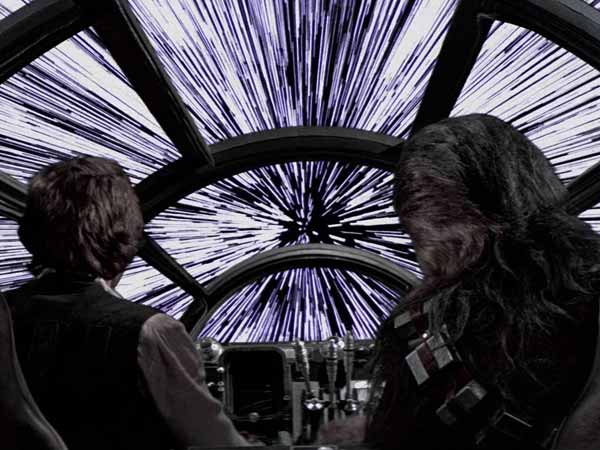
falcon_startrailsRemember that moment in Star Wars when the Millennium Falcon went into hyperspace?  When Harrison Ford shouted “go strap yourselves in, I’m going to make the jump to light speed,” and the sky lit up as the stars streaked by?  That was my first introduction to faster-than-light (FTL) travel, and I haven’t looked back since.

FTL is a major recurring trope in space opera, and not just because of how cool it is.  If you’re going to have a galactic empire, you need some way to get around that empire–or at least some way to transmit information without too much difficulty.  The distance between star systems is measured not in miles or kilometers, but light years–that is, the distance that a particle of light can travel in one year.  Considering how the nearest star to Earth, Proxima Centauri, is ~4.24 ly away, you can see the need for some sort of magical technology to bridge the distance.

FTL travel comes in four basic flavors:

  • Warp Drives — The ship breaks the speed of light as easily as our modern fighter jets break the speed of sound.  Impossible to justify, except through hand-waving.  The most prominent example of this is Star Trek.
  • Jump Drives — The ship disappears from its current position and reappears somewhere else.  Also requires hand-waving, but is at least a little easier to justify.  Battlestar Galactica is a good example of this, as is Schlock Mercenary.
  • Hyperspace Drives — The ship enters an alternate dimension which allows it to travel faster through our own.  The alternate dimension is called ____space, usually “hyper” but also “quasi,” “x,” etc.  Star Wars is the classic example, though Star Control II took things a step further by having a hyperspace dimension within hyperspace.
  • Wormgate Network — The ship (or maybe just the passengers) enters a portal which transports it to a portal somewhere else.  A network of these portals allows travel throughout the galaxy.  Stargate and Babylon 5 use this method.

An alternate way to do it is to make FTL travel impossible, but hold the galactic empire together through FTL communication.  This technology, known as the ansible, features prominently in Ursula K. Le Guin’s books and the Ender’s Game universe.  It has some really interesting implications: for example, even though planets can communicate instantaneously with each other, it takes almost 40 or 50 years to go from one to another, but at near-light speeds, it feels as if only a few months have gone by.  Thus, if you’re going to travel to another world, you have to leave everything behind, including your family and loved ones.  By traveling from world to world, you can skip entire generations, spreading your natural lifespan across thousands of years of normal time.

In writing FTL, one thing you have to be really careful about is to keep in mind ways in which the system can be abused.  For example, if jump drive technology makes it possible to instantaneously transport anything anywhere in the universe, then you can bet that someone is going to send a bomb into the White House (or whatever the equivalent is in your fictional universe).  Thus, the invention of unrestricted jump drive technology will lead to a very short and brutal war.

This actually happened in Schlock Mercenary, and the solution was Terraport Area Denial (TAD) zones, or broad areas of space where a force field prevents anyone from either jumping in or out.  Thus, anyone who wants to visit a planet in a TAD zone has to jump to the edge of the field and travel the rest of the way at sublight speeds.

FTL isn’t always appropriate for a science fiction story.  If the story is supposed to lean more toward hard sf, then it’s probably better to stick with our current understanding of the rules of physics, which state that nothing can travel faster than the speed of light.  Still, with things like quantum entanglement and other recent discoveries, if you know the science well enough, even the speed of light might not be an upper limit.  But for the rest of us mortals, FTL is basically just magic–a sufficiently explained magic, perhaps, but magic nonetheless.

Personally, I’m a fan of the jump drive form of FTL.  That’s the one I use the most in my own books.  The cost is that the further distance you try to jump, the harder it is to pinpoint exactly where you’ll end up.  To overcome this, you can use jump beacons to draw out anyone trying to jump into your particular sector and have them exit jumpspace next to the beacon.  This comes in handy in combat, when the enemy tries to jump a nuke onto your ship.

In the later Gaia Nova books, FTL is facilitated by jump stations spread out in a line across space, with reactors powerful enough to jump ships rapidly to the next point along the line.  In the earlier Star Wanderers books, that technology hasn’t been invented yet, so there’s still an Outworld frontier.

It gets kind of complicated, but it’s lots and lots of fun to world build.  For example, how does a particular change in the FTL tech alter the galactic balance of power?  When settlers try to colonize a new system, what do they establish first–starlanes, jump beacons, Lagrange outposts, or what? As with any magic, changing one thing affects everything else, which also affects everything else, which … yeah, you get the picture.

Story Notebook #5 (part 2)

For those of you who don’t know (or can’t remember, since it’s been so long), I’ve been doing this ongoing thing where I go through my old story notebooks.  Last time, we covered my last semester of classes at BYU; this time, we’ll cover my time in Washington DC, when I was trapped in an internship from hell.

Now, you may be wondering: “why is this guy just giving away his ideas for free?” Well, last week at dinner group, the conversation turned to story ideas, so I pulled out my current story notebook and started going down the list.  This quickly turned into a game of “name that tune,” where we managed to show that EVERY SINGLE IDEA had already been done. 

And you know what?  That’s perfectly okay!  There are no original ideas anymore, just new ways of executing them, and maybe a handful of combinations that haven’t yet been tried.  The purpose of keeping a story notebook with you at all times isn’t to come up with something new, it’s to keep track of the stuff that really turns you on.

Enough with that.  On to the notebook.

In a spacefaring culture, the custom will be for the males to leave the station and depart in search of a wife at another port, either to capture or win over in some way.  The women will tend more to running off with the travelers.  This preserves genetic diversity.

This is actually something I want to talk about in a longer post.  The problem of inbreeding in a space-based society is something that many science fiction authors have wrestled with, from Robert Heinlein to C. J. Cherryh.  Their solutions are quite inventive, but while I was in Washington DC working on To Search the Starry Sea (my escapist retreat from a hellish internship), I managed to come up with a few of my own, and used them in Star Wanderers.  More on that later.

What if one of the founders was a time traveler, sent on a mission to ensure that the US constitution made it through?

Hehe…in other words: James Madison, Time Traveler.  It has a certain ring to it, no?

The human mind is like a congress–so many people at extreme odds, arguing constantly but holding together somehow.

Oh boy.  If that were true, the US congress today would be like a paranoid schizophrenic.

A subway haunted by patrons from the past–maybe you will become one when it goes back in time.

Who hasn’t been creeped out by the subway at some point or another?  Except the New York subway system is way creepier than the Washington DC Metro–I swear, some of those rats are man-killers.

A magic system where the cost is your unborn children.  If you don’t have children within a certain period of time, you die.

Sounds like some of the Arab short stories I’ve read.  Families and children are much more important to them than to us in the West.

When the Developed World develops instantaneous transportation devices, it will essentially merge into one super country, while the developing world will be left out.  The only sense of distance will be in the developing world, and terrorism will be an issue.

Kind of like Larry Niven meets dependency theory.

A government where the Supreme Court is a super-intelligent robot.

Hopefully this would rid the country of activist judges…or would it??

A character who believes, at his core, that there is no such thing as a genuine surprise, simply a lack of information–and that if we had perfect information, there would be no surprises.

Sounds a lot like the platonic 19th century ideal of a scientist.  What with quantum physics and such, there aren’t a whole lot of those left.

There are two kinds of shame: shame from loss of honor, and shame from not following the herd.  Don’t mistake the one for the other.

This one isn’t so much a story idea as an observation.  I learned a lot in my hellish Washington DC internship, most of which had very little to do with my area of study and everything to do with the less-than-honorable ways in which the world works.  And on that note:

____ always felt that the world around him was somehow less than real; an illusion.  While staring out the window of the train, he wondered if the window wasn’t just a video screen, like the car windows of old movies–or when looking out at the view of the mountains beyond his house, with the picturesque clouds and too-blue sky, if it wasn’t just an elaborate painting on a wall at the end of the world.  In moments like these, ____ longed to peel back the video screens–to break down the pretty painted wall at the end of the world–and see what lay on the other side of reality.

If my hellish internship on K street taught me anything, it taught me that I would rather be a writer than have all the connections or political influence in the world.  I got out of Washington DC as fast as I could, and haven’t looked back since.

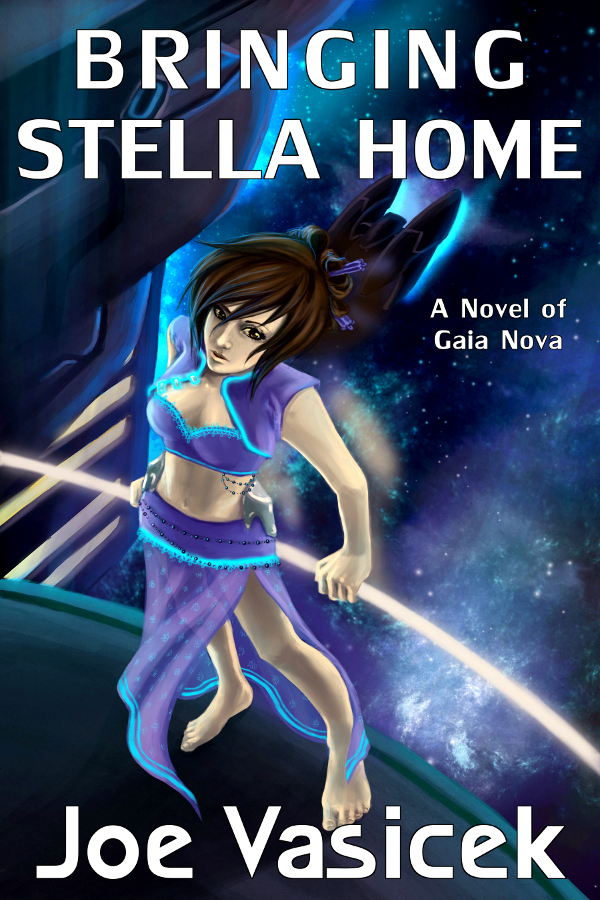
Bringing Stella Home is now up on Amazon!

That’s right–after a whole lot of work, my novel is now up on Amazon for $3.95.  Check it out!
This novel is the first of a much larger series that I have planned.  It’s not a series like Ender’s Game or Song of Ice and Fire, though; all of the novels are supposed to stand alone, though they share the same setting and feature recurring characters.  In that sense, it’s more like Gemmell’s Drenai series.

Even though the series is space opera, I tried to keep the science plausible at least on a high school level.  So while there’s “magic” like FTL and artificial gravity, I’ve tried to bend rather than break the laws of physics.

At its core, the story is more about the characters than the setting or even the plot.  It follows a young boy who is determined, at all costs, to save his brother and sister, even as his world quite literally falls to pieces all around him.  Along the way, he meets up with a mercenary captain who is running from some demons of her own.  The way they help each other overcome their personal challenges is a major driving force throughout the book.

Anyhow, I suppose that’s enough.  I could ramble on forever, but I don’t want to get in the way too much.  Thanks so much, and I hope you enjoy it!

Another publication in Leading Edge!

That’s right!  My poem “Zarmina,” dedicated to Gliese 581 g (the first exoplanet discovered in its sun’s habitable zone) is published on page 98 of issue 61 of Leading Edge!

Also included in this issue is an excellent essay by Brandon Sanderson, in which he introduces his second law of magic systems.  It’s an excellent essay, and has made me rethink how I do FTL systems, especially for the Gaia Nova universe.  I’ll have to do a post a little later on that.

Besides this landmark essay by Brandon Sanderson, this issue features stories by Dan Wells and Dave Farland, as well as an interview with Howard Tayler.  And as always, it includes a number of excellent stories and illustrations.  Check it out!

(Full disclosure, I volunteer as a slushpile reader and occasional copy editor for the magazine.  However, my work always goes through the submission process under a pen name, where only the head editor knows who I am until the decision on whether to acquire the story has been made.)

In other news, Genesis Earth is now up on Goodreads, so go check that out as well!  The nice thing about Goodreads is that you can give the book a # star rating without having to write out anything else.  If you’re so inclined, I would very much appreciate an honest review–but if you do give it a rating, please be honest.  Don’t worry; even if you give me less than five stars, I won’t hunt you down like this crazy author (hint: get some popcorn and read the comments).

So anyhow, that’s what’s been going on here.  Desert Stars is coming along slowly but surely, and I’m working on getting some cover art for Bringing Stella Home.  If you have any ideas or suggestions on the art, please let me know.  I’ll probably go through my back issues of Leading Edge to search out good sf artists.  For some reason, I’m having a hard time finding anything that clicks on deviantart.  My goal is to epublish that book by the end of July.

Why I love Robert Charles Wilson

From Mysterium, which I plan to review here soon:

“Do you ever wonder, Howard, about the questions we can’t ask?
“Can’t answer, you mean?
“No. Can’t ask.
“I don’t understand.”
Stern leaned back in his deck chair and folded his hands over his gaunt, ascetic frame. His glasses were opaque in the porch light. The crickets seemed suddenly loud.
“Think about a dog,” he said. “Think about your dog–what’s his name?”
“Albert.”
“Yes. Think about Albert. He’s a healthy dog, is he not?”
“Yes.”
“Intelligent?”
“Sure.”
“He functions in every way normally, then, within the parameters of dogness. He’s an exemplar of his species. And he has the ability to learn, yes? He can do tricks? Learn from his experience? And he’s awarer of his surroundings; he can distinguish between you and your mother, for instance? H’es not unconscious or impaired?”
“Right.”
“But despite all that, there’s a limit on his understanding. Obviously so. If we talk about gravitons or Fourier transforms, he can’t follow the conversation. We’re speaking a language he doesn’t know and cannot know. The concepts can’t be translated; his mental universe simply won’t contain them.”
“Granted,” Howard said. “Am I missing the point?”
“We’re sitting here,” Stern said, “asking spectacular questions, you and I. About the universe and how it began. About everything that exists. And if we can ask a question, probably, sooner or later, we can answer it. So we assume there’s no limit to knowledge. But maybe your dog makes the same mistake! He doesn’t know what lies beyond the neighborhood, but if he found himself in a strange place he would approach it with the tools of comprehension available to him, and soon he would understand it–dog-fashion, by sight and smell and so on. There are no limits to his comprehensions, Howard, except the limits he does not and cannot ever experience.
“So how different are we? We’re mammals within the same broad compass of evolution, after all. Our forebrains are bigger, but the difference amounts to a few ounces. We can ask many, many more questions than your dog. And we can answer them. But if there are real limits on our comprehension, they would be as invisible to us as they are to Albert. So: Is there anything in the universe we simply cannot know? Is there a question we can’t ask? And would we ever encounter some hint of it, some intimation of the mystery? Or is it permanently beyond our grasp?”

This is the kind of science fiction that I love: the kind that brings me right up to the limits of human knowledge and makes me feel naked in the face of the unknown. The kind where the aliens truly feel alien, not like an unusually bizarre race of human beings. I want the aliens to surprise me–I want to feel that there’s something about them that is completely beyond my comprehension. Something sublime, something romantic.

In all of his books that I’ve read, Robert Charles Wilson captures this feeling spectacularly. So does Arthur C. Clarke, C. J. Cherryh, and Orson Scott Card. Larry Niven, Jerry Pournelle, John Scalzi and Alastair Reynolds are excellent writers, and I’ve genuinely enjoyed their books, but their aliens are too…understandable. Too clear cut, too defined. After a while, you don’t feel that there’s anything left to surprise you, anything that is so alien it’s beyond your grasp.

In some ways, I think this boils down to the author’s worldview. Those with a more positivist worldview believe that the world is fundamentally understandable, and that every phenomenon can be modeled and predicted, provided that we have a sophisticated enough understanding of natural law. The interpretivist worldview, on the other hand, posits that while truth may exist, there are limits to our understanding–that some things are inherently unpredictable and impossible to model.

I used to think that I was a positivist. Then I took Poli Sci 310 with Goodliffe, and it turned my world upside down. Genesis Earth is, in some ways, a product of that personal worldview shift. I don’t think I’m anywhere near on par with my aliens as Wilson, Clarke, and Card are with theirs, but I hope I’m on my way.