Fantasy from A to Z: M is for Magic

Magic! What would fantasy be without it? About the same place as science fiction if you took out the science. Speculative fiction is all about the sense of wonder that it makes you feel, and the main way that fantasy does that is through magic.

In Brandon Sanderson’s writing class (which he has generously made available to the public, by videotaping and podcasting his lectures), Sanderson divides magic into two broad types: hard magic and soft magic. And while some fantasy readers take issue with the way that Sanderson leans more toward hard magic in his own books, the division he draws between hard and soft magic is still quite useful.

Soft magic is the kind of magic that isn’t fully explained, and is mostly left up to the reader’s imagination. Magical things happen, and we don’t know how or why, but it helps to instill a feeling that the world is vast and wondrous. As such, soft magic is primarily used as a way to enhance the setting.

In Tolkien’s Lord of the Rings, a good example of this is the elves. We know that they are immortal and that they are far more glorious than most other races, but we never really know the full extent of their capabilities. Gandalf is another example of this. Just what was he doing with the Balrog, and how did defeating that ancient beast in a marathon spelunking-hiking-wrestling match? Who knows!

And that’s the biggest criticism of soft magic: if you don’t know how the magic works, how do you know that the heroes won’t just pull a rabbit out of their hat to save them at the last possible moment? Or summon the eagles, which amounts to the same thing. For that matter, if the eagles are so awesome, why don’t the heroes just fly on their backs all the way to Mount Doom? I mean, can you believe what it would have been like if they had to walk the entire way? Somebody might have died!

Hard magic, on the other hand, is the kind of magic where everything is explained. It’s not just magic, but a whole magic system, which operates by rules in the same way that our physical universe works according to rules. In essence, it is the fantasy inverse of Clarke’s third law, where any sufficiently explained magic is indistinguishable from science. The reader might not know all of the rules, but the writer does, and he drops enough hints throughout to make the reader confident that there are rules.

In Lord of the Rings, a good example of hard magic is the ring of power itself. What does it do? It makes you invisible if you put it on (though it makes you shine like a beacon to Sauron and his ringwraiths), and it tempts you with false promises of power, with the goal of leading you back into the clutches of Sauron. If Sauron ever gets the ring, it’s game over, because he will regain all of his powers. Oh, and it also stretches out your lifespan, at the cost of your quality of life (and quite possibly your sanity).

Because we know the rules the govern the magic of the one ring, we aren’t upset when Tolkien uses that magic to advance the plot of the book. Indeed, that is the biggest strength of hard magic: that it can be used in all sorts of interesting and creative ways to advance the plot.

“But hold on!” the advocates of soft magic will say. “If you reduce your magic into a fancy plot device, it kills the sense of wonder that comes with the best magic systems.” After all, there’s a reason why Tom Bombadil is in the book. There are two big things that happen when the hobbits make their detour to his house: first, Tom Bombadil puts on the ring and shows that it has absolutely no effect on him; and second, when Frodo puts on the ring and goes invisible, Tom Bombadil demonstrates that he can still see Frodo. 

It’s subtle, but it’s there—and believe it or not, it’s there for a reason. By demonstrating that there are higher or more powerful forces that can supersede the laws of magic surrounding the one ring, Tolkien preserves that sense of vastness and wonder that more rules-based magic systems tend to lose.

There is a rejoinder to that point, however. When hard magic is done well, it creates its own sense of wonder, more akin to what we feel when we’re playing a good video game. It’s the wonder that comes from imagining what it would be like to exercise the kind of magical powers that we see the characters exercise. Brandon Sanderson is a master of this, and my favorite example is from his novella The Emperor’s Soul. By the end of that book, I couldn’t help but daydream what I would do if I had my own set of soulstamps. One of them would make me an awesome writer, the other an awesome marketer, and the third an awesome publisher. How cool would that be? (Okay, maybe you have to be an indie author yourself to fully get it… but still!)

As you can probably guess, though, the best fantasy novels feature a blend of hard and soft magic—and Sanderson says as much in his lectures. There’s a reason why he draws from Lord of the Rings for examples of each, much as I’ve done here. And ultimately, it’s less of a binary and more of a spectrum. The important thing is to know when to lean more toward the soft side, and when to lean more to the hard side. The best authors can play to the strengths of both to capture that magical sense of wonder that makes fantasy such a pleasure to read.
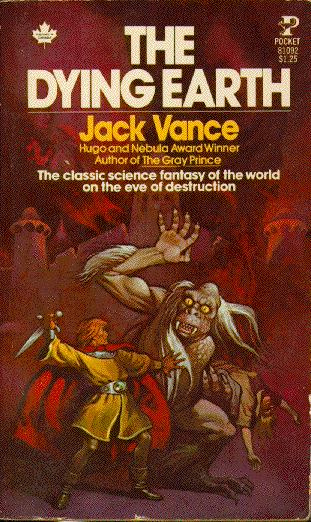
The Dying Earth by Jack Vance

the_dying_earthDo you remember those creepy-weird montages from those old 60s and 70s era Disney movies?  The ones like Dumbo, or The Three Caballeros–or heck, the entire thing of Fantasia–where all these weird kaleidoscopic shapes and psychedelic colors just move in and out of each other in twisted, convulsing ways?  Well, guess what?  Jack Vance’s The Dying Earth is like one of those montages in written form, and I loved it.
I picked up this book in order to familiarize myself a little better with the Sword & Planet subgenre, which I’d like to write in (as you may remember … my WIP is currently on hold, but I’d like to pick it up again soon).  This one is a lot different from the Princess of Mars series, with an eerie apocalyptic feel, arcane magic and forbidden knowledge, weird, monstrous creatures, and above all else, a decidedly un-Disney fairy-tale feel that pervades the book with doom and danger.

If you’re looking for straight-up Science Fiction, you’re better off looking elsewhere.  This book is even more fantastic than Ray Bradbury’s stuff, and while there’s a little bit of a sci-fi dressing thrown in, there really is no scientific justification for anything.  The basic premise is that the Earth is dying, meaning that the sun is growing dimmer and dimmer and will soon go completely out.  The last few people eking out an existence on this planet are mostly wizards and witches, each one intent on building their own little empire and cheating or stealing from everyone else.  There are a few pure-hearted souls, but the world is completely lawless, and the only way to survive is through magic or brute force.

The chapters are really more like interconnected short stories, where each one stands on its own, and yet may feature a recurring character, or be set in the same place as another.  There were only six chapters in the version I read (the 1977 Pocket Book edition), which makes me wonder if I missed any.  If I did, I would definitely like to read them, because the stories were absolutely mesmerizing!

Because I read this book to get a feel for the sub-genre, I’m going to list some of the things I really enjoyed about it.  Here they are:

  • The fairy-tale story structure.  None of the chapters started out with “there once was a …” but it certainly felt like they did.  Each character started off with a quest or dilemma, and then went on a journey of some sort where they faced trials, made friends, and defeated enemies in order to attain some sort of boon at the end.
  • Lots and lots of world-breaking magic.  Seriously.  One of the guys sets out on his journey with a spell that basically keeps him from any danger whatsoever, so long as he stays on “the path.” Since he really has no idea where he’s going, “the path” is basically any path he chooses to travel.  Since all the rest of the magic is just as world-breaking, you have no idea what could happen next.  There’s always a sense that anything could happen.
  • An elevated sense of diction.  The characters don’t speak like we do, they speak like people from the 18th or 19th centuries, with words like “thus,” “whence,” “wherefore,” and grammatical structures like “I know not,” and “half yet remains.” It’s not just the characters, either–the whole book is like that.  It really adds to the fantastic, otherworldly feel.
  • Lots of contrasting extremes.  The demons are truly perverse and sadistic, with death and brutality on every other page.  At the same time, though, the moments of beauty and love are just as great.  My favorite line from the whole book, which practically made me cry, is “My brain is whole! I see–I see the world!” If I explained it any more, it would be a spoiler.
  • High adventure.  LOTS and LOTS of high adventure.  There isn’t a viewpoint character in the book who doesn’t leave home to go on some sort of quest through all sorts of wild and creepy dangers.  Every character is seeking something, and not in a “meh” kind of way–they are so wholly focused on what they’re seeking that they put their very lives in peril just to obtain it.  Almost all the romance is rescue-romance, of the pulpiest possible kind.  It’s awesome.

There are more, but those are the big things.  Overall, I’d say that this book is about 50% Fantasy, 30% Horror, and 20% Science Fiction, with none of the more modern conventions of any of those genres.  It was first published in 1950, but it feels a lot closer to Robert E. Howard and Jules Verne than J.R.R. Tolkien and Arthur C. Clarke.  If you’re looking for a good spec-fic throwback with lots of magic and adventure, this is a great one to check out.

F is for Faster Than Light

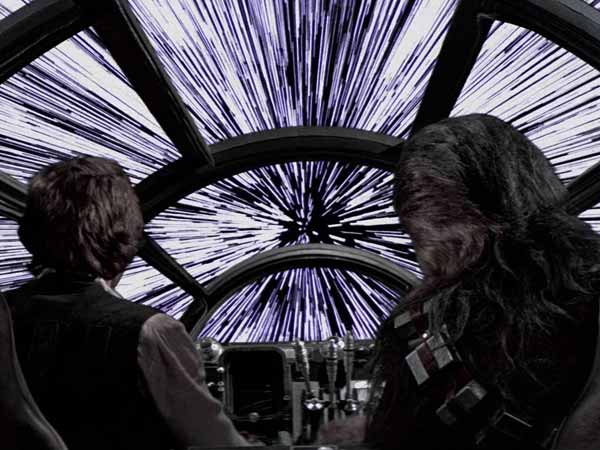
falcon_startrailsRemember that moment in Star Wars when the Millennium Falcon went into hyperspace?  When Harrison Ford shouted “go strap yourselves in, I’m going to make the jump to light speed,” and the sky lit up as the stars streaked by?  That was my first introduction to faster-than-light (FTL) travel, and I haven’t looked back since.

FTL is a major recurring trope in space opera, and not just because of how cool it is.  If you’re going to have a galactic empire, you need some way to get around that empire–or at least some way to transmit information without too much difficulty.  The distance between star systems is measured not in miles or kilometers, but light years–that is, the distance that a particle of light can travel in one year.  Considering how the nearest star to Earth, Proxima Centauri, is ~4.24 ly away, you can see the need for some sort of magical technology to bridge the distance.

FTL travel comes in four basic flavors:

  • Warp Drives — The ship breaks the speed of light as easily as our modern fighter jets break the speed of sound.  Impossible to justify, except through hand-waving.  The most prominent example of this is Star Trek.
  • Jump Drives — The ship disappears from its current position and reappears somewhere else.  Also requires hand-waving, but is at least a little easier to justify.  Battlestar Galactica is a good example of this, as is Schlock Mercenary.
  • Hyperspace Drives — The ship enters an alternate dimension which allows it to travel faster through our own.  The alternate dimension is called ____space, usually “hyper” but also “quasi,” “x,” etc.  Star Wars is the classic example, though Star Control II took things a step further by having a hyperspace dimension within hyperspace.
  • Wormgate Network — The ship (or maybe just the passengers) enters a portal which transports it to a portal somewhere else.  A network of these portals allows travel throughout the galaxy.  Stargate and Babylon 5 use this method.

An alternate way to do it is to make FTL travel impossible, but hold the galactic empire together through FTL communication.  This technology, known as the ansible, features prominently in Ursula K. Le Guin’s books and the Ender’s Game universe.  It has some really interesting implications: for example, even though planets can communicate instantaneously with each other, it takes almost 40 or 50 years to go from one to another, but at near-light speeds, it feels as if only a few months have gone by.  Thus, if you’re going to travel to another world, you have to leave everything behind, including your family and loved ones.  By traveling from world to world, you can skip entire generations, spreading your natural lifespan across thousands of years of normal time.

In writing FTL, one thing you have to be really careful about is to keep in mind ways in which the system can be abused.  For example, if jump drive technology makes it possible to instantaneously transport anything anywhere in the universe, then you can bet that someone is going to send a bomb into the White House (or whatever the equivalent is in your fictional universe).  Thus, the invention of unrestricted jump drive technology will lead to a very short and brutal war.

This actually happened in Schlock Mercenary, and the solution was Terraport Area Denial (TAD) zones, or broad areas of space where a force field prevents anyone from either jumping in or out.  Thus, anyone who wants to visit a planet in a TAD zone has to jump to the edge of the field and travel the rest of the way at sublight speeds.

FTL isn’t always appropriate for a science fiction story.  If the story is supposed to lean more toward hard sf, then it’s probably better to stick with our current understanding of the rules of physics, which state that nothing can travel faster than the speed of light.  Still, with things like quantum entanglement and other recent discoveries, if you know the science well enough, even the speed of light might not be an upper limit.  But for the rest of us mortals, FTL is basically just magic–a sufficiently explained magic, perhaps, but magic nonetheless.

Personally, I’m a fan of the jump drive form of FTL.  That’s the one I use the most in my own books.  The cost is that the further distance you try to jump, the harder it is to pinpoint exactly where you’ll end up.  To overcome this, you can use jump beacons to draw out anyone trying to jump into your particular sector and have them exit jumpspace next to the beacon.  This comes in handy in combat, when the enemy tries to jump a nuke onto your ship.

In the later Gaia Nova books, FTL is facilitated by jump stations spread out in a line across space, with reactors powerful enough to jump ships rapidly to the next point along the line.  In the earlier Star Wanderers books, that technology hasn’t been invented yet, so there’s still an Outworld frontier.

It gets kind of complicated, but it’s lots and lots of fun to world build.  For example, how does a particular change in the FTL tech alter the galactic balance of power?  When settlers try to colonize a new system, what do they establish first–starlanes, jump beacons, Lagrange outposts, or what? As with any magic, changing one thing affects everything else, which also affects everything else, which … yeah, you get the picture.

Trope Tuesday: Supernatural Aid

Getting back to our discussion of the Hero’s Journey, I think it’s important to briefly touch on one of the earlier stages: supernatural aid.  At some point between refusal of the call and crossing the threshold of adventure, the hero typically encounters a mentor figure from the unfamiliar world who gives him something supernatural or otherworldly to help him on his quest.  While the mentor often dies (as we saw last week), the supernatural aid that the mentor gives later proves to be a key to defeating the big bad and passing the ultimate test.

Often, this is an actual object.  In Lord of the Rings, for example, Galadriel gives each member of the fellowship a specific object.  She gives Sam a magical vial, which he uses later to defeat Shelob and save Frodo and the ring.  In The Lion, The Witch, and the Warderobe, Aslan gives each of the kids a weapon item specially suited to their characters (except Edmund, who was a prisoner of the queen at the time).  In Star Wars IV: A New Hope, Obi Wan gives Luke his father’s lightsaber–though for the purposes of this trope, we can also count his special training with the force, since Luke doesn’t use the lightsaber until episode V.

In discussing this trope, Joseph Campbell said the following:

Having responded to his own call, and continuing to follow courageously as the consequences unfold, the hero finds all the forces of the unconscious at his side. Mother Nature herself supports the mighty task. And in so far as the hero’s act coincides with that for which his society is ready, he seems to ride on the great rhythm of the historical process.

So if the mentor is supposed to die (or get put on a bus) in order for the hero to stand on his own feet, why does the hero need some kind of supernatural aid?  Isn’t that just cheating?

Not exactly.  Often, the aid is itself part of the ultimate test, and the hero doesn’t figure out how to use it properly until after he’s already experienced everything from the adventure that he needs.  The silver slippers from The Wizard of Oz are a good example of this.  So is AURYN from The Neverending Story.  The hero doesn’t fall back on the supernatural aid until after he’s completed his growth arc.

That’s not the only reason, though.  In order for the adventure to have meaning and impact, the stakes have to be really high.  Having some sort of mysterious character from the outside world grant the hero something supernatural is a great way to do this, especially at the beginning.  If the hero is part of something bigger than himself–saving the world, for example–then it makes sense that he would get some kind of help from the people depending on him, especially if those people have something supernaturally powerful to give.

The Force from Star Wars is one of my favorite examples of supernatural aid.  I hear that when episode IV debuted in the theaters, the crowds jumped up and screamed when Obi Wan said “use the force, Luke!” in the clip at the top of the post.  Just because it’s so awesome, here’s the full scene (more or less):

“Remember–the force will be with you. Always.”

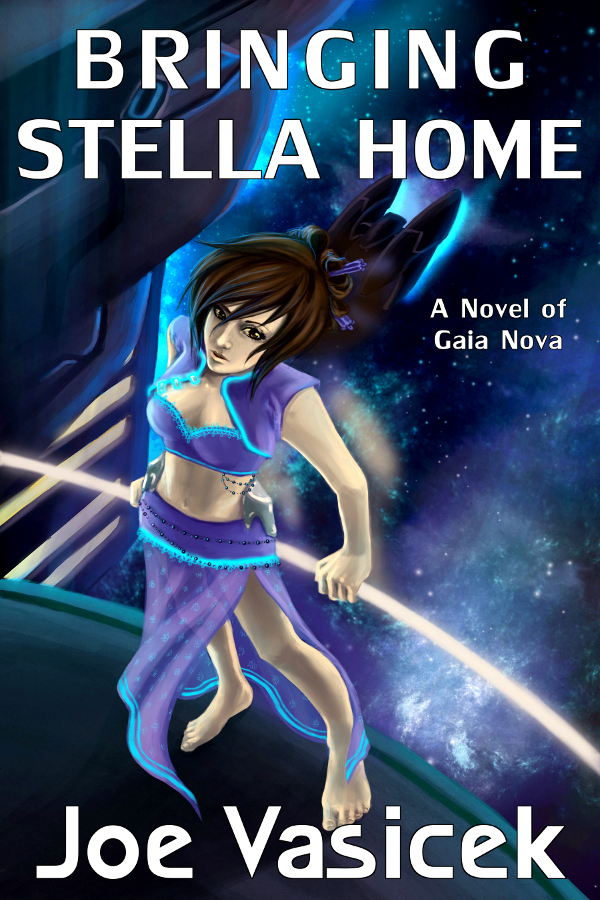
Bringing Stella Home is now up on Amazon!

That’s right–after a whole lot of work, my novel is now up on Amazon for $3.95.  Check it out!
This novel is the first of a much larger series that I have planned.  It’s not a series like Ender’s Game or Song of Ice and Fire, though; all of the novels are supposed to stand alone, though they share the same setting and feature recurring characters.  In that sense, it’s more like Gemmell’s Drenai series.

Even though the series is space opera, I tried to keep the science plausible at least on a high school level.  So while there’s “magic” like FTL and artificial gravity, I’ve tried to bend rather than break the laws of physics.

At its core, the story is more about the characters than the setting or even the plot.  It follows a young boy who is determined, at all costs, to save his brother and sister, even as his world quite literally falls to pieces all around him.  Along the way, he meets up with a mercenary captain who is running from some demons of her own.  The way they help each other overcome their personal challenges is a major driving force throughout the book.

Anyhow, I suppose that’s enough.  I could ramble on forever, but I don’t want to get in the way too much.  Thanks so much, and I hope you enjoy it!

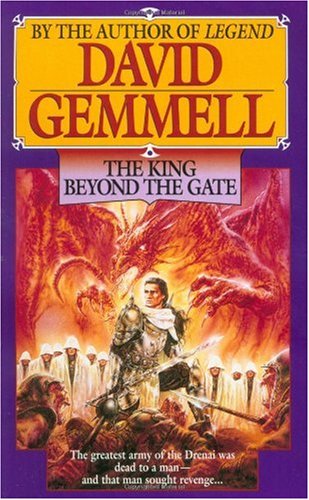
The King Beyond the Gate by David Gemmell

Tenaka Khan was a child of two nations and an outsider to both.  Half Nadir, half Drenai, the only home he ever knew was in the ranks of the Dragon, the elite fighting forces of the Drenai.  But now, a mad dictator rules the land, and the Dragon has been destroyed.

With all his friends dead at the hand of the evil Drenai emperor, Tenaka has only one desire: to steal into the palace and assassinate him.  Along the way, however, he makes a number of friends, all of whom seek the same thing, but all for different reasons.  As they join forces with the Skoda rebels, Tenaka realizes that he not only has something to die for–he has something to live for.

But in order to defeat the mad emperor, the rebels must fight the Joinings–terrible creatures made from man and beast, who slaughtered the Dragon years before.  Only the Nadir can save them–but the Nadir want nothing more than to ravage the Drenai.

If  you’ve read my review of David Gemmell’s Legend, you know why I love his books.  This one was no less incredible.  Parts of it were just as poignant as anything in Legend, and the ending, while bittersweet, was no less satisfying.

It’s really fascinating to me, because Gemmell’s books are not particularly flowery or well written.  His descriptions are sparse, his prose is unassuming, his characters, while distinguished from each other, sound more or less the same, and his viewpoint is often inconsistent.  But in terms of raw storytelling, his books are unequaled by anything else I’ve ever read.

He makes me fall in love with his characters: I cheer for them when they rise to the heroic deeds that circumstances demand of them, I cry when they fall short of what they could have been, and I weep when they give their lives in the service of something greater than themselves, which is almost invariably the case.

My favorite part of any David Gemmell book has got to be the order of warrior priests known as the Thirty.  They don’t show up in every book, but they show up in many of them, and they always share the same characteristics.  The warrior priests are dedicated to the Source (Gemmell’s equivalent of God in his Drenai universe), and have the supernatural abilities to speak telepathically, put thoughts into others’ minds, shield their comrades from the magic of the Chaos brethren, and leave their bodies to fly across the world and do battle in other dimensions beyond the grave.

The way the order is run is absolutely fascinating.  One person is the mouth, the other the ears, the other the heart, etc.  The most unlikely characters always fill the particular roles–but always for good reason.  They fight to defend the innocent and pure, but more than that, they always have some great destiny to perform–a destiny that invariably pits them against the forces of Chaos in some great, decisive battle.  In that battle, all of them invariably die, except for the weakest among them, who goes out to found the next order of the Thirty.

I don’t know about you, but this kind of stuff, just makes me want to jump up and down.  This is fantasy at its best–good versus evil, warriors facing death, and the most unlikely heroes rising to the level of greatness that war and honor demand of them.  Throw in a little magic, a brotherhood of evil sorcerers bent on crushing all that is good in the world, and terrible monsters the likes of which exist only in nightmares, and I am so there, man–I am so there.

In short, this book was nothing less than awesome.  If you love any book by David Gemmell, I think you’ll enjoy this one.  It’s got everything you could possibly expect from heroic fantasy, and more.

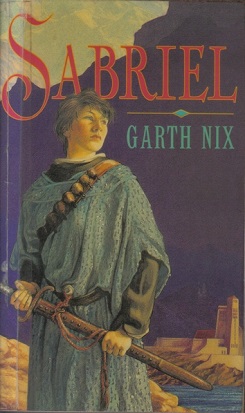
Sabriel by Garth Nix

Sabriel doesn’t know it, but her father is more than just a powerful necromancer; he is a key in the political intrigue of the Old Kingdom–the land beyond the wall. When he interrupts her class at Wyverly college by sending a hand–an enslaved spirit–from beyond the fourth gate of Death to drop off his sword and magic bells, Sabriel knows that something is wrong.

Something is holding her father hostage in Death, and Sabriel is determined to find him and rescue him. When she crosses over the wall, however, into the world of magic, both free and charter, she discovers just how little she knows about the history of the world, and the conflict in which her father was intimately involved. On this side of the wall, the world nearly ended two hundred years ago, and something that should have passed beyond the ninth gate of Death has come back to finish what it started and claim the world as its own…

I read this book for English 318 this year; we discussed it in class a couple of weeks ago. I ended up reading the book in about 48 hours, and as far as required reading goes, it wasn’t bad. Not bad at all. In fact, I really enjoyed it.

Garth Nix creates a fascinating world in this book, with magic that feels wondrous and otherworldly and places that feel fantastic. His conception of Death as a river with nine gates–nine waterfalls–is extremely fascinating, and the use of the bells to cast spells is really well done. The first hundred pages of this book felt a little bit like the beginning of The Dark Is Rising: it felt really dark and spooky, like being lost in the woods and knowing that something ancient and dangerous was out there with you.

The characters were also interesting and likeable. Sabriel is a necromancer who, in some ways, is afraid of facing death–the fact that everyone has to go at sometime. This is a YA book, so she was basically a young adult thrown in way over her head, tossed back and forth from crisis to crisis. At the same time, she takes charge often enough that she is definitely not just a weak character, driven passively from place to place. When the love interest enters the story, she’s basically the “prince” that rescues him from the “dragon,” repeatedly.

The biggest issue I had with this book was its predictability. It seemed that I could see every plot development and big reveal at least fifty pages before it happened. That said, the main thing driving me through the book wasn’t the plot–it was the setting and the characters. Sabriel has to learn some difficult lessons in order to succeed, and the magic she uses is just really freaking cool. Charter symbols, free magic, the five great seals of the charter, the nine gates of Death and the voices of the bells–cool stuff. That was enough to keep me interested, despite the relatively straightforward and unsurprising plot.

Overall, this was definitely a good fantasy. Garth Nix does a great job creating a sense of wonder, and his characters were interesting too. If you like fantasy and haven’t yet heard of this one, I’d definitely recommend it.