A clip of this podcast showed up in my YouTube recommendations, and it was interesting enough that I clicked through to the full-length interview. Definitely worth a listen. Adam Lane Smith really knows his stuff—and he’s not at all woo woo or touchy feely like most of the women people giving relationship advice. Just solid, practical, down-to-earth “this is how it is,” kind of like hoe_math except concise and to-the-point, with a Christian angle and scientific evidence. Very interesting stuff.
Tag: love
2019-10-10 Newsletter Author’s Note
This author’s note originally appeared in the October 10th edition of my author newsletter. To subscribe to my newsletter, click here.

I saw Joker yesterday. Don’t worry, I won’t give away any spoilers. It was every bit as incredible as I expected it to be, and yet in some key ways, not what I was expecting at all.
First, the basics. This movie is dark. Very, very dark. I believe this is the darkest, most terrifying iteration of the Joker ever made. Part of that is because it is so realistic. There are no magical superpowers, no aliens or infinity stones or any of that stuff. This story could have already happened in our world. It could yet happen.
That said, it is clear that the people who made it have deep respect and appreciation for the franchise. It isn’t like The Last Jedi, where the filmakers explicitly tried to subvert all of the things the fans love about Star Wars. In many ways, Joker is a homage to all of the iterations of Batman that have come before it. This could just as well be the origin story of Cesar Romero’s Joker as Heath Ledger’s.
Joaquin Phoenix is incredible. I didn’t think it was possible to do a better Joker than Heath Ledger, but Phoenix has done it. He really draws you into the Joker’s head, and his transformation from a broken misfit to a sociopathic supervillian is believable, compelling, and utterly terrifying. He earned every moment of the eight-minute standing ovation this movie received on its debut.
There is a dramatic arc to violence that very few movies, TV shows, or even books show in its entirety. When a character swings an axe at someone’s head, the scene usually cuts. You know what happened. But in Joker, you see everything. It’s a lot like Blade Runner in that respect. The bodycount is not that high, but the violence really hits you, and stays with you.
If you aren’t in touch with your dark side, this movie will profoundly disturb you. It will also screw with your mind. If you struggle with PTSD, this is probably one to avoid, unfortunately. Even if you think you like dark movies, this one may be too much for you. But if you do enjoy it, you will probably want to see it again, and again. There are so many layers to this movie that a single viewing is not enough to fully take it all in.
Without question, Joker is a major cultural landmark. It is, above all else, a brutally clear and damning indictment of all of us. In a world convinced that guns cause violence, Joker focuses on mental health and the cracks in our healthcare system. In a world obsessed with priviledge and inequality, Joker is about our pathological lack of empathy and compassion.
Part of the controversy surrounding this movie is the gulf between the critics who hate this movie, and the general audience, which loves it. After watching it, I think the critics can be divided into three camps.
First, there are the social elites who are so out of touch with the reality that the rest of us live in that Joker is anathema to their lived experience. It’s not that they hate it, so much as that they’re confused and bewildered by it. They are also bewildered by Brexit and the election of Donald Trump.
Second, there are the wokescolds who hate Joker because they recognize it as an indictment of themselves. They deride it as an “incel movie” because they know that their woke politics are partly responsible for creating a culture where “incels” are a thing, and that drives these people to violence.
I actually think that this isn’t the case for most of the critics. Sargon of Akkad recently put out a video on this, and while I agree with him that the wokescold critics see Joker as a mirror, I don’t think they see themselves as the people who drive the Joker into psychopathic madness. Instead, I think that the vast majority of the wokescold critics see themselves in the Joker.
In Milo Yiannopoulos’s interview with Jordan Peterson, he made the very salient point that the angriest, most radical people on the far left are, in their personal lives, broken and in pain. Often, they are victims of abuse. Personally, I would expand that to include many on the alt-right as well, but the point still stands.
The wokescolds want to see themselves as heroes working to overcome systems of oppression and inequality. They see themselves as builders, but Joker shows them that all they really want is to burn it all down. That’s why I believe this movie has provoked such a virulent backlash from the wokescolds: because it is a mirror that shows them as they really are, and they are terrified of what they see in it.
Without love, it is impossible for our culture and society to heal. That, I believe, is Joker’s ultimate message. The reason that Arthur becomes the Joker is because no one ever showed him any compassion, empathy, or love. He laughed through the pain until the pain made him laugh, and became the villain that Gotham deserved.
How often do we really listen to each other? How often do we reach outside of ourselves and genuinely connect? A recent study shows that the average American hasn’t made a single new friend in the last five years. Is that you? Is that your neighbor? The family across the street, or the guy who lives down the hall?
It doesn’t take much to reach out. Sometimes, all it takes is a smile—but isn’t that the joke? Somewhere, I hear maniacal laughter…
The love languages of Star Wanderers
So I’ve been reading this really interesting book recently called The Five Love Languages. Maybe you’ve heard of it. The basic idea is that all expressions of human love and affection fall into five basic categories or languages, and that we’re all better at speaking or understanding one language than we are at the others. There’s actually an online test where you can figure out what your primary language is (mine is physical touch), and learn how to better speak the others.
As I was reading this book, I couldn’t help but think about the characters from my books, especially the Star Wanderers books. Just for fun, I decided to figure out what their primary love languages are. Just as a warning, there will be unmarked spoilers below.
Jeremiah
Jeremiah’s primary love language is definitely physical touch, and that’s probably why I was able to write him so well. For him (and for me), physical intimacy implies an emotional commitment, which is why at first he turns Noemi down (he doesn’t want to make a promise that he can’t keep). When they finally do get together, the language barrier isn’t so much of an issue for him because he gets all the love and affection he needs through physical touch.
Noemi
Noemi’s love language is quality time. For her, physical touch is more just a means to an end, which is why she’s okay with offering herself physically to Jeremiah before she really knows him. But at the various points in the series where it looks like he might leave her for a while, she freaks out a bit, even when she knows it’s only temporary. Because the Ariadne is so small, and she and Jeremiah are basically forced to live on top of each other, she’s able to bond very quickly with him because of all the time they spend together.
Mariya
Without a doubt, Mariya’s love language is acts of service. It’s not until Jeremiah saves her family by getting them a berth on the Hope of Oriana that she really starts to fall for him. She tries to express her love by offering to help translate between Jeremiah and Noemi, which has the added benefit of making them both dependent on her to some degree. When Lucca rescues her from the pirates, she starts to fall for him instead, which culminates after he helps her to save everyone else.
Lucca
I’m not sure what Lucca’s love language is exactly. I want to say it’s acts of service, because he also doesn’t really fall for Mariya until she saves him. At that point, she goes from being the pretty trophy he won in the contest with the pirates into an actual human being that he can love and respect. He also has a bit of quality time going on, since he really comes to love her after the time that they spend together.
Jakob
At first, I thought that Jakob’s love language would also be acts of service, because of how he slaves away to support his family and feels rebuffed when they don’t appreciate it. But then I remembered that his pride makes it hard for him to accept acts of service from others. After thinking about it some more, I think his primary love language is words of affirmation. Salome’s constant nagging really grates on him, and her harsh words nearly drive him to the brink of suicide. He’s too proud to admit that he needs to be told that he’s loved, but he really does.
Salome
Salome’s love language is almost certainly receiving gifts. When Jakob’s work at the Oriana Station dockyards take him away from her, she feels unloved because he isn’t giving her the gift of his presence. More importantly, when he sent both of their sons away on the Medea, she felt as if he had taken two of the most important things in her life away from her—the exact opposite of giving gifts. The fact that they’re so poor certainly doesn’t help things.
Just for fun, let’s do a few characters from Sons of the Starfarers as well!
Isaac
Isaac’s love language is probably physical touch. He feels like he has to be within an arm’s reach of Aaron at all times, which is one of the reasons that Aaron resents him. He’s also hyper-aware of Reva’s no nudity taboo, and is very careful not to touch her when she isn’t wearing any clothes. When she puts a hand on his shoulder, he has a minor breakdown, and when she gives him the henna tattoo, that’s also a big deal mainly because of how it involves physical touch.
Aaron
I’m pretty sure that Aaron’s love language is words of affirmation, though I haven’t fully thought it through yet. He misbehaves and acts irresponsible because of how Isaac constantly nags him, and when he’s surrounded by friends who give him verbal encouragement, he starts to shape up rather quickly.
Reva
I’m not sure what Reva’s love language is. It isn’t physical touch, and it isn’t words of affirmation—her father wasn’t very good with words, but she still knew that he loved her. It isn’t receiving gifts either, since she doesn’t think much of the clothes that Isaac buys for her. So just by process of elimination, her love language is probably either quality time or gifts of service. Of those two, I’m more inclined to say that quality time is the more important one, which should become obvious in Book V: Captives in Obscurity.
Mara
Mara’s love language is almost certainly words of affirmation. In the first chapter of Book IV: Friends in Command, she has a nightmare that should make that abundantly clear. She’s also closed herself off in a lot of ways, to the point where she’s no longer comfortable with giving or receiving any sort of affection. That’s why she can be so harsh when she’s criticizing Aaron—though, to be fair, she always strives to make her criticism constructive.
So there you have it! Six characters from Star Wanderers and four characters from Sons of the Starfarers, with all of their love languages worked out. For the characters I’m not so sure about, I should probably take the online test for them just to see how it ends up. That would be a fun project, but for now, I think my time would be better spent writing the next Sons of the Starfarers book.
Take care, and let me know what you think!
Ghost King by David Gemmell
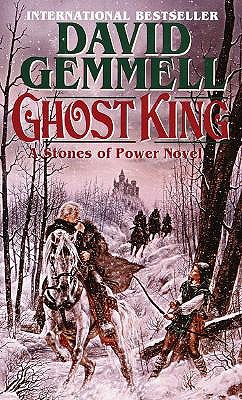 Another review of a David Gemmell book? Yes, because I’m just that much of a fanboy.
With the Drenai series finished, I decided to sink my teeth into the Stones of Power series. This series confuses me, because I’ve read The Jerusalem Man, which was retroactively put in as book three, but that’s a post-apocalyptic tale of the gunslinger Jon Shannow, but the series actually starts in Arthurian England. As soon as I got a couple chapters into the first book, though, I began to see the connection.
Ghost King is an alternate history tale of King Arthur (Uther, in the book), and how he rises to become the Blood King of Britannia. His grandfather, Culain, takes him into the mountains after the Brigantes assassinate his father, and there trains him to become a leader and a warrior.
Culain, of course, is one of the immortal Atlantians, just like his friend Maedhlyn (Merlin). After the fall of Atlantis, they have wandered the Earth as gods, using the powers of the Sipstrassi stones to accomplish wonders. Worshipped in turn by the Greeks, the Romans, the Hittites, and the Babylonians, Culain has tired of immortality and now wants to live out a mortal life. But his jilted lover, the Ghost Queen, wants revenge on him for leaving her. She was the one who killed Uther’s grandmother and mother, and who now wants to kill him and rule all of Brittania. But her son Gilgamesh has corrupted her, so that in a parallel universe she must kill twenty pregnant woman every month just to replenish the magic of her Sipstrassi …
Okay, I might as well give up trying to explain the plot, because it only gets crazier. Somewhere in this parallel dimension, a lost Roman legion has been wandering for hundreds of years, consigned to the void by Culain. Also, Gain Avur (Guenevere) is in there too, as well as the Lance Lord (Lancelot), though he doesn’t come in until the epilogue. There are also demons and vampyres, all sorts of battles, and lots of other crazy stuff. It’s pretty freaking dang awesome.
I really enjoyed Uther’s transformation from the weak, bookish boy to the warrior king, as well as the budding of his relationship with Gain Avur (what can I say, I’m a sucker for romance). My favorite character, though, was Prasamaccus, a crippled Brigante peasant who becomes one of Uther’s close advisors. He’s basically a regular guy who gets sucked up into the whole adventure, but he’s level-headed and practical enough that he manages pretty well. He’s also just a good person, which was quite refreshing in a world full of death and drama.
At one point, after rescuing Uther, he’s a guest in Uther’s chief general’s villa. The general gives him a servant girl for the night, since in this world most men think nothing of bedding a slave. Prasamaccus is a peasant, though, and he’s kind of shy. The girl was actually captured in a raid in Germany, where she was raped, and this is her first time bedding someone since those traumati not the monster she’s afraid that he’ll be–they actually share a really tender moment of intimacy that heals much of her trauma and introduces him to the love of his life.c events. She’s absolutely terrified, but so is Prasamaccus–he’s a cripple, and assumes that women just don’t want him. He spends the night with the girl but doesn’t force her to sleep with him, and when she realizes how gentle he is–that she holds the power, and that he’s not the monster she’s afraid that he’ll be–they actually share a really tender moment of intimacy that heals much of her trauma and introduces him to the love of his life.
It’s poignant, story-rich moments like that that make me such a David Gemmell fanboy. Usually they happen in the midst of war, between battle-hardened friends who are forced by circumstance to do something heroic, but they also happen in the quiet moments between characters who carry other scars. That whole thing in the previous paragraph only happened in three pages or so, but it was still so incredibly powerful and moving. Every moment of a David Gemmell book is like that, sometimes from the very first paragraph. It’s awesome.
As far as David Gemmell books go, I’d put this one in about the middle of the pack. It’s not quite as powerful as Legend or Wolf in Shadow, but it doesn’t meander as much as White Wolf or have such an anti-climactic ending as Ironhand’s Daughter (which was probably split by the publisher–more on that when I review The Hawk Eternal). The characters aren’t quite as memorable as Druss, Skilgannon, or Waylander, but they are pretty awesome nonetheless. I’d rate this book a 3 compared to Gemmell’s other books, but a 4.5 out of fantasy overall. Definitely worth a read.
Trope Tuesday: Slap Slap Kiss

Unless you have an unhealthy aversion to kissing books, you’re probably familiar with Slap Slap Kiss. It’s common in genre romance, but you’ll often find it in science fiction & fantasy too. When done well, it’s a great way to make sparks fly, but when done poorly…I think you can fill in the rest.
The basic underlying concept is that love and hate are just two sides of the same coin. Both involve strong feelings for another person, the kind that drive you crazy and make it hard to think straight. According to this theory, it’s a lot easier to fall in love with someone you hate than to fall in love with someone you don’t really care about. And once you fall in love, the rest is easy. <snark!>
Kiss Kiss Slap is the Tsundere’s standard MO. An effective way to end the will they or won’t they? phase, though the trope is so common that you can spot it almost as soon as the slapping starts (Dinosaur Comics has a good commentary on that). Sometimes happens in conjunction with Foe Yay, though the couple doesn’t have to start out as sworn enemies. The kiss itself is usually one of those “lovely trick[s] designed by nature to stop speech when words become superfluous.” When set up properly, is often accompanied by a Love Epiphany.
Of course, it’s possible to go too far. There’s a fine line between “all’s fair” and kicking the dog, and if you cross it…good luck. Alternately, if the slapping doesn’t cross the line, but the kiss doesn’t live up to expectations, it’s also going to fall flat. And if the main reason you invoke this trope is because the plot demands it…let’s just say, you’re doing it wrong.
In general, I think it’s important to keep the following in mind:
- The attraction needs to be properly foreshadowed. If the characters start slapping each other without even a hint of sexual tension first, no amount of backpedaling is going to make up for it.
- Neither of the characters should tear each other down. There’s a big difference between a slap and a punch (and a roundhouse kick, for that matter). Even though the characters may abuse each other, they have to have at least some mutual respect. After all, Han still called Leia “your highness,” and Leia still complimented Han on his “bucket of bolts” (albeit sarcastically). Once the respect is gone, so is any hint of romance.
- The kiss needs to be proportional to the slap. Lots of slap with an innocent little peck is going to feel anticlimactic, while a tap on the chin with a giant make out moment immediately afterward is going to feel melodramatic. The two need to be balanced in order for the trope to work.
- The couple should have at least something in common. “Opposites attract” is often just an excuse for shoddy character development. In real life, if the two people don’t have at least something in common, value-wise and personality-wise, the romance is pretty much doomed to fail. As always, however, Your Mileage May Vary.
Finally, even though there are a lot of reasons to hate this trope, there’s a reason we keep coming back to it. What that reason is exactly, I can’t say, but I know it when I see it. After all, you really shouldn’t over analyze some things. Like this video:
I think my work here is done. What sayest thou?
Ali and Nino by Kurban Said
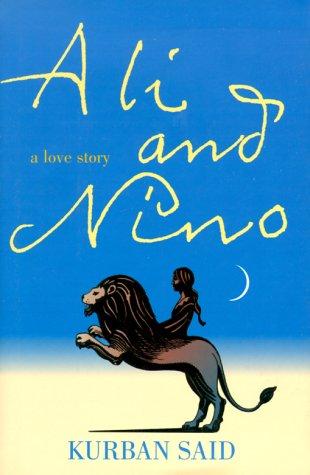
At the crossroads of Europe and Asia, Christianity and Islam, the progressive West and the reactionary East, the peoples of the Caucasus lie poised between three empires and their own dreams of independence. And at the city of Baku, where the ancient and unchangeable desert meets the oil rigs of the Caspian Sea, young Ali Shirvanshir has fallen in love with Nino Kipiani, a Georgian and a Christian.
A timeless story of forbidden love, Ali and Nino is both the Romeo and Juliet of the Caucasus and the national novel of Azerbaijan. It is as much a romance as it is a story of the clash of cultures and identities in our rapidly changing modern world. Above all else, it is a beautiful and haunting tale that will leave you dreaming with your eyes open and yearning for lands that you’ve never seen.
This is, quite possibly, the most perfect book I have read all year. I picked it up in Tbilisi from another TLG volunteer on Sunday, and I finished it at a breathless sprint on Wednesday. But while the story was good, it was the writing itself that really captivated me. The simple yet surprisingly rich descriptions of the alien cultures, so dreamlike and yet so straightforward, often to the point of being shocking–here, let me give an example:
“Shamil’s Prayer!” called Iljas Beg to the musicians. Immediately a wild melody arose. Iljas Beg jumped into the middle of the hall. He drew his dagger. His feet moved in the fiery rhythm of the Caucasian Mountain Dance. The blade glittered in his hand. Nino danced up to him. Her feet looked like small strange toys. Shamil’s Mystery began.
We clapped to the rhythm of the music. Nino was the bride to be abducted…Iljas put the dagger between his teeth. Like a bird of prey, his arms outstretched, he circled round the girl. Nino’s feet flew whirling round the hall, her supple arms depicting all stages of fear, despair, and submission. In her left hand she held a handkerchief. Her whole body trembled. Only the coins on her cap lay quietly on her forehead, and that was the correct way–this is the most difficult part of the dance. No one but a Georgian girl can do such fantastically quick turns and not let even one coin on her cap tinkle.
Iljas raced after her. Without stopping, he chased her round and round. The wide gestures of his arms became more and more dominating, Nino’s defensive movements more and more tender. At last she stopped, like a deer overtaken by the hunter. Closer and closer Iljas Beg circled. Nino’s eyes were soft and humble. Her hands trembled. A wild, short howl from the music, and she opened her left hand. The handkerchief fluttered to the floor. And suddenly Iljas Beg’s dagger flew onto the little piece of silk and nailed it to the floor. The symbolic dance was finished.
By the way, did I mention that before the dance, I gave Iljas Beg my dagger and took his? It was my blade that pierced Nino’s handkerchief. It is best to be on the safe side, for a wise rule teaches: “Before you trust your camel to Allah’s protection, tie it fast onto your fence.”
The whole novel is like that, and it’s awesome. The narrative passes from one description to the next, and you feel almost like you’re caught up in a dream, reading a fairy tale. It’s only the railroads and oil rigs, the mention of Paris and London and Moscow, that make you step back and realize that this isn’t a fantasy novel, but something set in our modern world.
And yet, even though it feels like a fairy tale, the author gets a surprising number of things right. Georgians really do have some of the most beautiful eyes of any people. I haven’t yet been inside the sulfur baths at Tbilisi, but everything else in Said’s description of that city is more or less correct. Kakhetian wine really is the most famous within Georgia, and probably the whole Caucasus as well.
The most gratifying thing is to see how it all comes together. Even though the descriptions sometimes feel as lavish as a Persian rug, no word is wasted–there is a good reason for every tangent, solidly grounded in the story. There are plenty of red herrings and Chekhov’s guns to make the plot twists thoroughly satisfying. But never at any point did I feel compelled to try and predict what would come next. I enjoyed the story so much, I was barely aware of the fact that I was reading.
Whether you’re looking for an exotic romance, or you just want to explore a culture thoroughly alien from your own, Ali and Nino is a book you will thoroughly enjoy. If, like me, you have any interest in the Caucasus, you probably won’t be able to stop coming back to it. And if you’re just looking for a good read, I can think of few books that are more perfect than this one.
მოტაცება, or how to bag a wife–literally
მოტაცება (pronounced mot’atseba) is the Georgian word for bride kidnapping, as opposed to regular kidnapping, which takes a different word. It’s an ancient practice in the Caucasus region that doesn’t happen as much as it used to, but still happens, especially in the rural areas. Today, most Georgians condemn it, but there’s still a whole slew of lingering cultural subtexts that can be very difficult for a Westerner (like me) to understand and navigate.
The video clip at the top is from a Georgian comedy program (named, aptly enough, “Comedy შაუ”), and does a pretty good job illustrating how mot’atseba works. Of course, the genders have been reversed–50% of Georgian humor is cross-dressing, and the other 50% is cross-dressing with slapstick–but everything else is pretty accurate. Like I said in a previous post, it’s like a weird game of capture-the-flag involving sex and arranged marriage, where the flag is the girl.
This is how it works: boy meets girl. Boy decides to marry girl. Boy gets his friends together and kidnaps the girl (with or without her consent), holding her captive overnight. The next morning, boy contacts girl’s parents to ask for girl’s hand in marriage.
Since the girl has been held overnight, the implication is that she’s been raped (which may or may not be true). Therefore, to avoid a scandal which could tarnish the family’s reputation, the parents will usually marry their daughter off as quickly as possible. However, if the girl can escape, or the girl’s brothers can rescue her before nightfall, the crisis can be averted.
I first heard about mot’atseba from this post on Georgia On My Mind, back when I was looking into TLG about a year ago. It disturbed me a little, but not enough to dissuade me from coming to Georgia. A couple of weeks ago, however, I learned that that was how my host parents got married.
Here’s the thing, though: they both seem to remember it kind of fondly. In fact, when my host mom saw the clip from Comedy შაუ, she couldn’t stop laughing. Her mom lives with them now, and from time to time they go out to visit his family in the village, so it looks like everyone’s on pretty good terms.
So what the heck happened?
Here’s the story, as best as I can piece it together. They were introduced by his sister, who was her coworker at the hospital. After a month, he got together with some friends and took her without violence to his family’s house out in the village. She was surprised and upset at first, of course, but her parents gave their consent, and so they were married the next day by a magistrate. Now, they’ve got four kids–a huge family, by Georgian standards–and seem to be pretty happy together.
As a Westerner, it blows my mind that a strong, healthy family can come out of something as violent as an act of kidnapping. Indeed, I have yet to be convinced that that’s a normal outcome. However, after asking around and doing some research, I’ve come to realize that mot’atseba isn’t a black and white issue: there are all sorts of cultural subtexts that make the issue much more complicated.
The key to understanding how all this works is the following proverb, which underscores the entire Georgian concept of gender roles and the differences between men and women:
If a woman says no, she means maybe. If she says maybe, she means yes. If she says yes, she is not a woman.
From this, two things follow:
1: Women are fickle, therefore men should be assertive.
As a man, I see this all the time. All three of my co-teachers are women, and all of them constantly defer to me, even though they have far more professional experience than I do. When I had some pretty serious differences over teaching methodologies with one of them, she suggested that I take over the next lesson and teach it without her interference, so that she could get a better idea that way. This isn’t the case with the female volunteers–many of them complain about how hard it is to get anyone to take their suggestions seriously.
2: A woman can never say no.
If “no” is constantly interpreted as “maybe,” then it follows that no one (or at least, no man) is going to believe that a woman is even capable of saying “no.” This turns the whole concept of rape into a nebulous gray area, unlike the United States, where women have a lot more power at least in terms of the law.
This is not to say that in Georgian culture, women are doormats or property (even though that’s what some TLGers claim). Women have a number of support networks, such as family, friends, and other women, and can use these networks to ward off unwanted attention. When I asked my host sister if she’s worried that a mot’atseba would ever happen to her, she said no, because if it did, her three brothers would kick some serious ass.
On top of all this, Georgians have no real concept of casual dating. If a girl and a guy are seeing each other, they’re either married or about to be married. This shows up in the way they use Facebook and other social networks: instead of listing themselves as “in a relationship,” the girl will give her password to the guy she’s dating. And they don’t just do it because the guy demands it–when my host sister was seeing someone, he asked her if she wanted to give her password to him, as if that was the natural next-step in their relationship. From the way she told me, she seemed to be worried that she’d made a mistake by telling him no. Of course, I told her she’d made the right decision!
Combine all of these together, and you should start to get a clearer picture of some of the subtext surrounding mot’atseba.
When I asked my first co-teacher about it, she said it was only an ancient practice and absolutely didn’t happen anymore. When I brought up rape and asked if that was also a part of it, she was horrified and didn’t want to talk about it. However, when I asked if it’s possible for a happy marriage to come of it, she kind of smiled a little and said that if the woman likes it, then why not?
My second co-teacher was much more straight with me. Yes, it happens occasionally, though it was a lot more “fashionable” about twenty or thirty years ago. No, it’s not romantic. Yes, a lot of the marriages aren’t very happy, which is why so many of them end in divorce. She told me that one of her friends from college was married through mot’atseba, and that she knows of at least one case in our school where an 8th grader was kidnapped and married. However, under President Sakashvili, mot’atseba is now a serious crime, so it’s not as common as it used to be.
My third co-teacher’s answer was a lot sketchier. The first time I asked about it was in passing, as she walked in on the conversation I was having with my first co-teacher. When I asked her about rape, she laughed and said “well yes, of course it happens!” as if that wasn’t a big deal. Later, however, she sat me down and said quite seriously that mot’atseba is a horrible thing, that it’s a criminal act, that it doesn’t happen anymore, etc etc.
However–and this was perhaps the most illuminating thing–she said that sometimes, when a guy and a girl are in love, but she’s being wishy-washy and non-committal, he’ll sweep her off her feet and carry her off. In fact, that was what happened with her: her boyfriend wanted to marry her, but she kept putting it off, so one day he tricked her into getting in the car and told her “all right, enough is enough–we’re getting married this weekend.” And they did.
When I asked her if that was mot’atseba, she said no, but I think the subtext was similar. A real man knows how to assert himself and take what he wants. Since a real woman will never say yes, sometimes you just have to man up and tell her how it’s going to be. And don’t worry if she says no at first–she only says that because she doesn’t really know what she wants yet. She’ll come around eventually.
It sounds pretty horrible, but that seems to be how it works. And really, there are gradations of it. Most Georgians will agree that it’s wrong for a guy to kidnap a girl he doesn’t know so that he can rape her and force her to marry him. But if the guy and the girl know each other, and are already pretty serious (ie seeing each other at all), and he wants to speed things up–or, alternately, if she knows her parents would never say yes otherwise–that’s when everyone speaks of it with a wink and a nod.
And really, can we say that our culture’s problems are any less abhorrent? What about teenage pregnancy? Secret abortions? Date rape? At least with mot’atseba, the guy is trying to marry the girl, not just sleep with her and walk away. If it’s just sex that the guy is after, there are a lot more easier ways to get it than risking a prison sentence.
So is it “wrong”? I don’t know if it’s possible to say yes or no, except on a case by case basis. My host sister knows a girl who was kidnapped at age 12 and had a baby the year after. I’m pretty sure that’s wrong. But when I told her what would happen to that guy in the states–that he would go on the registered sex offender list and spend the rest of his life ostracized and unable to find work–she thought that that was wrong too. And as for my host parents, well, it seemed to work out well for them.
I don’t know. But either way, it’s definitely an interesting anthropological experience.
Trope Tuesday: Language of Love
 Oh look! While traveling in distant lands, the hero met a girl–probably the chief’s daughter–and fell (or rather, stumbled) in love. The catch? Neither of them speak the same language.
That’s okay, though: through the power of love, the two of them will somehow find a way to understand each other. Whether through touch, music, math, or a montage filled with magical sparkles, they come to discover that love itself is a language, one which they know fluently.
To be honest, I was a little disappointed in the page for this trope. It’s pretty dang sparse, though it does make a couple of good points. The main one is that this type of story almost always has the male character speak the language of the audience, with the female character being the foreign or exotic one. That might be because the seductress is such a powerful character archetype…but then again, it might just be because everything sounds sexier in French.
My favorite example of this trope is in the film Jeremiah Johnson, where the hero unwittingly stumbles into a marriage with–you guessed it–the chief’s daughter. What starts out as an awkward pairing, to say the least, turns into a wonderfully endearing love story, as Jeremiah builds a cabin for the two of them (and the mute boy he picked up earlier…long story) and together they become a family.
Because this is a major driving element in Star Wanderers, the novel I’m currently writing, I’m especially conscious of this trope right now. However, I can’t think of many good examples where this trope came into play. Do you have any ideas that you can share? Favorite stories where love overcame a major language barrier? If so, I would love to hear about it. Because in spite of my tongue-in-cheek comment about the sparkles, I think this trope has some really awesome potential.
Image by Kevin Jackson. Taken from here.
Trope Tuesday: Abduction is Love
In real life, abduction is an awful, violent thing that we hope would never happen to us or anyone we know. But in fiction, the Rule of Romantic can make abduction the basis of a wonderful, heartwarming love story…at least for some of us.
This is actually a more common trope than you might think. It’s the underlying premise for Beauty and the Beast, though Disney rewrote that part out of it. It’s a major plot element in Watership Down, as well as The Courtship of Princess Leia. More recently, Twilight featured a few variations on this trope, though considering the source, that probably isn’t surprising.
In G and PG rated versions, this often leads to And Now You Must Marry Me. In PG-13 and R rated versions, leads to Rape Is Love, with many unfortunate implications. Due to the violent nature of the story, it often involves a lot of Slap-Slap-Kiss. Stockholm Syndrome, the psychological phenomenon whereby victims of abduction develop an emotional connection with their captors, is the overarching theme, making any abduction love story a match made in Stockholm.
In the West, this trope tends to be a lot less prominent than it used to be. However, if you look at the trappings of our marriage customs, you start to notice some disturbing trends that point to a time when abduction-as-romance was much more common. For example, what was the original function of the best man at a wedding? Quite possibly, it was to keep the bride from escaping (or being rescued). And why does the groom whisk the bride away to a remote, isolated place to consummate the marriage? To evade the bride’s angry family, of course.
Here in Georgia, this trope is alive and well, not just in fiction but in real life–seriously. It’s called motatseba, and is often discussed with a wink and a nod. In the family that’s hosting me, the mother married her husband after he abducted her, then bore him four children. Now, they both seem to remember it rather fondly.
This is such a bizarre tradition that I’m going to dedicate an entire post to it…after I figure out just what the hell is going on. Seriously, I can barely make sense of the practice–it’s like a twisted game of tag involving sex and arranged marriage. How it can possibly lead to love…that’s what I’m trying to figure out.
However, I’m sure it involves some interesting variation of this trope.
Trope Tuesday: Celibate Hero vs. The Fettered
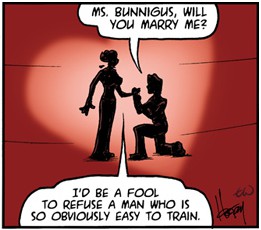
I’m mashing up two tropes this week because I’m not satisfied with the one. There are a bazillion tropes about characters who are sexually active, but very few about sexually chaste characters that don’t portray them as weak, clueless, or socially inept.
According to tvtropes, a celibate hero is a main character who “doesn’t do the romance thing.” Unlike the chaste hero, who is just clueless, the celibate hero has made a conscious decision not to engage in sexual relations or get tied down in a relationship. There may be any number of reasons for this, but it usually comes down to some combination of Love is a Weakness, Love Hurts, and It’s Not You, It’s My Enemies.
(As a hilarious example of this: TESLA!!!)
But what about the character who isn’t necessarily opposed to romance, but feels that they should wait until marriage to have sex? Unfortunately, this trope is pretty rare nowadays. I can only think of two mainstream examples: Edward from Twilight and Reverend Theo from Schlock Mercenary.
Theo in particular is a great example of this, because he’s not clueless, he’s not weak, and he not only gets the girl, he gets the girl that everyone wants. The only reason he holds out is because his religious order forbids sex before marriage. It does permit priests to marry, however, so Theo does manage to balance the two.
So why are characters like this so rare? Unfortunately, I think it comes down to the widespread notion that a true man isn’t a virgin, and that sex makes people cool. If we accept these tropes as true, then that means that men who exercise self-restraint are actually weak and pitiful, and couples who choose to wait are pathetic losers.
It’s worth pointing out that both Edward and Reverent Theo were created by writers who are practicing Mormons–people who belong to a religious community where it’s still the norm to wait until marriage. If literature is the way that the culture speaks to itself, then this goes to show just how unrestrained the rest of Western society has become.
This is why I think that the better trope for this kind of character is The Fettered. Unlike the celibate hero, who usually gives up sex for some kind of external reason, the fettered gives it up as a matter of principle. Living by his ideals isn’t easy, and he’s constantly tempted to give in and break his moral code. However, by resisting these temptations, the fettered gains great strength, and can stand like a beacon of light in an otherwise disillusioned world.
This is actually something that I tried to do with my latest novel, Desert Stars. The main character, Jalil, is a man who believes in honor, and follows a code of abstinence before marriage. However, to manipulate him into staying at the camp, his father charges Mira, the female protagonist, to seduce him. Since the fettered’s strength is also his greatest weakness, if Mira can get Jalil to sully her honor, then out of shame he will return and marry her.
The catch? She actually has feelings for him, and doesn’t want to manipulate him in this way. In this way, merely persuading him to have sex isn’t a win condition–in fact, if done in the wrong way, it could be a very serious “game over.”
Whether or not I actually pulled it off well is up to the readers to judge. But one thing I was definitely shooting for was to write a character who fulfills this trope in an unconventional yet powerful way. And if you’ll permit me to step onto my soapbox for a little bit, I think our culture desperately needs more heroes like this–heroes who show that real men are capable of self-restraint, and that following a moral code is still cool, even if it means waiting to consummate a relationship.