Another overseas adventure?

About a year ago, I blogged about how I need to get out of Provo before I went stir-crazy. Well, it’s been a year, and I haven’t gone anywhere yet. My love/hate relationship with Provo has mellowed out a bit–I’m not as anxious to get out as I used to be–but still, it would be good to change things up and go on another adventure.

This time, I’m thinking quite seriously about going to the Czech Republic. My sister is working to become a certified genealogist, and she keeps a fairly intensive blog on Czech family history research. If I were to go over there, I’m sure she would have all sorts of fun places for me to check out–places where our ancestors used to live. She’s already contacted a fifth cousin of ours, descended from the side of the family that didn’t emigrate, and she has a lot of other contacts over there as well. It would be an amazing life experience to live and travel over there.

Until now, every time I’ve gone overseas I’ve been a part of some sort of program. Even in Georgia, where I didn’t speak the language, didn’t know anyone, and barely knew anything about the country at all, the TLG program still had a fair amount of support infrastructure for us to fall back on whenever we ran up against a wall. I suppose I could find a similar sort of program in the Czech Republic, but that’s not what I want to do. This time, if I do go over, I want to go over on my own.

I’m still kind of on the fence about this, because it is kind of a big leap from where I am right now. But I’m earning enough with my book royalties that I could probably support myself on that income alone. From what I’ve heard, living costs in Prague can run as low as 450-600 USD per month, though most expats spend more in the 800-1200 USD range. That’s certainly doable. If I don’t need to take a TEFL job to support myself, why should I? Better to spend that time writing and/or seeing the country.

Of course, without making any concrete plans, this is still just a crazy dream. So here’s what I would need to do to make it happen:

  • Save up for plane tickets and a reasonable cash reserve, at least 150% the cost of a ticket back to the states. It looks like tickets to and from JFK and Prague run about $1,500, so I’d probably have to save up at least $4,000 (not including what it would take to get to New York from Utah).
  • Look up the rules for getting a visa, housing contract, insurance, etc (my Slovakian friend tells me that health insurance in the Czech Republic is mandatory).
  • Connect with the expat community online and figure out what the support network would look like. This would include stuff like couchsurfers, Kate’s contacts, the local church community, etc.
  • Learn some basic Czech, starting with the alphabet.
  • If possible, figure out some sort of housing arrangement in advance. Better yet, find a travel buddy.

I think those are all the big ones. And honestly, they’re all fairly doable. The hardest one would be to save up the money, but if I can find a short-term job on top of my writing that pays fairly well, I could do it in a few months. Since I plan to attend LTUE and Westercon this year, I probably won’t go overseas until mid-July at the earliest.

So yeah, that’s what I’m thinking at this point. It’s definitely something to work toward, and I think it could be another awesome life changing adventure. What do you guys think? Is there anything glaringly obvious that I’m missing? Got any tips or advice? Please share–I’m definitely open to feedback and suggestions!

3am thoughts, or why everyone says to be an accountant

I’ve been reading in bed on my smart phone recently, which is probably a bad idea because it makes it harder to go asleep.  At the same time, though, it tends to get my mind rolling, and when 3am comes around my thoughts tend to go some really interesting places.  Sharing those thoughts is probably going to get me into trouble, but hey, you might find them interesting, so why not?

When I was eight years old, I knew I was going to be a writer.  There was never any question about that.  I spent all my free time making up stories, and my favorite stories were the ones I found in books.  However, I knew I never wanted writing to be my job, because 1) everyone hates their jobs, and I didn’t want writing to ever become something I hated, and 2) everyone knows that writers can’t make a decent living.  Even at the young age of eight, I had bought into some of society’s most pervasive myths about jobs, careers, and how to make money.

Americans are generally horrible with money–we struggle to keep budgets and put all sorts of things on credit, and pay more than twice what our houses are worth by signing mortgage contracts we barely even read.  Because we’re so horrible with money, we tend to see it as a sort of magical force, something that can solve all our problems and make us happy.  Rich people are like powerful wizards or sorcerers, so far above the rest of us that we can hardly fathom their ways.

Nowhere is our stupidity about money more apparent in the fact that most of us spend our lives acquiring it by working for some sort of hourly or salaried wage.  Wages and salaries are basically the same, in that they convert time into money.  That’s why we all measure income in terms of dollars per hour, or salary per year.  But for anyone who understands how money works, that is stupid, stupid, stupid, stupid.  Money comes and goes, but time?  Time is one of the most finite and precious resources known to man.

All of us are going to die someday.  Most people are scared shitless by that fact, so we try to ignore it or put off thinking about it until some unspecified time in the future, like when we’re retired.  But not all of us get the opportunity to put our affairs in order after retiring comfortably from the workforce.  In fact, any of us could die tomorrow, or the next day, or at any other time.  And even if we do all live to be centenarians, our time on this Earth is still finite.  It’s non-renewable, too–you can’t go back and relive that day or that hour or that minute once it’s passed, no matter how much you regret it.

Converting time into money is basically trading gold for lead, or wine for water.  Yet that’s exactly what we do, because money is this strange, magical force that so few of us understand.  And the machines that do all the converting for us are businesses and corporations.

Questions like “where do you work?” “what is your job?” and “what do you make?” are much more common than “what do you do for a living?” That’s because most of us have bought into this idea that money comes from working for someone else, exchanging your time directly for a salary or paycheck. Sure, we do stuff with that time, but we don’t actually own it–the company does. While we’re on the clock, the company owns us and anything we produce. That’s the pact we make in exchange for this magical substance we call money.

It wasn’t until college that I started to become disabused of the childhood notion that I shouldn’t pursue writing as a career path. For one thing, I came to realize that plenty of people love their work–that just because you do something as a job doesn’t necessarily mean that you’ll come to hate it. But it wasn’t until I graduated unemployed in the middle of a recession that I realized how much of a myth it is that writers can’t make a living.

You see, people say that about every career choice–every career, that is, except accounting. That’s because accountants are the ones who work for the businesses and corporations, counting the magical money. Since we all get our money from businesses and corporations, exchanging our time for money, the only career with complete security is the one that the businesses and corporations will always need. After all, they’re not going to go belly up, are they? Not the big ones, anyway. They can’t–they’re the magical machines where all the money comes from.

Of course, anyone who knows anything about money knows that the only real way to make a lot of it is to produce something of value that can scale. It’s not about time at all–it’s about producing something that people want, and producing it in such a way that the more you sell, the more you make. At no point in that equation does time become a variable. It’s certainly a variable in the production equation, but even there, it’s not necessarily the most important one.

The most important thing, though, is that you have to really own what you produce–and that means owning all the failures as well as the successes. When you work for a corporation, it’s easy to shift the blame. It’s a rare case where one person is solely responsible for bringing down the whole collective enterprise. But when you work for yourself, you can’t blame anyone else when things go wrong. You’ve got to be ready to take the risk, and the bigger the payoff then chances are the bigger the risk.

That’s why everyone says that you can’t make a living as a writer. They say the same thing about making a living as a sports caller, or a musician, or a political activist. I’ve even had people tell me that there’s no money in math or in Arabic. They say that because they think that money is supposed to come from corporations, and corporations only really need people who can count their money. Every other part of the business they can either figure out how to do it with robots or outsource the work to India. They might not outsource all of the jobs, but there’s always a risk that they’ll outsource yours (unless you’re an accountant, of course, because corporations always have money).

In the end, though, it’s all just silly. Money isn’t some sort of vague magical force, and it doesn’t come out of the void from businesses or corporations–it comes from making something that people are willing to pay you for. It comes from producing something of value, or at least convincing people that you have something of value. And you don’t need to sell your time at $7.25 an hour or $24,000 per year to do that. You just need hard work, a great idea, and the opportunity to succeed as well as fail.

So can you make a living as a writer/artist/blogger/activist/global nomad/whatever your dream happens to be? Of course! It won’t be easy–you’ll probably fail a lot, perhaps even spectacularly–but it is possible. So why not give it a try? At the very least, you shouldn’t buy into the myth that accounting is the only career path guaranteed to make you any money.

I need to get out of Provo, but where to live next?

ProvoLogo_FullColor
… yeah, no thanks.  Not yet, anyway.

It’s been almost six months since I moved back out to Provo, and I don’t think I’ll be staying here much longer.  It’s a great place if you’re a Mormon college student in your early twenties, or married with kids and looking for a nice, quiet place to settle down, but for everything in between it’s just not the greatest.

So where am I going to go next?  Honestly, I don’t have a clue.  Probably somewhere in the United States, but I’m not ruling out the possibility of another overseas adventure.  In fact, that’s exactly the sort of thing that I’d love.

But I’ve got to be honest here: I came back to the States mostly to find a girl.  I don’t know about getting married or not–that’s like step twenty-five, while I’m still on step three–but I do know that next time I go overseas, I want to go with someone, preferably someone special.  That’s what I learned while I was living in the Caucasus mountains, that an adventure is like ten times better when you have someone to share it with.

I may be opening up a little bit in this post, and I don’t want to give the wrong impression to the people I know who read it.  It’s not that I’m uninterested in any of my female friends here, but so far, nothing has really worked out.  Some of that is because I’m not as interested as I thought I was, but the reverse is probably just as true.  Nothing wrong with that, and I still value all of my friendships.  And hey, you never know–things can always change.  But when you start to get sick of a place, that’s probably a good time to move on.

So what am I looking for?  Ideally, a place with a lot of Mormons in their late twenties / early thirties, most of them young professionals or recent graduates.  A place with a decent art scene, or that sort of vibe to it, where I can meet up with other artists / entrepreneurs like myself and be a part of that community.  I really want to live in a place with mountains–my sister is moving to a town just out of Des Moines, and omigosh just from looking it up on Google Earth I know I could never live there.  Barring that, I really love deserts, so I wouldn’t mind living in Arizona or New Mexico.

I’ve heard good things about Salt Lake City, so that’s pretty high on the list.  I’ve got a couple of friends up that way, and lots of family as well.  Other than that, I wonder if Saint George or Cedar City might be good places for a guy in my situation to live.  I really love Utah, so if I could find another place out here besides Provo, that would be ideal.  Moab, perhaps?  Seems like a tourist town more than anything.  Though if I could score a job at a hostel out there, that could be a lot of fun.

Texas is also fairly high on the list.  Beautiful place, Texas.  I’ve always loved driving through that country.  Lots of Mormons too, apparently, though where I’d want to go exactly, I have no idea.

One place I absolutely do not want to go is Washington DC.  I HATE that place, especially after my internship experience.  It’s a great place to visit, and the museums and cultural stuff are amazing, but I never want to live there again.

Other than that … I’ve got a couple of friends who suggested Portland, but I dunno.

And honestly, a not insignificant part of me wants to go somewhere crazy, like Mongolia or the Czech Republic, or even back to Georgia.  I’m making enough on my book sales right now that I could probably get a small apartment in Tbilisi and support myself entirely off of my ebook royalties alone.  Better yet, I could arrange a long-term boarding situation back in the village, or out in Kutaisi, or maybe even up in Svaneti … but that’s probably just me missing the place.  I miss it almost every day.

All I know for sure is that I absolutely cannot stay here in Provo much longer.  If I do, I’ll either go crazy or get old and fat and complacent, and I’m not sure which is worse.  I’ll stay here through the summer, just to save up some money, but when September comes around, I am getting out of here.

Thoughts on making a living as a writer

As many of you know, my biggest life goal (besides obtaining a signed first-edition copy of David Gemmell’s Legend) is to make a living telling stories that I love.  Accomplishing that goal is no small task.  For the last five years, I’ve been focused on that goal like a hellfire missile, and as of right now it continues to elude me.

I’m getting closer, though.  I’ve got 14 ebooks out, hopefully 18 by the end of the summer, and they’re actually selling.  I won’t go too much into specifics, but my gross income is about 30% to 40% of what I’d need to cover all my expenses without another job.

Granted, I’m a young single guy with good health and no dependents, living on a shoestring budget in the cheapest housing in one of the cheapest states in the US, but that’s not an insignificant accomplishment.

Right now, I’m reinvesting all of that into the business, in order to boost sales and to avoid self-employment tax.  But if I have a difficult month and need something to fall back on, my books are generating a fair amount of passive income, and that income is growing.  If I keep doing what I’m doing, and things stay on more or less the same trajectory, I expect that I’ll be making enough to support myself in one or two years.

That’s actually a little better than the timetable I set a year ago, where I determined to go full-time by 2016.  Then again, I also set a goal to be married by then, and I have no idea how that will change things.  I suppose my spouse’s income would be able to supplement my own, but then there’s insurance and taxes and all sorts of other expenses that I can expect to go way up.

(At the same time, I have this wild dream of running off with my wife to some remote part of the world and spending a couple of years on some crazy-insane adventure, like trekking across Mongolia, or joining a Bedouin tribe, or couchsurfing across Europe.  The world is a very different place outside of the US, and the cost of living in much of the world is significantly lower.  Especially in the developing world, people know how to make do and be happy with much, much less.)

Even if I suffer a major setback, like an irreversible drop in sales or a technological shift that made my current business model obsolete, making a living is no longer a pie-in-the-sky sort of dream.  It’s within reach, and I think I have a pretty good idea how I’ll get there.

First of all, it’s probably not going to be a sudden, earth-shaking event.  It’s much more likely that I’ll ease into it gradually, first as a fallback for months when work is slow, and then as a way to pay off my bills while I keep a part-time job for spending money.  One day, I’ll wake up and realize that it’s been five or six weeks since I’ve done anything but write, and then I’ll open up my budget and realize that I’ve arrived.

As I get married and start a family, my expenses will no doubt rise, and I or my wife may have to take another job for a while to make ends meet.  Then again, if book sales continue to snowball with each new release, then we might be able to time it so that the kids start arriving just as the writing income really starts to take off.  Even then, book sales fluctuate so much from month to month that until we have a significant amount of money in savings, we’re always going to feel like we’re a couple of weeks away from having to find another job.

And then, with the writing bringing in a comfortable six-figure income, we might finally be able to afford a house.  It’s almost impossible to get a mortgage as a self-employed freelancer, so I fully expect to pay for most of the house up front.  Good thing I don’t want to live in a city.

Of course, it’s also possible that the writing will never bring in a six-figure income.  Science fiction is a relatively small genre, and the only stories I really care to tell are the ones that take place on other worlds.  But that’s okay–as long as I’m able to support myself and my family, I’ll be happy.  Anything above that, and it’s not about the money.  In fact, it’s really not about the money right now.

The point of all this is that I don’t expect there to be a moment where I’ve suddenly “arrived.” If anything, it’s just going to be a continuation of what I’m doing right now, scaled up to meet life’s changing demands.

And you know what?  I’m okay with that.

My resume might look a bit checkered, and job interviewers may raise their eyebrows when they see that I’m a college graduate, but these odd jobs give me a lot more flexibility than a stable “day job” with insurance and all that.  I like being able to take a week or two off to do nothing but write, even if the off-time is unintentional on my part.  I know how to be flexible, and I’m quite comfortable living a lifestyle where I don’t know where I’ll be getting my next paycheck.

And to friends and family who are concerned because I’m almost thirty and don’t have a full-time job … don’t be.  I’m following my dream, and my dream is within reach.  Everything else is just a stepping stone.  I have a career, I’ve taken full responsibility for it, and I’ve turned it into something profitable.  If making a living as a writer is a bit like making grizzly bear soup, I’ve already killed the bear.

In related news, I learned this week that I’ve been pirated in Japan.  I’m not sure whether to be flattered or alarmed, but since my books are 1) available from multiple retailers 2) relatively inexpensive, and 3) DRM-free (on all the sites that allow it, anyway), I’m not too concerned about it cutting into my income.  I am worried about people downloading my books from an unsafe site that might give them a virus or something, but people will be people and there’s not much I can do about that.

If anything, it’s just another sign that I’ve arrived–or rather, that I’m exactly where I’ve wanted to be all along, and it’s just a matter of making things work.

Y is for Yesteryear

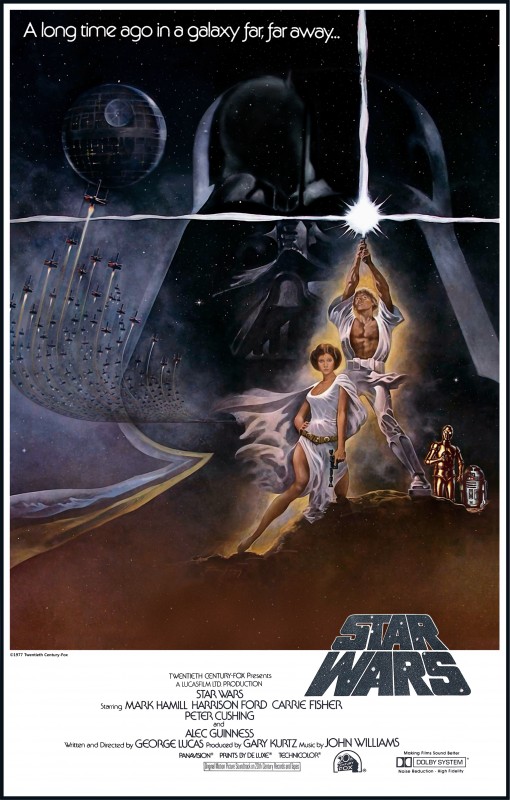
Star_wars_oldThey say that the golden age of science fiction is about twelve years old.  That’s definitely true for me.

My first exposure to the genre was Star Wars: A New Hope.  I saw it when I was seven, right around the height of my dinosaur phase.  Everything about the movie completely blew me away, from the Jawas and Sand People of Tatooine to the stormtrooper gunfights and lightsaber duels.  After watching Luke blow up the Death Star, I spent the next few hours running around the yard pretending to fly my own starfighter.

In a lot of ways, I’ve never really stopped.

My parents made me wait until I was nine to watch The Empire Strikes back, because it was rated PG.  Without any exaggeration, I can say that those were the longest two years of my life.  I was literally counting down days by the end, and to pass the time without going crazy, I read up on all the books about space that I could possibly find.

My father bought the original X-wing flight simulator game somewhere around then, and I soon became totally engrossed in it.  Since the 386 was our only entertainment system (no Super Nintendo–I had to visit a friend’s house for that), X-wing became the defining game of my childhood.  I spent hours and hours on that game, to the point where I knew exactly which simulated missions the characters from the books were flying and how to complete them faster and easier.

I thought The Empire Strikes Back was a little slow the first time I saw it, but it’s since grown on me, to the point where now it’s my favorite film in the whole series.  Thankfully, my parents let me watch Return of the Jedi the next day, and for the next few months my life felt utterly complete.

Around this time I discovered the Star Wars novels and soon immersed myself in them.  The Courtship of Princess Leia by Dave Wolverton soon became one of my favorites, as well as the Heir to the Empire trilogy by Timothy Zahn and the X-wing series by Michael A. Stackpole.

But it was Roger Allen McBride who first introduced me to a different flavor of science fiction with his Corellia trilogy.  As I mentioned in V is for Vast, those books had just enough of a touch of hard science to intrigue me about the other possibilities of the genre.  That was the last Star Wars series that I read before branching out into other works of science fiction.

The Tripod trilogy by John Christopher was my first introduction to the dystopian / post-apocalyptic genre, depicting an enslaved humanity after an alien invasion.  Those books really captured my imagination for a while.  The Giver was also quite interesting and thought provoking, though since it didn’t involve spaceships or aliens it wasn’t nearly as compelling.

I read a lot of fantasy in my early high school years, including Tracy Hickman, Lloyd Alexander, and (of course) J.R.R. Tolkien.  While I enjoyed those books and immersed myself in them for a while, my true love was still science fiction.  For almost a year, I watched Star Trek: Voyager religiously with my dad.  And every now and again, I’d pick out a science fiction book from the local town library and give it a try.  That’s how I discovered Frank Herbert’s Dune.

In eleventh grade, my English teacher had us choose an author and focus our term papers solely on their books for the entire year.  She suggested I choose Orson Scott Card, but I chose Cormac McCarthy instead.  I’m not sure if that was the worst decision of my high school career, or the best decision, since assigned high school reading tends to make any book feel like it sucks.  I discovered Ender’s Game the following summer, and finished it in a delirious rush at 3am the morning after checking it out from the local library.

More than any other book, Ender’s Game cemented my love for the genre, and showed me just how powerful and moving the genre could be.  It opened so many insights into the world and human nature, reading that book made me feel like I’d opened a pair of eyes that I didn’t even know I’d had.  Looking back, that was probably the moment when I knew I would be a science fiction writer.  I’d known I was going to be a writer ever since I read A Wrinkle in Time at age eight, but to be a science fiction writer specifically, that goal was probably cemented by reading Orson Scott Card.

After high school, I served a two year mission for my church, during which I didn’t read any novels or watch any TV or movies.  When I came back, though, Orson Scott Card and Madeline L’Engle helped me to ease through the awkwardness of adjusting back to normal civilian life.  When I left for college, I expanded my horizons even further, starting with Isaac Asimov’s Foundation series and Edgar Rice Burrough’s Princess of Mars.

When I discovered Pioneer Books in downtown Provo, I knew I’d found my favorite bookstore in Utah Valley.  I have so many fond memories sitting cross-legged on the floor in the science fiction section, browsing through the musty used books for hours at a time.  That’s where I discovered C.J. Cherryh, Arthur C. Clarke, Robert A. Heinlein, Ursula K. Le Guin, and numerous other authors who are among my favorites today.

When I discovered Spin, Robert Charles Wilson soon became one of my favorites.  I picked up that novel as a free PDF from Tor, and read it over the summer while studying abroad in Jordan.  Once again, that same hard sf sensibility I’d gotten from Roger Allen McBride touched me in an unforgettable way.  But it was the human element of that book that really moved me–in fact, it’s always been about the human element.  The world building in Downbelow Station was great and all, but the romance of Merchanter’s Luck had a much more lasting impact.  Starship Troopers had some good ideas, but it was Mandella’s personal journey in The Forever War that moved me almost to tears.  The intrigue of the Ender’s Shadow series was quite entertaining, but it was Ender’s Game and Speaker for the Dead that really taught me what it means to be human.

I finished my first novel, Genesis Earth, shortly after returning from that study abroad, and tried to capture the same sensibility from Spin as well as the intimately human element.  Since then, I’ve written several more sci-fi novels, some of them tragic, some triumphant, but in all of them I’ve tried to get as close as I can to the personal lives of the characters.  I don’t know if I’ll ever write a character portrait so intimate as Shevek’s in Ursula K. Le Guin’s The Dispossessed, but I certainly hope to someday.

For me, science fiction started out as a wonderfully exciting entertainment and turned into something much more meaningful.  If there’s anything the genre has taught me, though, it’s that the two aren’t mutually exclusive–that you can have your adventure and learn what it means to be human as well.  Indeed, the more imaginative the adventure, the greater the truths I’ve taken from it.

Because of that, even though I’m almost in my thirties now, I can’t possibly foresee a time when science fiction isn’t a major part of my life.  It’s a love affair that’s grown just as much as I have, and continues to grow with each new author I discover and each new book I write.  When I’m old and grizzled and pushing eighty, I’m sure there will still be a part of that twelve year old boy in me, still running around the yard flying his starship.

Back in Utah…again!

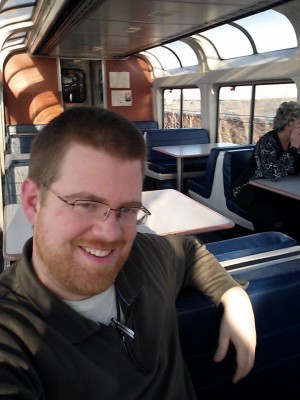
Chillin' on the observation car of the California Zephyr.

So Sunday afternoon, I boarded a train with most of my earthly possessions (at least, all of the ones I care to enjoy for the next year) and headed out to Utah.  I arrived Tuesday night, without a car, a job, or a place to live, but things have been working out really well so far and I hope to get all that stuff squared away in the next few days.

This was my sixth or seventh time traveling cross country by train, so I knew the drill.  The hardest part is getting enough sleep, so I brought a blindfold and some earplugs, and that actually worked out really well.  There were a lot of interesting people on the train, and I spent some time chatting with a few of them.  The train is one of the easiest place to make friends, just because the people who take it tend to be very laid back and friendly.

BAsUBItCIAAYenbMost of the time, though, I spent reading, figuring out my new phone, and writing.  Made some good progress on The Sword Keeper, though it looks like I’ll be putting it on hold for a while to get Stars of Blood and Glory ready for publication.  Wrote a little bit in Star Wanderers: Benefactor as well–man, whenever I need a good escape, it’s always fun to write a Star Wanderers story!  I have no idea when this one will be ready, but I think it will turn out well.

The train arrived in Provo late Tuesday evening, and I spent the night at my brother in law’s family, where I’m staying until I find a place to live.  Let me just say, it’s great to have friends and family to help you out when you really need it.  My old car was in the shop, so I set out on foot the next morning in search of an apartment.  Not much luck on that front so far, but I got my car back and found a few job leads, so it looks like I should be settled back down before long.

So why am I moving back to Utah?  A lot of reasons, but mostly because I just really like it out here.  I wanted to take a break before my next overseas adventure, catch up with some old friends and spend some time in a place that I know and love.  It also helps that there’s a good writing scene out here, with a bunch of great local conventions and conferences in the spring.

I didn’t always like Utah, but it’s really grown on me since I first came out here for college back in 2006.  The landscape is beautiful, with lots of amazing places to explore.  The people are really friendly and easy to get along with, even if your political views aren’t conservative (though admittedly, it’s harder).  The Mormon culture makes some things kind of quirky, but not in a way that makes it too hard for me to fit in.  In fact, if there’s any place in the world where I “fit in,” it’s probably here.

Things are kind of upside down right now, of course, but that will change once I find a place to live.  That’s going to take the focus away from my writing for a while, though hopefully not for too long.  In the meantime, today is another day, so I’d better get busy!

Someday…

Someday I will settle down, probably in southern Utah or somewhere else in the American West.  I will live with my wife and kids in a small house in the country, one that I’ve built with my own hands. It won’t be larger than 1,000 square feet, but we’ll have at least five acres of land–a small house with a big yard.

We will keep a sizeable garden and grow at least half of the food we eat.  We’ll start with tomatoes, peas, cucumbers, and zucchini, then move on to other crops as our tastes change and our gardening skills improve.  We will keep live chickens, and maybe a cow if it’s not too difficult.  We will eat what we love, love what we eat, and live by the maxim: “Eat food.  Not too much.  Mostly plants.”

In the winter, we’ll stay warm with a wood burning stove.  Everything in our house will all be centered around one main room, which will help to keep our family close.  We’ll sleep in the loft, with the kids on the other side.  Daddy’s writing space will be off in the corner, but not cut off from the rest of the family.

Our house will be well-insulated, so it will be warm in the winter and cool in the summer.  We’ll get our water from a well on our property.  Like good old-fashioned Mormons, we’ll grind our own wheat and bake fresh bread every week.  We won’t own a lot of material things, but we won’t waste anything either.  The people in our lives will always be more important than the things.

When we aren’t at home, we’ll be on the road.  Our children will see the whole country, from the rolling hills of New England to the oil fields of West Texas, from the orchards of California to the skyscrapers of New York.  My wife and I will have seen the world together, and we’ll visit our international friends as often as we can.

Above all else, we will be independent.  No one will own us, and we’ll stay out of debt as much as possible.  Our failures will be our own, as well as our successes.  And when our friends and family need us, we’ll be there.

All of this will happen someday.  That’s my dream.  Someday soon, I’ll find a girl who shares this dream, and together we’ll make it a reality.

A Letter From My 2013 Self

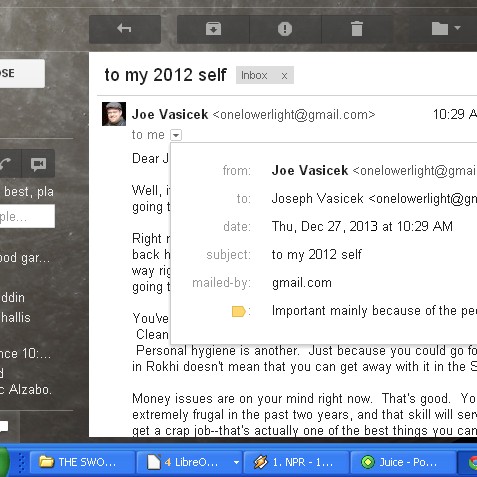
tomy2012selfSo shortly after writing up my last blog post, I got an email from myself marked December 27, 2013.  How freaky is that?I don’t know if it’s a glitch or a feature, but apparently in 2013, you can use gmail to send messages back in time.

In any case, the letter is pretty interesting, so I thought I’d post it.  Here it is:

Dear Joe,

Well, it’s been an interesting decade so far, hasn’t it? Not a bad time to be alive–and that’s going to be even clearer by the end of 2013.

Right now, you’re still in the Republic of Georgia, anxious to get on that flight and head back home. Don’t be. You’re going to miss that place, even though it’s hard to feel that way right now. Your time there has changed you a lot more than you realize, though it’s going to take most of the year for you to figure that out.

You’ve picked up some bad habits, mostly from the other expats. Swearing is one of them. Clean up your language–it’s not going to do you any favors, especially back in Utah. Personal hygiene is another. Just because you could go for days without showering back in Rokhi doesn’t mean that you can get away with it in the States.

Money issues are on your mind right now. That’s good. You’ve learned how to be extremely frugal in the past two years, and that skill will serve you well. Don’t be afraid to get a crap job–that’s actually one of the best things you can do right now. The economy hasn’t improved much since you left, but if you look in the right places and speak with the right people, you’ll be able to make ends meet without too much trouble.

Remember, your writing career should be your main focus. Don’t go chasing after the dollar. You’ve experienced a taste of success in the last few months, and you’re going to taste it again. It comes in spurts, though, so be prepared for that. You’ll figure it out–in fact, you’re already most of the way there. Just remember to keep your butt in that chair, and you’ll be all right.

By the way, you really should spend more time on your business plan. Don’t just use it as motivation to write something else–that stuff is actually important. In Georgia, you can get away with winging it, but not in the States. That’s going to take some getting used to as well.

Your biggest anxiety right now is your supposed lack of self-discipline. That’s actually not as much of a problem as you think. After spending a year in Georgia, you might feel incapable of working another honest day in your life, but that feeling will soon pass. In fact, 2013 is going to be a very productive year for you. All that self-discovery is going to pay off in a big way soon. So don’t worry about it so much, and remember, you haven’t written your best book yet.

Perhaps the most important thing about your year in Georgia is that it really lit a fire under your butt. You know what I’m talking about. If you can travel alone to a foreign country, you can work up the courage to ask her out. No, I’m not going to tell you who. You’ll know her when you see her. But you may have to trim the beard. Just sayin’.

You won’t spend the entire year back in the States, but when you do go overseas again, you won’t be alone. No, I won’t tell you who you’ll go with, or where. Some surprises are better left unspoiled.

There’s more I could tell you, but that’s enough for now. You’ll figure things out on your own, same as you always have. Hope for the best, plan for the worst. Follow the path of least regret.

Joe

A Letter To My 2011 Self

Dear Joe,

Well, 2011 has been an eventful year, hasn’t it? It sure didn’t feel like it when you were down in the trenches, but now that it’s over, you’ve got to admit, you sure came a long way.

You’ve discovered a lot of things about yourself since January. In your quest for economic security, you’ve learned that you’d rather work for yourself as a freelancer than be anyone else’s employee. You took the plunge and self-published, something you thought you’d never do (and yes, it’s okay to call it ‘self-published’–the stigma will be dead in another year). You attended your first Wordcon, made a couple of cross-country road trips, worked a ton of crap-jobs just to make ends meet, and now you’re on your way out of the country to try your hand teaching English. It sure seems like a lot, doesn’t it? Just wait. Next year is going to be just as full of changes, though it won’t always seem like it at the time.

I know, I know–cut to the chase and give me some advice already. Well, looking back on what you’re going to go through in 2012, here’s what I have to tell you.

First, don’t stress out so much about the whole self-publishing thing. You’ll figure it out all right. No, I can’t say whether you’re going to hit the turning point before the end of the year. In fact, that’s not even a healthy way to look at it, so stop thinking about it that way. Follow the slow growth model, and don’t angst about sales or price points so much. Keep your butt in that chair, because writing new words is still the most important thing you can do.

Don’t beat up on yourself so much for failing to meet your ridiculously high goals. You’re going to write a novel in the next six weeks, and the rest of the year is going to be a struggle. Right now, you place too much emphasis on your daily word count. Relax a bit, and don’t be too hard on yourself. You’ve still got a lot to learn about your own creative process, so take the time to figure it out.

By the way, you totally rock the beard. Growing it out was a great idea, no matter what your sisters told you back in 2010.

About your upcoming excursion to Georgia, the best advice I can give you is to remember what Spencer told you back in 2008. Adventures are like stories–they each have a beginning, a middle, and an end. You’re going to experience all of that in the next year. No, you probably won’t write another travel journal. Most of your experiences are going to be too personal for that kind of thing anyway. You’re going to accomplish all of your goals, though, so don’t worry–things are going to be just fine.

The most important thing you can do is keep yourself grounded spiritually. I know, I know, that’s always the most important thing. Well, it’s especially true now. Where you’re headed, you’re not only going to be the only Mormon, but the first Mormon to live there. Sundays are going to be a struggle. Everyone is going to think you’re crazy because you don’t drink. You’re going to make wine, though, and that’s going to be an interesting story for your friends back in Utah. Just be sure to keep doing the things you know you should be doing, and everything will turn out all right.

You’re going to love teaching English. Oh, you won’t love everything about it, but it’s something you’re naturally good at, so don’t worry about that. Just try to listen to your Georgian co-teachers and be more considerate of them. And don’t worry about the language. You’ll pick it up pretty quick. Just realize that Georgian verbs are impossible to conjugate unless you’re a native speaker.

I could tell you what your biggest mistake is going to be, but I think it’ll be better if you go ahead and make it. Just be sure to hope for the best, even as you plan for the worst. Follow the path of least regret, and you’ll make some really awesome memories–not to mention some truly amazing friendships.

At this point, I’d tell you you’re on the right path, but that isn’t exactly true. There is no ‘right’ or ‘wrong’ path for you right now, but you’re on a good one, so keep it up and see it through to the end. You’ll be glad you did.

Take care!

Joe

Last day of school

So today was the last day of school in Georgia, with all of the craziness that that entails.  It was kind of sad to say goodbye, even though I’ll probably be coming back to the same school in September.  In the meantime, I’m going to miss being a rockstar to all the 7-12 year olds and giving them high fives after class and in the hallways.

I haven’t posted much about my teaching experience, but it’s generally been positive, though not without its ups and downs.  I’ve met a lot of great people, taught a lot of great kids, and lived in a culture very different from my own.  I’m not sure how I’ve grown yet, or what I’ve learned from the experience, but it isn’t over–I’ll be back after the summer, for a least one more semester.

I asked to be placed in the same school again, though I’ll be changing homestay families.  If they can’t find another family in this district, I asked to be placed in a village near Kutaisi.  It’s impossible at this point to say what will happen, though, and things in this country tend to change without notice.

When I came to Georgia, my goals were to find out if I could balance teaching English with my writing career, to get some useful teaching experience, and to gain some cultural exposure that would enhance my writing.  On all three counts, I think I’ve had success.

My writing productivity has gone down  slightly since coming out here, but I think that has more to do with the homestay and finding a good, quiet place to write.  I’m still writing every day, just 1.5k words instead of 2.5k.  Teaching English isn’t the problem–in fact, it’s probably one of the best careers for aspiring writers, just so long as you know your creative process and have a modicum of self-discipline.  I’ll probably do another post on that later.

As far as teaching experience, I don’t know how much my time here in Georgia is going to help my resume, but it has helped me to have a bit more confidence when it comes to teaching.  I still feel like there’s a lot of room for professional improvement, though, and it’s going to be difficult to get that here.  I like Georgia, though, so I’ll be happy to come back.  If anything, I figure one year looks better on a resume than six months.

And as for cultural exposure, coming out here was definitely a good move.  Living in a developing country changes your perspective in a lot of interesting ways, and Georgia is so different from America that I’m sure I’ll be talking about it for years to come.  How all of this will affect my writing, I don’t exactly know, but I’m sure it will only enhance it.

So yeah, that’s been my experience so far.  The last day of school was kind of bittersweet, but I’m definitely looking forward to coming back!