Bringing Stella Home is a character-driven military science fiction novel that asks a deceptively simple question: what does it mean to have agency when freedom has already been taken away? In a universe shaped by conquest and domination, the novel explores whether choice still matters when the best options have been stripped away. Rather than framing agency as escape or rebellion, the story focuses on the quieter, harder work of choosing who you will be under tyranny. Rather than centering on battles or political intrigue, the story is driven by character choices and moral tension within a military science fiction setting.
Where the Idea Came From
This theme grew directly out of my fears as an older brother. Growing up, I was deeply protective of my younger sisters, and the idea of not being able to save the people I love has always terrified me. That pushed the story away from a simple rescue narrative and toward a deeper exploration of agency, responsibility, and moral choice under tyranny.
How Agency Under Tyranny Shapes the Story
Stella’s storyline is where this theme takes its clearest form. Captured by the Hameji and absorbed into a system built on hierarchy, conquest, and dehumanization, she loses nearly every form of conventional freedom. She cannot leave. She cannot reshape the system that controls her. And yet, the novel insists that her choices still matter. Her agency survives not through open defiance, but through the moral boundaries she maintains, even when compliance would make her life easier or safer.
James’s journey reflects a different facet of the same theme. His actions are driven by loyalty, love, and a desire to restore what has been lost, but the story steadily challenges the idea that agency means control or correction. As events unfold, he is forced to confront the reality that respecting another person’s agency—especially under tyranny—may require restraint, humility, and the willingness to accept choices he cannot fully understand or direct.
What Agency Under Tyranny Says About Us
The theme of agency under tyranny speaks to a difficult truth about human nature: we do not always choose our circumstances, but we remain responsible for who we become within them. Tyranny works by narrowing choices until obedience feels inevitable, offering safety or comfort in exchange for moral surrender. Bringing Stella Home suggests that agency persists even in constrained forms, and that the decisions people make under pressure—often unseen and uncelebrated—still shape their identity, integrity, and future. This is a story for readers who are less interested in easy victories than in moral resilience, responsibility, and the cost of choosing well.
Why This Theme Matters to Me
I care about this theme because it reflects how life often actually works. We don’t always get clean victories or heroic options. Sometimes we are forced to live inside broken systems, painful relationships, or irreversible losses. Writing Bringing Stella Home was my way of wrestling with the belief that dignity, responsibility, and moral choice still matter—even when the world refuses to be fair, and even when doing the right thing doesn’t lead to the outcome we might hope for.
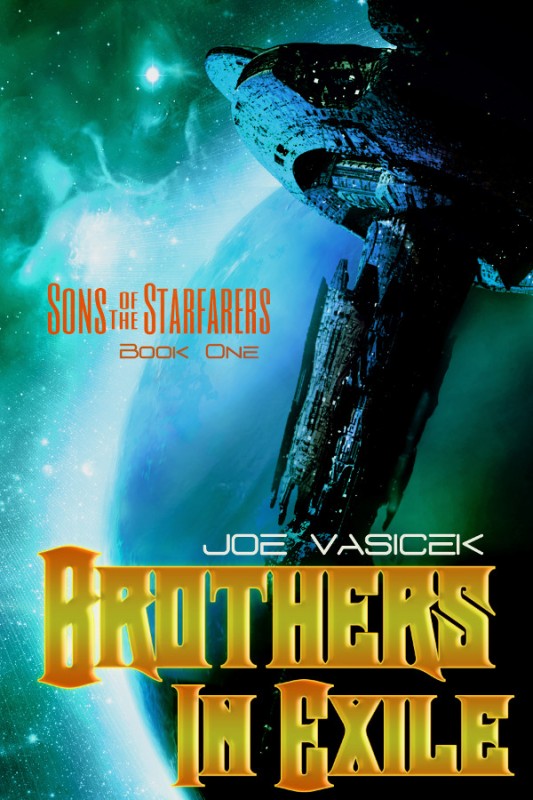
At its heart, Brothers in Exile is a character-driven space opera and science fiction adventure built around a single, defining moral choice. The story asks a deceptively simple question: what happens when compassion turns freedom into responsibility? From that choice grows a story about brotherhood, moral obligation, and the moment when an independent life gives way to lasting commitment.
Where the Idea Came From
Brothers in Exile grew out of my thoughts on frontier stories about rugged individualism and personal freedom. On the edge of civilization, mobility means safety: you can leave, disengage, and avoid entanglements. I wanted to explore what happens when characters reject that logic—not because they’re naïve, but because compassion demands commitment. What if, in a frontier science fiction setting, compassion isn’t a momentary kindness, but a decision that permanently ties you to others—and to a future you can no longer walk away from?
How the Cost of Compassion Shapes the Story
In Brothers in Exile, Isaac and Aaron begin as independent starfarers with no fixed home, no political allegiance, and no long-term obligations beyond each other. Compassion changes that. When they choose to help a young woman frozen in cryosleep—someone they were never meant to be responsible for—they are no longer merely passing through the Outworlds. They become involved—personally, morally, and historically.
The cost of compassion in this story is not framed as regret or doubt; the brothers never question whether they did the right thing. Instead, the cost appears as entanglement: new enemies, new loyalties, new dangers, and the slow erosion of the freedom they once prized. Isaac feels this as the weight of responsibility—each compassionate choice narrowing his room to maneuver. Aaron experiences it as clarity: once you recognize another person’s humanity, walking away is no longer an option.
This tension—between freedom and obligation, independence and belonging—drives the conflict of the book and sets the trajectory for everything that follows.
What the Cost of Compassion Says About Us
We often want to think about compassion as something offered freely, but real compassion creates bonds—and bonds create responsibility. Brothers in Exile reflects the idea that freedom is comfortable precisely because it avoids commitment. True compassion ends that comfort. It ties us to people, to places, and to futures we did not plan. The story suggests that while this cost is real and often painful, it is also the price of meaning. For readers who enjoy thoughtful, hopeful science fiction where moral choices matter more than spectacle, this tension sits at the heart of the story.
Why This Theme Matters to Me
This theme matters to me because I don’t believe that moral choices exist in isolation. Compassion changes who we are and what we’re responsible for next. In Brothers in Exile, Isaac and Aaron don’t lose their freedom because they make a mistake—they lose it because they choose to care. That choice doesn’t make their lives easier, but it gives them direction, purpose, and a place in a larger story. That, to me, is what makes the cost of compassion worthwhile—and why this story belongs at the beginning of the Sons of the Starfarers series.
I’ve been going back and forth on this post for almost a year now, wondering how exactly to express my thoughts. Some of the positive reviews on my fiction have expressed that I write “libertarian fiction,” and in some ways, I think that’s accurate: certainly, I value liberty very strongly, and support those government policies that are designed to safeguard our liberties while opposing those that seek to destroy it. That has not changed. But my views of libertarianism more generally have, perhaps in some ways that might surprise my longtime readers.
First, a little bit of my personal history. I grew up in one of the most liberal parts of the country, Pioneer Valley, Massachusetts, and considered myself a conservative while I lived there. Then, after serving a two-year mission for my church in Silicon Valley, California—what is probably the most progressive, leftist part of the country—I went to college at Brigham Young University, in the most Republican county of the most Republican state in the United States. At that point, I considered myself to be a sort of left-leaning classical liberal. When Dick Cheney spoke at BYU’s commencement, I blogged about the protests and attended the alternate commencement where Ralph Nader spoke.
I graduated in 2010, in the middle of the Great Recession, and made the fateful decision not to go to grad school at that time. To this day, I count that as the single best decision I ever made in my life (right up there with deleting my Facebook and Twitter accounts). Not only did this force me to learn how to navigate the real world, but it also got me out of the indoctrination factory that the national university system has become, even to a degree at my alma mater, BYU.
About five years after I graduated, I got red-pilled and started listening to right-wing commentators like Glenn Beck, Ben Shapiro, and Dennis Prager. I also looked seriously into Ron Paul and the libertarian movement, and became something of a libertarian. As fractitious as libertarianism is as a political philosophy, it seemed like the most logically coherent and intellectually honest way of understanding the world, whereas leftism and conservatism were both riddled with internal contradictions.
But then I got married and started a family. That experience has changed me in a lot of ways, perhaps even more than all the rest of my life experiences combined. But politically, the biggest thing it has caused me to rethink is this question:
What is the fundamental unit of society?
I’d always played lip service to the belief that the family is the fundamental unit of society, but starting a family of my own has made that real for me—indeed, has made me realize—in a way that simple bumper-sticker slogans never could. Before, I was living for myself. Now, I live for my children. Before, I was the hero of my own story, and that story was a single volume. Now, my story is just a single volume in an ongoing saga, a link in the chain of the generations that came before and will go on after me.
Libertarians believe that they stand in opposition to authoritarians of all stripes, be they communists, fascists, socialists, etc. But both libertarians and authoritarians operate on the unspoken assumption that the individual, not the family, is the fundamental unit of society. Leftists want to destroy the family and put the state in charge of raising and educating children, in order to make them obedient to government authority. Libertarians, on the other hand, romanticize this idea of the atomized individual who follows his own path and eschews all forms of collectivism, including the family. Ayn Rand’s books are populated by ubermensch who seem like they’ve sprung forth from the head of Zeus, and the children in her novels are basically just adults in miniature.
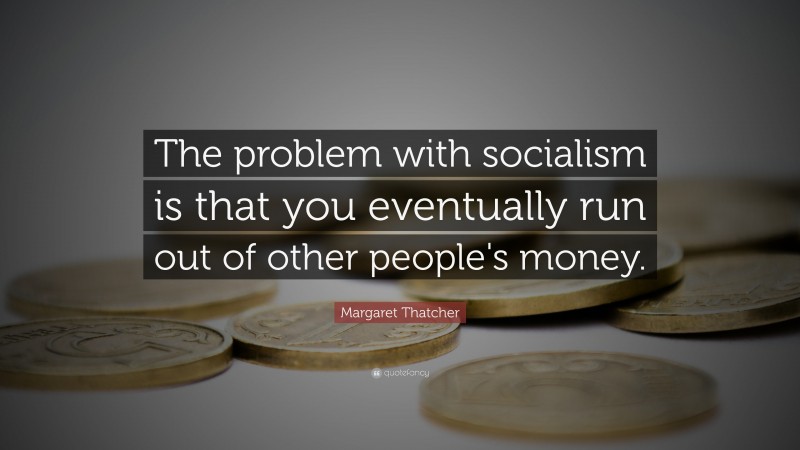
Allow me to put it this way: Margaret Thatcher had a brilliant quote about socialism that libertarians love to repeat. And from a purely economic standpoint, I believe that the libertarians are correct. But change that quote just a little, and you get this:
The problem with socialism libertarianism is that you eventually run out of other people’s money families.
Families don’t just happen. They take a lot of work to build and to maintain, and unless they are planted in a culture that nourishes them, they will wither and die. Libertarianism does not foster that kind of a culture, yet it depends on families in order to raise the kind of people who can make a libertarian society work. People from broken families often lack the mental and emotional maturity to take upon themselves the personal responsibilities that come with personal liberty—in other words, they lack the capacity for personal independence which libertarianism depends on. Growing up in a healthy family isn’t the only way to develop that sort of independence, but a society of broken families will invariably fail to produce such a people.
This is why libertarianism ultimately leads to authoritarianism. We aren’t all characters in an Ayn Rand novel: we aren’t all ubermensch all of the time, reshaping the world by the strength of our will. And when we inevitable fail, where can we turn to for help? If society is nothing more than a group of individuals, then ultimately the only place to turn to is the state. Perhaps there may be churches, companies, or other private civic organizations to which a person may turn, but any form of libertarianism that rejects altruism as a moral good will fail to foster these organizations as well. So, in the absense of anywhere else to turn, individuals will, over time, turn increasingly to the state, trading their libertarian freedoms for economic and social security. A society that exalts the individual at the expense of the family will always, in the end, devolve into a statist tyranny.
If you want to create a stable society that recognizes individual freedom, you have to recognize the family as the fundamental unit of that society, and you have to proactively enact policies that will foster a culture of strong families. Not only does this give you a social safety net that is totally apart from the state, but it also ensures that your society will be self-perpetuating, since one of the central purposes of the family is to create and raise children.
In fact, the family is perhaps the best antidote to government power creeping into every facet of society, which also makes it the best way to push back against woke leftism, ESG, and the Great Reset. Hence why everything about leftist progressivism is calculated to destroy the family. Parents concerned about CRT in their schools? Domestic terrorists. Kids who say that they’re transgender? Transition them without telling the parents, and take them away from their families if the parents object.
But it’s not just a partisan issue. If the family is the fundamental unit of society and needs to be strengthened, then there are things on both the left and the right that need to change. For example, poverty is a huge issue for families, since poor families are much more likely to break up due to the stress. But conservatives often ignore the issue of income inequality, mouthing platitudes about the free market while giving us socialism for the rich and capitalism for the poor. And the libertarians are little better, what with how they push for the legalization of drugs, prostitution, abortion, and pornography. Few things have done more to destroy the family than widespread substance abuse and the hypersexualization of our society.
This is why I’ve mostly given up on reading Heinlein anymore. He’s a brilliant writer with a fascinating take on some of science fiction’s most fundamental tropes, but whenever he writes about sex or sexuality, all I can think of is “the problem with libertarianism is that you eventually run out of other people’s families.” Heinlein and his boomer readership took the family for granted, neglected their own, and gave us a world of widespread sexual promiscuity, where society is falling apart.
So that’s why I don’t consider myself a libertarian anymore, even though there are many tenets of libertarianism that I still admire and believe, especially on the economic side. I suppose you say that I’m a conservative, but that isn’t really accurate either, because most strains of conservatism in 2024 really seem more about conserving the leftism of two or three generations ago. So I guess that means I’m politically homeless—just like most of my fellow Americans these days.
Steve Deace made an interesting point on his show today. They were talking about the tendency for some people to vote purely along cultural lines, even when they disagree with almost everything that “their” candidate stands for—or in other words, people who vote Democrat “because we are Democrats” or Republican “because we are Republicans.” In that context, he posed the question: in the Fetterman-Oz race, where Fetterman clearly is not mentally fit for the job, would he and his co-hosts have voted for the Fetterman candidate if the R and the D were reversed?
They all admitted that yes, they would have plugged their nose and pulled the lever for the incompetent candidate over the one from the party that is, in their words, advancing a demonic agenda. In other words, when you’re in the midst of a “cold civil war” (I don’t really like that term, but it is gaining traction for a reason), the most important thing is to close ranks and defeat the other side, no matter how bad your own guys may be.
With the way our politics are trending, I think there are a lot of people on Team Red and Team Blue who see it that way. I also think there are a lot of people on Team Don’t-Talk-To-Me-About-Politics who despise that, and are deliberately voting against the partisan firebrands because they are such firebrands. And that’s laying aside the question of voter fraud, which is really starting to piss me off. Seriously, if Arizona were a developing country, our State Department and half the NGOs in Washington would be crying foul right now and declaring that Arizona is no longer a democratic nation capable of holding free and fair elections. But I digress.
The discussion made me think about something my wife said about the abortion debate, how the deeper problem is that we only ever frame it in terms of what is legal, not in terms of what is good. By focusing on the law and on what is or should be permissible we overlook things like the rape victim who decides not to get an abortion, but put the child up for adoption instead, or the struggling young mother who doesn’t want to get an abortion, but doesn’t feel like she has any other option.
This tendency that have to make everything about politics, or everything about the law, is very convenient for those agendas that are seeking to subvert our individual liberty and sovereignty, and turn us from citizens into mere subjects and wards of the state. Under these circumstances, the more we look for a political solution, or turn to a political savior, the more we play into the factions with the anti-freedom agenda.
In other words, we don’t just have a political problem in this country: politics is the problem. If our families were strong, our culture were wholesome and uplifting, our churches (or mosques, or temples) were full, and our money were based on honest value, our politics would not be so toxic and divisive, because we wouldn’t feel like we needed our politicians to save us.
Of course, if this is true, it means that the partisan divide is merely symptomatic of a much deeper political problem. Even if one side got their savior, be it Trump, or Desantis, or Bernie Sanders—or dare I say, Barack Obama—the underlying issue would remain. And what is that issue? I suspect it has to do with our transformation from a nation of citizens into a nation of subjects, or of debt-serfs subjugated to a fundamentally dishonest fiat money system.
At the end of the day, we get the politicians that we deserve and are willing to put up with. Even the most totalitarian dictator only rules because of the will of the people. When enough people are willing to risk everything to stand up to him, that is the day that he falls. Likewise, it’s not our “sacred democracy” that makes us free. God made us free. The state cannot grant us the freedom that God has already given us; it can only take our freedom away.
This was a fun one to write, even if it did go a little dark at first. The idea for it came from this article about a couple in San Francisco who received an outrageously huge warning fine ($1,500) for parking their car in their own driveway. In the comments to the article, I wrote:
This is why property taxes are evil. If the government can seize your house for non-payment of taxes, was it ever really yours to begin with?
But here’s the thing: every possible answer to that question is terrifying.
If you answer “no, I guess it wasn’t ever really my house,” you’re acknowledging that Mao was right and all power (and with it, ownership) flows from the barrel of a gun.
If you answer “yes, it’s still my own house,” then you have to answer the question: does the state have the right to issue property taxes?
Answer “yes, the state is within its rights,” then congratulations, you’ve just given the Maoist approach to property ownership a veneer of legitimacy and revealed yourself for a boot-licker and a coward.
Answer “no, the state is not within its rights,” then you’ve just acknowledged that you live under a tyrannical regime. It might be a relatively benign regime, but a petty tyrant is still a tyrant, as we saw during the covid lockdowns.
But you’ve still got one more question: do you pay the property taxes, or don’t you?
Answer no, and the state seizes your property and/or throws you in prison.
Answer yes, and you’ve just put yourself in the same position as the landlord who pays protection money to the mob. The only difference is that this mob wears uniforms and has a geographic monopoly on the use of deadly force.
This is why the Roman farmers welcomed the barbarians. Perhaps we should as well.
Later, as I thought on it, I wondered if perhaps I couldn’t write a short story that gets across everything I hate about the property tax. I came up with an idea where the thing that’s being taxed isn’t your property, but your time and your body—literally.
Once a quarter, you are required to voluntarily submit your body to the state, who uses a chip in your brain to turn you into a mindless zombie and exploit you for manual labor. If you have no record and a clean social credit score, it’s typically only for a couple of days. Otherwise, you’ll be a mindless zombie slave of the state for a couple of weeks, or maybe even a couple of months. If you’re a criminal, you may spend more of your life as a zombie slave than as a free man.
To make it even more outrageous and controversial, the story is about a young woman who wakes up from the body tax and finds that she’s pregnant. She was used as a sex worker, and the birth control failed. But the twist is that she’s pro-life, and wants to keep the child. Yay for controversy!
Like I said, it was a really fun story to write. And even though it goes to some pretty dark places, it actually has a happy ending, oddly enough. But the way I’ve currently written it, I think it’s a bit too sappy, so hopefully my writing group can help to smooth that out and make it end on the right note.
This will probably be my last short story for a while. I’ve decided to turn “Christopher Columbus, Wildcatter” into two stories: “Christopher Columbus, Wildcatter” (which I’ve already written) and “Christopher Columbus, Treasure Hunter.” That will probably turn into a wild and zany series of short stories. Also, based on the feedback from my writing group, I will probably turn “The Freedom of Second Chances” into two short stories (one of which will also be very pro-life, oddly enough).
But I may have to come back and write more short stories soon. “Blight of Empire” and “Christopher Columbus, Wildcatter” are both out on submission to the traditional markets, and both of them have received some surprisingly favorable responses from the editors. No contracts yet, but they are on hold for consideration. If they do get picked up, then I’ll have to write a couple more short stories (probably in the Christopher Columbus series) to fill out my publication schedule. Got to keep a solid buffer of short stories to publish.
In the meantime, I’ve resumed work on Children of the Starry Sea and hope to have it done by Thanksgiving. That should be enough time to finish the rough draft and cycle through all the necessary revisions, barring some unforeseen hangups like another major writing block or a difficult life event. But that’s the plan.
That’s all for now. I’ll leave off this post with an excerpt from “The Body Tax,” where Ellie (the protagonist) confronts the terrorist leader who has kidnapped her:
“If the state can throw you into prison—or worse, turn you into a robota—for failure to pay the body tax, was your body ever really yours to begin with? Be careful, because every possible answer to that question is terrifying.”
I sighed heavily. “All right. Suppose I say that you’re right, and it means that I don’t own my own body?”
Mav leaned forward, grinning manically from ear to ear. “Then you’ve just admitted that Mao Tsedong was right, and all power—as well as ownership—flow from the barrel of a gun. But consider the implications if your answer is no—that in spite of the body tax, you do still own your body. Then you have to ask yourself: does the state have the legitimate authority to levy such a tax, or does it not?”
“I don’t know,” I said, growing tired of these rhetorical games.
“If you answer that the state is acting within its authority to issue such a tax, then congratulations, you have just legitimized the Maoist philosophy of property and ownership. Might makes right, the strong always take what is theirs, and possession is the whole of the law. But if you answer contrarywise, that the state does not have legitimate authority to issue the body tax, then why do you pay it? Is it not simply because you fear what the state will do to you if you do not pay? In that case, your position is no different than the man who pays protection money to the mob—only this mob wears uniforms and calls itself the law. In which case, the state is simply the dominant criminal enterprise—or dare I say it, terrorist organization—in the area in which you live. Terrifying, yes?”
“Yes,” I agreed, more to get him to drop the subject than anything else. “It’s terrifying.”
This author’s note originally appeared in the September 19th edition of my author newsletter. To subscribe to my newsletter, click here.
It’s September, which means (among other things) that it’s time to revisit my business plan and update it for the next year. Every January 1st, I print out a new and revised copy of my business plan, which provides a great opportunity to evaluate my efforts and hone in on the things I need to do better.
For the last couple of weeks, I’ve been working on the section titled “What I Write.” In this year’s business plan, it was a pretty straightforward breakdown of all of the series in my catalog. But for next year, I took a few steps back to address things like what is a Joe Vasicek book? or what are some of my books’ recurring themes? or what kind of science fiction and fantasy do I write specifically, and how does my work contribute to the genre?
The exercise really got me to think about why I write. In the day to day life of a writer, it’s very easy to lose sight of the forest for the trees. Deadlines and daily word count goals keep the focus on the page right in front of you, and when you do think ahead it’s usually just to the next chapter. But without taking time to step back and look at the bigger picture, it’s easy to lose that creative drive, or settle for second-rate work.
So what is a Joe Vasicek book? I hope it’s a book that’s memorable and meaningful. It may be dark, but never dismal. It may push you out of your comfort zone, but it also leaves you feeling rejuvenated and inspired. It features interesting characters wrestling with complex ethical dilemmas and struggling to do the right thing as best as they know how.
What are some of my books’ recurring themes? The balance between liberty and responsibility is a huge one. Actions have consequences, and true liberty is taking ownership of those consequences as well as your actions. Another is the sanctity of sex, contrasting selfish gratification with the affirmation of commitment and love. The yearning for God is another recurring theme, with a great deal of religious diversity in the starfaring civilizations of my books. Another theme I keep coming back to is the call of the frontier.
I’m curious, though, to hear what you guys think. What do you think makes a Joe Vasicek book? What tropes or recurring themes have you enjoyed in my books? As a writer, I’m often too close to my own work to see what’s obvious to everyone else. What do you think is my biggest contribution to the genre?
If you told the average person that you believed with near 100% certainty that intelligent alien life exists in the universe, they would consider you crazy. Yet the truth is that our universe is so incredibly vast, so full of Earthlike planets, that the odds that intelligent life only emerged here are low enough to be indistinguishable from zero.
Yet the near-certainty of intelligent life is, to most people, an unthinkable truth. It’s something that many people, perhaps even our entire society, just cannot accept.
Our world is full of unthinkable truths. Indeed, our society is built upon them. We can find examples of them in our taboos and social mores, or in the unspoken things that everyone “just knows.” In order for civilization to function properly, there are certain things we must all agree on, such as the idea that all men are created equal, or that we all have certain rights. It’s easier and more efficient to just program people not to accept some ideas than it is to encourage them to examine everything, and hope that truth prevails.
For Americans, one of our most unthinkable truths is the idea that our constitutional rights and freedoms are fragile, and can all be taken away. Those of us who were born in this country don’t realize that the United States is, in many ways, an aberration. We take it for granted that the world around us will continue the way it always has, and that our nation will endure. Anything else is unthinkable.
But how many nations have endured? How many republics have survived the crucible of history? Rome barely lasted a thousand years, and the republic was dead long before the empire reached its greatest glory. The Middle East is full of the bones of dead empires, from the Hittites and Babylonians to the British and the French. Even the most powerful dynasties ultimately fall into ruin, and the periods of relative freedom are the exception in history, rather than the rule.
I got into an argument on Facebook (yes, I’m back on Facebook, though I haven’t decided whether to stay back permanently) where the other person said, quite unironically:
We live in an Era in which our rights are secured by the free dissemination of information; not through the ability to send rounds down range… the fact that you can type those words is proof enough that [you don’t need an AR-15].
As a student of history, this argument strikes me as obscenely absurd. There are numerous countries in the world today that have access to “the free dissemination of information” via the internet just as we do, but are horribly repressive even by historical standards. In China, for example, political prisoners are held in concentration camps and harvested for organs. In Syria and Iraq, ISIS burns people in cages and carries off young non-Muslim girls as sex slaves. In Canada and Europe, you can be imprisoned or fined for merely saying things on social media that the government deems “right-wing.”
The mere existence of Liberty does not guarantee its preservation. The only way that any people have ever remained free is by cultivating a culture of self-sufficiency. Without the right to bear arms, self-sufficiency is impossible, because it forces people to depend on the government for their own self-defense and preservation of their Liberty.
I’ve blogged before about why I need a gun. This post is largely a continuation of those thoughts. It’s unthinkable to us here in the United States that our country may one day fall, but if history is our teacher then that fall is inevitable. It may not come for another thousand years, but it may also come within the next ten.
There is no meaningful difference between Clinton and Trump.
Both are narcissists.
Both are habitual liars.
Both are corrupt.
Both have a tendency to blame others for their failures instead of taking responsibility for their own actions.
Both treat the people underneath them poorly or with outright contempt.
Both think they are above the law, and seek to use the law to put down those who stand in their way.
Both are masters of saying what their audience wants to hear without saying anything of actual substance.
Both have flip-flopped 180 degrees on major national issues.
Both want to accelerate the same fiscal irresponsibility that got us into the Great Recession and prolonged it for so long.
Both are perfectly willing to order the military to do things that violate their sacred oath to defend the Constitution.
Both believe in an authoritarian government that violates constitutional principles and the basic rule of law.
I cannot, in good conscience, vote for either of them.
My greatest political fear is that our Republic is about to be overthrown and transformed into an Empire. We have a system of checks and balances to prevent that from taking place, but that system has been steadily eroded ever since the New Deal (or arguably the Civil War).
Eight years of economic stagnation have created a tremendous amount of restlessness. Looking at global trends, it seems that things are going to get worse before they get better. Historically, this type of chronic restlessness tends to lead to war, as leaders seek to either deflect it toward an outside enemy or channel it for their ruthless ambitions.
And both Clinton and Trump are nothing if not ruthless.
Everything old is new again. The authoritarian ideologies of the 20th century have resurrected and taken on new forms. Every day, I hear echoes of the deadly drumbeats on social media and the news.
Fascism is back. Communism is back. The 21st century equivalent of bookburning is taking place on campuses across the nation. The class warfare that started with the Occupy movement has taken on some decidedly racial undertones. If we’re following history’s playbook, a strong leader will soon emerge, promising security and prosperity at the cost of liberty.
Both Clinton and Trump promise to be that strong leader.
There’s a long tradition of doomsday predictions among political commentators in this country. At the risk of sounding paranoid, I’d like to chime in with some of my own. After all, just because you’re paranoid doesn’t mean that everyone isn’t out to get you.
First, the gobal economy is about to suffer a massive downturn. China, Russia, the Eurozone crisis—it’s all headed toward collapse. The US will come out on top, but only because we won’t fall as hard as everyone else. We’re still going to take a fall.
Healthcare in this country will continue to be broken and unaffordable for the next four years. Best case scenario, Obamacare collapses and the gridlock in Washington prevents us from replacing it with anything else. Worst case scenario, socialized medicine stiffles innovation, costs and inefficiences skyrocket, and committees are formed to decide who lives and who dies, just like every other nationalized healthcare system.
The originalists on the Supreme Court will be replaced with activist judges who will dismantle the checks and balances of the Constitution, causing it to hang by a thread. Frankly, this is the thing that scares me the most. It’s already starting to happen with the controversy surrounding Scalia’s replacement, and he won’t be the only Supreme Court justice who passes in the next four years. This will be the ultimate legacy of whoever wins the presidency in 2016.
The world is about to get a lot less safe for Americans abroad. It’s already a lot more unsafe after eight years of Obama, but it’s about to get worse. The chaos in the Middle East will spread. Terrorist attacks will accelerate, both abroad and at home. The wars and rumors of wars will increase.
There are a number of unlikely but plausible scenarios I’ve been mulling over. The most frightening of these involves a second American civil war, in the form of an insurgency, and the true nightmare begins when the UN sends a peacekeeping mission into this country much like Lebanon or the Balkans. Like I said, I don’t consider it likely. But it’s just plausible enough that it would make an excellent novel—the kind that later generations laud as being written before its time.
In short, I predict another four years of economic stagnation, fiscal irresponsibility in Washington, cronyism, corruption, and collapse. If America becomes “great” again, it will only be the Empire at the expense of the Republic.
So what am I doing about it?
Stocking up on food storage. Growing a garden. Learning how to be a responsible gun owner. Striving to be as independent and self-sufficient as possible.
And you can bet that all of this is influencing my writing. There’s a war of ideas that’s raging right now, one that may influence the ultimate outcome of our era more than any elected official. As a writer, I see it as my responsibility to play a role in that battle, not through message fiction per say but through stories that reflect truth. I have no idea if any of my stories will be as influential as 1984 or Les Miserables, but I intend to write them as if they could be.
It appears we’ve been cursed to live in interesting times. Let us rise to the occasion and write timeless and interesting stories.