LTUE 2014

Without a doubt, my favorite sci-fi convention / writing conference / symposium is LTUE. I say this every year, but this year’s symposium was one of the best! Orson Scott Card and Brandon Sanderson were both there, along with a whole bunch of other authors and artists, local and otherwise. It drew a huge crowd, too–around 1,800 people over the course of the weekend–but there was plenty of space at the Provo Marriott, so it never felt too crowded.

If anything, I think that LTUE has gotten better since leaving BYU. There’s much more openness, much less administrative or bureaucratic restriction. Fans can dress up in cosplay and that’s okay, panels can discuss pop culture topics without having to pretend to have academic value, non-LDS panelists are free to share their perspectives without feeling like the religious censors are breathing down their backs, and we have a whole hotel hotel to ourselves, as opposed to a corner of the student center.

At the same time, all of the stuff that makes LTUE great is still there, and there in abundance. Since the vast majority of attendees are LDS, the panels all revolve around the LDS perspective and experience. In his main address, Orson Scott Card talked about how his experiences growing up in the church influenced the writing of Ender’s Game and his views on leadership. At the banquet, Brandon Sanderson referenced Orson F. Whitney’s famous Home Literature speech in discussing Mormons’ place in the current science fiction & fantasy field.

In other words, all the good stuff was still there this year, plus a liberal helping of cosplay and facial hair. And who can say no to that?

In any case, I had a blast. I was on five panels this year, and they were tons of fun. In particular, the Writing Romance panel was really great. Since I’m not familiar with romance as a genre, I was a bit worried that I’d be out of my league. But the discussion was all about how to put romance in your sci-fi, and I know a lot about that. At one point, I argued that men have just as much of a hunger for romance as women. That surprised some of the female panelists, but I definitely believe that that’s true. We got into a lengthy and interesting discussion out in the hallway, which is how the best panels seem to go.

One major shift I’ve noticed from previous years is that self-publishers and self-publishing has all but lost its stigma, with people talking openly about the benefits of that career path. In fact, it was a major undercurrent throughout the entire symposium. In the green room, we got into some really intense discussions about the AE report, which came out just days before the symposium began. It seemed that I was constantly hearing or overhearing people talk about whether and how to self-publish, and on several panels people were openly advising to skip traditional publishing altogether.

Three years ago, people would have treated me like I had leprosy if I openly admitted I was self-published. Now, everyone seems to be embracing it. It’s so awesome that we’re past the stigma, because it means that we can all be open and supportive of each other and focus on the important things, like writing the best possible stories and connecting with our readers.

By far, the best event I attended was John Brown’s presentation on Clear and Vivid Writing. HOLY CRAP GUYS. That presentation completely blew my mind. The powerpoint is up on John Brown’s blog, so you can grab it and see for yourself. All I can say is that the man is a writing genius. The presentation completely changed the way I think about my own writing, and will definitely influence what I write from here on out.

Another great event was Sandra Tayler’s presentation on how to build a fan community around your stuff. She talked about the difference between a following and a community (basically, a community is a following where the fans talk to each other), how to cultivate a safe and inviting place for your fans, and what to expect from when you first start out to when the community starts to get rather large. I still feel as if my writing career is just getting started, but her advice will no doubt be very useful in the coming years.

The What Makes a Hero panel was really great. Peter Orullian, Larry Correia, and Lisa Mangum were all on it, so the discussion was energetic and full of awesome, juicy stuff. The big takeaway I got from that one was that as long as the reader doesn’t throw the book across the room in disgust, you can always bring back a fallen character and redeem them. There is nothing so beyond the pale that makes it impossible for a character to step up and become the hero once again. It takes skill to pull it off, of course, but it can be done–and that is one of the most awesome things about what it means to be a hero.

There was a bunch of other stuff that I took away from LTUE this year, but those are the major things. By the end of it, I just wanted to sit down and write! The climactic final battle for my current WIP, Sons of the Starfarers: Comrades in Hope came to me in all its awesomeness as I attended the various panels, and holy crap am I so excited to get to that part! It’s going to be amazing, and the cliffhanger ending is going to make you scream so horribly, but that’s okay because the next book will pick up right where the previous one left off, then take things in an even more awesome direction.

In any case, that was LTUE this year. SO MUCH FUN. If every convention can be like this one, holy crap, sign me up for them all!
The interior designer’s approach to story

I recently read a fascinating post on John Brown’s blog with an interesting exercise for analyzing the kinds of stories you most like to read.  By finding out what really turns you on in a story, you can have a much better idea what to write, and how to make your own stories better.

He prefaced the exercise with a story about the interior designer who helped them to decorate their house.  The designer spread out a number of home magazines in front of them, and told them to go through and tear out the pictures that most turned them on.  After doing this, they analyzed the pictures to see what they had in common, and thus discovered how to best decorate their house.

The exercise works much the same way.  First, pick out five books you really like that immediately come to mind.  Mine are:

As many of you know, these are some of my favorite books of all time.  I’ve reread three of them, and I intend to reread the other two at some point.

Next, pick out the elements that these books have in common.  Here’s what I came up with:

1) Set in a different time and place.

Not all these books are science fiction, but the all take place in a world far removed from our own.  Only Spin takes place largely on Earth, but the events of the story transform the world as we know it so much that by the end of the novel, it’s completely different. SPOILER (highlight to see) Besides, at the very end, the two main characters leave Earth by going through the giant portal to another planet, so the novel is arguably about escaping the world as we know it.

2) Stakes that are much more personal than global.

This was interesting, and highlights something I realized when I compared Merchanter’s Luck with Downbelow Station.  In all of these stories, the central driving conflicts are extremely intimate and personal.

To be sure, many of these stories also have an epic backdrop; Mistborn certainly does.  However, I was much more interested in Vin’s growth and development than I was in how the Ska would overthrow the Lord Ruler–in fact, Mistborn is my favorite book in the trilogy for that very reason.

3) Encourages deep introspection.

This shouldn’t come as too much of a surprise if you’ve followed this blog for a while, but I love love LOVE stories that make me see the world in a new way.  Thrillers and adventures are all fun and good, but if it doesn’t make me think, I’m usually like “meh” at the end.

4) Female characters who aren’t weak or passive.

This one might be a bit more controversial, but in all of these stories, I’ve noticed that the female characters are pretty strong, even if they aren’t all kick-butt Katniss wannabes (ugh…I hate Katniss).  Even in Legend, which is largely dominated by men, you still have the earl’s daughter, who is one heck of a spirited woman.

5) Life and death conflicts.

This is interesting: in all of these books, the threat of death is immanently real.  Some of them, such as Legend and On My Way to Paradise, are among the most violent books I’ve ever read.  I’m not sure what it is, but there’s something about life and death struggles that really draws me.

6) Romantic in a broad sense.

I’m using Tracy Hickman’s definition here, in which romance is all about teaching us to feel and bringing us in touch with our deepest feelings.  That’s the central theme of On My Way to Paradise: learning how to be a man of passion after witnessing some of the worst atrocities of war.

All of these books not only make me feel, they are about the feelings that they inspire.  In other words, the emotional elements of the story are both a part of and deeply embedded in the story’s central theme.

The exercises isn’t complete after this, though.  For the last part, take another five books and analyze them to see how they compare.  My second list includes:

So how does the list stack up?  Let’s see…

  1. Definitely true.  NONE of these stories take place in the world as we know it–and that’s awesome.
  2. A Canticle for Leibowitz might seem like an exception, since it follows the broad rise and fall of human civilization after the nuclear apocalypse.  But the things that really drew me to the story were the more personal elements: the novice who makes the illuminated manuscript of the electrical diagram, for example, or the abbot at the very end who SPOILER tries desperately to convince the single mother not to take her baby to the mercy killing station after the bomb fatally irradiates them.  In any case, it’s telling that A Canticle for Leibowitz made this list, whereas none of Arthur. C. Clarke’s books even came to my mind.
  3. Definitely true.  Even Citizen of the Galaxy, which is more adventure fiction than high concept sf, features a fascinating society of interstellar traders that really made me sit back and think about the way we structure our society.  Heinlein has a really awesome way of doing that with everything he writes.
  4. The only possible exception here might again be Heinlein, who had some very extremist views of women (putting it lightly).  However, if I recall, Citizen of the Galaxy has a female character at the end who helps pull out the main character from his indigent circumstances and helps him to come into his own.  Again, they might not all be kick-butt tramp-stamp vampire slayers, but they certainly aren’t weak.
  5. Less true of The Neverending Story and The Dispossessed, but while the central conflicts might not be about life and death, the threat of death (or a total loss of identity) certainly comes into play.
  6. Definitely true.  Few books have taught me to feel more deeply than The Neverending Story.  An absolutely magnificent piece of literature.

So there you have it.  According to this exercise, I should write books set in another time and place, where strong female characters face life and death decisions that personally impact the people in their lives and make the readers think and feel.  Interestingly enough, that is a PERFECT description of Bringing Stella Home, as well as Desert Stars and Into the Nebulous Deep.

Cool stuff.  Makes me want to write.  So on that note, I think I will.

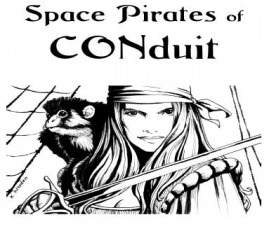
Space Pirates of CONduit

So this weekend I went to CONduit up in Salt Lake city.  It was a great experience! Lots of fun, lots of friends, and lots of excellent panels on writing.

The usual crowd was there: Dan Wells, Brandon Sanderson, L. E. Modessitt, Bob Defendi, Dan Willis, Paul Genesse, Julie Wright, John Brown, Larry Corriea, James Dashner, Eric James Stone, and tons of others.  Besides the bigger names, I saw a lot of other aspiring writers like myself who have yet to make it big–friends from World Fantasy and LTUE.  It was good to catch up and reconnect.

Friday had a number of excellent panels.  My personal favorite was A Writer’s Life, in which a number of relatively newer writers gave advice on breaking in and talked about what their lives are like now that they’re published.

At one point on the panel, a fearful aspiring writer asked the question: “when do you know when it’s time to quit and give up?”  The responses from the panelists were quite insightful.  Basically, the only way to know that you need to quit writing is if you can imagine your life without it.  If you can’t, you may feel that you’re writing currently sucks, but you’ve still got stories in you, and those stories need to find a voice.

There were a number of other gold nuggets on that panel.  Larry Corriea surprised me by saying that there is no such thing as an “outline writer” or a “discovery writer”–that these concepts simply describe writing tools, and that different projects require different tools.  Julie Wright said that if you are not enough without a publishing deal, you will never be enough with it.  John Brown (I think) said that writer’s block doesn’t exist: if you’re blocked, it means either something’s wrong with you or something’s wrong with the story.

Saturday had a number of excellent panels as well.  The guest of honor was Barbara Hambly, and she was a delight: witty, saucy, and full of interesting stories and great advice.  For her main address, she simply talked about how her life has changed in the past thirty years, but it was fascinating.

One of the more interesting things she said was that God places an angel with a flaming sword in front of every door in our lives that we shouldn’t take.  Sometimes, it seems that you’re simply staring down a corridor full of guarded doors–and sometimes, especially towards the end of life, it seems that you’re staring down a corridor and the angels are saluting you.  That made her tear up–she’s had a long, rough, yet interesting and vibrant life.

When asked to elaborate on the decline of the fantasy market in the past twenty years, she gave a very interesting response.  Today, instead of buying fantasy novels by the pound, fans are immersing themselves in MMORPGs like World of Warcraft.  Because it requires much less effort to play a game than to read a book, people are turning to games as a substitute.

Another fascinating panel was Riding the Rocket, in which a number of established authors discussed the career blast off and what to expect.  Lee Modessitt made the point that there are two basic approaches to writing: storytelling or writing excellent prose.  In order to be successful, a writer has to master both, but they generally start out better at one than the other.  The key is to know which one you’re weaker at and consciously work on it.

When asked about their greatest fear, the unanimous answer was that they’re terrified their next book will tank and that they’ll fade into obscurity–that they’ll be forced to go back to that dreaded day job.  The only way to deal with that, though, is to keep writing, keep working on your craft, and control the things you can while not fretting too much about the things you can’t.  If you do what you can, things will generally work out for the best.

There were a ton of other excellent panels, other nuggets of wisdom.  I recorded a number of panels, but I’ve decided not to post the mp3s publicly here: if you want them, just email me and I’ll send you a copy.

All in all, I’m very glad I came!  Besides all the panels and networking opportunities, it was just a lot of fun to hang out and talk science fiction and fantasy with a bunch of like minded people.  CONduit is an awesome convention–if you’re a local Utah writer and you have the chance to come, I definitely recommend it!