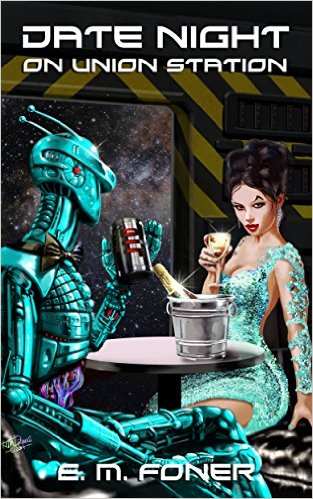
Date Night on Union Station by E.M. Foner

date_night_on_union_stationI saw this book on the Amazon also-boughts for my Star Wanderers books and decided to check it out. It’s a series of short novels: the first one is currently free and the others are $2.99. Like Star Wanderers, it’s a sci-fi romance, though it leans more toward science fiction than toward romance.

I really enjoyed this book! It’s a sort of romantic comedy-of-errors about a guy and a girl who go on a series of really bad dates before finally ending up with each other. She’s a member of the Earth embassy staff on a giant space station run by super-intelligent robots who view humans as a childish junior race that needs to be nurtured into galactic society. He’s a former mercenary who runs the station scrapyard and has a knack for picking up orphaned children (including one of the robots).

Their misadventures are quite hilarious. One of the running gags are the antics of the flower girls, who run their flower-peddling business with more ruthlessness than an Arab shopkeeper. They actually make more money at it than Kelly, the embassy staff employee, who can barely cover her own rent. The super-intelligent robots are the ones who run the dating service, but as each bad date leads to another diplomatic crisis of some sort, Kelly starts to feel like they’re using it more to help her do her job than to set her up. But with each new promotion in the embassy, she ends up making less and less. And those long-distance calls from her nagging mother certainly don’t help…

My favorite part of the book was watching one bad date lead to another, and wondering how these two people would eventually end up. From the way the book is structured, it’s pretty obvious that they’ll end up together (one chapter from her POV, the next from his). But some of those dates were really, really bad… at one point, she even gets kidnapped by her “date”! But when they finally do end up together, it’s quite satisfying.

So yeah, if you’re looking for a good, clean sci-fi romance with a generous helping of comedy thrown in for good measure, you’ll enjoy this book. And even if that’s not what you’re looking for, if you enjoy a good space story, you’ll probably like this one as well. I’d rate it 4/5 stars, and look forward to reading the next in the series.

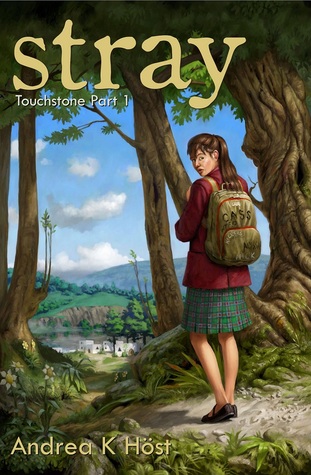
Stray by Andrea K. Höst

Stray (Adrea K Host)So I picked up this book on the Kindle Store shortly before boarding the California Zephyr for a cross-country train trip. For those of you not familiar with Amtrak, the California Zephyr runs from Emeryville to Chicago and is one of the most picturesque train routes in the United States, with some of the best views of the Colorado Rockies that you will ever see.

Well, I wasn’t paying much attention to the scenery this time, since I was way too engrossed in this book! I was more than halfway through by the time we got to Chicago, and finished it somewhere in the northeast corridor. It was an awesome, amazing read, one that I could hardly tear myself away from!

It starts out kind of like Hatchet, with a teenage Australian schoolgirl named Cassandra who suddenly and inexplicably finds herself in an uninhabited wilderness. It’s written in first person as a personal diary, so the first few chapters are all about the things she does to survive, such as finding food, water, and shelter, dealing with the wildlife, and trying to figure out just where she is exactly and how she can get herself rescued.

Eventually, she figures out that she’s on an alien planet. After a long trek in search of civilization, she finds a bunch of white stone ruins inhabited by cats. Then some weird things happen, which she doesn’t really understand (or oddly enough, doesn’t seem to be too bothered about), and shortly after that, she gets rescued–though not by people from our world.

It turns out that there are people living on another planet who have access to these naturally occurring inter-dimensional portals or gates, and use them to travel between real-space and near-space. This enables them to jump between worlds. Their civilization is about a hundred years more advanced than ours, with computers integrated directly into the human brain and other cool stuff like nanotech suits. They also have psychic abilities, like levitation, telekinesis, elemental manipulation of fire, water, lightning, etc, and supernatural sight.

Here’s the thing, though: they’re fighting a war against an infestation of trans-dimensional creatures called Ionoth, which originate in near-space and are creeping more and more into real-space. Some of them are relatively harmless, others are dangerous but unintelligent, and still others–the Cruzatch–are intelligent, highly dangerous, and very, very hostile. A special forces group called the Setari has been organized to fight them off, but the infestation is getting worse, and new gates are opening faster than anyone can close them. If nothing changes, humanity will be overrun in just a few short years.

It doesn’t take long for Cassandra to learn that she has psychic abilities of her own. The strange thing is that her abilities aren’t like any of the others. The people who rescued her soon enlist her into the Setari, where she may prove to be the key to turning the tide of the Ionoth war. But if the people of this dimension need her, how will she ever get back to Earth? Or will she even want to?

What starts off as a simple survival story soon turns into a complicated tale full of lost civilizations, trans-dimensional beings, psychic magic, high-tech, and political intrigue. At the center of it, though, is a very well-developed character who feels both real and authentic. Cassandra isn’t your typical YA heroine or “strong female character”–she doesn’t kick ass, she isn’t particularly attractive or popular, and she doesn’t get involved in any sort of sappy love triangle. But she is intelligent and resourceful, holds together under pressure, and is open and emotionally honest with her friends. She’s a great example of a female character who doesn’t have to be masculine or violent to be strong.

The world of this book is awesome. I was already sold on the ancient ruins and the alien planet wilderness, but the trans-dimensional stuff just takes it to a whole other level. The Taren civilization with their mind computers and neural network is pretty cool, and Andrea Höst very deftly works out the social and cultural implications of that technology. I’m not sure I’d want the government to have access to everything I can see, but this is definitely a world I’d like to explore. Fortunately, Stray is the first book in a trilogy, so it looks like I’ll be able to do just that!

The book ends almost exactly like you’d expect an old stock-bound composition notebook to end–on the last page, with a short entry that reads “sorry, ran out of room, will continue in the next volume.” The first book doesn’t have a clear ending that ties everything together, which is okay, because it fits very well with the overall tone and voice–it’s supposed to be a personal journal, after all. I wasn’t really bothered by it.

In fact, I can’t say that there was anything about this book that really bugged me. It’s a solid, awesome story. It does get a bit complicated by the end, but it’s not hard to follow, and the complications make it all the more engrossing. Reading this review, you probably think I’ve given away the plot of the whole book. Well, let me tell you, this quick synopsis barely scratches the surface! But I’m not a fan of spoilers, so I’ll end it here.

If you’re a fan of speculative fiction in any form–fantasy, science fiction, whatever–you’re probably going to love this book. You’ll especially love it if you’re sick and tired of the stereotypes that usually revolve around YA heroines and “strong female characters.” And if you just want to get lost in an alien world, this is one you won’t find your way out of easily!
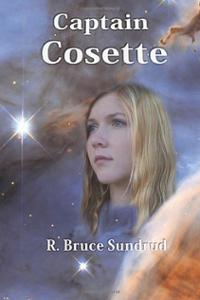
Captain Cosette by R. Bruce Sundrud

captain_cosetteSo I saw this book in my alsobots on Amazon a few months ago, and it looked interesting so I figured I’d give it a shot.  The cover is admittedly pretty bad, but it has two of my favorite things in the universe (space and girls), and besides, I’ll sample just about anything.  A few days later, I realized the sample folder on my Kindle was getting pretty big, so I decided to go through and clear some of it out.

Well, I ended up buying this one.  The beginning really hooked me, and the rest of the book did not disappoint.

Captain Cosette is basically a Cinderella story set in space, except instead of getting glass slippers and going to the dance, Cosette goes to war and becomes a knock-out starship pilot.  It’s military sci-fi with a lighter edge than Drake or Haldeman.  And it’s good.  I think I read from the 36% mark to the end without stopping.  Sundrud is really good at making you care about his characters and then putting them in peril.

One thing that I really enjoyed were all the pulpy Renee Chevalier books that Cosette always reads, which were really just tongue-in-cheek references to modern pop-culture phenomena like Twilight and Casablanca.  It broke the fourth wall at times, but I always found them hilarious, especially with some of the twists they add at the end.

Unlike some other sci-fi books that I’ve started recently and failed to finish, the science fictional elements here are not just window dressing–they really drive the plot.  I thought the teaching machine was particularly interesting, especially when it … well, I won’t give away any spoilers.  And of course, the lost colonies and border worlds were also fascinating.  Cosette comes from a backwards farming planet, and the way she thinks about things at first, you really get the sense that this has been her whole universe.  As she gradually comes to understand the geo- (astro?) politics of Union and Alliance, her awareness expands, and so does yours as the reader.  It’s very cool.

There are a couple of things I wish this book had done a little better.  The world is not nearly as immersive as I wanted it to be, and sometimes it feels like the characters are hurrying from place to place.  Also, sometimes the characters seemed to blend together a bit.  There was enough to differentiate them, but at times they sounded almost the same.  None of these issues took much away from my overall enjoyment of the book, however.  The story was solid.

So yeah, if you like the kind of stuff I like to write, you’re probably going to love this one.  At $2.99 for the ebook, you really can’t go wrong.  Even if you’re not a huge military sf fan, if you like Cinderella stories (and who doesn’t?), this one is definitely worth checking out.

Yesterday’s Gone: Episode One by Sean Platt & David Wright

Imagine you wake up tomorrow, and find out that everyone around you has vanished.  Well…not everyone.  But the ones who are still around claim to see strange things that you can’t see.  And then, you get an eerie feeling of a presence…something dangerous, something coming at you right now.  And then, things get really weird…

Yesterday’s Gone is a post-apocalyptic serial thriller: basically,  a novel divided into six parts or “episodes,” the first of which is free.  Since I’m interested in doing something similar with my next project, I decided to check it out.

From the very start, I was hooked.  The conflict was intriguing, the pace was fast and gripping, and the characters were interesting, with reactions that were spot on.  I wasn’t intending to finish the whole thing in one sitting, but once I’d started, there was no way I could put it down.

A couple of things jolted me out of the story, though.  The first was the sheer immensity of the cast of characters.  Literally, the first half of the episode was just introducing new ones, and none of them got more than two viewpoint scenes in the whole ebook.  I was on board for the first three or four of them, but around number six or seven, I just wanted to skip them and get back to the first guy.

Two of the later characters were just painful to read–not only did I not care about them, I vehemently hated who they were and wanted them to die or get out of the way so I didn’t have to read their viewpoints anymore.  The first was an eight year-old boy who had some mystical connection with animals…I just couldn’t sympathize with him at all.  The other one was a serial rapist and/or murderer who saw the apocalypse as just an opportunity to run around raping and killing the other survivors.  I skipped his scenes, but then had to go back because there were some clues hidden there and I didn’t want to miss them…ugh.

The other thing that really bothered me was the very last scene in the episode, where the authors made the mistake of showing the monster.  I won’t spoil it for you, but the image on the page clashed so strongly with the image in my mind, it deflated almost all the tension for me.  What was supposed to be a cliffhanger instead turned out to be a big “huh?”

Your mileage may vary, however, so if you’re into post-apocalyptic fiction, I think it’s definitely worth checking out.  Just like the happy pills in the empty lot behind the school, the first one is free: you can pick it up on Amazon or Smashwords.  And in spite of its problems, there was a lot in this story that I really liked.  Maybe you’ll enjoy it more than I did.

In terms of the serial format, I think it worked very well, except for those two problems: too many characters to keep track of, and an ending that booted me out of the story.  Otherwise, I think it’s a great way to publish, and I’ll probably experiment with something similar in the future.

One Confirmed Kill by Peter Johnston

The best description of this book that I think I could give is the disclaimer at the front:

The following is not fiction. The characters and events described are closely based on real life, and any resemblance to real persons, organizations and events is purely intentional, and should be construed in the most negative light the text will support. Some names have been changed to protect the author from violent reprisals from the real people thus depicted, in the unlikely event that any of them have learned to read.

Thus begins a darkly cynical account of one soldier’s experience (or lack thereof) in Al-Anbar Province during the Iraq War.  At times hilarious, at times surprisingly moving, this book made me laugh out loud and kept me engrossed all the way to the end.

Full disclosure: the author is a friend of mine from the Leading Edge slushpile, and I was one of the beta readers for this book.  That said, I really enjoyed this novel, both the earlier draft that I read and the finished version that I bought as soon as it came out.  It’s a lot like Catch 22, except I actually liked this one (whereas I could hardly get through the first chapter of Catch 22).  The writing is witty and sarcastic, and the story, while far from honeycoated, ends on a note that makes the read worthwhile.

If you’re happily employed by the military, this book will probably make you livid with rage…or it’ll send you roaring on the floor laughing your ass off.  I can see my military friends taking it either way.  But one thing is for sure: you won’t find it boring.

One Confirmed Kill is an indie published ebook, and you can currently pick it up in all formats for $.99 on Smashwords.  Disclosure: as a Smashwords affiliate, I get about $.10 from the sale.  However, even if I didn’t get anything for it, I’d still recommend it, because it’s a great read.

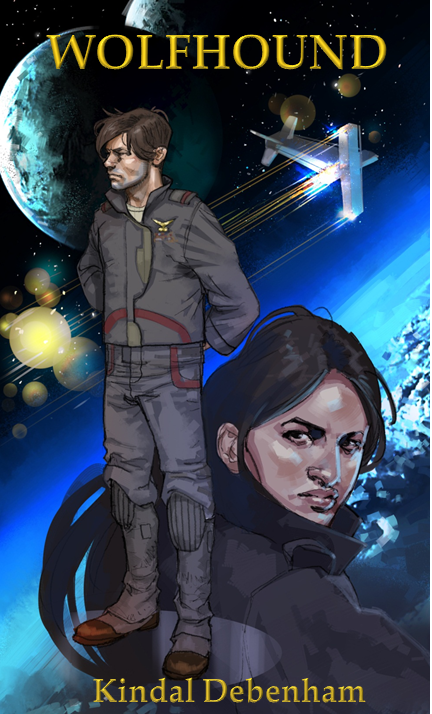
Wolfhound by Kindal Debenham

Jacob Hull may be just a spacer’s son, but he’s not afraid to dream big.  As an ensign in the Celostian Navy, his biggest dream is to pilot a destroyer like the Wolfhound, the brand new ship on which he receives his first assignment.  But when pirates attack on their training exercises and drive them far from the rest of the Celostian fleet, Hull realizes that his dream might be more than he asked for…

Full disclosure: Kindal Debenham is actually a good friend of mine–we were both members of Quark in college and still keep in touch as alpha readers for each others’ books.  That’s not why I’m saying that I loved this book, though.  I’ll admit, I had a few doubts when I first started it.  The descriptions are a little wordy, the formatting isn’t perfectly clean–but none of that really matters, because the story is AWESOME.

Why is it so awesome?  Because it’s full of characters you want to root for, facing one impossible conflict after the other, each one bigger and more daunting than the one before.  The story gets off to a decent start, but it really starts to take off after the first third or so, and just keeps getting better and better right up to the end.

Seriously, this is the kind of book I used to hunt for in the library as a kid.  It reminds me a little of the old Star Wars novels by Timothy Zahn, Kevin J. Anderson and Michael A. Stackpole.  Forget dark, dystopian futures and boring, high-concept stuff–this is some rip-roaring space opera, with stations you wish you could visit and starships you wish you could fly.

So yeah, I loved this book.  Great read; once I got into the second half, I couldn’t put it down.  If you’re a fan of space adventure stories, you should definitely check out this book.  It’s available from both Amazon and Smashwords as an indie published ebook, and it’s actually holding it’s own quite well on the Amazon bestseller lists.  It definitely deserves the spot!  Oh, and if you want to check out Kindal’s blog, you can find him here.

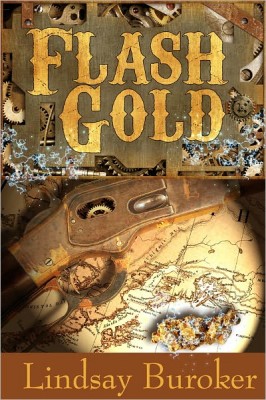
Flash Gold by Lindsay Buroker

All Kali McAlister wants is to leave Moose Hollow far, far behind–and with her dogless sled, the $1,000 prize for the sled race is just her ticket.  But with pirates, gangsters, and thugs in the Yukon after her late father’s alchemical secrets, she’ll be lucky to make it to the finish line alive.  And then there’s that striking man by the mysterious name of Cedar–why is he helping her?

This was a fun steampunk adventure story.  It was fast-paced, well-written, and quite enjoyable; Buroker knows how to hook a reader with interesting characters and conflicts.  I’m looking forward to reading more books set in this universe.

That said, I did have a few issues with this book.  At some parts, the dialog came across as wooden because the characters’ words and reactions didn’t match the intensity of the scene.  For example, Kali and Cedar got caught up in a couple of friendly discussions during gunfights, one about her automatic reloading rifle (which was somewhat excusable) and one about the status of their relationship (which felt a little contrived).  Also, the climax of the story revolves around a late third act info dump, which is a pet peeve of mine.  It didn’t bring the story to a screeching halt, but it did feel a little clumsy.

None of those kept me from enjoying the story, but they were definitely things I noticed.  My biggest issue was probably a lack of real dept or thoughtfulness; what I like to call a “stuff happens, the end” kind of story.  The main character had good internal motivations, but no real internal conflict.  For example, she had this whole history with a previous lover betraying her trust, but she didn’t really struggle much with learning to trust again; all that old baggage was just a part of her background.

Overall, though, this was a fun action-adventure romp.  The steampunk setting was great, one that I’d like to come back and revisit.  And in spite of my critiques, I didn’t feel cheated by this story at all; it really was an enjoyable read.  For $.99, what do you have to lose?

You can find Flash Gold at the author’s site here, or at Smashwords and Barnes & Noble (for some reason, the Amazon link appears to be broken).

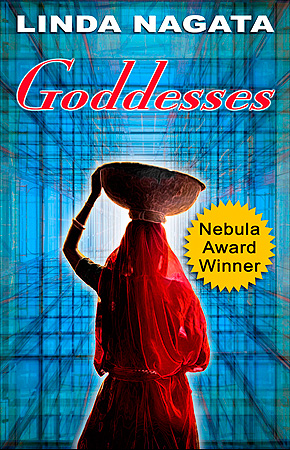
Goddesses by Linda Nagata

From the book description:

Michael Fielding is the newly appointed site director of the Four Villages project in rural India, tasked with guiding the economic development of the region. But a chance encounter with an ailing, homeless, and very young widow plunges him into the maze of an ossified and violent traditional culture, while putting his own career at risk.

On the other side of the world, Cody Graham’s hazardous waste cleanup company, Green Stomp, has earned a reputation for tackling the toughest, dirtiest jobs around. The harder the challenge, the more Cody likes it. But when chance—and the polluted ground water of Four Villages—brings Michael back into Cody’s life, both are forced to question their shared past, their values, and what it means to do good in the world.

This book was a change of pace for me.  It’s science fiction, but takes place on a near-future Earth much like our own.  In fact, the two driving elements of the story (infertility and economic development) are such contemporary issues that at points, I felt I was reading a piece of mainstream literature.

The writing is quite good, both on a technical and an artistic level.  The storytelling is a little slower, but the character development is very well done, especially for Rajban, the native Indian girl whom Michael takes in and rescues.  The parts from her point of view made me think a bit about my friends who did micro-finance after graduation; I think they would like her story a lot.

As a writer, one thing that interested me was how Nagata started off with a whole bunch of flashbacks and actually pulled it off.  They tell you never to do this, but she made it work by grounding those scenes with clear action and a relatable conflict (childbirth, for example), all in the first couple of paragraphs.  There were a couple of parts that confused me, but overall I think she handled it very well.

The ending was a bit ambiguous, which was dissatisfying in some ways but in other ways fit the story much better than a clean wrap-up.  The story raises some very thought provoking questions about tradition and modernity, and a more definitive ending would probably have ruined a lot of that.  But still, I wish I knew what happened to some of the characters after the end.

Overall, I’d give this book four stars.  If you enjoy science fiction but you’d rather read something grounded in the real world, you’ll probably enjoy this book.  If you’re interested in the developing world at all, I’d highly recommend it.

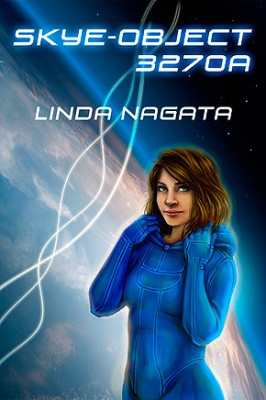
Skye Object 3270a by Linda Nagata

It’s not easy being a teenager in the orbital colony of Silk–especially when all the adults are functionally immortal and anyone under one hundred is considered an adolescent.  To make matters worse, Skye fell to the city in an escape pod when she was just a baby, with no idea who she is, where she’s from, or how long she was drifting in space.

Fortunately, she’s a tough girl with several close friends and a determined spirit.  One way or another, she’ll find out where she’s from–and whether there are any of her people still out there.  

I thoroughly enjoyed this book.  It combined the best of both science fiction and young adult: likeable teenage characters struggling to find their place in a high-tech alien world.  In particular, I found it fascinating how the widespread nanotech shaped both the society and the universe.

But the story isn’t about the technology, it’s about the characters, their adventures, and the friendships that form between them.  This was what really made the story come alive for me.  There’s a small amount of wish fulfillment, which may or may not be your thing, but overall I found the characters to be both believable and likeable.  It was a lot of fun to watch them grow and learn together.

At times, though, it felt as if the characters weren’t challenged enough.  The friendship and relationship issues were well done, but it wasn’t until the end that they started to have any significant try-fail (or try-almost fail) cycles in their adventures.  Also, while the ending was quite satisfying, it was also a little abrupt.

Those didn’t detract much from the rest of the story, though.  Overall, I thought it was a very satisfying read–the sort of book I wish I’d found when I was twelve or thirteen.  If I wasn’t already hooked on science fiction by that age, I have the feeling that this book would have turned me into a lifelong fan.

As a footnote, I’d like to add that this is EXACTLY the kind of book that indie publishing was made for.  It’s a great story, but the science-fictional setting is so unconventional that most publishers wouldn’t take a chance on it.  Even houses like Tor and Baen are focusing more on sub-genres like urban fantasy and military sf, which both have large, proven readerships.  For something that’s a little more niche or experimental, it’s good to see that there’s still a way to get it out to readers who would love it.

So yeah–if you like young adult books and you’re not turned off by space elevators, nanobots, or alien planets, you should totally try out this book.  I think it will surprise you just how much you enjoy it.

Paradise Seekers by Nathan Major

Haven–a land where no one knows who they are, where they’re from, or how they got there.  A place where everyone has a different recurring dream every night, which gradually grows in intensity until it drives them to madness.  A place where everyone has only a short amount of time to find Paradise, before they perish.

When Sam first comes to Haven, he thinks he’s found an idyllic utopia.  However, as he slowly uncovers the gruesome secrets of the place, he realizes he’s in a race against time to make Atonement and escape.

But how can he do that, when he can’t even remember who he is?  And how can he save the girl he loves, when she has only days before her dreams drive her into madness?

A few weeks ago, I said I’d start reviewing indie books on this blog.  This is my first one.  As a disclaimer, Nathan Major is a fellow Utah writer and a friend of mine, and I received a copy of the book for free, with the agreement that I would review it.

I genuinely enjoyed this book.  It’s a very compelling story, with a mysterious dystopian world and an intriguing premise.  Nathan is very good at building suspense and keeping the reader hooked, and the ending fully lived up to its potential.

As far as editing goes, I noticed only minimal spelling and grammatical errors.  However, the copy I read had some major formatting issues, such as wacky indents and an auto-generated table of contents that missed a few chapters.  Nathan assures me he’s fixed those issues, but I can’t vouch for the most recent copy.

As for the story, while I enjoyed it, it did feel as if it had been published too early.  More than once, I wanted to scream at the characters for doing something stupid, and the romance was occasionally over-the-top sappy.  The level of melodrama was on par with most anime, which is great if you can stand it.  Still, the story kept me hooked, and while I occasionally had to put the story down just to cool off, I always came back to it, right up to the very satisfying end.

If you like dystopian YA, I think you’ll like this book.  It reminded me a little of The Giver, with the urgency and sense of danger of a thriller.  Like I said, it also had a bit of an anime flair to it, so if you’re a fan of anime and manga, the issues I had with it probably won’t be as bad for you.

Overall, I rate Paradise Seekers at 3.5 stars.  If the formatting issues were fixed, I would rate it at 4.  Nathan has a natural talent at good storytelling, and I expect we’ll see many good things from him in the future.

Paradise Seekers is available for .99c from Amazon and free on Smashwords.