Adventures in ebook formatting

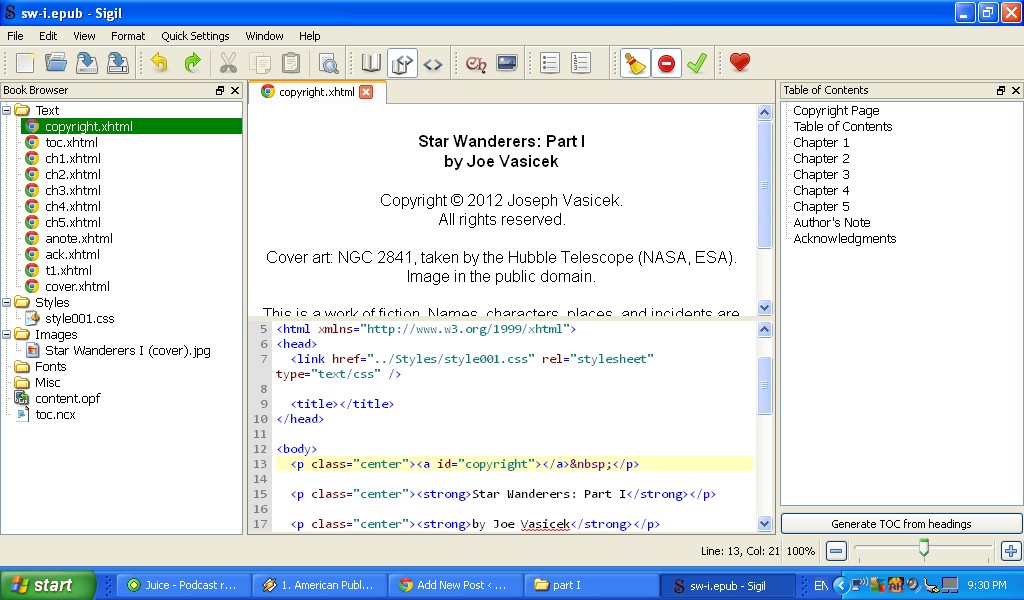
Under the hood of my latest ebook release, Star Wanderers: Part I.

So a couple of days ago, I set out on a quest to figure out a better way to build an ebook.  In the process, I ended up learning WAY more about ebooks than I’d bargained for, in the most awesome of possible ways.  Seriously, I don’t think I’ve ever felt so empowered as an indie author as I do right now.

My old process was extremely convoluted.  It basically involved saving my manuscript as HTML (introducing all kinds of excess code) and using four or five programs to cobble together a Frankenstein-like creation, with bolts sticking out of its forehead and extra arms and fingers sticking out of weird places.  The tools I was using were like blunt instruments, and I was operating them blindfolded.

So what changed?  Well, three things:

  1. I added the Writer2ePub plugin for Open Office / Libre Office,
  2. I downloaded an open-source epub editor called Sigil, and
  3. I watched this video:

So what did I learn?

<geek>

First of all, that ebooks are WAY simpler than I thought they were.  An epub is basically a zipped folder containing HTML files for the text, jpgs/gifs for the cover and any interior illustrations, a CSS stylesheet, maybe some extra fonts (if you want to get fancy), and two additional additional files ending in .opf and .ncx that look a lot like HTML files.

So why is this so exciting?  Because it means that if you know HTML/CSS, you can build a fully functional epub file using only notepad, windows explorer, and the command prompt.  THAT’S IT!  And if you want to learn HTML, you can do so for free at w3schools.com.

Basically, an epub is structured just like a website, except that an ebook reader reads it instead of an internet browser.  If you can build a website, you can build an epub with very little trouble.  Even if you can only tweak a website, you can build an epub with very little trouble.

</geek>

In other words, the barriers to entry for ebook publishing are ridiculously low.  If you’re patient and a good learner (or hell, just a good learner), there is not a single reason why you need to spend any money to format your ebooks, upload them directly to retailers, or do anything else.  Using tools that are 100% available for free, you can create a product that looks every bit as professional as anything coming out of New York–in many cases, even more professional.

So what’s my new process?

1) Format the master file in Open Office.

This includes adding the copyright page and table of contents, adding anchors (in OO they’re called “bookmarks”) and hyperlinks, adding the author’s note and acknowledgments, any teasers, etc.  I save the file in open document format, add “Smashwords Edition” on the copyright page and save it as a .doc file for Smashwords.

At some point, I’m going to upgrade to Libre Office, but I haven’t gotten around to it yet.  When I do, it’ll basically be the same thing.

2) Export as .epub using the Writer2ePub plugin.

I cannot tell you how happy I am with this Open Office / Libre Office plugin.  It pulls out all of the unnecessary formatting and breaks up every chapter into a separate, cleanly coded HTML file, all bundled together into a fairly simple epub.  SO MUCH BETTER THAN SAVING AS HTML.  Or Mark Coker’s “nuclear option,” for that matter.

I don’t add the cover at this point, though.  Writer2ePub adds some weird stuff if you do it that way, and I find it easier just to code it manually in the next step.

3) Finalize the .epub in Sigil.

Sigil is basically just an HTML editor with some extra functionality that allows it to build an epub from those HTML files.  It’s easy to learn, simple to use, and tells you exactly what’s wrong when something breaks.  Unlike Calibre and Mobipocket Creator, you can always see what’s going on underneath the hood.  Simple, clean, and elegant.  I love it.

This is the phase that takes the most work.  I add the cover, fill in the relevant metadata, tweak the CSS stylesheet for margins and indents, add the book guides, build the table of contents, etc.  If you want to know exactly how I do this, let me know and I’ll write up a post on it later.  It’s a little technical, but not too difficult.  Like I said, if you know even a modicum of HTML, you can figure it out.

Once this step is finished, I have the final epub version of my book.  I upload that to Pubit! and Kobo Writing Life, and just about anywhere else outside of Amazon where I sell my book.  Someday soon, Smashwords will hopefully allow you to directly upload an epub, at which point I’ll do that here as well.

4) Convert to .mobi with KindleGen.

Amazon uses its own proprietary format for ebooks, unlike everywhere else, which takes the open source epub format.  This is probably because of all the weird and funky stuff that Amazon likes to track for data collection purposes, although honestly, who knows?  A mobi file is about twice as large as an epub, and I suspect that that’s the reason.

KindleGen is a free program that Amazon has made available to developers in order to facilitate conversion of epubs and other ebook formats into mobi.  It’s a command line tool, which means that you have to get a little retro to use it.  But hey, I grew up in the 90s with DOS, so it’s actually kind of nostalgic.

Once you’ve got KindleGen installed to c:\kindlegen, all you basically need to do is go to the file folder where your ebook is saved and enter the following command:

c:\kindlegen\kindlegen mybook.epub -c1 -verbose

“mybook.epub” is whatever you named your epub file, “-c1” stands for standard DOC compression, and “-verbose” stands for verbose output (whatever that means).  There are other options you can enter, but I’m not sure what they do yet.  All I know is that if you want to convert from epub to mobi, this will give you a clean result.

There are a few small things that get lost in the conversion, so you need to add them as redundancies in the epub.  The biggest one I’ve noticed so far is the paragraph indents: if you go into the CSS stylesheet using Sigil and add p { … text-indent: 2em; … } that should fix it.

And that’s it!  Once this step is finished, I’ve got the final mobi version and can upload that directly to Amazon and my kindle.  Once that’s done, my book is available from every major ebook retailer in every country in the world.  Total time = maybe an hour (plus however long it takes for the retailers to publish the files to their stores).

I know it’s 2012 and this is old news by now, but do you have any idea how cool this is?  With one hour of work and two or three programs, all of which are available for free, I can produce a clean, professionally formatted ebook, and sell it around the world instantaneously with a marginal cost of zero.

And now, because I took the time to learn how to use the tools, I can be confident that there aren’t any bits of rogue or useless code in it either.  The only “black box” is really the mobi format, but I could probably crack that and figure it out if I wanted to.

So yeah, needless to say, I am extremely happy to be an indie writer. 🙂
Yay for Kobo Writing Life!

So after a month of waiting, Kobo’s publishing platform, Writing Life, is finally up!  I just finished uploading all of my titles (except my short stories–I’ll just continue to distribute through Smashwords for now). Genesis Earth is already available, and the others should be up soon.

For those of you who are readers, this means that you’ll be able to find my books on Kobo almost as soon as they go up on Amazon.  The formatting will (hopefully) be cleaner, since I’ll have direct control.  Prices will generally be the same as on other platforms, but when I change the price on Amazon, I’ll change it simultaneously on Kobo, too–no waiting for weeks on end for the price to drop.

For those of you who are writers, I’ll be sure to keep you updated with thoughts on my experience.  So far, it looks pretty good: the royalty rates are better than Amazon (70% for titles priced $1.99 – $12.99, 45% for all other titles), the publishing process is faster, and the upload formats (.epub, .doc, .docx, .mobi, and .odt) are generally more flexible.  Downsides include a higher minimum threshold for direct deposit ($100 or every 6 months), fewer category choices, and what appears to be a forced 2:3 aspect ratio for cover art.

Besides that–oh, look, Bringing Stella Home and Journey to Jordan just went up too!  Man, that’s fast!  And it looks like the aspect ratios went back to 3:4, so I won’t have to redo the covers.  That’s a relief!  So yeah, I’ll be sure to keep you updated.

Also, in preparing my books for upload to Kobo, I discovered some pretty egregious formatting errors for the Barnes & Noble copies of Bringing Stella Home and Sholpan.  I’m not sure what happened–probably it had something to do with an older version of Calibre or Open Office, since I was overseas at the time and only had access to my netbook.  So yeah, if you downloaded one of the broken copies, just shoot me an email and I’ll send you the updated epub version, no questions asked.

In general, I need to revamp my publishing process.  Currently, it resembles jumping through a ring of fire while juggling half a dozen angry poodles.  Open Office, Mobipocket, Notepad, Calibre, KindleGen, DOS prompts, and Kindle for PC–yeah, I’d better get on that.  If you have any suggestions for free/open source software that does .mobi and .epub, please let me know.

In other news, I finished my first pass through Stars of Blood and Glory, and should be finished with draft 2.0 by the end of the week.  After that, it’s back to Star Home and Star Wanderers.

If you’re thinking of self publishing, read this. All of it.

I just read a fascinating Q&A on Reddit with Hugh Howey, author of the self-published phenomenon Wool.  After six trancelike hours reading through all the comments, all I can say is “wow.”

Okay, I guess I can say a little more.  Yesterday, I listened to Brandon Sanderson’s lecture on self-publishing from his English 318 class this year.  While I agree with much of what he says, a lot of it is already out of date.  Probably the biggest thing is whether it’s still advantageous for indies to go with a traditional publisher after making a name for themselves.  In 2011, Amanda Hocking had some good reasons for going traditional.  In 2012, Hugh Howey has some very good reasons not to.

The other big thing, though, is this idea of author platform–that to be a successful indie, you have to find some way to drive large numbers of people to your books.  Well, not necessarily.  Hugh Howey was a nobody for three years, and the title that finally pushed him over the tipping point was the one he promoted the least.  To me, that shows:

  1. current sales are not a predictor of future sales, and
  2. a great book will grow into its audience independent of its author.

Granted, there may be a threshold that needs to be crossed before word-of-mouth really starts to kick in, but if a nobody with passable cover art and no author platform can cross it, that threshold isn’t very high–and that’s good news for all of us.

The way I see it, there are three big myths that writers struggle with in making the shift from traditional to indie publishing:

1) The flood of crap books will keep you from getting noticed

This grows out of the paradigm of limited shelf space–that the best way to get noticed is to have your book occupy more space relative to all the other books on the shelf.  This might be true in the brick and mortar world, but the rules are much different in the digital realm.

Think about it: how many new blogs are launched every single day?  Thousands, if not hundreds of thousands.  And yet people still find the good content amid the sea of crap.  On Youtube, an average of one hour of video content is uploaded every single second.  And yet there are still entertainers making a lot of money through their Youtube channels.

The rules in the digital realm are completely different from everything in the physical world.  Figuring that out requires a huge paradigm shift, one that even indie writers struggle with.

2) Publishing a book is an event that must be promoted

This grows out of the paradigm of velocity, or as Kris Rusch puts it, the “produce model” of publishing:

Every month publishing comes out with brand new product. Shelf space is limited in every single brick-and-mortar bookstore.  Big Publishing makes the bulk of its money during the first few months of a book’s existence.  So if a book sits on a bookstore’s shelf until the book sells and that sale takes six months to a  year, the bookstore and the publisher lose money.

Better to dump the old inventory on a monthly basis—for full credit for unsold items—than it is to have the inventory sit on the shelves and grow “stale.”

Of course, the flaw in this logic is that digital shelf space is unlimited, therefore books do not “spoil.” No matter how much time passes, an ebook can still be found in the same place.

Therefore, does it really make sense to make a big deal over an indie book release?  Maybe to jump start some word-of-mouth, but it’s not like your career is going to be harmed if you do nothing.  In fact, it might be better to hold off until you have a few more titles up, so that when you give the first one that push, readers will have something else to read once they’ve finished it.

3) To succeed you need to find a way to “break in”

This grows out of the gatekeeper paradigm, where the system is closed and the few entry points are guarded by a select group of taste makers whose job is to bestow legitimacy on those who meet the qualifications to get in.  It’s the concept of patronage, where success comes from being chosen by a wealthy benefactor, and it’s connected with the idea that you haven’t truly “arrived” until <fill in the blank>.

The flaw with this paradigm, of course, is that publishing is no longer a closed system.  The gates haven’t just been flung open, the walls themselves have been torn down.  The job of the taste makers is no longer to protect readers from the dross, but to lead them to the gems–which is honestly much closer to what it should have been in the first place.

So what does this mean for creators?  It means that there’s no longer a system to break into.  You don’t need to write better than everyone else, you just need to find (and keep) your 1,000 true fans.  Success isn’t bestowed upon you by some higher authority, it’s something that you discover on your own as you hone your craft and build your business.

Honestly, this is one that I still have a lot of trouble with.  When I left to teach English in Georgia, in the back of my mind I had this vague notion that I was going into a self-imposed exile, and wouldn’t come back or settle down until I’d “broken in.” Of course, this made me quite discouraged, because it felt like things were out of my control–or worse, that I’d somehow failed.

But listening to Brandon’s lecture and reading Howey’s Q&A session helped me to remember that it’s all still in my control.  I don’t need a benefactor, I just need a good plan, if that makes any sense.  So right now, I’m thinking things through and making the necessary revisions to that plan.  There probably won’t be any big ones–I still think I’m more or less on the right track–but it will be good to update my paradigm.

By the way, the title of this post applies to the Q&A with Hugh Howey, not to the post itself.  Though if you are thinking of self publishing, I hope it’s helped out in some way.

Also, I just finished part I of Wool, and it deserves every bit of praise that it’s got.  Expect to see a review of the omnibus shortly.

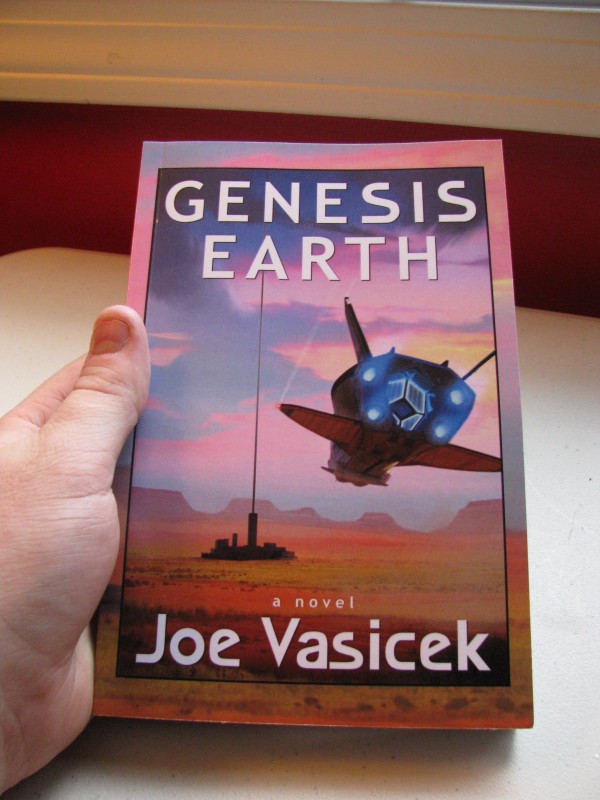
The print edition of Genesis Earth is in!

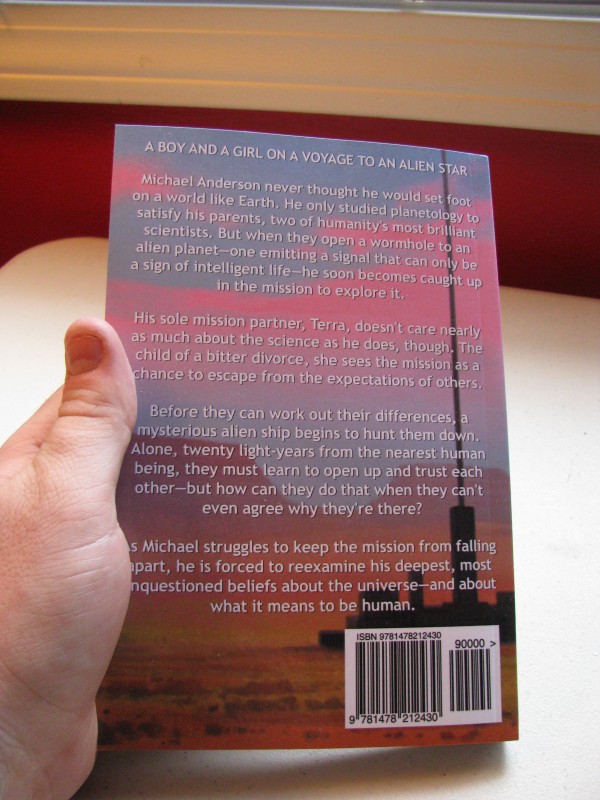
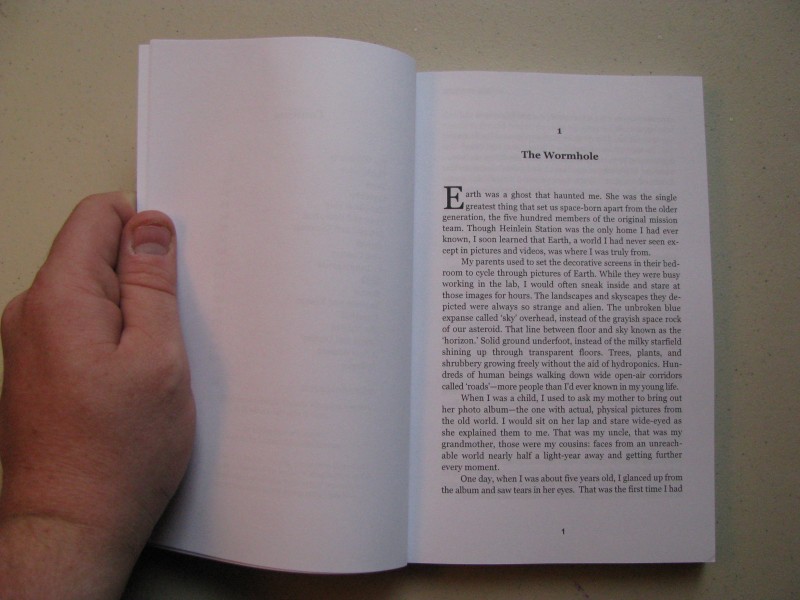
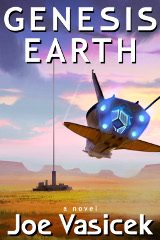
The proof for the print edition of my first novel, Genesis Earth, just came in the mail–and it looks AWESOME!  Check it out!

Front cover.
Back cover.
Page 1, Chapter 1.

Holy crap, it is so cool to have a book in my hands THAT I ACTUALLY WROTE.  So cool!

I approved the proof a couple of hours ago.  It’s currently up for sale on CreateSpace (where I get a higher royalty), but it should also be up on Amazon in 5-7 business days.  I haven’t opted for the extended distribution, which means that those are the only places where it’s going to be available for a while.  I might opt in a little later, but I haven’t made a decision just yet.

Next step: put out print editions for Bringing Stella Home and Desert Stars.  Those should be coming soon, probably by mid-August.

Man, this is so much fun!

No more word counts and other paradigm shifts

This August, it will be five years since I decided to start writing on a professional level.  A lot of things have changed since then, and in some ways they’re changing even faster now.

For example, in May 2009 I started a spreadsheet to keep track of my daily word counts.  I’ve been keeping it diligently ever since then, with graphs and everything.  But just recently, I’ve decided to stop doing that.  Word count is a very shallow indicator of progress: it only measures quantity, and often leads to unnecessary angst or diverts attention from more important things.

Instead, I’m going to focus more on deadlines and work to develop some other, better indicators.  Number of books published per year is probably a key one, as well as number of manuscripts finished.  But deadlines are probably going to be the most important drivers from here on out: publishing deadlines as well as writing deadlines.

Another thing that’s shifting is my revision process.  I know that a lot of beginning writers hate Heinlein’s rules, but almost all the long-term professionals swear by them–especially the ones with careers that I would like to emulate.  This makes me think that I need to scale back on the revisions and develop more trust in my creative voice.

Just as a point of reference, Heinlein’s rules are:

  1. You must write.
  2. You must finish what you write.
  3. You must refrain from rewriting, except to editorial order.
  4. You must put the work on the market.
  5. You must keep the work on the market until it has sold.

I’m currently on the second draft of Stars of Blood and Glory, and what I’ve found so far is that the overall story is actually pretty good.  Some of the scenes are a little out of order, and some of the plot-lines are missing elements that need to be added in, but aside from a few chapters where I got lost for a couple of pages, not a lot needs to be changed.

Of course, I could spend a draft or two tweaking every other sentence, tossing out most of what I wrote in the heat of my creative passion–but would that really make the story any better?  I recently had Kindal’s writing group critique my first chapter–the one that I revised pretty heavily in April–and they found all sorts of problems that weren’t in the original draft, as I wrote it back in December.

Don’t get me wrong–I do think there is an important place for revision.  But I think it’s best epitomized by Tracy Hickman in this episode of Writing Excuses:

We write from the heat of our passion, but we edit to see the fire through the smoke.

And even Tracy only does three drafts.

The other thing that’s changing is how I look at alpha reading.  I used to have different tiers of alpha and beta readers–most of whom were writers in other genres, and not really fans of  science fiction.  I asked them to give me as much feedback as they could, and bugged them for weeks or months at a time asking if they’d read my story.  I then compiled all their line-by-line comments into one giant master-file, which I kept open on the left side of my screen as I made the changes to my manuscript on the right.

Well, I’ve started to realize that there’s a huge difference between reading for criticism and reading for enjoyment.  Because of that, a lot of the things my alpha and beta readers pointed out were things that most regular readers probably wouldn’t have noticed.  Towards the end, I started to get wise on this, and only followed about a third of the criticism that I received.

Don’t get me wrong–I do appreciate the feedback.  A lot of it helped me to see and fix problems that I’d otherwise missed.  But a lot of it came out in casual conversations with my readers after they’d finished the story–not in the line-by-line comments on the original draft.

For those reasons, I think I’m going to change the way I ask for feedback.  Instead of alpha and beta readers, I’m going to go with a handful of “test readers”–readers who enjoy the kind of science fiction I like to write, but who may or may not be writers themselves.  Instead of asking for a detailed, line-by-line critique, I’m going to ask them three things:

  1. Did you enjoy the story?
  2. If you stopped reading it, where did you stop?
  3. Did you enjoy it enough to pay for it?

I’ll ask them to give it three chances, and if they still can’t finish, that’s okay–just let me know where the hangups were.  And if they do finish it, I might have some questions for them–but then again, I might not.  It all depends on the story.

Compared to where I was when I started out–or even where I was three months ago–those are some pretty huge paradigm shifts.  I have no idea how it’s going to turn out.  I’ve grown a lot as a writer recently, and I hope that this is moving me in the right direction, but I won’t really know until I’ve tried it out for a while.

In any case, this post is long enough.  I’d better get back to writing.

Rivers and orphans and rivers, oh my!

So one of my goals this summer is to release POD (print-on-demand) editions for the three novels I currently have up as ebooks (Genesis Earth, Bringing Stella Home, and Desert Stars).  I started with Genesis Earth a couple of days ago, and wow!  I had no idea that getting a book ready for print could be so much fun!

I just finished formatting and typesetting the interior today, and it looks pretty awesome!  Drop caps, chapter headings, page numbers, a pleasingly arranged text–there’s something immensely satisfying about paper, an experience that ebooks (as awesome as they are) just don’t quite capture.  If I weren’t a writer, I’d be a typesetter–but because I’m an indie, I can be both!

As with ebooks, the learning curve for print formatting is pretty steep, but I think I’ve got the hang of it.  The guys over at Kindle Boards gave me a lot of helpful advice, and sent me a really awesome POD guide that’s been a lifesaver.  My editor (who’s also trained in typesetting) gave it a once over too, so I think we’re in good shape.

Barring any unforeseen complications, the print version of Genesis Earth should be up in a couple of weeks.  The cover art is more or less done–I just need to revise the blurb, send the PDFs out to CreateSpace, and wait for the proof to come in the mail.

One thing I’m wondering is whether to go with the free ISBN (which will list CreateSpace as the publisher) or to spend $10 and go with my own imprint.  My gut tells me to go with the free option–not because it’s cheap so much as because it’s less complicated–but I wonder if there might be some advantages down the road to taking the other.

ISBNs, imprints, and distribution channels, oh my…I’ll have to save that for another post a little later. 🙂

Star Wanderers: Part I is now available!

That’s right–the first part of my novel Star Wanderers is now available on Kindle and Smashwords for $2.99!  Barnes & Noble, iTunes, and Kobo editions should be coming out shortly (though I’m waiting for Kobo to launch their direct publishing platform, which may take a while).

This is the first part of a four part novel, but really it’s more of a series of short novellas since each part has its own distinct story arc with a beginning, middle, and end.  This one is about 15,000 words (or 40-60 pages), and takes place in the Gaia Nova universe about a thousand years before the events of Bringing Stella Home.  It’s about a boy and a girl who don’t speak the same language but find themselves alone on a starship together.  Here’s the description:

HE WANDERS THE STARS IN SEARCH OF A HOME. INSTEAD, HE GOT A GIRL WITHOUT ONE.

When Jeremiah arrived at Megiddo Station, all he wanted was to make some trades and resupply his starship. He never thought he’d come away with a wife.

Before he knows it, he’s back on his ship, alone with his accidental bride. Since neither of them speak the same language, he has no way to tell her that there’s been a terrible mistake. And because of the deadly famine ravaging her home, there’s no going back. She’s entirely at his mercy, and that terrifies him more than anything.

Jeremiah isn’t ready to take responsibility for anyone. He’s a star wanderer, roaming the Outworld frontier in search of his fortune. Someday he’ll settle down, but for now, he just wants to drop the girl off at the next port and move on.

As he soon finds out, though, she has other plans.

Also, I’m happy to report that I finished the full-length version of Star Wanderers over the weekend, making it my seventh written novel!  Here are the stats:

words: 68,367
chapters: 20
ms pages: 317
start date: 1 September 2011
end date: 1 July 2012

And some other stats, just for fun:

kilometers traveled: ~32,000
languages encountered: English, Georgian, Russian, Mingrelian, Hebrew, Arabic, Turkish, Farsi, Polish, Slovakian, German, Armenian, Spanish, French, and Australian
other books started before finishing: 4
other books finished before finishing: 2
other books published before finishing: 2

Part II is pretty close to publication, but Parts III and IV still need a bit of work.  Since the rough draft is finished, though, it shouldn’t take too long to get everything else ready.  If all goes well, I’ll publish Part II in August or September, and the other parts in two month intervals.

This novel was a lot of fun to write, in spite of how difficult it sometimes was.  I always knew it was a story worth telling, and that gave me both the motivation to finish it and the courage to send it out into the world.  I think you guys are really going to like it, especially if you’ve enjoyed my other sci fi romance stuff.  As I said on Twitter back in 2011, girl + starship = WIN!

So yeah, check it out!  And be sure to keep an eye out for Part II, which should be coming out in just a month or two!

Form rejection and WOTF closure

So I finally got an email from the Writers of the Future contest.  It reads:

Dear Entrant,

Your story has now been judged and did not win or place in the 1st quarter. Even though you have never had to wait for results in order to submit for the next quarter, this hopefully gives you incentive to submit again. The more often you enter, the better chance you have of winning, and improving  your skills.

I do urge you to join our forum if you have not already, or subscribe to our judge, David Farland’s newsletter. Lots of great tips at both locations to help you.

I do hope you are already working on that next story and do let me know that you did get this e-mail.

Best regards,

Joni Labaqui

I’m not going to lie: it’s a pretty disappointing way to end an 8+ month wait.  But when you’re a writer, rejection is just a normal part of the business.  I was hoping to get at least an honorable mention, but oh well.

Stories are fundamentally subjective: what might work really well for one reader might not for another.   The important thing is to write the best stories that you can, and to send them out into the world until they grow into their audience.  I still feel confident that Star Wanderers represents some of my best work to date, so I plan to make it available as soon as I can.

I’m flying back to the States on Friday, but Part I is already edited and formatted, so I’ll probably publish it over the weekend.  In the meantime, I’ll finish the first draft of the complete novel somewhere between Tbilisi and New York.  That’s one good thing about the long wait–it helped me to finish the story and work out some of the kinks before publishing it.

So yeah, the WOTF rejection is a bit of a setback, but at the same time, it’s also quite liberating.  All I really wanted was to get this story out to the readers, and now I can finally do that!  If you like my other stories, I think this is one you’re really going to enjoy.

Expect to hear more about it soon!

Blurb and cover for Star Wanderers

So the first quarter finalists for the Writers of the Future contest were finally announced (finally!), and I wasn’t among them.  Oh well.  But the good news is that I can move ahead now to publish part 1 of Star Wanderers!

First, though, I need to work out a killer blurb.  This is what I’ve got so far:

When Jeremiah arrived at Megiddo Station, all he wanted was to make some trades and resupply his starship. He never thought he’d come away from the frontier outpost with a wife.

Before he knows it, he’s back on his ship again, alone with his accidental bride. Since neither of them speak the same language, he has no way to tell her that there’s been a terrible mistake. And because of the deadly famine that has ravaged her home, there’s no going back either. The only way forward lies across a dozen parsecs of cold, empty space.

Jeremiah wasn’t looking for someone to keep him warm on the long voyages, and he certainly isn’t ready to settle down. He’s a star wanderer, roaming the Outworlds in search of his fortune. But there’s a dark side to his wandering–a loneliness that threatens to destroy him. His unexpected passenger may be willing to end that, but how can she when they barely understand each other?

So what do you think?  Does it tickle your fancy?  Are you intrigued to read more?  Or are you thinking it’s kind of “meh”?  Any feedback would be much appreciated, even if it’s just “this reminds me of _____.”

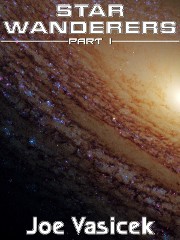
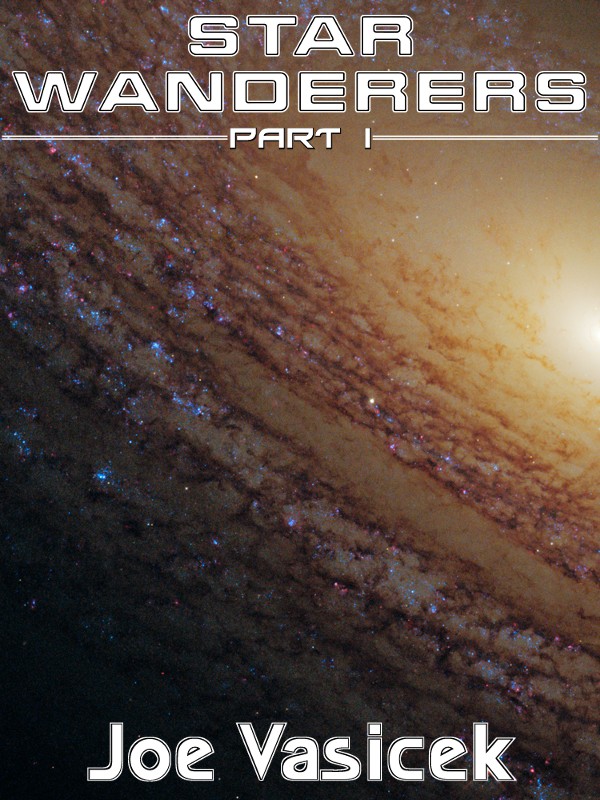
By the way, here’s the cover:

I’m experimenting a lot with this next novel.  The plan is to release it in a serial format first, then publish the full-length novel once I’ve serialized the sequel (more of a parallax actually.  The tentative title for that one is Star Home, and it’s the story from the girl’s perspective).

Here’s how I plan to publish it:

  1. Release Part I for $2.99.
  2. Give newsletter subscribers a two week coupon code on Smashwords to download Part I for free.
  3. Release Part II for $2.99 and drop Part I to free.
  4. Give newsletter subscribers a two week coupon code on Smashwords to download Part II for free.
  5. Release Part III for $2.99 and drop Part II to $.99.  Keep Part I at free.
  6. Give newsletter subscribers a two week coupon code on Smashwords to download Part III for free.
  7. Release Part IV for $2.99 and drop Part III to $.99.  Keep Part II at $.99 and Part I at free.
  8. Give newsletter subscribers a two week coupon code on Smashwords to download Part IV for free.
  9. Publish the full-length novel  at $4.95.

This way, no one has to pay more than five bucks for the whole thing, and people who subscribe to the newsletter get a really sweet deal.  There shouldn’t be more than a month or two between release dates–Part II is almost ready to go, and I plan on finishing the complete first draft in the next couple of days.

So yeah, that’s the plan.  I’m excited to finally get this story out to you!  I really had a blast writing it, and I think you’ll enjoy reading it, especially if (like me!) you’re a fan of science fiction romance.

More to come!

Quick update (yes, I’m still alive)

I just had an awesome weekend.  Saw the most amazing cave complex of my life, toured Kakheti o a TLG excursion, met a bunch of really cool people, and hung out with them in Tbilisi for a while.  I’ll have to save all that for another blog post, though, probably in a couple of days.

Rumor has it that the judging was finished for the first quarter Writers of the Future contest over the weekend, and all the finalists were contacted.  I didn’t get a call or an email, so I’m probably not a finalist this time around.  Oh well.

In any case, I’m very much looking forward to getting the results so that I can finally publish this dang story!  It’s been way too long since I published anything, and while there have been reasons for that (moving to another country, starting a second career), I really need to be publishing new stuff more regularly.

Here’s what I want to publish before the end of the year:

  • First and second parts of Star Wanderers (my Writers of the Future story).  This is a novel I plan to publish in four parts, with each part being its own self-contained story.  I blogged about it a while ago…more on that later.
  • A companion novella to Desert Stars.  This is still just in the planning stages, but there’s plenty of backstory to draw from, and I really would like to revisit that corner of the Gaia Nova universe.
  • Either Heart of the Nebula or Stars of Blood and Glory.

That last one is going to be an ambitious undertaking, since both of them are still in the alpha-reading phases right now.  Also, I don’t now whether I’ll have regular access to a reliable source of electricity in the fall, which will further complicate things.  However, I do believe it’s possible to put out one or the other before the end of the year, though probably not both.

All of this is still up in the air, though, and I can’t promise anything except to get Star Wanderers: Part I up as soon as the results come in for the Writers of the Future contest.  It’s already formatted and ready to go, just need to fine tune the blurb and hit “publish.”

And of course, before I move on to any of these other projects, I have to finish the one I’m currently working on.  So so long!  I’m off to the library to write.