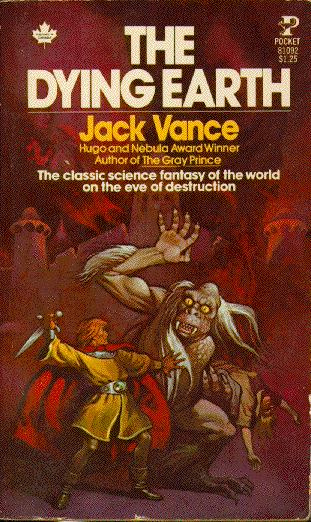
The Dying Earth by Jack Vance

the_dying_earthDo you remember those creepy-weird montages from those old 60s and 70s era Disney movies?  The ones like Dumbo, or The Three Caballeros–or heck, the entire thing of Fantasia–where all these weird kaleidoscopic shapes and psychedelic colors just move in and out of each other in twisted, convulsing ways?  Well, guess what?  Jack Vance’s The Dying Earth is like one of those montages in written form, and I loved it.

I picked up this book in order to familiarize myself a little better with the Sword & Planet subgenre, which I’d like to write in (as you may remember … my WIP is currently on hold, but I’d like to pick it up again soon).  This one is a lot different from the Princess of Mars series, with an eerie apocalyptic feel, arcane magic and forbidden knowledge, weird, monstrous creatures, and above all else, a decidedly un-Disney fairy-tale feel that pervades the book with doom and danger.

If you’re looking for straight-up Science Fiction, you’re better off looking elsewhere.  This book is even more fantastic than Ray Bradbury’s stuff, and while there’s a little bit of a sci-fi dressing thrown in, there really is no scientific justification for anything.  The basic premise is that the Earth is dying, meaning that the sun is growing dimmer and dimmer and will soon go completely out.  The last few people eking out an existence on this planet are mostly wizards and witches, each one intent on building their own little empire and cheating or stealing from everyone else.  There are a few pure-hearted souls, but the world is completely lawless, and the only way to survive is through magic or brute force.

The chapters are really more like interconnected short stories, where each one stands on its own, and yet may feature a recurring character, or be set in the same place as another.  There were only six chapters in the version I read (the 1977 Pocket Book edition), which makes me wonder if I missed any.  If I did, I would definitely like to read them, because the stories were absolutely mesmerizing!

Because I read this book to get a feel for the sub-genre, I’m going to list some of the things I really enjoyed about it.  Here they are:

  • The fairy-tale story structure.  None of the chapters started out with “there once was a …” but it certainly felt like they did.  Each character started off with a quest or dilemma, and then went on a journey of some sort where they faced trials, made friends, and defeated enemies in order to attain some sort of boon at the end.
  • Lots and lots of world-breaking magic.  Seriously.  One of the guys sets out on his journey with a spell that basically keeps him from any danger whatsoever, so long as he stays on “the path.” Since he really has no idea where he’s going, “the path” is basically any path he chooses to travel.  Since all the rest of the magic is just as world-breaking, you have no idea what could happen next.  There’s always a sense that anything could happen.
  • An elevated sense of diction.  The characters don’t speak like we do, they speak like people from the 18th or 19th centuries, with words like “thus,” “whence,” “wherefore,” and grammatical structures like “I know not,” and “half yet remains.” It’s not just the characters, either–the whole book is like that.  It really adds to the fantastic, otherworldly feel.
  • Lots of contrasting extremes.  The demons are truly perverse and sadistic, with death and brutality on every other page.  At the same time, though, the moments of beauty and love are just as great.  My favorite line from the whole book, which practically made me cry, is “My brain is whole! I see–I see the world!” If I explained it any more, it would be a spoiler.
  • High adventure.  LOTS and LOTS of high adventure.  There isn’t a viewpoint character in the book who doesn’t leave home to go on some sort of quest through all sorts of wild and creepy dangers.  Every character is seeking something, and not in a “meh” kind of way–they are so wholly focused on what they’re seeking that they put their very lives in peril just to obtain it.  Almost all the romance is rescue-romance, of the pulpiest possible kind.  It’s awesome.

There are more, but those are the big things.  Overall, I’d say that this book is about 50% Fantasy, 30% Horror, and 20% Science Fiction, with none of the more modern conventions of any of those genres.  It was first published in 1950, but it feels a lot closer to Robert E. Howard and Jules Verne than J.R.R. Tolkien and Arthur C. Clarke.  If you’re looking for a good spec-fic throwback with lots of magic and adventure, this is a great one to check out.
Trope Tuesday: Curiosity is a Crapshoot

curiosity
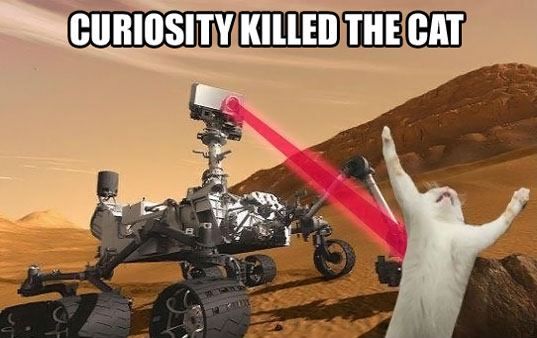
Is there life on Mars? NOT ANYMORE!

Is curiosity a bad thing?  Well, it depends how genre savvy you are.  It seemed to work out pretty well for Alice, but not quite so well for Pandora (or the rest of the ancient Greek world, for that matter).  Curious monkeys seem to come out all right, and their constantly curious counterparts also seem to do okay in the end, but anytime you run into schmuck bait you know that things aren’t going to turn out well.

The truth is, for just about every stock Aesop warning about the perils of being overly nosy, you can find another one exalting it as a virtue.  In fact, you could say that curiosity is a crapshoot.

But what is curiosity exactly?  The Merriam-Webster dictionary defines it as “desire to know,” and “interest leading to inquiry.” As you can imagine, there are situations where this could be good or bad.  Thus, what a story says about curiosity often changes depending on its genre.

For example, in most horror stories, curiosity and nosiness are usually bad, leading the protagonists to go places where they shouldn’t and uncover things that should never have been uncovered.  At the same time, a lack of curiosity can also be fatal … in fact, a lot of things can be fatal in a horror story.

In mythology and folklore, curiosity is often even worse.  From Pandora to Eve, Psyche to the proverbial cat, curiosity leads to Very Bad Things.  Perhaps this is because these kinds of stories are mostly tales of warning, passed on from generation to generation as a way to preserve our collective knowledge about the dangers of the world, rather than inspire us to go out and face them.

(As a side note, there are a few exceptions in the realm of folklore.  In the Bluebeard myth, curiosity killed off all of Bluebeard’s previous wives, but combined with cleverness, faith, and friendship, it saved the last one’s life.)

In fantasy, curiosity is often a mixed box bag.  For example, take the hobbits: most of them are perfectly content to live out their lives in the shire, but the few who are inquisitive enough to venture outside end up saving the world in a way that the elves, dwarves, and humans never could.  At the same time, it puts them through a great deal of pain, even after the world is saved–neither Bilbo nor Frodo are ever able to be content in the shire again.

Curiosity, in other words, is complicated.  It’s not just a quirk or a character flaw–it’s an underlying quality of the hero’s journey.  Without curiosity, either of the world around him or the internal struggles within, the hero would be content to live out an unremarkable life.  Certainly he wouldn’t have the capacity for the cleverness, guile, wisdom, and sensitivity that he needs in order to descend into the darkest dungeon, face his own nadir, and return with the elixir of life.  Curiosity may lead to sorrow, pain, or even death, but it also leads to adventure.

As a subgenre of fantasy, many of these issues carry over into the realm of science fiction.  And yet, as a genre unto itself, science fiction has a distinctly positive view of curiosity compared to other genres.  Science is nothing if not the primary process of human inquiry, where curiosity is not only a virtue but the virtue, one of the most important aspects of humanity.  Consider these words from Adam Steltzner, one of the leading engineers of the NASA Mars Curiosity mission:

Likewise, curiosity is a staple of science fiction.  In Star Trek, it’s the basis of the entire mission: “to explore strange new worlds, to seek out new life and new civilizations, to boldly go where no one has gone before.” In Doctor Who, it’s how the Doctor finds his companions.  In Babylon 5, it’s Delenn’s curiosity about the humans that ultimately saves all the alien races.  And in 2001: A Space Odyssey, it’s the gift from the black monolith that helps monkeys to turn bones into space stations (well, not literally, but you get the idea).

Curiosity isn’t a central theme in most of my books, but it is a major part of Genesis Earth.  If anything, that book is about the importance of balancing curiosity about our universe with curiosity about ourselves and what it means to be human.  In Star Wanderers, Noemi’s curiosity is a huge part of her story, helping her to turn around a horrible (not to mention awkward) situation.  In Desert Stars, curiosity is complicated; it leads Jalil far away from home and puts a schism between him and the girl who loves him, but it also leads him to discover the truth about who he is, giving him the strength to return.

In general, I suppose it all comes down not only to genre, but to the underlying worldview of the author of the story.  Since I have a very positive and enthusiastic view of curiosity, it usually works out for the best in the stories that I write. Then again, perhaps that’s why I’m drawn to science fiction … how about you?

Trope Tuesday: Sinister Surveillance

secure
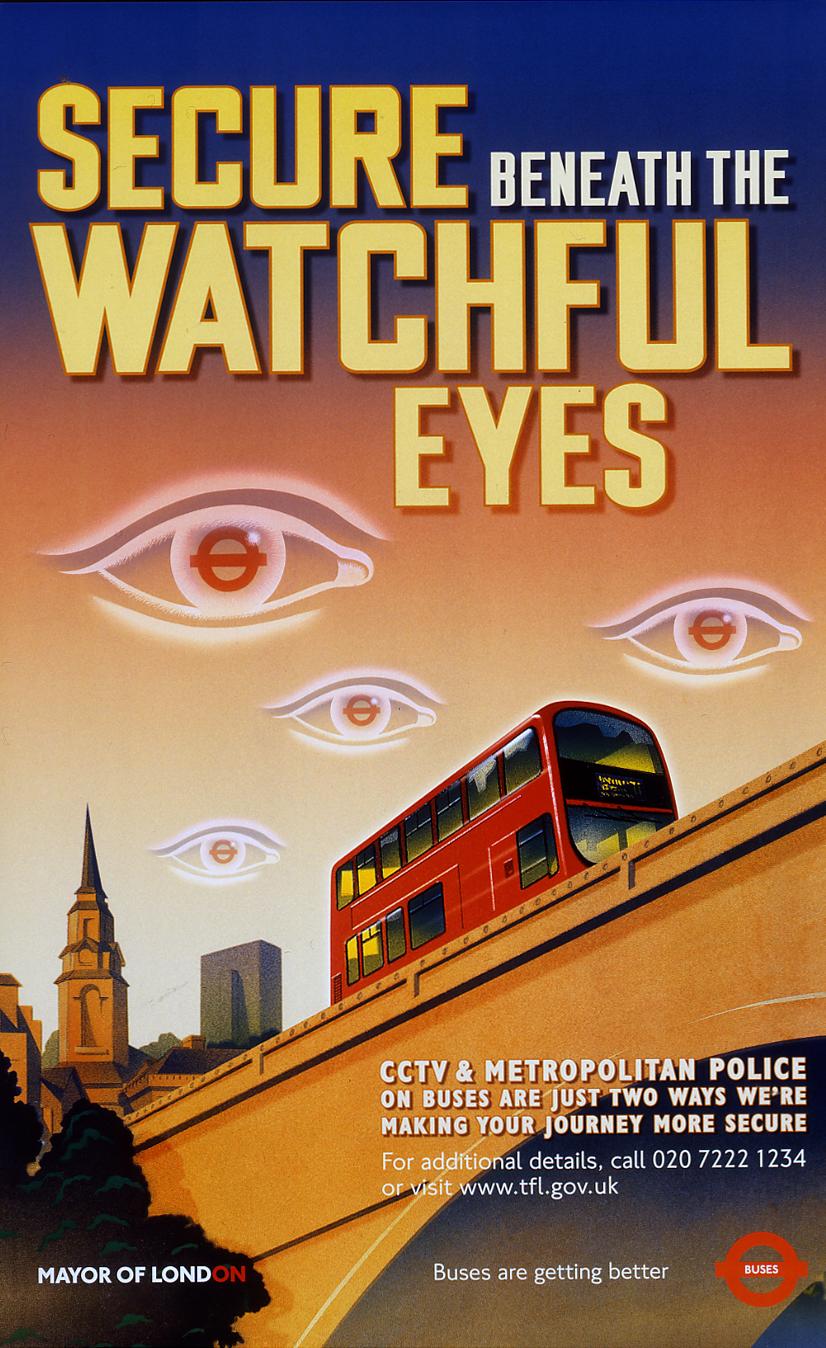
This was actually a real poster.

Someone is watching you.  Their eyes are everywhereEverything you do, everything you say … it’s all being recorded in a giant database.  But don’t worry–you can trust the ones watching youThey have your best interests at heartThey’re only after the bad guys.  You won’t even know that they’re there.

Sinister Surveillance is a hallmark of Dystopia, as essential to the genre as the Crapsack World and the Police Brutality tropes.  Often, you’ll find all three in the same story together.  It’s closely related to Big Brother is Watching, where the government is so powerful, and reaches into so many aspects of everyday life, that they see and record everything you do.  Where Big Brother shapes every aspect of the society, however, down to the language of the citizens and the basic truths accepted as facts, Sinister Surveillance is more about the surveillance itself, and the ulterior motives behind it.

It’s not enough for the government to simply watch you, though.  Even more important in some ways is the idea that you don’t know what they can and can’t see.  The reason for this is the same reason why, in horror stories, we almost never see the monster until the very end–because our imagination makes things a lot scarier than they really are.  If we the bad guys know the limitations of our government surveillance, we they can safeguard our privacy and basic rights game the system.  We’re all afraid of the dark, not because of what’s actually there, but what could be.

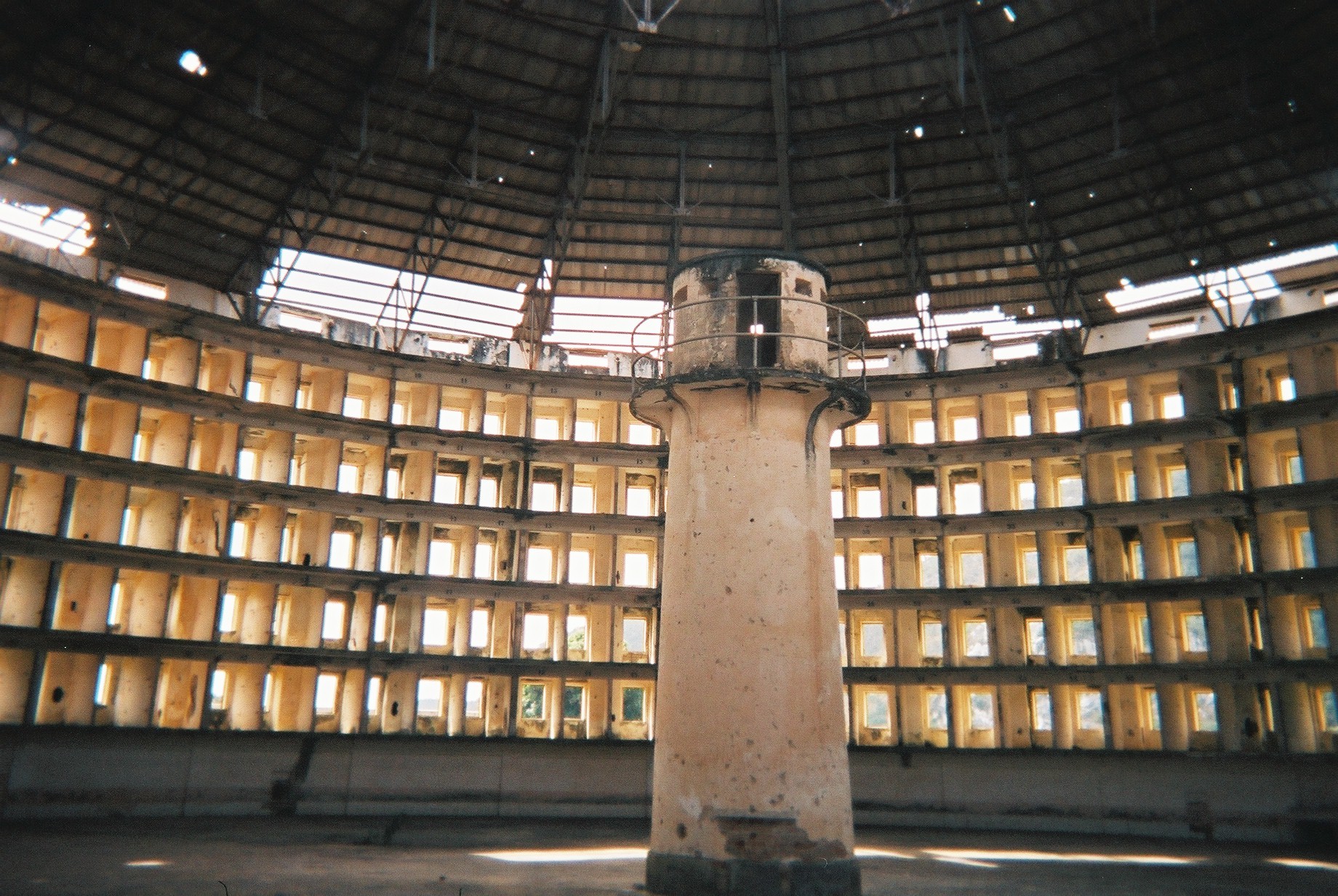
The concept behind all this goes back to the Panopticon, a hypothetical prison where the prisoners know that the guards are constantly watching them, but can’t actually see any of the guards themselves.  Proposed by the British philosopher Jeremy Bentham in the 1700s, the idea is to disempower the prisoners and empower the guards simply through the act of surveillance.  If everything you do can be seen, and you don’t know exactly who’s watching, that puts a tremendous amount of social pressure on you to conform.  As Michel Foucault put it:

The Panopticon creates a consciousness of permanent visibility as a form of power, where no bars, chains, and heavy locks are necessary for domination any more.

But if the prisoners are the citizens, and the guards are the government, how can such a system ever be democratic?  How can the citizens of such a society ever give their informed consent?  Well, that’s kind of the point.  The government in dystopian stories is rarely democratic–it’s usually a dictatorship of some kind, or a system that turns well-meaning people into Knights Templar, showing how even the best of us die like animals when the game is rigged.

As benevolent the intentions of the government may initially be, it is nonetheless true that power corrupts, and absolute power corrupts absolutely.  Just as the Panopticon takes power from the prisoners and concentrates it with the guards, so does universal surveillance grant dangerous amounts of power to the government–not because the act of surveillance is dangerous in itself, but because it brings out the worst in the people doing the surveillance.

In The Road to Serfdom, Freidrich Von Hayek pointed out that self-serving, ambitious, power-hungry people tend to rise in government a lot faster than people who have others’ best interests at heart, especially when so much power is concentrated in the government.  That’s one of the biggest dangers of surveillance–and in stories where Sinister Surveillance is in play, the government has already passed that point.

I wish I could say that this trope is limited mostly to the realm of fiction, but unfortunately, that does not appear to be the case.  These days, it’s impossible to talk about surveillance without getting political, even on a blog dedicated to books and writing.  Because everything these days is online, it’s easier now than ever before for our governments to watch us.  And if Edward Snowden’s claims are even partially correct, that’s exactly what they’re trying to do.  Even more worrying are the indicators that they’re trying to do it in secret, such as this recent letter from Senators Wyden and Udall.  The United States government has lied to us in the past about the extent of the PRISM surveillance program, and it would appear that they’re continuing to do just that.

Wherever you fall politically on PRISM or the Edward Snowden case, I think that Sinister Surveillance is a trope that we should all find profoundly disturbing.  When George Orwell took this trope to its extreme logical conclusions in 1984, he did so to prevent that horrific social order from ever coming to pass.  I wonder: only two or three generations after that book came out, have we forgotten its lessons already?  Or do we need a new retelling to remind us?  I fear that that retelling is taking place, not in the pages of a novel, but in real time on the major blogs and news sites.

Yesterday’s Gone: Episode One by Sean Platt & David Wright

Imagine you wake up tomorrow, and find out that everyone around you has vanished.  Well…not everyone.  But the ones who are still around claim to see strange things that you can’t see.  And then, you get an eerie feeling of a presence…something dangerous, something coming at you right now.  And then, things get really weird…

Yesterday’s Gone is a post-apocalyptic serial thriller: basically,  a novel divided into six parts or “episodes,” the first of which is free.  Since I’m interested in doing something similar with my next project, I decided to check it out.

From the very start, I was hooked.  The conflict was intriguing, the pace was fast and gripping, and the characters were interesting, with reactions that were spot on.  I wasn’t intending to finish the whole thing in one sitting, but once I’d started, there was no way I could put it down.

A couple of things jolted me out of the story, though.  The first was the sheer immensity of the cast of characters.  Literally, the first half of the episode was just introducing new ones, and none of them got more than two viewpoint scenes in the whole ebook.  I was on board for the first three or four of them, but around number six or seven, I just wanted to skip them and get back to the first guy.

Two of the later characters were just painful to read–not only did I not care about them, I vehemently hated who they were and wanted them to die or get out of the way so I didn’t have to read their viewpoints anymore.  The first was an eight year-old boy who had some mystical connection with animals…I just couldn’t sympathize with him at all.  The other one was a serial rapist and/or murderer who saw the apocalypse as just an opportunity to run around raping and killing the other survivors.  I skipped his scenes, but then had to go back because there were some clues hidden there and I didn’t want to miss them…ugh.

The other thing that really bothered me was the very last scene in the episode, where the authors made the mistake of showing the monster.  I won’t spoil it for you, but the image on the page clashed so strongly with the image in my mind, it deflated almost all the tension for me.  What was supposed to be a cliffhanger instead turned out to be a big “huh?”

Your mileage may vary, however, so if you’re into post-apocalyptic fiction, I think it’s definitely worth checking out.  Just like the happy pills in the empty lot behind the school, the first one is free: you can pick it up on Amazon or Smashwords.  And in spite of its problems, there was a lot in this story that I really liked.  Maybe you’ll enjoy it more than I did.

In terms of the serial format, I think it worked very well, except for those two problems: too many characters to keep track of, and an ending that booted me out of the story.  Otherwise, I think it’s a great way to publish, and I’ll probably experiment with something similar in the future.

Holy Amazon rankings Batman!

So about 24h hours ago, Amazon noticed that I was giving “From the Ice Incarnate” away on a number of other sites, and decided to drop the price down to free.  What happened next was INSANE.

Almost immediately, the downloads started pouring in.  Within a matter of hours, it cracked the #1,000 spot in the Kindle Store rankings, breaking into the top 100 for horror.  By noon today, it was at the #14 spot for Horror and #256 overall.

Holy crap!  That’s a jump of three orders of magnitude from where it was in the rankings before–more ebooks downloaded in just a matter of hours than I’ve sold across all platforms since April!  The really cool part is that it’s driving some interest in my other stuff.  Not a whole lot at this point, which is fine, but more than I was expecting, especially in my other short stories.

One thing I’m a little worried about, though, is that it seems to be selling with a different crowd than my target audience. “From the Ice Incarnate” definitely has some prominent horror elements, but it’s essentially a science fiction story.

I changed the category in KDP and republished the ebook, but I’m worried that the act of republishing will set the price back to $.99.  I like having it free; I’m hoping it will generate more interest in my novels, which is where I hope to make my bread and butter.  To jump off the free train right now, just as things are starting to take off…

…well, it wouldn’t be the end of the world.  Still, holy cow!  It’s a wild and crazy ride!

In other news, I recently did an interview over at my cousin Angela’s blog.  Angela is a mom, a writer, and an all-around awesome person, and she publishes a bunch of poetry on her blog, both her own and by others.  The interview covers why I feel drawn to science fiction, themes in Genesis Earth, and how studying political science influenced my writing.  Good stuff; check it out!

Back in Mass

Mass = Massachusetts = “back east,” for all you unwashed Utahans!

My sister’s wedding is this weekend, so I’m back at my parents’ place helping them get everything set up.  It’s going to be a busy day tomorrow, but I’ve got my netbook and will probably get a couple good hours of writing in.

I managed to write a bit on the plane today, but not as much as I was hoping.  My goal is still to finish Into the Nebulous Deep 1.1 by May 14th; I’ve got about 15k-20k left to go, and since I’m taking the next few weeks off to work on writing projects, I shouldn’t have any problems meeting that deadline.

Yesterday, I took the unedited manuscript of Genesis Earth and formatted it nice and pretty so my friend Laura could read it on her Kindle, and…man, it looks like a real book!  There’s something about seeing your work in the actual form that people are going to read it in that is just…well, for lack of a better word, magical.  It’s definitely motivated me to get GE up quickly, as well as Journey to Jordan.  More on that in the next few days and weeks to come.

It’s getting late out here and I’d better get some sleep, but before I do, I want to put a plug in for my new favorite webcomic, The Zombie Hunters.  Ross Wolfe, Quark’s renowned zombie expert, introduced me to the comic a couple months ago, and I have been totally hooked ever since.

The comic is set in our world after the zombie apocalypse, where a band of five thousand survivors struggles to rebuild civilization on an island that was previously the site of a major research campus.  The zombie plague has a dormant phase, where the infected can live normal lives, but turn into zombies when they die.

The infected live in segregated barracks as second class citizens, but teams of them regularly venture out into the wastelands to salvage supplies from the zombie-infested ruins.  The comic basically centers around one of these teams of zombie hunters; their struggles and challenges, their relationships with each other, and their hopes and dreams for the future.

The storytelling is fantastic, the characters are engaging and real, the post-apocalyptic setting dark, gritty, and yet totally immersive and frighteningly believable–man, it’s just awesome.  And the longer it runs, the better it gets!  I can’t wait to find out how Charlie the half-life fits in with his ability to communicate with the zombies, or to get the full backstory with Jenny and Milo.  And I love the banter between Jenny and Sammie, her alcoholic sociopath best friend.

Right now, though, the main storyline is on hold while the author works through some business problems, but the short story is absolutely fantastic.  I love her fantastic use of point of view–how she gets into the little boy’s head and shows the apocalypse unfold from his perspective.  And the kid’s grisly end…man, zombies are even freakier when you never see their faces!  I wouldn’t be surprised if I have nightmares tonight about it–I have in the past.  Crazy awesome zombie nightmares, heh.

As a side note, may I point out what may quite possibly be the perfect weapon for the zombie apocalypse, the AA-12 shotgun.  All it needs is a bayonet and like a bajillion clips of ammo.  A must-have for any zombie contingency plan.

But yeah, let me just say I am in awe of The Zombie Hunters.  Awesome, awesome story–every time it updates, I get immersed again in the post-apocalyptic world, and it is amazing.  If I ever end up writing a zombie apocalypse story (which will probably involve starships and space travel in some fashion), I would be tickled if it’s even half as good as this excellent webcomic.

I Don’t Want to Kill You by Dan Wells

John Cleaver, teenage sociopath and demon hunter, has put his inner monster to work protecting his small town community from supernatural beings.  But now, the head demon, known only as Nobody, has come to take him down.

As if that weren’t difficult enough, the most popular girl in John’s class, Marci, has taken a liking to him–and he soon finds that he likes her back.  What’s more, she’s not as weirded out by his obsession with the string of murders in their town–in fact, she’s interested in them too.

Just as their young romance begins to blossom, however, a rash of teen suicides makes John wonder: why does he even try if the people he’s trying to protect are just going to throw their lives away anyways?  To defeat Nobody, he must search within himself and find the answer.

This book was awesome–like, Return of the Jedi awesome–and I’m not just saying that because the author is a friend of mine.  It brings the Serial Killer trilogy to a dramatic and satisfying conclusion.  Dan Wells’s storytelling skills are amazing, and he puts them to good use throughout this book.

The thing I loved the most was probably how all the major characters had to sacrifice something huge for the people they loved in order to overcome the evil forces at work in their lives.  And the demons–whoa, they were pretty freaky.  Supernatural freaky, yes, but in a way that was frighteningly true to life–even more so than the previous demons in the series.

Wells has an excellent handle on character arcs, and he applies that here to the romance subplot with excellent results.  The romantic aspect of the novel was both believable and gripping, and made the ending all the more emotional.

If anything, though, I wish he would have played up the love triangle a little more than he did.  No spoilers, but there were a couple of shifts toward the end that felt a little abrupt.  Not too much, but I thought it could have been done better.

This is definitely an urban fantasy, but one surprisingly close to the real world.  Unlike Mr. Monster, where the supernatural aspect came in halfway as something of a shock, I thought the supernatural and real world elements in I Don’t Want to Kill You were blended almost perfectly.  Not only was it clear from the beginning that both elements were going to be important, but the feedback loop between the two was handled extremely well.  If I ever write urban fantasy, Dan Wells has certainly set a high standard to follow.

All in all, a great book, one I highly recommend.  If you enjoy urban fantasy or superhero stories, you’ll probably love this book.

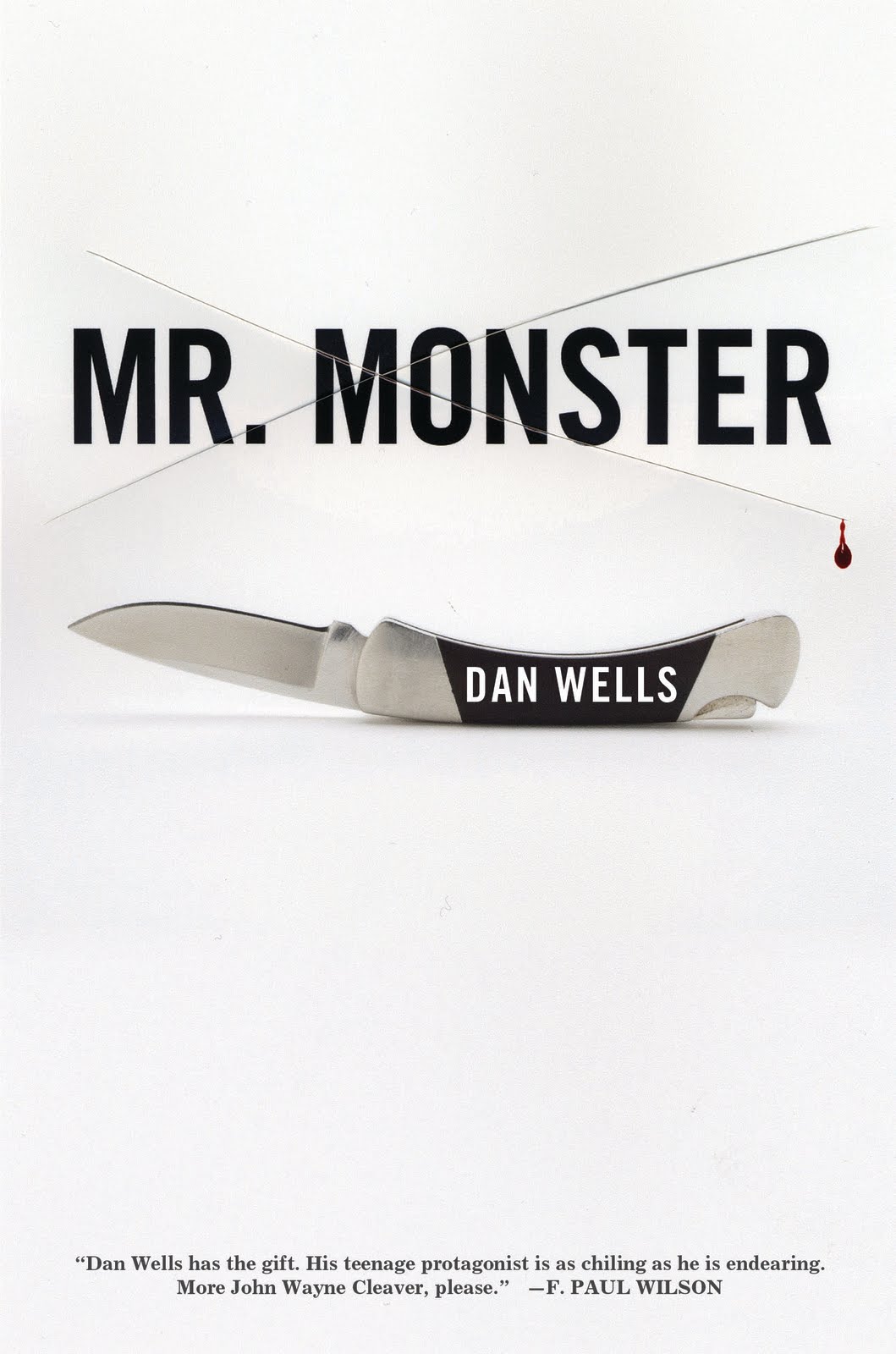
Mr. Monster by Dan Wells

John Wayne Cleaver wants very much not to kill you.  He wants it so much, in fact, that he’s made up a host of rules to keep his inner monster from taking over.  The way he complimented your shirt, for example–he said that to counteract the delicious thought of you tied to a wall, screaming in terror while he skins you alive.

It’s nothing personal.  He doesn’t hate you.  He just has a need–or rather, his inner monster has a need–to take your life.

You see, John Cleaver is a sociopath with all of the psychological tendencies of a serial killer.  Now that he’s killed once (albeit to save his community from an ancient demon), it’s getting very difficult for him to tell who he really is.  Is he his addiction?  Or is that a separate persona–one that he can control, suppress, and eventually overcome?

He’d better find out quick, because a new killer has arrived in town–a demon, just like the first–except this one is in touch with the Brotherhood.

This was a good book.  I enjoyed it as much as I enjoyed the first, perhaps a little more so.  The ending was awesome–excellent lead-in to the last book in the trilogy.  Too bad we have to wait a year to read it. <shakes fist at the universe>

Dan Wells is very good at writing strong, well-developed characters, especially with his main character, John Cleaver.  This might sound bad, but as a Mormon I can relate with John’s personal rules to keep his stray thoughts under control.  Not that I have a secret desire to murder people, but I’d be lying if I said that it’s easy to live a celibate, porn-free lifestyle as a twenty-something young man.  But I digress.

The best part of this book was the way the romantic tension compounded the basic conflict of John vs. his need to kill.  It’s not easy to date a girl when you have passionate dreams every other night of killing her.  That tends to make things a little awkward (just a little).  In spite of how sick that might sound, John and Brooke’s relationship is quite compelling, and I found myself instantly drawn to them because of it.  Again, it makes it easy to relate–not that I, uh–yeah.  Whatever.

Overall, the book is great.  However, I do have one criticism, which may be more personal, but I’m sure it applies to others as well.  When John confronted the killer, things got a little too disturbing for me–not the tense, wide-eyed, “oooh, what happens next?” kind of disturbing, but the “this is just wrong–why am I reading this?” kind of disturbing.  It didn’t make me put the book down, and the resolution was quite satisfying, but I did step back and ask that question at one point.

The ending, though, is pure awesome.  The last page–man, I’m looking forward to see what happens next!  And if there are only three books in this series, John Cleaver has to come to terms somehow with his inner monster–he can’t continue in this way all his life.  He just can’t. He’s got to find some kind of equilibrium.  And him and Brooke–well, let’s just say I’m very eager to see how the series wraps up.

Mr. Monster comes out in the US at the end of September (I borrowed the UK edition from my sister).  Like I said, it’s probably not for everyone, but if you can stomach a particularly gruesome episode of Law and Order: SVU, you shouldn’t have a problem with this book.  Or should you?  Guilt!  Guilt!

I Am Not a Serial Killer by Dan Wells

John is a weird kid. When he isn’t helping out his mother at their small-town mortuary, taking intense, morbid pleasure from opening up the dead bodies and exploring their insides, he’s researching serial killers, devouring every book he can find on the subject. If he had his way, he would open bodies all day–dead and living bodies, exploring them, savoring the addiction. That’s why he must constantly work hard to stop himself.

But when a demon comes into town, killing off members of the small community one by one and hiding in plain sight by posing as a normal human being, John is the only one who can stop the monster from killing again. To do this, he unleashes his own demon–the one urging him to kill. As the monster inside of him starts to take over his life, he starts to lose control and sink deeper and deeper toward his destiny.

Will he return from the dark side, having fought fire with fire? Or will he give in to fate and become a serial killer?

This book was a surprisingly fast read. I borrowed it from a friend and finished it only a couple of days after I started it. Part of this was because it’s a short book, but part of it was because the story and characters were so interesting.

The character development in this book is awesome. Dan Wells does a wonderful job making a morbid sociopath into a genuinely likable character. I felt like I knew him–and liked him–after only a couple chapters. Even though he’s got a disturbing, dark side, he’s constantly trying to fight it and keep himself in check. From almost the very beginning, I found myself rooting for this character.

The book had some sick, disturbing stuff in it, but it wasn’t nearly as violent or fundamentally disturbing as some of the other books I’ve read (Neuromancer, On My Way to Paradise). It was more of an “eww…cool!” kind of thing for me than a heart stopping, I-can’t-believe-what-I-just-read kind of thing. Still, the book definitely made me squirm. I’m glad none of my family works in a mortuary, I’ll say that much.

For a story so engaging, the writing was surprisingly simple. Unlike a lot of the fantasy and science fiction that I read, Dan Wells includes very few concrete details–just enough to keep you in scene–and tends to be a little adverb heavy. None of this was an obstruction to reading–on the contrary, the sparseness and simplicity is part of what makes this book a quick, enjoyable read. As an aspiring writer, it helped me to see that story trumps the minor, sentence level stuff, like using excessive adverbs with said bookisms (not that that’s a problem with this book–the writer part of my brain noticed it, but the reader part didn’t care).

The book reads very much like a thriller (…probably because it is one) and reminded me of a lot of the Michael Crichton stuff I used to read when I was in high school. While it isn’t as gripping as Sphere or Jurassic Park, it has about ten times the character development of any of Crichton’s works. Although the plot is definitely engaging, I read as much for the character as for the plot, if not more.

If you’re looking for a good, squeamish read with interesting, believable characters, this is a good one to pick up. It doesn’t come out in the US until 2010, but if you check out Dan’s website, you can probably find a way to get it. Check it out!

Apocalyptic story idea

Ok, here’s another crazy story idea.

When I was really young, I used to hang upside down off the edge of the bed and look up at the ceiling, trying to imagine what it would be like if the ceiling were the floor and the floor were the ceiling.  You should try it sometime–it really changes the landscape of your house.  I think there was a Calvin and Hobbes comic strip on this same concept, too.

So, here’s the idea.  It’s a little wacky, but here goes.  What if everyone, all over the world, suddenly fell UP instead of falling DOWN?  Not objects, or animals, or anything else–just people.

Imagine where you are sitting right now.  Look up.  What would it be like if all of a sudden you fell down–or, rather, up?  Would it hurt?  How much?  Would you die?  Would you be able to grab onto something?  What would it be like once you stood up and found yourself on the ceiling?

Then, imagine the change to the landscape!  Imagine the change to the WORLD!  Instead of sky, there’d be nothing but ground overhead, and a giant, bottomless blue abyss beneath!  Would you be able to leave the building you’re in?  If you were in your car, what would you do?  If you were in your car, and you got into an accident, what would you do?

Imagine all those people, walking around outside in the city streets, or walking around campus the moment the apocalypse hits, and BAM!  They’re all falling skyward!  How crazy would that be?  How tragic!

What would you do after you’d realized what happened?  Would you be able to get around?  If you had access to a car, probably–just lie down on the ceiling and drive upside down, I suppose.  But then again, what about the accelerator pedal?  How would you reach it?  You’d have to rig something up–it would be difficult.

And what if you were trapped in a building with no way out?  What if your car were parked outside somewhere?  How would you survive?  Where would you get food?  What would you do once that ran out?  How would you contact people?  Would you even make it?

What if the ceiling weren’t strong enough to support your weight?  What if you fell through it?  What if you were with someone who fell through a weak part in the ceiling?  What would happen?

You get the idea.  It’s a pretty wacky idea, but think about it–if it happened, it really WOULD be apocalyptic!  Crazy!