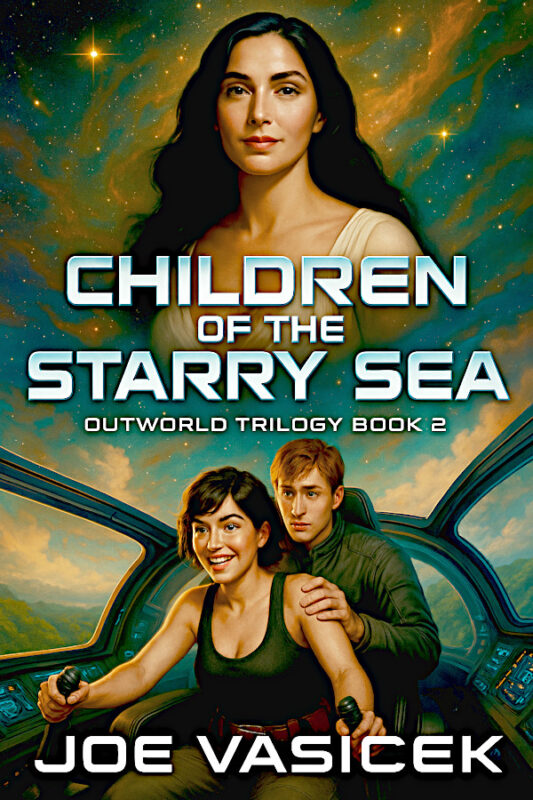
Children of the Starry Sea is a character-driven space opera about the cost of protecting your family when an empire takes control of your world. Set on a contested colony and orbiting space station, this second book in The Outworld Trilogy blends political tension, intimate family drama, and high-stakes escape into a story about courage under pressure. This is science fiction that cares as much about parents and children as it does about fleets, invasions, and interstellar power struggles.
What Kind of Reader Will Love This Book?
If you love…
- character-driven science fiction focused on family, faith, and moral responsibility
- space opera about resistance movements and underground escape plans
- stories where parents must protect their children in impossible political situations
- multi-POV novels that balance action with emotional depth
- hopeful sci-fi that wrestles with sacrifice, loyalty, identity, and belonging
…then Children of the Starry Sea is probably your kind of story.
What You’ll Find Inside
Children of the Starry Sea follows Jeremiah, Reva, Mariya, Isaiah, and Salome as their colony and orbital station fall under the control of the Hameji—an expansionist empire determined to enforce submission. Pirates resurface, political negotiations turn coercive, and secret escape plans unfold under constant surveillance. At the same time, the mysterious collective consciousness that binds Reva and Isaac raises urgent questions about identity, assimilation, and belonging. The emotional journey moves from fear and disorientation to quiet resolve and sacrificial courage. The result is a tense but intimate space opera—fast-paced in moments of infiltration and escape, reflective in scenes of family, faith, and moral choice—about standing firm when everything familiar is stripped away.
What Makes Children of the Starry Sea Different
Fans of traditional military space opera will recognize invasions, political negotiations, and resistance efforts—but this story takes those elements in a deeply personal direction. Where many science fiction invasion stories focus primarily on fleet battles and tactical maneuvers, Children of the Starry Sea leans into the domestic and moral cost of occupation: dinner tables under surveillance, parents negotiating with conquerors, teenagers stepping into adulthood too soon.
Readers who enjoy layered ensemble casts will appreciate the shifting perspectives between parents, children, and outsiders—especially the unique thread of the collective consciousness that shapes Reva and Isaac’s storyline. Instead of framing assimilation as pure horror, the novel explores belonging, identity, and agency in unexpected ways, making it both intellectually and emotionally distinctive within modern indie space opera. Where many science fiction stories treat hive minds as purely monstrous, this novel explores collective consciousness as both gift and danger—complicating the usual invasion narrative with questions of agency, consent, and chosen belonging.
What You Won’t Find
You won’t find grimdark nihilism, graphic brutality, or cynical antiheroes. While the stakes are high and the threat is real, this is not a hopeless dystopia. Violence has consequences, and moral choices matter. If you’re looking for relentless darkness or shock-value storytelling, this may not be the right fit.
Why I Think You Might Love Children of the Starry Sea
This story matters to me because it explores something I think science fiction doesn’t always take seriously enough: the quiet, daily courage of families under pressure. At its heart, Children of the Starry Sea is about parents learning when to protect and when to let go, about teenagers stepping into adulthood too soon, and about holding onto faith and identity when larger powers try to define your future for you. Finishing this novel required persistence and trust—much like the characters themselves must learn. If you care about science fiction where family is central rather than incidental, I think this book will stay with you.
Where to Get the Book