C is for Cryo

halo_cryochamber

I think every science fiction writer has a cryo (aka “human popsicle“) story sitting around somewhere, even if it’s just in the back of their head.  It’s one of those tropes that keeps coming back, just like the alien invasion, the robot apocalypse, and the Adam and Eve plot.

The basic concept is pretty simple, even if the technology is a bit more complex: a human or animal undergoes rapid freezing in order to put themselves into stasis for an extended period of time.  Months, years, or even centuries later, someone thaws and resuscitates them so that they wake up in a completely different time and place.

There are a lot of good reasons why going into cryo makes sense in a science fiction universe.  One of the more common ones is that the characters are colonists on a mission to an alien star, and their spaceship doesn’t have a faster-than-light drive.  Rather than go through all the trouble of building a generation ship, the designers instead built a series of cryo chambers to put the colonists into stasis for an extended period of time.  It might take centuries or millennia for the ship to reach its destination, but when it does, the colonists wake up as if it’s just been a long, dreamless night.

In The Worthing Saga, Orson Scott Card has a somewhat unusual rationale behind the prevalence of cryo in his universe (though they call it “hot sleep,” and it’s induced by a drug called soma).  Only the rich can afford the technology, and the imperial overlords very carefully regulate the use of it so that there’s a clear hierarchy based on who goes under for the longest amount at a time.  It’s a way for the citizens to achieve a simulated form of immortality, by skipping five or ten years every year or two of their lives.

In the Halo video game series, the UNSC uses cryo as a way to preserve their greatest military assets, the Spartans, for the times when they’re needed.  The first game in the series starts when John-117, aka the Master Chief, is awakened just as the starship Pillar of Autumn crash lands on a mysterious alien structure.  Like something from an old Norse legend, the third game ends when the Master Chief seals himself into the cryo chamber of a derelict starship, telling the AI Cortana “wake me when you need me.” (highlight to view spoilers).

So why are cryo stories so prevalent in science fiction?  For one thing, they’ve been floating around in our cultural subconscious a lot longer than the genre has been in existence–just think of Sleeping Beauty or Rip Van Winkle.  For another thing, the science is not that far-fetched.  Certain animals can be revived after extended periods of frozen stasis, and according to the New York Times, it’s happened at least once with a human being.  Science fiction has a long history of turning fiction into fact (for example, Arthur C. Clarke and communication satellites), so perhaps it’s only a matter of time before human cryotech becomes a reality.

I’m definitely a fan of this trope in my own writing.  Genesis Earth has a chapter with a rather horrific cryothaw scene, which I later spun off into a short piece titled “From the Ice Incarnate.” I haven’t played with it much in my latest books, but in Heart of the Nebula which I hope to publish later this year, the cryotech plays a very important role in the plot.  And if I ever write a prequel to my Gaia Nova series showing how that universe got started, it will feature a cryo colonization story.  The main premise of that series is that a group of human colonists fled 21st century Earth and went into cryo to colonize a distant corner of the galaxy, but when they woke up, they couldn’t find Earth anymore, so it became something of an ancient holy legend (which is a major driver for Desert Stars).
STARS OF BLOOD AND GLORY is now up on Amazon, B&N, and Smashwords!

thumb (Stars of Blood and Glory)

Hey guys!  My latest novel, Stars of Blood and Glory, is now up on Amazon, Barnes & Noble, and Smashwords!  Kobo, iTunes, Sony, and Diesel editions should be up shortly.  I’ll start typesetting the print version in the next few days, and it should be out through CreateSpace sometime next month.

Stars of Blood and Glory takes place fifteen years after the events of Bringing Stella Home, and includes many characters from that story (such as Danica, Roman, and the other mercenaries) as well as some characters from Desert Stars (especially Rina).  From the book description:

The only hope for the last free stars now lies on the path of blood and glory.

The princess of Shinihon could not have picked a worse time to run away. The largest Hameji battle fleet ever gathered threatens to overrun the last of the free stars. To make matters worse, a rogue assassin from an unknown faction has killed the high admiral of the Federation. Without clear leadership, the war may be lost before she can be found.

But Danica Nova and her band of Tajji mercenaries are no strangers to lost causes. They’ve fought the Hameji before, and they’ll fight them again—not for honor, or for glory, but simply for the pay. War has been their way of life ever since the diaspora from the homeworld.

Master Sergeant Roman Krikoryan is one of the few remaining mercenaries still old enough to remember the homeworld. But he’s an old cyborg, and his humanity is fading. Death is a mercy he doesn’t expect to find on this mission.

They aren’t the only ones after the princess, however. Hungry for glory and eager to make a name for himself, Sholpan’s son Abaqa seeks to make the girl his slave. Though only a boy, he’ll stop at nothing to prove himself to his Hameji brethren.

With the Federation in disarray, the bloody end of the war may come too soon for some of them. But one thing is certain—not all of them will live to see it.

If you’re on Goodreads and would like to add the book to your to-read list, you can find it here.  I’m not entirely sure if I listed it properly, but at least it’s up now.

Also, if you’re a blogger and want to have me on for an interview or guest post, feel free to shoot me an email!  I’m not doing a blog tour or anything fancy for this release, but I love blogging and would be happy to give you some content and link back to your site.

That’s just about it for now.  I’ll get the Trope Tuesday post up a little later this afternoon.  In the meantime, back to writing!

Book teasers are HARD…

…but I think I’m on to something with this one.  What do you think?

THE ONLY HOPE FOR THE LAST FREE STARS NOW LIES ON THE PATH OF BLOOD AND GLORY.

The princess of Shinihon could not have picked a worse time to run away. The galaxy is at war, and the massive Hameji battle fleets threaten to overrun the last of the free stars. Only the boy emperor Katsuichi dares to stand against them, but with his sister gone missing, the burden of command may be too much for him to bear.

The job falls on Captain Danica Nova and her band of mercenaries to bring the princess safely home. Among them, Master Sergeant Roman is one of the few still old enough to remember the homeworld. But he’s an old cyborg, and his humanity is fading. Death is a mercy he doesn’t expect to find on this mission.

They aren’t the only ones after the princess, however. Sholpan’s son Abaqa is eager to win honor and glory by making the girl his slave. Though only a boy, he’ll stop at nothing to prove himself to his Hameji brethren.

With the Federation in disarray, the bloody end of the war may come too soon for some of them. But one thing is certain—not all of them will live to see it.

This is, of course, for my upcoming novel Stars of Blood and Glory.  I just got back the first round of edits from my editor, and it looks pretty good.  There’s just one scene we agree needs some extra work, and that shouldn’t take longer than a week.  The cover art might take a little longer, but if the book’s not published this month it definitely will be in the next.

But first, I’ve got to really nail the teaser.  So what do you guys think?

Stars of Blood and Glory coming out soon

So last year about this time, I wrote a novel in the Gaia Nova universe.  Usually when I sit down to write a novel, it falls apart about midway through the first draft, or I have some kind of a break down, or something else comes up and I have to put it on hold for a while.

From start to finish, this one came out in about six weeks.

Even the title, Stars of Blood and Glory, really seemed to stick (usually, I go through three or four lame titles before finding one that works).  It took a lot of energy to write it, but the writing process itself was fun.  Seriously, everything just came together and the story practically wrote itself.

However, writers can often be notorious judges of their own work.  For that reason, I set it aside and tried not to touch it for a few months (I did rework the first couple chapters, but later ended up cutting out most of that stuff and going back to the original version, which was better).  Over the summer, I picked it up for the first revision, and while the scenes were out-of-order and a few of them were missing, but for the most part, everything that was there seemed pretty good.

Just to be safe, I sent it out to some first readers and laid it aside for another six months.  I didn’t hear back from everyone I sent it to, but those who did read it said it was pretty good.  The problems they found were relatively minor, or could be fixed relatively quickly, without having to overhaul the story.

To be perfectly honest, this blew me away.  My first drafts are usually really messy, and require a lot of work before they’re any good.  But this one…this one seems different.  This one, I might have just nailed it <fingers crossed>.  And if that’s indeed the case, it’s probably better not to risk revising it to death, or polishing the voice right out of it.

It’s always a scary thing to send a book out into the world.  However, I think the time to send out this one has come.  I’m going to do one last revision pass, just to make sure there isn’t anything too egregious, and then I’ll send it out to my editor and commission the cover art.  If all goes well, I’ll finish the revision next week, and publish it in ebook and print-on-demand sometime in February.

As an indirect sequel to Bringing Stella Home and Desert StarsStars of Blood and Glory has a lot of recurring characters.  Here are some of them:

  • Captain Danica Nova
  • Master Sergeant Roman Andrei Krikoryan
  • Rina Al-Najmi
  • Stella McCoy, aka Sholpan

Besides that, here are some of the other cool things you can expect to see:

  • A far future Japanese-Polynesian society on an ocean planet with giant floating cities.
  • A Hameji offensive, with massive space battles and planetary slaggings.
  • A lonely boy emperor who fears that he’ll never live up to his father’s dying wish.
  • A runaway princess who wants to experience everything the universe has to offer.
  • A young Hameji prince who yearns to prove himself in the field of battle.
  • A cyborg mercenary who feels like his humanity is slowly fading into irrelevance.
  • An unlikely assassin whose mind and body are not completely her own.

All of this comes together in a war of epic proportions that will determine the fate of the last free worlds in the galaxy.

So yeah, I’m really excited about this story.  It’s a departure from some of the more intimate (and less action-y) science fiction romances I’ve been putting out lately, but in all of the right ways.  If you read Bringing Stella Home and wondered when you’d get a worthy sequel, well, this is it.  And hopefully, it’s just the first of many.

Expect it to be out in ebook and print-on-demand sometime next month.

Trope Tuesday: Terraforming

The fantastical element here isn’t that Mars could actually look like this in a millenia or two, but that NASA might actually get the funding.

One of the problems with interplanetary colonization is that Earth-like worlds are fairly rare (though possibly not as rare as we once thought).  In our own solar system, the only other world that comes anywhere close (Mars) is a radiation-blasted desert with only the barest hint of an atmosphere and a surface temperature colder than Antarctica.  To get around this problem, you can do one of two things: build an artificial enclosed environment to house the colony, or change the world itself to make it more Earthlike–in other words, terraform it.

The actual science of terraforming is far too complex (not to mention way over my head) to do it justice in this post.  Instead, I’ll just point you to the Terraforming Wikipedia page as a starting point and focus on how the concept is used as a story trope.

According to tvtropes and Wikipedia, the term came from a 1942 novella by Jack Williamson titled “Collision Orbit.” The concept of changing the environment of an entire planet actually goes back much further, with H.G. Wells subverting the trope in War of the Worlds (instead of humans terraforming other worlds, the hostile Martians try to xenoform Earth to make it habitable for them).  Before the U.S. and U.S.S.R. put probes on the surface of Mars and Venus, it was fairly common for writers to speculate that those planets were able to support human life, at least on a basic, rudimentary level.  Once the science showed that that isn’t actually the case, terraforming as a story trope really began to take off.

Today, this trope occurs commonly across all ranges of the Mohs scale.  Soft sci-fi stories (such as Firefly) use it as an excuse to have planets that look and feel like Earth.  Hard sci-fi stories (such as Red Mars, Green Mars, and Blue Mars) use it as a fundamental premise, or to pose questions like “what is the ultimate destiny of human evolution?” or “how important is it to our species’ survival that we spread out beyond Earth?” Although it’s not something that we as a species have (yet) done, our present science seems to place it well within the range of the plausible, and that means that makes it fair game for any kind of science fiction.

In order to be believable, however, any significant terraforming project requires two things: resources and time.  LOTS of time.  We’re talking on the order of centuries and millenia here.  Because of that, stories that use this trope generally fall into the following categories:

  • The terraforming happened a long time ago and is part of the world’s ancient (or near ancient) history.
  • The terraforming is on-going and directly impacts almost every element of the world’s culture and setting.
  • The terraforming has failed in some way, which may (or may not) make it a key element in the story conflict.

As with generation ships, the scope of this trope spans more than just the interests of a single character–it deals with the ultimate destiny of entire cultures and civilizations.  In hard sci-fi stories, the planet that’s being terraformed may actually become more of a character in itself than the individual people who are terraforming it.  Unless they have some form of immortality, they have little hope of ever seeing the ultimate end of it.

Of course, that almost makes the project more of a religion to the colonists than a science, with all sorts of interesting philosophical and story implications.

Why is this trope so widespread in science fiction?  I can think of a few potential reasons.  First, it hits on some of the key issues that lie at the very heart of the genre, such as the ultimate destiny of humanity and the ethical issues surrounding our ability to play God through the wonders of science.  Also, it captures the imagination in a way that few other tropes can equal.  Because the scope of any terraforming project is so vast, the implications touch on almost every key element of the story, including setting, character, and conflict.

But on an even more fundamental level, it hits on one of the key elements of any fantasy magic system: limitations.  We can’t live on an alien world because the conditions are too hostile, but we can’t just wave our hands to make it Earth-like either.  We have to undergo a painstaking, laborious process that could unravel at any point and throw everything we’ve worked for into chaos.  We have to dedicate our whole lives to the project for dozens of generations before it will ever pay off.  There are no shortcuts–none that won’t strain our readers’ suspension of disbelief, anyway.  But if it all works out, then we will have created a new Earth–and how is that not magic?

Needless to say, I’m a big fan of this trope.  I’ve used it in just about every science fiction story I’ve written, though I probably play with it the most in Star Wanderers.  The main character of that story comes from a world where a terraformation project failed, having severe religious implications that drive the whole series.  Sacrifice is largely set in orbit around a world that is midway through the terraforming process.  Elswhere in the Gaia Nova universe, people build domes just as often to keep humanity from screwing over a terraformed world as they do to provide room to live on one that isn’t.  After all this, though, I feel like I’ve only begun to scratch the surface of this trope.  You can definitely expect to see it in my work in the future.

Trope Tuesday: Lawful Evil

If the term “villain” applies to anyone, it applies to the Lawful Evil.  Whether the evil overlord, his trusted right-hand man, or one of his devoted minions, these characters are dedicated wholeheartedly to their cause, whether they believe it will lead to a better world or not.  Taking over the world is often a major obsession, because hey, someone’s got to do it.  A staple of the evil empire, these guys often turn their country into an industrialized wasteland, though they often have propaganda machines to take care of any bad press.  Bonus points if they can transform into a freakish monster in battle.

From the easydamus character alignment page:

A lawful evil villain methodically takes what he wants within the limits of his code of conduct without regard for whom it hurts. He cares about tradition, loyalty, and order but not about freedom, dignity, or life. He plays by the rules but without mercy or compassion. He is comfortable in a hierarchy and would like to rule, but is willing to serve. He condemns others not according to their actions but according to race, religion, homeland, or social rank. He is loath to break laws or promises.

While Lawful Evils believe in following rules and keeping their word, they’re not above emotional manipulation, negotiating unfavorable contracts, or following the law in letter only.  Even so, they tend to suffer from genre blindness and bureaucratic stupidity (as well as megalomania–but hey, that’s part of the job description).

According to tvtropes, Lawful Evils come in four types:

  1. The supreme ruler, dedicated to establishing and maintaining a civic order that is itself evil.  A good example of this would be Sauron from The Lord of the Rings.
  2. A zealot or übermensch whose moral code falls outside of established social norms.  Khan from The Wrath of Khan is a pretty good example of this, as is Tyler Durden from Fight Club (though your mileage may vary).
  3. The Dragon or other minion who may have their own goals, but answers to the big bad.  Darth Vader is probably the most well-known example.
  4. A complete monster who is dedicated to the destruction of free will and liberty.  The Mormon conception of Satan fits this perfectly.

The scary thing about this trope is that it actually exists in real life.  In fact, outside of our sheltered middle-class, liberal democratic existence (a relatively recent and unusual development in the eyes of history), this type of overlord tends to be the rule and not the exception.  You don’t have to look any further than North Korea, Burma, or Syria for examples of this–which is to say nothing of the Soviet Union, the Third Reich, or the British Empire.

My favorite example of this trope is probably Darth Vader, not just because of how badass he is, but because of his heel face turn at the end of Return of the Jedi.  Ignoring how bad episodes I, II, and III were, his character arc really is the thing that makes that story.  And while we’re on the subject of history, let’s not forget this epic showdown between Stalin and Hitler.  Seriously, click that link.

In my own work, the best example of a Lawful Evil would probably be Qasar from Bringing Stella Home / Sholpan.  He’s more of the affable type than a true evil overlord, though; that would be Tagatai, who doesn’t really come to power until Stars of Blood and Glory. A much more sinister example would be Emile from Heart of the Nebula, or the villain I have planned for Edenfall–I’d better finish those!  And of course, there’s Sheikh Sathi from Desert Stars, though he’s mostly a type 3 Lawful Evil under the thumb of his Neutral Evil wife.

Perhaps one of the reasons I haven’t done a truly despicable Lawful Evil yet is because I’ve been kind of sheltered here in the states.  It will be interesting to see how my writing changes after spending some time in Eastern Europe; Georgia, after all, is the homeland of Stalin.

Darth Vader helmet taken from this site.

Tomorrow, tomorrow

So, I was going to finish Stars of Blood and Glory today…and then I went and spent some time with an old friend, had some dinner and spent the evening with the missionaries…long story short, I think it would be better just to wait until tomorrow than to do a rush job tonight.

I’ve only got two scenes and an epilogue left, which is very strange, because the novel isn’t even 75k words long yet.  Something definitely seems to be missing, and it probably has to do with the storyline of the new characters I introduced.  They’re the prince and princess of a futuristic Japanese culture (with a mix of Polynesian elements) that’s built on giant floating cities on a water world that never fell to the Hameji.  I think I skipped a little too much on the research, so the culture doesn’t feel fleshed out enough at this point.  Also, there’s a whole host of minor characters that I neglected to even give names; in the next draft, I’ll have to work out who they are and how they fit into things.

I’ll definitely finish this book tomorrow, though.  There’s nothing stopping me, and I really need to get it done.

After that, the plan is to immerse myself in the world of Star Wanderers.  I’ve got to be honest, I’m really looking forward to it.  This story came to me like a love child: completely unexpected at a time when I was supposed to be working on other things.  And yet, few other projects I’ve worked on have given me so much satisfaction.  When I let my mind wander, I inevitably find myself daydreaming about it.  And yet, it’s not a story I can force.  I tried that once, and it was as if the characters just refused to cooperate; the answer, quite firmly, was “no.”

As for my next publishing project, I’m going to try to get the illustrated version of Journey to Jordan formatted and up on Amazon and Barnes & Noble before the end of the week. It’s a little intimidating, because I don’t yet know how to add pictures in html such that they turn out well in ebook format.  However, I think it will be a good learning experience, once I climb the learning curve.  Expect to see some news about that very soon.

And as for my New Year’s goal to read a book every week…I know, I know, I missed it last week.  But I plan to make up for it with a couple of really good books in the next couple of days.  Both of them are indie published, and they’re both really fun reads.  The only reason I haven’t finished them is because I’ve been too busy working on my own projects.

So on that note, I think I’m going to retire for the evening with a good book while I wait with baited breath for Kris Rusch’s next Business Rusch post to go live.  Have a good night!

What I’ve been up to recently

I thought it would be a good idea to do a quick post explaining what I’ve been up to the past month or so, since a lot of things have changed and I’m sure they will be changing a lot more in the future.  So, here’s what’s up:

As you may or may not know, I decided about four or five months ago to leave the USA to teach English abroad.  For the past few little while, I’ve been applying for a program to teach English to elementary school kids in Georgia.  I had the interview over Skype just yesterday, and I think it went pretty well!  I should hear back in the next couple of days, so fingers crossed on that.

If they decide to hire me, I’ll leave in three weeks and stay until at least mid-June.  At that point, I’ll either sign up for another semester or go somewhere else, either the Middle East or Eastern Europe. The pay isn’t great, but it seems like a good cultural experience, and I’m a lot more interested in the Caucasus than I am in East Asia (no offense to Asians).

Ever since I graduated in 2010, I’ve been looking for a fulfilling career that I can balance with my writing aspirations.  I learned pretty quick that that simply doesn’t exist in Washington DC; either you sacrifice everything for your career, including your family, or you end up trapped in an office pushing papers all day.  In Utah, I bounced around a lot of temporary jobs while struggling to make ends meet, but I never found anything more permanent that seemed to strike a balance.

I hope that teaching English will help me to find that balance, and from what I’ve heard from some of my former expat friends, I’m optimistic that it will.  Perhaps more importantly, it will probably enrich my writing by exposing me to new peoples and cultures.  Desert Stars was certainly enriched by the time I spent in Jordan; without having lived in that culture, I don’t think I would have been able to write it.  Besides, English is something I’m good at, and so is teaching–so why not capitalize on the skills I already have?  It certainly sounds better than wasting my 20s in a warehouse.

So that’s the plan: launch a TEFL career and spend at least the next three to five years abroad.  At least.  I might not get married until my 30s–or who knows, I might find someone out there and go native–but this is something I want to do as a career, not just as temporary filler before I figure out what I want to do with my life.  I’m through with filler.  Whether it takes one year or ten for my writing career to take off, I’m going to get out and do something useful and worthwhile.

That’s the plan, anyway.  And of course, I’ll always keep writing.

Right now, I’m finishing up Stars of Blood and Glory; I’m on chapter 15, with only three more and an epilogue after that, so I should finish that well before I leave.  After that, the next big project is Star Wanderers, which is already about halfway finished.  I’ll probably take some time off and work on polishing part II, then release parts I and II sometime in the spring–unless by some weird fluke it wins Writers of the Future.  I’ll know in February.

And after that?  Well, I’m thinking it’s almost time to pick up Edenfall again, but I can’t say for sure. Probably, though–I definitely want to finish that one before the end of the year, and preferably get it published.  After Stars of Blood and Glory, I’ll probably take a break from the McCoy continuity in the Gaia Nova universe, though I may pick up something from Jeremiah’s timeline in Star Wanderers.  I really want to do a parallel novel from Noemi’s point of view–maybe that’s the one I’ll do in seven days, just to hit that resolution.  Everything has to be ready fist, though, and right now it isn’t.

So much is changing–I have no idea where I’ll be in the next six months, creatively or physically. But right now, I’m just enjoying a relaxing time with my parents and getting ready for the next big transition.  Life is good.

Character Interview: Master Sergeant Roman Andrei Krikoryan

So I recently heard about a really interesting blogfest, where the goal is to blog about the characters in your story, as well as have a little fun with flash fiction.  The prizes look pretty good, too: a couple of free books and a manuscript critique, from a couple of up-and-coming editors.

Not bad…but the 250 word limit on the character interview seemed a little too restrictive.  The idea really caught my imagination, though, so I decided to go ahead and do it for the main character of the book I’m writing now: Stars of Blood and Glory.

It was really fun!  Stuff like this can be great for working out different aspects of your character.  I already knew most of this stuff about Roman, but the exercise helped to solidify it.

And so, without further ado: enjoy!

========================================

Hello, and welcome!  I’m here on the Tajji Flame with Master Sergeant Roman Andrei Krikoryan, one of the Tajji mercenaries in Bringing Stella Home and a major character in the sequel, Stars of Blood and Glory.  How are you doing today, Roman?

How do you do, my friend.

Very well, thank you.  Let’s get started shall we?  First question: What is your biggest vulnerability? Do others know this or is it a secret?

What is my vulnerability?  This is strange question to be asking a mercenary.  Why do you wish to know? <narrows eye>

Um, it’s not meant to be intrusive, more just as ah, um…well, what would you say is your biggest emotional vulnerability?

“Emotional vulnerability”?  Look at me.  I am not a man anymore, but a cyborg; what “emotions” I still feel, they are distant and weak.  Rare pleasures, like sweet, unbidden memories.

I tell this to the doctor every time at check up, but she does not believe me.  She is still young, and wishes to believe that there is some humanity left in me.  Who knows?  Perhaps she is right.  But cyborgs do not die, my friend: their humanity fades until they are a ghost within a machine.

I have wandered the stars for over seventy standard years; I have seen my homeworld conquered not once, but twice.  I have killed many men, I have slept with many whores, I have watched my old friends die, and had other friends watch me, thinking I was dead.  I am old–too old.  And yet cyborgs do not die: they fade.

So if you consider this as “emotional vulnerability,” then this is mine: to be alive, and yet not truly living.  And it is no secret.  I am a man of very few secrets.

What do people believe about you that is false?

Many things, some more false than others.  You cannot be soldier for as long as I without learning how to cultivate a certain, how do I say?  Persona.  My men, they see the side of me that is strong–and it is a true side, for in battle, it is impossible to live a lie.  But the side that they do not see, that is the pain–the memories, the weariness, the silent longing.  It is dull now, but it is still there, even if I do not show it.

And so, if there is something that people believe about me that is false, it is that I feel no pain.  I have always felt pain, until even before the rebellion was lost.  It is way of life for me now.  When the pain finally stops, then I will know that I am no longer human.

What would your best friend say is your fatal flaw? Why?

My best friend is the captain, Danica Nova.  She knows of my pain; she shares in it.  And what would she say is my flaw?  That I suffer in silence, perhaps.  Every time she has question, she is asking me for help, seeking for my guidance.  She believes that everyone must have someone on whom they can lean, that without this, no one can truly stand.  And so she sees me suffering, and wishes that I would talk with her, so that these wounds might heal.

But I do not wish for my wounds to heal.  They are the last thing I have left–the pain which tells me I have not yet faded, that I am still human.  I have lived many years with this pain, and I do not know what would become of me without it.  And so, it is not my friends, but the pain, that has been my constant companion these many long years.

I do not know if this is flaw, but I do know that Danica would say that it is.

What would the same friend say is your one redeeming quality? Why?

That question, I know without a doubt what is the answer.  It is that I will do anything–anything–for my men.  You see my arm, how that it is prosthetic?  I lost the original fighting in a battle that all of us thought we would lose.  If I am fading, it is because I have given my life for my men–and I will continue to do so until I have nothing left to give.

What do you want most? What will you do to get it? 

<laughs> A strange question, with an even stranger answer.  As you can see, I am man of war–but if there is one thing that I wish for, it is peace.  Peace!  And what sort of peace, you may ask?  I will tell you.  I wish for the peace that one feels by coming home. <throws back head and laughs again>

And so you see, my friend, this is a peace that I can never feel.  My homeworld is gone–slagged into oblivion.  My country has been destroyed, my people scattered across a hundred stars. I have nothing left but to keep on fighting; and so, even though I long for peace, I continue to make war, because it is all that I am.

But what will I do to get this peace?  I will tell you.  Since I do not have a homeland, I will find this peace by dying for my men.  It is fitting, is it not?  That the man of war should only find peace in his own death?  This is as it should be.  But it must not be a selfish death–it must be a sacrifice, so that others may live.

Thank you very much, Roman.  I enjoyed writing Bringing Stella Home, and look forward to chronicling your further exploits in Stars of Blood and Glory.

My pleasure.

========================================

As an interesting side note, if Roman had a theme song, this would be it.  Have a great day!

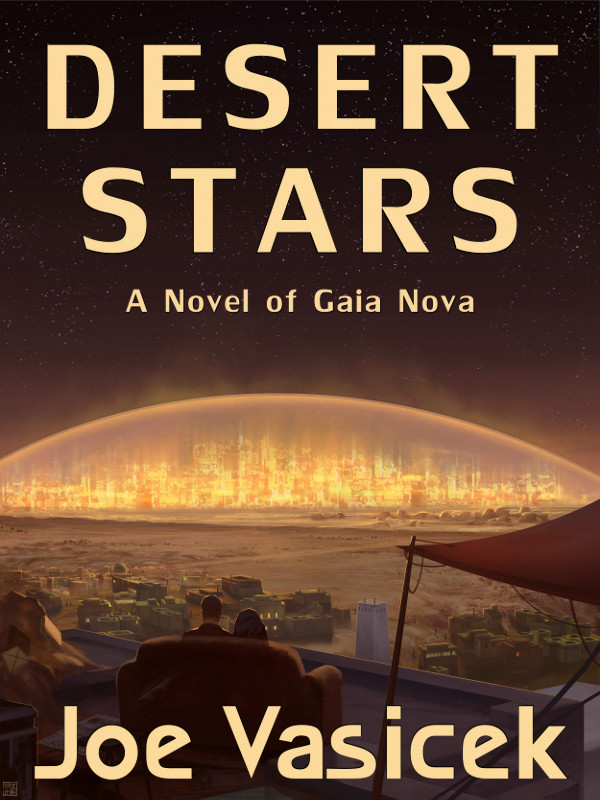
Desert Stars is now published!

Desert Stars, my third novel (and second in the Gaia Nova series), is now available as an independently published ebook from Amazon, Barnes & Noble, and Smashwords.  Within the next couple of weeks, it’ll be available through Kobo, iTunes, Diesel, Sony, and Xinxii as well.

It’s been a long journey, and I’m thrilled to finally see it come through.  I started the first draft back in the fall of 2008, but had been working on ideas for the world since 2005, when I returned from my LDS church mission in California.  Spending the summer of 2008 in Jordan was a major catalyst for my imagination, and I soon was bursting with ideas for a far-future story on a desert world.

I got stuck in the winter of 2009, however–right before taking Brandon Sanderson’s English 318 class.  Since he encourages all of his students to work on something new, I decided to write a book in the same universe in order to work through some of the world-building things that were holding me up.  That book became Bringing Stella Home, which was a thrill to write all of its own.

The strategy worked; by the time I’d finished that one, I had a much clearer idea where to go with Desert Stars, and an awesome ending that was nothing like anything I’d planned in the first draft.  And so, after graduating in April 2010, I soldiered through and finished the rough draft that summer.

It still had a lot of problems, though.  Fortunately, my first readers were extremely helpful both in pointing those out and in giving me fantastic ideas for other things I could do.  In the second draft that winter, I completely scrapped a major subplot in the second half of the book and focused on perfecting the character arcs for the two main characters: Jalil and Mira.

Around this time, I made the paradigm shift from traditional to indie publishing.  Other projects like Genesis Earth and Bringing Stella Home took my attention for a while, as I learned the basics of the new world and prepared those books for publication.  However, I always kept coming back to Desert Stars: I knew I had a good story there, and I was just itching to bring it to its full potential.

In the fall of 2011, I finally had that opportunity.  The last draft flew by in three weeks, and was one of the funnest writing experiences I’ve had since I started writing seriously in 2007.  By the end, I knew it was ready.  I sent it out to my editor, Josh Leavitt, and started to prepare it for publication.

In writing any book, there are always moments that stand out; experiences where things come together in an unexpected yet memorable way.  One of those came to me in Jordan, while I was walking down Queen Rania street from the University of Jordan to Al-Dustour, and the phrase “Temple of a Thousand Suns” flashed into my mind and sparked the whole novel.  Another of those moments happened while I was driving from Salt Lake to Provo, and Mira’s final words in the last chapter came to me; I literally could not stop screaming for two or three minutes.

I could share more, but if I did, I’d find it difficult to maintain the illusion that I’m not a loony psychopath. 🙂

In any case, it’s just awesome to see the story come to maturity and embark out into the world.  I’m sure this isn’t the end of the journey, but it’s definitely entering a new and exciting phase.  I sincerely believe that this is my best book yet, and I hope you find it as worthwhile to read as I have found it worthwhile to write.  If you do, I would appreciate it greatly if you took the time to post a review, or share it with a friend.  Every little bit helps, and I’m grateful for whatever support you can give!

In the next couple of days, I’m going to send out a newsletter with some freebies including desktop backgrounds of the cover art.  If you’d like to get in on that, be sure to sign up for the email newsletter via the form on the sidebar; you’ll also receive notices for other giveaways, as well as new releases.  It costs nothing and you can always unsubscribe, so there’s no pressure or obligation.

And that just about wraps it up.  Now: on to the next book!