The week from hell

That might be a bit of an overstatement, but this week is shaping up to be really crazy stressful.

First, I’ve got to move out of my current apartment. I think I’ve got a place lined up to move to, when makes things a lot less stressful than they were last week, but I’ve still got to physically move my stuff, clean up my apartment, handle all that stuff, etc.

Second, because of the move, I’ve got a serious cash flow problem until the end of the month. My current apartment won’t send me the deposit until thirty days after I move out, but I’ve still got to pay a deposit and first month’s rent in my new place, so … yeah.

Third, my book sales have unfortunately hit the summer slump–that, or they seem to have fallen off of a cliff. It’s hard not to panic when that happens. If I were better at marketing, this probably wouldn’t be happening, but unfortunately I am not. So I guess I’ll just have to write and publish my way out of it.

Fourth, however, I’m going on vacation with my girlfriend next Monday, and we’ll be gone for two weeks. That means no new releases until at least the end of the month, and not a whole lot of writing either. Which means that I need to get the revisions of Strangers in Flight (Sons of the Starfarers: Book III) done before going on vacation, or at least on the train ride out there, in order to send it to my editor in time for a late August / early September release.

Fifth, my phone died today, only to come back from the dead about an hour later. It was extremely weird: at first, my calls wouldn’t go through, then they would go through, but I wouldn’t hear anything, then I could only hear something if my headphones were plugged in, then after going into “settings” and hitting “activate phone,” everything works fine. But wow, did that give me a panic.

So yeah, I’ve got a lot on my plate right now. Which is not to say that I’m complaining, just that you’re probably not going to hear much from me for a while. I was hoping to release Strangers in Flight this month, but I’ve got to deal with these other things first, so it’s probably going to be pushed back a bit (though definitely not more than a month).

In any case, I’m keeling over from exhaustion over hear, so that’s enough for now. Later!

Yay for short stories!

So for the past three weeks while waiting for my first readers to get back to me with their comments on Strangers in Flight, I’ve been working on short stories. It’s a great way to stay busy and productive between projects, and feels really gratifying too because it only takes a week or two to finish things.

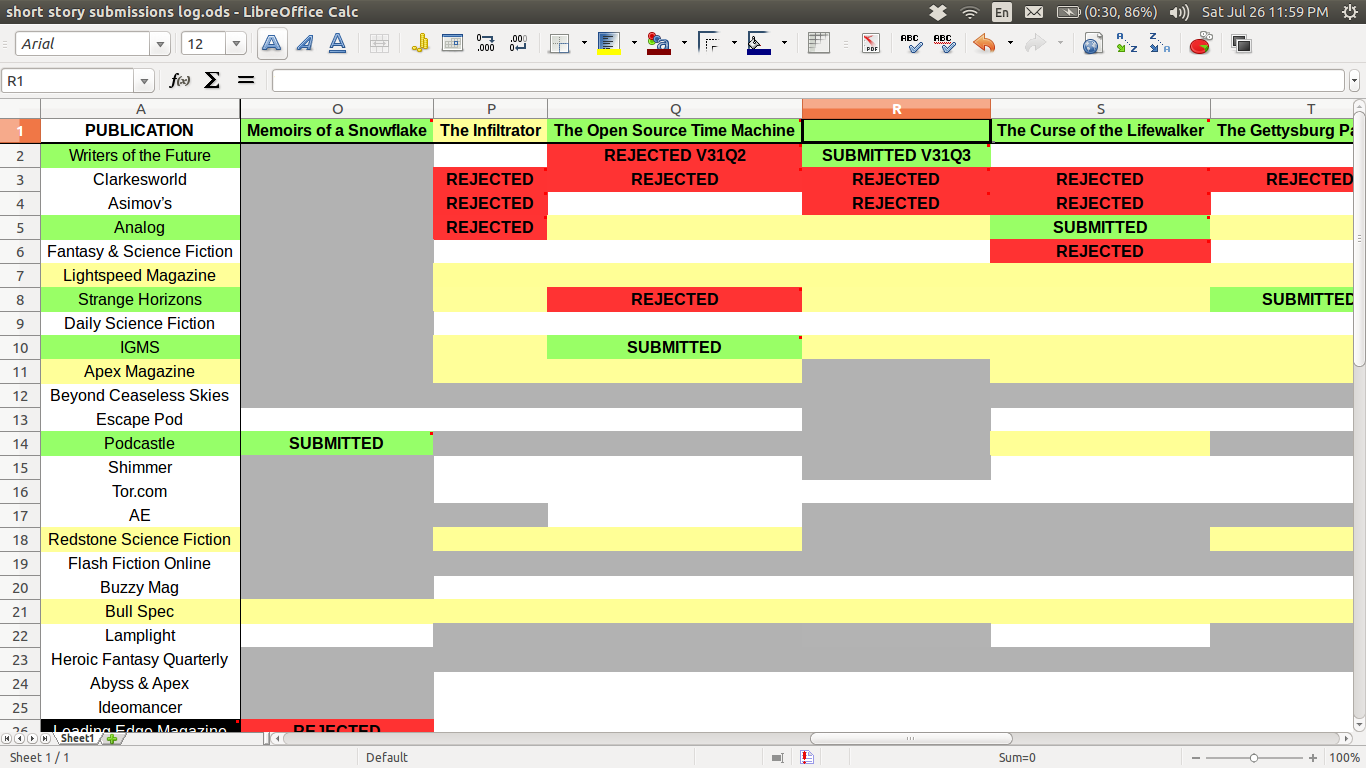
Screenshot from 2014-07-26 23:59:19The really gratifying thing for me, though, is sending off my stories to the magazines and having half a dozen or more on submission at any time. I love self-publishing, but for short stories, it makes a lot more sense to shoot for publication in one of the traditional markets first. They don’t buy exclusive rights, so you’re free to self-publish later, and they put your writing in front of a new audience, giving you some great exposure–all while paying you!

So far, the only market I’ve cracked has been Leading Edge. But the more I write, the sooner that will change! And since I still have the option to self-publish, the rejections don’t feel quite so discouraging. Instead, it’s almost like a friendly competition with myself to see how many rejections I can rack up, and how many stories I can have on submission at one time.

Lately, I’ve been working on a Sword & Sorcery story titled “A Hill On Which To Die.” It started off as a short story, but then it morphed into a novelette–not quite as long as Star Wanderers: Outworlder (Part I), but long enough that most of the markets won’t take it. It’s also long enough that it will probably need a revision once it’s done, and I may run it past a reader or two. It’s definitely turned out to be more work than I’d bargained for.

There’s another story I’m working on about a naturally occurring time portal in rural Pennsylvania, and how the Amish are so isolated from modern society because they’re the ones guarding it. Then I’d like to rewrite “The Infiltrator,” to cut out most of the stuff at the beginning and dive straight into the action. That should take only a day or two. And then, there’s that story about the uplifted Deinonychus that my girlfriend really wanted to read …

Gah! So many ideas to play with! I cannot possibly write fast enough to keep up with them. It’s the most frustrating thing in the world!

I suppose for most of my readers, this talk of short stories is kind of frustrating too, since they probably won’t be available for you to read for a while. But one way or another, they will come out eventually! And it’s definitely better to write something while in that weird space between projects. At least I’m finishing stuff.

So that’s what I’ve been up to lately. I’ll probably finish “A Hill On Which To Die” in a day or two, then work on “That Which Is About is” until it’s finished. It’s an Amish sci-fi romance–I can barely wait to get it all down on the page!c And after that, I’ll probably move on to Strangers in Flight, making the revisions and getting it ready to publish in August.

Why I quit Facebook

quit-facebookLast month, I made the decision to quit Facebook. Permanently. As in, the Facebook account that I created eight years ago as a college freshman no longer exists, unless Facebook continues to store and monetize data from its ex-users long after they’ve quit the service. Which wouldn’t surprise me at all, since Facebook is in the data business, which makes its users its product, not its consumer. But I’m getting ahead of myself.

I’ve thought about quitting Facebook for some time. Some of the reasons that have moved me in that direction have been that it’s a waste of time, that it’s the high fructose corn syrup of the internet, that it violates my privacy in creepy ways, that it cheapens my interactions with my friends … the list goes on. However, these reasons alone were never enough to convince me to quit. They got me to scale back my usage and cull my friends list, but never delete my profile outright.

Last month, though, Facebook revealed a new ad program where it downloads its users’ browser histories. With this program, Facebook now collects data straight from your browser–data from your internet activity outside of Facebook’s service–and sells that along with the personal data that you share on their site.

Facebook has always had major privacy issues, with the FTC stepping in in 2010 to force them to change their policies. However, until now, the argument was always that if you didn’t want your personal information to be shared, you shouldn’t put it on Facebook. Now, however, Facebook is collecting information that you don’t share with Facebook–information that they gather straight from your computer–without any reliable way to opt-out.

Facebook claims that this program is mainly for advertisers, but what’s to stop them from sharing this data with the NSA? With the Snowden revelations, we already know that there are entities within the US government that are working to create a surveillance state. Facebook is already practically in bed with these people, who have gathered personal information about Facebook users in the past. And since Facebook already has a dismal history of abusing privacy rights, changing its TOS without notice, and undermining its user privacy settings with unannounced updates, I fully expect them to gather that information and share it whether I want them to or not.

This may not be a huge change from the way Facebook used to do business, but it was a huge wake-up call for me. Since I’m not a huge fan of Facebook to begin with, this was the final straw that pushed me away.

I joined Facebook in 2006 when I was 21. I was just getting ready to head out to college, and at that point only college kids were on the site. It was a cool new thing and seemed like a great way to make and keep in touch with friends. Since I was moving away from home and starting a new phase of life, that was important to me.

My first year, I searched out and friended all of the people in my freshman ward at BYU and posted tons of pictures and other updates. It made me feel like I was very close to them! But the next year, I moved and made a new group of friends, and stayed in touch with only one of them. All those other friends just gradually drifted off into other things.

I posted a few more pictures, but mostly just profile pictures because anything else didn’t seem like it was worth the work. Facebook added groups, and I joined a bunch of silly ones just for laughs, but not any serious ones. Friends kept inviting me out to events, and my default answer was “maybe” because it didn’t make me look like as much of a jerk when I just didn’t want to go.

Then I got into a huge political debate with an old friend from high school, and it got insanely ugly. It was weird, because we always seemed to get along so well in person, but online we were just slugging it out at each other. It was very strange. I tried to get him to agree to disagree, but by this point his friends were posting to his wall and goading him on, so he refused. Then he attacked my religion, and the only way I could end the debate was to block him. I haven’t seen or talked with him since.

Facebook changed a lot over the next few years. The biggest change was probably the newsfeed, which replaced the wall. At first, I thought it was a great idea, because I could get all the updates on my friends in one place. Then the feed got swamped with updates from all the friends I’d added over the years. Most of them were people I’d drifted away from–people I’d seen a lot for a semester or two, but hadn’t bothered to keep the friendship up after we’d moved on.

Facebook became a fire-hose, and it started to eat up a disturbing amount of my time. I stayed away from all the obvious distractions, like Farmville and those other games, but it wasn’t enough. The information was just too dense, and though it gave me the illusion that I was staying close to my friends, in reality my interactions weren’t that meaningful.

Facebook developed algorithms to filter the newsfeed, but all that really did was make me use the site more. It didn’t help me to keep in touch with the people who mattered the most to me, since those weren’t the people who were posting the most. Instead, it resurrected a bunch of friendships that had long since faded in the real world and turned them into these weird zombified online relationships where we shared stupid memes, argued politics, and discussed random articles–all without ever seeing each other in person.

By the time I went overseas to teach English, Facebook had become a huge timesuck, and I wanted to break free of it. The first semester, I lived in a large town where I had constant internet access. The center of social life for us expats was a Facebook group called “Georgian Wanderers.” It felt good in some ways to be part of a community where people actually spoke English, but there was a lot of drama and ugliness in that group too. In my second semester, I lived in a tiny village where internet access was spotty, and I didn’t miss much while I was out there.

In fact, living without regular internet access was exactly what I needed. It gave me the chance to step back from my life and see how it had become cluttered. Before going back to the States, I decided to clean things up so as to keep myself from falling into the same rut. A major part of that online decluttering was to go through my 700+ friends list and delete all the people I didn’t want to stay in face-to-face contact with.

I cannot tell you how refreshing that was. At first, it felt like cutting off an arm or something, since I’d been “friends” with these people for so long and how was I going to keep in touch with them? But then, I realized that I didn’t really want to keep in touch with most of them, and besides, dropping them from my friends list wasn’t like disowning them in real life. We could still get in touch with each other in real life and strike up those friendships again.

My newsfeed was decluttered and those zombie friendships had (mostly) been neutralized, but even after all that, it didn’t seem like enough. I just wasn’t getting what I wanted out of Facebook. Every once and a while, I’d have a genuine exchange with someone, but most of the time it was just memes and random articles. I found myself slipping back into useless distractions and frustrating political debates, punctuated only occasionally by major life events from people I cared about.

Over the next year (2013), I found myself using Facebook less and less. Then the Snowden revelations came out, and Facebook seemed creepier and creepier. I’d learned from Douglas Rushkoff that Facebook’s business depended on milking its users for data, and the fact that the government was so intent on the mass collection of data profoundly disturbed me. From then, I suppose it was only a matter of time before Facebook crossed a line where I wasn’t willing to go.

Here’s the thing about Facebook: when you’re using it, it doesn’t feel like a network or a service. It feels like it’s an integral component of your closest friendships. Phrases like “Facebook official” and “pics or it didn’t happen” evince this. We become so entrenched in Facebook that permanently quitting it feels like betraying our friends.

But Facebook’s business doesn’t depend on strengthening our friendships, it depends on monetizing them–on collecting and extracting data to sell to the highest bidder. And since there’s nothing that most of us wouldn’t do for our friends, we grin and bear whatever terms Facebook feels like offering us. We tolerate the most egregious violations of our privacy because we want to keep our friendships, even as the quality of our interactions gets worse and worse.

Not only does this give Facebook incredible license to take liberty with our personal data, it gives them the power to shape and mold our interactions with each other. Just after I deleted my Facebook account, news came out that sociologists had engaged in a massive experiment to see if they could manipulate the mood of its users. The experiment confirmed that yes, Facebook most certainly can manipulate the emotional state of its users. Does this also mean that they can manipulate friendships? That over time, they can make you draw closer to some people and further from others? I’d be willing to bet that they can.

Instead of merely reflecting our relationships, giving an online dimension to friendships that exist in real life, Facebook is increasingly manipulating and constructing them. This in turn makes us more dependent on Facebook as a medium of social exchange. And the tighter we latch on to the network, the more they milk us for everything they can get.

The fundamental problem with Facebook is a misalignment of incentives. In order to make money, Facebook either has to get really creepy about the data it collects and what it does about it, or it has to control what we see on the site in order to create an artificial scarcity. Because it’s a publicly traded company now, it has to do both, because Wall Street is pressuring them to make more money.

When I was a user of Facebook, I felt like I was constantly being used. But now that I’ve quit, it feels much better. I haven’t noticed any sort of deterioration in my friendships, and I’m keeping in touch with my more distant friends just fine. Because that’s the thing about a truly close friendship: it doesn’t matter how much time goes by or how much distance comes between you–when you finally meet up again, it’s like you were never apart at all.

I don’t need Facebook to help me maintain my friendships, and I certainly don’t need it to help me make new ones. It’s one way to keep in touch, sure, but at this point, the benefits just aren’t worth the costs. And so, after eight years of being on Facebook, I deleted my profile and left for good. I doubt I’ll regret it.

Towards a new measure of writing productivity

When I decided back in college that I wanted to write professionally, I made a point of tracking my daily word counts. I even made graphs with the data, showing both my daily count and a seven-day rolling total (some of you may remember how I used to post those graphs on this blog). Tracking my daily word count like that was very helpful when I first started out. It helped me to develop the discipline to write daily, and gave me the encouragement I needed to push ahead even when I didn’t feel like writing. It also gave me a lot of satisfaction to see how much I had written over time.

But then I started to notice some problems with that system. For one thing, it didn’t track revisions very well. I eventually decided to count progress on a revision the same as counting new words, but that meant that whenever I revised something, my word count shot up dramatically. Consequently, I focused more on revising old stuff than on writing new words, since that was the fastest way to boost my word count. Also, because I didn’t feel as much pressure to push forward, I sometimes spent months at a time on revisions that should have taken just a couple of weeks.

Then I went overseas, and everything about the old system threw me into a funk. Adjusting to a new culture can be difficult and exhausting, not to mention that it takes up a lot of mental headspace. These made writing extremely difficult, but because of the daily word count tracking, I didn’t feel like I could take a break. But when I tried to write, it didn’t come out well because of all the stress I was going through. Of course, the more I failed to meet my word count expectations, the worse I felt for it. The thing that had been such a great motivator at the start of my career now threatened to drag me down.

So I did what all good creative people do and abandoned the routine that wasn’t working. And it helped–it really did. Without all the useless pressures and misplaced incentives, I wrote a novella in little less than a month.

But then I started to feel lost. Without those word counts, I had no way of measuring my productivity. The pressures were gone, sure, but so was any sense of orientation. I had no idea whether I was writing as much as I could reasonably expect to, or whether I was falling behind. My daily rhythms would fall out of whack at the slightest interruption. The self-imposed deadlines that I thought would keep me in line instead gave me one more thing to procrastinate about–and I am a master of procrastination.

So I looked for other metrics that I could use to gauge my productivity. For a while, I tried using a timer, with the idea that measuring time spent writing would be better than measuring raw word count. That experiment ended in disaster. It added even more pressure than the word counts did, and drove me so hard to busywork that my creativity was almost stifled. For some people, the clock might be a good source of motivation, but for me it was absolutely horrible.

I looked around for something better than word count, and never really found it. Eventually, I learned how to do my work without a direct way to measure it. When writing is your calling, you can’t not write, so I learned how to listen to my own creative rhythms and nurture them. That worked pretty well when I was excited about a project, but when I ran into a block, everything took a hit. And even when everything was going well, I still felt kind of lost without a concrete way to measure my productivity.

Last month, I ran into a pretty big block with Strangers in Flight (Sons of the Starfarers: Book III). I had expected to finish that book by the end of May, but instead I ran into some problems and had to go back and rewrite a few chapters. That should have taken two or three days, but instead it took two or three weeks. And during those weeks, I figured that I needed to change things up a bit.

I decided to base my new system on word count, since that seems to be the most reliable and objective measure of writing productivity. Instead of measuring it quantitatively, though, I decided to set a daily minimum word count, and mark on a calendar the days where I reach it. For new words, that minimum is 2,000, and for revised words, it’s 4,000. That seems to work with my natural rhythms–just enough so that I have to push myself, but not so much that I put it off and procrastinate instead.

So far, the new system seems to be working. As soon as I implemented it, progress on Strangers in Flight took off, to the point where it should be finished in just a couple of days. This past week, my daily routine was thrown off a bit from getting Comrades in Hope ready for publication, but even while I was busy with formatting and uploading, I managed to get 2k words written (on the author’s note and a short story). That surprised me, and makes me wonder if maybe the next time I publish a book, I can still manage to keep my writing routine intact.

The really nice thing about having a concrete way to measure your daily productivity is that it helps you to separate your work life from your personal life. When you’re self-employed, the two tend to blend into each other a lot, so that you’re always wondering if you should be spending your time doing something work related. But by keeping a daily minimum word count, I can say to myself “all right, today’s work is done–time to go play” and not feel guilty about it.

The danger, of course, is that the daily minimum will become a ceiling instead of a floor, holding me back from being as productive as I could be instead of pushing me to do that last little bit. However, I think I have a way around that. On the calendar that I’m using to keep track of all this, I’ll mark down not only the days where I hit my minimum word count, but the days where I double (or even triple) it. That way, if I hit the 2k mark a little early, I’ll still have incentive to push farther. Besides, that 2k minimum isn’t set in stone. I plan to review it each month, and change it accordingly.

In any case, that’s my new system. If you guys want an update in a month or two on how it’s working, let me know–I’d be happy to share any insights I might have. But blog posts don’t count toward my daily word count, and since the rest of my afternoon is wide open, I’d better get cracking at it!

Familiar vs. original vs. WTF?

In writing, you’ve always got to strike a balance between things that the readers find familiar and things that might be original or new to them. Every genre has its own standard set of tropes, plot twists, character archetypes, and other such story elements, and even if the readers can’t explain them all to you, they know them well enough to tell when something is off.

Different genres strike different balances between the original and the familiar. Romance tends to lean more toward the familiar, with happily-ever-after (or happy-for-now) endings a fairly ironclad rule. Fantasy tends to have a little more originality, depending on the subgenre, but there’s still a host of familiar tropes and world-building elements that you can usually expect to find. Anime tends to go pretty crazy with the original elements, but even in a wacky show like Hetalia there are still a bunch of anime-specific tropes that ground the story in a degree of familiarity.

A great way to introduce originality is to pull a common trope or story element from a different genre and adapt it to a genre in which the readers are much less familiar with it. This is what Suzanne Collins did with The Hunger Games: she borrowed elements from suspense and thriller, and combined them in a novel that was solidly grounded in YA. As much as I hated the book, I have to admit she did a very good job blending those elements into another genre.

So combining familiar elements in unfamiliar ways is one way to create originality. But another way–and potentially a much more risky way–is to throw in something that the reader has probably never seen before.

I don’t know why, but as a writer I seem to be drawn to these stories–much more so than I’m drawn to them as a reader. As an example, when I wrote Star Wanderers, this weird polygamy element got woven in, with the best friend of the female protagonist trying to convince her to share her husband. I have never read a story where anything like that happened, but that was where the story wanted to take me, so I followed it as best as I could.

The danger in throwing in something that is so far outside the realm of familiarity is that the readers will go “WTF?” and get thrown right out of the story. With Star Wanderers, I tried to do my best to develop the characters and convey their motivations in order for it all to make sense, but it was still really hard to write because I didn’t know if the polygamy thing was something that they’d swallow. And when you’re worried how the readers are going to respond to you story, it can be very hard to write it.

I suppose I should give more credit to my readers, though. Their experience is probably a lot broader than I think it is, and their hunger for strange new experiences may actually be stronger than I can ever fulfill. With Star Wanderers, I got a handful of reviews saying that I should have taken the polygamy thing further, or that I should have paired up characters in ways that I’d never even considered. I’m sure there were others who were disgusted by the whole thing, but the books are still selling, so it’s clear that I didn’t alienate everyone.

Right now, I’m writing Strangers in Flight (Brothers in Exile: Book III), and I’ve got another element in there that you don’t really see very often in any genre–at least, not in the way I’ve chosen to play it. It flirts with the taboo a bit and I’m sure it will make some people uncomfortable, though probably not as uncomfortable as it will make me to know that people are actually reading it.

For that reason, writing this book has put me in a weird mental headspace that’s making it very difficult to finish the thing, no matter how many deadlines I give myself. I’m still going to write it, and unless an unforeseen disaster happens I’ll finish it in time to publish it before the end of the summer, but it won’t be easy.

That said, this is a really fun story. Aside from all my fears about how readers are going to respond to it, I’m having a blast writing it. So maybe I should just put that other stuff out of my mind and focus on what I enjoy about the story. Because if I enjoy the story, then you probably will too.

U is for Uncertainty

There’s a lot of uncertainty that comes with being a working writer. I’m caught up in the middle of it right now as I get ready to launch a new series, and it’s enough to drive me crazy.

First of all, I’m not sure whether this new series, Sons of the Starfarers, will do well or whether it will flop. It’s a spin-off series from my Star Wanderers books, but the story is very different–much more action/adventure, whereas Star Wanderers is more of a sci-fi romance. I hope that my readers will eat up both of them, but until I actually hit “publish,” there’s no way to know.

The uncertainty is harder for me to deal with because the stakes are a lot higher. When I published Star Wanderers, I did so on a shoestring budget as a sort of side project that I didn’t think would take off. For Sons of the Starfarers, though, I’m going all in, commissioning a cover designer and hiring a professional editor. I don’t anticipate the production costs to go much higher than $300 per book, but there’s going to be nine books at least. Those costs add up rather quickly, and at $2.99 it’s may take a while for these books to earn back their costs.

Still, the stakes could be much higher. I’m a young single guy with no dependents, living on his own in a rather inexpensive part of the United States. My health is good and I’m fortunate enough to have graduated college without any debt. At this stage in my life, I’m in a really good position to take some calculated risks. Pursuing this writing career has definitely been one of them, and so far, it’s paid off about as well as I could have hoped.

But things would be very, very different if I had a wife and kids to take care of. If it’s just me that I have to worry about, I’m perfectly fine with taking risks and committing to projects that may fail spectacularly. But if there were a possibility that someone else could be hurt by my failures–someone I care very much about–I’d be a lot more worried.

At least the nice thing about being an indie writer is that you get your royalty checks like clockwork every month. I can look at my sales reports for March and know exactly how much money is going to come in in June. With legacy publishers, I hear it’s not unusual for royalties and advances to come four or five months late, or to be wildly off when they do come. That’s one uncertainty that I don’t have to worry about because I’m an indie.

Another uncertainty that I don’t have to worry about is that something out of my control in the production process will doom my book. I’m totally in control of my book’s production–if the cover art sucks, I may have to scrounge up a couple hundred bucks to hire a new cover designer, but I can do that without having to worry about my publisher ignoring my concerns. There may be a lot of uncertainty, but as an indie there’s also a lot of flexibility and control.

Uncertainty is a fact of life, whether or not you’re a career writer. Generally, though, where there’s more uncertainty, there’s also more opportunity. When I took the plunge and became a self-published writer, I was under no illusion that my success would be guaranteed–but I also knew that the only limitations would be the ones I put on myself. And personally, I like it that way. The uncertainty might be enough to drive you crazy when you’re staring it in the face, but when the risks pay off, they pay off very well.

Hope for the best, plan for the worst. Follow the path of least regret.

Further thoughts on the drama in the SF&F community and a rescinding of some previous thoughts

About a year ago, there was a big discussion in the science fiction & fantasy community about sexual harassment and sci-fi conventions. As a result of that discussion, allegations were thrown out about a certain senior editor at Tor, rumors began to fly, and through what some might characterize as popular justice and others might characterize as an internet bullying campaign, the editor was fired.

That disturbed me, so after engaging in a rather heated discussion on Mary Robinette Kowal’s blog about it, I wrote a blog post of my own, which I then took down (though not before it was picked up elsewhere) after some private email correspondences that were rather toxic. Even though I had an opinion, I decided that this wasn’t where I wanted to plant my flag, especially since it looked like I’d be hard-pressed to defend it.

Well, at the risk of taking some rightly earned flak, I want to bring back that post in order to give myself an opportunity to respond to it. My views and opinions have changed since then, and I don’t think I was right.

First of all, it’s come to my attention that this isn’t the first instance of high drama within the SF&F community. In fact, there have been so many inane kerfluffles and genuine spats over the years that for lifelong, hardcore fen, engaging in them is practically a sport. So now, I can see that my concerns about the community “tearing itself apart” were naive at best, and concern trolling at worst.

Second, through the efforts of writers like Jim C. Hines and Cora Buhlert, through following various discussions on Twitter, KBoards, and blogs like The Passive Voice, and through various conversations on-line and off-line with personal friends, I’ve come to realize that bigotry, sexism, and sexual harassment are much bigger problems within the SF&F community than I thought they were. The majority of voices now being raised are not trying to advance some nefarious PC agenda, but are simply pushing back against some very legitimate grievances. If we’re only hearing about those grievances now, it’s because they’ve been swept under the rug for too long.

Whether or not there is a faction in the SF&F community with an overt political agenda, that’s an entirely separate and disconnected issue from sexism, sexual harassment, and the stigmatization of minorities. Just because it’s not as visible to me as a white male author and fan doesn’t mean that there isn’t a major problem. If anything, I’m the least qualified person to make that judgment. The people who are complaining about these issues should be taken entirely at their word.

The science fiction & fantasy community as a whole is maturing and diversifying, and that’s a very good thing. It’s bringing in a rich influx of wildly imaginative stories, which strengthens the genre tremendously. Whatever your worldview, whatever your gender, whatever your preferred fandom, you should feel like there’s a place for you here if that’s what you want to read and write. Anything that makes people feel harassed or unsafe, stigmatized, or unwelcome is a much bigger threat to the genre than anything else.

As the SF&F community continues to mature and epublishing brings in a whole new generation of writers, there’s going to be a lot more drama as issues that have been swept under the rug for years are brought into public view. As this happens, I think it’s important to keep in mind what makes our genre strong: a rich variety of visionary and imaginative voices. The message should always be “there’s a place for you here,” not “you’re only welcome if you look and think like me.”

So yeah, I want to go on the public record and take back what I said in that previous post. There’s a much bigger issue here that should not be overshadowed, and it was wrong for me not to acknowledge it. I hope that no one feels that I’m disparaging of women, minorities, transgendered individuals, or any other group within fandom, because that’s not what I stand for. I may not agree with all of your views–in fact, I expect I’ll disagree with many of them–but that’s what makes the genre strong, and I don’t want anyone to feel like their voice is being silenced.

As for the other issues, I’m not quite so worried about the internet bullying aspect anymore because it’s clear that most of the pushback is not malicious, even if it can become quite vocal and heated at times. I don’t condone internet bullying at all, and I reserve the right to be critical where I believe the intent is malicious. At the same time, I don’t think there can be much credibility when gender-normative white male writers cast themselves as the victims.

If you felt demeaned or angered by what I said, either here on my blog or by my comments somewhere else, I’m sorry. My views on these issues are evolving, so I hope you’ll take that into account. And I hope that we can all keep an eye on what makes the community strong, which is a wide diversity of visionary and imaginative voices.

I’m not going to talk about nanowrimo

I’m not going to talk about nanowrimo because … yeah, I’m not going to talk about nanowrimo.

I’ve been doing a lot to get the print versions of the Star Wanderers novellas up, but beyond that, not a whole lot of writing.  Still one scene to go in Sons of the Starfarers: Brothers in Exile (that’s the working title, anyway), but I keep putting it off because … I dunno.  So many other things going on, maybe?  Sometimes it’s the easy stuff you put off the longest, sometimes, the hardest stuff.  But I already said I wasn’t going to talk about nanowrimo …

In any case, I set Thanksgiving as the deadline to get all the print versions out for Star Wanderers, and it looks like I’ll be able to hit it.  Outworlder, Fidelity, Sacrifice, and Homeworld are already up, and should propagate to Amazon in the next couple of days.  Dreamweaver is in the proofing process, and I should be able to typeset Benefactor and Reproach in the next couple of days.  It’s a relaxing thing to do while listening to podcasts, and the books are short enough that I can get all the work done in just a few hours.

In December, I hope to release a new Star Wanderers book: Deliverance, which covers the events of Homeworld from Mariya and Lucca’s points of view.  This was a fun one to write, so I’m looking forward to getting it out there for you guys to read.  It’s with my first readers now, who should get back to me by the first week of December or so.  The draft is already pretty clean, so unless they bring up some major issues, I should be able to get it out fairly quickly.

And after that, I think I’m going to take a break from the Star Wanderers universe for a while to work on some novels.  It’s been fun doing the shorter stuff, and I’ll definitely return to the novella form in the future, but there are a bunch of unfinished projects screaming at me to work on them.  First among them is probably Heart of the Nebula, which I haven’t even touched in almost a year.  It needs a huge overhaul–I’ll probably scrap a good half or so from the middle, probably more.  But the ideas behind the story are solid, and I would really like to get another Gaia Nova novel out soon.

But the one that’s calling the most to me is probably Lifewalker.  That’s the post-apocalyptic one with the guy wandering down the ruins of I-15 with a copy of Brandon Sanderson’s Mistborn toward a Las Vegas populated by cannibals.  There’s actually a lot more to it than that, but that’s the 10 second pitch I’ve been giving people.  The voice on that one was so different from anything else I’ve done, I had to take a break from it after I got to a good stopping place.  But recently, it’s been calling out to me to finish it.  I’ll probably move on to that one if I don’t go to Heart of the Nebula first.

Then there’s Edenfall, The Sword Bearer, a couple of other untitled ones, that Sword & Planet story I said I’d write … holy crap, so many unfinished books.  I feel like I’m a bad writer whenever I don’t finish everything I start, but that just seems to be part of my process.  Hopefully none of my readers are too impatient to get any particular book–although, come to think of it, that kind of pressure might be just what I need.

Either way, I really need to get back to writing.  But I already said I wasn’t going to talk about nanowrimo (I wonder if this blog post counts?)

😛 Later.

Quick update and a funny thing

SW-VII Reproach (thumb)First, just a quick update on my latest writing projects.  I got the feedback from my second round of test readers for Star Wanderers: Reproach (Part VII), and while I think the story still needs work, it’s getting closer. I probably won’t be able to get it out by the end of September, but first or second week of October it should be ready.

It’s funny–I sent it to a guy and a girl, and while the guy thought it didn’t need any changes (and he’s studying to be an editor), the girl pointed out a few things that need a little more reinforcement and development.  It’s mostly just minor changes I think, getting more into Noemi’s viewpoint and figuring out exactly what she’s going through, and making that clear to the reader.  So yeah, it shouldn’t be too hard.

In some ways, writing this book has been like writing myself out of a corner.  The story in Reproach runs parallel with the events of Sacrifice, and some of the stuff that happens there is pretty complicated.  For example, it’s got a sixteen year old girl who feels like her only hope at happiness is to convince her best friend to share her husband, and the best friend actually kind of comes around to it by the end, though the whole ordeal is almost unbearable for her.

Writing about monogamous relationships is hard enough when you’ve always been single–it’s doubly hard when you’re writing about polygamy.  But I’m actually fairly pleased with the way it’s come out so far–even though it’s not quite ready to be published, everyone who’s read it has really gotten into it, even the readers who haven’t yet read the earlier books in the series.  It’s been a challenging book to write, but it’s been a gratifying one, and I think you guys are going to enjoy it.

Of course, all of this is yanking me away from Sons of the Starfarers, which is really kind of aggravating.  On an interview I listened to recently, Jim Butcher said that writers are either writing, thinking about what they’re writing, or thinking about what they’ve written.  The way my brain is wired, I can only really do one of those things at a time, and I’d much rather write or think about what I’m writing than think about what I’ve written.  But yeah, Reproach is more important, so after finishing the current chapter I’ll put Sons of the Starfarers on hold for a couple weeks.

Also, I’m working to get print editions out for all of my Star Wanderers books before Christmas.  Part of this is because of the new Matchbook program from Amazon, but mostly it’s just because … well, why not?  For those of you who want paperback versions of these novellas, that will soon be an option.  I’m having a little trouble figuring out the cover art (RBG vs. CMYK, getting the covers to print attractively instead of turning out way too dark, etc), but that shouldn’t take longer than a few weeks to iron out.  Expect to see parts I-IV out by November.

Finally, a funny thing happened to me at Leading Edge.  For those of you who don’t know, it’s a student-run science fiction & fantasy magazine where student volunteers read every story submission and write a critique for the author.  Well, while sitting in the slushpile, one of the editors came in and showed me a story that I’d critiqued … twice!  The first time, I’d given it a rejection.  The second time, I’d actually recommended that the editors buy it!

Well, I racked my brain a little bit to figure out what had happened, and as close as I can tell the only real difference was in how distracted I’d been when I’d read it.  The first time, it had been fairly noisy and there’d been a lot of distractions.  The story had some good parts to it, which I mentioned in the letter, but I didn’t really pick up on the character motivations well, so I rejected it based on that.  The second time, though, it had been quiet enough for me to really pay attention to the story, enough to really get what was going on.  I finished it, and the ending moved me so much that I knew I’d have to recommend that we publish it.

The editor wanted to keep the rejection sheet anyway, but I tossed it in the garbage since really it wasn’t all that helpful anyway.  And the moral, if there is one, is to pick up every story with the idea firmly in mind that you’ve got a potential gem in your hands.  Too often, I think we read stuff flippantly, as if we already know that it’s not worth our time and attention.  Well, don’t do that!  Who knows but what you’ve got your new favorite story of all time sitting right in front of you?  Give it a chance!

And on that note, I leave you with this:

See you guys around!

Writing at a stroll

I haven’t been writing too much these past few days, or revising much either, but I have been rereading a lot of stuff and getting myself back into the fantasy world of my next big novel. I’ve made a few changes, but decided to keep most of the stuff that I wrote while in Georgia, and that amounts to about 50k words.  Just today, I finished the chapter where I’d left off, so now I’m ready to go full steam ahead.

I changed the title from The Sword Keeper to The Sword Bearer, since the story is more about Tamuna than Ivanar, and I may end up adding a subtitle since this is going to turn into a series.  Right now, the tentative deadline for the first draft is September 30th, which should be plenty of time to finish it, even with all the traveling I plan to do for the rest of the month.

The projected total word count at this point is 120k words, but I’m not so sure about that anymore.  I’m in the middle of Part II, at about 52k words, and while I’ve got a pretty good idea of what happens in the next three chapters, there’s a lot in the middle that I don’t know about.  I know how the book is supposed to end, but how to get there is the question, and I’m not sure if it will take me 120k words or 90k words, or upward of 150k words (though I doubt it).  I’ll probably have to discovery write most of it.

I’m looking forward to that, though.  Some of the best stuff pops out of my head when I have no idea what’s supposed to happen next.  Characters take on a life of their own, and reveal some really surprising things about themselves that end up becoming central to the rest of the story.  But to do it well, I need to spend some time just thinking about things in a loosely structured way, allowing myself to get immersed in this world.  That’s why I haven’t been pushing myself too much.

At the same time, I’ve picked up work on another Star Wanderers story, mostly as a way to keep putting words on the page when I just don’t feel up to working on The Sword Bearer.  This is either going to be Part IX or Part X, and frankly I’m really worried about botching it up.  A lot of you have really enjoyed the Star Wanderers stories so far, and I’m pretty sure you’ll like this one too once I’m done with it, but I’m going some places in this book that really make me uncomfortable, and I’m not sure how to do it without crossing the line that makes me never want to make it available for the world to read.

I dunno.  I’m probably angsting about it too much, and should just write the thing and see how it turns out.  But for now, that’s a background project to keep things fresh while I work on The Sword Bearer.  And really, I should probably work exclusively on the novel for the next week or so, just to get some momentum going.  One day, I’ll be really excited to work on it, while the next, I can barely bring myself to open the manuscript.  That’s how I tend to be when I haven’t yet latched onto a project, which seems to be most of the time.

SW-VII Reproach (thumb)Star Wanderers: Reproach (Part VII) is in the alpha reading stage right now, though if you would like to give it a read, feel free to shoot me an email.  I only let people I know in real life read my unpublished stuff, though, and even then only if we’re close friends.  Depending on the feedback, it could come out anywhere between the end of August (unlikely) to the end of September (more likely).

This is another one I’ve angsted a lot over, so I’m not sure when it will be ready but I know it will be before the end of the year.  Part VIII, on the other hand … Part VIII is probably on the verge of being ready right now, and I really want to get that one out soon, so all the more reason to publish Reproach!

That’s about it for now.  I’m heading on the train back to Massachusetts on Tuesday, where I’ll be for most of the rest of the month.  I might put together that A to Z blogging challenge thing as an ebook, just to publish something while I’m on vacation.  That would be a good diversionary project, something to do while on vacation.  Though I certainly plan to write as well–at least 2k words a day, hopefully.  Gotta build up that momentum.

Speaking of which, it’s 2am and I should get some sleep.  Gnight!