I’ll just come out and say it: I predict that the world’s last Worldcon will happen before 2034, and that after that, the convention (and possibly the Hugo Awards themselves) will be permanently disbanded. That’s what I think will be the ultimate consequence of the latest “scandal” regarding Seattle Worldcon’s use of ChatGPT, and the anti-AI madness currently sweeping the science fiction community on Bluesky.
If you haven’t been following the “scandal,” you ought to check out Jon Del Arroz’s coverage of it. He’s definitely partisan when it comes to politics and fandom, but he’s neutral on the subject of AI, or as neutral as you’re going to find, especially in writerly circles.
But here’s the TL;DW: the people organizing Worldcon 2025 in Seattle decided to use ChatGPT to help them decide which authors and panelists to put on which panels. This triggered a bunch of authors and panelists who are opposed to generative AI, simply on principle. Some of these authors—including Jeff VanderMeer, who is up for a Hugo award—have bowed out, while others have called for resignations and apologies. Many of the volunteer staff have also stepped down, exacerbating the staffing shortage—which is why the convention relied on ChatGPT in the first place. And apparently over on Bluesky, the scandal is taking on a life of its own, with everyone working themselves up to a massive frenzy over the subject.
My own opinion of the “scandal” is this: it isn’t a freaking scandal! Whatever your opinion on AI-assisted writing, using ChatGPT as an aid to research panelists is totally above-board and a legitimate use of AI. To disagree with that is to say that there is no ethical use-case for generative AI whatsoever, which is hypocritical and absurd—unless, of course, you’re still writing your books on a manual typewriter and submitting them to your publisher via the US postal service. Or using WordStar, if your name is G.R.R. Martin and you’re the last person on earth who “writes” with that defunct software (putting “writes” in quotation marks, since we all know by now that Martin isn’t actually writing anything).
But it isn’t the “scandal” itself that interests me, so much as what the fallout will likely be. Ever since the Sad Puppies debacle in 2015 (and arguably long before that), Worldcon has been dominated by the wokest fringe of SF&F fandom, and it’s been an open secret that the Hugo awards themselves are controlled by the publishers, largely for marketing purposes.
So at this point, the only things really keeping the whole Worldcon/Hugo charade going are 1) woke authors who use the convention to manufacture clout for their failing careers, because they wouldn’t otherwise have a platform, and 2) woke publishers who use the awards to manufacture clout for their poorly-selling books, because they don’t actually know how to market books effectively (at least, not to readers—libraries are a whole other subejct deserving of its own discussion, because there is a genuine scandal there). Once those two things dry up, and all of the ruin has been exhausted from these institutions (ie Worldcon and the Hugos), I really do think they will collapse and go away.
That’s what I find so fascinating about this scandal: it is so utterly toxic and absurd on its face that it’s going to do permanent damage to Worldcon and the Hugos. The writers of the rising generation who will one day dominate the field are all playing around with these AI tools right now, and doing really interesting things with them. Meanwhile, most of the authors who are screaming about AI on Bluesky right now will either be dead or irrelevant (or both) in the next 20 years. And yes, Mike Glyer, you can quote me on that.
Seriously, though: if the Worldcon community is so vociferiously opposed to a legitimate use-case of ChatGPT—namely, to alleviate the already overwhelming burdens being carried by the volunteer staff—AND they continue to be absolutely toxic about it online… who in their right mind would want to be a part of that community? And since the only thing keeping the whole charade going is its ability to manufacture clout, that’s why I think its years are numbered—and likely in the single digits.
On the plus side, if/when the Hugos finally die, I won’t have to read any more crappy woke books to be able to say I’ve read (or DNFed) every Hugo award-winning novel.
Ever since I made a spreadsheet to track all the Hugo and Nebula award-winning books, I’ve noticed some interesting patterns. I’ve already blogged about how the genre seemed to transform after the creation of SFWA and the introduction of the Nebula Awards. That seems to mark the point where the left’s long march through the institutions began in our genre, though it may be coincidental as that is also when the New Wave began. Or the two events may be connected, which wouldn’t surprise me.
In any case, I’ve expanded that spreadsheet to include the Dragon Awards and the Goodreads Choice Awards for the fantasy and science fiction categories, and I’m now in the process of adding all the books from the Locus magazine’s readers’ poll, at least for science fiction and fantasy. From what I can tell, Locus basically sets which books will be considered for nomination with most of the older awards, creating what a cynical person might call a “master slate.” And since Locus has been insufferably woke for a very long time (I still read my local university library’s copy every month, though articles like this one make me question why), that goes a long way to explaining how the Hugos and Nebulas became so woke—though I’m still not sure if Locus is woke because its core readership (and primary revenue source), the New York publishing establishment, is woke, or if the organization was captured during the left’s long march through the institutions. Or if Locus has simply been woke from its inception.
But I’ve noticed other patterns, including some with the Goodread’s Choice Awards (which include a very public vote tally) that seem to indicate that the Hugos, the Nebulas, and the Locus readers’ poll are now of minimal cultural significance: a sideshow, if you will, or a very small clique that represents the genre’s past, not its future. Which is actually pretty obvious—you don’t need to assemble a spreadsheet of thousands of books to see that. But it’s an interesting pattern nonetheless, and it’s made me wonder if perhaps the rise of the internet—in particular, social media—killed fandom, at least as we traditionally understand it.
From what I can tell, SF&F fandom began in the 20s during the era of Hugo Gernsback’s “scientifiction” and the pulps. During the Golden Age of the 30s and 40s, fandom began to organize things Worldcon and the Hugos, but the genre was still very monolothic, with so few books and magazines being published each year that it was possible for a devoted fan to read all of them. In fact, the culture generally was very monolithic, with ABC, NBC, and CBS dominating television, the New York Times dominating the newspapers, and Life and the Saturday Evening Post dominating the magazines.
Because of the monolithic nature of the culture during this time, it was possible for a single figure to dominate and shape the field, like Walter Cronkite in journalism, or John W. Campbell Jr. in science fiction. But fandom was still mostly a localized affair, with geographical distance and the limitations of communications technology keeping fannish controversies from becoming too fractious or toxic—though not for lack of effort. But in a world without internet, where arguments happened either in person at conventions or the local club, or else evolved gradually in the pages of the various fanzines, none of the factions ever tried to split or go their own way. Granted, part of that was due to the monolithic nature of the genre—if they did split off, where would they go?—but there was still a sense that everyone in their small corner of fandom was a part of a far greater whole, even with all of their passionate and sometimes fractious opinions.
But as science fiction grew, it became less monolithic, if for no other reason than that it was no longer possible to read all of the books and magazines that were coming out. From what I can tell, the genre crossed that threshold sometime in the 60s. This was also when the New Wave pushed back against the standards set by Campbell and began producing some very experimental (and also more left-wing) work. But fandom didn’t totally fracture at this time. Instead, from what I can tell, the Locus reader’s poll emerged in order to filter out everything but the very best work for consideration for the awards.
In a world where everyone considers themselves to be part of the larger community of fandom, awards—even the relatively minor ones—carry a lot of weight. This remained true through the 70s and 80s as science fiction grew to the point where it truly went mainstream. In fact, the awards became even more important, because there was no longer any way for even the most devoted fan to read (or watch, or play) all of the new books and magazines (or movies, or shows, or games) that were coming out. New subgenres and subcultures of fandom began to emerge, but everyone still looked to the awards—particularly the Hugos and the Nebulas—as the standard of excellence.
But the publishers placed even more weight on the awards, because winning a Hugo, or getting on a New York Times bestseller list, often were key to propelling sales. So over time, the publishers gradually took over the awards, as well as the organizations and infrastructure that had been built around them. With the Nebulas, it isn’t hard to see how this happened, as SFWA allows publishers to be members (creating a very obvious conflict of interest that the leadership of that organization has chosen to ignore). With the Hugos, it probably happened through Locus, since the magazine depends so much on advertising for its financials. This became even more true as the subscriber base declined in the 90s, as it did for all of the major magazines in the field.
What caused the decline in subscribers? The internet, of course. Fans no longer depended on the ‘zines to stay in touch with the broader community, but began to organize into listservs, email chains, and message board forums instead. Later, blogs and social media continued this trend. Geographic distance became increasingly irrelevant, and fandom became less of something that you connected with through your local group of friends and more something that you connected with online as an atomized individual.
But ironically, the more interconnected fandom became via the internet, the more it began to fracture. All of those passionate opinions were no longer tempered by the boundaries of time and distance, and the snarkiest and most vitriolic or self-righteous opinions were often the ones that garnered the largest audience. This became even more true with the advent of social media, which relies on amplifying outrage to addict its users and maximize profits. Social media also encouraged the formation of echo chambers, where the various corners of fandom spent so much time talking to each other than they soon had little in common with the wider fandom. Geographical distance counted much less, but ideological distance counted for more—much more.
But did the internet ruin fandom, or save it? Or in other words, was this transformation a net loss or a net gain for fans of the genre? Because, on the creation side of things, I think the internet was very much a positive development. No longer did a creator have to rely on a small clique of ossified New York gatekeepers for their work to see the light of day, and the nature of online distribution meant that a quirky book written for a tiny but underserved subculture could find and grow an audience quite effectively, even without any mainstream appeal. Of course, this only accelerated the division of fandom, but it also meant that those subcultures—many of which had been underserved for decades—now had much more content tailored specifically for them.
In the 10s, the deepening divisions within fandom manifested in a fight for control of the major awards—specifically, the Hugos. That was whate the puppies were all about. But the fight became so toxic that the awards themselves became discredited, and the victory of the wrongfun brigade proved to be a Pyrrhic one. And because the culture is no longer monolithic, and fandom is no longer a single community united by a love for the same thing, the fall of the awards has given us a world where it matters much less that you’re a fan of science fiction and fantasy generally, and much more that you’re a fan of X author, or X game, or X thing.
Gone are the days when a single author, or editor, or influencer can reshape the culture in their own image. The wrongfun brigade is still trying to do that, but all they will ultimately accomplish is to destroy everything that they touch, including all of the legacy institutions that they now control. But this also means that we’ve lost that sense of being part of a larger, broader community. Of course, it’s fair to argue that that was always just an illusion, and that we’re all much better off now that there’s something literally for everybody. But I do think that’s come at a cost of increasing social isolation.
The pandemic has no doubt accelerated this. I wasn’t at Chicon or Dragoncon this past weekend, but I have friends that were, and I plan to meet up with them at FanX Salt Lake later this month. It will be interesting to get their take on all this. In the meantime, I will continue to fill out my book awards spreadsheet and look for interesting patterns.
There was a time when science fiction was bigger than fantasy. More people read it, more authors wrote it, and more editors demanded it. Would-be fantasy authors were steered toward writing science fiction, because they knew that it would sell better than the stuff they actually wanted to write.
Now, the roles are reversed. More people read fantasy, more authors write it, and more editors are demanding it (except in the short story world, but none of them are in it for the money, which proves my point). For every year of the Goodreads Choice Awards, the fantasy section has gotten more total votes than the science fiction section. And authors like me, who often prefer to write science fiction, are instead veering more toward fantasy, because we can see that it sells better.
I’m not decrying this shift. I enjoy fantasy differently than I enjoy science fiction, but I genuinely enjoy them both. And as science fiction writers have pivoted to writing fantasy, I think it’s improved fantasy considerably, with magic systems that actually have rules and fantasy worlds that are actually realistic, given our understanding of physics, geography, etc. So just to be clear, I’m not complaining about this.
But I have wondered more than once how it got to be this way. What caused science fiction to fall out of favor? What made readers turn toward fantasy instead? Why has science fiction been on a general decline for the better part of half a century?
There was a time when science fiction was fun and inspiring. When scientists, engineers, inventors, and pioneers cited their favorite science fiction stories as major inspiration for their work. These were the people who put satellites in orbit, who put a man on the moon, who invented computers and the internet and in many ways built our modern world. And it worked both ways: not only did the fiction writers inspire the scientists and pioneers, but the new discoveries and inventions inspired the next generation of science fiction writers to write fun and inspiring stories about that.
What broke the cycle? What got us to the point where today’s kids no longer dream about becoming astronauts or paleontologists, but about being YouTube stars and “influencers,” whatever the hell that means? Why is there such a dearth of truly inspiring science fiction nowadays?
To be sure, there are a lot of factors at play, and no one single person or organization bears all of the responsibility. But if I had to point to just one thing as the primary cause, it would be SFWA.
The Science Fiction and Fantasy Writer’s Association, formerly known as the Science Fiction and Fantasy Writers of America, formerly known as the Science Fiction Writers of America, was started in 1965 by noted author and Futurian member Damon Knight. (Who were the Futurians? We’ll come to that later.) It is a professional organization for writers with a membership requirement of making at least 3 professional short story sales (only from SFWA-approved markets, of course), or a professional novel sale (also only from SFWA-approved markets), or to make something like $5,000 in sales on a single title if you’re self-published (which involves opening the kimono to these sleazeballs), or… frankly, I don’t know what the membership requirements are these days, and I don’t think SFWA does either, because their membership requirements page currently says that they have “a plan to create a comprehensive market matrix or scorecard to better guide creators toward professional publishers,” and that they are just now “starting with short fiction markets on this rollout.” Whatever the hell that means.
In practice, SFWA is a very snobbish club of “important” science fiction (and fantasy?) writers, or rather, a club of snobbish people who consider themselves to be important. Every year, they give us the Nebula Awards, which are supposed to represent the “best of the best” that science fiction (and fantasy?) has to offer.
The reason I’m keeping “fantasy” in parentheses is because the organization was very clearly founded with a focus on science fiction, and to the extent that it later expanded to include fantasy, it did so as a means to stay relevant in a world where fantasy had come to dominate science fiction. At least, that’s what I gather. But even if I’m wrong about that, I’m not wrong that the SF in SFWA originally standed for “science fiction,” and that the addition of fantasy came much later—and not without a ridiculous amount of controversy typical of this toxic and disfunctional organization.
Those of you who have been following the devolution of the genre since the dumpster fire that was the response to the Sad Puppies will no doubt agree that SFWA is a major part of the problem. But the thing that may (or may not) surprise you is that SFWA was toxic from the moment of its inception, and was always the primary factor in science fiction’s decline.
To see why, let’s go back to the Futurians. This was a small but tight-knit community of superfans, kind of like the Inklings, whose members went on to found Worldcon, the Hugos, DAW books, the Nebulas—and yes, SFWA itself. These were all people who grew up with the pulps, were active during the golden age, and became the movers and shakers in the field in the latter half of the 20th century: people like Donald A. Wollheim, Frederik Pohl, Isaac Asimov, Damon Knight, and others.
The key thing to know about the Futurians is that they were left-wing radicals. In the 1930s, when communism was a very dirty word, Pohl was literally a communist. Wollheim was also a believer in communism, and stated that science fiction writers and fans “should actively work for the realization of the scientific world-state as the only genuine justification for their activities and existence.” (Carr, Terry (1979). Classic Science Fiction: The First Golden Age p430) According to Asimov, the Futurians broke off from the Greater New York Science Fiction Club precisely because of their political and ideological differences. In short, the Futurians were all true blue, dyed-in-the-wool, die-hard Marxists of one stripe or another, and they were very overt about bringing their politics into their fiction.
When I first started to get involved in fandom, I heard an apocryphal story that at the very first Worlcon, there was a schism between the group of fans who wanted science fiction to advance the cause of global communism—basically, the Futurians’ view—and the majority of fans, who just wanted to read and talk about fun science fiction stories. That first major schism (or so the story goes) became the root cause of every fannish conflict and controversy that has ever happened since.
Now, if we had to sum up the chaos and insanity of the last ten years in just three words, most of us would probably agree that “politics ruins everything” is a fair assessment. For science fiction, it was no different. The science fiction of the golden age, for all its flaws, was fun, adventurous, inspiring—and not overtly political (for the most part). Then, in the 60s and 70s, science fiction took a strong turn to the political left, glorifying sexual liberation and Marxist utopias, and pounding the idea that the world was going to end very soon in some sort of climate catastrophe, or a nuclear holocaust brought on by politicians like Goldwater and Reagan.
I used to think that science fiction was an inherently political genre, but why should it be? After all, there is nothing inherently political about science. If the pandemic has taught us anything, it’s that the moment science becomes politicized into “The Science,” it becomes toxic and unreliable. And the more I read, the more I’m convinced that this is true of science fiction as well. The difference between art and propaganda, truth and narrative, is the same difference between science and “The Science.”
What happened in the 60s and 70s was science fiction’s version of the long march through the institutions, as the Futurians and their ideological allies came to dominate the professional side of the field. Even though they were outnumbered and their political views put them solidly in the minority, they took their love of science fiction way more seriously than everyone else, and so while a lot of those early fans of the 40s and 50s either grew out of science fiction or moved on to other things, the Futurians and their allies stayed. Science fiction was their life. Science fiction was their passion. And thus they became the next generation of authors, editors, and publishers.
Through SFWA, they were able to leverage their position and influence into real power. With Worldcon and the Hugos, anyone who was willing to shell out the money could vote or join the convention, and a lot of people did. It was much more democratic that way. But with SFWA, you had to sell enough stories to the qualifying markets—and increasingly, all of those qualifying markets came to be run by left-wing political ideologues.
In a recent Project Veritas expose, an engineer at Twitter explained that one of the reasons why Twitter has such a left-wing bias is because the left-wing extremists refuse to compromise on any of their views. According to the engineer, right-wingers tend to say “I disagree with what the other side is saying, but I don’t think they should be silenced for it,” whereas left-wingers tend to say “that’s violence and hate speech, and if you don’t censor it, I won’t use your platform.” Because the left-wingers are the super-users, Twitter is more likely to cater to them, and thus rewards their extremism instead of limiting it.
A similar dynamic emerged in science fiction, where the left-wing editors and publishers—many of whom had always viewed science fiction as a means to achieving their ideological ends—rewarded politically like-minded authors with story sales, publishing contracts, favorable reviews, and the Nebula Award. These left-wing authors went on to join SFWA and vote for other left-wing authors in the Nebulas, feeding the cycle.
Meanwhile, all the other authors and fans—the ones who cared more about telling good stories than conveying a political message—only stuck around so long as the quality of the stories hit a certain minimum threshold. And I’ll be the first to point out that there were many left-wing authors who wrote genuinely good stories: Ursula K. Le Guin, for example. But there were also some real hacks who were awarded the Nebula mainly because of their politics. Since the minimum threshold was different for every reader, as the stories got more political, more and more readers abandoned science fiction.
In other words, the reason why science fiction became so political was because the institutions—most notably, SFWA—rewarded political purity more than they rewarded telling a good story. From the beginning, SFWA had this toxic dynamic, because it was founded by political ideologues who wanted to use science fiction to achieve their ideological ends. And because politics ruins everything, SFWA ruined science fiction.
How does all of this end? With an insanely toxic purity spiral and a collapse into cultural irrelevance. That is what we are witnessing right now, with the recent brouhaha over Mercedes Lackey accidentally saying “colored people” instead of “people of color.” (Both terms are equally racist, by the way: it’s just that the one flavor of racism is more fashionable right now.) The purity spiral has been ongoing for years, perhaps since SFWA’s inception, and the collapse into cultural irrelevance is well underway. The only questions left are 1) how much damage will be done before SFWA fades into much-deserved obscurity, and 2) if science fiction has a comeback from its long decline, who or what will turn it around?
As to the second question, it’s possible that the damage is permanent and nothing will stem the genre’s decline. That’s what ultimately happened to the western, after all. Or maybe it will follow the same path that horror did, with some authors adapting to the changing market and rebranding as something else (ie urban fantasy, paranormal romance), while the genre purists languish, at least in terms of commercial viability.
Or maybe, if SFWA just dies, science fiction will begin to experience a renaissance. Same thing at this point if Worldcon doesn’t survive the pandemic (or gets totally captured by the Chinese, which honestly would be an improvement). With the advent of indie publishing, the field is very different right now, and we’ve already seen some amazing indie authors like Andy Weir and Hugh Howey take the field by storm. Without the toxicity of SFWA holding us back, I think we will see some very good things come out of the genre in the coming years.
But for that to happen, SFWA really does need to die, or at least fade into cultural irrelevance like the Author’s Guild and the Libertarian Party. Starve the beast. Don’t let them have any of your money. Mock the organization relentlessly, both online and offline, or else ignore them entirely. And if a book or a story wins a Nebula, take that as a mark against it. I’ve read all but five of the Hugo and Nebula award winning novels, and now I can say with certainty that the best predictor that I will personally hate a book is if it won a Nebula but not a Hugo. Test that out for yourself. If you haven’t been red-pilled yet, you’ll probably be surprised.
Also, check out this podcast if you haven’t already. Good stuff as always from Steve Diamond and Larry Correia.
So Worldcon 2016 and the Hugo Awards happened over the weekend. It went down about how I expected it would: the award for Best Novel went to an outspoken racist, one of the most prominent female editors in the field lost (again) to No Award, and the TruFans and SJWs made the convention Safe for Diversity by silencing or evicting everyone who did not think, act, believe, or look like them.
In other words, it was a complete crapshow, and I’m glad that they didn’t get any of my money. Instead, I’ve decided to follow in the Grand American Capitalist Tradition by offering you an opportunity to give me your money instead.
That’s right: “Welcome to Condescension,” my Sad Puppies short story, is now available on all the major ebookstores. Check it out!
Lately, I’ve taken a serious interest in family history. A huge amount of records have gone online in the past decade, making it far easier to trace your ancestors. Before that, my father was able to trace the Vasicek line to the Czech lands (places with cool names like Frenštát, Vratimov, Trojanovice, Staříč, etc), but that was as far as he could go. Just a couple of years ago, however, my sister found the parish records for that region. They’re mostly all scanned and online, and they go back as far as the late 15th century to the start of the Hapsburgs. The pieces are all there—all we have to do is put them together.
Needless to say, this has got me really excited. It also made me wonder: how far back is it possible go? According to my sister, who is also a certified genealogist, the European records start to get really sketchy around the 7th or 8th century. Only the royal lines go back that far, and since they were all trying to connect themselves to mythical figures and Biblical characters, the records are not very reliable.
So I went to Wikipedia to look up the period of Late Antiquity leading up to the 7th century, and soon became completely absorbed in it. This is the period when the Roman Empire collapsed, leaving Europe in a hot mess. The Vandals, Franks, Goths, Visigoths, Ostrogoths, Huns, and Saxons were running around all over the place, sometimes fighting for the Romans, sometimes fighting against them, constantly fighting each other, and migrating clear across the continent in their search for new homelands.
As clear as I can make it out, this is how it basically went down:
There once was a tribe on the Italian penninsula that built a city called Rome. Through innovations in engineering, warfare, governance, and philosophy, they conquered virtually all of the known world and built a mighty empire. Rome became legendary as the center of it all.
Over time, however, the Romans became decadent and corrupt. The empire slowly began to disintegrate and fall apart, though great pains were taken to preserve the appearance that all was well. By the end of the third century, it had effectively split into two halves: the eastern empire and the western empire. This division fell roughly along cultural lines: the Greco-Roman culture in the east, and the Latin-Roman culture in the west.
Around this time, a barbarian tribe (or alliance of tribes) appeared on the northeastern frontiers of the empire. Known as the Huns, these barbarians launched an invasion of Europe that completely shuffled the deck. They only briefly threatened the Romans, but had a much larger impact on the barbarian tribes of Europe, displacing them from their homelands and forcing them to seek a new home. This launched what is known as the migration period.
There were a lot of barbarian tribes seeking a new homeland: the Franks, the Saxons, the Goths, Visigoths, Ostrogoths, and the Vandals. With the Huns at their backs, they invaded the Roman Empire, which was the weaker of the two.
…except “invade” isn’t quite the right word. Many of these tribes became allies or foederati of the Romans (often after defeating them). Even some Hunnic tribes were absorbed into the empire in this way, and were often employed as mercenaries to fight against the Frankish, Gothic, and Vandal tribes that hadn’t allied with Rome. The salient point is that Rome had become weak, and thus had to make concessions to these barbarians who were starting to flood the empire.
At the end of the fourth century, a tribe of Visigoths that had settled in the eastern empire became upset with the way that the Romans were treating them. After being starved, taxed, and treated as sub-human, they took up arms under a leader named Alaric the First. They were unable to make much headway against the eastern empire, so instead they went west and invaded the Italian penninsula.
Over the course of the next two decades, the western empire vacillated between accomodating them, backstabbing them, and declaring outright war. This was mostly due to internal power struggles that had little to do with the Visigoths. Even though Alaric threatened the heart of the western empire and laid seige to Rome three times, they treated him with outright contempt, blatantly violating previous agreements and going so far as to ambush him under a flag of truce.
In 408, the internal power struggle eliminated the faction that was willing to accomodate the Visigoths. Shortly thereafter, Alaric decided that he’d had enough and marched on Rome. In 410, he sacked the city, shocking the civilized world.
Up until that point, Rome was considered sacrosanct. Sure, the barbarians were overrunning the frontiers and threatening vast swaths of the empire, but Rome was the cultural and spiritual center of the world. How could it possibly fall? But it did, and following the sack in 455 at the hands of the Vandals, the Roman Empire never regained its former glory.
Reading up on this history at the same time as the 2015 Hugo Awards played out has made me notice a bunch of similarities between the two events. Obviously, the decline and fall of Rome is not a perfect analogy for the decline and fall of the Hugo Awards, but there are some very interesting parallels.
The Hugo Awards were founded in the 1950s, back when SF&F fandom was a tiny community of geeks on the fringes of society, and not taken seriously by anyone in the cultural mainstream. Over the next several decades, the geeks took over the world, dominating the popular culture with things like Star Wars, Star Trek, Lord of the Rings, Harry Potter, Game of Thrones, etc.
But somewhere along the way, this happened:
Fandom (with a capital F) became decadent and corrupt as the Truefen jealously guarded their turf, creating all sorts of weird Hugo categories (“related work”? “short-form” editor vs. “long-form” editor?) and pushing back against the mainstreaming of the SF&F field. As a result, Worldcon went from the premier SF&F convention to a second-tier convention that falls well short of Dragoncon, Gencon, San Diego Comic Con, Salt Lake Comic Con and Fan Ex, etc, all of which are 1-2 orders of magnitude larger than Worldcon now. The once-prestigious Hugos were now decided by mere hundreds of votes.
Around this time, a tribe (or alliance of tribes) of cultural Marxists began to invade the cultural space. Also known as Social Justice Warriors (SJWs), they began to dominate multiple forms of media, pushing out many of the more conservative readers and viewers who resisted. Fandom (with a capital F) gradually embraced them, using them as mercenaries in their internal power struggles.
By this time, Fandom had split into two broad divisions: Baen and Tor. Baen books were more about action & adventure, while Tor books were more about social issues (though of course there was some overlap). These two houses dominated the field, but it was the Tor side of Fandom that had more ownership in the Hugos than the Baen side.
The SF&F fans who had been displaced by the SJW invasion formed the Sad Puppies and Rabid Puppies. To Fandom, however, they were all just “wrongfans”—essentially, barbarians. And it wouldn’t exactly be right to say that the puppies “invaded” Fandom, because many of them were already there or were willing to coexist and make alliances. Others, of course, were not.
Vox Day entered the scene as one of the disgruntled puppies who had had enough of Fandom. The Tor side was far more susceptible to his machinations, responding to him in knee-jerk fashion at every turn, so he went after them. In 2015, he sacked the Hugos, causing “no award” to sweep five categories (and place in eight more).
To an impartial observer, Vox Day was the only clear victor of the 2015 Hugo Awards. How else can you explain all the “no awards”? His stated goal was never to win the Hugos, it was to destroy them, and he accomplished that spectacularly. When an esteemed professional such as Toni Weisskopf loses to “no award” purely out of guilt by association (on a ballot decided by less than 6,000 total votes, no less), how can anyone possibly take the Hugos seriously anymore? What was once considered the most prestigious award in the SF&F field has now proven to be a narrow, exlusivist club of politically like-minded elitists.
Fandom (capital F) accomplished many wonderful things back in the days before SF&F entered the mainstream. In a very real sense, they conquered the world. But by doggedly trying to hold on to their turf and refusing to let others play with their toys, especially those who see the world differently than them, they are declining. Like the sack of Rome in 410, the sack of the Hugo Awards in 2015 was a watershed moment that demonstrated just how much the old order had decayed.
Can the Hugo Awards be saved? I seriously doubt it. The “truefans” will jealously clutch it to their chests until they die, and with the graying of fandom, that will probably be accomplished fairly soon. But just as the Renaissance rose from the long-cold ashes of the Roman Empire, so too I hope that something good will eventually come out of all of this. Because really, there is a place in fandom (lower-case f) for everyone, and that has never changed.
I have a lot of thoughts on the new Star Wars trailer. But first, a little background.
Growing up in the 90s, I was a huge Star Wars fan. It’s not an exaggeration to say that Star Wars was my life. I played X-Wing every day, I watched at least one of the original trilogy movies every week, I read every Star Wars book in the library that I could get my hands on, and I daydreamed and made up Star Wars stories all the time. I was living in the golden age of science fiction (about age 9-12), and that meant Star Wars.
Then Episode I came out. Like all the other fans, I was super, super excited about it. Like all of the other fans, it was a huge disappointment. Several things ruined that movie for me, but the biggest were Jar-Jar Binks and midichloriens. The most magical aspect of the Star Wars universe, the Force, was singlehandedly ruined by the whole midichlorien thing, and as for Jar-Jar … I don’t even want to go there.
There were a lot of other little things too: like the pod racing sequence, where the sand people were thrown in for a gag, and that part where Obi Wan and Qui Gon Jinn drove a submarine through the center of the planet. My suspension of disbelief was stretched to the breaking point, and this awesome thing that I loved now felt like a little kid story. But the biggest things that broke the movie for me were Jar-Jar and the midochloriens.
But that was Episode I, and Episode II was bound to be better. After all, how could you screw up the Clone Wars? Unfortunately, I was about to find out.
To be fair, Episode II wasn’t nearly the disaster that Episode I was. Not that that’s saying much, but still, it wasn’t horrible–it was just bad. The romance was cringe-worthy, the pace was glacial, and the action sequences had too much flash and not enough substance.
Jar-Jar was gone (thank the stars!), but C-3PO and R2D2 were little better, and the fact that they were in the story at all caused a major sprain to my suspension of disbelief. The lightsaber duel with Yoda and that other guy felt like it was thrown in for a gag, and Anakin … yeah. By the time the big stadium battle happened at the end, all I could do was yawn. The battle of Hoth had a lot less flash to it, and yet was infinitely more engrossing.
By this point, I’d started to phase Star Wars out of my life. I still occasionally watched the original trilogy movies, and played stuff like X-Wing: Alliance from time to time, but I wasn’t nearly as invested in the franchise as before. I’d moved on to stuff like Tolkien and Lord of the Rings, and spent more time playing stuff like Civilization and Alpha Centauri. Star Wars did not hold the same magic as it had before.
Then came Episode III, the final nail in the coffin for me. I can sum it all up in one word: “NOOOOOOOOOOOO!!!!!”
Episode III was marginally better than Episode II, but that was only because of Order 66, where all the Jedi died and the Republic transformed into the Empire. Order 66 was pretty cool. But the rest of the movie? I mean, right from the first battle, I knew that it was going to suck. When a ship in orbit tilts to one side, it does NOT cause everything to fall in that direction! Lucas might as well have shown people falling off of the south pole. From that point on, my suspension of disbelief was shattered beyond any hope of recovery.
But the worst part was Anakin’s transformation. Here’s a guy who is supposed to turn from this whiny, annoying brat into the most iconic sci-fi villain of all time … and I just wasn’t buying it. With each progressive step, he just didn’t seem any different than before. Instead of the character driving the story, it felt like the plot was shoehorning the character into a role, and all he could do was passively accept it. The slaughter of the young Jedi knights at the temple, the oath of fealty to Chancellor Palpatine–none of it felt authentic at all. And even after he put on the mask, he was still the whiny, annoying brat from before. Darth Vader, the linchpin of the entire franchise, was ruined.
At that point, I completely checked out. That’s right–the kid whose whole life was tied up with Star Wars now wanted nothing to do with it. I still went back to some of the old, pre-Episode I stuff from time to time, just for nostalgia’s sake, but I had no desire to keep up with any of the new stuff that was coming out. Books, games, TV shows–I was done.
Then Disney bought Star Wars, and rumors started to fly. My expectations at first were pretty low, but George Lucas had done so much to screw it up already that I figured Disney couldn’t do any worse. Then I realized that Disney does a lot more than princesses and fairy tales these days, and my indifference turned to curiosity. When J.J. Abrams was slated to direct it, curiosity turned to the faintest glimmer of hope.
Which brings us to this:
I have to be honest, I’m actually kind of excited. After all that the prequels did to ruin Star Wars for me, that’s saying quite a lot.
First of all, the black stormtrooper. I’ve heard a lot of griping about the fact that he’s black (or more accurately, that he isn’t one of the clones from Episode II), but come on guys–do you really expect the first generation stormtroopers to stay on active duty for fifty-plus years? Of course the Empire is going to replace the clone warriors with newer soldiers (hopefully, ones that can actually shoot).
Personally, I think it’s kind of awesome that he’s black. More than that, though, I think it’s awesome that he has a face. Imperial stormtroopers have always been quintessential mooks, and that’s always bugged me. Just once, I’d like to see the good guys face off against a bunch of stormtroopers who can actually shoot straight–it would add a whole new level of tension and danger. To feature one as an actual character is promising indeed
One of the things I loved the most about Star Wars was the grungy, dirty, second-hand feel of most of the technology. In the original trilogy, you really get the sense that you’re in a used future, especially on the planet Tatooine. From what I can see in the trailer, it looks like they’re bringing that back. Deserts + derelict spaceship wreckages + super fast hovercars that look like they’re about to break down = OMG YES.
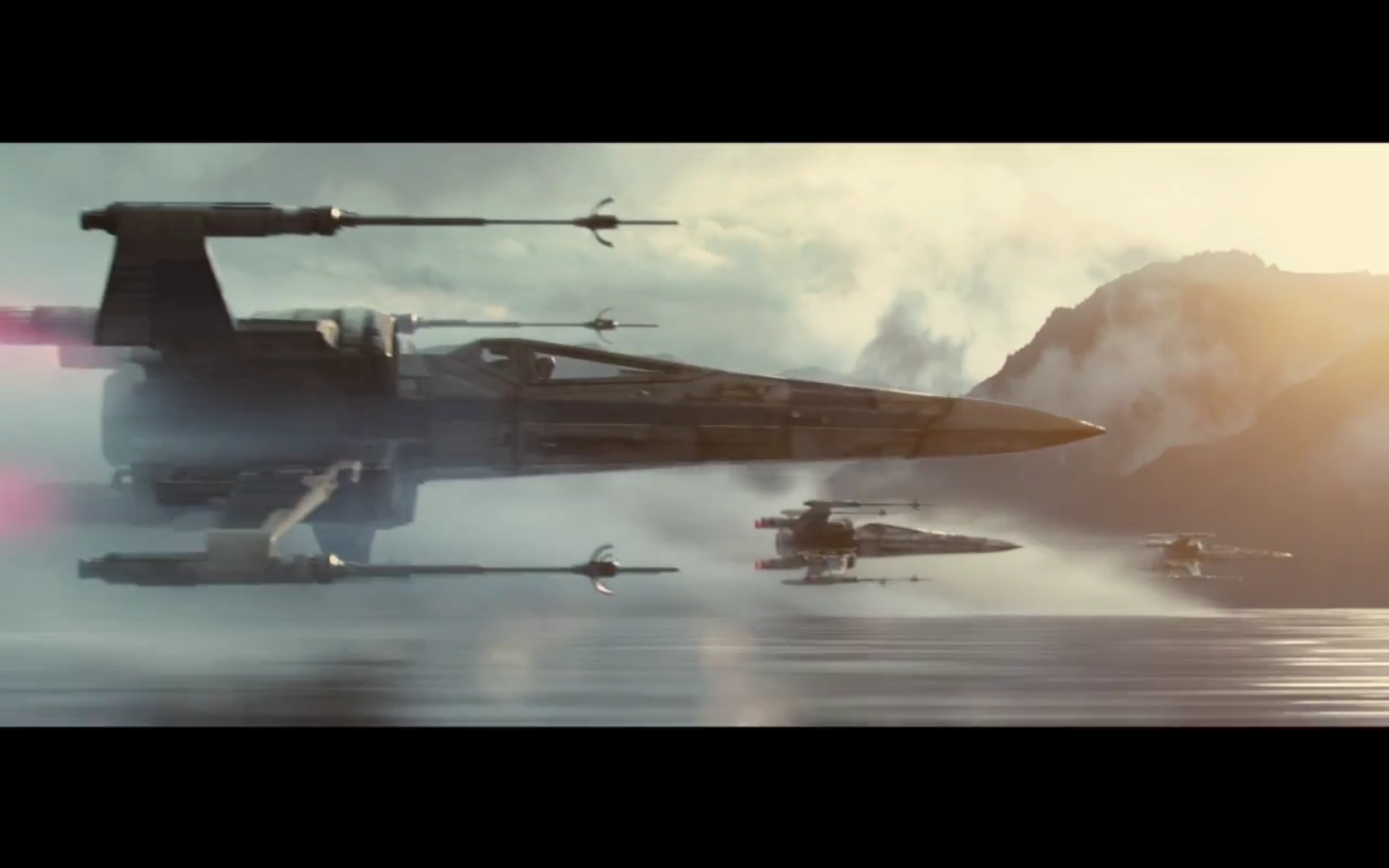
But the part of the trailer that really won me over was this part right here:Specifically, how realistic the X-Wings look. The way they kick up those clouds of water as they buzz the surface of that lake–you can’t deny, that’s pretty freaking awesome. My biggest running issue with the prequels was how they constantly abused my suspension of disbelief, so the fact that these X-Wings actually look real is perhaps the most promising part of the trailer for me.
Yes, the bad guy’s lightsaber with the dinky little lightsaber spurs looks … well, dinky. No argument there. But the last part, with the Millennium Falcon doing the crazy barrel roll as the music hits you with all of its glory–HOLY CRAP YES!!!!!
There’s not a whole lot of substance in this trailer. It’s only a tease–but wow, what a tease! I’d hate to get my hopes up only to have them dashed as badly as Episode I dashed them, but I’ve got to be honest: I’m actually kind of stoked for this movie now.
Episodes I, II, and III alienated a lot of the older fanbase, but it did appeal to the younger generation that came to the Star Wars universe without any preconceptions or expectations. Before I saw the trailer, I thought that Episode VII would simply continue that trend. Now, I actually think it may turn things around–bring back the old-school fans while showing the younger generation that Star Wars can be so much more.
 As clear as I can make it out, this is how it basically went down:
 Fandom (with a capital F) became decadent and corrupt as the Truefen jealously guarded their turf, creating all sorts of weird Hugo categories (“related work”? “short-form” editor vs. “long-form” editor?) and pushing back against the mainstreaming of the SF&F field. As a result, Worldcon went from the premier SF&F convention to a second-tier convention that falls well short of Dragoncon, Gencon, San Diego Comic Con, Salt Lake Comic Con and Fan Ex, etc, all of which are 1-2 orders of magnitude larger than Worldcon now. The once-prestigious Hugos were now decided by mere hundreds of votes.
 Then Episode I came out. Like all the other fans, I was super, super excited about it. Like all of the other fans, it was a huge disappointment. Several things ruined that movie for me, but the biggest were Jar-Jar Binks and midichloriens. The most magical aspect of the Star Wars universe, the Force, was singlehandedly ruined by the whole midichlorien thing, and as for Jar-Jar … I don’t even want to go there.
 To be fair, Episode II wasn’t nearly the disaster that Episode I was. Not that that’s saying much, but still, it wasn’t horrible–it was just bad. The romance was cringe-worthy, the pace was glacial, and the action sequences had too much flash and not enough substance.
 Then came Episode III, the final nail in the coffin for me. I can sum it all up in one word: “