Fantasy from A to Z: S is for Sanderson

Brandon Sanderson is, without a doubt, the most popular fantasy writer currently living and writing today. He is also one of the classiest and most gracious authors you will ever meet, in any genre. I’ve also got a personal connection to him, from taking his writing class at BYU.

Brandon decided to become a writer when he was very young. The way he explains it, the bug really bit him when he read Dragonsbane by Barbara Hambly. Depression runs in his family, and growing up, he always felt emotionally monotone and distant—until he read that book. From then on, he became obsessed with fantasy, both with reading and with writing it.

The way I heard Brandon explain it, that emotional monotone has been both a personal struggle and a great asset. It’s part of the reason he’s able to write so much, since where other writers tend to have huge emotional swings that affect their ability to write, Brandon is able to just sit down and do the work, day after day after day. It’s also part of what gives him an even keel that makes him such a gracious and generous person. Where other writers tend to get worked up on social media or join outrage mobs, Brandon avoids all of that. I don’t think I’ve ever seen or heard of him becoming outraged about anything.

Brandon was one of the last major authors to break into book publishing before the indie revolution began turning everything upside down. He broke in by researching agents and editors, attending all the important conferences, and networking with everyone who’s anyone in the genre. He also wrote a lot of really good books—as well as a lot of crappy ones. I believe that Elantris, his debut novel, was actually the sixth novel he wrote, and Mistborn: The Final Empire was something like the 13th. He landed his agent, Joshua Bilmes, from attending World Fantasy, and his agent eventually got him his publisher, Moshe, at Tor.

Elantris and Mistborn were good, but not immediate bestsellers. In fact, Brandon was on track to be an average mid-list fantasy author with a relatively unremarkable career, until Robert Jordan died, leaving the Wheel of Time unfinished. By that point, a lot of readers felt frustrated with the series and used his death as an opportunity to write scathing screeds about how it had gone off of the rails and grown far too bloated and large. But Brandon was much more classy and gracious than that, and wrote a tribute to the man instead, praising his work and the impact it had had on his life. When Robert Jordan’s widow read Brandon’s post, she decided that he was the one who should finish the Wheel of Time.

Personally, I’m not a huge Wheel of Time fan. I read the first three books and enjoyed them, but I got lost midway through the fourth book. My wife read them all and feels like the series is overrated, and I generally trust her judgment. But I can appreciate how a lot of people really love the series—and really, there is a lot to love. Just because it isn’t to my personal taste doesn’t mean that it isn’t good. 

My friends who are Wheel of Time fans tell me that Brandon not only finished the series—he rescued it. Apparently, the last three books rejuvenated the series, wrapping things up in an incredibly satisfying way. Of course, Brandon would defer and say that it wasn’t his genius that turned the series around, but Robert Jordan’s original vision and the detailed notes and outlines that Brandon followed. But there’s no denying that Brandon really stuck the landing.

It was around this point in the story that I met Brandon. I was a student at BYU at the time, and I had an opportunity to take his writing class. From the time when I was eight, I had wanted to be a writer, but I didn’t think I would ever turn it into a career. Brandon’s writing class changed all that, and helped me to see that I could pursue writing as a career. He also taught me the nuts and bolts of writing fiction, vastly improving my writing skills. I had started several novels in high school, but never finished anything until I took his class. And while my first finished novel was a disaster that I promptly locked in the trunk, my second novel attempt (which I started writing in Brandon’s class) ultimately became my debut, Genesis Earth.

(As a side note, my wife was also in that ‘08 class with Brandon Sanderson, though we didn’t actually meet each other until almost a decade later when we matched on Mutual. She also started a writing group with her college roommate, who won the Writers of the Future and married into Brandon Sanderson’s writing group. Our writing group has also got one of Brandon’s college roommates.)

Brandon’s success with Wheel of Time was what catapulted Brandon from a midlist author to a bestselling phenomenon. But even then, if he wrote at the same slow pace as most other fantasy authors, he would have forever been known as “the guy who finished Wheel of Time.” Instead, he became famous for writing and publishing massive +300k word doorstopper tomes at an unprecedented rate, leading fans to joke about his writing super powers. Then the pandemic happened, and he wrote four “secret” novels with all of the extra time he had from not traveling anywhere. The fans went crazy, and his kickstarter blew everything out of the water.

I haven’t read all of Brandon’s books. I really loved the Mistborn era I books, and the first Stormlight Archive book was good, but my favorite is Emperor’s Soul, because I think that Brandon is at his best when he writes shorter novels rather than the massive +300k word doorstopper tomes. In my experience, Brandon is a 3-star author who writes 5-star endings. His writing tends to meander, especially in the early middle, but around the 3/4ths mark there’s usually a twist that brings things together, and the conflict escalates consistently until it builds into a really satisfying ending.

Brandon is also known for his hard magic systems, which have become a signature trait of his books. Some readers feel that clearly explaining the rules of magic defeats the sense of wonder that a fantasy novel should have, but that’s not been my experience with his books. When I read a Brandon Sanderson novel, I feel almost like I’m reading a video game. Knowing the ins and outs of the magic helps me to see the possibilities for the characters to use it, and Brandon is usually really good at adding an unexpected twist, exploiting the rules of magic in a surprising yet inevitable way. This creates its own sense of wonder that really adds to his books.

Brandon also is known for how all of his books are tied together into the same transdimensional “cosmere” multiverse, though I actually think this is the least remarkable thing that makes his books so distinctive. For one thing, he’s not the first one to do it—David Gemmell also discretely linked all of his books, which blew my mind when I discovered that particular easter egg. For another thing, Brandon has turned his cosmere from a delightfully hidden easter egg and nod to the fans to the grand key that you must possess in order to understand and appreciate his later books. As a result, the cosmere is becoming an obstacle to new readers, even as his most ardent fans all swoon over the cosmere connections.

I think Brandon’s ultimate goal is to turn his books into a massive cinematic universe, kind of like the MCU. From what I understand, he was really close to signing a Hollywood deal, but it fell through at the last minute, leaving him back at square one (I don’t know all the details, though Jon Del Arroz did some interesting reporting on that). This is also probably why his books have become more woke in recent years. 

I’ve already written at length about that subject, so I won’t belabor the point here. But I really do feel that this represents a betrayal of his more conservative fans, many of whom turned to Brandon precisely because his books tend to be free of all of the gratuitous language and sexual content of most modern fantasy. Also, one of Brandon’s really great strengths during the gamergate and puppygate fannish controversies of the 2010s was his strict neutrality. While the culture wars were raging all around them, he continued to be his classy and gracious self, refraining from picking sides or wading into the mudfest. With the LGBTQ romantic subplot in Wind and Truth, that appears to have changed.

I hope he turns away from all of that. What the world really needs right now are books that transcend the whole woke vs. anti-woke divide, bringing us together and healing the artificial (and in many cases subversive) divisions that pit us against each other. Maybe Brandon will surprise me, and accomplish exactly that, just from the left side of the aisle. But as of Wind and Truth, I can’t help but wonder if we’ve reached peak Sanderson. Only time will tell.

Regardless, I will always be grateful to Brandon Sanderson for the things he taught me, and for all of his graciousness and generosity that he showed in his writing class. Without that experience, I probably would have pursued a different career, and not written nearly so many books. I also probably would not have married my wife, since one of the big things that drew her to me was my love and dedication to my writing craft. 
Fantasy from A to Z: M is for Magic

Magic! What would fantasy be without it? About the same place as science fiction if you took out the science. Speculative fiction is all about the sense of wonder that it makes you feel, and the main way that fantasy does that is through magic.

In Brandon Sanderson’s writing class (which he has generously made available to the public, by videotaping and podcasting his lectures), Sanderson divides magic into two broad types: hard magic and soft magic. And while some fantasy readers take issue with the way that Sanderson leans more toward hard magic in his own books, the division he draws between hard and soft magic is still quite useful.

Soft magic is the kind of magic that isn’t fully explained, and is mostly left up to the reader’s imagination. Magical things happen, and we don’t know how or why, but it helps to instill a feeling that the world is vast and wondrous. As such, soft magic is primarily used as a way to enhance the setting.

In Tolkien’s Lord of the Rings, a good example of this is the elves. We know that they are immortal and that they are far more glorious than most other races, but we never really know the full extent of their capabilities. Gandalf is another example of this. Just what was he doing with the Balrog, and how did defeating that ancient beast in a marathon spelunking-hiking-wrestling match? Who knows!

And that’s the biggest criticism of soft magic: if you don’t know how the magic works, how do you know that the heroes won’t just pull a rabbit out of their hat to save them at the last possible moment? Or summon the eagles, which amounts to the same thing. For that matter, if the eagles are so awesome, why don’t the heroes just fly on their backs all the way to Mount Doom? I mean, can you believe what it would have been like if they had to walk the entire way? Somebody might have died!

Hard magic, on the other hand, is the kind of magic where everything is explained. It’s not just magic, but a whole magic system, which operates by rules in the same way that our physical universe works according to rules. In essence, it is the fantasy inverse of Clarke’s third law, where any sufficiently explained magic is indistinguishable from science. The reader might not know all of the rules, but the writer does, and he drops enough hints throughout to make the reader confident that there are rules.

In Lord of the Rings, a good example of hard magic is the ring of power itself. What does it do? It makes you invisible if you put it on (though it makes you shine like a beacon to Sauron and his ringwraiths), and it tempts you with false promises of power, with the goal of leading you back into the clutches of Sauron. If Sauron ever gets the ring, it’s game over, because he will regain all of his powers. Oh, and it also stretches out your lifespan, at the cost of your quality of life (and quite possibly your sanity).

Because we know the rules the govern the magic of the one ring, we aren’t upset when Tolkien uses that magic to advance the plot of the book. Indeed, that is the biggest strength of hard magic: that it can be used in all sorts of interesting and creative ways to advance the plot.

“But hold on!” the advocates of soft magic will say. “If you reduce your magic into a fancy plot device, it kills the sense of wonder that comes with the best magic systems.” After all, there’s a reason why Tom Bombadil is in the book. There are two big things that happen when the hobbits make their detour to his house: first, Tom Bombadil puts on the ring and shows that it has absolutely no effect on him; and second, when Frodo puts on the ring and goes invisible, Tom Bombadil demonstrates that he can still see Frodo. 

It’s subtle, but it’s there—and believe it or not, it’s there for a reason. By demonstrating that there are higher or more powerful forces that can supersede the laws of magic surrounding the one ring, Tolkien preserves that sense of vastness and wonder that more rules-based magic systems tend to lose.

There is a rejoinder to that point, however. When hard magic is done well, it creates its own sense of wonder, more akin to what we feel when we’re playing a good video game. It’s the wonder that comes from imagining what it would be like to exercise the kind of magical powers that we see the characters exercise. Brandon Sanderson is a master of this, and my favorite example is from his novella The Emperor’s Soul. By the end of that book, I couldn’t help but daydream what I would do if I had my own set of soulstamps. One of them would make me an awesome writer, the other an awesome marketer, and the third an awesome publisher. How cool would that be? (Okay, maybe you have to be an indie author yourself to fully get it… but still!)

As you can probably guess, though, the best fantasy novels feature a blend of hard and soft magic—and Sanderson says as much in his lectures. There’s a reason why he draws from Lord of the Rings for examples of each, much as I’ve done here. And ultimately, it’s less of a binary and more of a spectrum. The important thing is to know when to lean more toward the soft side, and when to lean more to the hard side. The best authors can play to the strengths of both to capture that magical sense of wonder that makes fantasy such a pleasure to read.

Yes, Brandon Sanderson has gone woke

By his own admission, in his latest blog post: On Renarin and Rlain. He says the post is addressed “toward my more conservative readership.” However, he also calls himself “an ally to LGBT+ people” and boasts about writing the “first openly gay men [in] the Wheel of Time.” When discussing Christianity and his own Latter-day Saint faith, he makes repeated appeals to “empathy” and “respect,” without addressing the Bible’s clear condemnation of sexual sin. He also does not mention the Family Proclamation, which clearly lays out his own church’s position on homosexuality, transgenderism, and gay marriage.

In other words, Brandon basically told his conservative readers “I hear you, but you’re wrong.” He implies that any conservative Christian who has concerns with the gay romance in Wind and Truth is lacking in empathy and respect. He also implies that by voicing their concerns, they are dividing the world into “us” vs. “them” and betraying a key tenet of their own Christian faith.

If Brandon genuinely wanted to allay the concerns of his conservative readers, he would have acknowledged the Family Proclamation and Biblical standards of sexual morality. He would have discussed the gay romance of his latest book in the context of such standards. Then, he would have presented an argument similar to Andrew Klavan’s: that conservative art is not the same as conservative life. Good art must provide an honest and truthful representation of life. It should not glorify or promote those aspects of life that are evil. Brandon starts to make the first half of that argument, in discussing how Tracy Hickman portrayed gay characters in his books, but he fails to follow it up. He doesn’t explain how making a gay romance essential to the plot of Wind and Truth serves the good, the true, and the beautiful.

Brandon doesn’t seem to trust his conservative Christian readers to be able to separate the sin from the sinner. He also refuses to acknowledge the lived experience of his gay and lesbian readers who have chosen to live morally pure and faithful Christian lives. Like Brandon, I am a member of the Church of Jesus Christ of Latter-day Saints. Some of the most inspiring members of the church for me are those who struggle with same-gender attraction but still live true to their testimonies. I imagine it must feel pretty lonely at times like this, when their brother in Christ has chosen to side with those who preach the false gospel of pride, equity, and self-worship, instead of the gospel of the One who declared “Father, Thy will be done, and the glory be Thine forever.”

Has Brandon denied his faith? I’m not Brandon’s bishop, nor am I his eternal judge. It’s important to remember that the church is not a place for perfect people. I do think there ought to be a place in the church for self-described LGBT+ allies, so long as they sustain the leaders—and the doctrine—of the church. But if he hasn’t crossed the line, he’s certainly standing a lot closer to it than I ever would.

My personal testimony is that the Family Proclamation is inspired of God, and that the men who wrote and signed their names to it are prophets, seers, and revelators. It teaches true principles about the family and sexual morality. We are all children of God, gays and lesbians included, and that makes us all brothers and sisters regardless of how we choose to live. At the same time, Christ didn’t suffer and die for us so that we could continue in our sins. If the Family Proclamation is true, affirming homosexuality is not an act of love, no matter how empathetic it may be. Christ had empathy for the woman caught in adultery, but because He loved her, He also commanded her to “go, and sin no more.”

On a personal level, I feel frustrated and disappointed by Brandon’s recent turn. I count Brandon as an early mentor—in fact, it was Brandon’s class that inspired me to pursue writing as a career. I haven’t spoken with Brandon in years, but I do still count him as a friend. If I could sit down with him I would ask him about the people he’s surrounded himself with. They seem to be leading him in a bad direction, since he seems to have grown out of touch.

Has he betrayed his conservative readers? Yes, I think he has, and that he’s making a big mistake by doing so. One of the things that set him apart until now was the fact that his books are very clean. His fans may argue that Renarin and Rlain’s romance is also clean, but as a conservative reader, it feels more like a camel’s nose peeking under the tent. In a world of drag queen story hour, pornographic gay pride parades, and genital mutilation of children, is it even possible to have a clean gay romance? I think not. To paraphrase Brandon, as much as we may long for the days where there was no slippery slope, maybe that world never existed. Maybe there will always be an instinct to divide the world into the “clean” and the “queer.”

So let me just say this: whatever the stories that Brandon wants to tell, I can no longer trust that they’ll be the kind I’ll want to read. He could still turn around, of course, and I genuinely hope that he does. But reading between the lines, it seems that this turn toward the woke is not a new direction from him. It seems to be something that he’s contemplated for some time. I’ll still read the rest of his secret projects and keep my signed copies of the original Mistborn trilogy. But I’m going to DNF the Stormlight Archive, and probably won’t buy his future books.

Brandon ends his blog post by saying that one of his primary goals in life is to be more empathetic. This is what motivates him to write: because it’s how he explores the world. I, too, feel compelled to explore the world through my stories, but my primary goal is to pursue the truth. Those two goals aren’t always in conflict, but when they are, I think the pursuit of truth should be higher. The pursuit of truth ultimately leads us to love one another more fully and more meaningfully than the pursuit of empathy does. It saddens me that Brandon disagrees.

#GiveThanks Day Three

(30) My wife posted today that she’s grateful for Tillamook Mudslide ice cream. So am I!

(31) I’m grateful for the original Star Wars series for cultivating within me a deep and lifelong love for science fiction.

(32) I’m grateful for Michael Ende and his magnificent book The Neverending Story, which remains my favorite novel of all time, and showed me as a child just how powerful and moving a book can be.

(33) I’m grateful for Madeline L’Engle and A Wrinkle in Time for helping me to realize that one day, I would be a writer.

(34) I’m grateful for Ursula K. Le Guin and her masterful book The Dispossessed for showing me how the written word can make you feel you understand a fictional character from a completely alien culture better than you understand yourself.

(35) I’m grateful for Orson Scott Card and Ender’s Game for keeping me up until 4am and giving me one of the most incredible reading experiences of my life.

(36) I’m grateful for David Gemmell and his Drenai Series for moving me to tears with the inspiring heroism of his characters.

(37) I’m grateful for my childhood teachers who encouraged me to read and instilled in me a love of reading.

(38) I’m grateful for Terry Pratchett and his wonderfully entertaining Discworld books, which definitely helped me to become a funnier person.

(39) I’m grateful for Paperback Swap, which has been a wonderful tool for swapping books and building my personal library.

(40) I’m grateful for all of the wonderful books I have yet to discover.

(41) I’m grateful for Goodreads for helping me to organize and keep track of the books that I read, and to set reading goals.

(42) I’m grateful for the ability that I have to blog about my writing and my reading, something that didn’t really exist until just a couple of decades ago.

(43) I’m grateful for NaNoWriMo and the encouragement that it gives all of us to write things we didn’t think that we could.

(44) I’m grateful for Brandon Sanderson, his wonderful books, the positive influence that he is on the fantasy genre, and for the class he taught at BYU that both I and my wife were privileged to be able to take (though we didn’t know each other at the time).

2019-10-17 Newsletter Author’s Note

This author’s note originally appeared in the October 17th edition of my author newsletter. To subscribe to my newsletter, click here.

I had a major realization about my creative process while writing “Sex, Life, and Love under the Algorithms.” My original goal was to take a short break from The Stars of Redemption in order to work through a creative block. Instead, I came away with a plan that could revolutionize the way I write everything.

The major realization was that my natural writing length is between 10k and 30k words. When I try to write short stories, they tend to balloon very quickly into something longer. But when I try to write novels, I always run into a creative block somewhere in the middle, usually around the 30k-40k word mark.

This doesn’t mean that I can’t write novels; just that I have to find ways to work through this problem. I remember asking Brandon Sanderson a question about this ten years ago while taking his writing class:

Me: So I have this problem, where every time I try to write a novel, I always get stuck in the middle and have to put it aside for a few months before I can finish it.

Brandon: But you finish it, right?

Me: Uh, yeah. But—

Brandon: Then what’s the problem? So long as you end up with a finished novel, your creative process is still working. It might not work the same as someone else’s, but it works.

Ever since then, that’s basically been my process. I work on a novel until I hit a creative block, then lay it aside and pick up another half-finished novel and work on it until I either finish it or hit another creative block, at which point I lay it aside to work on something else.

But in 2017, I decided that wasn’t good enough. I wasn’t producing novels fast enough to keep up the rigorous release schedule that I needed in order to stay relevant in the indie publishing world. So over the course of the next two years, I developed an outlining method to write faster, cleaner, and more efficiently.

I’ve written three or four novels using this new method, and in spite of all my best efforts, I always find myself getting stuck somewhere in the middle—in other words, after surpassing my natural writing length. At the same time, I still haven’t managed to write more than 2-3 novels per year.

It’s very difficult to keep writing on something that won’t be finished for months when your sales are starting to flag and you know you need a new release to boost everything again. Some people thrive on that sort of pressure, but not me.

That’s why “Sex, Life, and Love under the Algorithms” was so refreshing to write. From start to finish, it only took a month to write (and the only reason it took that long was because I was taking it easy). No creative blocks. No long breaks. What’s more, I now have a story to submit to the major markets, or self-publish, or do whatever else I can think of to earn money and reach new readers.

This made me wonder: what if I could write all of my novels this way?

In the golden age of science fiction, there was this thing called the “stitched novel.” Most SF writers specialized in short stories, but found it much more difficult to write novels. The solution they found to this problem was to stitch together several short stories that took place in the same world, and turn that into a novel. Asimov’s Foundation books were written this way, for example.

What if, instead of stitching together a novel after the fact, I used my novel outlines to come up with short stories or novelettes that I could later assemble into a finished novel? Each story would be a complete story in itself, and I might only reuse half of it in the novel, or rewrite it from a different character’s point of view.

Not only would I avoid hitting creative blocks, but I’d also be able to get paid during the novel-writing process itself, and also have more frequent new releases. I would also have more material to submit to the major magazines and other traditional short story markets, potentially getting my name out that way.

To keep my readers from paying for the same story twice, whenever I self-published one of these stories, I would make it free for the first couple of weeks. I would also retire most of these stories after the novel itself came out, though I might use one or two of them to help promote it.

There are a couple of novels I still need to finish using the old method. The Stars of Redemption is one of them, and I should probably also finish the Twelfth Sword Trilogy before doing anything too experimental. But I have some new story ideas that could really work out well with this assembled novel technique. Also, I think it’s time to retire the Star Wanderers novellas and combine them into a single novel, which could serve as a proof-of-concept.

I have no idea if this plan will work or not, but I figure it’s worth a try. If breaking things down to my natural writing length enables me to write more novels in the long run, that would be fantastic. And if the quality of my novels goes up because the short stories help to flesh out things like character and setting, so much the better.

Life, the Universe, and Everything 2019

Life, the Universe, and Everything was this past weekend. It’s a local Utah convention with an academic flair, which means there’s a little less cosplaying and a lot of interesting and informative presentations, in addition to all the great panels. There’s also a strong writing and publishing track, though in recent years they’ve expanded the tracks on art, music, and film. Regardless, it all comes back to science fiction and fantasy.

I’ve been coming to LTUE for the last eleven years, and I think this was my favorite one yet! Part of that might have to do with the fact that future Mrs. Vasicek was there with me, but still. Lots of friends, lots of books, lots of panels, and lots of fun!

On Thursday, there was a really fascinating presentation on pre-modern methods of food preservation, such as pickling and fermentation. Really interesting stuff. Not only did we geek out on cheesemaking and sauerkraut recipes, but we also looked at how the production and supply of salt shaped trade routes, empires, and wars. It was extremely informative.

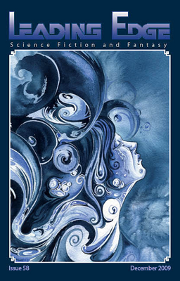
Since Thursday was Valentine’s Day, I picked out some chocolates and a copy of Leading Edge issue 58, where my first published work appeared. I was a bit worried that it would seem tacky, but some friends assured me that it wasn’t, and future Mrs. Vasicek seemed to really appreciate it.

There were a bunch of interesting panels on Friday. My favorite was probably the one on community building for creatives, with Sandra Tayler and M. Todd Gallowglass. They both had some very interesting stories and advice, as well as the other panelists. My biggest takeaway was that in order to build a community around my own work, I need to be a better participant in other creative and fan-based communities. Like LTUE, for example.

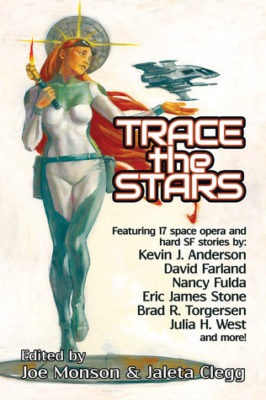
I also picked up a copy of the first LTUE benefit anthology, Trace the Stars. My mission for the rest of LTUE was to get as many authors from the anthology as I could find to sign it. Some of them weren’t there, but I did get most of the ones who were. One day, I’ll get all the signatures and turn it into a book of power! Wuah-haha!

The book signing was fairly low key. A lot of the big names didn’t show up, partly due to the weather, but there was still a good turnout. One of my very first fans who bought Desert Stars at my first ever book signing came over to chat. It was really good to catch up with him, and to let him know that I’m still writing and publishing.

There were a lot of really great panels on Saturday, on topics like surgery in space and what archaeology would look like on an artificially created world. Caught up with Eric James Stone and his wife Darci, who is a close friend of future Mrs. Vasicek. As we were all hanging out in the library, Brandon Sanderson walked up to say hi, and I was able to introduce future Mrs. Vasicek to him. We were actually both in Brandon’s class ten years ago, and didn’t know each other at the time. Brandon got a kick out of that.

My Saturday panels were very well attended and went off very well. The one on villains was particularly good, I think. There was just enough contrast in our viewpoints to keep it interesting without being too argumentative, and everyone had good points. When we made our plugs at the end, I urged everyone to subscribe to Pewdiepie, which got a kick out of the audience. I’m doing my part!

The panels were great, the banquet was great, catching up with old friends was also great. I may have spent a little more than my budget on books, but it was great to support my author friends, and I’m really looking forward to reading some great stuff!

All in all, another great year!

I’m engaged!

So a couple of days ago, I proposed to the girl I’ve been dating for the past few months. She’s pretty amazing. She’s currently at BYU, getting a masters in computer science. Where I make stuff up for a living, she actually makes stuff happen.

The funny thing is that we were both in Brandon Sanderson’s English 318R class back in 2009, even though we didn’t know each other at the time. She also lived in German house at the FLSR (Foreign Language Student Residence) during the summer I was on the Jordan study abroad. I lived in the Arabic house the year before and the year after. Also, after I came back from Jordan, she studied at the BYU Jerusalem Center.

So many near misses, but the way we actually met was through an online dating app. A couple of years ago, I wondered if I should try online dating, but I got this feeling like I should wait. Then around June of 2018, I got this feeling that the time had come to set up a profile and start looking around.

We started dating back in September, and decided to go exclusive after watching Venom (kind of a weird movie to cuddle together at, but still fun). I spent Thanksgiving and Christmas with her family in Provo, and apparently made a good impression. While playing a board game, her six year-old niece smiled at me and said “you’re my uncle!” to which I replied “not quite.”

Dating this girl has been a real adventure. Without getting into all the personal details, I can say that she’s got everything I’ve been looking for, and then some. On one of our earlier dates, we did an exercise where we each listed twenty things we wanted out of life, and five of those things were on both of our lists.

So yeah, she’s a keeper. I secretly met with her parents last weekend, and proposed on Tuesday. Nothing elaborate, just went on a walk around campus after eating lunch together. We’ve talked about getting married before, so after asking if there was anything else she felt we needed to talk about, I said “I can think of one thing,” got down on one knee, and took out the ring.

We’re planning to get married in June. My dad will be out of school by then, and hopefully my sister and her boyfriend will have their residency papers in Brazil figured out so that they can come. It feels like a long engagement period, and perhaps for a Latter-day Saint wedding it is, but I can be patient. Probably.

Good things are definitely happening!

Why writing every day may not be the best advice

When I started writing back in college, the prevailing advice was to write every day. And to be fair, at the time, that was very good advice. I was just getting started on my writing career and had a lot of learning to do. My writing improved by leaps and bounds as I strived to make progress on my WIPs every day.

Now, though, I’m not so sure that writing every day is the best thing to strive for.

It’s not that I’m against the idea of practice. Writing is one of those rare creative professions where people don’t think you get better the more you do it. Of course, that’s flat-out wrong. The best musicians put in hours and hours of practice, as do the best chess players, or the best soldiers, or the best sports stars. Writing is no different. If you don’t put in the time and effort, you won’t get the results.

At the same time, there’s a tendency among aspiring and even journeyman writers to become consumed with guilt because they missed their writing goal for the day. This is counterproductive. Goals don’t exist to give you satisfaction or guilt, but to give you direction. Satisfaction comes from what you achieve in pursuit of a goal, not in the goal itself.

So that’s one aspect of it. But there’s another aspect, and that’s how effective it is (or isn’t) to write every day.

Between high school and college, I worked as a gofer on a masonry crew. One of the things my boss used to say was “work smarter, not harder.” He often said it rather tongue-in-cheek, but it’s still an important concept. It doesn’t matter how hard you work if you’re doing it wrong.

This applies to writing as well. What does it matter that you write every day, if you’re just going to throw out most of it anyway? Is that really the best use of your time and energy? If by taking a week to establish things like plot, character, world-building, etc, you could write a much cleaner and better first draft, does it matter that you technically weren’t writing every day during that week?

Write smarter, not harder.

Now, I’m very glad that I did write every day back when I was starting out. My first (and possibly my second) million words were mostly crap, so it was better to put in the time and get through it as quickly as possible, just for the learning and growth.

But now that I’m an established journeyman writer, I find that the results are much better if I take the time to do some basic prewriting before I attack the first page. My first drafts are cleaner. The story comes together easier, with fewer problems. I don’t have to do “triage” revisions, where I’m throwing out characters, subplots, or even major plot points simply because they don’t work.

In Brandon Sanderson’s writing class, I once asked what I needed to change so that I could write my WIPs straight through without getting stuck in the middle. Brandon asked me if I was still finishing them, and when I said yes, he basically said don’t worry about it. That was good advice then, but it isn’t anymore. I’ve reached the point where writing smarter is more important than writing harder.

Anyway, those are my thoughts at the moment. Things change a lot when you’ve been writing for 10+ years, and unlike all the resources available for aspiring writers, there isn’t a whole lot of stuff out there to help guide you through the later phases. I’m basically figuring it out as I go.

So it’s the middle of June, and I really should have finished Patriots in Retreat by now, but it’s been difficult to stick to any kind of writing routine, and the story is at that place where everything seems broken and writing through it is like slogging through a swamp.

Call me crazy, but I’m starting to think that’s not healthy. In Brandon Sanderson’s English 318R class at BYU, he always said the most important thing was to power through and just finish the damn thing–that you can always go back and “fix it in post”–but while that’s good advice for a new writer who hasn’t ever finished anything, I don’t think it works very well for my own writing process.

I think that what I need to do is take every weekend to cycle through the entire story from the beginning, not necessarily to rewrite it all, but to bring it into line with the stuff that unfolds later. Invariably, when I get to the three quarters mark of my WIP, it feels like the whole thing is barely holding together and that I’m writing myself into a train wreck.

For the last several years, I’ve tried to just write through that, only for one of two things to happen: either something else catches my interest and I decide to put the WIP on the back burner for a while, or it actually does turn into a train wreck and I have to set it on the back burner for a while in order to approach it with a new set of eyes.

Needless to say, neither of those outcomes is very productive.

Now, I don’t think Patriots in Retreat is broken. I think there’s actually a really good story in there, but it needs a little more excavation in certain parts before I can pull the whole thing out in one piece. This was my first time in years experimenting with the cycling process, and I don’t think I did it enough. Next WIP will be another experiment.

Long story short, I will probably have to push this one back another two weeks, which is going to push the release schedule for Sons of the Starfarers back another month. I’ve got another short story I can use to fill in the gap, but it is a bit of a personal disappointment.

Why is it so difficult to keep my own self-imposed deadlines? Am I really that flaky and unreliable? Not in other aspects of my life. Maybe my writing process really does need a complete and fundamental overhaul. Should make for some interesting future posts.

In any case, that’s what I’ve been up to. I really really really want to write a couple of short stories in a universe that may turn into a recurring one, but those will have to wait until Patriots is finished (hopefully early next week). On the publishing side of things, I’ve got a new short story and short story bundle out—more on that tomorrow! Lots of other stuff too, but it’s mostly behind the scenes, so not worth talking much about atm.

Patriots in Retreat will be finished soon, it’s just in the “this sucks and I’m a horrible writer!” phase. Which, hopefully, I’ll find a way to remove from my writing process altogether, because it isn’t healthy. When I figure out how to do that, I’ll let you know.

Guest Lecture to Brandon Sanderson’s English 318R class

A couple of weeks ago, I gave a guest lecture to Brandon Sanderson’s English 318R class at Brigham Young University. I was one of Brandon’s students back in 2008, and he wanted me to talk about my experiences as a self-published indie writer. The lecture wasn’t recorded this year, but here is a rough outline from my notes. Enjoy!


How many of you know for sure that you want to write fiction professionally? (about half) How many of you know enjoy writing as a hobby, but know that you don’t want to do it professionally? (a handful) How many of you aren’t yet sure? (the vast majority)

Eight years ago, I was where you are today: sitting in Brandon Sanderson’s class, wondering if I should turn pursue this writing thing as a career. Back then, self-publishing was the kiss of death. If you self-published any of your books, you would never be taken seriously by anyone in the publishing world again. They would treat you like the kid who ate the paste in kindergarten.

You see, back then there was a very strict and well-defined path to get published. First, you wrote query letters to agents. You did not write them to editors, because none of them accepted unsolicited submissions, and submitting to them directly was bad form. You had to personalize your query letter for the agent you were submitting it to. You had to spend almost as much time revising and reworking your query letter as you did on your manuscript.

If you were lucky enough to get picked up by an agent, they would (hopefully) get you a publisher. If you were lucky enough to get a publisher, they would (hopefully) get you into bookstores. And if your books got into bookstores, you would (hopefully) get readers. Get enough readers, and you’d be swimming in caviar, having dinner parties with Castle as a bestselling author. That was the dream.

After taking Brandon’s class, I decided to pursue writing as a full-time career. I graduated in 2010 and immediately faced a dilemma. The Great Recession made it virtually impossible to find a day job, so I had to figure out how to make the writing thing work. Writing was my plan A, and there was no plan B.

Brandon Sanderson had taught us to attend the major conventions, where we could rub shoulders with the bigwigs in publishing and maybe score a book deal through networking connections. But when I attended World Fantasy in 2010, I noticed a couple of things that were disconcerting. First, there were a lot of other aspiring authors trying to rub shoulders, many of whom were more aggressive about it than I was. Second, none of the major publishers seemed to want the stuff that I was writing (far future space opera and military SF).

Brandon’s advice, I realized, basically amounted to “if you want to get struck by lightning, wave a metal pole from the rooftop while standing in a bucket and shouting at the wind.” Which is good advice if there’s a thunderstorm. But it’s not so good on a clear and sunny day, and since none of the major publishers seemed to want the kind of science fiction I was writing, I realized I would have to find another way.

I kept trudging along, writing more books and querying agents (most of whom never responded). Then I submitted my novel Genesis Earth to the Amazon Breakthrough Novel Award contest. To my surprise, it passed the first two rounds of voting and became a quarter-finalist. It looked like this could be my lucky ticket into the world of publishing.

Around this same time, Amanda Hocking became one of the first self-published writers to sell more than a million books on Amazon. When she did that, it made me sit up and take notice. Here was a twenty-something aspiring writer just like me, who had decided to eat the paste and do the thing that you were never supposed to do. Instead of failing at it, though, she made it big. What was going on here?

I began to re-examine the traditional path to publishing that before had seemed so sure. I started following Dean Wesley Smith and Kristine Katherine Rusch, Joe Konrath, David Gaughran, The Passive Voice, and a bunch of others who were breaking out of the mold. I questioned the established wisdom, and started to find all sorts of inconsistencies in what I had always believed.

For example, why has the slushpile been outsourced to agents if they aren’t getting paid for it? Is an agent really going to go up to bat for you if you only represent an income stream of a couple hundred dollars for them? Why should publishers take 75% of net for the lifetime of the book for something that you can do on your PC in a couple of hours with open-source software?

In the Writer > Agent > Publisher > Bookstore > Reader value chain, there are really only two people that matter: writers and readers. Everyone else is a middleman. In the traditional publishing model, however, the bookstore takes half, the publisher takes most of the rest, and the agent takes a 15% cut of whatever you make. Most books never earn out their advance, and most book advances for SF&F are $5,000 or less!

As I was sorting through all of this, I heard back from the Amazon Breakthrough Novel Award contest. Genesis Earth had not made it past the quarterfinal stage. The review from Publisher’s Weekly read like someone had handed the manuscript off to an unpaid intern and said “here’s one of the books that didn’t make it past the quarterfinals, write a half-assed review that makes us look good so we can fulfill our contractual obligations to the contest.” It was clear from the review that the person at PW didn’t even read science fiction.

It was at that point that I realized I didn’t want to win the publishing lottery or be struck by publisher lightning. I wanted to build a career.

Now that I’m self-published, am I swimming in caviar or having dinner parties with Castle? Hardly—or at least, not yet. There’s nothing about self-publishing that makes it easier or less work than the traditional publishing path. But it does give you a lot more control, and a lot more ownership over your successes and failures.

My first year of self-publishing, I put a lot of money into my first couple of novels and published them to a resounding chorus of crickets. In my second and third year I wised up a bit, wrote a series of short novellas, published them on a shoestring budget, and made the first one permanently free. Sales began to rise, and I went from making pizza money to learning just how much it sucks to pay self-employment taxes.

Ever since then, I have been running a profitable business. Of course, it’s had its ups and downs, but even in the bad months, it’s made more money than it’s cost.

In fact, my second and third years were successful enough that in 2014, I made enough to support myself on my writing income alone. It was then that I learned one of my most important lessons: that you always need to have an impossible dream to strive for. Up until that point, my impossible dream was to make a living telling stories that I love. When I found I had achieved that, I lost direction and went into a writing slump that lasted the better part of a year.

One of the other important lessons I learned was not to underestimate the importance of marketing. When Amazon rolled out their Kindle Unlimited program, my sales took a major hit because Amazon’s algorithms started prioritizing KU books over non-KU books. Until that point, I’d been relying almost totally on Amazon to market my books for me, which was a major mistake.

My biggest mistake, though, was to underprice my books, which I did for the better part of 2015. In order to push sales of my other series, I dropped the prices of all my Star Wanderers novellas to $.99. It backfired spectacularly. I did glean a lot of data from it, however, and learned that the best price points for my own books was between $2.99 and $3.99. The $.99 price point did not see enough of an increase in sales to offset the lower royalty, or lead to any noticeable increase in my other books. However, the $3.99 price point did see increased sales and revenue compared to $4.99 and $5.99.

As you can probably tell, self-publishing is the sort of thing you learn how to do as you’re doing it. There is no clear path, no one true way to success. But I’ve learned a lot over the past few years, and I’ve seen my sales and readership grow from it. I’m no longer as worried about my future as I was back in 2010, because I know that I can make it work. And if you’re willing to put in the effort and learn from your experiences, you can too.

I sincerely believe that this is the best time in history to be a writer and a reader. There are so many publishing opportunities available to us now that would have been unthinkable just a generation ago, and this has led to an explosion of fantastic new books that would have never gotten published under the old system.

So is it possible to make a living as a self-published writer? Yes! It’s not easy to make your own path, but it’s definitely possible to do it and find success. So set your sights on an impossible dream, and when you’ve achieved it, find another one. When you have nothing to lose and everything to gain, don’t let your fears hold you back.