2020-02-20 Newsletter Author’s Note: Thoughts on the History and Future of Science Fiction (Part 1)

This author’s note originally appeared in the February 20th edition of my newsletter. To sign up for my author newsletter, click here.

One of the projects I hope to get to someday is to make a podcast on the history of science fiction. I’m a huge fan of podcasts, and subscribe to almost 100 of them, and some of my favorites are history podcasts like Hardcore History, History of Rome, Revolutions, The Cold War: What We Saw, etc. At this point in my life, I don’t think it’s the right time to get into podcasting, but at some point in the next few years I’d really like to try my hand at it.

I have thought a lot about what this History of Science Fiction podcast would look like, though, and it’s led to some interesting thoughts about the future direction of the genre. Let me explain.

Modern science fiction began with Mary Shelley’s Frankenstein, which laid the groundwork for just about everything else. Authors like Jules Verne and H.G. Wells picked up the torch, launching “scientific romance” as its own literary genre. Many of the conventions and tropes of science fiction were set during this era, which lasted from the 1820s through the early 1900s.

The next major era of science fiction was the era of the pulps, which experienced its heyday in the 1920s and 30s. The publishing innovations that had made the penny dreadfuls possible only a generation earlier now led to a proliferation of novels and short story magazines, opening up all sorts of opportunities for new writers.

This was the era of bug-eyed aliens and scantily-clothed damsels in distress, as frequently displayed in the cover art. Science fiction, mystery, western, adventure, and true crime stories were all mashed up together. Major names from this era include Edgar Rice Burroughs and Hugo Gernsback, who coined the term “scientifiction” to distinguish the stories that would later be called under the name “science fiction.”

The pulps laid the groundwork for the golden age, which lasted through the 40s and 50s. It was greatly influenced by John Campbell’s tenure as editor of Astounding Science Fiction, and the authors that he mentored. This was when science fiction really came into its own. Major authors from this era include Isaac Asimov, Robert A. Heinlein, Arthur C. Clarke, George Orwell, and Ray Bradbury.

The next major era was the New Wave, when authors like Ursula K. Le Guin, Michael Moorcock, Frank Herbert, and Phillip K. Dick broke out of the conventions established by Campbell and other golden age figures, experimenting with new styles and creating new tropes. This was when we began to distinguish between “hard” science fiction that revolved around the hard sciences like physics and math, and “soft” science fiction that revolved instead around things like political science and social studies. The political radicalism of the 60s and 70s also influenced the science fiction of this era.

At this point, most histories of science fiction point to an era called “cyberpunk” or “the digital age,” which emerged in the 80s and defines the period that we’re currently living through. However, I don’t think this is correct. Instead, I think that literary science fiction went through a dark age from the mid-80s to the late 00s, and only recently began to emerge from it. Let me explain.

In film, TV, and video games, the 80s and 90s were a golden age. For books, however, it was exactly the opposite. The rise of the big box stores like Borders and Barnes & Noble drove independent booksellers out of business, which caused many local distribution companies to collapse. This, in turn, led to a period of mergers and consolidation within the publishing industry, giving rise to the “big six”: Hachette, HarperCollins, Macmillan, Penguin, Random House, and Simon & Schuster.

At the same time, the rise of the internet led to a massive and precipitous decline across newspapers and periodicals, including traditional short story magazines such as Analog and Asimov’s. Most of the science fiction magazines folded, unable to adapt their business models to the changing world. This would later change as podcasting and crowdfunding, but before those innovations would later revolutionize the industry, many considered short stories to be dead.

The effect of all of this was that literary science fiction entered a period of managed (and sometimes catastrophic) decline. As the publishing houses merged and consolidated, their offices all moved to New York City in order to pool talent and resources into one geographic center. However, this also led to problems like groupthink as publishing fell in an echo chamber.

Science fiction began to balkanize. The proliferation of cyberpunk, steampunk, deiselpunk, biopunk, and all the other _____punk subgenres is emblematic of this. Furthermore, as all of the major editors became caught up in the echo chambers of progressive, blue-state politics, they increasingly overlooked red state authors from “flyover country.” Baen, whose offices are in North Carolina, has never suffered from this, but Tor and the other New York publishers really have.

I think Orson Scott Card really bookends this period. In the 80s, he was the first author to win the Hugo and the Nebula in the same year. In the 00s, he was all but excommunicated from the canon for his allegedly homophobic views. Science fiction had transformed from the big tent genre of the 50s, 60s, and 70s to something so balkanized, elitist, and radical that “wrongthink” had unironically become a crime in the very genre that had invented the term.

And then indie publishing happened.

This author’s note is getting long, and there are other things (including writing) that I have to do today, so I’ll have to end on that note. I’ll follow up in my next newsletter with my thoughts on current trends in the science fiction genre, and where we’re heading from here. I think the 20s will see some massive creative destruction, but ultimately I’m hopeful that the best is yet to come. The dark age is over, and there’s never been a better time to be a reader—or a writer!

Plans for My Personal Home Library

If everyone has a weird or quirky super power, mine is the ability to acquire books. Even when I was living out of a suitcase in a remote Caucasian village, or traipsing across the Middle East, I was constantly acquiring books.

With my marriage to Future Mrs. Vasicek coming up, I’ve decided to put this super power to use. Instead of acquiring books randomly, I’m approaching the task of building a personal library with goals and a plan. Part of that plan is to inventory all of the books that I own, with lists of books / ebooks / audiobooks that I want to acquire. Part of it is to find a place in my home where I can shelve them all, instead of keeping them in boxes or the closet. And another part is categorizing all of the books, with goals for each category.

Requirements

After putting some thought into it, here are my basic requirements:

  • The entire library must fit in a single room / device / server.
  • The only books that I’ll keep are ones that:
    • I want to read again,
    • I want to talk about with others, or
    • I want to share with my family.
  • Ebooks and audiobooks must be DRM-free and device agnostic.

A while ago, I did a blog post on the pros and cons between print books, ebooks, and audiobooks. That seems to be a pretty good set of criteria for determining which formats to collect my books in, or whether to collect a particular book in multiple formats.

Ideally, I want to set up my personal library in a shared space in my home, where I can host guests. Future Mrs. Vasicek and I are going to get a set of scriptures, kind of like the tradition of a family bible, and I want this to be the centerpiece of my personal library. Eventually, I also want to get a dedicated ereader (or set of ereaders) that lives in the library, as well as a portable hard drive for all of the audiobooks. I don’t want any of it to depend on the cloud.

Categories

So far, I’ve got eight categories, though I’m sure this will expand. They are:

  1. Science fiction & fantasy
  2. Other fiction
  3. LDS non-fiction
  4. Self-improvement
  5. Writing & publishing
  6. Arabic language
  7. History & current events
  8. Other non-fiction

I have a lot more fiction books than non-fiction (go figure). For now, I’m using Goodreads as a library inventory system, though I may want to find something better in the future. If you check out my Goodreads profile, you can probably see all of them.

I’m working to come up with goals and plans for each category. Here’s what I have so far:

Science Fiction & Fantasy

My main goal here is to collect the complete works of David Gemmell. He is my favorite fantasy writer of all time, and I’ve read all of the Drenai series and most of the Stones of Power and the Rigante series as well. I’m holding off on the Troy books, mostly because I want to savor them. He’s also got a few standalones and duologies, most of which I’ve read.

Other series that I want to collect in print are:

  • Louis McMaster Bujold’s Vorkosigan series
  • All of Heinlein’s juveniles
  • The Barsoom series by Edgar Rice Burroughs (Princess of Mars, etc)
  • Ursula K. Le Guin’s Hainish cycle
  • All of the books by my writer friends

There are also a bazillion trilogies that I either own or want to collect, but it’s not worth listing them all here. I’m sure this is going to be a very dynamic part of my personal library.

Other Fiction

My main goal for this section right now is to collect all of the Sackett books by Louis L’Amour. There are only two left, both of which I’ve requested on Paperback Swap. Now I get to read them all, without any interruption!

I also plan to focus on collecting Jeff Shaara, especially the Civil War books. I currently have The Killer Angels by his father, as well as Gods and Generals and The Last Full Measure. But before that, I need to read Rise to Rebellion and The Glorious Cause, which I also own (those ones cover the Revolutionary War). Depending on how much I enjoy those, I’ll decide whether to collect Shaara’s complete works.

LDS Non-fiction

There are a tone of authors that I want to collect in this section: Nibley, Givens, Gileadi, Groberg, and more. There are also a few key books that I need to acquire and read, mostly biographies and church histories.

One series that I’m really looking forward to is the four book SAINTS series published by the church. The first book was fantastic; I listened to the whole thing on the train, and it was really cool to pick out the people from my own family history and learn how they contributed to the rise of the church. The next book is going to cover the westward migration, and I have a bunch of ancestors who participated in that, including a few in the Willie handcart company. Really looking forward to it!

Here in Utah, it isn’t difficult to collect LDS non-fiction books. You can find most of the older titles in thrift stores, and there are lots of LDS bookstores to choose from. That said, I don’t have any concrete goals for this section yet. The biggest challenge will probably be in refining this section so that I only keep the best books (ha), since it would be very easy to let this section get cluttered with good but mediocre books. That seems to be the general trend.

Self-Improvement

The biggest thing I need to do in this section is reread How to Win Friends and Influence People, preferably once a year. Fantastic book.

I should also probably focus on marriage and relationship books, since y’know, I’m getting married. Personal finance is also huge: I’ve got Rich Dad, Poor Dad, and should probably collect all of Kiyosaki’s books. Stephen Covey is another huge one.

Beyond that, my cowriter Scott Bascom is really into self-improvement, so my plan for now is to build out this section based on his recommendations.

Writing & Publishing

There are a few classics that I need to re-acquire, such as Character and Viewpoint and On Writing. One classic that I will probably skip is Strunk & White’s Elements of Style (can’t stand that pretentious book). Other than that, the biggest thing is to stay current and focus on indie publishing. For that reason, I suspect that I’ll collect mostly ebooks in this section.

Arabic Language

My main goal here is to read The Book of Mormon (كتاب مورمون) in Arabic. I also have plans to study the Qur’an, though that’s not a priority at the moment.

Most of these books are ones that I acquired while studying Arabic in Jordan. I don’t think I’ll acquire many more anytime soon, though if an opportunity arises, I probably won’t turn it down. The big question in my mind is whether to expand this section to Arabic language & culture, since I do have a bunch of English books on the Middle East.

History & Current Events

My biggest goal for this section is to build a collection of monetary & financial books that together make a complete history of the United States. This subject is my current pet interest, much to Future Mrs. Vasicek’s chagrin. I also have plans for a coin collection / history that I’m currently writing, though that’s on the back burner for now.

Other than that, I plan to focus on book recommendations by Ben Shapiro and Glenn Beck.

Other non-fiction

No real goals yet for this section. At some point, I will probably spin off family histories as a separate category, since there are a lot of them in my family.

General Goals

The biggest thing I need to do is read every book that I own. I may be really good at acquiring books, but I’m not as good at actually reading them. Currently, I’ve read only about 20% of them.

When will I have them all read by? Ideally, the end of the year, but I doubt that’s going to happen. Then again, if I can keep my goal to read for an hour or two each night, a year might just be enough.

Since the library is constantly growing, though, I suspect this will be more of an aspirational goal, or a moving target. Even when I manage to hit it, it probably won’t take long before I acquire more books and have more reading to do again.

The next big goal is to find a place for all these books, which probably won’t happen until after Future Mrs. Vasicek and I are married. At which point, all of these plans may change, since she has a bunch of books too—but probably not too much. We’ve talked about it, and it shouldn’t be too hard to merge our books into one family library, if that is what we decide to do.

Aside from that, I’d like to get as many books signed and personalized as I can. Shouldn’t be too hard: just look up the guest list of any convention I’m attending, and bring the books along.


That’s basically the plan as it stands right now. With my quirky super power for acquiring books, it shouldn’t take long to build an epic personal/family library.

Y is for Yesteryear

Star_wars_oldThey say that the golden age of science fiction is about twelve years old.  That’s definitely true for me.

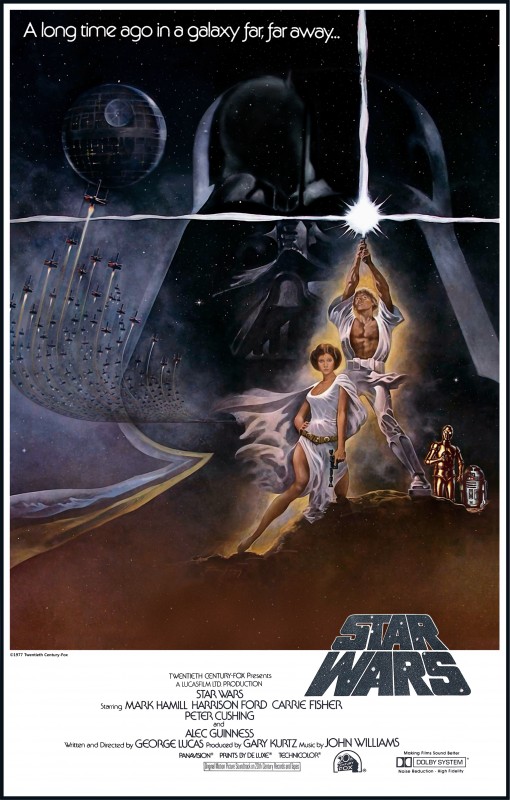
My first exposure to the genre was Star Wars: A New Hope.  I saw it when I was seven, right around the height of my dinosaur phase.  Everything about the movie completely blew me away, from the Jawas and Sand People of Tatooine to the stormtrooper gunfights and lightsaber duels.  After watching Luke blow up the Death Star, I spent the next few hours running around the yard pretending to fly my own starfighter.

In a lot of ways, I’ve never really stopped.

My parents made me wait until I was nine to watch The Empire Strikes back, because it was rated PG.  Without any exaggeration, I can say that those were the longest two years of my life.  I was literally counting down days by the end, and to pass the time without going crazy, I read up on all the books about space that I could possibly find.

My father bought the original X-wing flight simulator game somewhere around then, and I soon became totally engrossed in it.  Since the 386 was our only entertainment system (no Super Nintendo–I had to visit a friend’s house for that), X-wing became the defining game of my childhood.  I spent hours and hours on that game, to the point where I knew exactly which simulated missions the characters from the books were flying and how to complete them faster and easier.

I thought The Empire Strikes Back was a little slow the first time I saw it, but it’s since grown on me, to the point where now it’s my favorite film in the whole series.  Thankfully, my parents let me watch Return of the Jedi the next day, and for the next few months my life felt utterly complete.

Around this time I discovered the Star Wars novels and soon immersed myself in them.  The Courtship of Princess Leia by Dave Wolverton soon became one of my favorites, as well as the Heir to the Empire trilogy by Timothy Zahn and the X-wing series by Michael A. Stackpole.

But it was Roger Allen McBride who first introduced me to a different flavor of science fiction with his Corellia trilogy.  As I mentioned in V is for Vast, those books had just enough of a touch of hard science to intrigue me about the other possibilities of the genre.  That was the last Star Wars series that I read before branching out into other works of science fiction.

The Tripod trilogy by John Christopher was my first introduction to the dystopian / post-apocalyptic genre, depicting an enslaved humanity after an alien invasion.  Those books really captured my imagination for a while.  The Giver was also quite interesting and thought provoking, though since it didn’t involve spaceships or aliens it wasn’t nearly as compelling.

I read a lot of fantasy in my early high school years, including Tracy Hickman, Lloyd Alexander, and (of course) J.R.R. Tolkien.  While I enjoyed those books and immersed myself in them for a while, my true love was still science fiction.  For almost a year, I watched Star Trek: Voyager religiously with my dad.  And every now and again, I’d pick out a science fiction book from the local town library and give it a try.  That’s how I discovered Frank Herbert’s Dune.

In eleventh grade, my English teacher had us choose an author and focus our term papers solely on their books for the entire year.  She suggested I choose Orson Scott Card, but I chose Cormac McCarthy instead.  I’m not sure if that was the worst decision of my high school career, or the best decision, since assigned high school reading tends to make any book feel like it sucks.  I discovered Ender’s Game the following summer, and finished it in a delirious rush at 3am the morning after checking it out from the local library.

More than any other book, Ender’s Game cemented my love for the genre, and showed me just how powerful and moving the genre could be.  It opened so many insights into the world and human nature, reading that book made me feel like I’d opened a pair of eyes that I didn’t even know I’d had.  Looking back, that was probably the moment when I knew I would be a science fiction writer.  I’d known I was going to be a writer ever since I read A Wrinkle in Time at age eight, but to be a science fiction writer specifically, that goal was probably cemented by reading Orson Scott Card.

After high school, I served a two year mission for my church, during which I didn’t read any novels or watch any TV or movies.  When I came back, though, Orson Scott Card and Madeline L’Engle helped me to ease through the awkwardness of adjusting back to normal civilian life.  When I left for college, I expanded my horizons even further, starting with Isaac Asimov’s Foundation series and Edgar Rice Burrough’s Princess of Mars.

When I discovered Pioneer Books in downtown Provo, I knew I’d found my favorite bookstore in Utah Valley.  I have so many fond memories sitting cross-legged on the floor in the science fiction section, browsing through the musty used books for hours at a time.  That’s where I discovered C.J. Cherryh, Arthur C. Clarke, Robert A. Heinlein, Ursula K. Le Guin, and numerous other authors who are among my favorites today.

When I discovered Spin, Robert Charles Wilson soon became one of my favorites.  I picked up that novel as a free PDF from Tor, and read it over the summer while studying abroad in Jordan.  Once again, that same hard sf sensibility I’d gotten from Roger Allen McBride touched me in an unforgettable way.  But it was the human element of that book that really moved me–in fact, it’s always been about the human element.  The world building in Downbelow Station was great and all, but the romance of Merchanter’s Luck had a much more lasting impact.  Starship Troopers had some good ideas, but it was Mandella’s personal journey in The Forever War that moved me almost to tears.  The intrigue of the Ender’s Shadow series was quite entertaining, but it was Ender’s Game and Speaker for the Dead that really taught me what it means to be human.

I finished my first novel, Genesis Earth, shortly after returning from that study abroad, and tried to capture the same sensibility from Spin as well as the intimately human element.  Since then, I’ve written several more sci-fi novels, some of them tragic, some triumphant, but in all of them I’ve tried to get as close as I can to the personal lives of the characters.  I don’t know if I’ll ever write a character portrait so intimate as Shevek’s in Ursula K. Le Guin’s The Dispossessed, but I certainly hope to someday.

For me, science fiction started out as a wonderfully exciting entertainment and turned into something much more meaningful.  If there’s anything the genre has taught me, though, it’s that the two aren’t mutually exclusive–that you can have your adventure and learn what it means to be human as well.  Indeed, the more imaginative the adventure, the greater the truths I’ve taken from it.

Because of that, even though I’m almost in my thirties now, I can’t possibly foresee a time when science fiction isn’t a major part of my life.  It’s a love affair that’s grown just as much as I have, and continues to grow with each new author I discover and each new book I write.  When I’m old and grizzled and pushing eighty, I’m sure there will still be a part of that twelve year old boy in me, still running around the yard flying his starship.

I have a confession…

…I’ve started writing a Sword & Planet story.

In case you’re wondering what the heck is Sword & Planet, think Conan the Barbarian in space.  With giant lizards and man-eating plants.  And half-naked princesses getting kidnapped by evil technomancers with giant four-armed bodyguards that wield laser-bladed swords.  Basically, science fiction in the style of the classic 20s pulp adventure novels.

In other words, this:

I’ve read a lot more Heroic Fantasy and Sword & Sorcery than straight Sword & Planet, but I figure there’s a good deal of overlap.  I read A Princess of Mars way back in college and really enjoyed it, and of course I’m a huge fan of Star Wars and other series that were heavily influenced by the genre.  Basically, I want to try my hand at a classic science fiction adventure style, without the scientific rigor of Hard SF or the sprawling world building of Space Opera.  It’s all about the adventure, with liberal helpings of awesome sprinkled with omigoshomigoshomigosh.

The tentative title for this book is The Last Warrior Princess, though it’s about a twenty-something college grad working a wilderness job in southern Utah who accidentally finds a portal to another world while wandering around Arches National Monument.  The princess comes later, though not too much later.  I don’t know much about her yet.

In fact, I don’t know much about the story at all.  I’m discovery writing everything, and I do mean everything.  This is a fly-by-your-pants ready-set-go kind of book, with no restrictions and no limits–just me and the muse, not caring what anyone else thinks.  My internal editor is bound and gagged in the cellar with the spiders, and if he breaks out somehow I’ll hamstring him and toss him back down.  This project might never get another mention beyond this post, but I’m okay with that because it’s going to be a whole lot of fun.

For those of you waiting for the next Star Wanderers story, don’t worry, I’m still writing those too.  This is more of a side project at this point, so I won’t put up a progress bar for it until I get fairly close to the end and know it’s something I want to keep.  Which might never happen.

So basically, it’s just a personal pet project for now.  It’s interesting, though, because when you’ve got nothing to fall back on but your own creative impulses, the words start to flow in remarkable ways.  Take this passage, for example:

I drove up just as the sun was setting. The crescent moon hung like a razor in the yellow-orange sky, with Venus a twinkling point on its edge. Blood-red Mars was not far off, while Jupiter loomed ascendant.

I have no idea where that came from, but in the white-hot creative heat of the moment, it just spewed out onto the page that way.  The only word that I changed was “loomed,” which I had originally written as “hung” (maybe I should change it back? Nah, who cares).  In a little over an hour, I committed about 1,500 words, all just like this.

So yeah, if nothing else, this project will help to shake up my creative process and get the juices flowing for other projects.  I could really use that right now, what with a couple of recent life roles (my grandmother passed away last week, which wasn’t unexpected but it did throw a kink in my already rocky routine).  And who knows?  If it turns out well, you might see me put it out as a novel in a few months.  Or maybe the first part of a new series … nah, better not get carried away.  Better just write it first.

Besides the A to Z challenge (which I may also turn into a book at some point) and Star Wanderers: Reproach, that’s what I’ve been up to recently.  I’ve got a Star Wanderers omnibus in the publishing queue, but there’s nothing firm I can say about that yet, other than it will probably be for Parts I-IV and feature a professional cover (though I plan to keep the space images for the individual installments).  I could say more, but I want to go for a walk.  Later.

R is for Rebel

rebel_allianceJust as sprawling interstellar empires are a staple of space opera, so are the plucky rebels that fight against them.  From Star Wars to Battlestar Galactica, Firefly to FTL, there’s no shortage of characters in science fiction trying to stick it to the man.

I’m not sure how it is in other cultures, but in America, it seems like science fiction upholds a host of values closely related to rebel tropes, such as self-reliance, individualism, freedom and independence, frontier justice, enterprising self-made men, etc.  A lot of this probably grew out of the genre’s early ties with pulp-era adventure fiction, which often featured former Confederate soldiers leaving the civilized world for the realms of adventure following the US Civil War.  That’s certainly the case with John Carter in A Princess of Mars, and echoed to some extent with the Browncoats from Firefly.

It may go even further, though, to the revolutionary origins of the United States itself.  The frontier has always loomed large in our culture, shaping our values in the early days of settlement and, now that the age of the frontier is largely over, standing for an idealized nostalgic past.  Americans have always favored the self-made individual who stands up to injustice and corruption in high places, and we’ve always had an aversion to the centralization of power and authority.

Back in the days of the Cold War space race, when writers like Heinlein and shows like Star Trek really started to popularize the genre, there seems to have been a real push to promote American identity and values.  The science fiction of that day certainly got caught up in all that, which is weird because as pro-Americanism became the establishment, a genuinely rebellious counterculture began to push back.  To its credit, though, there was plenty of science fiction that embraced the counterculture, especially in the New Wave movement that followed the Golden Age.

So why are we so enamored with rebels?  Probably for the same reason that we all love a good rogue.  Since space is the final frontier, it’s naturally the kind of place that would attract a more rugged, individualistic type.  At the same time, rogues and rebels are much more likely to have exciting adventures than the more mild-mannered folk who are apt to stay at home and conform.  Let’s not forget that most people who read science fiction are adolescent boys (of all ages), hungry for adventure and often a little rebellious themselves.

Though the rebels are often the good guys, that’s not always the case.  It all depends on who they’re fighting against, and how black and white the story is trying to be.  If they’re fighting against the Empire, then they’re almost always courageous freedom fighters standing up for truth and justice and all that, but if they’re fighting against the Federation, things can be a lot more gray.  In FTL, for example, the rebels are the outright antagonists, and you have to save the galaxy by defeating them.

The rebels don’t always win, either.  In stories like Star Wars that skew towards idealism, then in the end they usually do, but in darker, grittier tales (such as most cyberpunk), they may or may not.  And even in some happy-go-lucky adventure stories, the rebels are apt to be martyrs for a lost cause–again, think of the Browncoats from Firefly.

The wide variety in the role of rebels in science fiction is a good indication of a healthy, vibrant back-and-forth in the genre that’s been going on for some time.  It also means that there’s plenty of room for a new writer to take these old, worn tropes and shake them up in a new and exciting way.  As much as we love Luke Skywalker, we love Han Solo just as much, and if you combine him with John Carter to get Mal, then you’ve got a rebellious character that a whole new generation can come to know and love.

I love playing around with these tropes, and do so quite often in my own fiction.  In Bringing Stella Home, James McCoy is very much a rebel, though it’s not the Hameji that he’s fighting against so much as everything standing between him and his brother and sister.  In that sense, he’s kind of a martyr without a cause, a determinator who shakes his fist at the universe even when the more sensible thing is to learn how to cope.  Similarly, Danica and her band of Tajji mercenaries all fought in a failed revolution and have been wandering the stars ever since.  Their backstory features much more prominently in Stars of Blood and Glory, in which things come around full circle.  And then, of course, there’s Terra from Genesis Earth, who isn’t about standing up to the man so much as giving him the finger and running off somewhere where none of that even matters–the frontier ethic taken to its furthest extreme.

So yeah, I’m a fan of this trope, and have been ever since I saw Star Wars and fell in love with the genre.  You can definitely expect to find lots of rebellious characters throughout my books in the future.

P is for Planets


Gliese 581 by ~arisechicken117 on deviantART

One of the best things about a good science fiction story is that it can take you to another world–literally!  Well, not in the sense of actually physically taking you there, but if you want to experience the thrills of an alien world from the safety of your favorite chair, the best way to do it is to immerse yourself in a good space adventure story.

Planets are to science fiction what islands and continents are to fantasy.  It’s possible to tell a story where no one ever sets foot on one, but then you’ve basically got a sea story (since space is an ocean, at least in most space opera).  Even then, your characters are probably going to put into port from time to time, if for nothing else than a change of scenery to make things interesting.  And if there’s anything science fiction interesting, it’s the wide variety of possible planet types.

For example, what would a planet be like if it were covered completely by water?  If the world-ocean was so deep that there was no visible land?  Assuming that the planet orbits within its sun’s habitable zone, where the temperature ranges allow water to exist as a liquid, then you would have a pretty interesting place.  What would the hurricanes be like?  A lot more intense than the ones here on Earth, that’s for sure.

Then again, suppose that the planet was a bit closer to its sun, and most of that water existed in the atmosphere as a gas.  You’d have some pretty intense atmospheric pressures on the surface, but the density of the atmosphere would make it much easier to keep airships and flying castles aloft.  In fact, that might be the most practical way to settle that kind of a world.

In our own solar system, there is an incredible amount of variety.  On Mars, for example, glaciers of dry ice cover the southern pole, while the sun sets blue in a normally dirty brown sky.  The tallest mountain actually summits above the atmosphere, and every few years, dust storms cover the whole world.  And believe it or not, Mars is a lot more similar to Earth than anything else in our solar system.

On Titan, rivers of liquid methane flow down mountains of water ice, while black carbon dunes drift across a desert shrouded in orange haze.  While the sun rises and sets with predictable regularity, the planet Saturn is suspended at the same point on the horizon and dominates a large portion of the sky.  Don’t expect to see any rings, though–Titan orbits along Saturn’s ring plane, so the rings are mostly invisible.

Europa, one of the four Galilean moons of Jupiter, is also dominated by its host planet.  Water ice covers the surface, but deep, deep below, there’s a massive liquid ocean that has never seen the light of the sun.  What sort of monsters lurk in those depths–an ocean buried beneath a world?

Jupiter itself is pretty intense.  A gas giant world with swirling bands of planet-sized clouds, it hosts a monstrous hurricane large enough to swallow at least two Earths.  This vortex has been churning across the planet for over 150 years, and possibly as much as 350.  I still remember the chills I got when I read 2001: A Space Odyssey, and the scientists’ probe dropped through the haze to a cloud deck as massive as one of our continents here on Earth.

Gas giant planets can be really interesting.  They aren’t human habitable, since the gravity and pressure are so intense that anything man-made would be crushed before it could hit the surface, but those same forces can lead to some other interesting things.  For example, at the lower levels, you may find storms that rain diamonds.  Go further still, and you find an intense magnetic core that’s just on the verge of being able to sustain nuclear fusion.  Detonate enough nuclear material down there, like they did in a short story from the Halo universe, and you can turn the planet into a star.

And that’s just our solar system.  What about the hundreds of exoplanets that astronomers are now discovering?  The first one to be confirmed, believe it or not, was orbiting of all things a pulsar!  Imagine that–instead of the life-giving rays of a sun, the planet is bathed in highly lethal X-rays and gamma rays.

Of course, there are plenty of planets orbiting stars like our sun, but most of the ones discovered so far are hot Jupiters–gas giant worlds that orbit so close to their sun that the years are measured in hours.  Some of these planets are so close that the sun is actually blasting the atmosphere away.  We haven’t discovered the rocky core of a gas giant world that’s been destroyed in this manner, but theoretically it could exist.

Or what about the planets with highly elliptical orbits that traverse the habitable zone of their stars?  Imagine: a world where the winters are so cold that the oceans freeze solid.  After several of our Earth years, the spring brings a massive thaw.  For a few short months the weather is actually quite balmy.  Then, as spring turns to summer, the heat grows more and more intense, until the oceans begin to boil!  When the summer reaches its zenith, the planet is nothing but a scorched desert wasteland.  Soon, though, the autumn cool brings back the rains, with storms so intense that they refill the oceans in just a matter of months!  Then, the deep freeze of winter begins, and the world returns to its long icy tomb.

One of my favorites, though, is the ribbon world that Asimov predicted in some of his stories.  Worlds like this occur most commonly at class M red dwarf stars, which are so cool compared to our sun that planets within the habitable zone are tidally locked.  This means that the sun neither rises nor sets, but remains stationary in the sky.  The day side is burning hot, with either a barren desert wasteland or a giant hurricane large enough to cover most of the hemisphere.  The night side, on the other hand, is so cold that all the water is completely frozen.  The only habitable parts of the planet exist in a ribbon-like swath where the sun is just on the other side of the horizon, casting the land in perpetual twilight.

Believe it or not, we’ve actually discovered a planet like this in the Gliese system.  Gliese 581g, or “Zarmina’s World” as the lead astronomer dubbed it, was discovered back in 2010.  I was so excited by the discovery that I dedicated a blog post to it.  Since then, the findings have not yet been confirmed, so it isn’t safe to call it a planet for sure, but if/when it ever is confirmed, it may be one of the first truly Earth-like planets to be discovered (at least, as Earth-like as a ribbon world can be).

In much of science fiction, there’s a tendency to make planets single biome only.  Thus, you have your desert planets (Arrakis, Tatooine, Gunsmoke), your ice planets (Hoth, Gethen), your ocean planets (Calamari, Aqua), your jungle/forest planets (Dagobah, Lusitania, Kashyyyk), and even planets that are nothing but giant cities (Trantor, Coruscant).  Some of the more recent series like Halo try to avert this, but even today it’s still fairly common.

If there’s anything that modern astronomy is showing us, though, it’s that the variety of planets and worlds out there is beyond anything we could possibly imagine.  This is why I get a bit irked when an otherwise excellent series like Firefly makes out every planet to be like Wyoming.  What about Gliese 581gKepler 22bGJ 1214bKepler 16b?

As more exoplanets are discovered, I can’t help but believe that science fiction is going to experience a paradigm shift.  What was once purely the realm of imagination is now being confirmed as reality.  Alien worlds exist–alien Earths, even.  And just as our conception of Mars changed from the Sword & Planet tales of Edgar Rice Burroughs’ Princess of Mars to the hard sf epics of Kim Stanley Robinson’s Red Mars, Green Mars, Blue Mars, so will our conception of other alien worlds.

I’ve got a lot of different planets in my own books, some borrowing a lot from the recent exoplanet discoveries, others leaning closer to the single biome worlds of classic space opera.  In Desert Stars, Gaia Nova is kind of a cross between Arrakis and Trantor, with giant domed arcologies covering half the planet’s surface while the rest is mostly desert and wasteland.  In Bringing Stella Home, Kardunash IV is (or rather, was) an Earth-like world, with forests, mountains, and oceans.  In Stars of Blood and Glory, New Rigel is a straight up ocean world, while Ebitha from Star Wanderers is an ocean world tidally locked to its dwarf M class sun.  I haven’t yet played with the elliptical planet, but I probably will someday.

One of the things I love most about a good science fiction story is that it takes me out of this world.  With all the incredible new discoveries that astronomers are making, that aspect of the genre is only bound to get better.  They’ve certainly enriched my own work, and will doubtless continue to do so in the future.