New! Email newsletter

Just a quick post to let you know about a new feature:

I just started an email newsletter for my ebooks, to keep my readers up to date with the latest releases.  I also plan on doing some giveaways, discounts, and exclusives, so if you’re at all interested, sign up by filling out the form in the sidebar just below the featured ebook!

My goal with the newsletter is to establish a channel where I can connect with my core readers, those who are interested in everything I release.  Hopefully, this will be a good way to cultivate their interest and build a tribe of followers, who will then be excited to go and share my books with their friends.

Of course, I’ll be sure to keep any personal information confidential and not share my subscriber’s emails with any third parties.  I’ll also keep the newsletters sparse, so as to keep from cluttering people’s inboxes.  This blog is for regular writing updates; the newsletter is strictly for announcing new releases, giveaways, discounts, and exclusives.

As a reward to everyone who signs up over the weekend, I’ll be giving out a free copy of Sholpan via the newsletter on Monday.  I’ll do that through Smashwords, so it’ll be available in multiple formats.

That’s just about it for the newsletter.  In other news, I received my first royalty payment from Amazon today!  I celebrated with my roommates by breaking open a bottle of sparkling grape juice that I’d been saving for the occasion.

As of right now, I am a professional novelist.  Weird, huh?

Part I of Star Wanderers is finished!

That’s right–I was up until about 2 am last night finishing it.  Man, time goes by fast sometimes.  This is probably just the first part of a much longer novel, but I hit a good stopping point so I’ll probably put it on the back burner for now while I finish Edenfall and do a final polish for Desert Stars. 

What I really want to do is submit this first part to Writers of the Future, since it falls just under 15k words.  I might be a little biased, but I think it’s got potential. 🙂 It’s going to need some work, though; the story literally sprung out of my head one day, and while that doesn’t necessarily mean that it’s bad, it’s probably missing a couple of scenes and needs some work with the transitions.  Also, the tone completely shifts midway, from a happy go lucky space adventure to something much more serious.  Not sure what to do about that.

So yeah, I’ll probably set this story aside for a little while so I can come back at it with fresh eyes.  It’s not too long, so the revisions should be pretty quick; hopefully, I’ll have it ready to submit to Writers of the Future before January.  If it doesn’t make the contest, I’ll shop it around the short markets for a year while I finish the novel-length version.  At some point I’ll probably epublish it, but I’m not sure when.

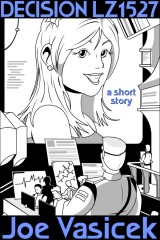
In other news, my short story “Decision LZ1527” just went free on Amazon, so if you want to pick up a copy or tell your friends, go right ahead!  It’s right around #200 in the Kindle free category now, but for some reason hasn’t hit any of the lists.  Hopefully that’ll change before the ranking drops back down.

“Decision LZ1527” first appeared in the December 2009 issue of Leading Edge, and was my first traditionally published short story.  Basically, it’s about a college freshman working up the courage to ask out a girl he likes, as told from the perspective of the little men inside his head.  Like Star Wanderers, the story just sprung out of my head one day.  It was a ton of fun to write, and I’m glad that so many others seem to enjoy it too.

In other news, I just got back the edits for Sholpan, so I’ll hopefully have that up on Amazon and other eretailers over the weekend.  More on that as it happens, but it’s happening soon.  I’d also like to put together a blog tour for Bringing Stella Home and Sholpan both, so if you’d like to have me on as a guest blogger, shoot me an email at joseph dot vasicek at gmail dot com.  More on that later as well.

And that’s just about it for now.  Take care, and I’ll see you around!

My first 1 star review

Well, I went through a significant rite of passage over the weekend: I got my first one star review on Amazon. 

The review was for “From the Ice Incarnate,” which doesn’t really surprise me because it’s currently my lowest rated story.  The biggest complaint seems to be that it feels more like a vignette than a complete story, which is a fair criticism.  I’ve tried to make it clear in the description that this is an excerpt from a larger work, so hopefully it doesn’t feel like a bait and switch.

I wish everyone loved all of my stories, but of course that’s not possible.  And although it’s easy to dismiss readers who complain about free ebooks, any book takes an investment of time and emotional energy; no matter what the price, the writer has a responsibility to deliver the best story they can write.

This is the reality of the new system: readers are the new gatekeepers, and rankings are one of the major ways that they give feedback.  It’s a lot more public than a rejection letter, but ultimately I think this is a much better way for stories to grow into their natural audience. 

Every writer gets one star reviews from time to time; writing is so subjective that it’s inevitable.  My object isn’t to please everybody, but to do my best and to be constantly learning. 

In the meantime, I’ll keep writing.

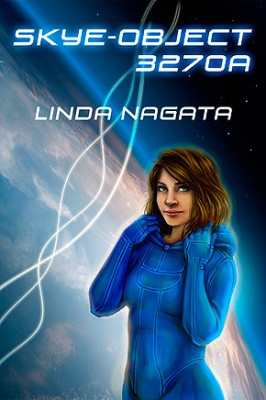
Skye Object 3270a by Linda Nagata

It’s not easy being a teenager in the orbital colony of Silk–especially when all the adults are functionally immortal and anyone under one hundred is considered an adolescent.  To make matters worse, Skye fell to the city in an escape pod when she was just a baby, with no idea who she is, where she’s from, or how long she was drifting in space.

Fortunately, she’s a tough girl with several close friends and a determined spirit.  One way or another, she’ll find out where she’s from–and whether there are any of her people still out there.  

I thoroughly enjoyed this book.  It combined the best of both science fiction and young adult: likeable teenage characters struggling to find their place in a high-tech alien world.  In particular, I found it fascinating how the widespread nanotech shaped both the society and the universe.

But the story isn’t about the technology, it’s about the characters, their adventures, and the friendships that form between them.  This was what really made the story come alive for me.  There’s a small amount of wish fulfillment, which may or may not be your thing, but overall I found the characters to be both believable and likeable.  It was a lot of fun to watch them grow and learn together.

At times, though, it felt as if the characters weren’t challenged enough.  The friendship and relationship issues were well done, but it wasn’t until the end that they started to have any significant try-fail (or try-almost fail) cycles in their adventures.  Also, while the ending was quite satisfying, it was also a little abrupt.

Those didn’t detract much from the rest of the story, though.  Overall, I thought it was a very satisfying read–the sort of book I wish I’d found when I was twelve or thirteen.  If I wasn’t already hooked on science fiction by that age, I have the feeling that this book would have turned me into a lifelong fan.

As a footnote, I’d like to add that this is EXACTLY the kind of book that indie publishing was made for.  It’s a great story, but the science-fictional setting is so unconventional that most publishers wouldn’t take a chance on it.  Even houses like Tor and Baen are focusing more on sub-genres like urban fantasy and military sf, which both have large, proven readerships.  For something that’s a little more niche or experimental, it’s good to see that there’s still a way to get it out to readers who would love it.

So yeah–if you like young adult books and you’re not turned off by space elevators, nanobots, or alien planets, you should totally try out this book.  I think it will surprise you just how much you enjoy it.

How do you know when you’ve succeeded?

With books and publishing changing so quickly, a lot of writers are wondering how they can tell when they’ve actually “made it.” It’s a valid question, one that I think we all need to answer if we want to write seriously.  For myself in particular, as an indie writer, how will I know when I’ve achieved success?

The question made me think about my experience as a Mormon missionary in California, and the definition of success that my mission president (the ecclesiastical leader and father figure for the missionaries) often quoted:

Success is peace of mind which is a direct result of self-satisfaction in knowing you did your best to become the best you are capable of becoming.

— John Wooden

This definition taught me that success isn’t just about external things that may or may not be in your control (for example, the number of convert baptisms per month), but is more about doing the things that are in your control to stretch yourself and reach your full potential.  To be sure, external factors are important measures of success, but at the end of the day, it’s not just about the numbers.

That said, for a writer like me who hopes to make a living at it, the numbers are pretty dang important.  At my current standard of living, I need to sell between 550 and 750 ebooks per month priced at $2.99 and $3.95 to accomplish that goal.  Right now I’m doing about 30 to 50, so I still have a ways to go.

But is that the best measure of commercial success?  If I have 10 titles selling around 55 to 75 copies each per month, will those books be hitting their full potential?

Probably not.  For that reason, I’ll probably end up signing a deal with a publisher at some point in my career; there’s only so much that I can do by myself.  However, in order for me to do that, the terms have to be right; I’m not going to sell myself short just to see my name in print.

(This is one thing that bugs me whenever I hear writers discuss whether traditional or indie publishing best fits their goals.  If all you want is “to see my name in print,” or “to see my book in a bookstore,” how is that any different from vanity publishing?  If that’s really your goal, fine, but don’t think it somehow puts you above indie writers–many of whom have goals that are much more pragmatic than yours.)

Artistically, I think the best way for me to achieve success is to take on a new challenge with every project and still feel like each book is better than the one before it.  Contests and reviews have their place, but going back to the definition, success is all about self-satisfaction and peace of mind.  I don’t want to tie any of those to someone else’s opinion about my work–that way lies madness.

But really, I think it all comes down to the readers.  Unless you stuff your manuscript in the closet, writing is never a solitary act: it is an act of collaboration with the reader.  If I have any measure of success, it will be because someone took the time to read my words.  To be sure, I can’t please everyone, but that doesn’t matter; it only takes one person to make a story come alive.

When I was a missionary, I constantly asked myself whether I was doing the will of God in the life of every person that I met.  That’s how I knew that I had succeeded: when I felt the peace of mind that came from knowing I’d made that personal difference in someone’s life.

I expect it to be similar with my writing.  Commercial success is great, but numbers aren’t everything.  What really matters is telling a story that connects with people on a deep and personal level, transforming them in some meaningful way.  If I can do that and make a living at it, that’s how I’ll know I’ve succeeded.

Worldcon 2011: Friday

Wow, it feels like the second day of Worldcon was forever ago.  Usually, Friday is the first real day of a convention, but since Thursday was the first full day of Worldcon, that wasn’t the case.

I don’t remember a whole lot from it, but there were a few really awesome panels.

In the morning, I went to a social networking panel with Tee Morris and Cory Doctorow, among others.  Awesome, fast paced discussion–pure gold, every second of it.  The main takeaway I got was to try out everything, but only stick with the things I actually enjoy.  There are lots and lots of ways to use social networking tools, and if something is compelling but not enjoyable, it’s not much better than a life-killing addiction.  Also, Facebook is the equivalent of high fructose corn syrup.

In the afternoon, I went to a panel on romantic elements in science fiction, with Louis Master Bujold on it, among others.  She made perhaps the most interesting point I heard all weekend: that in romance, women typically write about love and life, whereas men typically write about love and death.  SO TRUE.  It happens all the time in my own work, to the point where you can set your watch by it.

After a long and tiring day, I took off a couple hours before the parties just to decompress (and also blog about Thursday, as you may have noticed).  Got caught up on David Gaughran‘s blog, which as usual had some interesting analysis about the latest news in the ebook revolution.  And then…well, let’s just say I got into a little bit of a discussion with a senior editor at Tor about ebooks and whether it’s a good idea now to self publish.  His parting shot: “You’re not going to win this argument!” To which I wanted to respond: “I don’t care about winning it with you; I care about winning it with the readers.”

Seriously, when it came to ebooks and epublishing, almost every editor, agent, and author at the convention either had deer in the headlights syndrome or was in outright denial.  It’s gotten to a point where they can’t ignore it, but literally everyone who brought up the subject on a panel either dismissed all successful indie writers as outliers, or brought up the flood-of-crap argument that so many people have already debunked.  I don’t think the publishers are quite as stupid as the record labels in the late 90s…but seriously, they aren’t much better.

Not that I was purposefully trying to be antagonistic.  I only brought up the subject with that particular editor because I knew I didn’t have a chance with him.  For the most part, all I did at the con was listen and observe.  But man–there’s a lot of willful ignorance out there.  And after a while, that made me a little disillusioned with the whole convention…but more on that later.

Suffice it to say, Friday was a long and eventful day that went by so quickly I’ve forgotten almost everything else that happened.

Worldcon 2011: Thursday

Wow, the last couple days have been packed with awesome con-stuff, but I’ve got a short break so I thought I’d blog about it.

Thursday was great, attended a few panels but mostly just wandered around meeting people.  I’m a little surprised with how many people read this blog.  Got Brandon to sign my Kindle, and he was really supportive about my decision to epublish.  I seem to be one of the only Utah writers going full-steam with indie publishing, but a handful of others are considering it, though for now they’re in the minority (which surprises me).

Anyhow, Thursday had a couple of really notable panels.  The first was on faith and science fiction, and had both Eric James Stone and Moshe Feder on it, among others.  Excellent discussion, though a couple of the commenters tried to derail it.

I found it surprising that the panelists didn’t have a good answer to my question: how do you reconcile far future sf with millenialist religions?  That’s exactly what I’m trying to do with my Gaia Nova universe–create a far future epic that isn’t incompatible with the major western religions (Islam, Christianity, Judaism, etc).  From the after-panel discussion, I got a strong recommendation to read C.S. Lewis’s space trilogy, so I’ll definitely be checking that out soon.

The other notable Thursday panel I attended was on ebook art, and featured John Picacio and Lou Anders, among others.  John feels pretty strongly that indie writers are seriously devaluing cover illustration, and within the first ten minutes someone in the audience literally told him to f___ off!  Wow, talk about tension–but even though it almost fell apart, the panel turned out to be very enlightening.

Let me just take a moment to say that I’m very impressed with what Lou Anders is doing over at Pyr.  While the rest of the publishing world seems to have their heads in the sand when it comes to the ebook revolution, Lou is one of the few who sees it more as an opportunity than a threat.  I’m not currently looking for a publisher, mostly because I’m waiting to see how things shake out, but I would be very surprised if Pyr is one of the publishers that goes under.

The parties in the evening were pretty good–as always, the Tor party was literally packed.  Brandon saw a group of us clustering together, so he broke us up and sent us off to talk with editors and agents.  He tried to point me out to an agent, but…you know, I’m not really looking for one right now.  Brandon keeps telling me not to believe DWS when it comes to agents, and while I’m certainly not fundamentally opposed to them, I feel that I can better build my career by going in other directions.  At some point in the future, maybe, but for now…not so much.

Speaking of Dean, I spent the whole evening hunting for him, then gave up around midnight only to find out the next day that he showed up at the SFWA suite fifteen minutes after I left (nooo!). And now that it’s 9pm in Reno and the parties are just getting started, I think I’ll cut this blog post here and recap Friday sometime later.

See you around!

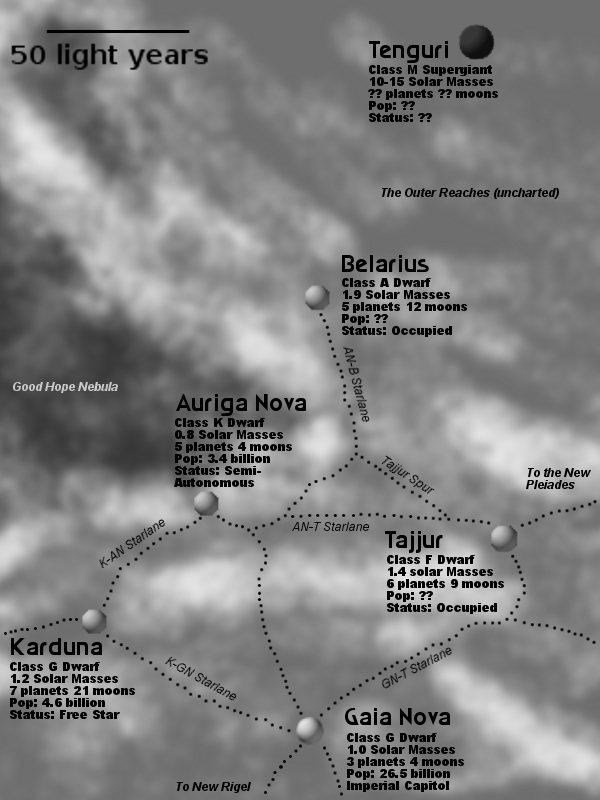
Teaser: Starmap from Bringing Stella Home

First off, let me get some business out of the way.  I did another post for the Genesis Earth blog tour, this time on my friend Cavan’s blog.  The subject: how and why I decided to become an indie published writer.

Also, if you live in Europe, it may interest you to know that Genesis Earth is now available on XinXii, a European ebook retailer website.  The price is 2.99 USD and I believe that is VAT inclusive, which should make it much less expensive than Amazon and other American sites.

Finally, an update on my upcoming novel Bringing Stella Home.  I’ve commissioned the cover art from Līva Šmaukstele, an artist from Latvia.  We just got the sketches finalized this week, and I am very excited to see the final copy!  My copy editor, Josh Leavitt, is finishing up with the edits in a couple of weeks, so if all goes well with the art Bringing Stella Home should be up before the end of the month.

And now, the teaser: I spent a couple of hours this afternoon putting together the starmap for Bringing Stella Home.  This will appear in the front, just before chapter one. Check it out:

Pretty cool, eh?  I might touch it up a little before publication, perhaps lighten the background a tad.  I did it in B&W so that it would work better for the Kindle.  Many thanks to Logan Kearsley for help with the stellar classes; it really pays to have geeky friends who know so much.

And yes, the Good Hope Nebula will be in the cover art.  Yes, it’s going to be awesome.  Expect another teaser to come out soon.

😀

Why I am not afraid of the Noise part II

A recent op-ed in the Wall Street Journal titled “Cherish the Book Publishers–You’ll Miss Them When They’re Gone” has ignited a firestorm across the indie publishing community.  The post’s basic argument is that the ease of self publishing and the end of New York as the gatekeepers of quality will make it harder for readers to find the truly worthwhile literature amid the flood of crap that will inevitably overwhelm us all.

Joe Konrath fired the opening salvo; in characteristic fashion, he decried the op-ed as hogwash and blamed jealousy among traditionally published writers for the perpetuation of this myth.  He concluded that while the “tsunami of crap” is real, it is ultimately irrelevant.

His advice? “Don’t write crap.”

Michael A. Stackpole responded by examining the much more dangerous fear of authors worried about the coming flood; the fear that their own work is crap, and not worth putting out.  After examining what we mean when we call something “crap,” he concludes that the really bad stuff will sink to the bottom…

…not because of a rising tide of crap, but because they deliberately swim toward the bottom, open their mouths, and willfully suck.

And the rest of us will happily swim past the effervescent markings of their demise, moving on into the golden age.

Kris Rusch’s take on the issue was perhaps the most instructive of all.  First, she used her own experience as editor of The Magazine of Fantasy & Science Fiction to completely blow out of the water the idea that editors are arbiters of good taste.  Editors buy what they like; when they try to predict what the public will like, more often than not they fail–and when they try push their own reading tastes onto the public, they make themselves irrelevant.

She concluded that the only truly relevant “gatekeepers” are other readers–that word of mouth is still king, and because the traditional publishing system treats books “like produce, taking them off the shelf as if the book will rot after a month,” indie publishing is much better suited to help the good stuff rise to the top.

David Gaughran responded next by pointing out all the ways that indie publishing and the ebook revolution are enriching the literary world.  He concluded that the only people hurt by these changes are the middlemen–that both writers and readers only stand to benefit.

Well.  Like I said, it’s quite a firestorm.

So what’s my take? I already posted my thoughts on why the original argument is invalid–that fear of the Noise, aka the “tsunami of crap,” is a specious reason not to epublish.  However, I think that the real issue goes much deeper than that.

The most fundamental divide between those who embrace the ebook revolution and those who fight it is whether or not they trust readers to find the truly great works of literature on their own.

The obvious question, of course, is what exactly constitutes “great literature.” As a lover of genre fiction, I measure the quality of literature by the impact it has on readers; that when readers can’t stop talking about how awesome a book is, it’s a good book.  For that reason, I’ve never put much credence by Twilight bashers; paranormal romance might not be my thing, but Stephanie Meyer struck a chord in a lot of people, and that certainly counts for something.  In other words, story is King.

Putting it that way makes the argument somewhat circular.  Can we trust readers to find the good stuff on their own?  Yes, because readers read what they love.  But what about that literary piece about a depressed writer who has a sexual affair that completely changes his life?  Well, I guess it just wasn’t that good.  But they would have loved it, if not for all that genre crap flooding the system!

As for readers getting swamped, I think the system itself prevents that.

First, readers browse by means of tags, search terms, categories, top seller lists, “also bought” lists, etc.  They follow book bloggers and take recommendations from friends.  When they find a book with an attractive cover, they click on it, give the book description a cursory glance, and perhaps check a few reader reviews.  If their curiosity is still piqued, they download the free sample to their ereader.

Up to this point, no money has been spent.  Readers can download as many free samples as they want, of anything that catches their fancy.  When they finally get around to reading the sample, they can decide whether they want to buy the book.  If they do, all they need is to click a button on their ereader, and the book is theirs.

Once they finish the book, the ereader prompts them to leave a review (at least the Kindle does this–not sure about the others).  If they enjoyed it, they can give a favorable rating which helps other readers find the book.  If they don’t, they can give an unfavorable rating which warns others to stay away.

What is happening is nothing less than the democratization of literature.  Therefore, it should come as no surprise that those who trust readers will embrace the new system, while those who still cling to editors-as-gatekeepers will reject it at all costs.

But can we really trust readers?  Yes, if we believe that story is King.  If readers and writers are collaborators in the literary experience, and the truly great literature is that which has the greatest impact on its readers’ lives, then it stands to reason that readers must be the ultimate judges of quality.

Therefore, if we truly believe in the power of story, we cannot help but put our trust in the readers.  And if that’s true, why shouldn’t we rejoice in the revolution?

I sincerely believe that we are witnessing the dawn of a great golden age of literature.  The invention of the ebook is at least as revolutionary as the Gutenburg press, perhaps a great deal more.

The only ones who have anything to fear from the revolution are those who have built their livelihoods by pushing their own arbitrary tastes on others.  Frankly, that’s nothing less than cultural tyranny–and with the democratization of literature, we no longer have to put up with it.

Viva la Revalucion!
Arrrgh Smashwords!

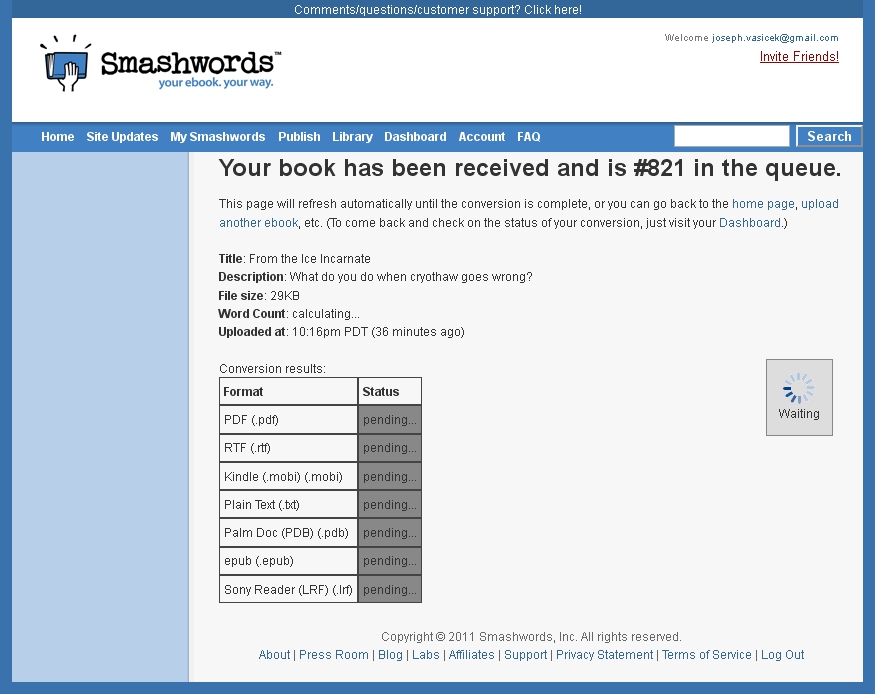
So I go to upload “From the Ice Incarnate” to Smashwords as a free give away, and this is what I see. Arrgh!  Why do I have to wait??  Why can’t my book be up nowww…?

Okay, seriously, it’s not that big of a deal.  I’ll just have to wait until tomorrow to start spamming everyone sharing it.  And unlike last week, I’m going to be more open about the fact that I’m giving this story away for free.

I decided last week to put up “Decision LZ1527” and “Memoirs of a Snowflake” for free on Smashwords, mostly to see if I could get Amazon to price match.  So far it hasn’t worked, but it has given me some very interesting insight into the minds of ebook buyers.

The results aren’t scientific, of course, but so far it’s confirmed what I’ve heard elsewhere: that there’s a HUGE difference between people willing to pay more than $1 for an ebook, and people who will grab anything because it’s free.  So far, 62 people have downloaded “Decision LZ1527,” 33 people have downloaded “Memoirs of a Snowflake,” but only 2 people this week downloaded the free sample of Genesis Earth–and no one has bought a copy.

Of course, this is only after one week.  Perhaps the people who downloaded the free stories are just taking a long time to read them.  Perhaps they just can’t afford to buy many ebooks right now, but because they read and enjoyed my stories, they’ll check it out when they have more time/money.  Maybe some of them will run across my ebooks years later and remember “oh hey, that’s the guy with that crazy sci fi dating story” and check me out then.  Or maybe they’re all cheapskates who only read stuff they can get for free.  I don’t know.

But I don’t think it’s the last one.  A friend from my apartment complex walked up to me today and told me he’d read and enjoyed my story.  It was pretty cool.  That’s what I’m really after at this point: exposure and readers.  So I think it’s a good idea to give at least some stuff away for free, even if it doesn’t push people to buy your other books in the short term.

Speaking of which, I’ve tried out something else new: raising the price of Genesis Earth from $2.99 to $3.85.  Why in the heck would I do that?  Mostly because of value perception; I want people to know that I have confidence that my book is worth at least #3.85, that I believe they’ll feel it was worth what they paid for.  The kind of books I want to write are the kind that people will want to read twice, and I want to see if changing the price to reflect that will build the kind of readership that is looking for that sort of thing.

I might be totally wrong, of course, but hey it’s worth a shot.  I’ve sold two copies so far this month, so at least it hasn’t totally killed sales.  I’ll probably keep it at that price for at least a couple of weeks, just to see what happens.

But I can tell you one thing I don’t think I’ll ever do: price a novel higher than $5.  I’ve always thought that $6.99 and $7.99 for a paperback is a little steep, even if the book completely changes my life.  That’s not something you can put a dollar value on, and even if you could, why would you want to charge that much?  If your book was so deep and meaningful, wouldn’t you want to give it away for free?

So yeah, I’m trying to suck my readers dry, only to find a business model that works.  And if you think $3.85 is too steep, please let me know.  I’d like to give my books away for free, but at the same time, I want to eat without spending my life as a wage slave.

In the meantime, if you haven’t already, check out my free stories!