Z is for Slaying the Zombie Memes of Publishing

Being an indie writer is awesome. Without a doubt, self-publishing is one of the best decisions I have ever made, and has enabled me to build exactly the kind of writing career I have always wanted.

So it frustrates me to no end when people in the publishing industry try to discourage new writers from self-publishing the way that I did. What’s worse, they often justify their advice with information that has been debunked or opinions that have been shown to be unfounded. These “zombie memes” keep coming back as if the act of repeating them is enough to make them true.

Some examples of these zombie memes include:

  • Self-publishing is a bubble.
  • Ebook growth is stalling and will soon decline.
  • Getting visibility as a self-published author is impossible.
  • Amazon is evil because _______.
  • Amazon is destroying literature.
  • Self-publishing is destroying literature.
  • ______ is destroying literature.
  • Publishers nurture writers.
  • Publishers are the guardians of literature.
  • Traditional publishers only publish high-quality books.
  • Self-published books are flooding the market with crap.
  • Only a handful of indie writers are making a living.
  • Self-publishers should not be called authors.
  • Ebooks shouldn’t be cheaper than print.
  • Publishing a book is harder than writing one.
  • Readers are reading the wrong books.
  • Publishers help authors navigate the digital world.
  • Agents help authors navigate the digital world.
  • There is nothing unethical about agents who act like publishers.
  • There is nothing unethical about standard publishing contracts.

Bullshit, all of it. Pure, unfiltered bullshit.

No matter how many times you kill these memes, they just refuse to die. Some people get a thrill at rehashing all the old arguments, but not me. I’d much rather leave the good fight to others, and quietly keep building my career while the naysayers all please themselves with the sound of their own voices.

Then again, perhaps that’s the key to slaying the zombie memes right there–successfully building your own career in spite of all the critics and naysayers. It’s a lot harder to believe all this crap when you see enough people succeeding in spite of it. The critical mass of indie writers is growing, and becoming a lot harder for the establishment to ignore.

This month, I sold over 700 books. I’m making enough on my books now that I don’t need a full-time or even a part-time job–writing is what I do full-time now. It’s still touch-and-go from month to month, but I’m living the dream, and because of the opportunities made possible by self-publishing, I have every confidence that I will continue to live that dream until the day I die.

The best way to slay a zombie meme is to create a competing meme that speaks even louder. That’s exactly what we in the indie movement are doing. And one day, when the zombie memes are finally dead for good, ours will be alive and thriving. It’s a new world of publishing, and never a better time to be a writer.

Y is for Yog’s Law

Anyone who was trying to break into publishing before the ebook revolution should be familiar with Yog’s law, which states:

Money should always flow toward the writer.

The purpose of the law was to keep new writers from falling into one of the many writing scams. Places that charged writers to publish were almost all vanity presses, and those that weren’t didn’t give writers access to the distribution channels necessary to make their work widely available. If you wanted to have a career, you had to go with a publisher, and the best way to tell if a publisher was legitimate was to look at how the money flowed.

Nowadays, with self-publishing, the line between writer and publisher has been blurred. An indie writer can expect to contract out work, sometimes to the tune of several hundred or even thousand dollars, in order to produce a professional product. In these cases, money clearly is not flowing to the writer. So what does this mean for Yog’s Law?

Some people have attempted to reformulate Yog’s law by drawing a distinction between the writing side of the business and the publishing side. While I think that that’s instructive, I’m not convinced it’s entirely useful. The distinction is not always clear, and even where it is, in practical terms it’s basically meaningless. You can just as easily fall for a publishing scam with your publisher hat on as with your writer hat.

So is Yog’s Law obsolete? Is it a curious relic of a publishing era that is passing into the twilight of history? In its old formulation, perhaps, but I would like to propose a new formulation that is perhaps even more relevant to today’s publishing industry than the old one ever was. That formulation is as follows:

Control should always flow toward the writer.

In the old days of publishing, writers had virtually no control over their careers. Publishers decided which books would make it to readers, which writers would get the attention of the publishing establishment, and how many books those writers could publish in a year. Authors had almost no say in their cover art, marketing, or any other aspect of the production and distribution of their work. In such an environment, the only assurance they had that their publisher would do a reasonably competent job was by seeing whether they put their money where their mouth was–hence Yog’s Law.

But today, writers do have control. We have a variety of publishing options today, and money isn’t the only factor in determining whether a path is legitimate. In fact, it may be one of the worst factors. Not only have advances gotten worse in the last few years, but the rights grabs have gotten so bad that signing a traditional book deal today basically amounts to selling your birthright for a mess of pottage. Yes, money is flowing to the writer, but the writer is still getting screwed.

Control means being able to have the final say on the cover art, the editing, or on an other aspect of a book’s production. It means that important stuff like the metadata or book description is not left to an entry-level employee that the author has never met.

Control means that no contract should be one-sided. It means an end to non-compete clauses of any kind. It means that rights reversions should actually have meaning, and that no book should be tied up for the life of copyright.

Control means that the bulk of the revenue should go to the person who does the bulk of the work. Bringing a book to market is not a challenge in the digital age, but writing a book certainly is. Publishers exist to serve writers, not the other way around.

Control means that a writer should know exactly what services they are paying for. If they commission work from a freelance editor or cover designer, they should be the one who directs that work, not a third-party who doesn’t also assume some of the risk if the project doesn’t work out.

By the standard of control flowing to the writer, most of the contracts coming out of New York fail miserably. That is not acceptable in an age where the New York publishers aren’t the only game in town. If a writer can make a living by going it on their own, then anyone who pays less than a living wage is basically running a scam.

Control should always flow toward the writer. Money used to serve as a proxy for control, but now that we have the real thing it’s no longer the best measure. Control, not money, is what you need to build a career.

N is for Noise

With all the millions of books out there, and more coming out each year, is it getting harder for authors to market their books? Since anyone can publish a book now, is all that noise drowning out new voices?

It’s tempting to think that way, especially when you’re just starting out as an indie author. Everything is a big struggle, and you find yourself grasping for something–anything–to explain why you aren’t seeing the success that you want to see. With all of the millions of books flooding the marketplace, it’s easy to feel that your own books are getting buried.

Personally, though, I reject this idea that the noise is drowning us all out. You aren’t getting drowned out by all the other books out there. You’re not locked in a zero-sub competition with other authors. And readers who pick up another book in your genre aren’t overlooking yours–in fact, they’re more likely, not less likely, to find and enjoy your books.

A couple of years ago, I wrote three posts on this subject. The first one discusses self-publishing as it relates to traditional publishing, and why the ebook revolution is something for authors to be excited about rather than afraid of. The second one discusses how what the elites view as noise is actually the democratization of literature. The third one compares publishing a book with writing a message in a bottle–even though the ocean/marketplace is vast, if the bottle/book doesn’t sink to the bottom, it will eventually wash up somewhere and be discovered.

The idea that the noise is drowning out your book is based on a number of false assumptions, the first that all things equal, a reader is more likely to read your book if there are fewer options available. But for that to be true, 1) readers would have to be equally motivated to read all books, and 2) readers would have to devote the same amount of time to reading, no matter how many other priorities compete for their time.

No one reads a book for entertainment just because there’s nothing else for them to read. Perhaps that would be true if they were stranded on a desert island with just a couple of books, but boredom is a very, very low bar to cross and there are thousands of non-reading activities that can clear it as well or better than reading a book. Even for the voracious readers whose addiction to the written word is stronger than their need to eat, there’s an endless buffet of fanfiction and all sorts of other reading options made possible by the internet.

If someone reads your book, it’s not because there’s nothing else for them to read–it’s because they find your book interesting. And if someone reads another author who writes a lot like you, chances are that they’ll be more likely, not less likely, to pick up your book than someone who’s never read that kind of stuff before. Readers rarely tire of their favorite genres–the more they love a book, the more likely they are to search out another just like it.

Complaining about all the books that make it harder for readers to find yours is like complaining that girls never like nice guys. The people who complain the loudest never really seem all that willing to take a good, hard look at themselves and ask why it is that girls/readers aren’t interested in them. It’s not enough just to be “nice”–you’ve got to have some personality. If a book sinks, it’s almost always because something about it sucks. No author is entitled to success, just like no guy is entitled to a girlfriend.

I firmly believe that there’s room enough in the marketplace for everyone–provided, of course, that your book doesn’t suck. And even if it does, there are probably still readers out there who will love it. Beyond a certain point, literary quality is all subjective anyway. If you write good books, give them the proper mating plumage (blurb, cover, metadata), and put them out where readers can find them, they will–no matter how many other books are out there.

I is for Indie

I first started self-publishing in 2011, when “self-published” was still a dirty word. Back then, we called ourselves indies in order to escape the stigma–or mitigate it, at least. And that led to a war between us and the publishing establishment over the meaning of the term “indie.”

If it sounds dumb, that’s because it was. “Indie” is short for “independent,” as in an artist who is unaffiliated with a corporation or large commercial organization. Trouble was, the establishment was already using the term “indie” to describe bookstores that weren’t affiliated with the larger chains (Border, Barnes & Noble, etc), or the small presses that hadn’t been gobbled up by the Big 6.

Also, I think the technological disruption of ebooks caught the industry with their pants down. Authors, publishing their books themselves in this newfangled digital form? Diving into the wilds of the marketplace without the nurturing patronage of a publisher? As if ebooks will ever become a thing! Don’t they know that self-publishing is the kiss of death?

And it was, in the old days when publishers held a monopoly over all the important distribution channels. For the greater part of the 20th century, signing with a traditional publisher was the only viable way to have a career. There were a couple of self-publishing success stories, but they were the exceptions that proved the rule. For almost a century, there was no real way to be a writer and go indie.

Because of that, those of us who have chosen this path are largely making it up as we go along. Unlike the film industry, where “indie” has a connotation of artistic purity, or the music industry, where “indie” has a connotation of hip, local, and unique, indie books and indie writers have had to build their own reputations largely from scratch. It has definitely been an uphill battle.

Back when I first started self-publishing, I was very particular about calling myself an “indie writer” and not a “self-published writer.” Now, though, I’m comfortable with either term. The self-publishing stigma is pretty much dead, and “self-published” describes what I’m doing just as well as “indie” does.

That said, I think it was a good thing that we claimed the indie label when we did. Our mode of self-publishing is very different from the modes of self-publishing that came before, and distancing ourselves from the vanity presses and self-publishing scams helped a lot of us to let go of our inhibitions and jump into the new world of publishing with both feet. That certainly was the case with me.

In the future, I hope that indie books gain the same reputation for artistic integrity and creative freedom that indie films and indie music now enjoy. I think we’re definitely on the way. Sure, there are lots of crappy self-published books out there, but there are also a lot of really excellent ones, and those are the ones that readers are going to remember. Hopefully, some of my own books will be among them.


G is for Genre

Are there certain genres that indie writers should write in if they want to be successful? Are there other genres that they should avoid?

This is one of those pieces of common wisdom that really irks me, and not just because I write in a genre (science fiction) that isn’t as mainstream or popular as others. I think it’s a myth that you have to write in a “hot” genre in order to have success, especially if you’re an indie author. Here’s why:

1. You don’t have to be a bestseller to be an indie success.

This is something that Hugh Howie repeats all the time: that the true success stories in self-publishing aren’t the mega bestsellers like him or Bella Andre or H.M. Ward or Amanda Hocking, but the thousands and thousands of little guys who are carving out a comfortable space for themselves in this new world of publishing. You don’t have to be a huge bestseller to make a living as an indie writer–you can do quite well for yourself with a small but dedicated fan base.

I’m sure there are some people whose personal definition of success includes the kind of fame and recognition that comes along with being a bestseller. That’s fine–everyone has to define what ‘success’ means for themselves, based on their own personal goals and dreams. But being a bestseller is definitely not the baseline, at least for an indie writer.

2. Ebooks and epublishing have opened exciting new opportunities for niche genres.

Before epublishing, you needed a fairly extensive infrastructure to bring a book to market. Besides designing the book, you had to pay for printing, pay for shipping, pay for distribution and marketing to bookstores, pay for returns and remainders … the list goes on and on. Consequently, it was harder for niche genres to really get a foothold.

With ebooks, the economics of publishing have been flipped on their head. The marginal cost of producing another ebook is zero–digital content can be copied endlessly at virtually no cost. Shipping costs are also zero, and global distribution is as easy as uploading the book to Amazon’s servers–again, at zero cost.

Because of this, there’s room now for niche genres with much smaller readerships to actually turn a profit. And that’s what we’re seeing–an explosion of all sorts of niche, specialty, and experimental new genres. Books no longer have to be just like the Latest Big Thing (only different) in order to earn back their costs. There’s room for everyone in the new world of publishing.

3. It’s better to write what you love than to write what you think will sell.

The two aren’t always mutually exclusive, of course. Maybe you love a variety of genres, so that you’d be equally satisfied writing romance as you would writing something more niche like Amish vampire steampunk. But if all you’re doing is chasing the money, chances are that your heart won’t be in it nearly as much as it would if you were writing what you love. And if your heart isn’t in it, you won’t be able to bring that creative passion to the project that readers really love.

When I wrote Star Wanderers, I was following my passion. It was a science fiction story unlike any I’d either written or read, but I followed it where it took me without worrying whether it would sell. The genre description that best fits that series would probably be romantic frontier space opera–definitely a niche. But because I was passionate about it, the books were able to find readers who share that passion and touch them in ways that other books hadn’t. And guess what? Those are my best selling books.

There is a business side to publishing, but there is also an artistic side. You’ve got to be true to both. If your inner artist thrives on the challenge of chasing the market, great–go for it. But if doing that feels like you’re being unfaithful to your creative vision, you’ll probably write a better book if you strive to be authentic. And ultimately, I think that authenticity has a lot more to do with a book’s success than the genre it’s written in.

Readers are far, far more diverse than we give them credit. So long as you can write well and tell a good story, you can find success no matter which genre you write in.

LTUE 2014

Without a doubt, my favorite sci-fi convention / writing conference / symposium is LTUE. I say this every year, but this year’s symposium was one of the best! Orson Scott Card and Brandon Sanderson were both there, along with a whole bunch of other authors and artists, local and otherwise. It drew a huge crowd, too–around 1,800 people over the course of the weekend–but there was plenty of space at the Provo Marriott, so it never felt too crowded.

If anything, I think that LTUE has gotten better since leaving BYU. There’s much more openness, much less administrative or bureaucratic restriction. Fans can dress up in cosplay and that’s okay, panels can discuss pop culture topics without having to pretend to have academic value, non-LDS panelists are free to share their perspectives without feeling like the religious censors are breathing down their backs, and we have a whole hotel hotel to ourselves, as opposed to a corner of the student center.

At the same time, all of the stuff that makes LTUE great is still there, and there in abundance. Since the vast majority of attendees are LDS, the panels all revolve around the LDS perspective and experience. In his main address, Orson Scott Card talked about how his experiences growing up in the church influenced the writing of Ender’s Game and his views on leadership. At the banquet, Brandon Sanderson referenced Orson F. Whitney’s famous Home Literature speech in discussing Mormons’ place in the current science fiction & fantasy field.

In other words, all the good stuff was still there this year, plus a liberal helping of cosplay and facial hair. And who can say no to that?

In any case, I had a blast. I was on five panels this year, and they were tons of fun. In particular, the Writing Romance panel was really great. Since I’m not familiar with romance as a genre, I was a bit worried that I’d be out of my league. But the discussion was all about how to put romance in your sci-fi, and I know a lot about that. At one point, I argued that men have just as much of a hunger for romance as women. That surprised some of the female panelists, but I definitely believe that that’s true. We got into a lengthy and interesting discussion out in the hallway, which is how the best panels seem to go.

One major shift I’ve noticed from previous years is that self-publishers and self-publishing has all but lost its stigma, with people talking openly about the benefits of that career path. In fact, it was a major undercurrent throughout the entire symposium. In the green room, we got into some really intense discussions about the AE report, which came out just days before the symposium began. It seemed that I was constantly hearing or overhearing people talk about whether and how to self-publish, and on several panels people were openly advising to skip traditional publishing altogether.

Three years ago, people would have treated me like I had leprosy if I openly admitted I was self-published. Now, everyone seems to be embracing it. It’s so awesome that we’re past the stigma, because it means that we can all be open and supportive of each other and focus on the important things, like writing the best possible stories and connecting with our readers.

By far, the best event I attended was John Brown’s presentation on Clear and Vivid Writing. HOLY CRAP GUYS. That presentation completely blew my mind. The powerpoint is up on John Brown’s blog, so you can grab it and see for yourself. All I can say is that the man is a writing genius. The presentation completely changed the way I think about my own writing, and will definitely influence what I write from here on out.

Another great event was Sandra Tayler’s presentation on how to build a fan community around your stuff. She talked about the difference between a following and a community (basically, a community is a following where the fans talk to each other), how to cultivate a safe and inviting place for your fans, and what to expect from when you first start out to when the community starts to get rather large. I still feel as if my writing career is just getting started, but her advice will no doubt be very useful in the coming years.

The What Makes a Hero panel was really great. Peter Orullian, Larry Correia, and Lisa Mangum were all on it, so the discussion was energetic and full of awesome, juicy stuff. The big takeaway I got from that one was that as long as the reader doesn’t throw the book across the room in disgust, you can always bring back a fallen character and redeem them. There is nothing so beyond the pale that makes it impossible for a character to step up and become the hero once again. It takes skill to pull it off, of course, but it can be done–and that is one of the most awesome things about what it means to be a hero.

There was a bunch of other stuff that I took away from LTUE this year, but those are the major things. By the end of it, I just wanted to sit down and write! The climactic final battle for my current WIP, Sons of the Starfarers: Comrades in Hope came to me in all its awesomeness as I attended the various panels, and holy crap am I so excited to get to that part! It’s going to be amazing, and the cliffhanger ending is going to make you scream so horribly, but that’s okay because the next book will pick up right where the previous one left off, then take things in an even more awesome direction.

In any case, that was LTUE this year. SO MUCH FUN. If every convention can be like this one, holy crap, sign me up for them all!

Z is for Zenith

pioneer_book_scifiHas space opera passed its zenith?

Sometimes, it certainly looks that way.  All the major stuff seems to be reprints of past series and reboots of decades-old franchises.  Star Trek, Star Wars, Stargate, Battlestar Galactica, Ender’s Game, Dune, Babylon 5–all the big names seem to have had their start at least a generation ago.  At any science fiction convention, you’re likely to see more gray-haired men than kids in their teens and twenties.  And if you go to a publishing conference, new adult, urban fantasy, and paranormal romance are ascendant.

I’ve noticed that people are using the term “science fiction” increasingly to describe stories that don’t have anything to do with space.  Dystopian, post-apocalyptic, steampunk, even time travel–all of these subgenres are certainly part of the fold, but they’re very different from the stories about starships and alien worlds.  And then you have all the markets for short fiction that have been forced out of business–and even a few larger publishers, like Night Shade Books which is now selling off all its assets (read: authors) to avoid bankruptcy.

I remember going to World Fantasy 2010 in Columbus, Ohio, and feeling dismayed at the complete lack of science fiction.  World Fantasy is (or was, at least) the premier professional conference for speculative fiction literature, but all of the attention was going to urban fantasy and steampunk.  On the freebie table where publishers often dumped ARCs and review copies of their books, the only space opera stuff I really saw were a couple of titles by Glen Cook and one other guy–and I watched that table hawkishly for the full three days of the conference.

Sometimes, it seems as if it would be so much better if I had grown up in the 80s.  That’s when science fiction really had its heyday.  But all through the 90s, the genre seems to have been on the decline, much like NASA and the US space program.

So is space-centered science fiction on the way out?  Have we passed the glory days, and it’s now just a long decline until it becomes an obscure niche, beloved by some, but enigmatic to others?

In spite of everything I said above, I actually don’t think so.  In fact, I think we’re on the cusp of a science fiction renaissance, and that sci-fi geeks like myself will look back twenty years from now and wish that they were born in our era.  Here’s why:

1) Scientific discoveries are transforming the way we see the universe.

The day I posted P is for Planets, NASA’s Kepler mission announced the discovery of three Earth-like worlds orbiting in the habitable zones of their stars.  The existence of alien Earths is not conjecture–it’s a confirmed fact.  As our ability to study these worlds improves, it’s only a matter of time, IMO, before we find a world that has life.

We’ve discovered the Higgs-Boson.  We’re unraveling the fundamental building blocks of the universe.  We’ve built telescopes to look back to the dawn of time itself, and we’re learning more about the cosmology of the universe every year.  Perhaps even more remarkably, we understand now how little it is that we actually know–that the entirety of the observable universe is only about 5% of it, and even that’s optimistic.

All of this will take time to trickle down to the popular consciousness, but with all the new discoveries that are happening, I think that’s already in the process of happening.  In particular, I think the recent discoveries in the realm of exoplanets and astrobiology are going to shake things up in a major way in the next five or ten years.

2) The privatization of space travel is paving the way for a rapid expansion into space.

The US space program has been plagued with funding problems since at least the end of the Cold War space race.  Since the space shuttle program was retired just last year, the only way for our astronauts to get into space is through the Russian Soyuz spacecraft at Baikonur.  If NASA had to put a man on the moon, they do not currently have the knowledge or technology necessary to do it.

In the private sector, though, it’s been a very different story.  SpaceX has had a number of successful launches recently, most notably sending the first unmanned resupply capsule up to the International Space Station.  And just a couple days ago, Virgin Galactic had the first successful test flight of its rocket-powered spacecraft.

It’s sad to see the space shuttle go, but there are a lot of reasons why the program was flawed and inefficient to begin with.  By handing things off to the private sector and turning space exploration into a viable business venture, we can hopefully overcome those inefficiencies and eventually make space accessible to the general public.

And then you have the organizations like Mars One that are looking even further ahead to the colonization of Mars.  There’s a groundswell of excitement for Martian colonization that is starting to get some real money behind it.  Will it go anywhere?  It’s hard to say right now, but even if it suffers another decade or two of setbacks, it’s getting public attention, especially from the younger generation.

3) Video games are bringing a fresh new look and feel to the genre.

Not all of the big sci-fi series hail from 70s and 80s.  Halo started up as recently as 2001, and it’s a multi-billion dollar franchise with games, books–even Legos.  In fact, there are lots of sci-fi video game franchises right now, many of them right on par with other classic space opera.  Just look at Starcraft, for example, or Mass Effect, or Eve Online and Sins of a Solar Empire.  The number of sci-fi games has been exploding.

In fact, this explosion has been happening for some time.  While literary science fiction may have suffered something of a decline back in the 90s, that was the heyday of games like Master of Orion and Sid Meier’s Alpha Centauri.  Flight simulators like Flight Commander and X-wing proliferated like crazy, while even some of the classic RPGs like Final Fantasy borrowed heavily from science fiction tropes.  And those are just a few of the games that I can list off the top of my head!

Whether or not literary sf is on the decline, a whole new generation has been introduced to the genre through the medium of video gaming.  This is not just a small niche audience playing this stuff, either–in the US at least, Halo is as mainstream as Monopoly or Settlers of Catan.  In fact, you could say that science fiction is more mainstream now than it ever has been, and a lot of that is due to sci-fi video games.

4) The e-publishing golden age is giving us thousands of new voices.

But what about the world of literary sf?  Are we in a decline?  Do people just not read science fiction anymore?  How bright is the future for science fiction literature?

Actually, this is the area where I’m the most optimistic of all.

The publishing industry is changing at the speed of light, much in the same way that the music industry changed about a decade ago.  Just as the MP3 revolution allowed all sorts of eclectic yet entrepreneurial artists to thrive without the oversight of record labels, the epublishing revolution is opening all sorts of doors for the enterprising author.  And while the changes are driving publishers (such as NSB) out of business, they are enabling authors who only sell in the mid-list range to make a respectable living.

At Worldcon 2011, Ginger Buchanan (senior editor at Tor) asserted that there has never been a runaway science fiction bestseller.  In the eyes of New York publishing, that may be true–but New York has a notorious record for missing the catch in pursuit of one big fish.  Because of epublishing, whole new genres like New Adult that publishers thought would never sell are now going mainstream.

And even the niches that stay niches are becoming quite lucrative for the authors who can build a decent following.  When author cuts out the middlemen and develops a direct relationship with the readership, it only takes a thousand true fans or so become a financial success.  As Kris Rusch pointed out so aptly, those numbers may bring only scorn from New York, but for the writers who actually produce the content, that’s a vein of pure gold.

I can’t tell you how many success stories I’ve heard from fellow sci-fi writers over on the Kindle Boards, who started just for the grocery money and ended up quitting their day jobs.  But as Hugh Howey pointed out, the runaway bestsellers are not the true story of the epublishing revolution–it’s the little guys who only sell a few hundred copies a month but are earning enough to support themselves writing what they love.

Indeed, we’re already starting to see an explosion of new science fiction, thanks largely to the ease of electronic self-publishing.  I’ve only read a few of them so far, but Nathan Lowell stands out among them, as well as my good friend Kindal Debenham.  These guys and so many others are bringing a fresh new voice to space opera, revitalizing the genre in ways that simply weren’t economical back in the days of Big Publishing.

So even if space opera as a literary genre isn’t quite large enough to go mainstream, it is large enough to support a wide range of new voices under the emerging business models.  And as the epublishing revolution continues to mature, I think we’re going to see a new golden age comparable to the era of the pulp adventure stories.

I’ve been publishing my own work since 2011, and I can attest that there’s never been a better time to be a writer.  I’m not quite making enough to go full-time yet, but at the rate things are going, it will only be a  year or two before I realize my dream of making a living telling stories that I love.  And if they’re the kind of stories that you love too, then that’s great news for all of us!

So has science fiction reached its zenith?  I don’t think so.  It went mainstream about a generation ago, which was definitely a huge moment, but for the last few decades it’s been in the process of branching out and rediscovering itself.  Right now, I think we’re on the verge of a wonderful new renaissance that is going to blow us all away.  As a lifelong reader and writer of science fiction, I certainly hope that’s the case.  And because of the reasons listed above, I sincerely believe that it is.

Why I am not afraid of the Noise part III

These days, it seems as if everyone is terrified by the fact that anyone can publish a book.  Indies, self-published writers, authors with traditional book contracts–it doesn’t matter.  Everyone is mortified by the sheer volume of crap books coming out nowadays, as if Sturgeon’s Law is a new thing.  The assumption is that all this noise is making it harder to get noticed–that readers have to slog through all the crap to find the good stuff.

I’ve blogged about this twice before, here and here.  My views haven’t changed–I still think that the flood of crap ebooks is nothing for writers or readers to fear.  However, I’ve found a new way to think about it.

Message in a Bottle Washed AshoreIt’s been almost two years since I tested the waters of self/indie publishing.  Since then, I’ve learned that an ebook is like a message in a bottle, floating in the midst of a stormy sea.  Readers make up the ocean, and the vicissitudes of the market are the storms that rage across it.

A good book will tend to float, whereas a bad book will tend to sink.  Gimmicks like Select freebies and other promotional activities may pull the bottle back up to the surface, but they won’t make it float.  And maybe, if a bottle sinks to the bottom of the ocean, someone will come trawling for sunken treasure and haul it up, but more likely than not it will just stay there.

Most readers don’t go to the bottom of the ocean to find their books.  They go to the beaches, where the bottles eventually wash up. These represent communities like book clubs or Goodreads, or just groups of friends who like to talk about books.  When a bottle does wash up on a beach, that represents a book coming into its natural audience.  It might take years, but if the book is good enough to float, eventually it will wash up somewhere.

As long as the bottle floats, it doesn’t matter how deep the ocean is beneath it.  Similarly, as long as a book is selling a handful of copies a month, it doesn’t matter that there are ten million bazillion crap ebooks on Amazon, or Smashwords, or Kobo, or wherever.  Those books are all at the bottom of the ocean, where the waters are calm and cold.

When I was a kid, I was terrified of deep water.  Then I had a swimming instructor who told me that it didn’t matter how deep the water was–so long as I could swim, the ocean could be a mile deep and it wouldn’t matter.  Since then, I’ve swum in some pretty deep waters, and I can say with complete confidence that my swimming instructor was right.

Discoverability and visibility are challenges for authors everywhere, but the problem is not the flood of crap that everyone always worries about.  It doesn’t matter how deep the ocean is, or how many ebooks are being published.  Instead, the problem is making sure that your writing is good enough to float.  If it is, then with enough courage and perseverance, you’re going to make it.

Right now, I feel like most of my books are floating on the face of that stormy ocean.  A couple of them have sunk, mostly the short stories.  I’m not much of a short story writer, though, so that makes sense–I still have a lot to learn in that area.  But the novels and novellas are all selling, with no promotion other than the first title in the series set to perma-free.  That tells me that they aren’t crap.  So long as I can keep telling good stories, I’m confident that my books will find their audience.  When and where they’ll wash up, I have no idea, but one thing is certain: all the crap at the bottom of the ebook ocean isn’t going to keep me from making it.

Image taken from this site here, which I recommend checking out.  Interesting stories!

LTUE 2013

Man, LTUE 2013 was this weekend, and it was AWESOME.  One of the best conventions I’ve ever attended.  I spoke on my first panel, attended my first book signing event as an author, and got to meet up with some old friends, as well as some amazing new people.

Since I live tweeted most of the panels I attended, I thought it might be interesting to repost a few of those here, with some additional thoughts.  So…here goes!

THURSDAY

I believe this was Scott Parkin from the “What Do You Write?” panel. Good advice. Megan Whalen Turner also had some very interesting things to say on the subject of genre, which I have since forgotten. But I recorded it, and the recording will eventually be made publicly available in the LTUE conference archives, or so I’ve been told.

This one was from the “What Is ‘Punk’ Literature and Its Many Genres?” panel. David Butler and Larry Correia were HILARIOUS. Nearly got into a wrestling match right in front of us.

And when the esteemed Mr. Butler began to describe his book, I swear, a choir of steampunk angel Moronis somewhere began to sing a heavenly chorus. I mean, he had me with Edgar Allen Poe faking his death to become a secret agent, but Orson Pratt’s phlogiston guns? Eliza R. Snow as chief counterintelligence officer for the Kingdom of Deseret? I will definitely be checking out this book, City of the Saints (which is apparently a finalist for the 2013 Whitney Award).

David Butler is also a way cool guy. I hung out with him a bit in the dealer’s room, chatting about Mormon history, Lyman Wight (“shoot and be damned!”), Sir Richard Francis Burton’s expedition to Salt Lake City, and all sorts of other crazy zany stuff. And the whole time, he was playing a guitar. So yeah, definitely a way cool guy.

This discovery CHANGED MY LIFE. Also, it helped me to save immensely on lunch money, as well as join in on some way cool conversations with other panelists as they desperately tried to escape their fans. Okay, not really, but the green room was AWESOME.

Howard Taylor’s presentation on teasers was tremendously insightful. In a nutshell, he said that a teaser (aka book description on Amazon / back cover) should have or at least point to the following things:

  1. The inciting incident
  2. Character action
  3. Conflict
  4. Hook

We then went over a few examples, including some good ones that broke these rules, and finished up by doctoring a couple of teasers volunteered from the audience. Howard Taylor admitted to me later that he wasn’t entirely satisfied with the way he presented it, but I get the impression that he’s never entirely satisfied with anything less than perfection. It was a great workshop.

From “Engaging the Reader.” Great panel. Lisa Mangum described the planning / drafting / revising process for each of her first three novels, and they were all wildly different. With seven novels under my belt so far, I can definitely relate. Some, like Genesis Earth and Stars of Blood and Glory, practically write themselves. Others are like having a c-section with a hacksaw. And others…yeah, I’m not going to go there.

FRIDAY

Okay, maybe I said one useful thing: when there’s a language barrier, little things become big obstacles. One of the other panelists, Anna Del C. Dye, also had a bunch of stories about adapting to a foreign language and culture (in her case, the United States).

Overall, the panel was really, really fun! I also had some cards out for Star Wanderers: Outworlder, and a bunch of people came up afterward to get them. Guess I must have said something interesting. I hope you guys enjoy the book!


From “Current Trends in SF.” Great panel–it totally wasn’t just another over-hyped discussion about what’s hot right now. I asked how the panelists think the trend cycle will change in the age of self-published ebooks, and they had some very interesting things to say. They all agreed that speed to market, while it may give some advantages, isn’t a make-or-break game changer, or even really a good strategy (unless you really love the trend you’re writing to). Some things change, others remain the same. It will be interesting to give this one a re-listen.


From “Creators in the Community.” Probably one of the best panels of the entire convention. Tracy Hickman is really on top of the changes in the publishing world, and had a lot of interesting things to say about it in all of his panels. As for the subject of writerly communities, much wisdom and insight was shared by all of the panelists. Definitely look for this one.

Man, I’d forgotten how cool the guys at Dungeon Crawlers Radio are! They interviewed me back in 2011, when I was just getting ready to publish Genesis Earth. This time, we talked about space opera, sci-fi romance, language barriers in marriage and all the crazy things I have to look forward to, and a bunch of other stuff. I also shared some of my thoughts and opinions on self-publishing myths, especially regarding the “tsunami of crap.” We coined a new word, “nerdaissance,” to describe all the awesome new stuff that’s coming out now, thanks to the ease of self-publishing.

So yeah, it was a great interview! I’ll definitely be cross-linking once it goes live.

From “Effective Book Covers.” Great panel with some very good artists and cover designers, including Isaac Stewart who does all the maps for Brandon Sanderson. Although some parts were geared toward illustrators, most of the advice was for writers (especially self-pubbing writers) who are looking to design their own covers. Lots of great and insightful perspectives from the visual arts side of things.

FRIDAY NIGHT BOOK SIGNING

Okay, I’ve got to be honest: when I went into the mass signing with my cardboard box of CreateSpace POD novels, I didn’t expect to sell anything. I figured that was just my ticket to get a seat at a table and hand out cards for Star Wanderers: Outworlder to some of the casual book browsers.

Well, I was pleasantly surprised! An uncle of one of my old mission companions was impressed enough to buy a couple of copies. I think he’s one of these guys who likes to buy things from new authors to help encourage them. It’s great to see people like that. He told me to keep writing, and I told him I definitely would!

Lots of people snagged the card for Outworlder, and I came up with a pretty decent pitch: “it’s about a starship pilot who accidentally marries a girl who doesn’t speak his language.” That raised a lot of eyebrows! A lot of people were really happy to see a science fiction story, especially a space adventure. I get the impression that there’s a craving for this kind of stuff in the market that isn’t currently being satisfied. So yeah, that was very encouraging!

After things wound down a bit, I wandered around the signing checking out some of the other books. Saw a couple that I recognized from the Kindle Boards, which was interesting. Chatted with them, as well as a bunch of geeky guys about chain mail, Halo, Frank Herbert, and all sorts of awesome stuff. Man, the best part about sci-fi/fantasy conventions is the chance to just talk with people! So much interesting stuff. It was great.

SATURDAY


From “Write For the Market or Write What You Know?” Another great panel. Definitely will be re-listening to that one.

From the main address with Megan Whalen Turner. She talked about book censorship and the need to teach children how to make their own reading choices, rather than keeping them sheltered and making the choice for them. She pointed out how every time a New York Times article comes out bemoaning some YA book for inappropriate content, it’s kind of hypocritical because there are so many other books they miss. The Golden Compass, for example, didn’t even pop up on their radar until the movie came out. Kids don’t magically become mature, well-adjusted adults when they turn 18–we have to teach them to make these choices (and mistakes) for themselves.

From “How Does Your Story Mean?” Great discussion on the writing process. Saw a lot of other good live-tweets during this one.

Okay, I take back what I said about the best panel of the convention. THIS was definitely the best. “The Engines of Exploration,” with Howard Taylor, Megan Whalen Turner, Roger White, James Owen, Kevin Evans, and Charles Stanford–the panel was packed. It basically turned into a round-robin discussion of which commodities are most essential to modern civilization, which ones will be the most valuable in the event of a societal collapse, and which ones will take us to the stars. The eventual consensus on each of these eventually came down to goats. Seriously. GOATS!


From “Writing Romance Without Erotica.” Lots of delicious awkwardness, as well as some really interesting thoughts and perspectives on the subject of romance. One of the panelists talked about the importance of “character penetration” without realizing about halfway through the panel how hilarious that phrase sounded in this context. But yeah, there was also a lot of wisdom in there as well. There are a lot of strong opinions about sex and romance floating around in this part of the world, so it was a very spirited and interesting panel.


The last panel of the convention (technically, symposium, but whatever) was “eBook Publishing” with some highly successful indies like Michaelbrent Collings. As you can tell from the tweets, it was a bit controversial, but very, very interesting. Questions were flying all over the place, on subjects ranging from formatting to building an audience. The biggest shock to me was that none of the panelists (none of them!) are on Smashwords. It’s a wild, wild west out here in indie-land. Makes me wonder, maybe I should publish to iTunes through another venue? Hmmmm…

So yeah, that was pretty much the whole convention/symposium. I finished it out by playing Alhambra with a bunch of friends from Kindal Debenham’s writing group who came down from Seattle and Idaho. Good, good times–it was actually kind of sad to say goodbye. Definitely worth coming 11 time zones to attend.

All I can say is that I am STOKED for Conduit!

A Letter From My 2013 Self

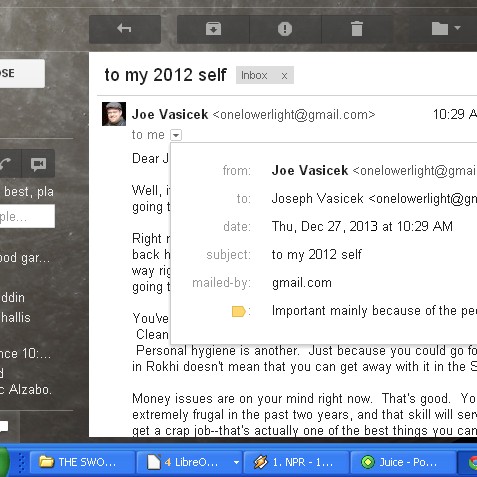
tomy2012selfSo shortly after writing up my last blog post, I got an email from myself marked December 27, 2013.  How freaky is that?I don’t know if it’s a glitch or a feature, but apparently in 2013, you can use gmail to send messages back in time.

In any case, the letter is pretty interesting, so I thought I’d post it.  Here it is:

Dear Joe,

Well, it’s been an interesting decade so far, hasn’t it? Not a bad time to be alive–and that’s going to be even clearer by the end of 2013.

Right now, you’re still in the Republic of Georgia, anxious to get on that flight and head back home. Don’t be. You’re going to miss that place, even though it’s hard to feel that way right now. Your time there has changed you a lot more than you realize, though it’s going to take most of the year for you to figure that out.

You’ve picked up some bad habits, mostly from the other expats. Swearing is one of them. Clean up your language–it’s not going to do you any favors, especially back in Utah. Personal hygiene is another. Just because you could go for days without showering back in Rokhi doesn’t mean that you can get away with it in the States.

Money issues are on your mind right now. That’s good. You’ve learned how to be extremely frugal in the past two years, and that skill will serve you well. Don’t be afraid to get a crap job–that’s actually one of the best things you can do right now. The economy hasn’t improved much since you left, but if you look in the right places and speak with the right people, you’ll be able to make ends meet without too much trouble.

Remember, your writing career should be your main focus. Don’t go chasing after the dollar. You’ve experienced a taste of success in the last few months, and you’re going to taste it again. It comes in spurts, though, so be prepared for that. You’ll figure it out–in fact, you’re already most of the way there. Just remember to keep your butt in that chair, and you’ll be all right.

By the way, you really should spend more time on your business plan. Don’t just use it as motivation to write something else–that stuff is actually important. In Georgia, you can get away with winging it, but not in the States. That’s going to take some getting used to as well.

Your biggest anxiety right now is your supposed lack of self-discipline. That’s actually not as much of a problem as you think. After spending a year in Georgia, you might feel incapable of working another honest day in your life, but that feeling will soon pass. In fact, 2013 is going to be a very productive year for you. All that self-discovery is going to pay off in a big way soon. So don’t worry about it so much, and remember, you haven’t written your best book yet.

Perhaps the most important thing about your year in Georgia is that it really lit a fire under your butt. You know what I’m talking about. If you can travel alone to a foreign country, you can work up the courage to ask her out. No, I’m not going to tell you who. You’ll know her when you see her. But you may have to trim the beard. Just sayin’.

You won’t spend the entire year back in the States, but when you do go overseas again, you won’t be alone. No, I won’t tell you who you’ll go with, or where. Some surprises are better left unspoiled.

There’s more I could tell you, but that’s enough for now. You’ll figure things out on your own, same as you always have. Hope for the best, plan for the worst. Follow the path of least regret.

Joe