Good things are happening!

It’s been a while since I posted a general update here on the blog, and while I’ve been sharing regular updates to my mailing list, enough has been happening that I suppose I should let all the rest of you know what’s going on.

First, I decided to pull out a bunch of investment money and put it into my writing, in order to go full-time for the next few months (and hopefully for the forseeable future). I shared more about this on my newsletter. Basically, I rewrote my business plan and decided that my best way forward is to go all-in for the next few months, writing more books and growing my business. I have a plan, and if it works, I’ll be able to go full-time indefinitely.

Second—and this may seem to contradict the first—I got a job at the local used bookstore, Pioneer Book! I’ve been going to this bookstore for years, befriending the manager and several employees, and several months ago (before I decided to reinvest in my writing business) I dropped off a resume in the hopes of getting a job there. When I got the call, I wasn’t going to turn it down.

It’s a part-time, 20 hours per week job that fits in perfectly with my writing. It’s also a job where I get to work with books, and be around bookish people, so I’m sure there will be lots of opportunities to learn interesting things that will help as I build my own writing and publishing career. Basically, it’s the perfect day job for a writer, and I’ve really been enjoying it so far.

Writing-wise, I just finished Gunslinger to Earth, the third book in the Gunslingers trilogy, and I’m finishing up the revisions to send it to my editor hopefully in the next few weeks. My next WIP is Edenfall, and I’m hard at work on it now. The goal is to finish it by March, and publish it over the summer.

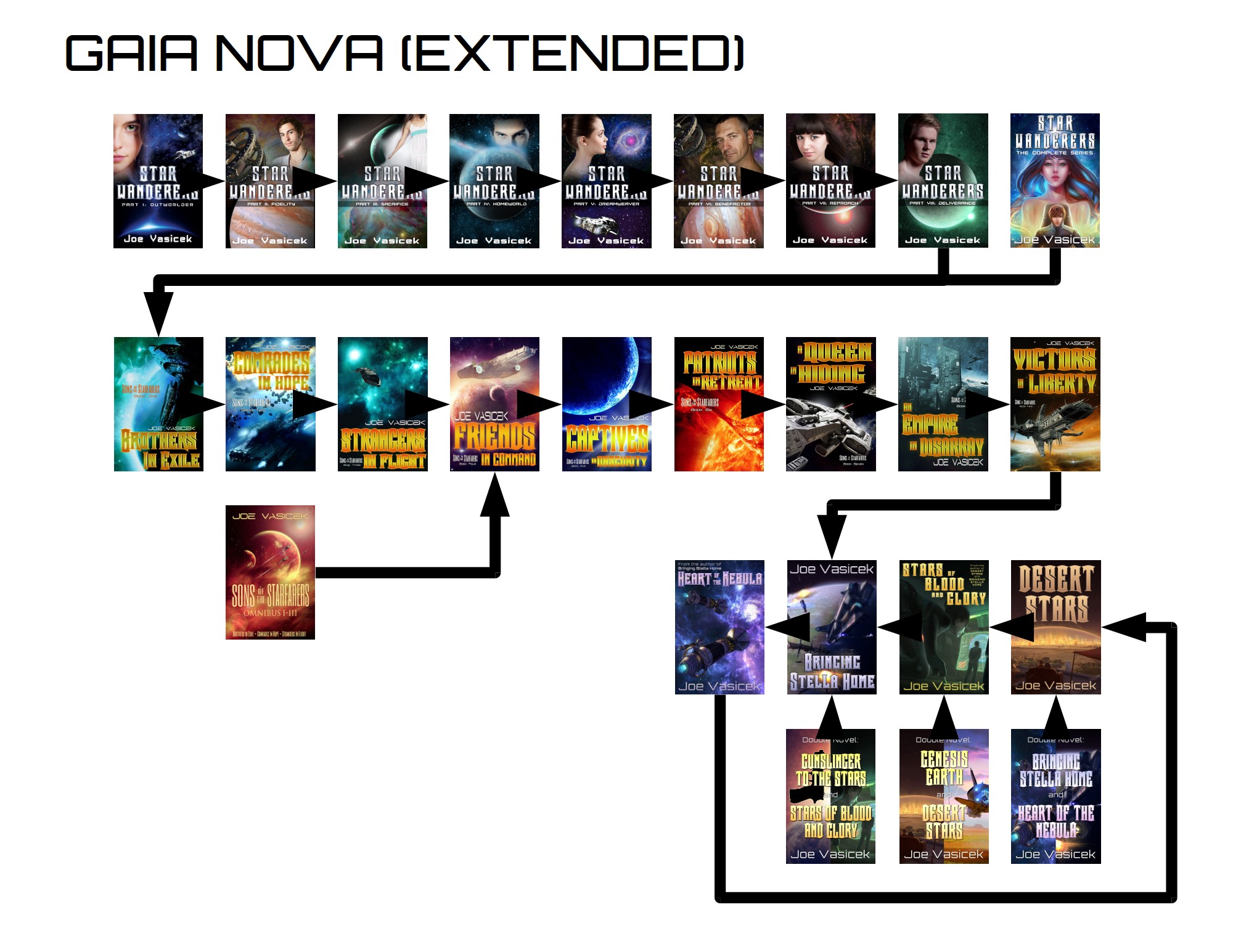
Publishing-wise, I’ve revamped the backmatter in my books again, with a new map for how everything connects to everything else. The biggest change is in my short stories, which aren’t mapped out here, but basically I’m going to focus on putting them into bundles, and have the singles point there. Eventually, I want to have only one or two singles for every bundle, with five to six stories per bundle. I have enough stories written to fill out four bundles, but a bunch of them are still out on submission, so it could take a while.

I’ve also been doing a lot more to build my email list, not just through Prolific Works but also through Bookfunnel, Story Origin, and MyBookCave. There is a method to the madness, and all of this fits into the wider plan. I’ve also updated the pricing on some of my books, and experimenting with AMS ads, though there’s not much to report on that front at the moment.

In short, I’ve been pretty busy. Most of my time and effort is going toward writing. I’ve got a very aggressive writing schedule for the next year, and hope to finish all of my trilogies before 2020, including the Genesis Earth trilogy and the Twelfth Sword trilogy. The way I have it planned out, if I can average 1600 words a day, I’ll be able to do that no problem.

As far as my personal life is concerned, I’ve been dating a really fantastic girl for the last few months and things are going very, very well. I’m not sure how much of that I should share, but you’ll probably hear more about it in the future, if not here on the blog, then definitely in my author’s notes and newsletter.

As of right now, 2019 is looking to be a fantastic year! I’m really looking forward to seeing what the rest of the year will bring, and I expect I’ll have lots of good things to share with you in the future. Take care, and thanks for reading!

A Change in Direction

This is going to be a rather long post. I’ll preface it with some demographic trends among my generation, then tie that in with my situation and how I got here. From there, we’ll see where it goes.

I was born in the early 80s, which technically makes me a Millennial, though it doesn’t always feel that way. Millennials get maligned for a lot of things, which is pretty typical of all generations as they rise, from what I can tell. Civilization is constantly under attack by barbarians, most of whom we call “children,” which is really just another way of saying this:

So how is my generation currently reinventing the world?

Thus far, not very well. The Great Recession hit us just as we were coming of age, and it shows. We were much more likely to move back in with our parents than previous generations. We’re putting off marriage and home ownership, some because we’re more focused on our careers, others because we just can’t seem to launch.

At the same time, not all of this is bad. In spite of the fact that most of us were never taught home economics or personal finance in high school (thanks, Baby Boomers, for all the participation trophies), we are rapidly learning more responsibility than our parents. Where six out of ten Americans would have to beg, borrow, or steal to cover a $500 emergency expense, nearly half of us Millennials have $15,000 or more in savings.

And yet, the problems we’ve inherited are truly daunting. Our national debt is $21 trillion and counting, and without facing a recession, war, or other emergency event, our deficit is still set to exceed $1 trillion per year for the forseeable future. Just this month, we learned that Medicare is set to run out of money in eight years, and Social Security is not far behind that. And don’t even get me started on the house of cards that is our national pension system.

Up until the 60s, previous generations saved and invested so that their children could be better off than they were. The Baby Boomers not only squandered this wealth, but they stole their children’s and grandchildren’s inheritance as well. History teaches us that there will be a terrible price to be paid for all of this. Our parents have proven themselves incapable of doing anything other than kicking the can down the road to oblivion.

That probably sounds more bitter than I intended it to be. Unfortunately, it’s the truth. Our parents just don’t understand the world that we’re living in. We’ve come of age in a world with far less opportunity than they did.

I had a conversation with my mother last year that demonstrates this. My mother likes to make cascarones for special events, like Easter or birthdays. To make them, however, you need a hollowed-out eggshell, which requires removing the yolk and whites in a very particular way. If you’re accumulating shells through normal consumption, it can get to be rather tedious.

One day, I came into the kitchen to find my mother blowing out eggshells and dumping the whites and yolks down the sink. She’d bought a whole bunch of them for 35¢ a dozen, and decided to just make the cascarones all at once instead of accumulating the shells over time. When I saw this, I was horrified.

“How could you waste all those eggs?” I asked.

“It’s not a waste,” she said. “They were 35¢ a dozen.”

“Yes, but we could have eaten them. That’s perfectly good food you’re dumping down the drain.”

She shrugged, as if it didn’t really matter. But I pressed her a bit further, until I came to a disturbing realization:

My mother has never been as poor as I am.

When I pointed this out to her, her answer was even more disturbing. With anger in her voice, she snapped “that’s because you choose to be poor.”
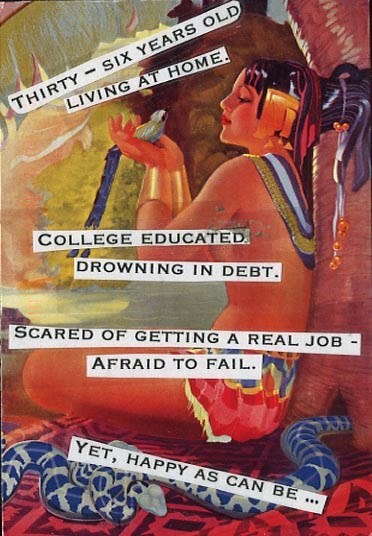
Is that true? Am I, a Millennial, poor because I choose to be poor? Perhaps. I’m not so irresponsible that I won’t own up to my life decisions, which have brought me to this place. But I think there’s this perception in the minds of our parents and grandparents that Millennials are generally like the person who wrote this postsecret above. Drowning in debt, living at home, so afraid to fail that we’ve utterly failed to launch, and yet blissfully oblivious to all of it. Perhaps that’s true for some of us, but not for those who will reinvent the world after our parents are gone.

To be clear, I love my mother and father. I don’t hold any of this against them personally, or anyone else of my parents’ generation (except the politicians who sold our Constitutional birthright, but that’s another rant altogether). Unfortunately, hard truths do not become softer because we choose to ignore them. And hard truth is this:

Hard men make good times.

Good times make soft men.

Soft men make bad times.

Bad times make hard men.
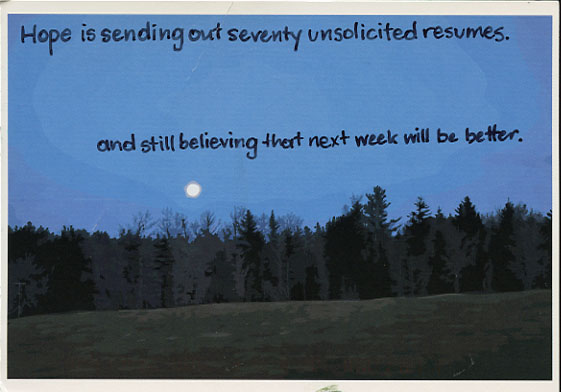
I graduated college in 2010. Through a combination of scholarship money, campus jobs, and (yes) generous parents, I was fortunate enough to graduate without any student debt. At the same time, it was the height of the Great Recession, and jobs were nearly impossible to come by. I can’t tell you how many of my writing friends put their dreams on hold, or abandoned them altogether. Almost all of them.

As a side note, I agree with Mike Rowe that “follow your passion” is bullshit advice. It ranks right up there with “be yourself,” and “you can be anything if you put your mind to it.” Don’t follow your passion. Follow opportunity, and take your passion with you.

But in 2010, I had an opportunity. Without any debt, and without any dependents or other obligations, I decided to pursue a writing career. And unbeknownst to me at the time, the industry was undergoing a revolution that would open the doors to make that possible.

I indie published my first short story, Memoirs of a Snowflake, in March 2011 and never looked back. Since then, I’ve published dozens of novels, novellas, short stories, and other works. It’s been an exhilarating journey. At the same time, it’s been the most difficult struggle of my life. And that is why I must now confront one of my most crippling fears.

Unlike the girl in the postsecret, I am not crippled by the fear of failure. If I were, I would never have published that first story, let alone all the others that followed. Instead, I have a fear of admitting failure, both publicly and to myself. It feels too much like an admission of defeat.

It’s an important distinction to make, though. The Romans admitted failure often and early—it’s how they learned from their defeats, ultimately going on to build one of the most powerful militaries in the ancient world. But they never admitted defeat. Even after Cannae, when Hannibal threatened the republic with utter extinction, the Romans refused to be defeated. And so, while Carthage fell into decline and decadence, the Romans endured until Scipio finally gave them victory at Zama, paving the way for the rise of Western Civilization.

I haven’t had a personal Cannae moment yet, but I do feel like I’ve been fighting a war of attrition. In 2014, the market shifted with the launch of Kindle Unlimited, and I failed to adapt. At that point, I was just on the cusp of going full-time with my writing, though looking back I can see that I didn’t yet have the foundation for a lasting career. Still, to have that dream snatched away when I was just on the verge of catching it, you can understand why I kept plugging along, believing that I was just a month or two from turning things around.

That’s basically what I’ve been doing for the last four years: writing full-time even though the writing doesn’t pay full-time wages. Maybe my mother is right. Maybe I have chosen to be poor.

And yet, while I now believe that I do have the foundation for a lasting career, I need to confront the fact that it may be ten years or more before I achieve it. Should I continue, like so many of my peers, to delay major life decisions until my career reaches that point? Is it worth it to put off marriage, family, and home ownership until my forties or fifties, if that’s what it takes? Or is it time to admit failure so that I can leave this dead end and find another way?

Back in 2010, I had no plan B. It was the Great Recession. I didn’t have a day job because I couldn’t find one—hardly anyone could. And from 2013 to 2014, writing paid well enough that I didn’t need one. Things were looking up, and I was just a couple months away from a sustainable long-term career.

Well, it’s time to admit that that line of thinking has turned out to be a trap. I’m approaching my mid-thirties and I’m still single and poor. I need some kind of long-term backup, because I can’t count on the writing career to take off like I need it to, at least not anytime soon.

So I’ve moved my writing onto a part-time footing. I’m limiting the number of words I write each day, leaving time for other pursuits. And I’m looking for a day job, preferably one that teaches me something useful and pays well enough to make ends meet.

I haven’t been defeated yet, though. Failure is not final until you decide to give up. I have not given up, and will continue to write, even if only on a part-time basis. And when I am making enough to go full-time, I have the foundations in place to do so.

In the meantime, though, I’m not going to put my life on hold for a dream.
Early October Update

Holy crap, so much to discuss. Where should I begin?

First, the writing is coming along well. I’m doing a quick revision of Patriots in Retreat to get it ready for publication in January. It’s actually much better than I remember. Hopefully the same can be said of A Queen in Hiding, because I’m finishing that one next.

My goal is to have A Queen in Hiding up for preorder by the time Patriots in Retreat goes live. To do that, I need to have them both published by the beginning of January. It doesn’t get any easier, either, because An Empire in Disarray needs to be up for preorder before A Queen in Hiding goes live in March, and I haven’t even started that one yet!

It’s a pretty demanding schedule, but that’s good, because I need more practice at keeping deadlines and schedules. And if all goes well, the Sons of the Starfarers series will be complete by summer 2018.

On the publishing end of things, I’m making some changes to my pricing strategy after reading an interesting post by Dean Wesley Smith. Will probably do a longer blog post on that topic. It’s all an experiment, so it will be interesting to see how it turns out.

So much other stuff happening on the publishing / marketing ends of things. I’m getting ready to put out print versions of everything I’ve published. That’s going to take a while. Also, I want to start experimenting with audiobooks. Lots of fantastic new opportunities have opened up there, and I need to figure out how best to take advantage of them.

On a more personal note, Friday was my last day at the day job. Good company and good people, but the work schedule was too inflexible, and it’s more important right now to pursue my writing career. With the money I’ve managed to save, I plan to move back to Utah and spend a few months working exclusively on the writing and publishing. Expect to see big things from me in the not so distant future!

Late September update

I am not a pleasant person to be around when I’m struggling to finish a difficult book.

Me: There’s just not enough time in the day.

Dad: I know how you feel, son.

Me: I don’t think that you do. You’ve never been self-employed.

Later…

Me: I need to quit my job.

Dad: But Joe, what about the benefits?

Me: Screw the benefits! I don’t want to be dependent on anyone for “benefits.” Besides, there’s a public pension crisis looming over this country, and in ten years your teacher’s pensions are all going to dry up. You can thank a decade of 0% interest rates for those “benefits.”

Like I said, not very pleasant.

So I had to push the deadline back another week for A Queen in Hiding. Really hate to do that. Problem is, the only writing time I can carve out of my schedule comes in short 1-2 hour chunks, and a single interruption can throw off everything. Like when a truck shows up during my lunch break. Or like when I’m playing catch-up and sleep in past my alarm.

It doesn’t help that every chapter, I run up against a wall that forces me to go back two or three chapters and completely change the direction of the story. This is definitely one of the weirdest books I’ve ever written. It’ll come together eventually, but it’s definitely taking more effort than it’s worth. Should lead the series in an interesting direction, though, and tie into the Gaia Nova series much further down the road. If I ever write any more of those books.

Anyway, so that’s coming along slowly. On the marketing end, I’m trying out a bunch of new things and/or working harder at things I’ve been doing for a while. All of my free and 99¢ book deals are scheduled through August 2018—now I just need to figure out how I’m going to promote them.

Not much is happening on the publishing front, other than The Sword Keeper which comes out this weekend. I’ve got a release schedule that runs through August 2018, which is part of the reason why I’m so stressed about getting Sons of the Starfarers finished. That series WILL be complete before the end of 2018, hopefully before July 2018. Four more books, of which 1.5 are currently written.

So that’s what I’ve been up to. Time to get back to writing.

3am thoughts, or why everyone says to be an accountant (Blast from the Past: October 2013)

A lot of my blog posts this week had to do with money, wealth, and politics, so when I was searching for an old post to bring back, this one made me stop and reflect for a while.

My opinions and perspective have changed a bit since I wrote it, but the fundamental message is still one that I agree with. I’ve trimmed out some of the parts where I think I was wrong, and left the stuff that still resonates. Hopefully it resonates with you as well. Either way, feel free to let me know.


I’ve been reading in bed on my smart phone recently, which is probably a bad idea because it makes it harder to go asleep. At the same time, it tends to get my mind rolling, and at 3am my thoughts tend to go some really interesting places. Sharing those thoughts is probably going to get me into trouble, but hey, you might find them interesting, so why not?

When I was eight years old, I knew I was going to be a writer.  There was never any question about that. I spent all my free time making up stories.  However, I knew I never wanted writing to be my job, because 1) everyone hates their jobs, and 2) everyone knows that writers can’t make a decent living. Even at eight years old, I had bought into some of society’s most pervasive myths about jobs, careers, and how to make money.

Americans are generally horrible with money. We struggle to keep budgets and put all sorts of things on credit, and pay more than twice what our houses are worth by signing mortgages we barely even read. Because we’re so horrible with money, we tend to see it as a magical force, something that can solve all our problems and make us happy. Rich people are like wizards or sorcerers, so far above the rest of us that we can hardly fathom their ways.

Nowhere is this stupidity more apparent than in the fact that most of us spend our lives working for some sort of hourly or salaried wage. Wages and salaries are basically the same, in that they convert time into money. That’s why we all measure income in terms of dollars per hour, or salary per year.  But for anyone who understands how money works, that is stupid, stupid, stupid, stupid. Money comes and goes, but time? Time is one of the most finite and precious resources known to man.

All of us are going to die someday. Most people are scared shitless by that fact, so we try to ignore it or put off thinking about it until we have to. But not all of us get the opportunity to put our affairs in order before we die. And even if we do all live to be centenarians, our time on this Earth is still finite. It’s non-renewable, too—you can’t go back and relive that day or that hour or that minute once it’s passed.

Converting time into money is basically trading gold for lead, or wine for water. Yet that’s exactly what we do, because money is this strange, magical force that so few of us understand.

Questions like “where do you work?” “what is your job?” and “what do you make?” are much more common than “what do you do for a living?” That’s because most of us have bought into this idea that money comes from working for someone else. While we’re on the clock, the company owns us and anything we produce. That’s the pact we make in exchange for this magical substance we call money.

It wasn’t until college that I started to become disabused of my childhood notions about writing for a living. First, I came to realize that lots of people love their work—that just because you do something as a job doesn’t mean that you’ll come to hate it. But it wasn’t until I graduated unemployed in the middle of a recession that I was disabused of the notion that writers can’t make a living.

People say that about every career—that is, every career except accounting. That’s because accountants are the ones who count the magical money. They’re the ones who know where it comes from. Their jobs are the ones that the people with the magical money will always need.

But there are other ways to make money—thousands of ways. Millions, even. It’s not about time it’s about producing something that people want and need. But when you’re working for yourself, that’s hard. You have to own up to your work—the failures as well as the successes.

When you work for a corporation, it’s easy to shift the blame. It’s a rare case where one person is solely responsible for bringing down the whole collective enterprise. But when you work for yourself, you can’t blame anyone else when things go wrong. You’ve got to take the risk.

That’s why everyone says that you can’t make a living as a writer. They say the same thing about any career where you strike out on your own.

In the end, though, it’s all just silly. Money isn’t a vague magical force—it comes from the value you create. It comes from producing something that people are willing to pay you for. And you don’t need to sell your time at $11 an hour or $44,000 a year to do that. You just need hard work, a great idea, and the ability to learn from your mistakes.

So can you make a living pursuing your dreams? The answer to that question depends entirely on you.

Things I Learned from Working in a Call Center (Blast from the Past: September 2010)

While poking around in the archives, I came across this interesting post from my first year out of college. At the time, I was just getting started in the labor force and wanted to learn as much from my jobs as I could—even the mundane ones. The result was this.


Over the summer I worked part time at a local call center.  At the time, it was just what I needed: a flexible job that helped me pay the bills while figuring out where I wanted to go next.  That said, I learned very quickly that call center work is not the sort of thing I want to do for large portions of my life.

I’m glad to say I quit my job on good terms with the management, and was one of their more productive interviewers.  I don’t harbor any hard feelings against the company I worked for or any of the particular employees.

However, I do want to reflect a bit on the nature of the work itself, which was less than awesome, as well as some of the things I learned about myself in the process.  Since this has nothing to do with the company I worked for, I’m not going to mention it by name.  Also keep in mind that the things I have to say are heavily influenced by my own opinions, so they may not apply to you.

That said, here are some of the things I learned from working in a call center:

1) In the long run, jerks only punish themselves.

I spoke with a lot of incredibly rude people in this job.  I also spoke with a lot of people who were courteous and well-meaning.  Without exception, the jerks seemed overstressed and miserable, while only the courteous people ever seemed genuinely happy and content with their lives.

I think the way we treat others says more about ourselves than anything else.  People who are mean and nasty to each other are never truly happy.

2) A small amount of patience makes most things go faster and smoother.

I hated it when people told me “just put ten for everything.” As an interviewer, I couldn’t do that—I was required to ask every question verbatim.  Those who were patient enough to let me do that got through the survey quickly and painlessly, while the impatient people who tried to rush things almost always got upset.

I think it’s safe to say that this has a general application as well.  When we’re patient enough to let things happen the way they’re supposed to, things happen faster and more smoothly.  When we try to rush things that shouldn’t be rushed, we screw up.

3) The ability to genuinely listen is a rare skill.

I can’t tell you how many times I asked a simple question on a survey, only to find the person on the other line answering something completely different.  I didn’t expect anyone to drop everything and devote their full attention to me, but how much effort does it take to answer a simple question?

I’ve known for a long time that listening is a skill that requires work to cultivate, but apparently, it’s also one that few people have truly mastered.  If you can’t understand a straightforward question well enough to give a yes or no answer, how can you understand something as complex as another person’s feelings?

4) Political campaigns are evil.

This is a little tongue in cheek, but I stand by it one hundred percent.  Every survey we conducted for a political campaign asked questions that were clearly geared toward developing negative campaign ads and manipulating public perception.  None of them asked how the government could best serve the people.

5) Having a flexible work schedule makes writing both easier and harder.

It makes it easier because you can plan your time around other things that are going on; it makes it harder because your days generally have less structure.

I think I hit a pretty good balance by working in the morning and writing in the afternoon, then going in to work again in the evenings if I needed the hours.  Call centers are always looking for people to work in the evenings.

6) Reducing everything to numbers makes human interactions meaningless.

This was, by far, the thing I found most frustrating about my work.  I talked with hundreds of people from all over the country and didn’t connect with hardly any of them on a personally significant level.  It was all about checking off boxes, where each completed survey was just another number in the system.

This tended to be more true of the short surveys, less true of the longer ones.  For that reason, I loved it when I got a survey that took twenty or thirty minutes to complete.  It’s very hard to talk with someone for thirty minutes without making some kind of a connection with them, however fleeting.

7) If you have a love of learning, find a job that lets you use your mind.

To be perfectly honest, I never felt completely satisfied at my work.  A robot with sufficiently advanced voice recognition software could probably have done my job as well as I could (at least for the ninety second surveys).  Over time, I felt like my work was turning me into a robot.

That’s ultimately why I felt I had to get out.  Maybe I have a problem with authority, but I can’t stand being just another cog in the corporate machine.  There’s got to be a way to pay the bills and still live life meaningfully.

Image courtesy W. Lowe

New day job, new routine

So I just got a part-time day job with Monsanto, here in the Des Moines area. My brother-in-law works as a scientist there, so he was able to connect me with the right people. It’s basically a warehouse job, handling all the shipping and receiving as well as the inventory. The hours are perfect, the job is interesting, and the people are really awesome, so I think things are going to work out really well.



Of course, that means adjusting to a new daily routine, which is why I neglected this blog all last week. Writing takes priority, so I’ve been focused on that first. I’m currently working on a short story prequel to Gunslinger to the Stars, which should be done later today and up for you guys to read before the end of the month.

I’m really, really excited about Gunslinger to the Stars. I think it’s my best sci-fi adventure novel yet. It’s coming out right around the same time as Guardians of the Galaxy 2, which also looks really awesome. Think Guardians of the Galaxy meets Monster Hunter International, with a heaping dose of Firefly mixed in for good measure. That’s Gunslinger to the Stars.

Gunslinger to the Stars

Gunslinger to the Stars

$15.99eBook: free sale!Audiobook: $2.99 sale!

Sam Kletchka here, freelance gunslinger and interstellar privateer. This, my friends, is how I went from being stranded in the armpit of the galaxy to becoming the luckiest human being in the universe.

More info →

Lots and lots of stuff going on, but it looks like things are finally settling into a new routine. I should have a lot more for you guys in the future.

Have a fantastic weekend, and thanks for reading!

Take me to Arabia

Recently, I’ve found myself nearly overwhelmed by the sudden urge to run away to the Middle East and go totally and irrevocably native.  It may pass, but I still want to go back there–really bad.

So I looked up BYU’s TESOL certification program, and figured I could apply in January, start fall of ’11, and be on my way to an Arabian adventure in ’12.

Or…I could bypass the whole certification thing altogether, but I’d probably get a crappier job.  Besides, the certification could lead to other things, like perhaps an actual stable day job.  Who knows?

Regardless, I should probably find some way to actually use my Arabic degree.  After all, why did I get it in the first place?  Better put it to use!

So why am I tripping out on Middle East stuff?  Interestingly enough, I think it has a lot to do with the current novel I’m writing, Worlds Away from Home. I started it in fall ’08, just after getting back from BYU’s 2008 Jordan study abroad program, and the influence is definitely very visible.

Sometimes it makes me cringe a little, though; the fictional culture is patterned after my understanding of and experiences with Arab culture, but…it’s very pseudo Arab, if that make sense.  Kind of like it looks Arab, but it feels more Western.  I don’t know–I guess what I’m saying is that it’s bad (or maybe I just think that because I’m in the middle of the rough draft, when everything I write is utter and absolute crap.  Blegh).

But the thing is, if I try to make the culture truly foreign, I’m worried it will be more of a barrier to the reader than a gateway.  In other words, it’s the classic science fiction problem of aliens: the more you succeed in making your aliens truly alien, the harder it is for the reader to understand or sympathize with them.

But then again, isn’t that why we read?  To be transported to different times and places, experience other people and cultures, and be exposed to new ideas?  To expand our minds and enrich our understanding?  If that’s the case, there’s got to be something good and healthy about immersing the reader in a totally foreign culture.

Unfortunately, that doesn’t make it any easier.

Oh well.  I’m up for the challenge.  In the meantime, I’ll keep reading T. E. Lawrence’s The Seven Pillars of Wisdom and continuously loop all my Arab pop.  Not familiar with Arabic music?  Here’s a really good one:

Track 5

(ps: I’d tell you who wrote/performs the song, but frankly I have no idea.  Unfortunately, copyright doesn’t really exist in the Middle East.  Oh well.  Enjoy!)