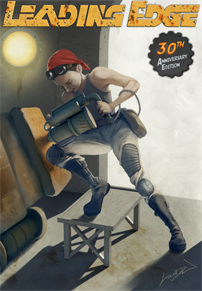
Trace the Stars edited by Joe Monson and Jaleta Clegg

I picked up my paperback copy of this anthology at LTUE this year, and immediately set about collecting all of the signatures from the authors that I could find. I’ve currently got everyone except for Nancy Fulda, Wulf Moon, Beth Buck, and Julia H. West. Once I have acquired these last four signatures, it will transform at last into a mighty book of power!

So I only gave this anthology three-stars on Goodreads, but that’s not because it’s a bad book. Rather, it’s because my Goodreads rating philosophy is different from my Amazon rating philosophy. A three-star on Goodreads is more like a four-star on Amazon: not terrible, but not super great either. I reserve my five-stars on Goodreads for the best of the best, the truly life-changing books that will forever leave their imprint upon me.

Anyways. Overall, I’d say that the anthology was pretty even-keel. There weren’t any amazing stories in it, but there weren’t any stinkers either. My favorite was “The Road Not Taken” by Sandra Tayler, about a starliner passenger who was subject to a freak anomaly that created a duplicate of the ship. One of them got the husband and the family, while the other got the career, and they meet up once a year to see how the other is doing. No matter what they say, you really can’t have it all.

I also really liked “Angles of Incidence” by Nancy Fulda. The aliens were really fascinating. Deep sea lava vent dwellers with knobby shells, but the really interesting part was the development of their language and how that factored into the story. Also, a slumbering god-queen who devours anyone who dares to wake her. Fun times.

Brad Torgerson’s and Kevin J. Anderson’s stories appealed to my inner twelve year-old, as did David Farland’s (though it had a rather slow start). “Cycle 335” by Beth Buck had a twist that I really enjoyed. The ending of “Neo Nihon” by Paul Genesse was also very satisfying, though wow—what a dark story!

Those were the ones that really stuck with me. The others weren’t bad—like I said, there weren’t any real stinkers. For a benefit anthology, it was pretty good. I’m looking forward to picking up the next one at LTUE 2020, as well as collecting the last four signatures and turning this into a book of power! Bwahahahaha!


Trope Tuesday: Pet the Dog

Awwwww!!

The basic principle behind this trope is that when you want your readers to feel some kind of sympathy toward a character, have them pet a puppy / puppy equivalent.  Often used to show who the good guy is, but can also be used to add depth to a villain.

I first learned about this trope in Brandon Sanderson’s English 318 class, where he taught it as a way to build immediate sympathy when introducing a major character.  A good example from his own work is Mistborn, where Kelsier’s first scene shows him giving the manor lord’s food to the skaa.  From that moment on, there’s never really any doubt that Kelsier is the good guy.

Although often used to introduce a good guy, this trope can also be used quite effectively in the middle of the story, especially in a gray and black world where it seems that everyone’s a bad guy.  A good example of this is Shadow from American Gods, who flips a coin with a hitchhiker to see who pays for dinner.  Even though he’s a thief and an ex-convict, he rigs the coin toss so that he can pay for her.  Through little gestures like this, Gaiman maintains rooting interest in his protagonist, even though everyone else in the novel is basically a jerk.

Another good example from a darker work is Angelo Osic from On My Way to Paradise.  On the very first page, a fugitive shows up at his pharmacy booth, asking him to grow her a new hand.  Even though he knows it’s dangerous, he takes her in and does what he can to help her.  Later on, this same character rips out a man’s testicles and guts him like a fish.  As repulsive as that is, however, I still keep rooting for him because I know that at his heart, he’s a good person.

Of course, when used most effectively, the pet-a-puppy moment has to grow naturally out of a person’s character.  Even though Shadow is an ex-con, he served his time and feels genuinely sorry for what he did.  Angelo Osic is a doctor, so it’s natural for him to try to help others; whenever he commits an act of violence, a part of his humanity dies, which becomes a major driving conflict throughout the book.

Don't. Touch. Me.

Finally, though this trope is often used to create rooting interest in a protagonist, it can also be used to add depth to a villain.  A prime example for this is Captain Nemo from 20,000 Leagues Under the Sea.  The first moment happens when he rescues the main characters after their ship sinks, but it happens many more times too, such as when Arronax finds him weeping over a picture of his family.  At the end of the book, even though we know that Nemo is the bad guy, we can’t help but feel a little sorry for him after he’s gone.

Puppy image courtesy Wikimedia.  Cat image taken by me.

NPR’s Top 100 Science Fiction & Fantasy

In case you didn’t know, NPR just put together a list of the Top 100 Science Fiction and Fantasy novels of all time.  The list had a panel of judges who vetted nominations, but the voting was public and turnout–over 60,000–was pretty high.

I usually don’t like top 100 lists, but this one did a pretty good job representing the genre.  I recognized about 2/3rds of the titles, and most of my own personal favorites were included.

There were a few notable exceptions, however.  David Gemmell wasn’t represented at all–a travesty of the highest proportions.  Neither was C.J. Cherryh, which I find very surprising.  Robert Charles Wilson has certainly written some books worthy of the list, and Dave Wolverton’s On My Way to Paradise–which, I would argue, is one of the best science fiction novels ever written–was notably absent.

Also, a few of the titles were further down on the list than I would have put them.  The Dispossessed by Ursula K. Le Guin came in at #78, while I would have put it at least in the top 20.  A Canticle for Leibowitz did better at #35, but was it really an inferior book to The Handmaid’s Tale?  Come on, people.

One thing I don’t think this list represents well (or top 100 lists in general) is the way in which sf&f fandom has split into dozens of communities and tribes, almost like Darwin’s finches on the Galapagos Islands.  Before science fiction went mainstream, it was possible to follow all the various titles and developments.  Now, however, there’s so much out there that it’s impossible to be fully cognizant of everything.

I think fandom has split into some very distinct communities clustered around the popular authors and sub-genres, and there’s not a whole lot of overlap between them.  None of them are large enough to spawn an entirely new genre (with the possible exception of paranormal romance), but lumping them all into science fiction & fantasy can be a bit problematic.

That said, I think this is a pretty good list.  What do you think?

Shoot your fans?

Today’s issue of Dave’s Daily Kick was titled “Hooking Credibility,” and I’m not sure what I think of it.  At the end, Dave’s brother Tailspin Jim had the following to say:

What I’m about to add is so basic that [Dave] would never think to include it, but you may be like the vast majority of Kick readers who just don’t have his depth of background on this subject or who would be benefited from taking a look at it.

Each hook or marketing ploy is like firing a bullet at your reader. You probably won’t kill their resistance with the very first shot. You want to fire bullet after bullet until they collapse and make the decision to buy.

Not only does this statement smack of everything I hate about sales and salespeople, but it seems to fundamentally clash with the new reality of publishing.

With social networking and the internet, writers can now connect directly with their readers.  For those going the indie route, this is absolutely essential.  The key element to success, from what I can see, is developing an ongoing relationship with your fans–one in which they take the role of patron, not merely consumer.

There’s a huge difference between thinking of readers as patrons and thinking of them as consumers.  If they’re just consumers, then the end goal is to get them to buy your product, and there’s nothing wrong with spamming them or shamelessly plugging yourself if that’s what works.

But if they’re patrons, the end goal is to develop that relationship–to connect with your readers on a meaningful level, both before and after they buy your work.  And in this brave new world of publishing, that seems like the best coarse to take.  Consumers have to be sold on each individual book; patrons are sold on you, so they’ll read everything you put out.

And as a reader, that’s how I buy.  Whenever I find an Ende or a Wilson or a Le Guin in the bookstore, I rush to grab it, because those are the writers who speak to me.  I’ve bought just about every Sanderson in hardcover because I love his work and want to support him.

That’s why this comparison of bookselling to “a series of bullets being fired from an automatic rifle at the prospective buyer” rubs me in all the wrong ways.  I’m not just peddling widgets; I’m creating art and sending it out into the world, waiting patiently for it to return back a hundredfold.  And if I work hard to create the best possible art and treat my readers (aka you guys) as my patrons, I sincerely believe that it will.

So to all of you who have read my books, regardless of whether you bought them or downloaded them from Smashwords for free, I just want to say thank you!  The greatest honor any writer can have is to be read, period.

I also want you to know that I’m never going to “shoot” you with a bunch of cheap sales tricks or “hooks” that get in the way of the story.  I’m just going to write damn good books and put them out where you can find them, trusting you to rate, review, like, and share them if you feel they truly deserve it.

I will never, ever, EVER put a gun to your head to get you to buy my work.  I’d much rather you jump at the chance to read a Vasicek, because that’s what speaks to you.

Another publication in Leading Edge!

That’s right!  My poem “Zarmina,” dedicated to Gliese 581 g (the first exoplanet discovered in its sun’s habitable zone) is published on page 98 of issue 61 of Leading Edge!

Also included in this issue is an excellent essay by Brandon Sanderson, in which he introduces his second law of magic systems.  It’s an excellent essay, and has made me rethink how I do FTL systems, especially for the Gaia Nova universe.  I’ll have to do a post a little later on that.

Besides this landmark essay by Brandon Sanderson, this issue features stories by Dan Wells and Dave Farland, as well as an interview with Howard Tayler.  And as always, it includes a number of excellent stories and illustrations.  Check it out!

(Full disclosure, I volunteer as a slushpile reader and occasional copy editor for the magazine.  However, my work always goes through the submission process under a pen name, where only the head editor knows who I am until the decision on whether to acquire the story has been made.)

In other news, Genesis Earth is now up on Goodreads, so go check that out as well!  The nice thing about Goodreads is that you can give the book a # star rating without having to write out anything else.  If you’re so inclined, I would very much appreciate an honest review–but if you do give it a rating, please be honest.  Don’t worry; even if you give me less than five stars, I won’t hunt you down like this crazy author (hint: get some popcorn and read the comments).

So anyhow, that’s what’s been going on here.  Desert Stars is coming along slowly but surely, and I’m working on getting some cover art for Bringing Stella Home.  If you have any ideas or suggestions on the art, please let me know.  I’ll probably go through my back issues of Leading Edge to search out good sf artists.  For some reason, I’m having a hard time finding anything that clicks on deviantart.  My goal is to epublish that book by the end of July.

Wolverton interview and more

The interview with Dave Wolverton was a resounding success!  We had a fascinating conversation about science fiction and the gospel, his latest book In The Company of Angels, self-publishing, the English 318 class at BYU and the profound impact it’s had on the LDS writing community, and much, much more.
On that, I suppose I should disclose my full reasons for going down to St George and meeting with Dave.  I’m putting together an article for the December 2010 issue of Mormon Artist, where I hope to give a brief history of BYU’s “class that wouldn’t die” and explore the impact that it’s had on both the LDS writing community and on mainstream sf&f.

The “class that wouldn’t die” was the group of students who signed up for the first English 318R science fiction creative writing class at BYU, back in ’78 (I think it was ’78…gotta check that).  After the semester was over, the students banded together through forming a writing group, which they called “Xenobia.”

They didn’t stop there, however.  As Xenobia grew and matured, the students decided to form other organizations designed to help new writers (especially sf&f writers) improve their craft and build their writing careers.  Specifically, they founded Quark, BYU’s science fiction and fantasy club; Leading Edge, a student-run magazine that gives written feedback to every story submitted; and LTUE, an annual science fiction and fantasy symposium (like a convention, only no costumes).

These organizations, as well as the 318 class, led directly to the explosion of LDS writers in science fiction and fantasy.  Several bestselling LDS authors, including Stephanie Meyers, Brandon Sanderson, and Dan Wells (among many others) can trace the launch of their careers back to this class.  In turn, these authors are having a tremendous impact on mainstream sf&f literature.

The article is slated to come out in next December’s issue of Mormon Artist Magazine, just in time for LTUE 2011 (which I hope to attend).  Right now, I’m in the research phase, meeting with some really amazing people and gathering some fascinating stories.  This article is going to be awesome.

In parting, let me share one of the more interesting things Dave said in the interview.  As we talked about all these amazing resources available for sf&f writers in Utah valley, I asked him why this happened in this community and not elsewhere.

His answer was extremely insightful: for many writers, the mentality is that once you break in, you have to close the gate behind you.  It’s something of a zero-sub game, where people horde their ideas, compete with each other to break in, etc.

Not so in the LDS community.  As Latter-day Saints, we have a deep-set mentality of helping each other and building each other up.  That’s exactly what happened with the “class that wouldn’t die”–they did everything they could to foster other writers.  The proliferation of Latter-day Saints in mainstream sf&f is a direct result of this.

That’s Dave’s take on it, anyway.  It will be interesting to hear what others think.

Oh, and FYI, Mormon Artist is 100% volunteer run and free, so when the article and interview come out, you won’t have to pay anything to read them.  I’ll certainly provide links on this blog–stay tuned!

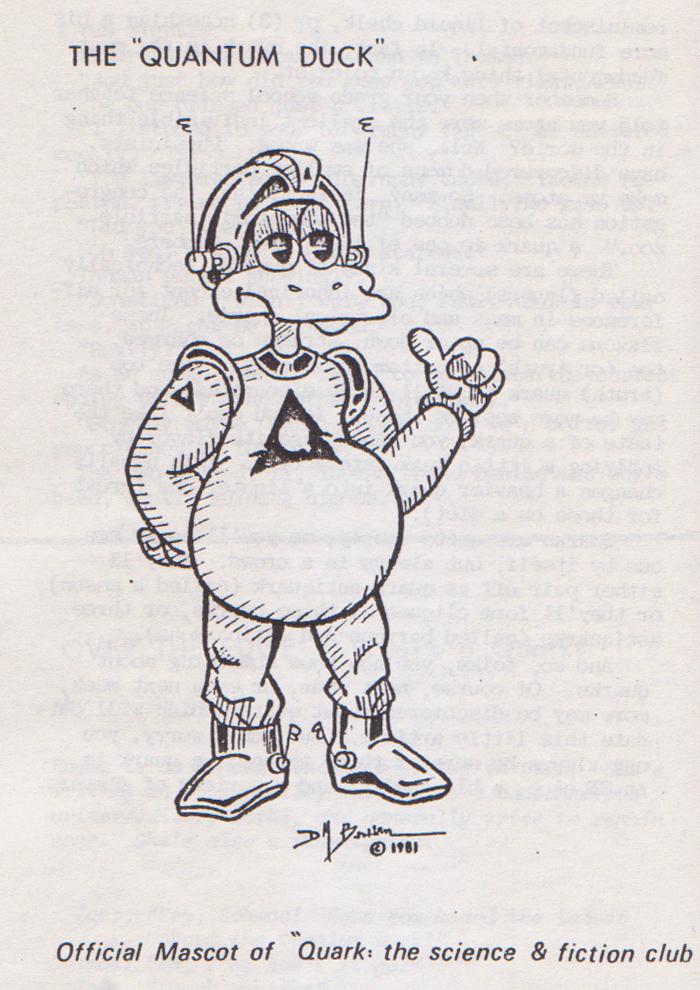
And as one final note, check out this piece of Xenobia history: the original Quantum Duck, as featured in the first issue of The Leading Edge.  Why a quantum duck, you ask?  Because that’s where the club’s name came from: a bumper sticker that said: BEWARE THE QUANTUM DUCK THAT GOES ‘QUARK,’ ‘QUARK’!

T-minus 600 hours and counting

Haircut: check.
Clean clothes: check.
Bag lunch and dinner: check.
Chilled water bottles: check.
Directions to St George from Provo: check.
Interview questions: check.
iRiver 800 with sufficient recording space: check.
iRiver to USB cord: check.
Extra batteries: check.
Asus netbook: check.
2003 Buick LeSabre Custom: check.
4+ hours of ocremix and other music: check.
Copy of On My Way to Paradise to get signed: check.

Tomorrow I am going on a road trip to St George, Utah to interview bestselling author Dave Farland (aka Dave Wolverton) for Mormon Artist magazine.  Wish me luck!

The time sink

Man, life is different outside of school.  So much time, so little structure.  I find that I either write a lot, or I get distracted on some side project and write almost nothing.

For example, my bike broke down last week.  Since that’s currently my only form of transportation besides walking, I spent a good amount of time this week fixing it.  In fact…I took it apart and completely rebuilt it on a new frame.  It was fun, educational, satisfying, and a good way to meet girls, but it took a lot of time away from writing.

Job hunting is another example.  I signed up with a temp agency this past week, but haven’t seen any work yet, so I’m still somewhat antsy.  It’s not easy watching money leave when you have no way to replenish it.  But when your mind is on getting a job, it’s very hard to think about anything else.

I dunno.  Maybe I’m just very bad at multitasking.  But tonight, for the first time in a few days, I put all that aside and completely submersed myself in the act of writing.  Boy, it sucked up a lot of time…but at the end, it felt so good.  So satisfying.

I need more of that, if I’m going to make this writing thing take off.  Got to outline a space for every necessary thing (including writing) and be careful about not overfilling that space.  Looking for work is good, but thinking about it so much that I don’t have time for other things, that’s not good.

In the meantime, I’ll try to find some balance and update this blog more often.  It’s my only active blog now, so I figure I should write more frequently.  One thing I want to do with this free time is read more; I read a George R. R. Martin book last week, and I’m finishing up Dave Wolverton’s On My Way To Paradise for the second time right now.  Expect some book reviews in the near future.

(hmm…I wonder if I could find a way to review books and get paid for it?)

“Why people read”

Dave Farland puts out this great e-newsletter called “Dave’s Daily Kick-in-the-Pants.” For the kick today, he suggested the following exercise:

You probably have a good idea about what you want to write—horror, mainstream, fantasy, historical, romance, westerns, religious fiction, and whatnot. Sit down for ten minutes and on the left-hand side of your paper, list five things that you feel you most like in the fiction you read. On the right-hand side of your paper, list the biggest potential danger that you see in trying to create that effect.

Doing this exercise will help you understand who your potential audience is, and some of the challenges that you may face in reaching that audience.

This was my response:

Why I read:

1) To meet interesting characters and get lost with them in an exciting fantastic world.

2) To think deeper about fundamental truths I see in my own life.

3) To feel like I understand another person and connect with them.

4) To be reassured that true heroism is real, alive, and within the realm of possibility.

5) To experience beauty in the language and metaphor, the imagery and tension.

Potential dangers:

1) Trying to write about a world without a story–all info dumps, exposition, lacking interesting characters with whom the reader can journey and experience the world.  Story IS experience, and experience does not exist independent of the person doing the experiencing.

2) Waxing allegorical or didactic in the writing–trying to force the message instead of leaving it open for the reader to discover multiple layers of meaning.

3) Focusing so hard on the character that the plot lacks the structure and tension to keep the reader interesting.  Characters do not exist separate from plot or setting; they change and grow in reaction to both.

4) Creating a hero whose struggle is so far removed from the real world or our real life experience that the reader feels that this type of person could only exist within the pages of a book.  Or, trying so hard to follow the monomyth structure that the story falls flat (ie Star Wars I, II, III).

5) Thinking that poetic license frees you from basic rules of style and grammar.  Creating metaphors that are so unusual that they are merely non sequiturs.  Writing prose so thick and “literary” that it kicks the reader out of the book.

Breaking 90k and other mundane excitements

(I almost always have trouble figuring out titles for these blogs posts.  I mean, my writing life isn’t all that exciting–I just write.  Check out my study abroad blog from last year for true (if old) excitement).

I broke 90k words in Bringing Stella Home today.  According to my goal of 120k, that’s the 3/4 mark.  Yay!  I’m happy to say I’m going strong, and will probably “finish” this thing in a couple of weeks.

I say “finish” because it needs a LOT of work.  Oh yeah.  Not even ready for the alpha readers yet.

But I’m excited for the story.  Dave Wolverton at CONduit this past weekend suggested full and complete immersion as a way to write well.  I think that applies here: without school or a job, I basically write all day.

Speaking of which, I haven’t quite gotten up to doing 4k words steadily each day.  Right now, I’m hovering at around 3k, which is twice as much as my daily wordcount during the school year, but not yet up to where I want it to be.

However, getting up to that level is like training your muscles.  Through a number of small, intangible things, I feel that I’m working myself up to the 4k/day level.  

For example, I’ve been opening my word document and plugging out the first few hundred words BEFORE I open a web browser and waste an hour of time checking out my favorite blogs and websites.  That’s progress.

I’ve also started writing more in the time that I set aside to write.  These days, I usually write for a couple hours from 11pm to 2pm, take lunch and do something to recharge my creative batteries, do some more writing in the midafternoon (usually not too much), then take dinner, head out to the library (because the parking gate opens at 7pm) and write until about 11:30pm when the LRC closes.

In each of those three blocks of time, I used to be getting around 800 to 1,200 words done.  Today, from 11am to 1pm I wrote about 1,500.  Progress.

The bar says that I only did about 2,9k today, but that was because a good friend of mine is going active duty in the Air Force and his farewell party was tonight.  Also, Leading Edge took up the 7pm to 9pm slot.  So, without those things, it probably would have been 4k.

However, I’ve noticed something interesting: doing the math, 4k/day equates to just over 120k per month.  120k is a freaking novel!  Taking out Sundays, that’s still over 100k, which is also an acceptable novel length.  

So…if I were really doing 4k/day, would I be writing a rough draft of a novel each month?  Or are most published writers doing less than 4k words of new material each day?  I wouldn’t be surprised–this is not a business you get into because of your glowing math skills.

Regardless, 4k/day is still my goal.  Heck, if I get used to writing that much and find that the practice improve my craft, I might even go up to 6k/day.

Oh, and one more mundane excitement: Charlie got freaked out by a spider today and had me come over to hunt it down.  After sprawling out on her bathroom floor and looking under all the appliances, I didn’t find it–but I did find the hole that it probably escaped through.  I didn’t think it was much of a deal, until I read this post from Miss Snark’s archives.  So…I may start making it a practice to shake out my shoes from now on, especially since my room in my sister’s apartment is slightly buggy.

Fortunately, I usually wear my old pair of Birkenstocks these days.  Awesome footwear.  I quite literally love them to pieces.