Some people say that Science Fiction writers are in the business of predicting the future. In fact, that’s only partially true: we don’t predict the future so much as we show people what possibilities the future may hold. But strategic forecasting is a real business, and the foremost personality in that business is George Friedman.
In a world run rampant with hyperbole and sensationalism, Friedman’s analysis consistently stands out for its calm and measured rationality, as well as its ruthless incisiveness. As cordial and softspoken as Friedman can be, he does not mince words or walk on eggshells. He calls it the way he sees it, and he sees some very interesting times coming in the years ahead.
In Flashpoints, Friedman analyzes the current situation in Europe by placing it in the context of history, beginning with the Age of Exploration and culminating in what he calls “the thirty-one years.” From 1914 to 1945, more than 100 million Europeans died of political causes, the most spectacular human catastrophe of the modern era. The question he asks is whether Europe has truly changed, or whether we are on the verge of a return to the savage cruelty that defined the 20th century.
Friedman’s take on the history of the continent is quite fascinating. He points out a number of things that most histories overlook: for example, that European unification was originally an American project, imposed on a recalictrant Europe as a means to counter Soviet expansionism. In any war with the Soviets, West Germany would be the first line of defense, and therefore NATO and the Americans needed a strong West Germany and a united continent. Thus, the European Union started as an essentially American project—something the Europeans often forget.
The thing that really made this book fascinating, though, were the numerous personal insights from Friedman’s own life. As a Hungarian Jew whose mother was a holocaust survivor and whose father was conscripted to fight in Operation Barbarossa, Friedman’s personal story is just as fascinating as the story he tells about Europe. The two weave together in a way that offers a unique and powerful perspective on the challenges currently facing the continent, providing insights that can’t be gleaned in any other way.
Friedman’s writing is remarkably clear. His analysis is eye-opening, and his predictions are compelling. By the end of the book, I not only felt like I had a better understanding of Europe, but a better understanding of humanity as well.
In my opinion, this is Friedman’s best book. The Next Hundred Years was quite excellent, but a project that large in scope couldn’t help but feel a little fantastic. The Next Decade was also good, but it had neither the grand scope of The Next Hundred Years nor the depth of focus of a book dedicated to a single geopolitical question. Flashpoints possesses both that depth of focus and the grand scope of historical context, tracing the rise, fall, and rebirth of what is simultaneously the most savage and civilized continent on this planet. It’s a fantastic book, and I highly recommend it.
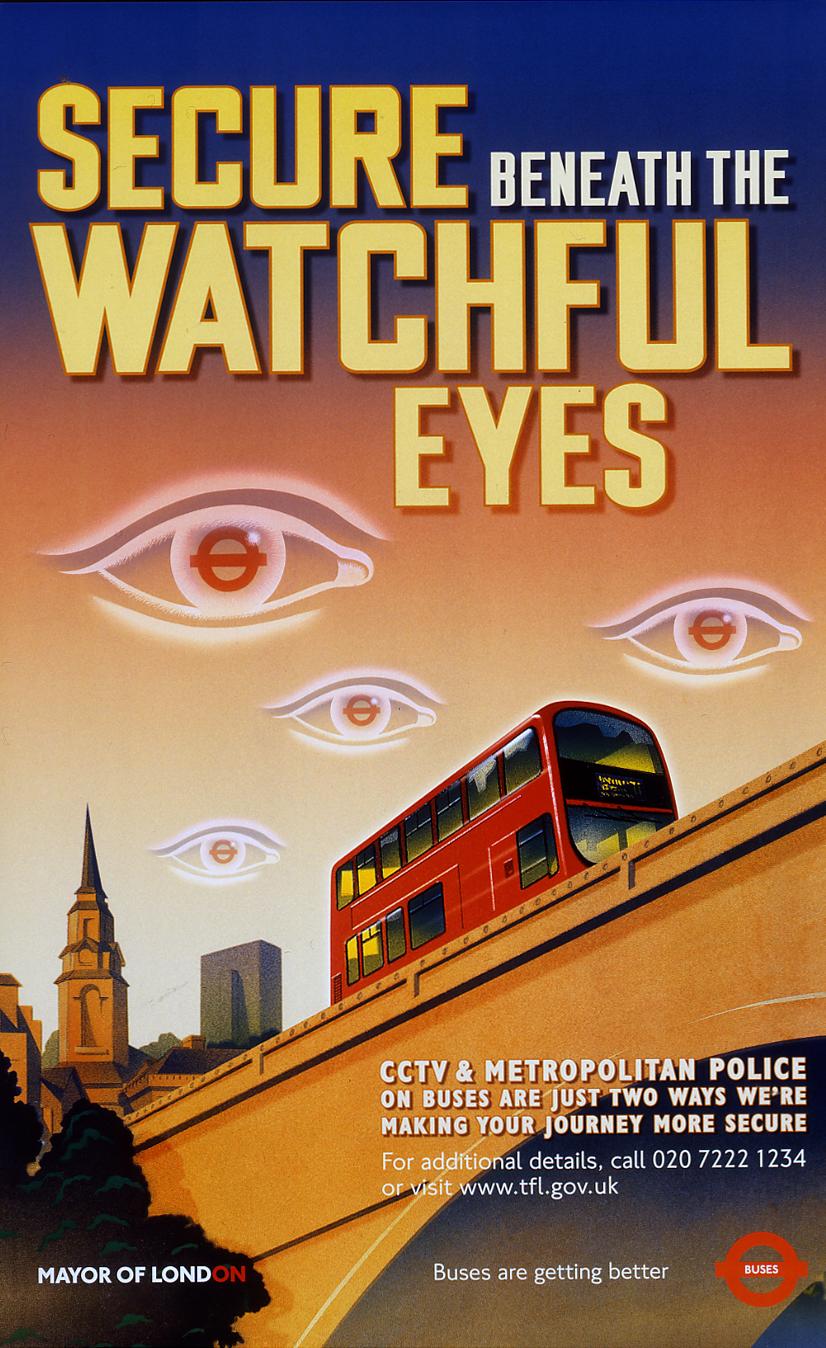
Sinister Surveillance is a hallmark of Dystopia, as essential to the genre as the Crapsack World and the Police Brutality tropes. Often, you’ll find all three in the same story together. It’s closely related to Big Brother is Watching, where the government is so powerful, and reaches into so many aspects of everyday life, that they see and record everything you do. Where Big Brother shapes every aspect of the society, however, down to the language of the citizens and the basic truths accepted as facts, Sinister Surveillance is more about the surveillance itself, and the ulterior motives behind it.
It’s not enough for the government to simply watch you, though. Even more important in some ways is the idea that you don’t know what they can and can’t see. The reason for this is the same reason why, in horror stories, we almost never see the monster until the very end–because our imagination makes things a lot scarier than they really are. If we the bad guys know the limitations of our government surveillance, we they can safeguard our privacy and basic rights game the system. We’re all afraid of the dark, not because of what’s actually there, but what could be.
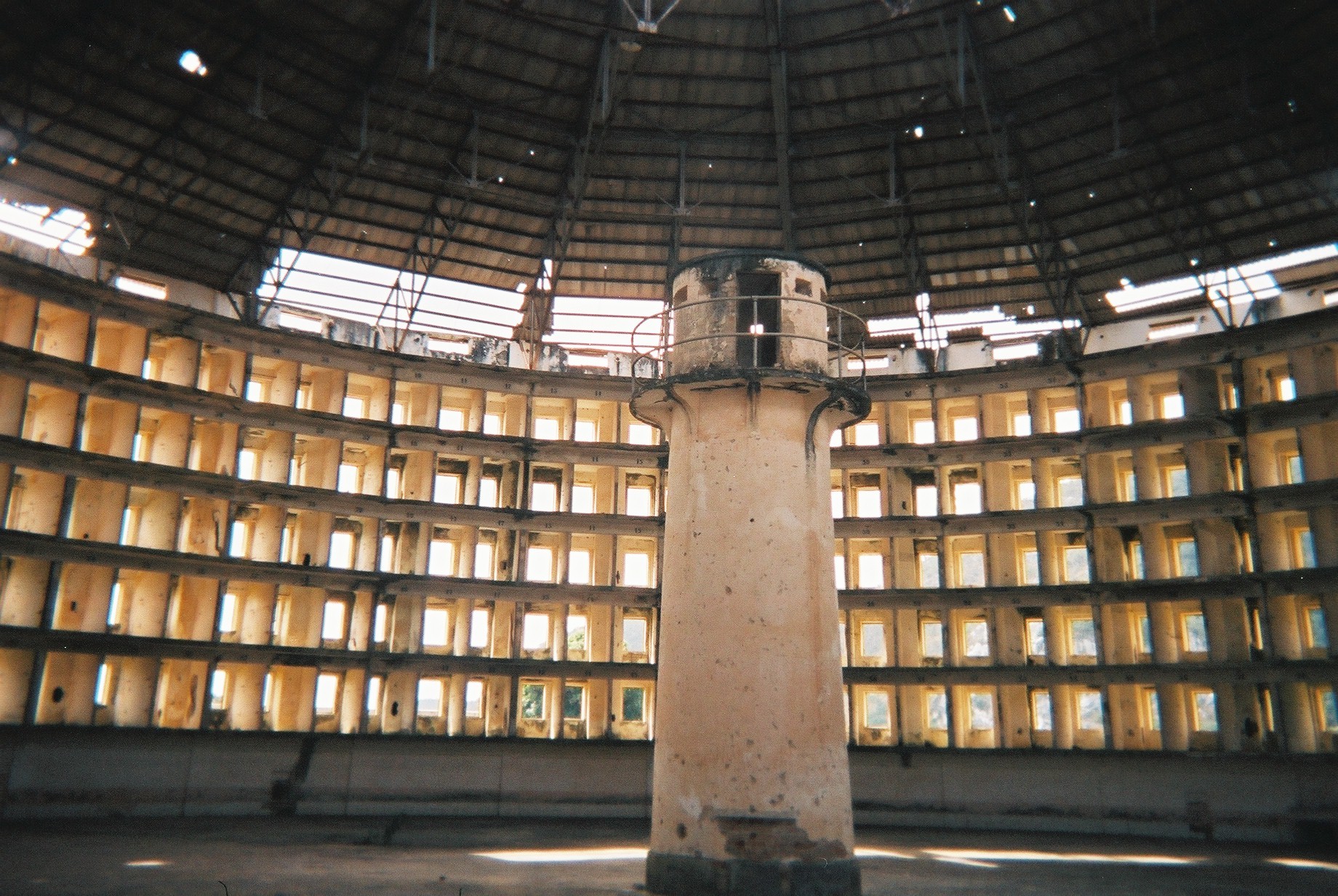
The concept behind all this goes back to the Panopticon, a hypothetical prison where the prisoners know that the guards are constantly watching them, but can’t actually see any of the guards themselves. Proposed by the British philosopher Jeremy Bentham in the 1700s, the idea is to disempower the prisoners and empower the guards simply through the act of surveillance. If everything you do can be seen, and you don’t know exactly who’s watching, that puts a tremendous amount of social pressure on you to conform. As Michel Foucault put it:
The Panopticon creates a consciousness of permanent visibility as a form of power, where no bars, chains, and heavy locks are necessary for domination any more.
But if the prisoners are the citizens, and the guards are the government, how can such a system ever be democratic? How can the citizens of such a society ever give their informed consent? Well, that’s kind of the point. The government in dystopian stories is rarely democratic–it’s usually a dictatorship of some kind, or a system that turns well-meaning people into Knights Templar, showing how even the best of us die like animals when the game is rigged.
As benevolent the intentions of the government may initially be, it is nonetheless true that power corrupts, and absolute power corrupts absolutely. Just as the Panopticon takes power from the prisoners and concentrates it with the guards, so does universal surveillance grant dangerous amounts of power to the government–not because the act of surveillance is dangerous in itself, but because it brings out the worst in the people doing the surveillance.
In The Road to Serfdom, Freidrich Von Hayek pointed out that self-serving, ambitious, power-hungry people tend to rise in government a lot faster than people who have others’ best interests at heart, especially when so much power is concentrated in the government. That’s one of the biggest dangers of surveillance–and in stories where Sinister Surveillance is in play, the government has already passed that point.
I wish I could say that this trope is limited mostly to the realm of fiction, but unfortunately, that does not appear to be the case. These days, it’s impossible to talk about surveillance without getting political, even on a blog dedicated to books and writing. Because everything these days is online, it’s easier now than ever before for our governments to watch us. And if Edward Snowden’s claims are even partially correct, that’s exactly what they’re trying to do. Even more worrying are the indicators that they’re trying to do it in secret, such as this recent letter from Senators Wyden and Udall. The United States government has lied to us in the past about the extent of the PRISM surveillance program, and it would appear that they’re continuing to do just that.
Wherever you fall politically on PRISM or the Edward Snowden case, I think that Sinister Surveillance is a trope that we should all find profoundly disturbing. When George Orwell took this trope to its extreme logical conclusions in 1984, he did so to prevent that horrific social order from ever coming to pass. I wonder: only two or three generations after that book came out, have we forgotten its lessons already? Or do we need a new retelling to remind us? I fear that that retelling is taking place, not in the pages of a novel, but in real time on the major blogs and news sites.
So unless you’re living under a rock, you know that there’s a revolution going on in Egypt right now.
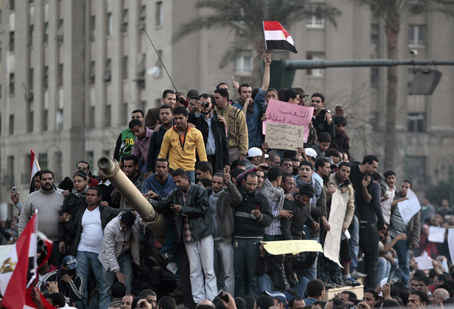
Protesters have been demonstrating 24 hours in Tahrir square in Cairo for the past seven days, demanding that President Mubarak step down from power. With police unable to contain the protests, the army has been called out, but seems to be taking a neutral role.
It’s hard to tell exactly what’s going on right now, but from what I can see, it doesn’t seem likely that Mubarak can hold onto power much longer. In some places, it seems that the military has actually sided with the protesters, allowing them to stand on top of tanks and blocking the police with their armored vehicles. Many of the looters include police officers, who apparently have read the writing on the wall.
If Mubarak does step down, the effects will be incredible. Egypt is by far the most populous Arab country, and a major center for regional cultural trends. Mubarak’s regime has also been one of the most authoritarian and repressive, and until now, his hold on power seemed as absolute as any Arab ruler. If he falls, where will the next revolution happen? Libya? Syria? Yemen? Sudan? Iran?
This wave of protests didn’t start in Egypt; it started in Tunisia, where a citizen’s self-immolation sparked massive unrest. When the protests reached their apex, the military and police stepped down, forcing President Ben Ali to flee the country. Tunisia had one of the most repressive regimes in the region, and the speed with which it collapsed was absolutely stunning–and no doubt an inspiration to the people of Egypt.
Some articles I’ve read suggest that the Iraq War and the fall of Saddam Hussein was a major cause of the current revolution, but I disagree. Most of the Arabs I’ve talked to consider the US invasion of Iraq to be a disaster, and have nothing positive to say about anything that’s come of it. The fate of Iraq is still very much in the air, and many people (myself included) don’t expect democracy to take root in that country without another dictator coming to power.
Instead, I think the root cause of this revolution is economic. According to the UN, food prices across the world have risen 25%, and the global recession has led to widespread unemployment. No doubt the people of Egypt have been feeling this, especially with the huge disparity between the rich and the poor. What we’re seeing right now is a loosely organized, broad-based popular uprising, with people from all segments of society demanding that Mubarak step down.
I’ve got to be honest; I think these protests are very exciting. The chaos and violence is definitely bad, but if it leads to a more just and democratic Egypt, I think that it’s definitely a good thing. When I visited Egypt back in 2008, my first impression of Cairo was that the place was a post-apocalyptic wasteland of a city, with trash in the streets and police armed with machine guns. The longer I stayed, the more I felt that the country was backward–and that a major source of the backwardness was the corrupt Mubarak regime.
I’m not an Egyptian, so I can’t say what’s best for the Egyptian people, but I hope and pray that they get what they are fighting for–a more just and democratic country.
Tuesday Sept 11th, 2001
Day of the Terrorist Attacks on the WTC and Pentagon
Today has been an incredible day. In describing the events that happened today, one of the teachers said that “the world has changed significantly from what it used to be.” There’s no doubt that that’s true. It’s so strange, I’m still having trouble computing it; it seems almost like a dream; that tomorrow we’ll get up and nothing will be different.
On September 10th, 2001, I resolved to keep a daily journal for one full year (and actually followed through on it until June the next year). That journal turned into a detailed account of my personal reaction to the 9/11 terrorist attacks, the most historic, world-changing event to happen in my lifetime.
September 11th was the first day of school for my junior year in high school.
I first heard the news in 2nd period, which was AP US History with Mr. Gunn. I was excited to see his class, see what the year would be like, etc. Everyone was scrambling for a test. He came in a bit late, and was visibly shaken. He told us that the test was cancelled, and then broke the news to us.
I don’t think anyone computed it right then. I know I didn’t. I heard about it, and immediately my love of storms, breaking news, and perilous events kicked in. But I knew that what had happened was big – and not cool one bit.
I choked down the impulse to get excited, but I did want to know more – a lot more. I asked several questions about what had happened, but there wasn’t much info right then. I had no idea what the incredible magnitude of the event was; I still have trouble, it’s like something from a movie or something.
Needless to say, that was the weirdest first day of school I’ve ever had. Classes went on as scheduled, except for the last period of day, which was canceled for an impromptu school-wide assembly. Everything was upside down, with teachers and students trying simultaneously to launch another school year while doing everything they could to find out what the hell was happening on the news.
I didn’t get to a TV until the mid-afternoon, during my lunch break.
CNN was on, and they were showing footage of the Trade Center and the second plane ripping through it. They showed the buildings on fire and the scene around the buildings. It was incredible; eerie…it was really then that I started to comprehend the sheer magnitude of what had happened.
I watched footage of the Trade Center as the building collapsed – that was incredible. I watched the footage reels play over and over again. There was one of someone at the very foot of the building shooting the building as it burned, then caught it as it began to collapse, and then it started jiggling around as the guy and everyone around him scrambled as fast as they could to get out of there!
It was surreal. In the middle school just across the street, kids burst out laughing when they watched the second plane hit the other tower–then looked around in frightened disbelief as they realized that it was real. I remember looking at the photographs from the New York Times the next day and thinking I was reading a superhero comic, not the newspaper. It just didn’t compute.
I had a ton of questions on my mind that day, and they generally went in this order:
1) Was anyone I personally know hurt or killed in the attack?
2) Were any of the victims friends or family of people I know?
3) Is there going to be a war?
We’re going to remember this day for years and years, it’s incredible. The world has changed; I can feel it. It seems tonight like the stuff on the news is amazing and true, but it doesn’t seem real – not in the sense that I think any of us fully understand everything that’s gone on – everything about everyone who’s been affected by this, including ourselves.
For me, it feels exciting and horrifying at the same time, and I almost feel as if it’ll be gone tomorrow, or at least people will still be reporting on it and nothing will have changed from tonight’s events. Of course, that’s not true.
Interestingly enough, I had been watching the news on an almost daily basis for over a year, waiting for something like this to happen. When the second Palestinian intifada began in 2000, I spent all my free time at school on the internet, checking on the latest developments in the Middle East. When the nightly news stopped covering it, I became so disgusted I stopped watching TV news.
So I already knew who Osama Bin Laden was. I knew all about the Taliban and their egregious human rights abuses in Afghanistan. I heard about the USS Cole only hours after it was attacked, and I was disgusted that the US government wasn’t doing more to defend us from terrorism.
So when the 9/11 attacks happened, I felt simultaneously excited and guilty. Finally, after months and months of slow news, something BIG is happening! But people are dying, too–thousands of people. Is it wrong to be excited? But I’m sad too–does that make it all right? How should I feel about this?
I’m not scared, I’m not terrified like the terrorists want, I’m not angry about all this – I’m just in shock, waiting to see how it all plays out. This is BIG!
Of course, the mental and emotional impact of the attacks were much larger than I understood at the time. I didn’t feel a sense of peace in my life until sometime the next week, when I watched a special LDS devotional broadcast from the Mormon Tabernacle in Salt Lake City. Even then, the impact of the attacks continued to transform me in ways that I didn’t fully understand.
Before the end of the school year, I wrote a short story that amalgamated all of the ways that the events of that year had changed my life. It was my first creative writing project since elementary school that I’d actually finished, and I found it surprisingly cathartic. If you care to read it, you can download it here:
The writing is terrible, the plot is cheesy, and it gets a little preachy towards the end, but it’s more honest and genuine than anything else I can possibly say.
After the shock and horror and fear and sadness, the events of that day ultimately brought me closer to God and the people around me. It also led to a lifelong fascination of Middle Eastern cultures alien to my own–and the desire to show that no matter our background or culture, we are all equally human.
That’s the best way to defeat evil–become a better person because of it.