Motatseba, or how to bag a wife—literally (Blast from the Past: April 2012)

With the rise of #MeToo, I thought it would be interesting to revisit this old post from my time in the Republic of Georgia. Here in the US, we seem to be in the process of completely reworking the societal norms for how men and woman interact in the public sphere. On one extreme, we have serial predators getting ousted from power in industries that enabled their abuses for years. On the other extreme, we have the perpetually outraged calling for blood because someone greeted a woman in public with an unwanted hug. False and anonymous accusations abound, while clear and obvious abusers like the Clintons have gotten off scot-free. In short, it’s a mess.

Changes this drastic always produce unintended consequences. One of the unintended consequences of #MeToo may be the blurring of the lines of consent. After all, if a woman can call it rape because she decided afterward that she regretted it, is positive consent worth anything in the first place? In eastern Europe and central Asia, consent has also been blurred, which is part of the reason why bridenapping is still a thing. In Georgia, I came face to face with this reality.

Let me make it clear that I do not condone bridenapping in any form. Cultures are not equal, and some cultures (or some aspects of a culture) are better than others. A culture that condones the kidnapping and forced marriage of women is much worse than a culture that ennobles and empowers women to be agents of their own destiny.

With that in mind, here’s the updated post.


მოტაცება (pronounced motatseba) is the Georgian word for bride kidnapping, as opposed to regular kidnapping, which takes a different word. It’s an ancient practice in the Caucasus region that still occasionally happens, especially in the rural areas. Today, most Georgians condemn it, but there’s still a whole slew of lingering cultural subtexts that can be very difficult for a Westerner like me to understand and navigate.

This is how it works: boy meets girl. Boy decides to marry girl. Boy gets his friends together and kidnaps the girl, with or without her consent, holding her captive overnight. The next morning, boy contacts girl’s parents to ask for girl’s hand in marriage.

Since the girl has been held overnight, the implication is that she’s been raped (which may or may not be true). Therefore, to avoid a scandal which could tarnish the family’s reputation, the parents will usually marry their daughter off as quickly as possible. However, if the girl can escape, or the girl’s brothers can rescue her before nightfall, the crisis can be averted.

Basically, it’s capture the flag with sex.

I first heard about motatseba from this post on Georgia On My Mind, back when I was looking into teaching English. It disturbed me, but not enough to dissuade me from coming to Georgia. A couple of weeks ago, however, I learned that that was how my host parents got married.

Here’s the thing, though: they both seem to remember it fondly. In fact, when my host mom saw a comedy skit on the subject, she couldn’t stop laughing. Her mom lives with them now, and from time to time they go out to visit his family in the village, so it looks like everyone’s on pretty good terms.

So what the heck happened?

Here’s the story, as best as I can piece it together. They were introduced by his sister, who was her coworker at the hospital. He liked her, but was too poor to afford a dowry, having just gotten out of the Red Army. After a month, he got together with some friends and tricked her into coming out to his family’s house out in the village. She was surprised and upset at first, of course, but her parents gave their consent, probably because she was starting to get into old maid territory (she was 29 at the time). They were married the next day by a magistrate. Now, they’ve got four kids—a huge family, by Georgian standards—and seem to be happy together.

As a Westerner, it blows my mind that a strong, healthy family can come out of something as violent as an act of kidnapping. Indeed, I have yet to be convinced that that’s a normal outcome. However, after asking around and doing some research, I’ve come to realize that motatseba isn’t a black and white issue: there are all sorts of cultural subtexts that make it much more complicated.

The key to understanding how all this works is the following proverb, which underscores Georgian concepts of gender roles and the differences between men and women:

If a woman says no, she means maybe. If she says maybe, she means yes. If she says yes, she is not a woman.

From this, two things follow:

Men should be more assertive

As a man in Georgia, I get this all the time. All three of my co-teachers are women, and all of them constantly defer to me, even though they have far more teaching experience than I do. When I had some pretty serious differences over teaching methodologies with one of them, she suggested that I take over the next lesson and teach it without her interference, so that she could get a better idea that way.  This isn’t the case with the female volunteers. Many of them complain about how hard it is to get anyone to take their suggestions seriously.

A woman can never say no—or yes

If “no” is constantly interpreted as “maybe,” then it follows that no one is going to believe that a woman is even capable of saying “no.” On the other hand, if a real woman can never say “yes,” then the man ultimately has to take matters into his own hands. This turns the whole concept of rape into a nebulous gray area, which is why motatseba isn’t universally considered to be a horrible thing.

This is not to say that in Georgian culture, women are doormats or property (even though that’s what some TLGers claim). Women have a number of support networks, such as family, friends, and other women, and can use these networks to ward off unwanted attention. When I asked my host sister if she’s worried that she would ever be kidnapped, she said no, because if she was, her brothers would kick some serious ass.

On top of all this, Georgians have no real concept of casual dating. If a girl and a guy are seeing each other, they’re either married or about to be married. This shows up in the way they use Facebook and other social networks: instead of listing themselves as “in a relationship,” the girl will give her password to the guy she’s dating. And they don’t just do it because the guy demands it—when my host sister was seeing someone, he asked her if she wanted to give her password to him, as if that was the natural next step in their relationship. From the way she told me, she seemed to be worried that she’d made a mistake by telling him no.

Combine all of these together, and you should start to get a clearer picture of some of the subtext surrounding motatseba.

When I asked my first co-teacher about it, she said it was only an ancient practice and absolutely didn’t happen anymore. When I brought up rape and asked if that was also a part of it, she was horrified and didn’t want to talk about it. However, when I asked if it’s possible for a happy marriage to come of it, she kind of smiled a little and said that if the woman likes it, then why not?

My second co-teacher was much more straightforward with me. Yes, it happens occasionally, though it was a lot more “fashionable” about twenty or thirty years ago. No, it’s not romantic. Yes, a lot of the marriages aren’t very happy, which is why so many of them end in divorce. She told me that one of her friends from college was married through motatseba, and that she knows of at least one case in our school where an 8th grader was kidnapped and married. However, motatseba is now considered a serious crime, so it’s not as common as it used to be.

My third co-teacher’s answer was a lot sketchier. The first time I asked about it was in passing, as she walked in on the conversation I was having with my first co-teacher. When I asked her about rape, she laughed and said “well yes, of course it happens!” as if that wasn’t a big deal. Later, however, she sat me down and said quite seriously that motatseba is a horrible thing, that it’s a criminal act, that it doesn’t happen anymore, etc etc.

However—and this was perhaps the most illuminating thing—she said that sometimes, when a guy and a girl are in love, but she’s being wishy-washy and non-committal, he’ll sweep her off her feet and carry her off. In fact, that was what happened with her: her boyfriend wanted to marry her, but she kept putting it off, so one day he tricked her into getting in the car and told her “all right, enough is enough—we’re getting married this weekend.” And they did.

When I asked her if that was motatseba, she said no, but the subtext was clearly similar. A real man knows how to assert himself and take what he wants. Since a real woman will never say yes, sometimes you just have to man up and tell her how it’s going to be.  And don’t worry if she says no—she just doesn’t know yet that she wants it. She’ll come around eventually. They always do.

It sounds pretty horrible, but that seems to be how it works. And really, there are gradations of it. Most Georgians will agree that it’s wrong for a guy to kidnap a girl he doesn’t know so that he can rape her. But if the guy and the girl know each other, and are already pretty serious, and he wants to speed things up—or, alternately, if she knows her parents would never say yes otherwise—that’s when everyone starts to wink and nod.

And really, can we say that our culture’s problems are any less abhorrent? What about teenage pregnancy? Secret abortions? Date rape? At least with motatseba, the guy is trying to marry the girl, not just sleep with her and walk away. If it’s just sex that the guy is after, there are plenty of other options for that.

Either way, learning about motatseba firsthand has certainly been an interesting anthropological experience.

U is for Universal Translator

In science fiction, whenever two characters from different planets or different alien races have to interact with each other, they almost always speak the same language or have some sort of universal translator that magically makes them able to communicate with minimal misunderstandings.  This is especially common in Star Trek, though it happens in just about every franchise involving a far-future space opera setting of some kind.

I’ve got to be honest, I think this is a cheap plot device that almost always weakens the story.  As a writer, it’s tempting to have something like this so you don’t have to deal with any pesky language barriers, but when you do this, you remove a major potential source of conflict, thus violating the rule of drama.  Also, you make your fictional universe feel a little less grand, your aliens a little less alien.  After all, if everyone can perfectly understand each other, then there must not be a huge difference between Earth and the far side of the galaxy.

There are some times when having a universal translator allows you to broaden the story and focus on other conflicts.  For example, if some sort of interstellar legislation is under review in the grand galactic council, you can’t spend all your time focusing on basic communication difficulties.

However, if this is the case, then you can usually overcome the language barrier through other means–a galactic lingua franca, for example, or translation tools that may or may not misfire on occasion (much like Google Translate).  Of course, if you’re writing a comedy like Galaxy Quest (or parts of Star Control II), then falling back on a universal translator is forgivable.  But if you’re going for believability and a sense of wonder, this trope isn’t going to do you any favors.

While linguists and technologists have been working on translation programs for some time (and admittedly making some significant breakthroughs), I’m extremely skeptical that we will ever develop a perfect universal translator in real life.  If we do, I expect we will have to develop a sentient AI as a prerequisite, since the nuances of language are so inseparable from the things that make us human.

Here’s how translation services like Google Translate work:

  1. They amass an enormous database of language material by scanning websites, newspapers, and other documents.
  2. They analyze this database to look at word combinations and frequencies, observing the likelihood that any one word will appear in combination with any others.
  3. They compare these combinations and frequencies with those in other language databases to match words and phrases.

This data crunch method of translation works fairly well for simple words and phrases, but it falls apart in the more complex grammatical structures.  I see this any time I try to use Google Translate with an Arabic source.  Arabic is an extremely eloquent language, with all sorts of structures that simply don’t work in English.  One mistranslated word can completely change the meaning of the entire text, and even when it works, the technically correct English translation sounds as if it’s full of errors.

The methodology also falls apart for languages that are too small to have much of an electronic database.  The Georgian language is a good example of this.  It’s spoken by only about 4.5 million people worldwide, most of them in the country of Georgia, which is predominantly rural.  Internet access for most of the population is very limited, and most Georgians who do communicate online tend to use the Roman or Cyrillic alphabets more often than their own.  As a result, Google Translate for Georgian is utterly useless–seriously, you’re better off just sounding out the letters and guessing at the meaning.  There are some other sites like translate.ge that try to fill the gap, but they seem to rely on actual lexicons, not databases and algorithms.

All of this is between entirely human languages that developed in parallel on the same planet–indeed, languages between human cultures that have traded and shared linguistic influences for thousands of years.  What happens when we encounter an alien race whose biology makes it impossible for them to make human-sounding noises?  Or an alien race that communicates through smell or electromagnetic impulses instead of sound?  What happens when humanity is spread out across hundreds of star systems, each of which periodically becomes isolated from the others for hundreds or even thousands of years?  When our definition of human is stretched so thin that we would not even recognize our far-future descendents as anything but alien?

There is so much wasted potential whenever a science fiction story falls back on a universal translator.  Case in point, compare Halo I, II, and III with Halo: Reach.  In the first three games, the Master Chief’s universal translator enables him to hear exactly what the enemy Covenant troops are saying.  This is great fun when you’re chasing down panicked grunts, but it tends to get old after a while.  In Halo: Reach, however, the human forces haven’t yet developed a universal translator, so everything the Covenant say is in their original language.  All of a sudden, the game went from a hilarious joyride to a serious war against aliens that felt truly alien.  That one little change did wonders to the tone and feel of the entire game.

Needless to say, you won’t find a universal translator in any of my books.  In Star Wanderers, the language barrier is the heart and soul of the story–it’s a science fiction romance between two characters from radically different worlds who don’t speak the same language, and yet overcome that to develop a strong and healthy relationship.  In Sholpan and Bringing Stella Home, Stella knows a language that is fairly similar to the one spoken by the Hameji, but there are still words and phrases that elude her.  This detail is critical because it impedes her ability to understand and adapt to the Hameji culture, leading to some major conflicts later in the book.

As someone who’s lived for significant periods of time in Europe and Asia and learned languages very different from English, I can say that the language barrier is not something that we as writers should avoid, but something that we should embrace.  There are so many interesting stories that can be told when two characters don’t speak the same language.  Please, don’t be lazy and write that out of the story through a cheap plot device!  Let your aliens be truly alien, and your worlds and cultures so fantastic that we can’t help but feel hopelessly lost in them.

This Week

I was listening to the latest episode of This American Life yesterday, and at the end of the podcast, Ira Glass mentioned that this week’s episode will be themed “this week”–in other words, things that all happened in just the last seven days.

Well, things haven’t been too eventful out here in Georgia, but I liked the idea for the theme, so I decided to write up something as if it would appear on the show.  Here it is:

Early Tuesday morning, before the sun rose, I woke up from a dream that I was in a faraway place somewhere on this planet. Then I opened my eyes and realized that I live in the Caucasus Mountains.

I’m an American teaching English in the Republic of Georgia, in a small village half an hour south of Kutaisi. I live in a farmhouse with a local family. The mother teaches math at the village school, her son teaches computer science and makes wine for a company based out of Tbilisi. My host mother’s sister in law also lives with us, and this week, she cooked the most delicious borscht I’ve eaten in my life. She told me she’d teach me how to make it, and I’m ecstatic.

We keep sheep, cows, chickens, pigs, a turkey, and grow about half of the food we eat. Last week, five of the chickens were eaten by a wolf, including a mother hen and three of her chicks. The last surviving chick has been struggling, so every day after school I take her out of the little cage where we’ve beek keeping her and feed her from my hand. She isn’t as afraid as she used to be, and seems to be getting stronger.

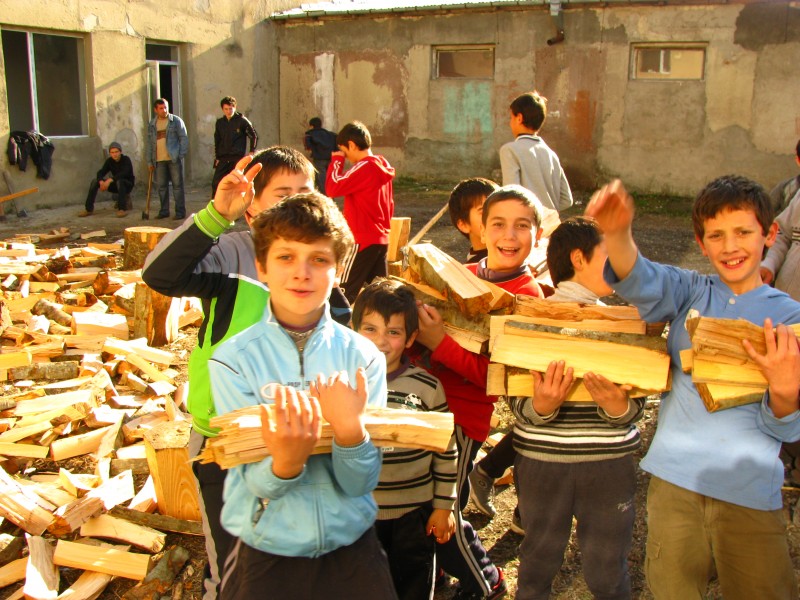
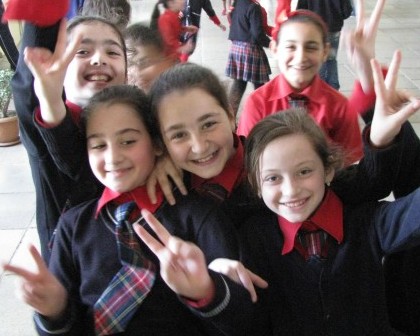
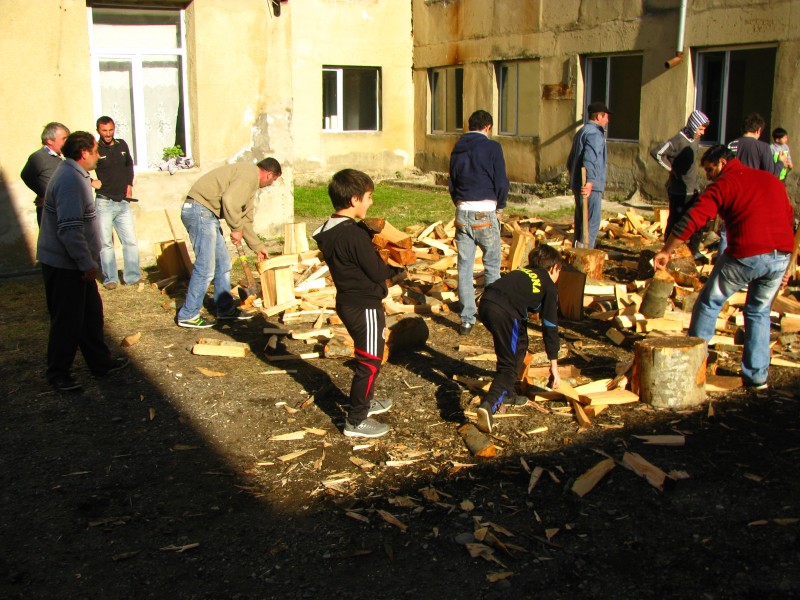
I teach grades I through VI at the village school, which amounts to about eighty kids. On Tuesday, we chopped wood for the winter. Each classroom has a small woodburning stove, and often smells like campfire smoke. It’s very warm, though–the teachers make sure of that, since cold leads to illness, and we can’t have that. The kids love learning, and I love teaching them. Every day after class, I say “goodbye,” and they run up screaming and laughing to give me high fives. I feel like a rockstar whenever I’m at school with them.

On Sunday, I went up to Kutaisi to use the internet. I use the internet maybe three times a week, sometimes four. The nearest place with reliable wifi is the McDonalds, and it takes half an hour and 1.5 lari to get there. On the way back, I chatted in the back of the marshrutka with some of the upper grade kids from my village. We sang songs by Michael Jackson, Justin Beiber, and Psy. Gangnam Style is very popular out here, and the kids think it’s hilarious when I do the dance for them at the village school.

It’s raining right now, which means that the power will probably go out soon. We have power outages almost every day, but they aren’t usually longer than one or two hours. Our water comes from a well, and our heat comes from the fireplace, where we also burn our garbage. When the rain lets up, I’ll help my host-brother cut down a few trees in the back and chop the wood.

Georgia is going through some difficult times politically right now, but we only hear about it through the TV. The country had its first peaceful democratic transition of power in October, and the new Prime Minister has been on a political witch hunt ever since. Some in the Western media find this disturbing, but my host-brother doesn’t think that Georgia has become less democratic because of it. We had a long conversation about politics on Monday night, which eventually turned into a discussion about the Israeli-Palestinian conflict, since the recent UN vote has also been in the news. He told me he’s pro-Palestinian because Israel’s occupation of Gaza and the West Bank sounds a lot like Russia’s occupation of Abkhazia and South Ossetia.

An expat friend of mine visited Abkhazia recently and posted the pictures on his blog on Tuesday. He called it an overpriced garbage dump, and from the pictures, you can definitely see why. Piles of trash in the courtyard of the biggest Orthodox church in Sokhumi, a derelict half-sunk ship rusting in the harbor, vines crawling up Soviet-era power lines that look about ready to fall over. And yet with Russia trying to keep Georgia from joining NATO, it looks like the status quo will remain in place for years to come.

Here in my village, though, that all seems far away. So do the economic problems back home, though they’re one of the reasons why I came out to Georgia in the firstplace. On Tuesday, I met up with a British friend of mine at McDonalds and we talked a bit about what we plan to do after we get home. He’s got a job lined up for him at the school where his mother works. I asked him if things are still tough in the UK, and he nodded. We didn’t have to say anything more than that to understand each other.

I don’t have a job lined up, but I’m actually not too worried. I’m a writer with a few science fiction stories self-published online, and on Tuesday I realized that I’ve earned as much money in the first four days of this month as I earned in the entire month of March earlier this year. It’s not enough to make a living yet–at least, not by US standards–but it’s growing.

On Sunday, I published another novelette, and on Wednesday, I went back to work on a fantasy novel that I started in October. The power hasn’t gone out yet, so I think I’ll get back to writing. It’s 3:32 PM and I have the rest of the day to myself, with maybe an hour to help my host brother cut down some trees. Life is good, especially out here in the Caucasus.

At this point, I should probably post some pictures:

Chopping wood at the school. A bunch of men from the village did the chopping, while the kids carried the wood back inside.
Some of my VI and IV grade students helping out.
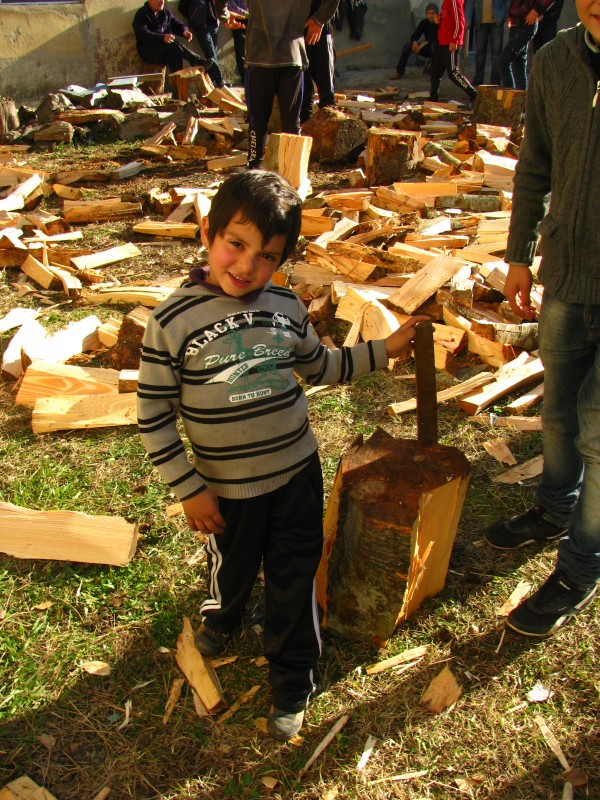
One of the first graders. I swear, this kid is like my biggest fan.
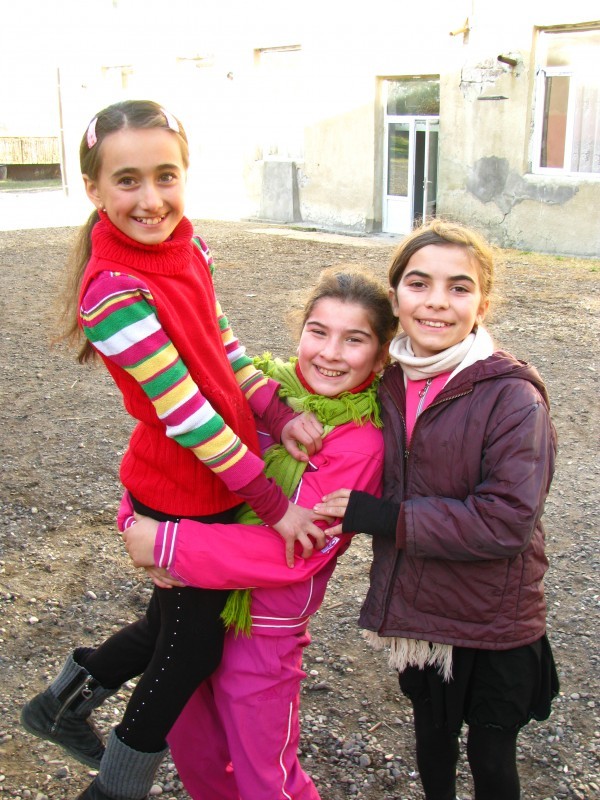
Some of my V graders. These kids are great.

In other news, I decided to drop my other projects and go back to writing The Sword Keeper.  I think part of the problem I had before was that I was trying to go too fast, writing-wise and story-wise.  This is my first time writing a fantasy novel, and I can already tell that it’s going to be a lot longer than I’d thought it would be.

Also, I took the time to draw up a map of the fantasy world where it takes place, and oh my gosh that changed everything.  Maps are awesome.  When I have access to a decent scanner, I’ll have to put it up.

That’s all.  See you around!


Grape harvest update

Sorry for missing the last Trope Tuesday post.  We’re in the tail end of the grape harvest here in Georgia, so I’ve been spending a lot of time helping out with that.  The next trope post is going to be a big one, so rather than trying to pound it out in the village (where most internet sessions are cut short by a power outage), I figured I’d just wait until next week.

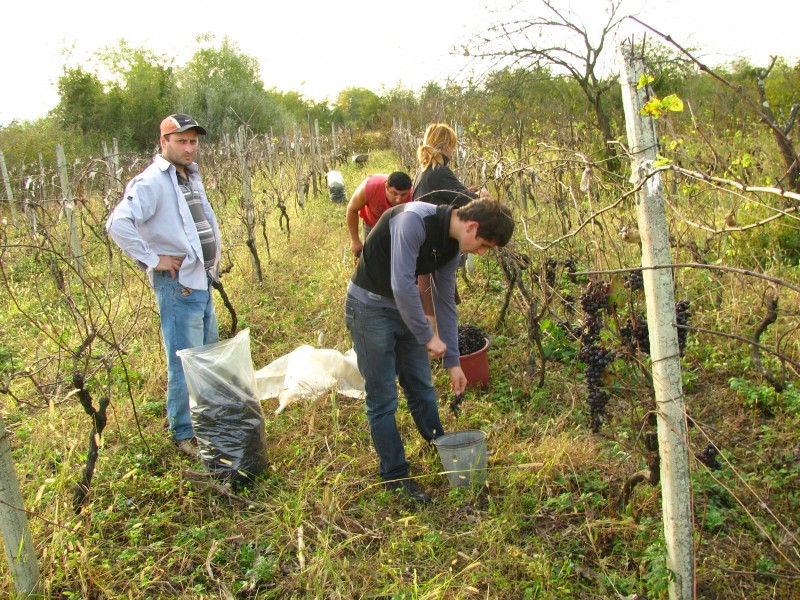
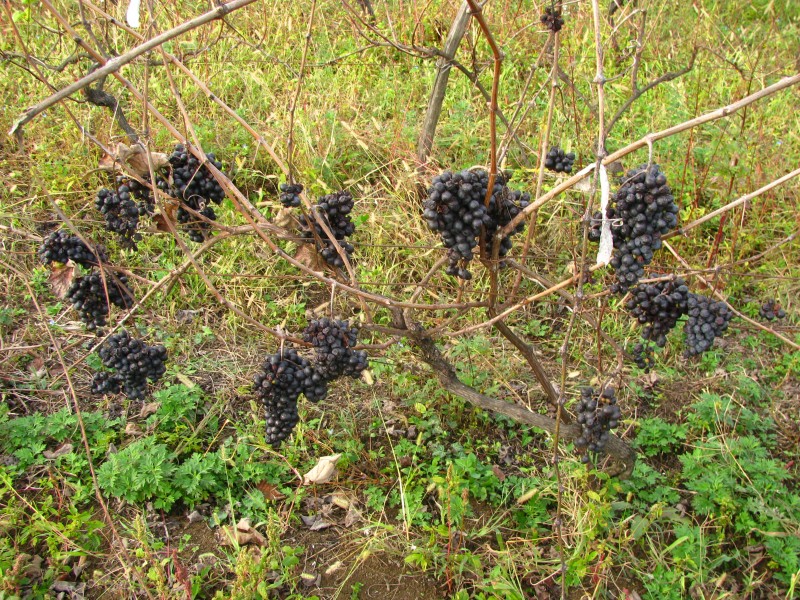
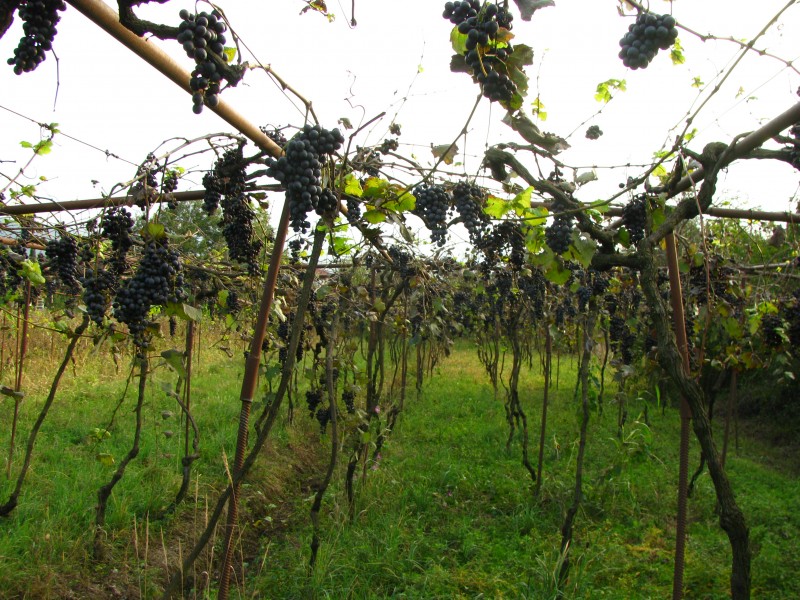
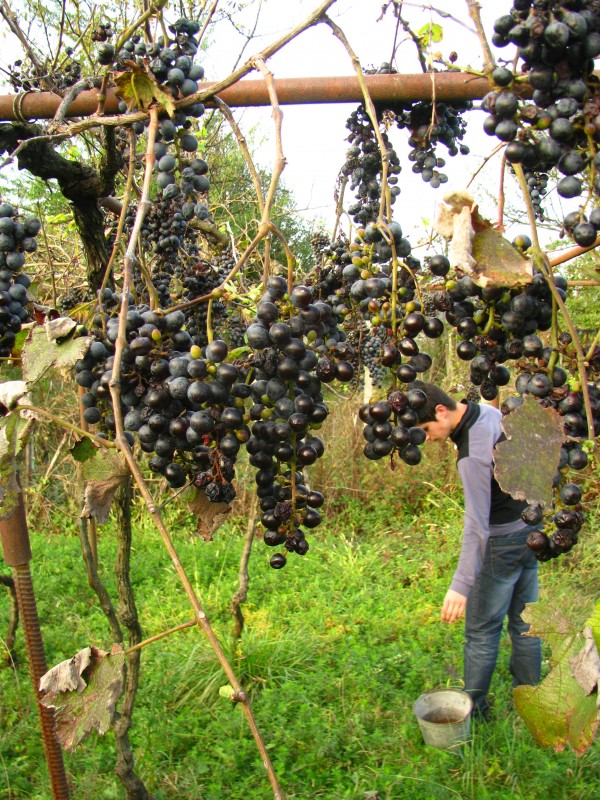
In any case, here are some pictures from the harvest that you might find interesting.  Georgia is pretty famous for its wine and grapes–there are over 500 different varieties in the country, many of them indigenous to the Caucasus region.  Almost everyone in the village has their own vineyard, so most of the stuff you buy in the market is locally grown and locally produced.  Let me tell you, there are few things more awesome than being able to get freshly picked fruit right in your own backyard.

Picking grapes. A bunch of the neighbors came out and helped, in exchange for a basketful of grapes and a nice dinner.
Grapes, fresh on the vine.
It takes a little more infrastructure to grow them this way, but the end result is much better.
The best part of picking grapes is being able to snack while you pick them. 🙂

In terms of writing, I’m making fairly decent progress on my next novel.  It’s a fantasy story, so it’s a pretty big shift from all the space opera stuff I’ve done over the last few years.  At least, that’s what it feels like.  I’m trying not to worry about how much it sucks right now, but if it’s anything like all my other books, it will turn out a lot better than I think it will.

That’s about all for now.  I’ll leave you with this hilarious youtube clip of a bunch of Koreans going ape over a Georgian dance troop.  The Georgians are awesome, but it’s worth watching for the Koreans’ reactions alone.  Seriously, best thing I’ve seen in a long time.

See you around!

I cannot tell you…

…how much I’m looking forward to being back in Georgia.

My flight leaves from JFK on Saturday and arrives in Istanbul at about 6 am on Sunday.  The flight to Tbilisi doesn’t leave for another seven hours, so I plan to take the tram downtown and see some of the sights.  I’ll arrive in Tbilisi late that afternoon, spend the night at a hostel…

…and then take off the next morning for Kars, Turkey.  I plan to meet up with a friend there and go tour the ruins of Ani, ancient capital of Armenia.  I have no idea yet how I’m going to get there, but there should be some buses in Tbilisi or Akhaltsikhe, and from Kars you can charter a taxi.

So after all that, I’ll head out to Baghdati to meet my new host family!  For the fall semester, I’ve been assigned to the school in the village of Rokhi:


View Larger Map

It’s about an hour south of Kutaisi, right up against the Lesser Caucasus mountains, and it looks like an awesome place!  A couple of other TLGers have been there before me, and they tell me it’s really great.  It’s definitely going to be a change of pace, going from city to village, but it’s one I’m looking forward to.  There are only 300 students in the school (grades 1-12), so maybe I’ll learn all my students’ names this time.

The family I’ve been assigned to sounds a bit older, with a thirty year old son who works at the school.  It sounds a bit rustic, with Turkish toilets and no internet at home, but I’m looking forward to that, especially the no internet part.  Don’t worry, I plan to get out and blog regularly–I’m sure there are local internet cafes, plus Kutaisi isn’t that far and I know where to get internet there.

Getting out to church is going to be a bit tricky: I’ll probably go into Kutaisi on Saturday, take the noon train into Tbilisi (5 GEL) and spend the night at a hostel (15 GEL), or take the sleeper train (10 GEL) and show up in the morning.  Getting back shouldn’t be too difficult: the Baghdati marshrutka leaves from Didube at 16:00 (or so I hear), and from there it’s only about 6 or 7 kilometers.

I have no idea how long I’ll be in Georgia this time: my contract runs until the end of December but I may extend again, depending on what other options open up.  I’ve really fallen in love with Georgia since coming there, and may just choose to stay on another year.  The Caucasus is a really amazing place, full of hidden treasures and remote places.

Which reminds me: I’m bringing a tent and sleeping bag this time, to do some backpacking in Borjomi and Tusheti.  Packing them was tough: the airline restriction is 20 kg total of weight (44.1 lbs), and after a whole lot of work, I finally got it down to 42.5 lbs.  The disassembled backpack frame is going to have to go as a separate piece of luggage, since it was too big to fit in any bag, but it shouldn’t be too hard to reassemble it out in Georgia.

That’s about it.  I’ll leave you with this awesome Georgian song I found on youtube.  The dance troop is Erisioni, and they put on an amazing show that’s kind of like Riverdance, except for Georgia.  Let me tell you: when it comes to dance (folk or ballroom), I don’t think anyone in the world is as amazing as the Georgians.

Magaria!

Back in the States

So I got back to the States last night, after about forty six hours of travel (and only four or five hours of sleep).  It’s good to be back, but I’m already missing Georgia and thinking about all the things I’ll do once I get back.

The weirdest thing about being back home so far is how non-stressful traveling is.  I got to JFK, turned on my American cell phone and found out that the sim card is no longer recognized.  My train ticket needed to be rescheduled, I didn’t know who was picking me up back home or when, didn’t know the New York subway system all that well…and yet instead of freaking out, I just shrugged and figured I’d solve all that later.  Sure enough, Penn Station had wifi, so I instant messaged my brother in law and had him call my mom and work it out.

The lack of beggars in New York City was kind of strange.  There was one kid on the Subway who announced (after apologizing for taking people’s time) that he was trying to make money by selling M&Ms, so I helped him out and bought one.  In Tbilisi, some ten year old gypsy kid would fall on her knees and give a huge sob story, then walk through the car with her tin can (and would get more money from it than this kid did in New York).

So that was the first thing I ate when I got here.  The second thing was a Jamba Juice.  Next was a slice of American pizza–so much better than the stuff in Georgia–and then a bottle of root beer.  Man, the soda over here is so disgustingly sweet!  I was wide awake until the sugar hit my system, and then it was like taking a sledgehammer to the face.

I’m doing pretty well now, even though I woke up at about 3:30 and didn’t really go back to sleep. There’s not much happening this week, so I should be able to get over the jetlag fairly easily.

As far as Star Wanderers goes, I finished everything but the last scene and the epilogue, so I’ll wrap those up today and get ready to publish Part I.  The last few chapters aren’t as awesome as I’d like them to be, but I should be able to work those out in subsequent drafts.

In other news, I recently did an interview on Scifinerdsare.us.  It’s more geared towards writers than readers, but worth checking out.  There seems to be a lot of polarization these days between writers who self publish and writers who follow the more traditional path, which is unfortunate.  That said, indie publishing is definitely the best thing career-wise that’s happened to me.

Finally, I just watched a fascinating lecture by Douglas Rushkoff on the Occupy movement and a new cultural phase that he terms “presentism.” The most interesting thing for me is what he has to say about the way our democracy is evolving–basically, it’s becoming a little  more like The Colony from Bringing Stella Home.  So many story ideas to play with…

To Racha and back

So I just got back from Racha this afternoon.  It was a lot of fun!  Saw Ambrolauri, Oni, and Shovi, only 20 km from the Russian border near Ossetia.  Don’t worry, though, we were safe the whole time–though the home we stayed at had a wolf pelt hanging in the dining room!

This video should give you a pretty good idea what Racha is like.  It’s part of a new ad campaign, and it does a good job capturing the feel of rural life in the region, as well as the blend of modern and traditional that you find throughout Georgia.  The music is a combination of two famous Rachuli songs.

I went with a fellow TLG teacher from Slovakia named Tomas, and together we made a really good travel team.  We met last week on the TLG excursion to Kakheti and hit it off right away, probably because I’m a quarter Czech.  He speaks a bit of Russian, and I speak a bit of Georgian, so between the two of us we were able to manage quite well.

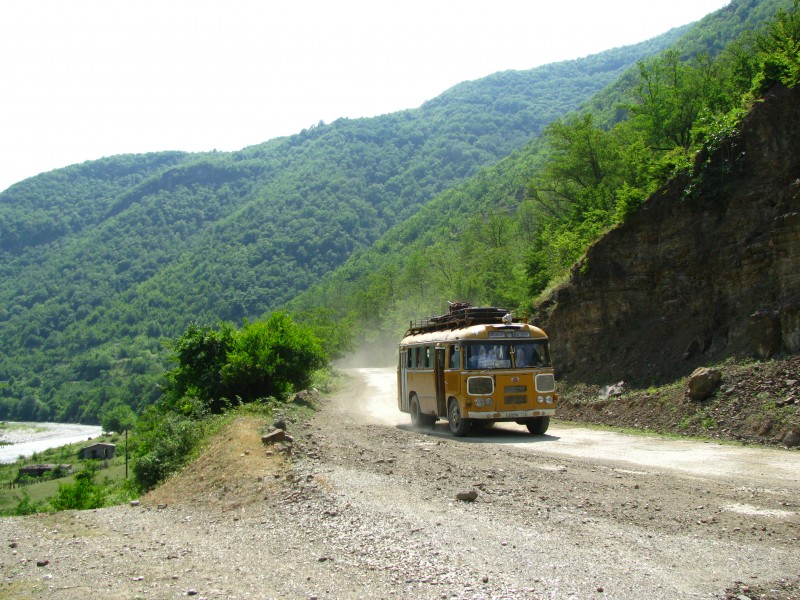
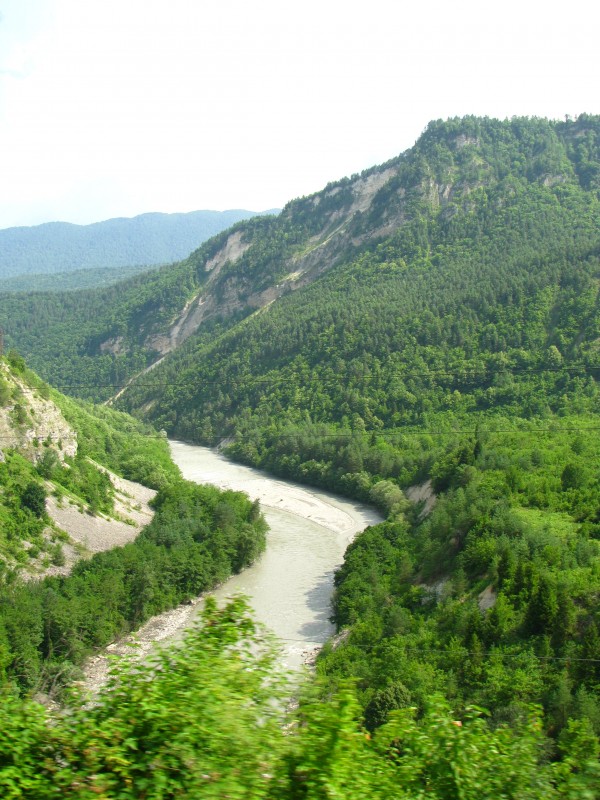
A rickety old bus crawling up the treacherous road from Kutaisi to Ambrolauri.
The Rioni river near the Racha-Imereti border.

We took the Kutaisi-Ambrolauri bus up along the Rioni river.  The road hasn’t been repaved since Soviet times, so it was quite treacherous, especially in places where the cliff had partially eroded. Spectacular views, though, especially once we crossed the border into Racha.

At Ambrolauri, we got out and hitched a ride to Oni.  The local police actually flagged down a passing tour bus full of Israelis and had them take us.  It was awkward at first, until we made friends with the guide–a veteran hitchhiker who has been everywhere from New Zealand to Mongolia to Turkey.  When traveling to a country with a foreign language, the five phrases she always tries to learn are:

  1. Please.
  2. Thank you.
  3. Hello.
  4. I want.
  5. I need.

Pretty sound advice.  The numbers should come pretty soon after that, along with “how much” and “what price.” “No” is definitely important too.

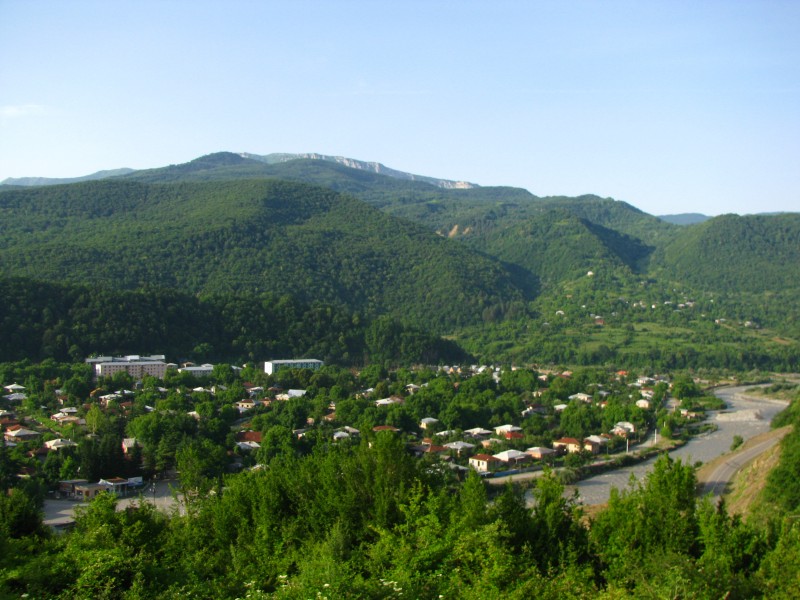
Oni, a beautiful Georgian town nestled inside the Caucasus Mountains.

At Oni, we spent a couple of hours shopping around the local homestays before settling on Family Hostel, a bed-and-breakfast type place with some really nice accommodations.  It was a little pricier than we were hoping, but was definitely worth it.  The food was great, and the dad showed us a bunch of interesting sites the next day.

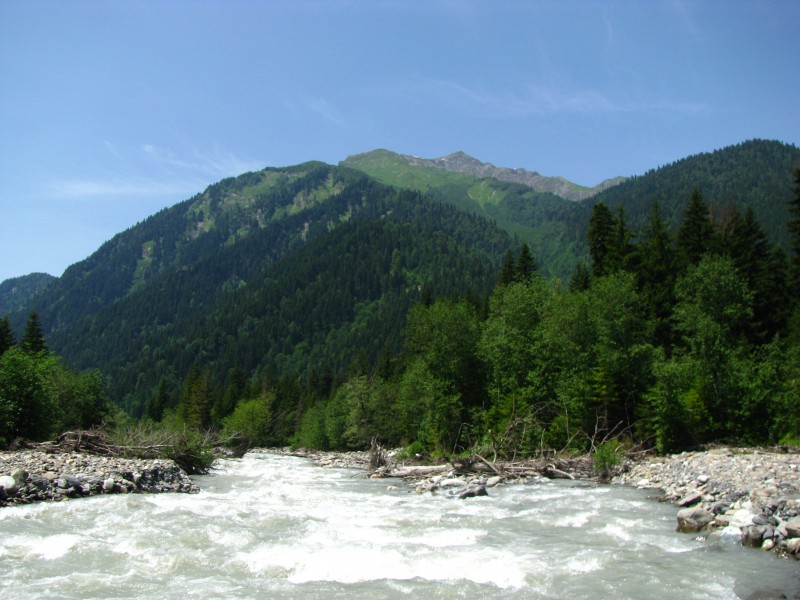
The Rioni headwaters, up near Shovi. Russian North Ossetia lies on the other side of that mountain.
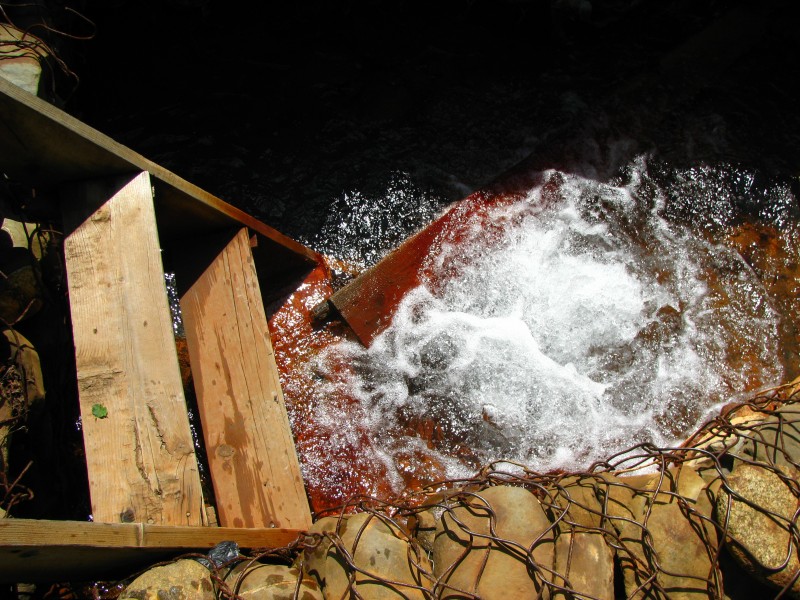
One of many mineral water springs in Racha.

We headed up to Shovi with another tourist from the hotel: an 80 year old Turkish man named Adnan.  He’s a big time hiker/trekker, and showed us a bunch of photos from his hike up Mount Ararat. He also made us Turkish coffee when we stopped for lunch up in the forest.

Shovi is an awesome rustic resort way up near the Russian border.  It’s on the other side of Mount Shota, which is about as high and as steep as Mount Timpanogos in Utah.  Maybe I’ll come back and hike it sometime.  Anyways, Shovi was pretty cool–definitely worth coming back for a camping trip, or perhaps for a couple of nights in the cabins.

The most interesting thing, though, was how many springs were in the region.  Seriously, we stopped almost half a dozen times at places just like the one pictured above, with so much water bubbling up that it almost seems like someone forgot to turn off the faucet.  It’s all natural, though, and comes out carbonated and infused with all sorts of minerals.  Tastes just like the sparkling mineral water from Borjomi or Nabeghlavi–the locals come up quite frequently to refill their jugs and bottles with the stuff.  You can drink it straight from the spring, without any need for purification.

Back at Oni, we had a fun time hanging out with the family and seeing the dad’s furniture-making shop.  They’re good people, and we were really fortunate to find them.  Showed them some photos of my family, and by the end, I think the mom had half a mind to set me up with a Georgian girl. To be honest, the longer I stay in this country, the more inclined I am to accept…

The next day, we took off with the 19 year-old son on the bus to Tbilisi.  He was heading out for his final exams–he’s hoping to study law and tourism, to come back and help the family business.  We came down past Shaori Lake through Tkbuli.  One of the back tires blew out near the Kutaisi-Tbilisi road, but we made it out in one piece. Tomas continued up toward Zestaponi, while I got out to catch a bus heading back to Kutaisi.

Four months ago, I would have felt totally lost, but I’ve been around Georgia so much by now that it was a piece of cake.  Went into town for some lunch, then came back for a much-needed shower.

So that was the trip!  It was amazing–I definitely recommend heading up that way for anyone who has a chance.  There’s a lot of beautiful country up this way, as well as some genuinely good people.  The best sights in Georgia can be a little hidden, and Racha is full of them.

Last day of school

So today was the last day of school in Georgia, with all of the craziness that that entails.  It was kind of sad to say goodbye, even though I’ll probably be coming back to the same school in September.  In the meantime, I’m going to miss being a rockstar to all the 7-12 year olds and giving them high fives after class and in the hallways.

I haven’t posted much about my teaching experience, but it’s generally been positive, though not without its ups and downs.  I’ve met a lot of great people, taught a lot of great kids, and lived in a culture very different from my own.  I’m not sure how I’ve grown yet, or what I’ve learned from the experience, but it isn’t over–I’ll be back after the summer, for a least one more semester.

I asked to be placed in the same school again, though I’ll be changing homestay families.  If they can’t find another family in this district, I asked to be placed in a village near Kutaisi.  It’s impossible at this point to say what will happen, though, and things in this country tend to change without notice.

When I came to Georgia, my goals were to find out if I could balance teaching English with my writing career, to get some useful teaching experience, and to gain some cultural exposure that would enhance my writing.  On all three counts, I think I’ve had success.

My writing productivity has gone down  slightly since coming out here, but I think that has more to do with the homestay and finding a good, quiet place to write.  I’m still writing every day, just 1.5k words instead of 2.5k.  Teaching English isn’t the problem–in fact, it’s probably one of the best careers for aspiring writers, just so long as you know your creative process and have a modicum of self-discipline.  I’ll probably do another post on that later.

As far as teaching experience, I don’t know how much my time here in Georgia is going to help my resume, but it has helped me to have a bit more confidence when it comes to teaching.  I still feel like there’s a lot of room for professional improvement, though, and it’s going to be difficult to get that here.  I like Georgia, though, so I’ll be happy to come back.  If anything, I figure one year looks better on a resume than six months.

And as for cultural exposure, coming out here was definitely a good move.  Living in a developing country changes your perspective in a lot of interesting ways, and Georgia is so different from America that I’m sure I’ll be talking about it for years to come.  How all of this will affect my writing, I don’t exactly know, but I’m sure it will only enhance it.

So yeah, that’s been my experience so far.  The last day of school was kind of bittersweet, but I’m definitely looking forward to coming back!

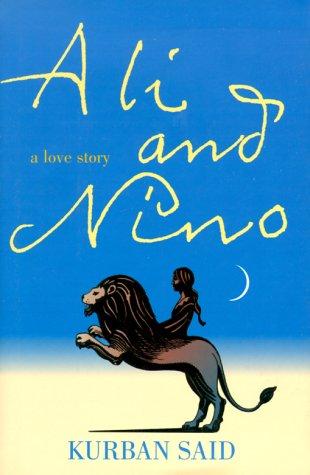
Ali and Nino by Kurban Said

At the crossroads of Europe and Asia, Christianity and Islam, the progressive West and the reactionary East, the peoples of the Caucasus lie poised between three empires and their own dreams of independence.  And at the city of Baku, where the ancient and unchangeable desert meets the oil rigs of the Caspian Sea, young Ali Shirvanshir has fallen in love with Nino Kipiani, a Georgian and a Christian.

A timeless story of forbidden love, Ali and Nino is both the Romeo and Juliet of the Caucasus and the national novel of Azerbaijan.  It is as much a romance as it is a story of the clash of cultures and identities in our rapidly changing modern world.  Above all else, it is a beautiful and haunting tale that will leave you dreaming with your eyes open and yearning for lands that you’ve never seen.

This is, quite possibly, the most perfect book I have read all year.  I picked it up in Tbilisi from another TLG volunteer on Sunday, and I finished it at a breathless sprint on Wednesday.  But while the story was good, it was the writing itself that really captivated me.  The simple yet surprisingly rich descriptions of the alien cultures, so dreamlike and yet so straightforward, often to the point of being shocking–here, let me give an example:

“Shamil’s Prayer!” called Iljas Beg to the musicians.  Immediately a wild melody arose.  Iljas Beg jumped into the middle of the hall.  He drew his dagger.  His feet moved in the fiery rhythm of the Caucasian Mountain Dance.  The blade glittered in his hand.  Nino danced up to him.  Her feet looked like small strange toys.  Shamil’s Mystery began.

We clapped to the rhythm of the music.  Nino was the bride to be abducted…Iljas put the dagger between his teeth.  Like a bird of prey, his arms outstretched, he circled round the girl.  Nino’s feet flew whirling round the hall, her supple arms depicting all stages of fear, despair, and submission.  In her left hand she held a handkerchief.  Her whole body trembled.  Only the coins on her cap lay quietly on her forehead, and that was the correct way–this is the most difficult part of the dance.  No one  but a Georgian girl can do such fantastically quick turns and not let even one coin on her cap tinkle.

Iljas raced after her.  Without stopping, he chased her round and round.  The wide gestures of his arms became more and more dominating, Nino’s defensive movements more and more tender.  At last she stopped, like a deer overtaken by the hunter.  Closer and closer Iljas Beg circled.  Nino’s eyes were soft and humble.  Her hands trembled.  A wild, short howl from the music, and she opened her left hand.  The handkerchief fluttered to the floor.  And suddenly Iljas Beg’s dagger flew onto the little piece of silk and nailed it to the floor.  The symbolic dance was finished.

By the way, did I mention that before the dance, I gave Iljas Beg my dagger and took his?  It was my blade that  pierced Nino’s handkerchief.  It is best to be on the safe side, for a wise rule teaches: “Before you trust your camel to Allah’s protection, tie it fast onto your fence.”

The whole novel is like that, and it’s awesome.  The narrative passes from one description to the next, and you feel almost like you’re caught up in a dream, reading a fairy tale.  It’s only the railroads and oil rigs, the mention of Paris and London and Moscow, that make you step back and realize that this isn’t a fantasy novel, but something set in our modern world.

And yet, even though it feels like a fairy tale, the author gets a surprising number of things right.  Georgians really do have some of the most beautiful eyes of any people.  I haven’t yet been inside the sulfur baths at Tbilisi, but everything else in Said’s description of that city is more or less correct. Kakhetian wine really is the most famous within Georgia, and probably the whole Caucasus as well.

The most gratifying thing is to see how it all comes together.  Even though the descriptions sometimes feel as lavish as a Persian rug, no word is wasted–there is a good reason for every tangent, solidly grounded in the story.  There are plenty of red herrings and Chekhov’s guns to make the plot twists thoroughly satisfying.  But never at any point did I feel compelled to try and predict what would come next.  I enjoyed the story so much, I was barely aware of the fact that I was reading.

Whether you’re looking for an exotic romance, or you just want to explore a culture thoroughly alien from your own, Ali and Nino is a book you will thoroughly enjoy.  If, like me, you have any interest in the Caucasus, you probably won’t be able to stop coming back to it.  And if you’re just looking for a good read, I can think of few books that are more perfect than this one.

Life in Georgia is like a game of backgammon

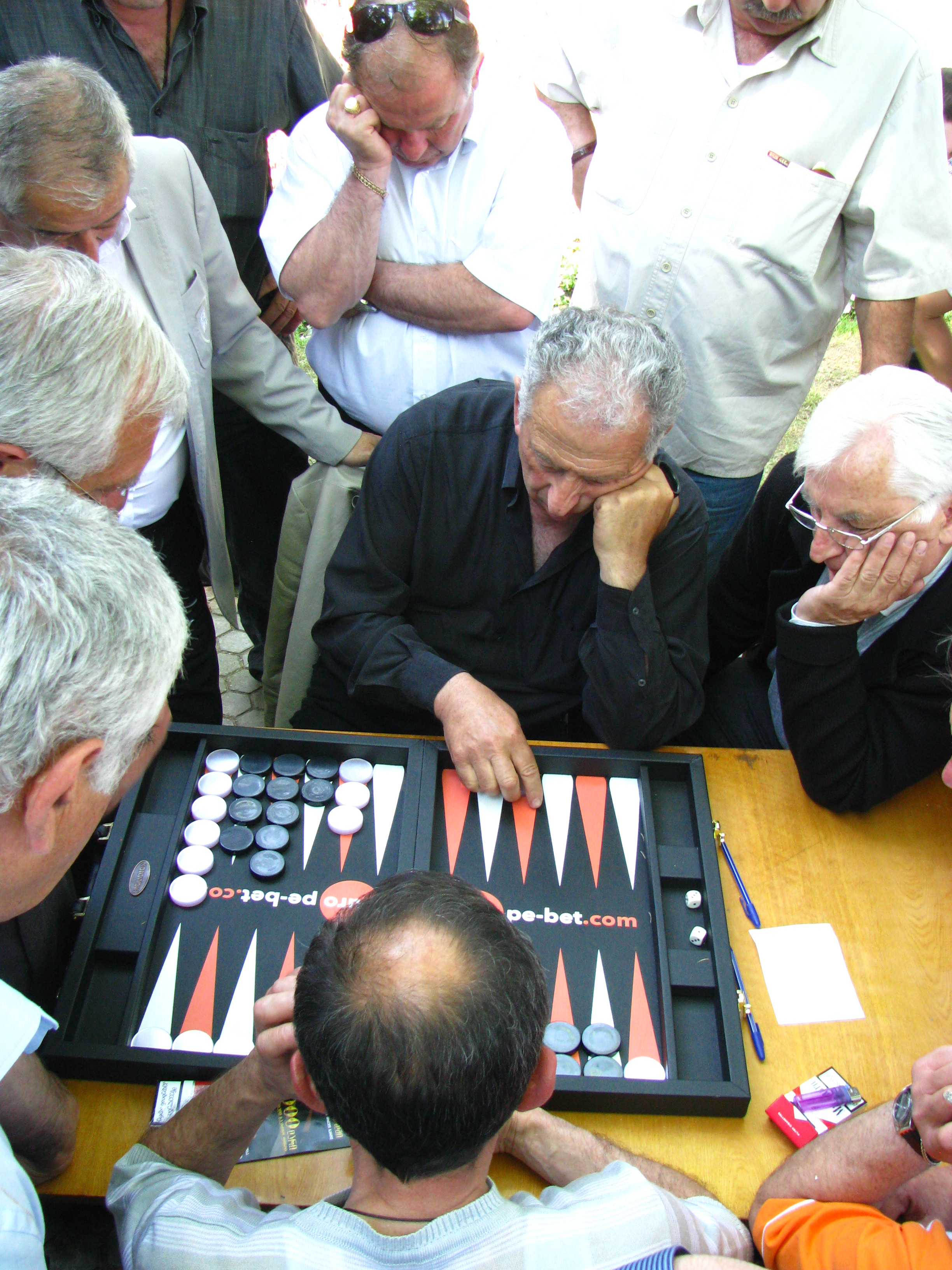
Just another game of high stakes backgammon.

Everywhere I go, I see people playing ნარდი (“nardi”), known in English as backgammon.  Men and women, children and the elderly–everyone knows how to play, and just about every family owns a backgammon set.  It’s popular everywhere in Georgia, but it’s especially popular here in Kutaisi, where it’s not uncommon to see clusters of old men playing on the side of the street.

I recently played in a nardi tournament at my school.  Long story short, I was massacred (I still want a rematch with the principal), but the experience got me thinking about how the game kind of parallels what life is like in Georgia.  As a foreigner, I’m sure I don’t have a complete picture, but it’s an interesting way to look at things, and I don’t think it’s completely off base.

So anyways, here’s my theory on how life in Georgia is like a game of backgammon:

1: Everything is driven by chance.

In backgammon, every turn starts with a roll of the dice.  Likewise, in Georgia, people tend to approach life like a game of chance.  Good things happen, bad things happen, but you’re never totally in control of your own destiny.  When your luck turns sour, the best thing you can do is just resign yourself to it until things get better.

One thing I’ve noticed about my host family is that they play the lottery almost every day.  Even when they aren’t playing, they usually tune in to see the results, probably just from force of habit.  I don’t know if every family is like this, but there are stands to buy lottery tickets in every major district of the city, and every kiosk sells them.

It’s not just the lottery, either–there are tons of casinos too.  In fact, Georgia is a very popular tourist destination for Israelis simply because of all the gambling.  That doesn’t mean that everyone in the country is a hardcore gambler, though–but if life is ultimately a game of chance, you might as well put a line or two in the water, right?

2: Skill is the ability to manipulate chance in your favor.

Even though backgammon is essentially a game of chance, there’s a lot of strategy to it too.  The key is to maximize your own options while limiting the options of your opponent.  It’s all about knowing when to move aggressively, and when to protect your own interests.

Likewise, even though Georgians put a lot of trust in luck, they also know that it’s better to make your own luck than to wait for luck to find you.  While my host family does spend a little bit on the lottery, they spend a lot more on physical improvements and their kids’ education.  My host dad works until 8pm every night, sometimes later.  They aren’t rich, but they’re taking advantage of opportunities their parents didn’t have, and making sure their children have more opportunities than they did.

3: No amount of skill can change the established pattern.

There’s not a whole lot of variation in backgammon.  Every game starts with the same setup, and follows the same general pattern: block your opponent while doing your best to advance.  Once your last piece passes your opponent’s last piece, it becomes a race to see who can get all their pieces home first.  Short of changing the rules, there’s really no way to break the game.

Likewise, life in Georgia is still very much about tradition.  If you were born in Kutaisi, you’ll probably die in Kutaisi.  If your parents are Orthodox, then that’s what you are, too.  If you’re a woman, you live under a certain set of restrictions and expectations.  Likewise, if you’re a man, there are certain things you’re expected to do to prove your manhood.

No matter how much Georgia changes to become part of the modern world, it’s an ancient country with a very, very long memory.  Most social norms aren’t going to change overnight, and some of them probably won’t change at all.  While this might seem incredibly stifling to us in the West, it does have its advantages, such as offering everyone a sense of identity and giving them a place where they know that they belong.

So that’s my theory.  I don’t know if this is why backgammon resonates so much with the people here, but it’s a fun way to look at it.  Now I just need to figure out which game is the most like life in the US.  Poker?  Monopoly?  Dungeons & Dragons?