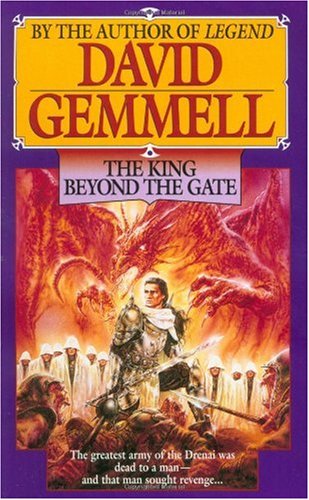
The King Beyond the Gate by David Gemmell

Tenaka Khan was a child of two nations and an outsider to both.  Half Nadir, half Drenai, the only home he ever knew was in the ranks of the Dragon, the elite fighting forces of the Drenai.  But now, a mad dictator rules the land, and the Dragon has been destroyed.

With all his friends dead at the hand of the evil Drenai emperor, Tenaka has only one desire: to steal into the palace and assassinate him.  Along the way, however, he makes a number of friends, all of whom seek the same thing, but all for different reasons.  As they join forces with the Skoda rebels, Tenaka realizes that he not only has something to die for–he has something to live for.

But in order to defeat the mad emperor, the rebels must fight the Joinings–terrible creatures made from man and beast, who slaughtered the Dragon years before.  Only the Nadir can save them–but the Nadir want nothing more than to ravage the Drenai.

If  you’ve read my review of David Gemmell’s Legend, you know why I love his books.  This one was no less incredible.  Parts of it were just as poignant as anything in Legend, and the ending, while bittersweet, was no less satisfying.

It’s really fascinating to me, because Gemmell’s books are not particularly flowery or well written.  His descriptions are sparse, his prose is unassuming, his characters, while distinguished from each other, sound more or less the same, and his viewpoint is often inconsistent.  But in terms of raw storytelling, his books are unequaled by anything else I’ve ever read.

He makes me fall in love with his characters: I cheer for them when they rise to the heroic deeds that circumstances demand of them, I cry when they fall short of what they could have been, and I weep when they give their lives in the service of something greater than themselves, which is almost invariably the case.

My favorite part of any David Gemmell book has got to be the order of warrior priests known as the Thirty.  They don’t show up in every book, but they show up in many of them, and they always share the same characteristics.  The warrior priests are dedicated to the Source (Gemmell’s equivalent of God in his Drenai universe), and have the supernatural abilities to speak telepathically, put thoughts into others’ minds, shield their comrades from the magic of the Chaos brethren, and leave their bodies to fly across the world and do battle in other dimensions beyond the grave.

The way the order is run is absolutely fascinating.  One person is the mouth, the other the ears, the other the heart, etc.  The most unlikely characters always fill the particular roles–but always for good reason.  They fight to defend the innocent and pure, but more than that, they always have some great destiny to perform–a destiny that invariably pits them against the forces of Chaos in some great, decisive battle.  In that battle, all of them invariably die, except for the weakest among them, who goes out to found the next order of the Thirty.

I don’t know about you, but this kind of stuff, just makes me want to jump up and down.  This is fantasy at its best–good versus evil, warriors facing death, and the most unlikely heroes rising to the level of greatness that war and honor demand of them.  Throw in a little magic, a brotherhood of evil sorcerers bent on crushing all that is good in the world, and terrible monsters the likes of which exist only in nightmares, and I am so there, man–I am so there.

In short, this book was nothing less than awesome.  If you love any book by David Gemmell, I think you’ll enjoy this one.  It’s got everything you could possibly expect from heroic fantasy, and more.

How do you write a character who is shy?

The writing is a little sporadic these days, but it’s coming along.  I’ve broken out of my most recent block, and progress is coming along on WAFH…or at least it was, when I didn’t have a temp job sucking up most of my time during the day.

Still, can’t complain about work–and even though all the job interviews from a couple weeks ago seem to have lead nowhere, I’ve got a few new opportunities opening up that seem promising.  More on those later.

One of the more challenging aspects of WAFH is writing the main female protagonist, Mira Najmi.  Mira is something of a shy pushover, who gradually learns to stand up for herself and make her own independent decisions.

Because of this, I find it difficult to write from her point of view.  When she isn’t letting people walk all over her, she’s either homesick and depressed or following others without making any real decisions for herself.  And yet, in order for her growth arc to work, this is the point at which she needs to start out; her gradual change into a strong and independent woman is a major part of the book.

In short, how do I make a shy, self-effacing protagonist sympathetic and interesting while remaining true to her character?

(Before I go further, I should note that Mira does have strengths.  She has a caring, nurturing personality, and is sensitive to the needs of others.  She often notices the little things that go right over the male protagonist’s head.  Besides that, she’s basically a good person, with a pure heart and an aversion to causing hurt or injury.  Oh, and she’s stunningly beautiful–though in some ways, that’s more of a handicap than a strength.)

Thus far, my strategy has been to delve into her internal monologue when in her viewpoint and try to make her underlying motivations clear.  I suspect it goes beyond that, though.  The best thing I can probably do is make her relatable to the audience–to make her shy in ways that make the readers feel like she’s one of them.

But that’s difficult for me, because I’m not a very shy person and I don’t generally relate well with people who are.  So how can I get a better understanding of what it’s like?  Do you guys have anything that you can share with me that would help me to understand?  Any tips or techniques for writing similar characters?

(image taken from http://webpages.scu.edu/ftp/lgrove/resign%20splashpage.htm)

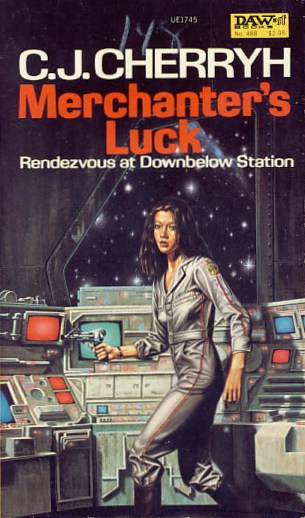
Merchanter’s Luck by C. J. Cherryh

He was a down and out merchanter, the captain, crew, and sole proprietor of a run-down bucket of bolts spacecraft.  She was a daughter of one of the finest starfaring clans, with seven hundred cousins standing between her and the one thing she wanted more than anything else: command of a starship.

They met at Pell during the height of the Company War–the key strategic point on the border between Union and Earth.  Their fateful meeting would affect not only the outcome of the war, but the course of their own lives–for the starship Lucy of Wyatt’s Combine was not at all what she seemed to be.

Before I review this book, I need to issue a disclaimer: you probably aren’t going to enjoy it very much unless you’ve already read Downbelow Station.  Cherryh isn’t the best at easing her readers into her worlds, and without the background on Union, Alliance, and the Company War, you’ll probably be hopelessly lost.

That said, I absolutely loved this book.

The premise is so awesome.  Space adventure hardcore, with a beautiful love story set amidst an epic interstellar war, where alliances are constantly broken and no one can be trusted…oh man, I LOVED this book!

While the premise seems pretty standard, C. J. Cherryh transcends the well-worn tropes and cliches of her genre by intimately developing her characters and working their motivations into the story until they are the ones driving the plot, and not the other way around.

Every character is unique, and though they act in ways that may seem strange to our modern sensibilities, there are always reasons for everything they do, cultural or otherwise.  As windows into their far-future spacefaring culture, they give the reader a wonderful view of Cherryh’s unique and marvelously constructed universe.

The thing that surprised me the most, however, was the sharp contrast between this book and Downbelow Station. While Downbelow Station traces the epic arc of the Company War through the viewpoints of a large cast of characters, much like Tolkien or Dune, Merchanter’s Luck focuses more on the characters themselves, in much the same way as David Gemmell or Ursula K. Le Guin.  In other words, while Downbelow Station is comparable to “high” or epic fantasy, Merchanter’s Luck would fall closer to “low” fantasy or sword & sorcery.

The interesting self-realization I took from the book was that I’m much more interested in the intimately personal stories than the sweeping epic tale of the Rise and Fall of cultures and civilizations.  I suppose that’s why I’m more of a David Gemmell nut than a Tolkien fanatic, and perhaps why I’m more into space opera and military sf than epic fantasy.  In all of my novels, the focus is always on the individual characters and their personal conflicts, and whenever I get sidetracked and focus too much on the overworld story, it always falls apart. 

Merchanter’s Luck definitely doesn’t get sidetracked, and that’s why I loved it so much.  I fell in love with the characters almost from the very first page–from the blurb on the back cover, even.  And most of all, I fell hopelessly in love with the starship Lucy:

You know you’re doing science fiction right when your readers bemoan the fact that they weren’t born in the 26th century, when they could command their own spaceship.  C. J. Cherryh is an amazing writer, and if I had the chance, I would teleport into her Union-Alliance universe in a heartbeat.

If you love well-crafted far-future worlds and stories about the people that live in them, check out Downbelow Station (or really, just the first chapter–that’s all you need for a solid grounding) and read this book!

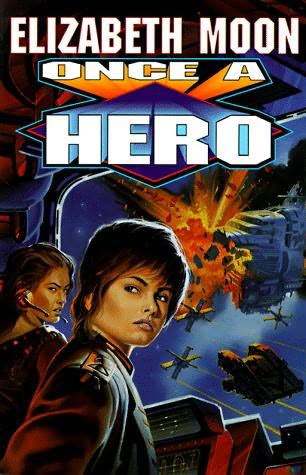
Once a Hero by Elizabeth Moon

Esmay Suiza never asked to be a hero.  All she wanted was to leave her dysfunctional home and join the navy.  But after surviving a mutiny and leading her spaceship to a most unlikely victory, everyone seems to be showering her with unwanted attention–or worse, examining her files for signs of command potential.

No, all she wants is to disappear–and now that her family has offered her a generous inheritance on her home world of Altiplano, she finds herself tempted to leave the stars behind and settle down for a while.

Little does she know, her family has hidden secrets from her–secrets from her past, which have the power to undo and destroy her.  Unfortunately, being a hero has a price–and the trauma of combat has already unearthed things from her subconscious than she cannot keep buried any longer.

This was my first time reading Elizabeth Moon, and I enjoyed it quite a bit.  Moon is extremely good at portraying a complex, believable military culture; she was a Lieutenant in the Marines, and definitely knows how to do military SF right.

My favorite part of the book was the descriptions of Altiplano, and Esmay’s experience returning to her homeworld of Altiplano.  Elizabeth Moon does an excellent job of creating a captivating world and transporting the reader there.  I fell in love with Altiplano almost instantly–not only with the planet itself, but the culture and the people, the whole society.  Excellent job.

Elizabeth Moon also does an excellent job developing her characters and giving them believable internal conflicts.  The way she portrays Esmay’s PTSD is quite striking, and very interesting.  Her struggles feel very real, and important too.  I think this novel helped me to better understand those who suffer from similar traumatic experiences, and that was very meaningful.

Storywise, however, I had a few minor issues, most of them having to do with the plot.  Things dragged a bit in the middle; when Esmay left her homeworld, I lost a sense of progression and felt that she was just wandering around.

When the antagonists came in–basically, a hostile army trying to capture her ship–I felt that Esmay solved her problems too easily, without any real try-fail cycles.  It gave me the sense that Esmay was some kind of superhero girl–not quite a Mary Sue, but toeing the line.

And Esmay’s love interest…I didn’t really get into him at all.  He seemed like a stereotypical damsel in distress, except with the sexes reversed.  I heard once that in good romance stories, the girl readers want to be the female protagonist, and the guy readers want to be the male protagonist.  Yeah…call me a chauvinist, but I never really wanted to be that guy.

I hate to be too critical, though, because Elizabeth Moon’s writing is quite good.  She has an excellent grasp of character, and her ability to transport her readers to another time and place more than makes up for her shortcomings with plot and story structure.  Also, I get the sense that this isn’t her best work.

In any case, if you’re a fan of military SF, you’ll probably enjoy this book.  I enjoyed it, and I will certainly be reading more Elizabeth Moon in the future.

A Game of Thrones by George R. R. Martin

Almost twenty years have passed since the fall of the Targaryen dynasty–twenty years since the last of the dragons was seen in the Land of the Seven Kingdoms.  Now, the libertine Robert Baratheon sits on the Iron Throne, blind to the conspiracies and secret combinations that surround him.

In this dangerous time, Ser Jon Arryn, the King’s Hand, dies of mysterious causes.  Most of the realm accepts the official story that the death was natural, but when Arryn’s wife Lysa sends a letter to her sister, Catelyn and her husband Ser Eddard Stark immediately suspect that the death was orchestrated by the Lannisters.  Only one thing remains: to travel to King’s Landing and uncover the proof.  Soon, King Robert calls on Ser Eddard to become his new Hand, giving them the perfect opportunity to do this.

Little does Ser Eddard know, the intrigue goes much deeper than any of them realize.  For the Lannisters are gathering an army, and Queen Cersei and her brother, Ser Jaime, harbor a secret that would tear the realm apart.  Meanwhile, the last of the Targaryens bears a child prophesied to rule the world, while far to the North, an ancient evil bides its time, waiting to sweep the seven kingdoms with horror the likes of which has not been seen in a thousand years.

Winter is coming–and the people of the Seven Kingdoms are ill prepared to face it.

Everyone seems to be talking about George R. R. Martin’s Song of Ice and Fire series these days–next to The Wheel of Time, it’s probably the biggest epic fantasy line of the last ten or fifteen years.  Martin is well known for killing off his characters and writing in shades of gray, so I thought it would be good to give this series a try.

As soon as I picked up the book, I was hooked.  Martin knows how to craft a beautiful, engrossing fantasy world.  In order to leave no doubt on that point, observe:

Yeah, that pretty much sums up what Martin did with his Land of the Seven Kingdoms. It’s an awesome fantasy world, and I found myself lost in it from the first page.

I must admit, however, after hearing so much about the Song of Ice and Fire series, I was surprised at how few characters died in this book. That’s not to say everyone survived–in fact, Martin killed my favorite character, which made me feel HORRIBLE–but I was expecting there to be more. However, this is the first book in the series, so I assume that the really crazy stuff happens later.

While overall I loved A Game of Thrones, I admit I did have a few misgivings about the book. Martin really does write in shades of gray, and while that makes the story unpredictable and surprising, it also makes things very dark and austere. Martin seems to have no interest in redeeming his characters, and when any of them try to be noble, he cuts them down at every turn.

Personally, I don’t care for that. Flawed characters may be more relateable, but seriously flawed characters (or characters with no interest in overcoming their flaws) turn me off. In this way, Martin is practically the antithesis of David Gemmell; whereas Gemmell makes you love his characters despite their flaws, Martin keeps you reading in spite of the fact that you hate all his characters.

How does he do it? By creating a beautiful, wondrous world. By crafting a masterful story full of intricate twists and turns. By making you hate some of the characters so #%$^! much that you have to stick around and see how they die. It’s all entertaining and extremely engrossing, but at the end of it all, I didn’t come away with any real love for Martin’s characters–except perhaps for a couple of Eddard’s kids, who are still young enough to be somewhat innocent.

I suppose it’s all a part of this new non-conciliatory movement in fantasy. Don’t get me wrong; A Game of Thrones is an EXCELLENT book, but it’s very…non-conciliatory. If that’s your thing, more power to you, but I personally prefer stories about redemption, where romance still lives and even the most unlikely character can be a True Hero, if only for a few fleeting, glorious moments.

Juggling projects isn’t a good antidote to procrastination

Yeah, the title basically says it all.  I’m working on Genesis Earth 5.0 and Into the Nebulous Deep 1.0, and while I’m doing really well in the one, I’m not keeping up so much in the other.

First, Genesis Earth. Since I finished the previous draft more than a year ago, I thought I’d find a lot of problems, especially with my prose.  Instead, while a lot of the sentence/paragraph level stuff needs tightening, I’m finding to my surprise that the writing isn’t all that bad.

Today, I breezed through over 8k words, and that between running, donating plasma, FHE, and a bunch of other distractions.  If I put even a moderate amount of effort into this, I can have it finished before next week.  That’s good, because I had an agent at World Fantasy request to see it; if I can put it on her desk before Thanksgiving, that can only be a good thing.

But as for my other project, ITND 1.0…yeah, it’s not coming along as well as I’d hoped.  The reasons are stupid, too–mostly just lost momentum and writer’s avoidance.

Right now, I’m stuck in a scene where I’m trying to build romantic tension between two characters.  I feel like I have a decent handle on who they are…but for some reason, it feels a little too shallow.  Maybe that’s because I’m still discovering who these characters are, maybe it’s because I tend to go deeper than most–or maybe it’s just because it’s the kind of scene that’s hard to get into, but once you’re in, it really flows.  I just haven’t forced myself to write it–maybe once I do, these problems will go away.

I do feel like I’m doing a pretty good job setting up the story.  Last week, I ran the first chapter through my online writing group, and while it definitely had issues, everyone said that they would keep reading if this was a book they’d picked up off the shelf.  That tells me that at least I’m starting in the right place.

The characters, though, and the conflict…I worry that it’s not as deep or as hard-hitting as the first book, Mercenary Savior. I skimmed over that book just a couple days ago before sending it out to a friend from World Fantasy, and…wow.  I don’t want to brag, but I think I did a good job with that one.  A damn good job.

So can I pull off that kind of depth and impact in the second book?  That’s the fear, that it won’t live up to the first one.  And certainly, the rough draft won’t be as good–not by a long shot.  But the subsequent drafts?  I don’t know.

Maybe I should just write and worry about it later, though.  When I was in the middle of Worlds Away from Home, I constantly thought to myself how crappy the draft was.  When I got to the end, though, and looked back on how far the story had come, I realized that it had potential to be at least as powerful as Mercenary Savior–perhaps even more.  And to be honest, that came as quite a surprise.

I don’t know.  I hope I’m not just deceiving myself–it can be hard, when you’re toiling in obscurity, to separate the truth from your own self-deception.  But for now, things are going well–I’m making good progress in Genesis Earth, and while Into the Nebulous Deep has lost a lot of momentum, all it really needs is a good solid block of undistracted writing to get it going again.  Life is good.

Crunch time

Sixty six percent!  I’ve officially passed the two thirds mark in the fourth revision for Mercenary Savior–and not a moment too soon.  With only a week and a half until World Fantasy 2010, it’s crunch time.  I’ll probably quit my temp job a week early in order to devote the last few days of the month to finishing it.

As I’ve been working on Mercenary Savior, though, a fascinating idea for a sequel has been stewing in my head.  It was sparked by an online conversation with one of my first readers:

Reader: I was never fully convinced that James felt he had closure
Me: I see
Reader: but I was satisfied with the thought that he would get it sometime after the story ends
he’s still young, so he’s still maturing
even at the close of the novel
Me: yeah
hmm
interesting

It’s true; James does have a lot of room to grow and mature after the events of Mercenary Savior. In that book, his character growth arc (without giving away spoilers) is about him learning to accept change and stop running from adulthood.

Nothing in that arc has much to do with the kind of person James grows up to be, however, or the significant other with whom he comes to share his life.  In other words, there’s a whole lot of untapped potential for building James’s character and giving him a romantic interest.

The question that immediately rose to my mind was: what’s the story?

Now when it comes to sequels, I think the best ones take a long, hard look at the first installment and answer the question: therefore, what? Thus, in Star Wars IV, V, and VI (which I believe to be one of the best examples of a trilogy in any medium), the Rebels defeat the first Death Star in episode IV, but find themselves on the run in episode V because the Empire knows the location of their base.  Luke uses the force to pull off a last-minute victory in episode IV, but finds in episode V that becoming a true Jedi takes a lot more discipline and self-mastery than he thought.

So I applied that principle to my own work and came up with the following overarching conflict: the Hameji occupation of Karduna is devastating the people of the Colony to the point where they collectively decide to depart en masse and establish a new community somewhere else.  It’s a logical conclusion taken from the ending of Mercenary Savior; the people are well enough off to survive, but too poor and oppressed to do much of anything else.

You may not know this, but the first story I wanted to set in this fictional universe was about a group of starfaring pioneers traveling into the heart of a nebula to escape religious persecution and establish a thriving community on the fringes of settled space.  That’s right–I basically wanted to set the Mormon pioneer exodus in space.

For various unrelated reasons, that never worked out, but the desire has always been there in the back of my mind.  What can I say–I think that pioneers are cool, and stories about colonizing unsettled new lands just fascinate me.  I’ll probably write a massive Utah pioneer epic someday.

But anyways, I started playing around with this old idea to see whether I could recycle it.  Right now, I think that I can.  The idea is that James becomes the leader for one of these emigrant groups, and has to see them safely through to a young planet in the heart of this nebula.  They decide to fly into the nebula in order to isolate themselves from the Hameji, since the FTL tech in my universe doesn’t work within a Nebula.

And then something really crazy happened.  This scene popped into my head, stronger than any other idea I’d had so far.  I imagined that a group of pirates had captured the expedition and refused to let them go unless they gave the pirates three young women to keep as slaves.

Pretty standard conflict, right?  But then, I thought: what if three young women of their own free will stepped forward and offered to sacrifice themselves to save the others?  What would James do then?

Well, it wasn’t hard to figure that out at all.  James would never let them go.  He’d fight the pirates, even if it meant risking all the lives of those he’s trying to protect.

This raises some interesting questions of morality.  Is it right to risk the lives of everyone in the community when three individuals have already offered to sacrifice themselves for the good of the whole?  Is it right to deny someone the opportunity to give their own life to save others?  Or is James just being stubborn and reckless?

At a first glance, that’s the way it looks.  But then I imagined what James would say to justify himself.  After what he learns from the events of Mercenary Savior, James would argue that the community needs to stick together–that in order for the whole to survive, everyone has to know with absolute certainty that no-one will be left behind.  Once the leader shows that he’s willing to sign his followers over, how can any of them trust him with their lives?  Under such conditions, trust breaks down and the community falls apart.

From that, a whole host of other ideas started gradually coming to mind.  How does this event tie into James’s romantic interest?  Does it tie in at all?  What would the people’s reaction be to this decision?  Coming from the background of the Colony, would they want to put the issue to a vote instead?  Is it ever right to suspend democracy when facing a crisis, and if so, under what conditions? 

So anyway, I won’t tell you what I have in mind, but I have a lot of really interesting ideas.  It’s gotten to the point, in fact, that I may just write the sequel after I get back from World Fantasy.

In closing, let me leave with this excellent track from one of ocremix’s latest albums, a rearrangement of Donkey Kong Country 2.  Believe it or not, this song could be the main theme of this novel.  Listen to it and I think you’ll see why.

Good night!

Dog dead workdays and killing your characters

This post is going to be super quick because I’m dead tired.

Due to power surges and computer glitches, I had to work overtime today and yesterday at the warehouse, so I really haven’t had time for anything except writing and a little socializing at Leading Edge.  However, things are going well.  I’ll get the extra hours off on Friday, which means a big chunk of free time to do whatever I want.

I broke 3k words today in Mercenary Savior. It was awesome.  I love revision–taking something good and making it really shine.  Just hit some major climaxes and killed off a side character, which is always exhilarating if you do it right.

As a footnote to that, I’m reading George R. R. Martin’s Game of Thrones, and I just reached the part where he kills off the first major character.  What’s more, he was my favorite character in the book so far!!! AAUGGH!  Why, Mr. Martin?  Why???  Yet I must confess, killing him was necessary to take the story to the next level of awesomeness <grumble>.

I’ve been thinking a lot about killing characters recently, and I figure the best way to do it is to recognize that everyone has to go sometime (in real life if not always in fantasy), and to write accordingly.  We tend to ignore our own mortality, when really, there can be so much meaning to it.  After all, to die for something is to make the ultimate sacrifice.  If you make sure your characters die for a reason–either heroic or tragic (or both)–then I think that’s the key to make it work.

The Book Academy Conference at UVU was great; I’ll do a writeup on that soon, probably over the weekend.  I probably won’t post the audio files, but if you want them, just email me and I’ll send you the link.

I’ve been waking up early each day this week, and it’s been great. I’m so much more productive in the morning, writing wise.  It’s like a computer: when you first boot up, your desktop is so clean. With only the startup programs running in the background, everything feels uncluttered.

At the end of the day, though, it’s the exact opposite. You’ve got maybe a dozen applications running, and it’s all too easy to get distracted by switching from one to the other. What’s more, you just don’t have the energy to get things done.

The downside (if you can call it that) is that it’s only midnight and already I’m about to collapse.  Oh well–guess I’ll just have to go to bed earlier.

In closing, let me leave you with this really weird, slightly disturbing anime clip I found on youtube of a vegetable committing seppuko. I guess it has something to do with the rest of the post, seeing as I went on a tangent about killing characters. Anyhow, this is the friendship among vegetables…

Job – reliable internet = spotty posting

Sorry for the general lack of posts these past few days.  I haven’t fallen off the face of the Earth (yet), I’m just working full time and living in a place that doesn’t have reliable internet.  Someone in the complex tried to set up a wireless router, and now the internet is down.  For some reason, the broadweave guys haven’t fixed it yet.

Student housing in Provo sux.

Anyways, here’s what’s going on in my life.  I found a temporary full-time job working in a warehouse.  They let me listen to my headphones while I work, so I’ve been catching up on a lot of podcasts and old recordings from cons and English 318.  It’s actually kind of awesome.  Definitely better than the call center.

I’m in the midst of finishing the research for the “class that wouldn’t die” article.  Basically, I have about half a dozen more interviews to do, then write up the rough draft.  I’m having lots of fun meeting all these awesome people and putting this article together.

But between work and the article, I’m finding it much harder to keep up with my writing.  I’m still producing about 2k consistently, but that’s not quite enough to have Mercenary Savior finished by World Fantasy.  Looks like I’ll have to sprint on the weekends.

I’m not too worried about it at this point, though.  The revision is going great–in fact, I might post a few excerpts.  I know the story’s solid, and the characters are a joy–especially Tamu, the slutty, self-centered concubine that becomes something of a mentor for Stella (to her horror, of course).

The Hameji are also quite interesting; one of my goals in this revision is to portray the rationale for their behavior as clearly as I possibly can.  Towards that end, I have a list of points about their culture that I want to get across in the narrative, and I’m keeping track of which scenes convey which points.  The goal is to have at least three scenes for each point, which will involve some substantial revision.  But if it works, the Hameji will go from horrific, brutal antagonists in the beginning to sympathetic if still brutal by the end–kind of like George R. R. Martin’s stuff.

Speaking of George R. R. Martin, I’m reading A GAME OF THRONES right now and I’m absolutely loving it!  I wish I had the time to sit down and read this book for hours.  Alas, the only way I can do that is to give up writing, and I can’t do that.  Weekends, though–better wait for the weekend.

Anyway, that’s what’s going on.  I’d better go to bed now, before I jinx myself tomorrow morning.  Or maybe I already have?  Blarg.  Night.

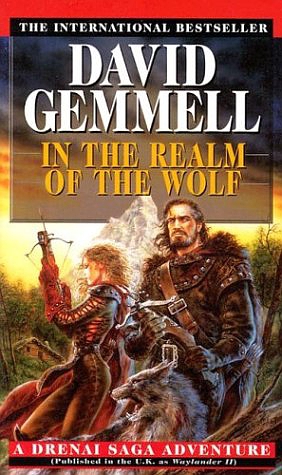
In the Realm of the Wolf by David Gemmell

Never leave home without a weapon, Dakyras taught his adopted daughter Miriel.  Though they live a quiet life alone in the mountains, death is never far from the man known as Waylander.

When the Assassin’s Guild puts out a high price on Waylander’s head, both Waylander and Miriel find themselves on the run.  With them come two ill-fated gladiators from Drenai: the loyal and steady Angel, and the arrogant and reckless Senta.  Both men vie for Miriel’s hand–and both are honor bound to kill each other.

But in the face of the evil hunting Waylander, Angel and Senta must lay aside their vendetta and take up arms against the Gothir army hunting the Wolf clan, tribe of the prophesied chieftain that will one day unite the Nadir.  For deep in the realm of the Wolf lies a castle more ancient than the three empires–a castle whose dark secrets threaten to upset the global order forever.

This book was awesome.  I loved every moment of it.  With each page, the story just got better and better, right up to the climactic finish.  If you’re looking for a rousing adventure, you can’t go wrong with David Gemmell.

One of the things I loved the most about this story was the love triangle between Miriel, Angel, and Senta.  At first, I thought I knew who was good, who was bad, and which one she’d end up with, but then things changed and I wasn’t too sure.  Even though I hated Senta at first, I spent most of the book vacillating with my feelings on him.  And the way things ended–I wasn’t disappointed.  Not one bit.

Even though the overall story conflict was much, much larger than life, Gemmell’s characters always felt very real.  Perhaps it has to do with the way their true nature always seems to come out in battle–and Gemmell gives them plenty of opportunity to show their true nature.

It also has to do with the things they’re fighting for, though–the stakes are always clear for each character, and when they’re confused what they’re fighting for, that’s made clear too.  Though the conflict itself is larger than life, the stakes for each individual character never are.

The ending really took the cake for me, though.  When I finished the book, I couldn’t help but smile.  Gemmell is a master at writing endings that make you want to stand up and cheer.

As awesome as this book was, though, the last book in the trilogy, Hero in the Shadows, is so much better.  The last scene of that book stands out so much more to me, now that I know everything about Waylander’s past.  So.  Freaking.  Epic.

But do yourself a favor: don’t read the last book first, like I did.  Start with Waylander, which is a good book–not great, but good–and read through the trilogy.  If you love stories about true heroes and epic adventures, you won’t be disappointed.