Sholpan, or The Great Novella Experiment

So now that I’m finished with Desert Stars, the next project I’m working on is a companion novella to Bringing Stella Home titled Sholpan.  While Bringing Stella Home is about James and his quest to rescue his brother and sister, Sholpan is entirely from Stella’s point of view and traces her rise in Hameji society, from prisoner and slave to…well, I won’t ruin it for you.

I started writing it on Monday, and so far it’s been a lot of fun.  In some ways, it’s kind of a break for me, since I already know the story (most of the material is lifted straight from Bringing Stella Home, with a few extra changes to make the viewpoint tighter and build more character development).

At the same time, though, it’s a challenge because I’ve never written in the novella format before.  The definition as given by SFWA, has mostly to do with length:

For the purposes of the Nebula Awards, the categories are defined as follows:

  • Novel — 40,000 words or more
  • Novella — 17,500–39,999 words
  • Novelette — 7,500–17,499 words
  • Short Story — 7,499 words or fewer

However, I can’t help but feel that there are many other artistic elements to consider.  For example, the Oxford Dictionary of Literary Terms gives this definition:

novella [nŏ‐vel‐ă], a fictional tale in prose, intermediate in length and complexity between a short story and a novel, and usually concentrating on a single event or chain of events, with a surprising turning point.

Other sites I’ve browsed (including this post from The Galaxy Express, this review from 2009 of several small press novellas, and another interesting post on short stories vs. novellas vs. novels) leave me with the impression that novellas typically

  • can be read in one long sitting, such as a train ride,
  • center around one major conflict, idea, or issue,
  • have more room for rich settings and lavish descriptions,
  • tend to focus more intimately on character,
  • are compact enough to take risks with voice and theme, and
  • can end without a definitive conclusion to the central idea or conflict.

I must confess, I’m not an avid reader of novellas.  I’ve read some of the classics, of course: Dr. Jekyll & Mr. HydeThe Time Machine, Animal Farm, etc, but in terms of modern sf novellas, all I’ve really read is I Am Legend (and a few golden/silver age “novels,” if you count them).  Point is, I’m not an expert on novellas by any means.

However, the novella seems like a very promising format for epublishing, especially in conjunction with a novel.  Readers can pick up the novella for $.99 and get both a sample of the writer’s longer novel-length stuff, as well as a complete story in itself.

That’s what I want to do with Sholpan.  I want to write a less-expensive derivative work that’s artistically sound in its own right, while also driving interest in the full length novel.  Besides, it’s just fun to experiment with new styles and formats.

If this is successful, I can see myself writing a companion novella to most, if not all of my novels.  And who knows?  Maybe I’ll be able to sell some of those to more traditional print and electronic markets.  It’s worth a shot, and no matter what happens, I’m bound to learn something new.

So yeah, that’s my current writing project.  If all goes well, expect to see it out sometime this fall.  And if you have any comments or suggestions regarding novellas, please share!  I’m very interested to learn anything I can.

Guest post: Developing Characters in a Fantasy Setting

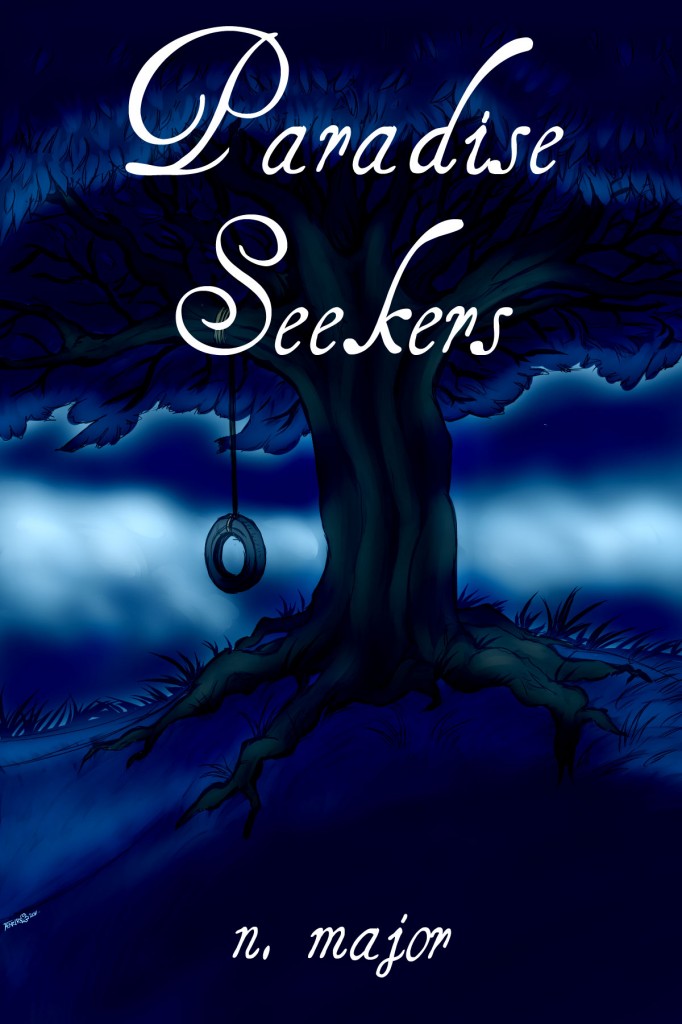
Nathan Major is a friend and fellow writing who, like me, has taken the epublishing route for his first novel, Paradise Seekers. I met him through our mutual friend Charlie at Brandon Sanderson’s English 318 class.  His book is pretty good; I’m only partway through it right now, but he’s playing with some interesting fantasy concepts and I’m definitely looking forward to seeing how he pulls it off.

I recently appeared on his blog with a guest post on how I develop my characters; for his appearance here, I decided to throw the question back at him.  Like a true fantasy author, he answered it with a multi-part epic that is probably only the first installment of a trilogy.  He makes some good points, though, and it’s definitely worth reading (and not just for the snarkiness, heh).

On a tangentially related note, I also appeared recently on Charlie’s blog with a post on ebook formatting and book DIY.  When you’re finished here, be sure to check it out!

And now, I give you Nathan Major…

================================================
When you think of fantasy, what is the first thing that comes to your mind? Mystical worlds populated with elves, dwarfs, and other magical races? Kingdoms and castles, dark lords and noble heroes? Perhaps you entertain a world that is more supernatural and more interesting than our own, one that would allow you to escape to its enchanted forests and sweeping vistas.

The fantasy genre differs from other forms of fiction (except perhaps science fiction) in that the worlds they take place in tend to be the stars of the stories. Middle-earth and Prydain. Oz and Earthsea. And within these worlds, a classic clash of good vs evil is expected. The characters and story can often take a backseat, with many authors spending years of their lives crafting the perfect magic system, most precise system of fantastical government, and the means to make their elves the best damn elves you’ve ever seen.

This drives me crazy.

I’ve been reading fantasy my entire life, but it wasn’t until a few years ago that I got fed up with the whole thing. I loved The Hobbit and The Lord of the Rings, but as I dug deeper and picked up more modern fantasy, it all seemed to start blending together. Here is our noble hero, beating the odds to fight against a nameless, oft-hidden dark lord. Here is his spunky princess sidekick slash love interest, his old mentor who dies in act two, and the hardened warrior with a dark secret. While not all books contained these tropes, the main issue still persisted: I wasn’t seeing any new characters.

That was actually what drove me to writing. After reading through a particularly popular fantasy book that was also atrociously generic, I remember tossing the book on the couch and thinking, “I could do better than this!” So I set out to try my damnedest to write a fantasy novel that, yes, was in a fantastic worlds that we wish we could live in, but was populated by people just as interesting and well-developed as the world.

Since I’m severely ADHD, I’m going to break this up into a few key ideas that (hopefully) will get my point across. These aren’t just applicable to fantasy, but it’ll be my main focus.

1) Plan your characters first, before you plan the world.

Simple enough, right? When speaking with most other fantasy authors on the subject of brainstorming, the first things they say are, “Oh, I got the coolest idea for a magic system!” or “This world is going to be amazing…it’s made entirely out of White Chedder Cheese-its!” To which I say, “Ok, but what’s the story? And who are the people influenced by the story?” This is usually met with a, “I don’t know, I’ll figure it out later!” Then I defriend them on Facebook and pretend they never existed.

Ok, so the last part was an exaggeration. But the point still stands: you may have the greatest world ever devised, but so do map-makers, and theirs looks better. What is actually in the book is the plot and the characters, and the world is just what it takes place in. You might have the greatest appendix ever at the end explaining how the Haku-Bula Wolf Tribe’s language is actually a combination of grunts and Swedish, but that doesn’t matter to the average reader. Figure that stuff out after you’ve got a story, because it’s less important.

2) Don’t fall into cliches.

This is a hard one, as discovered by me when writing my third book, Where Gods and Mortals Dance. If you’ll excuse a moment of self-indulgence, when writing this book I had a female princess as the main character. She was a strong character, but due to circumstances beyond her control she was thrust into a situation that was almost impossible for her to fix. I remember trying to design her as strong but still fragile, as parts of her past haunted her and made her ability to rule difficult.

Then I took her to writing group, where the group was divided. Half said she was the, “generic, strong, masculine princess who takes charge,” and the other half felt she was the “weak, needy, spoiled princess” who has everything done for her.

It frustrated me, but also proved a point.

I was relying on two cliches and stereotypes to design my character. I drew from both in an attempt to be original, but that didn’t work. This happens all the time in fantasy. We have the old warrior, somehow inferior to our spunky young farmhand who picked up a weapon for the first time yesterday. We have a dark lord who never actually does any fighting or has any coherent plans, he just sort of sits on his throne of skulls and knives (which is probably black and on fire) and waits for farmhands to come and kill him.

Even in the most original novels, these cliches can become evident. They might not be as blatant as the ones said above, but keep them in mind when writing. Your book doesn’t have to star a teenager. It could star a forty-year-old man who wants to save the world. There doesn’t have to be a Dark Lord at all; the enemy could be something completely different. Stay the hell away from elves, dwarfs, or anything that Tolkien used. And taking Orcs, changing them slightly, and calling them “Orks” doesn’t count as being original, it counts as being a cop-out. Fight the cliché. Make your characters deep and unique.

3) Remember: Everyone is a hero in their own story

Sympathetic villains are a rarity in fantasy. Most of the time we have a group that is distinctly bad, and a group that is distinctly good. You can usually tell by how they live. If they live in trees, clouds, or anything that communes with nature: good. If they live in filth, a swamp, or basically anywhere that looks like it’s under the constant duress of a smoke-machine: evil. Usually bad-guy motives are just “they are bad and hate the good guys,” which is a freaking awful excuse. Oh, and don’t get me started on the “he’s insane, that’s why he wants to destroy the world!” villains. That’s the biggest cop-out of them all and if you use it I want to punch you in the face right now. You are cheapening your characters and your story to make things easier for you. Here’s a revelation: good books aren’t easy. It took Tolkien how long to craft the novel that essentially invented modern fantasy? I’m not saying you should take two decades to make your book, but you should at least have to take more than one sentence to describe your villain’s motives.

The best part about the above expression (which is probably my motto when it comes to developing characters) is that it changes the way you look at your book. Life isn’t black and white: it’s a whole lot of gray. You might see something in black and white, but if you were given a chance to enter someone else’s head, perhaps your view would switch entirely. Nothing is scarier than a completely sane, totally competent villain whose goals just so happen to be the exact opposite of our hero’s. In fact, it makes the reader uncomfortable, because many of them will no longer know who to root for. If you are doing it right, your villain’s motives and values should be just as convincing as the hero’s, which means the reader should be second-guessing their loyalties throughout the book. It makes for a hell of an engaging read, let me tell you.

But this little ditty isn’t just for main characters. Side characters also need to be their own heroes. Sam didn’t just tag along with Frodo because it was a fun thing to do. He knew what had to be done (probably even better than Frodo) and fulfilled that personal quest. Your side characters need to have their own motives and motivations, depth and personality. Don’t’ drag them to Mt. Doom with the only reason being “because the hero was heading that direction anyway.” They should be just as deep (or at least close to the level of depth) as your hero. Make them interesting, and your reader will love them even more.

4) For your characters to be successful, you must know them better than they know themselves

Wow, that’s a long one, and it is sort of off the theme of “broad, overgeneralizing statements” that these bullet points have been so far. At any rate, I’ll try and be brief with this one because it seems self-explanatory.

I have a friend author who, upon designing a character, takes an online “100 questions personality test.” While I’m not saying this is the “go-to” answer for everybody, it can be an extremely helpful tool in understanding a character better. What do they like to eat? What is their taste in women (or men)? If they magically appeared in our world and wanted to hang out, what would you do? These are questions that’ll maybe never be addressed in the story, but you should know these answers. If a character has a name and is in the book for more than a single chapter, you should know everything about them.

This can be hard work, especially if you like having a billion characters. But even if you just have one or two, you really need to be in their heads. Know them. Be them. Imagine them in other situations besides in your novel. And once you really understand what makes your spunky farmhand tick, then you’ll be able to write him in both a convincing and believable way.

5) Write characters you’d like to read about

Figured I’d end this on a simple one. It’s very easy when writing to get the rose-tinted glasses put on, and all of a sudden everything in your book seems perfect. Your characters are a little cliched, but whose aren’t? Your dark lord doesn’t really have a idiom, but he does have a badass axe carved from the ashen bones of the long-lost race of dragons. Who wouldn’t like this book?

Take a step back and think. And if you can’t think of yourself, think of me. A cynical, jaded red-head who writes fantasy only because most of the fantasy currently out there pisses him off. I am your audience. I am biased, blatant, and unbelievably good looking. What would I say?

If you know your characters (see #4!), and you know them well enough then this step shouldn’t be an issue. You’ll like them regardless, because any author gets attached to a character they know every aspect of. In my current novel, Effulgent Corruption, one of the viewpoint characters is complete scum. My initial development of him was a murderous, rampaging madman whose only reason for existence was to kill and destroy. However, as I dug deeper and began to understand the character, he became sympathetic. I realized the man’s goals, what emotional pains he’s been through, and what hurts him now. I knew who he relied on, and what parts of himself he hated.

He quickly became my favorite character.

This should happen with you. You should love your villains, and hope that, should this whole “world-saving hero” thing blow over, their goals will be accomplished. Your side characters should be entertaining and fun, people you’d want to hang out with, just like your hero does. You should know everybody and at least have a shred of sympathy for them. Then, you’ll have great characters.

This, of course, isn’t a complete guide to developing good fantasy characters. Hell, it isn’t really even a very specific one. But I’m almost 100% sure that, should you take these ideas to heart, you can beat the odds and write a fantasy novel that is as interesting in its ideas about elven politics as it is with its elaborate, three-dimensional characters. Fantasy as a genre deserves better, and you (yes, you!) can be the one to do it. So go forth, young author, and write the epic that will shake the Barnes and Nobles across the land!

Plus, it’ll increase your chances that I’ll actually read it, which is a perk in and of itself.

Copyright (c) 2011 by Nathan Major
Rocking the rewrite

I am well into the third draft of Worlds Away from Home, and oh man–it is so much fun! That might seem a bit counter-intuitive (revising = fun?), so let me explain my process.
In a first draft, I have a ton of ideas, but it’s hard for me to keep track of them all (and they also tend to change even as I write them).  I’ll cobble together a story out of them, but it’s a rough, misshapen story, with subplots that go nowhere, characters who seem schizophrenic, scenes set in the wrong point of view, and setting details that are inconsistent.  The main throughline is still there, but it’s buried under a ton of crap, sometimes so much that even I can’t see it.

In a second draft, I cut out the worst of the crap and try to dig out the core story elements.  I’ll cut entire chapters and subplots, throw out characters, rework the world, and fix as many of the glaring errors as I can.

Some writers call this a “triage edit,” and that’s as apt a term for it as any.  I’m not doing surgery yet; I’m applying the field dressings that will get the wounded from the battlefield to the operating table.

But the third draft, by far, is my favorite.  That’s when I take a hard look at the story and figure out how everything connects.  It’s like dumping out a new Lego set and opening up the instructions.  This is where I iron out the major character arcs, where I start to intertwine the subplots properly, where I get a sense of the book’s themes and figure out how to make it insightful and thought provoking.

Writing the third draft is absolutely glorious, and I love it.

Right now, I feel so immersed in the world of my novel, it makes me want to lock myself in a room and do nothing but write.  I have to force myself to go to bed, otherwise I’d be up until 4am writing.  Even with some of the major changes I need to make with this book, I wouldn’t be surprised if I average 4k or 5k words per day for the next two weeks (about all the time I have before I have to go back to work).

I finished the third draft of Genesis Earth in less than three weeks.  I finished the third draft of Bringing Stella Home in considerably more time than that, but that was partially because of other real-world stuff out of my control (like a nightmarish internship), but between that and the fourth draft, it was much the same thing.

So anyhow, I’m having an awesome time revising Worlds Away from Home, and the finished draft is going to be AWESOME.  And next to changing someone’s life with one of your books, that’s probably one of the best feelings you can have as a writer.

Man, writing is so much fun. 🙂

Into the Nebulous Deep 1.1 is finished!

That’s right; my fifth novel, Into the Nebulous Deep, is finished! Here are the stats:

ms pages: 447
words: 101,215
file size: 230 KB
chapters: 20
start date: 7 March 2011
end date: 14 May 2011

And the wordle:

Wordle: Into the Nebulous Deep 1.1

This novel is a direct sequel to Bringing Stella Home, and takes place within the same universe as Worlds Away from Home (note to self: find new title for that one). I got the idea for the novel from a conversation with one of my first readers for BSH, who mentioned that James didn’t get a whole lot of closure at the end and still had a lot of maturing to do. Immediately, I saw that there was a story there, and got to work figuring out how to tell it.

This was back in October, and like so many other things, the project quickly started going in about twenty different directions. I was still on something of an sf romance binge, so I decided to throw in a love story, and that quickly turned into a love triangle with a weird sf twist. But then, I started getting interested in the girls’ stories, which led to other subplots, which led to more stuff…and…and…

Actually, for a rough draft, I feel I pulled it off pretty well. I dropped the ball on some aspects of the story (didn’t develop the techno-democracy elements of the Colony hardly at all, and dropped James’s sidekick without giving his character a satisfying arc), and forgot to throw in other stuff until well past midway through (the wolf vs. sheepdog debate–Lars has a rather feisty take on that, which should be interesting), but I think the overall structure is mostly intact. For a rough draft, I’m rather pleased.

Of course, it will need a major triage edit before I can send it out to any first readers. It has problems, I know what they are, and I need to give the draft a major overhaul to get it to the point where feedback would be helpful.

But after ten weeks of working on this thing, I’m ready to move on to something else. Next up: my second revision of Worlds Away from Home. I am sooo stoked to get working on this project–it’s going to be AWESOME!

The song that had the biggest impact on my as I wrote ITND was probably this remix of hot head bop on ocremix. I think the lyrics sum up James’s character pretty well, especially in this book:

Now, onto other exciting things!

Thoughts on outlining

I’m on track to finish my fifth novel in a couple days, and surprisingly, the writing has been going very smoothly.

Usually by this point, my eyes are bleeding and I feel as if I have a hundred caltrops in my pants.  Finishing a rough draft is still the hardest part for me, since by the end everything seems to suck and I just want to trash the whole project.

I still feel a little bit of that with Into the Nebulous Deep, but not nearly as much as with my previous stuff.  Part of that is probably because I feel confident that I can fix whatever I screw up, but the other part probably has to do with the way I’ve learned to outline.  In one short sentence, here’s what I’ve learned:

An outline is simply the story you tell yourself to help you tell the story.

I don’t think there’s any mortal writer on this planet who can keep a whole novel in their head at one time.  Scenes, yes; chapters, maybe; novels, absolutely not.

However, since everyone’s creative mind works a little differently, everyone has to find the process that works for them.  Brandon Sanderson, for example, writes story bibles that are almost 100k words long.  If I were to try to do that, I’d get bored halfway through and spend the rest of the day dorking around on youtube.  Other people prefer to fly by the seat of their pants, and while there’s something to say about trusting your subconscious, I need a little structure to keep from getting totally lost.

It took me a while to figure out the process that best works for me, but based on how ITND has been going, I think I’ve hit my stride.  Breaking it down into plot, setting, and character, here’s how I basically do it:

Plot

For me, the basic plot of the story comes in a flash of creative insight once all the ideas in my head have reached a critical mass.  It’s like watching a fissure shoot across a smashed window pane, or lightning arcing from the ground to the sky.

If I don’t have time to start the project right away, I’ll let the plot mull around in my head for a couple days, then open up notepad and free write the basic structure of the story in an unedited stream of consciousness.  When I do start the project, I’ll look back to the free write to refresh my memory, but otherwise work out of what’s in my head (which may have changed).

While the project is ongoing, I’ll divide the whole novel into parts, chapters, and scenes.  For the chapter I’m currently working on, I’ll have the various scenes listed in bold with their corresponding point of view character (eg: “1.1: James“), followed by a brief one or two line description of the action and plot significance.  If I introduce a new character in that scene, I’ll write their name in ALL CAPS (I believe that’s a screenwriting convention I picked up from my old college roommate).

For chapters I haven’t written yet, I just write a few lines of description for what I envision happening in them.  When I first start out, I usually have a clear idea where I want the story to end, but I don’t bother outlining all the stuff in the middle since that usually changes based on stuff that comes before.  I only keep my outline a few chapters ahead of where I currently am, and may change things completely if something new comes up.

This process works very well for me.  I use it for every draft, and refer to it often.

Character

I’ve found that I need to do a lot more outlining to figure out my characters than I do with my plot.  However, it’s like Tracy Hickman said with the marbles: don’t hold onto your outline too tight, or all the marbles will slip out between your fingers.

The things I absolutely need to know about my characters are:

  • back story
  • motivations
  • first impressions
  • flaws & handicaps
  • strengths & advantages
  • why the reader should care about / sympathize with them

For some odd reason, I find it most helpful to write this out longhand, usually while taking a walk.  For additional help, sometimes I’ll take a personality test on behalf of my character and get a handle on them through their personality type; for that, I prefer the Meyers-Briggs typology.

But once I feel I have a solid handle on a character, I’ll throw everything out if it feels instinctively right for a character to do something completely different.  Thing is, I need the outline (especially the motivations and back story) to get to the point where I know the character well enough to let them take over.

And for some reason, all my main characters feel too…generic.  I’m not sure why, but that’s something I’ve got to work on.

Setting

Setting, for me, is all about discovery writing.  I’ve tried using wikidpad to worldbuild my universe before I start, but that’s never worked.  Instead, I daydream a lot and trust my subconscious to give me what I need when I need it.

That’s not to say I don’t do research–just that most of my research is on the fly.  If I only stay on wikipedia and the footnotes and references, no problem; if I get sidetracked on facebook, however…

Often, when I’m doing setting descriptions, I’ll run a quick google image search to pull up pictures to give me a better visual idea of what I’m describing.  I especially use this for clothing; that’s why, if you check my search history (please don’t), you’ll find all these weird, girly terms like “ottoman dress,” “jumpsuit,” “leather jerkin,” and “full frontal snogging” (whoops, where did THAT come from??).

The big problem is when I figure something at the beginning of the book and then forget about it halfway through.  For that reason, I should probably invest in a good copy editor when I start to publish.  I should also take the time to draw out a starmap, since it’s getting REALLY hard for me to remember where the Belarian system is in relation to Tajjur and Karduna Prime…hmm…

I should probably figure out a better system to keep track of my settings, but as far as outlining them goes, the less the better.  I love waving my hand and creating stuff–it’s one of the main reasons why I’m a science fiction writer.

So anyways, that’s more or less the outlining system I currently use.  I might end up outgrowing certain aspects of it, or finding a better system, but this is what works best for me now.

Of course, I still have a lot to learn.

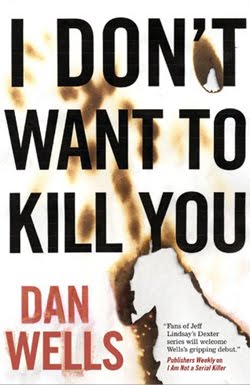
I Don’t Want to Kill You by Dan Wells

John Cleaver, teenage sociopath and demon hunter, has put his inner monster to work protecting his small town community from supernatural beings.  But now, the head demon, known only as Nobody, has come to take him down.

As if that weren’t difficult enough, the most popular girl in John’s class, Marci, has taken a liking to him–and he soon finds that he likes her back.  What’s more, she’s not as weirded out by his obsession with the string of murders in their town–in fact, she’s interested in them too.

Just as their young romance begins to blossom, however, a rash of teen suicides makes John wonder: why does he even try if the people he’s trying to protect are just going to throw their lives away anyways?  To defeat Nobody, he must search within himself and find the answer.

This book was awesome–like, Return of the Jedi awesome–and I’m not just saying that because the author is a friend of mine.  It brings the Serial Killer trilogy to a dramatic and satisfying conclusion.  Dan Wells’s storytelling skills are amazing, and he puts them to good use throughout this book.

The thing I loved the most was probably how all the major characters had to sacrifice something huge for the people they loved in order to overcome the evil forces at work in their lives.  And the demons–whoa, they were pretty freaky.  Supernatural freaky, yes, but in a way that was frighteningly true to life–even more so than the previous demons in the series.

Wells has an excellent handle on character arcs, and he applies that here to the romance subplot with excellent results.  The romantic aspect of the novel was both believable and gripping, and made the ending all the more emotional.

If anything, though, I wish he would have played up the love triangle a little more than he did.  No spoilers, but there were a couple of shifts toward the end that felt a little abrupt.  Not too much, but I thought it could have been done better.

This is definitely an urban fantasy, but one surprisingly close to the real world.  Unlike Mr. Monster, where the supernatural aspect came in halfway as something of a shock, I thought the supernatural and real world elements in I Don’t Want to Kill You were blended almost perfectly.  Not only was it clear from the beginning that both elements were going to be important, but the feedback loop between the two was handled extremely well.  If I ever write urban fantasy, Dan Wells has certainly set a high standard to follow.

All in all, a great book, one I highly recommend.  If you enjoy urban fantasy or superhero stories, you’ll probably love this book.

A Fascinating Moral Dilemma

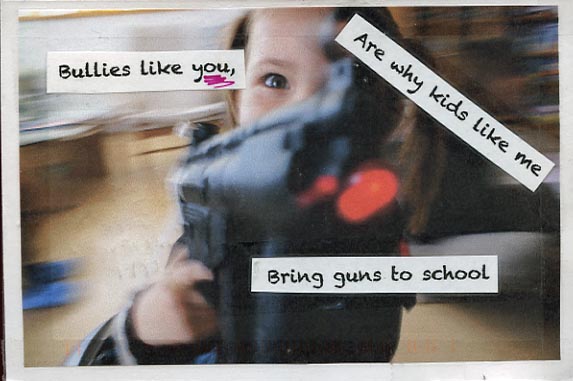
For FHE* tonight, we had an interesting discussion about ethical dilemmas and moral absolutes.  It started with the following question:

If you were a prisoner of war, would you consent to have sex with the prison warden if it would set you free?

The overwhelming answer, predictably enough (at least from a bunch of Mormons), was “heck no!” So then, the teacher upped the ante by asking: what if it would free one hundred other prisoners who were scheduled to die the next day?

I was a little surprised (but not really) when I was the only one who admitted that I probably would.  After all, there’s precedent for something similar in the Book of Mormon, and a very real question of whether or not the blood of the dead prisoners would be on your hands if you didn’t.  Also, I would still consider it rape, since I draw a distinction between the act of sex and the act of saving lives–IOW, the sex itself isn’t strictly consensual; it’s the cost of saving the other prisoners.

Laying aside completely the question of whether or not you can take the warden at his word, it’s a very interesting dilemma, and one that gets at the heart of what people really believe.  The fact that so many of my Mormon peers wouldn’t sleep with the guy tells you a lot about Mormon culture.  My follow up question would be: if it meant freeing yourself and the other prisoners, would you kill the warden?  Because I’m pretty sure most of them would say “heck, yes!” even though murder is typically considered to be a more heinous sin than fornication.

But anyway, the point here is that all of this makes excellent story material.  For your characters, what are the moral lines that they absolutely will not cross?  The ones where they’re a little more fuzzy?  What, for example, would a character be like whose method for choosing between two undesirable courses of action was to flip a coin–no matter the stakes?  And what about the characters like Ender Wiggins who flip the dilemma on its head by stabbing the giant in the eye?

This is the kind of stuff I love to read, and the stuff I love to write as well.  I’m hoping to pull off a really good one in Into the Nebulous Deep, but not for a couple of chapters.  Gotta set things up, get the story moving, and give the romance a little momentum.  But once the characters are all fleshed out and the stakes are insanely high, that’s when the fun begins.  Bwahahahaha!!

Man, I would make an awesome prison warden. ;P

Image courtesy postsecret.

*FHE (Family Home Evening) is, for young single Mormons, roughly the equivalent of a college-aged church youth group meeting.

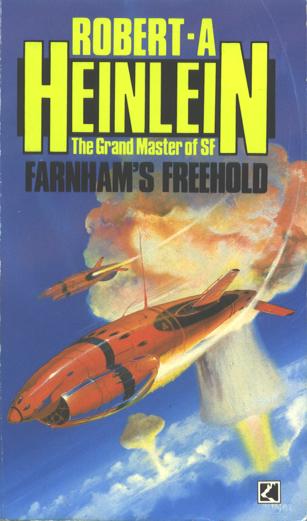
Farnham’s Freehold by Robert Heinlein

Bomb warning.  Third bomb warning.  This is not a drill.  Take shelter at once.  Any shelter.  You are going to be atom-bombed in the next few minutes.  So get the lead out, you stupid fools, and quit listening to this chatter!  TAKE SHELTER!

Thus begins the wild and crazy story of Hugh Farnham, a middle aged suburban American, with his alcoholic wife Grace, his law student son Duke and daughter Karen, their black house servant Joseph, Karen’s sorority sister Barbara, and the cat Mr.-Livingston-I-Presume.  When the Russians nuke the peaceful town of Mountain Springs into oblivion, only the uncanny foresight and resourcefulness of Hugh keeps them alive.  When they open their bomb shelter and climb outside, however, they find themselves in a world that defies anything they could ever imagine.

This book was incredible. I finished it at 4:00 am on a Sunday night, and honestly I wouldn’t have it any other way.  The characters are memorable and engaging, the plot face-paced and thrilling, the world fantastically imaginative, and the story both entertaining and thought provoking.  Wow.

Heinlein is an unparalleled storyteller, and I think he does it by creating worlds that are innately fascinating and imaginable and populating them with characters who act like real people, with the full range of reactions and motivations that real people have.

Consider the basic premise: who hasn’t wondered what World War III would be like?  No one who grew up during the Cold War, certainly.  And as for surviving and colonizing an uncivilized wilderness, people of all ages have been enthralled with that idea since Robinson Carusoe and The Swiss Family Robinson.  Heinlein capitalizes on this urge by telling us a story that we love to tell ourselves.

But the thing that really drew me in was the characters.

I’ll confess, when I got to the part where they open the bomb shelter and find themselves in a pristine, virgin wilderness instead of a blasted city, I threw the book across the room.  Up to that point, everything about the nuclear attack had been so realistic that the cross-dimensional time travel element totally threw me out.

However, even after I put the book down, I couldn’t stop thinking about Hugh Farnham.  The down to earth, no nonsense resourceful man who took the Boy Scout motto “Be Prepared” to a whole new level–who had the chutzpah to draw a gun on his own son when his rebellious behavior threatened to unravel the group–his undying attitude of “never surrender”–I just couldn’t stop thinking about him.  So I picked the book back up and finished it, and am I ever glad I did!

But it wasn’t just Hugh Farnham.  Grace, with her debilitating alcoholism and irrational outbursts, was a character I really loved to hate EVEN THOUGH she reminded me of people in my own family.  Joe, the longsuffering polite servant who changes so frighteningly with the reversal of fortune in the second half of the book; Duke, whose dysfunctional relationship with his father leads to so many problems; Barbara, the 60s era divorcee who goes from outsider to one of the closest members of the group–man, there were some memorable characters.  And NONE of them were caricatures; all of them had strengths and weaknesses, and while some fell prey to their flaws, others rose above them and triumphed magnificently.

I suppose that Farnham’s Freehold is a good example of pulp science fiction at its best: an imminently entertaining story that is also meaningful and thought provoking.  If so, then this is definitely the kind of stuff I want to write.  The descriptions may be sparse and the prose rather unremarkable–but man, the story…what a wild and crazy ride!

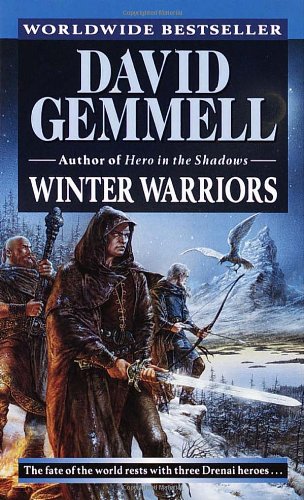
Winter Warriors by David Gemmell

Eons ago, in the Days of Fire, demons feasted upon the souls of men the way that men feast on cattle.  Those days ended when the second most powerful demon betrayed his people, damning them to purgatory so that men could inherit the Earth.

Four thousand years have passed, and the demons are beginning to come back.  The dread Kreyakin, advance guard to the demon invasion, have already passed into the world of men.  In order to open the portal to the other world, however, they must cast a spell requiring the lives of three kings.

Two of the kings have already been sacrificed.  The third lies within the womb of the Princess Axiana.

The fate of the mortal world now lies in the hands of three aged warriors–Nogusta the swordsman, Kebra the bowman, and Bison the brute–and a handful of unlikely fugitives.  Together, they must stand against the dread Kreyakin and all the forces of hell.

Alright, my attempt at a jacket blurb really doesn’t do this book justice.  I want to say it was one of the best Drenai books I’ve ever read, but the truth is it’s just like every other book in the Drenai saga, which is to say that it’s awesome.

I think I’ve figured out why I love David Gemmell’s books so much.  It’s because his books so perfectly capture what it means to be a man.  Women read Twilight because it perfectly captures the experience of being a teenage girl in love, and Gemmell’s books–all of them–capture what it means to be a man.

I’m not just talking about the platonic ideal of manhood–I’m talking about the everyday reality as well. Two men sitting together in “companionable silence.” A warrior who scoffs when his commander sends some lesser men to accomplish a mission, then after getting chided says “I spoke in haste,” and the matter is dropped.  Guys who tackle problem after problem, from fighting duels to fleeing from armies from helping the inexperienced princess with her messy childbirth, and do so without flinching, because hey, someone’s got to do it.

But the ideal is definitely there too, because in every single one of Gemmell’s books, circumstances conspire to push his characters right up to the very limits of their abilities.  When that happens, their true character shines out, and the most unlikely ones rise to great feats of heroism, often sacrificing their lives in the process.

Indeed, if there’s one underlying theme in all of Gemmell’s books, it’s about heroism and what makes a true hero.  It’s awesome.

The best part, though, is how Gemmell redeems even the darkest characters.  I can’t say much about this book without giving away the ending, but let me just say it was extremely satisfying.  Evil is not some slimy b-movie monster–it’s a quality that everyone possesses in varying degrees, alongside the potential for greatness.

In this way, I think Gemmell is the antithesis of George R. R. Martin.  While both authors write in shades of gray, Martin emphasizes how even the noblest, most honorable people have an ugly black stain somewhere in their character, whereas Gemmell focuses on the potential within all of us to rise above the darkness in our souls and accomplish feats of greatness.  His heroes are dark and gritty, but at the end of the day, they are heroes nonetheless.

In short, this book was awesome. If you’ve ever read a book by David Gemmell and loved it, I guarantee you’ll love this one.  I certainly did.

Writing update, getting ready for LTUE, & Katniss must DIE

So I’m back at work at WAFH, making slow but steady progress.  At this point, I’m throwing out about half of what’s on the page and redrafting stuff to fill in the gaps, but that’s only going to increase.

It’s not particularly hard, but it does take a lot out of me.  I’m finding that I can write for about two or three hours before my creativity runs dry.  When I’m spending more time online or playing games and less time focusing on the story, that’s a sign that it’s time to do something else to refill the well.

Man, I wish that well would stay full for longer…but in the meantime, 2.5k words per day isn’t so bad.  I’ll take it.

In unrelated news, I’m currently about a third of the way through The Hunger Games and I hate the main character, Katniss.  She’s a total attention whore, and fits all the classic characteristics of a Mary Sue.  A tortured past, a heart of gold, ridiculously well skilled, beloved by everyone and romantically irresistible, even to her enemies…blegh!  I hope she dies or gets tortured beyond all humanity.

In spite of this, I’ll probably finish the novel, just because it’s been such an influential bestselling title–as a writer, I’ve got to do my research.  However, I don’t see myself finishing the series.  There are other reasons why I don’t particularly like this book, but I’ll wait until a later post to articulate them.

In other unrelated news, LTUE 2011 is coming up, and I am so freaking excited for it!  Here are the panels I definitely plan on attending:

Thurdsay

9:00 am:
– Best and worst writing advice ever given
(Anna del C Dye (M), Mette Ivie Harrison, Tyler Whitsides, Frank L. Cole, James Dashner)

11:00 am:
– Self-Publication pros and cons
(Jessica Douglas (M), LuAnn Staheli, Sandra Tayler, Anna del C Dye)

2:00 pm:
– Writing Strong Female Characters
(Sheila A. Neilson, Aleta Clegg (M), Clint Johnson, Jessica Day George, Bree DeSpain)

4:00 pm:
– The Writing Life: how to set and keep goals, how to prioritize.
(Angie Lofthouse, Julie Wright (M), Sandra Tayler, Berin Stephens)

6:00 pm:
– Marketing and Publicity–what can you do?
(Stacy Whitman (M), Bree DeSpain, James Dashner, Dene Low, Elana Johnson)

Friday

10:00 am:
– Tracy Hickman Presentation

11:00 am:
– Main Address: Steve Keele

12:00 pm:
-Charisma is not a dump stat: The real world importance of personal appearance and social skills in achieving your creative dreams.
(Howard Tayler, Jake Black (M), Tracy Hickman)

2:00 pm:
– The Problem of Sequels
(Anna del C Dye, Mette Ivie Harrison, Larry Correia (M), Bree DeSpain, Jessica Day George)

5:00 pm:
– What You Can And Can’t Do In A YA Novel
(Mette Ivie Harrison (M), Elana Johnson, Bree DeSpain, Robison Wells, J. Scott Savage)

Saturday

9:00 am:
– What I wish I had done, if I could do it all over again – A Guide to New Writers
(Lisa Mangum, Dave Wolverton, Brad R. Torgersen (M), Kathleen Dalton-Woodbury)

11:00 am:
– Main Address: James Dashner

12:00 pm:
“Zombies and You: A guide to what does and does not constitute an apocalypse”
Ross Wolfe

2:00 pm:
– Building believable economies/politics
(Dan Willis, Eric Swedin (M), Roger White, David Ferro)

3:00 pm:
– Can your dreams pay your bills?
(Rebecca Shelley, Ami Chopine, Sandra Tayler (M), Dave Wolverton, Michael R. Collings)

There are more, but these are the ones that look most interesting to me.  As usual, I’ll record all of the panels I attend, so if you want a copy, just email me.

Man, I’m so excited!  LTUE this year is going to be awesome!