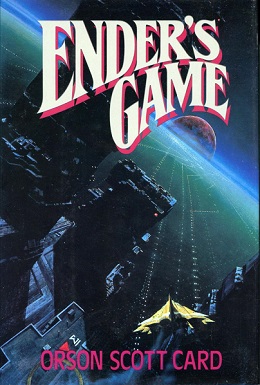
Ender’s Game by Orson Scott Card

“I’ve watched through his eyes, I’ve listened through his ears, and I tell you he’s the one.  Or at least as close as we’re goign to get.

“That’s what you said about the brother.”

“The brother tested out impossible.  For other reasons.  Nothing to do with his ability.”

“Same with the sister.  And there are doubts about him.  He’s too malleable.  Too willing to submerge himself in someone else’s will.”

“Not if the other person is his enemy.”

“So what do we do?  Surround him with enemies all the time?”

“If we have to.”

“I thought you said you liked this kid.”

“If the buggers get him, they’ll make me look like his favorite uncle.”

“All right.  We’re saving the world, after all.  Take him.”

Thus begins one of the greatest SF classics of all time, Ender’s Game. With such a spectacular beginning, it only keeps getting better.

I decided to reread Ender’s Game because a friend of mine in Washington was reading it.  I read this book back in high school in only two sittings–the first twenty pages in the library, and the rest back home, where I finished it wide-eyed at three in the morning.  I didn’t regret a single moment of it, then or now.

One of the most fascinating things to me about this book is the way that Orson Scott Card breaks almost all of the rules of writing.  On every page, he “tells” much more than he “shows”–some of the battles he glosses over in only a couple of paragraphs.  He gives only minimal setting details, and very few of these are visceral or concrete–it’s very hard to “get into” the world of Ender’s Game the way you would with a fantasy novel.  Most of the characterization consists of “navel gazing”–Ender thinking to himself about how bad things are, rather than taking action.

Breaking these rules, however, is exactly the thing that makes this a good book.  The story isn’t in the setting, or in the nitty gritty of the battles–it’s in Ender’s mind, how he reacts to the forces around him, and how those forces change him. “Telling” rather than “showing” allows him to keep the pace at a breakneck, thrilling speed while cutting out unnecessary details, and the “navel gazing” allows us to get an intimate picture of Ender’s mind.

It goes to show that good writing isn’t just about knowing the rules, but knowing how to break them.  And when it comes to plot, character, pacing, foreshadowing, thematic elements, and the hero cycle, Orson Scott Card proves his masterful brilliance in this work beyond a doubt.

One of the most fascinating things about this book is that it hits all eight points of the Campbellian monomyth.  This excellent article (originally published in Leading Edge) explains how.  The most incredible thing to me is that the year after Ender’s Game came out, Orson Scott Card did it all again–wrote a blockbuster book hitting all eight points of the monomyth–with Speaker for the Dead, which I think is a superior book.

Ender’s Game is a true classic of the science fiction genre.  Not only is it a highly entertaining story, it is deeply meaningful and insightful as well.  It’s one of those books you can reread multiple times, and it only keeps getting better.  Whether or not you’re a fan of science fiction, this is a book you will deeply benefit from reading.
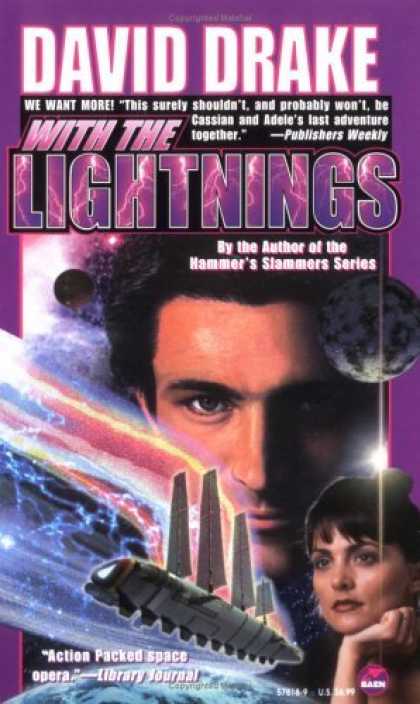
With the Lightnings by David Drake

Daniel Leary, Lieutenant in the Republic of Cinnabar Navy, dreams of commanding a military starship one day.  Unfortunately, as the estranged son of a corrupt senator, and with almost no money to his name, he has virtually no chance of ever seeing it happen.
While serving in an assignment on Kostrama, a neutral trade world between Cinnabar and her mortal enemies, the Alliance, he meets Adele Mundy, chief librarian of the Kostraman capitol.  The title is virtual meaningless, however, as the uncultured Kostramans would give the position to anyone–even a political exile from Cinnibar such as Adele.  Her whole family was assassinated by Leary’s father, and she has sworn to take revenge.

Little do they both know, the Alliance has other plans.

Ever since I met David Drake at World Fantasy 2009 in San Jose, I’ve been meaning to read one of his books.  I must say, I picked a good one.  With the Lightnings is the first book in his RCN Series, which is basically David Drake’s take on Patrick O’Brian’s Aubrey-Maturin novels.  Think Napoleon-era naval battles and political intrigue…in space.

Does it sound good already?  Yeah, I thought so.

I was a little surprised at first, because the first chapter started with a bunch of info dumps.  It took until about the halfway mark for the action to really start, but when it did, it was awesome. A bunch of navy guys marooned on a hostile planet behind enemy lines, trying to survive a planetwide coup and blowing all kinds of stuff up along the way–yeah, it was cool.

The thing I enjoyed most about this book, however, was the insight into the minds of the officers and the way the officers and soldiers interacted.  You can tell that David Drake has experience in the military–lots of experience.

It was evident in the little things the main character noticed–the colors and patterns of soldiers’ uniforms, competency among his own men and incompetency in men not under his command, leadership style and how he dealt with crises–stuff like that.  The language was colorful, but when the soldiers swore, their language had a bite to it that went beyond the actual words.  The people felt gritty, but very real.

At World Fantasy, I mentioned to David Drake that I’d read some of Joe Haldeman’s works, and knew they were both Vietnam vets.  He remarked that Haldeman’s works are very much different than his own: Haldeman’s characters are constantly stabbing each other in the back, whereas in Drake’s works, there is always a sense of teamwork and unity, even when the going gets messy.

I could definitely see that in With the Lightnings–it’s one of the things that made the book so fun to read.  Yes, things get pretty tough and a lot of people die, but there’s always a sense of loyalty within the platoon (or whatever the unit is called).

With the Lightnings is a great space opera action/adventure story.  After reading it, I really want to read more books in the RCN series.  If you want a good, fun military sf adventure story, this is a great one to pick up.

Thoughts on writing characters

A couple months ago, I was listening to one of my personal recordings of Brandon Sanderson’s English 318 lectures from last  year’s class.  The topic was writing characters.

Brandon outlined several techniques for making characters sympathetic.  He also outlined how to round them out: give them flaws and handicaps, as well as little quirks to make them unique and memorable.

However, I couldn’t help thinking that something was missing in his formulation.

Before I continue, let me say that I’m not disparaging or criticizing Brandon Sanderson’s abilities to write compelling, well-rounded characters.  As his novel Mistborn shows, writing characters is one of his strengths.

At the same time, I feel that the “checklist” approach to writing characters can be dangerously counter-productive.  Too often, characters in sub-par novels feel like a patchwork of characteristics and personality traits, not like actual, real people.

When I asked Brandon about this, he said that his techniques should be seen as tools, not as fundamentals.  He then went on to say that the most important thing to keep in mind is the character’s motivations–why they want what they want.  Beyond that, you just have to tweak the character until they fit into their role.

After thinking about it for some time, I came to the conclusion that the best way to write characters is to keep two essential rules in mind:

Rule #1: Every character is the hero of their own story.

Rule #2: Every story is composed of three parts: beginning, middle, and end.

The first rule is straightforward: every character sees their life as a story in which they are the main character.  This is because all of us, as human beings, view our own lives in this way.  We may look at other people and consider them nothing but extras in the story of our life, but they certainly do not think of themselves in this way.

To apply this rule, however, we need to understand what it exactly means to be the hero of one’s own story.  We can only understand this when we realize that a story is composed of three basic parts: beginning, middle, and end (or, as we see ourselves: past, present, and future).

Every hero has an origin and a destiny.  Without these, they don’t have a story; they don’t have a beginning and they can’t have a meaningful end.  This is why the hero cycle begins with the miraculous birth and ends with ascension and apotheosis.

Writers should keep this in mind as they sketch their characters.  If you don’t know where your character came from–who their parents are, where they  grew up, what were their major formative experiences, etc–your characters are going to fall flat because they’re just extras in someone else’s story; they have no story of their own.

Likewise, your characters need to have a destiny.  If you’re a discovery writer (like me), this might be harder because you don’t know, from the outset, where everyone’s going to end up.  Keep in mind, though, that rule #1 applies to the story the characters tell themselves just as much as the story you’re telling the reader.

Each character’s individual story is like a thread, which the writer weaves together with other threads to form a beautiful tapestry.  That tapestry is the novel; without the individual characters’ stories, the work would feel week, shallow–threadbare.

Of course, it’s not always possible (or a good idea) to reveal everything about every character.  It’s also not always possible to outline every character in great depth–not without catching “worldbuilder’s disease.” Instead, the rules of worldbuilding should apply–only use 10% of your worldbuilding in the actual story, no info dumps, etc.

I don’t think that’s a comprehensive theory of character just yet, but I think it’s a step closer to one.  If you have any ideas or suggestions of your own, please do share.

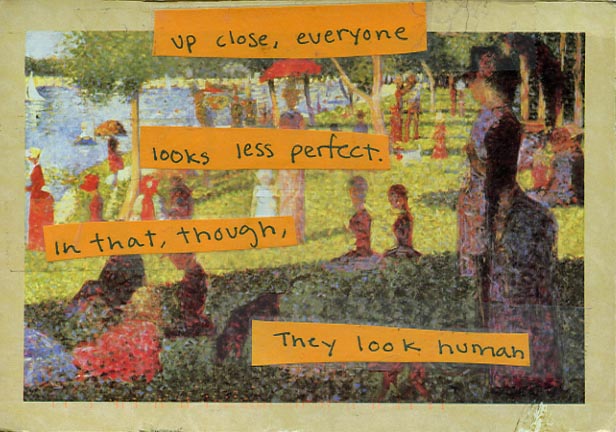
Image courtesy Postsecret

The Dispossessed by Ursula K. Le Guin

Urras and Annares, a world and its moon, separated by the gulf of space and two hundred years of mutual contempt.  On Urras, capitalist and socialist nations vie for dominance over the world’s rich and abundant resources.  On  Annares, the anarchist exiles scrounge for a meager living, but live in peace–and in hope.

Shevek has never known any other world than the anarchist utopia of Annares.  His life’s work is to develop a unified theory of simultaneity–a tremendous feat that will rework the paradigm of space travel and communication.  When the people of Annares reject his theory, however, he voyages to Urras in the hopes that by offering his theory as a gift to all nations, he can bridge the gap between the worlds.

Hopelessly inexperienced in the cutthroat ways of the propertarians, Shevek has no idea what he is getting himself into.  In his gilded prison, with nations vying for control of his person, can he find allies who share his idealistic, utopian vision?  Or is he alone in a world of greed, lies, and murder?

This is, quite possibly, one of the most impressive and beautiful works of literary science fiction that I have read.  It may be the best novel I’ve read all year.  Le Guin’s characters are so deep, her ideas so compelling, her worlds so rich, her writing so poetic and beautiful that I hardly know where to start.

One of the many things that made this book so good was the depth of Le Guin’s character development.  The story had a plot, and Le Guin dropped just enough pieces of it here and there for you to know that there was one, but more than anything this book is a portrait of an incredibly interesting man, Shevek.

The book actually contains two stories that merge into one in the end.  One taking place in the present, after Shevek arrives at Urras, and the other is a series of flashbacks showing how he arrived at that point.  Le Guin alternates brilliantly between past and present to reveal insights into Shevek’s character that would otherwise remain unexplored.  By the end of this novel, I felt that I knew this man–and loved him–better than anyone in real life, including myself.  It blew me away.

Le Guin’s worldbuilding, too is incredible.  Before reading this book, I didn’t consider myself an anarchist, but after spending so much time in the utopian society of Anarres, I almost want to become one.  Le Guin meticulously extrapolates her world from her highly perceptive understanding of human nature, paying such attention to detail that her anarchist world is not only surprisingly plausible, but enviable as well.  This is the kind of world that I would like to visit, explore, and perhaps even settle down in and live.

Her ideas, like her world, are meticulously well thought out and incredibly compelling.  In the Hainish cycle, Shevek is the inventor of the ansible drive, the technology that eventually enables peaceable diplomatic missions to other worlds, such as the one chronicled in The Left Hand of Darkness. Shevek’s struggle is to find a way to let this technology bring peace and break down walls, rather than empower tyrants to conquer and destroy.  Time and again, Shevek’s egalitarian, anarchist values come to the surface, clashing not only with those of capitalist Urras, but with our own.

All of this would be enough to make this a compelling, memorable story–but Le Guin’s stunning, beautiful prose puts this book into a league of its own.  The rhythm and beauty in her words made every page a joy to read, with descriptions that kept me entranced and dialogue that made her characters leap off of the page.  Above all, her prose conveys with powerful and compelling clarity the many life-changing ideas and themes of this story.  The book’s last words still haunt me.

The Dispossed is, without a doubt, is one of the best works of Science Fiction that I have read.  I would even go so far as to claim that it is a superior book to Le Guin’s better known work, The Left Hand of Darkness. If I could read a book this insightful every month, I would be a much better man, and have a much deeper and imaginative understanding of the world than I presently have.  This book is a true masterpiece.

A Canticle for Leibowitz by Walter M. Miller, Jr.

It was said that God, in order to test mankind which had become swelled with pride as in the time of Noah, had commanded the wise men of that age, among them the Blessed Leibowitz, to devise great engines of war such as had never before been upon the Earth, weapons of such might that they contained the very fires of Hell, and that God had suffered these Magi to place the weapons in the hands of princes, and to say to each prince: ‘Only because thine enemies have such a thing have we devised this for thee, in order that they may know that thou hast it also, and fear to strike.’
But the princes, putting the words of their wise men to naught, thought each to himself: ‘If I but strike quickly enough, and in secret, I shall destroy those others in their sleep, and there shall be none to fight back; the earth shall be mine.’

Such was the folly of princes, and there followed the Flame Deluge…

In the new dark ages of man following the nuclear apocalypse, an order of Catholic monks preserves the last vestiges of civilization: a shopping list, an electrical diagram, and other assorted scraps of a long-dead world.  As mankind rises from the dust, inevitable tensions arise between the church and the world, between Jerusalem and Babylon, Christ and Lucifer.

This book is epic.  Epic. I can’t begin to describe how incredible it is.  Virtually every page, especially towards the end, is packed with meaning.  A cautionary tale of the folly of man in this fallen world, this story held me captivated right up to the chilling final chapter.  Bravo.

As I understand it, Walter M. Miller Jr. wrote this book in the late 50s / early 60s, during the height of the Cold War.  Science fiction at that time was both sweepingly visionary and frighteningly pessimistic about the future of mankind, and this book successfully captures both extremes.  Like Asimov’s Foundation series, it reads more like a collection of elongated short stories, but Miller’s characterization and attention to detail is superior, in my opinion, to Asimov’s.

The most fascinating aspect about this book is the way that Miller hearkens to the past to give us a vision of our future.  Many of his ideas are straight out of Augustine and Aquinas–indeed, in several places, the story feels like it’s set in 3rd or 4th century Europe, which only adds to the delicious irony.

Yet, while this book has a strong Catholic feel, I never felt alienated or excluded from its intended audience.  Maybe it’s because my Mormon heritage is more compatible with Catholicism than other religious beliefs, but I don’t think it’s just that; the issues in this book are human issues, not just religious issues, and by focusing on that fact, Miller makes the story much more universal.

Even with all the deep, philosophical elements, this story is wonderfully entertaining.  Irony abounds, especially in the first section, in which a young novice takes a simple electrical diagram from the pre-deluge world and, completely unaware of its significance (or lack thereof), spends the rest of his life making a beautiful illuminated manuscript of it.  Even though the sections were  short, I quickly fell in love with the characters in each one, and connected with them almost instantly.

The final scene, in particular, was incredibly touching.  I won’t spoil it for you, but let me just say, if you are or ever have considered taking your own life, read this book, just for the final scene.   The degree to which the last abbot clings to life, even in the face of so many good reasons to give up, is just incredible.  And the final scene, in which…I won’t ruin it for you.  Just read it!

A Canticle for Leibowitz is one of the most powerful, meaningful books I have read in my life.  It is more than a good read, more than epic.  I class it as one of the best works of fiction this genre has ever produced.  If you have ever wondered about the destiny of mankind, or the proper relationship between the secular and the spiritual in our modern age–read this book!

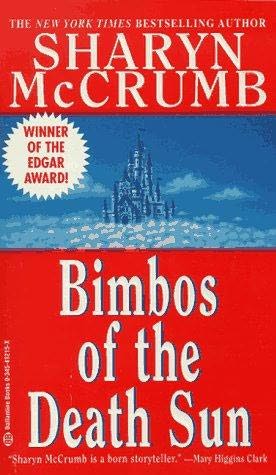
Bimbos of the Death Sun by Sharyn McCrumb

It’s that time of year! Elves, Klingons, slave women, gamers, computer geeks, aspiring writers, and superfans are converging on Rubicon, the annual science fiction convention. Mild mannered citizens beware!

Newest among the motley crew is Jay Omega, a young, local computer professor and first-time author on a mission: make sure that nobody he knows in real life finds out that he is the author of Bimbos of the Death Sun. Fortunately, his friend and secret lover (but only a secret to him), Marion, is there to promote his book and keep him from getting hopelessly lost.

But then, Appin Dungannon, famous author of the prolific adventure series of Tratyn Runewind, is found dead in his hotel suite.  Who could possibly want him dead?  Turns out, just about everyone: Appin is also famous for hating the series more than any other person on the planet, and for treating his fans like slime.

As the convention threatens to fall apart, Jay takes on the case and tries to answer: who killed Dungannon, and why? In a world where fantasy has more power than fact, however, the answer is stranger than anyone in theiTr right mind would expect.

This book was hilarious. Sharyn McCrumb explores science fiction and fantasy fandom the way a drunk anthropologist would explore an aboriginal jungle tribe. Even though her characters are all shallow caricatures of the real thing, their clumsy interactions turn the story into a wonderful farce that is as entertaining as it is educational.

There were only a couple of parts that bothered me. At one point, McCrumb gets into the head of an overweight, hopelessly ugly fangirl cosplayer and shows her thought process as she pursues a romantic relationship with an equally ugly and socially incompetent fanboy. I didn’t feel that McCrumb authentically portrayed the character’s own thoughts–it sounded more like a person from the outside giving their take on the experience. Then again, McCrumb was going for humor, not true character depth.

Besides that, this book is definitely dated. The computer technology in the novel is ridiculously primitive, on par with the Commodore 64, the Tandy 400, and the trusty old 386. In other ways, too, this book is solidly 80s–any science fiction convention nowadays would probably have less Trekkies and more Anime cosplayers. However, the dated aspects only make the novel more endearing, in my opinion. Who wouldn’t be nostalgic for the good old days of the 386?

This book isn’t high literature, and Sharyn McCrumb would probably be the first to admit it. It was, however, wonderfully entertaining, one of those rare and beautiful books that made me laugh out loud, heartily. For someone like me who is just starting to become involved in science fiction and fantasy fandom, it was a hilarios and helpful primer to this fascinating subculture. As McCrumb states in her foreward:

Science fiction writers build castles in the air; the fans move into them; and the publishers collect the rent. It’s a nice place to visit, but please don’t try to live there.

That said, I find it telling that it was people in fandom who recommended this book to me. Good to know that at least a few of us don’t take ourselves too seriously.

Revelation Space by Alastair Reynolds

Hundreds of thousands of years ago, an ancient race of sentient aliens known as the Amarantin went extinct just as their civilization experienced a golden age.  No one knows why, but archeologist Dan Sylveste is determined to find out.  Unlike the other colonists on the remote planet of Resurgam, he believes that the answer may be important.
He has no idea how right he is.

Just as he’s on the verge of a major breakthrough, a team of rebels takes over the administration of the colony.  Sylveste becomes a prisoner of war, and his research comes to a frustrating halt.

Meanwhile, on Yellowstone (the nearest human-inhabited planet to Resurgam), a mysterious entity known as The Mademoiselle hires assassin Ana Khouri for a special mission: kill Dan Sylveste.

The only ship headed in that direction, however, is an ancient warship commanded by a rouge crew of Ultras, genetically modified transhumans.  They seek Sylveste in order to heal their captain, who suffers from a plague that melds human biology with advanced technology.  The de facto leader, Illia Volyova,  hires Khouri to replace the ship’s gunner, who went mad and mysteriously died.

But neither Khouri nor Volyova realize that the thing that drove the gunner mad still resides deep in the ship’s systems.  It is neither human nor AI–and it knows what killed off the Amarantin nine hundred thousand years ago.

Revelation Space is a space opera unlike any other that I’ve read, with the possible exception of Dune. The far-future universe Alastair Reynolds created for this book is incredibly complex and expansive, almost completely unrecognizable from our own, with technology bordering on godlike, posthuman and transhuman races that are all but commonplace, and nothing but a blurry, indistinct line dividing the human and the machine.  On every page, I felt as if I had left the real world behind for something completely (and often disturbingly) alien.

Setting, by far, is the strongest point of this book.  In fact, as an aspiring writer, I found it  somewhat intimidating.  Reynold’s Revelation Space universe was completely alien, but in ways that made perfect sense for the far future in which it was set.  From this, I’ve learned that to make a far future setting believable, you have to make it…well, as alien and complex as Reynolds makes it.  It shouldn’t be an exact copy of Reynold’s mold, of course, but if it’s 500 years in the future and everyday life still feels exactly like our own–well, there had better be a reason for that.

As for character and plot, I did not feel that those were particular strong points of this book.  It’s not that they were done poorly,  it’s just that they weren’t done well enough, in my opinion.

The characters in Revelation Space did not particular engage me at first; I found that I had to force myself to keep reading, rather than read because I had to find out what happened to them.  Later on, as the story progressed, they grew on me, but I never felt that I intimately knew them.

As for plot, I felt that every fifty or one hundred pages, Reynolds would pause the story and throw something in from left field, simply because he had to foreshadow something coming up.  In this way, the book seemed a little choppy–like a debut novel (and, in Reynold’s defense, this is his debut novel).

Even with these issues, however, this was an incredible book, and it’s stuck with me even months after finishing it.  Reynolds pulled off an amazing ending–very satisfying, with a twist that I had not foreseen but that made good sense.  The final scene, and the last two sentences of the final scene in particular, were just awesome.  They made me want to clap my hands and say “bravo.”

If I could describe Revelation Space in terms of other works, I would say that it’s a cross between Neuromancer and Stargate the movie. While it’s solid space opera, it has a dark and gritty feel that borders on Cyberpunk / post-Cyberpunk.  It’s not exactly the kind of stuff I want to write, it comes pretty darn close.

Battle scenes are HARD

I’m in the middle of revising a major battle scene right now.  This is supposed to be one of the more important climaxes of the book, adding a lot more tension and emotion as the novel approaches the main climax.

Let me just say, writing a good battle scene is tough.  The first version of this one…yeah, it sucked.  Hardcore sucked.  I’m cutting whole sections at a time–five hundred words, eight hundred words–and completely rewriting them from the ground up.  I’m not sad to see these sections go, either–they were BAD.

I think the most difficult thing is to keep the pacing up without confusing the reader.  For that reason, I reconceptualized most of the action here and made it simpler.  I also repeated several times the main point of tension–basically, will we get out of here before reinforcements come and kick our trash?  I hate it when a fight scene is so confusing that the tension just leaks out.  I don’t want that to happen here.

At the same time, I’m trying to filter everything through the viewpoint character.  Too often, I’ll read an action scene that’s just a blow-by-blow of the physical action.  That gets boring REALLY fast.  Without character, you have no stakes.  I want the stakes to be high from the very onset.

Still, it’s hard.  I don’t know if I’m succeeding yet.  I probably won’t until I distance myself from what I’ve written tonight and take a good, hard look at it.

Since I can’t do that until the third revision, I’m not going to worry about it.  Better to write it out now and move on than to try so hard to get everything perfect that I can’t see the story for the words.

On the plus side, I’ve been listening to a LOT of Star Wars battle music while writing this.  That’s always fun!

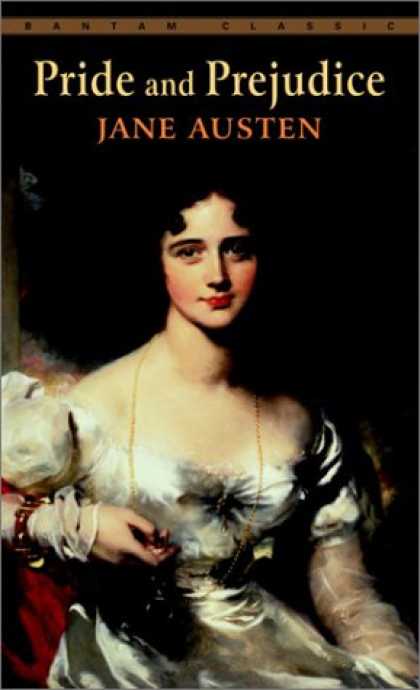
Pride and Prejudice by Jane Austen

I think the first line of this novel sums it up better than I ever could:

It is a truth universally acknowledged, that a single man in possession of a good fortune, must be in want of a wife.

I’ve been familiar with the story of Pride and Prejudice for a long time, but this was the first time I’d read the original.  Even though I don’t usually go for Regency romances, I have to say that I enjoyed this book very much!

Jane Austen has a genius for character.  She knows exactly what little mannerism to show or what description to give to make her characters come alive.  At several points in the book, I paused and said “holy cow, that’s just like so and so,” or “haha, I know exactly what this person is like.” At no point did I feel hit over the head or dragged through a long info dump explaining this or that character’s background.  Of all the possible details she could share, Austen always chooses the exact ones you need to get a clear, distinct picture–no more, no less.

Austen drives her story with some snappy, entertaining dialogue.  Far from being sappy or sentimental, her main character, Elizabeth, is snarky and spirited, and she clashes with a lot of people in ways that are much more interesting (and mature) than typical girl drama.  Be that as it may, I found it entertaining to compare Elizabeth’s dating/relationship experiences with my own.  As different as things were back then, in some very interesting ways they are still the same.

I did feel that the novel slowed down a bit in the middle, probably because that was when Elizabeth went on the tour of Derbyshire with her relatives and left behind most of the other characters that interested me.  Also (since I am a straight guy), Mr. Darcy didn’t really turn me on much, so Elizabeth’s gradual change of mind as she toured his house wasn’t as engaging to me.

One thing that confuses me, having read this book, is why women all over the place set up Mr. Darcy as the ideal male.  What exactly is his appeal?  He’s a little rough around the edges, has an independent streak, speaks his mind even when doing so would be rude, and is constantly aloof from everyone else.  Is this what women find so appealing about him?  I can see how the “Beauty and the Beast” syndrome can also be a turn-on–Elizabeth essentially wins him over by taming him–but that has less to do with who he is than how Elizabeth changes him.  Do women go for a guy who they have the power to change?  Is that what it is?  I’m still a bit confused.

One thing made me a little mad, and it had nothing to do with the book at all; it had to do with the blurb on the back.  It reads:

One of the most universally loved and admired English novels, Pride and Prejudice, was penned as a popular entertainment.  But the consummate artistry of Jane Austen (1775-1817) transformed this effervescent tale of rural romance into a witty, shrewdly observed satire of English country life that is now regarded as one of the principal treasures of English literature.

Austen’s “consummate artistry” transformed this novel from “popular entertainment” to “one of the principal treasures of English literature”?  Come on.  That statement is as pompous as it is illogical.  Once her book came out in print, Austen “transformed” nothing–the only thing that changed was the way people looked at it.  It started out as a popular genre novel, like anything by Rowling or Steele or Grisham or King, and when the literati decided to claim it, they rebranded it as something else.

What irks me is this idea that “popular entertainment” is somehow inherently devoid of literary worth.  Come on, people–virtually all the “great authors” before 1920 were well-read and well-loved in their day, among the masses as much as the literary elite.  It’s not a sin to make money writing books.

Overall, I enjoyed this book very much.  Just as Lord of the Rings is the quintessential fantasy novel, Pride and Prejudice is probably the lodestar of the romance genre.  I was pleased to find that it’s not a book that only women can enjoy!

I Am Not a Serial Killer by Dan Wells

John is a weird kid. When he isn’t helping out his mother at their small-town mortuary, taking intense, morbid pleasure from opening up the dead bodies and exploring their insides, he’s researching serial killers, devouring every book he can find on the subject. If he had his way, he would open bodies all day–dead and living bodies, exploring them, savoring the addiction. That’s why he must constantly work hard to stop himself.

But when a demon comes into town, killing off members of the small community one by one and hiding in plain sight by posing as a normal human being, John is the only one who can stop the monster from killing again. To do this, he unleashes his own demon–the one urging him to kill. As the monster inside of him starts to take over his life, he starts to lose control and sink deeper and deeper toward his destiny.

Will he return from the dark side, having fought fire with fire? Or will he give in to fate and become a serial killer?

This book was a surprisingly fast read. I borrowed it from a friend and finished it only a couple of days after I started it. Part of this was because it’s a short book, but part of it was because the story and characters were so interesting.

The character development in this book is awesome. Dan Wells does a wonderful job making a morbid sociopath into a genuinely likable character. I felt like I knew him–and liked him–after only a couple chapters. Even though he’s got a disturbing, dark side, he’s constantly trying to fight it and keep himself in check. From almost the very beginning, I found myself rooting for this character.

The book had some sick, disturbing stuff in it, but it wasn’t nearly as violent or fundamentally disturbing as some of the other books I’ve read (Neuromancer, On My Way to Paradise). It was more of an “eww…cool!” kind of thing for me than a heart stopping, I-can’t-believe-what-I-just-read kind of thing. Still, the book definitely made me squirm. I’m glad none of my family works in a mortuary, I’ll say that much.

For a story so engaging, the writing was surprisingly simple. Unlike a lot of the fantasy and science fiction that I read, Dan Wells includes very few concrete details–just enough to keep you in scene–and tends to be a little adverb heavy. None of this was an obstruction to reading–on the contrary, the sparseness and simplicity is part of what makes this book a quick, enjoyable read. As an aspiring writer, it helped me to see that story trumps the minor, sentence level stuff, like using excessive adverbs with said bookisms (not that that’s a problem with this book–the writer part of my brain noticed it, but the reader part didn’t care).

The book reads very much like a thriller (…probably because it is one) and reminded me of a lot of the Michael Crichton stuff I used to read when I was in high school. While it isn’t as gripping as Sphere or Jurassic Park, it has about ten times the character development of any of Crichton’s works. Although the plot is definitely engaging, I read as much for the character as for the plot, if not more.

If you’re looking for a good, squeamish read with interesting, believable characters, this is a good one to pick up. It doesn’t come out in the US until 2010, but if you check out Dan’s website, you can probably find a way to get it. Check it out!