Thoughts on the danger of falling in love with your characters

As a writer, I spend so much time in the heads of my viewpoint characters that I can’t help but like them. So it sometimes comes as a surprise when readers get frustrated and want to slap my characters around.

To be fair, sometimes I do that on purpose. For example, in Stars of Blood and Glory, Princess Hikaru does some incredibly stupid and naive things that end up getting everyone else in a lot of trouble. There’s a reason for it, though: she’s been sheltered in the palace all her life and knows nothing of the outside universe. Over the course of the story, she comes to realize just how naive and sheltered she’s been, and has something of a transformation.

Jeremiah from Star Wanderers is another character that readers sometimes get frustrated with. He’s very passive and lacks a strong backbone, at least at the beginning of the series. I did try to make sure that each story in his viewpoint was driven by his choices, rather than the things that happen to him. But he isn’t your typical alpha male starship pilot—far from it.

With Jeremiah, I tried to lean towards writing an “everyman” rather than a “superman.” In a lot of ways, he was also a case study in human nature for me, since I’m not a passive person and in real life tend to get frustrated with passive people. When I dove into Jeremiah’s head, though, I found it almost impossible not to like him, even with all his flaws.

SW-VII (thumb)Another good example from Star Wanderers is Mariya. Some of my readers absolutely hate her. Given her role in the story, it’s not hard to see why: she basically tries to steal away the love interest from the main female protagonist of the series.

In her head, though, she’s not stealing—she’s sharing. Everything she does makes sense for her perspective, and when she realizes how much she’s hurt everyone, she feels genuine remorse and regret. As a character, she fascinated me so much that that was one of the main reasons I decided to write a book solely from her point of view.

To be fair, one of the other reasons readers get frustrated with her is because she’s an angsty teenager. Her life is either amazingly awesome or on the verge of falling apart (the latter being much more common). I can’t fault readers at all for getting frustrated with that—all I can do is hope that the payoff is greater than the pain.

Looking back on all this, I think that one of the potential traps of being a writer is falling in love with your characters more than your readers ever will. That’s not to say that you shouldn’t love your characters, but that you shouldn’t let that love make you blind to how your readers are going to respond to them.

It’s kind of like the central paradox in Orson Scott Card’s Ender’s Game: in order to know an enemy well enough to defeat them, you have to know them well enough to love them as well. But just when you can’t help but love them, you have to destroy them. It can be the same way with your characters: even when you know them well enough to love them in spite of their flaws and weaknesses, you still have to give the readers their moment of schadenfreude.

Of course, a lot of it ultimately comes down to skill. If you truly excel at bringing readers into the character’s head, then perhaps you can get them to love that character as much as you do. But it also depends on the reader. If the reader isn’t particularly interested in falling in love with a character (or in falling in love with that character), then your writing skill probably isn’t going to change that.

It’s interesting to think about, and something I’ll definitely keep in mind as I continue to write. In the meantime, if you have your own thoughts on the subject, please leave a comment—I’d very much like to hear it!

Why I couldn’t finish Gone with the Wind

For the past month or so, I’ve been on a Civil War kick. I watched the movie Gettysburg to celebrate July 4th, read Gods and Generals, wrote a short story about a time traveler at Gettysburg, and have been listening to a lot of Civil War music as I write. One of the books I decided to give a shot was Gone With the Wind, that classic American novel that’s tied so closely with the Civil War.

It’s definitely a good book. There were parts of it that I really enjoyed, such as the perspective of the people of Atlanta as Sherman’s troops got steadily closer. The poverty of the plantation owners after Sherman’s march to the sea provided a stark contrast to the pompous gaiety of society before the war. You definitely get a sense of what it means to be Southern while reading the book–it’s surprising how similar some things are to the way they were. And just in general, the sheer sense of immersion that the novel gives you is just incredible. It’s rare that I’m sucked into a world as thoroughly as I was sucked into the quiet charm of the antebellum South and the frenzied optimism of Confederate Georgia.

The real shock to me was that I could enjoy the book even as I hated the main characters. Scarlett is a bitchy, stuck-up brat–an entitled rich white girl who cannot comprehend that the world does not revolve around her. Rhett Butler isn’t nearly as stuck-up as she is, but he is an arrogant jerk who sneers at other people, profits from their misfortune, and hides his cowardice with his biting cynicism.

The fact that I enjoyed reading about them even though I disliked them so much is a testament to the fact that not every character needs to be likable. Even thought Scarlett really peeved me off, I still found her fascinating because I felt like I really understood her. Margaret Mitchell does an excellent job of getting you into her characters’ heads and showing where they come from. In some ways, I felt that I understood Scarlett better than she understood herself.

But I have to be honest–from page one, I was only interested in Scarlett for the schadenfreude. I already knew how the story ends, with those classic lines “frankly my dear, I don’t give a damn,” and “tomorrow is another day.” If I’d been waiting instead for Scarlett to experience a growth arc (and she really does start in an excellent place for one), I probably would have thrown the book across the room much sooner.

The part that made me stop reading–and yes, this will spoil the book–was the part where Scarlett steals Frank Kennedy, her sister’s fiance, in order to get the money to save Tara. She’s so singly focused on saving the plantation (Tara) that she’s willing to backstab her own family, who ought to matter a lot more to her than a house and a spot of land. Yes, I understand that it was entirely in her character to do that, but when she actually betrayed her sister like that, I just couldn’t stand it anymore. I skipped to the last chapter, had my juicy moment of schadenfreude, and returned the book to the library.

I had a lot more sympathy for everyone who locked horns with Scarlett (except for Rhett) than I ever did for Scarlett herself. The O’Hara overseer who gets fired in the first or second chapter for making the poor Slattery girl pregnant–I didn’t think it was noble for him to try and steal Tara through his postwar connections, but I could see why he’d do it. He probably didn’t feel like he could marry the Slattery girl because the O’Hara’s weren’t paying him enough. Even if they were, the fact that he married her showed that at least he was trying to set things right. And though I didn’t admire the way he went about trying to get his revenge, a part of me wanted him to succeed.

My favorite character was probably Melanie. As soon as she showed up on the page, I liked her, and as the story progressed, I came to actively admire her. Ashley, too, was a very interesting character to me–his thoughts on the war and on the passing of the old way of life were fascinating. But I could never really respect him, because it was always so easy for Scarlett to manipulate him.

And even though Rhett wasn’t so prone to Scarlett’s machinations, I still couldn’t respect him because he was always such an ass to everyone. It’s not that he wasn’t a gentleman–there were plenty of gentlemen in the book who were jerks, and plenty of men who weren’t gentlemen who were still good people. The thing was, Rhett was just never a good person to anyone except Melanie, and throughout the book, that never changed.

I guess the takeaway here is that it’s almost impossible to have any sympathy for a character who treats their friends and family like garbage. For me, at least, if a character constantly betrays the people who are closest to them, I really want nothing to do with them. But I guess that’s just me–judging from the success of Gone With the Wind, I guess I can’t generalize that at all.

I don’t know. What do you guys think?

Trope Tuesday: Foolish sibling, responsible sibling

Whenever you’ve got two characters who interact with each other a lot, chances are that one is a foil of the other.  There are a lot of reasons for this, but the big reason is that it helps to highlight certain character traits by providing contrast.  Because the contrast is the important thing, the relationship between the characters can take a variety of possible forms.  It may be that one is the hero and the other the sidekick, or (if they’re villains) perhaps one is the Big Bad and the other is the Dragon.  If enemy mine or one of the other frenemy tropes is in play, they might be on opposing sides.

Foolish sibling, responsible sibling is what happens when the character foils are siblings.  It’s a subtrope of sibling yin-yang that contrasts the character traits of responsibility and recklessness, duty and prodigality, and how the two opposites somehow manage (or not) to live together and stand up for each other in spite of their differences.

It may be used to set up an aesop, usually along the lines of “be like the responsible sibling, not the foolish one,” but that’s not always the case.  It might be that the younger sibling is closer to earth and the uptight responsible one needs to learn how to loosen up.  Simon from Firefly kind of fits that mold, though he learns to loosen up not from his sister River so much as from the rest of Mal’s crew.

In a lot of stories, it’s not necessarily meant to send a message so much as set up an interesting dynamic between two equally sympathetic characters.  In the movie Gettysburg, for example, Lawrence Chamberlain is the commanding officer of the regiment, and thus has to lead the men, follow military protocol, etc, while his annoying younger brother Tom calls him by name and forgets to salute him, runs around chatting it up with union soldiers and rebel prisoners alike, and generally seems a lot more loose and carefree.

Usually, the responsible character is the older sibling, for reasons that should be fairly obvious to anyone who grew up with siblings.  As the oldest child in my own family, I can readily sympathize with the dutiful son, since I more or less was one.  That’s not always the case, though.  In sitcoms where the middle child is the main character, usually it falls on them to thanklessly pick up the slack (yeah, being the middle child pretty much sucks).  Bart and Lisa from The Simpsons are a good example of this.

I played with this a little in Desert Stars with some of the minor characters: as the second oldest, Surayya generally tries to do things by the book, whereas Amina tends to be more mischievous and conniving.  Michelle and Lars also fall into this trope, with Lars a carefree academy dropout and Michelle a hardworking (though also fun-loving) mechanic on her father’s ship.  Between Desert Stars and Bringing Stella Home, though, Lars completely turns around, so that by Heart of the Nebula (not yet published) he’s quite possibly one of the most responsible characters in the book (and I still have yet to give him a viewpoint … hmmm).

In Sons of the Starfarers, I’m playing with this character dynamic a lot.  Isaac is the oldest son, who always knew he would leave on his father’s starship to fulfill the Outworld traditions and seek his fortune as a star wanderer.  Aaron, on the other hand, kind of got roped into the whole thing unexpectedly (see Star Wanderers: Benefactor) and hasn’t yet matured.  The events of the story will no doubt give him a growth arc, but in the meantime, the dynamic between the two of them is a lot of fun to write.

There are a lot of other issues in that relationship to play with too, such as promotion to parent and always someone better, but I’ll save those for another Tuesday.

Trope Tuesday: It Has Been an Honor

If there ever was a phrase that invoked manly tears, it’s this one.

It has been an honor” is pretty much the go-to catch phrase for any Heroic Sacrifice or Bolivian Army Ending.  It’s often a precursor to a Crowning Moment of Awesome, and as far as last words go, it ranks right up there with “I die free,” “I die as myself,” and “I regret nothing.” Expect to hear it a lot from blood knights, members of the proud warrior race, or anyone who belongs to a martyrdom culture.

Occasionally, you’ll hear a villain say this when he acknowledges the hero as a worthy opponent.  In such cases, the villain may evolve into a friendly enemy or a fire-forged friend. Or, if the trope is played straight, they just die.

One time you won’t hear this phrase is when someone is trying to play More Hero than Thou.  In that case, two or more good guys in a friendly rivalry basically argue over who has to bite the bullet, so the honor becomes a point of competition between them.

In my opinion, the heart and soul of this trope is the idea that some things are worth dying for.  Obviously, a character facing death is not going to say this unless he values his honor more than his life.  What exactly constitutes “honor” may be up for debate (with the potential for some unfortunate implications, especially in real-life martyrdom cultures like Japan), but the core element here is that the hero is fully willing to give up his life for something greater than himself.  Bonus points if he starts out as a coward and this trope marks the conclusion of his growth arc.

While this phrase often leads to a death of some kind, that isn’t always the case.  The cavalry can still show up to save them, or one of the characters can ultimately survive (either the one who says this phrase, or the one to whom it is said).  The important thing, though, is that the characters face death in a meaningful way.  Without that, this phrase doesn’t have nearly as much power.

In my own work, this trope tends to pop up a lot, especially in the more military sci-fi books in the Gaia Nova series.  It shows up multiple times in Stars of Blood and Glory, and also in Bringing Stella Home, though more in a posthumous way than anything else.  I suppose you could also say it happens in Star Wanderers: Homeworld, if you use a broader interpretation.

But either way, I’m definitely a big fan of this trope.  Expect to see it many more times in my own work in the future.

As a final note, it’s worth pointing out that the bandmaster’s violin from the real-life Titanic has recently been recovered and confirmed genuine.  It’s now on display in Belfast, less than two miles from where the Titanic was built.

Trope Tuesday: Came Back Strong

This trope, also kown as apotheosis, is by far my favorite part of the hero’s journey.

Up to this point, the hero has faced a lot of tests and trials.  Some of them he’s passed, some of them he hasn’t, but the setbacks haven’t yet been enough to stop him.  Sure, the costs have been high–he may have lost a friend or mentor, for example–but at least he’s still in the game.  Then, just as he experiences the power of love (meeting with the goddess) and reconciles with the ultimate power in his life (atonement with the father), what happens?

He dies.

This may be literal or metaphorical, physical or spiritual–but whatever form it takes, the hero has to lose something significant, up to and including…well, everything.  After all, there are so many things worse than death.  While all the other failures up to this point left him more or less intact, this one completely shatters him–and in the process, transforms him.

Like a phoenix rising from the ashes, the hero comes back from the dead, often with a level in badass.  By dying, he gains that last piece of knowledge, experience, or resolve that he needs to defeat the big bad and gain the ultimate boon of his quest.  Whoever or whatever he was before, that person wasn’t strong enough to pass the test–but now, he is.

When done well, this is a stand-and-cheer moment of the best possible kind.  It’s the culmination of everything the hero has gone through, not just in terms of plot, but character as well.  Years from now, you might forget everything else in the story–even the parts that you loved–but you’ll remember how you felt when you got to this part.

One of my favorite examples of this trope is in the clip I posted from the Matrix.  Seriously, when Neo realizes that he is The One, that is one of the best moments in all of cinema.  The Empire Strikes Back also has a moment like this, though since the movie is essentially a tragedy, there’s a lot more emphasis on Luke’s death (falling through the gas mine shaft after confronting Darth Vader) than his resurrection (getting a new hand and reuniting with his friends).  The oldest examples, of course, come from mythology–Odin gained the ability to use magic by sacrificing himself on Yggdrasil, and before returning to Ithaca, Odysseus first had to journey to Hades to pay his old friend Agamemnon a visit.

So as writers, how are we supposed to get this trope right?  I’m by no means an expert, but my gut instinct tells me that the way to nail it is to be as excited about this moment in the story as we want our readers to be when we get to that point.  Even though storytelling is ostensibly just making stuff up, it’s not something you can fake–if you aren’t excited about your own story, how do you expect your readers to even care?

Fortunately, this is often the part of the story that drives us to write everything else.  There have definitely been times when I could hardly wait to get through the other stuff and finally write the chapter where this happens.  Bringing Stella Home was a big one–and that’s all I can say, at the risk of giving spoilers.  Star Wanderers is another one, though it wasn’t until I was midway through Fidelity that it really came to me.  Desert Stars was more of a Heroic Second Wind, which is basically Came Back Stronger without the death.  However, there was definitely a transformation, both for Mira and Jalil.

So yeah, I really, really, REALLY love this trope.  When done well, it’s one of those things that can turn a run-of-the-mill adventure story into something both soul-searching and powerful.  You can definitely expect to see me play with it a lot in the future.

Trope Tuesday: Supernatural Aid

Getting back to our discussion of the Hero’s Journey, I think it’s important to briefly touch on one of the earlier stages: supernatural aid.  At some point between refusal of the call and crossing the threshold of adventure, the hero typically encounters a mentor figure from the unfamiliar world who gives him something supernatural or otherworldly to help him on his quest.  While the mentor often dies (as we saw last week), the supernatural aid that the mentor gives later proves to be a key to defeating the big bad and passing the ultimate test.

Often, this is an actual object.  In Lord of the Rings, for example, Galadriel gives each member of the fellowship a specific object.  She gives Sam a magical vial, which he uses later to defeat Shelob and save Frodo and the ring.  In The Lion, The Witch, and the Warderobe, Aslan gives each of the kids a weapon item specially suited to their characters (except Edmund, who was a prisoner of the queen at the time).  In Star Wars IV: A New Hope, Obi Wan gives Luke his father’s lightsaber–though for the purposes of this trope, we can also count his special training with the force, since Luke doesn’t use the lightsaber until episode V.

In discussing this trope, Joseph Campbell said the following:

Having responded to his own call, and continuing to follow courageously as the consequences unfold, the hero finds all the forces of the unconscious at his side. Mother Nature herself supports the mighty task. And in so far as the hero’s act coincides with that for which his society is ready, he seems to ride on the great rhythm of the historical process.

So if the mentor is supposed to die (or get put on a bus) in order for the hero to stand on his own feet, why does the hero need some kind of supernatural aid?  Isn’t that just cheating?

Not exactly.  Often, the aid is itself part of the ultimate test, and the hero doesn’t figure out how to use it properly until after he’s already experienced everything from the adventure that he needs.  The silver slippers from The Wizard of Oz are a good example of this.  So is AURYN from The Neverending Story.  The hero doesn’t fall back on the supernatural aid until after he’s completed his growth arc.

That’s not the only reason, though.  In order for the adventure to have meaning and impact, the stakes have to be really high.  Having some sort of mysterious character from the outside world grant the hero something supernatural is a great way to do this, especially at the beginning.  If the hero is part of something bigger than himself–saving the world, for example–then it makes sense that he would get some kind of help from the people depending on him, especially if those people have something supernaturally powerful to give.

The Force from Star Wars is one of my favorite examples of supernatural aid.  I hear that when episode IV debuted in the theaters, the crowds jumped up and screamed when Obi Wan said “use the force, Luke!” in the clip at the top of the post.  Just because it’s so awesome, here’s the full scene (more or less):

“Remember–the force will be with you. Always.”

Trope Tuesday: Belly of the Whale

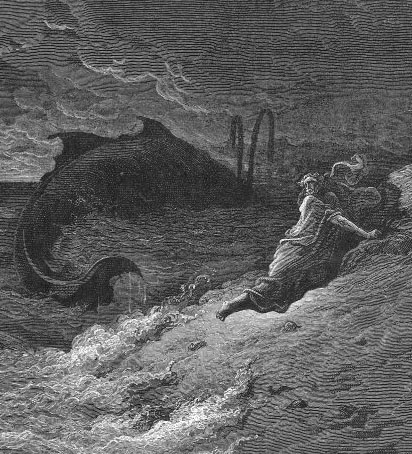
The last stage in the departure phase of the hero’s journey is called the Belly of the Whale, after the Biblical story of Jonah.  After receiving the call and passing the threshold to the land of adventure, the hero faces what may quite possibly be the darkest hour of his life and dies in some way to the home he has just left behind.

I know what you’re thinking: “Huh? Why does the hero die at the beginning of the story?  Isn’t that supposed to happen later?” Well…yes, it does, but the symbolic death at this point is important, too.  At its core, the hero’s journey is a story of transformation and growth.  When the hero comes back from the lands of adventure, he isn’t the same person he was when he first left–he’s been changed in some way.  And in order for that change to take place, the hero needs to let go of who he was and move forward.

Joseph Campbell describes it like this:

The idea that the passage of the magical threshold is a transit into a sphere of rebirth is symbolized in the worldwide womb image of the belly of the whale. The hero, instead of conquering or conciliating the power of the threshold, is swallowed into the unknown and would appear to have died. This popular motif gives emphasis to the lesson that the passage of the threshold is a form of self-annihilation. Instead of passing outward, beyond the confines of the visible world, the hero goes inward, to be born again.

Of course, the death and rebirth doesn’t have to be literal (though it can be, as it was with Dionysus).  The point is to show that the hero has fully crossed the threshold, cutting all his ties with home and burning his ships on the shores of the land of adventure.  Once the hero passes through the belly of the whale, there’s no going back–it’s all or nothing now.

So how common is this trope really?  Actually, it occurs more often than you might think.  In Harry Potter and the Sorcerer’s Stone, it happens when Harry boards the Hogwarts Express and realizes he’s leaving his old world completely behind.  It happens in The Lion, the Witch, and the Wardrobe when Peter and the others decide to go after Mr. Tumnas instead of returning to their own world through the wardrobe.  It happens in Star Wars IV when the Millennium Falcon gets sucked into the Death Star, and in Final Fantasy IV when Cecil washes up in Mysidia.

The main theme running through all these examples is that adventures are hard.  If they were easy, anyone could go on them–and no one would be changed by them.  They may be fun, and they’re definitely worth it, but to set out on one, you always have to give up something close to you–and that’s hard.

Trope Tuesday: True Neutral

The True Neutral is something of an enigma.  They generally take no side, either because they have moved beyond good and evil, or because they simply don’t see good and evil the way we do.  Or because this isn’t their war and they just want to be left alone.  Or…well, let’s get to it.

From the easydamus character alignment page:

A neutral character does what seems to be a good idea. She doesn’t feel strongly one way or the other when it comes to good vs. evil or law vs. chaos. Most neutral characters exhibit a lack of conviction or bias rather than a commitment to neutrality.

Some neutral characters, on the other hand, commit themselves philosophically to neutrality. They see good, evil, law, and chaos as prejudices and dangerous extremes. They advocate the middle way of neutrality as the best, most balanced road in the long run.

As you might expect, this alignment doesn’t describe just one type of character.  In fact, there are many different archetypes that fall under True Neutral.  They include:

That’s quite a spread, isn’t it?  The main thing to keep in mind is that these are the characters who refuse to take sides–not just in whatever overworld conflict is driving the story, but in the ethical questions that the story raises (unless neutrality itself is their answer).

My favorite example of this trope is the Childlike Empress from The Neverending Story.  As the very embodiment of Fantasia, she transcends good and evil so completely that her power, the Auryn, cannot be used to forbid a monster from acting on its own evil nature.  Truth from Fullmetal Alchemist is another good example of a transcendent True Neutral.

With everyday, down-to-earth characters, though, this alignment tends to tick me off.  The Ents, for example, very much fall under this trope (as does Tom Bombadil…unless you subscribe to this theory).  Most others examples either come across as weak, selfish, or cowardly to me, so I don’t really care much for this alignment–unless it’s the starting point of a well-constructed character arc.

For that reason, in my own work, most True Neutrals are either straight-up antagonists or gradually shift in alignment as the story progresses.  In Genesis Earth, Michael Anderson starts out as one of the weaker True Neutral types, but changes as events in the story make him grow.  In Desert Stars, Sathi probably falls into this type, though I’m not so sure; either way, he’s very easily manipulated by his Neutral Evil wife.  In Bringing Stella Home, Ilya falls under this alignment due to his moral cowardice, and Anya might as well, though more as a Selfish Good than anything else.  Roman probably does too, but more because he’s old and wants to give up the fight; that’s something I’m currently working on in Stars of Blood and Glory.

I haven’t done a transcendent True Neutral yet, but if I ever write a heroic fantasy tale with gods and demons, I probably will.  After all, if Michael Ende did it in my favorite novel of all time, how can I resist?

Trope Tuesday: Lawful Evil

If the term “villain” applies to anyone, it applies to the Lawful Evil.  Whether the evil overlord, his trusted right-hand man, or one of his devoted minions, these characters are dedicated wholeheartedly to their cause, whether they believe it will lead to a better world or not.  Taking over the world is often a major obsession, because hey, someone’s got to do it.  A staple of the evil empire, these guys often turn their country into an industrialized wasteland, though they often have propaganda machines to take care of any bad press.  Bonus points if they can transform into a freakish monster in battle.

From the easydamus character alignment page:

A lawful evil villain methodically takes what he wants within the limits of his code of conduct without regard for whom it hurts. He cares about tradition, loyalty, and order but not about freedom, dignity, or life. He plays by the rules but without mercy or compassion. He is comfortable in a hierarchy and would like to rule, but is willing to serve. He condemns others not according to their actions but according to race, religion, homeland, or social rank. He is loath to break laws or promises.

While Lawful Evils believe in following rules and keeping their word, they’re not above emotional manipulation, negotiating unfavorable contracts, or following the law in letter only.  Even so, they tend to suffer from genre blindness and bureaucratic stupidity (as well as megalomania–but hey, that’s part of the job description).

According to tvtropes, Lawful Evils come in four types:

  1. The supreme ruler, dedicated to establishing and maintaining a civic order that is itself evil.  A good example of this would be Sauron from The Lord of the Rings.
  2. A zealot or übermensch whose moral code falls outside of established social norms.  Khan from The Wrath of Khan is a pretty good example of this, as is Tyler Durden from Fight Club (though your mileage may vary).
  3. The Dragon or other minion who may have their own goals, but answers to the big bad.  Darth Vader is probably the most well-known example.
  4. A complete monster who is dedicated to the destruction of free will and liberty.  The Mormon conception of Satan fits this perfectly.

The scary thing about this trope is that it actually exists in real life.  In fact, outside of our sheltered middle-class, liberal democratic existence (a relatively recent and unusual development in the eyes of history), this type of overlord tends to be the rule and not the exception.  You don’t have to look any further than North Korea, Burma, or Syria for examples of this–which is to say nothing of the Soviet Union, the Third Reich, or the British Empire.

My favorite example of this trope is probably Darth Vader, not just because of how badass he is, but because of his heel face turn at the end of Return of the Jedi.  Ignoring how bad episodes I, II, and III were, his character arc really is the thing that makes that story.  And while we’re on the subject of history, let’s not forget this epic showdown between Stalin and Hitler.  Seriously, click that link.

In my own work, the best example of a Lawful Evil would probably be Qasar from Bringing Stella Home / Sholpan.  He’s more of the affable type than a true evil overlord, though; that would be Tagatai, who doesn’t really come to power until Stars of Blood and Glory. A much more sinister example would be Emile from Heart of the Nebula, or the villain I have planned for Edenfall–I’d better finish those!  And of course, there’s Sheikh Sathi from Desert Stars, though he’s mostly a type 3 Lawful Evil under the thumb of his Neutral Evil wife.

Perhaps one of the reasons I haven’t done a truly despicable Lawful Evil yet is because I’ve been kind of sheltered here in the states.  It will be interesting to see how my writing changes after spending some time in Eastern Europe; Georgia, after all, is the homeland of Stalin.

Darth Vader helmet taken from this site.

plot vs. PLOT and an interesting serial publishing idea

Back in English 318 at BYU, Brandon Sanderson used to tell us that there was a big difference between “little-p plot” and “big-p Plot.” The first applies mostly to chapters and scenes, which he said he could teach us.  The second refers to the overall story structure, which he couldn’t teach in a classroom setting and said we’d have to discover on our own.

I’ve been thinking a lot about this recently, because it seems that my books are starting to fall into a recognizable pattern–and that pattern has some interesting potential for serials and other alternate forms of publication.  Each book is divided into 3-4 parts, each part is divided into 3-6 chapters (typically 5), and each chapter is divided into 3-5 scenes.  Here’s how it works:

Chapter 1: Setup for the basic story arc.  Introduction of the characters and setting, the prominent theme or premise, and a little foreshadowing of the coming conflict.
Chapter 2: The inciting incident, a discovery or event that starts the plot rolling and puts the characters in motion and conflict.
Chapter 3: Complications arise, the problem gets worse, the first attempt at a solution fails, generally leaving the characters at a loss.
Chapter 4: Setup for the resolution.  The characters discover or build something that will help them to settle the conflict.  They stop reacting and start to be more assertive.
Chapter 5: The resolution.  The characters either succeed or fail, but the arc comes to a close either way.  The story question is answered, the thematic elements come full circle, and the story either closes or moves on to the next part.

Basically, it’s the 3-act format divided into five chapters.  When I wrote Heart of the Nebula, all four parts fell into this pattern, and now that I’m writing Star Wanderers, I’m finding myself  falling into the exact same pattern again.  Stars of Blood and Glory is a little bit different; there are three parts instead of four, and each part is divided into six chapters instead of five.  But still, it’s all very structured.

In short, Brandon was right.  It took me a few books to really learn “big-p Plot,” but now that I’ve found a story structure that works for me, it’s starting to come quite naturally.

The cool thing about this particular structure is that it’s very conducive to serialization.  Each chapter is between maybe 3,000 to 5,000 words, so each complete sub-arc is between about 15,000 to 25,000.  That’s the length of a short novella, and it takes me only a month or two to write (sometimes three, depending on how much revision it needs).

The only reason I haven’t done more with serialization up to this point is because I’ve found that sharing my work while it’s still unfinished tends to throw a wrench in my creative process.  The idea of publishing a work in progress on a chapter-by-chapter basis scares me, because if one of the story arcs has a flawed beginning, I wouldn’t be able to fix it.

However, by following a five-chapter arc format (with bits and pieces here and there to hint at a larger overarching structure), I can see myself publishing a novel or epic in a serial format.  It would be something like the Perry Rhodan series, which follows an arc structure of 25 to 100 issues (each a small novella) per cycle.

So here’s how I’m thinking of doing it:

  1. Publish the first installment and price it at free while writing the second one.
  2. Publish the second installment and price it at free, raise the price of the first installment to $.99 and write the third one.
  3. Publish the third installment and price it at free, raise the price of the second installment to $.99 and write the fourth one.
  4. Publish the fourth installment for $.99, drop the price of the first installment to free and publish the completed novel for $2.99.

So what do you think?  Does it seem like a good way to publish a book?  It gives the reader a reason to keep coming back, and rewards those who got in early by charging them less for the completed work.  By selling the novel in shorter chunks, I would be able to put more work out and hopefully gain more visibility, especially by making a portion of it free at any given time.

I’m seriously thinking about publishing Star Wanderers this way, once I hear back from Writers of the Future.  I’ve already finished the rough draft for the second part; it probably needs a good revision or two before it’s ready, but since it’s shorter, it shouldn’t take more than a few weeks to get feedback from some first readers and finish the next draft.  And if the third part is already finished by then…

So many awesome possibilities! 🙂 What do you think?