Should I keep it free?

My first three ebooks have been available for free for several months, and I’m happy for all the attention they’ve received, but I’ve got mixed feelings now about keeping them free indefinitely.  Downloads have more or less bottomed out, and they aren’t really driving any interest in my other work, so part of me wonders if I shouldn’t just raise the price to $.99.

If I could, I would love to give away all my work for free.  However, I also want to make a living as a writer, so that isn’t really practical.  Granted, I don’t expect to make much selling these stories at $.99, but from a business side of things, I need to get at least some kind of recompense for my work.

What I really want to do is have the readers set the price for these stories, so that you can pay what you feel is fair.  If finances are tight or you just want to try me out, you can download them for free and that’s great.  If you’ve enjoyed my other work and want to support me, that’s great too.

Right now, Smashwords is the only place I know of that has that option.  If there aren’t any strident objections, I’m going to do that and make these stories $.99 at every other outlet.  I’ll keep them available for free at least until November, though, so if you haven’t already picked them up, feel free to do so now.

I also want to do this for the experiment: how does raising the price from free to $.99 affect sales?  I think the “free train” has more or less run its course, so it will be interesting and useful to see where the new equilibrium ends up.

Random late night thoughts

I’ve been going on a lot of late night walks lately, just wandering restlessly around Provo.  Tonight I had some interesting thoughts about how much I’ve changed in the last year.  Surprisingly, I’ve grown a lot.

Last  year at this time, I was all geared up for World Fantasy Convention.  I had just finished Bringing Stella Home, and I my thoughts went something like this: “if I’m lucky, maybe I’ll find an agent, and they’ll like my pitch enough to see it, and after they read it they’ll want to represent me, and then they’ll sell my book somewhere, so that maybe, just maybe, I can make a living as a writer in ten years.”

Now, I don’t want to get into the whole indie vs. traditional debate, because I think it’s ultimately a false dichotomy.  However, now that I’ve gone ahead and published my own work independently, I feel like I’ve taken charge of my career in a way that I hadn’t before.  I’m no longer waiting on someone else to make my hopes and dreams come true, I’m going out and pursuing them myself.

That’s the big thing that I think has changed in the past year: I’ve gained a lot more confidence.  A year ago today, I was working a temp job in a costume company warehouse, fretting and worrying over how to make ends meet and where to find a stable job.  I had considered freelancing as a translator and teaching English in another country, but hadn’t actively pursued those options because frankly they terrified me.  And as for writing, that was the impossible dream that might come true someday, but not today.

Now, writing is still the impossible dream, but at least I’m on a path that doesn’t involve lottery thinking like the old one.  None of my books have really taken off yet, but at least I have them published and available for readers to discover, so when I do start to get some traction I’ll be in a much better position to succeed.  And either way, I’ve taken charge of my own career.

So yeah, I can say I’ve grown a lot in the past year–which is surprising, considering all I did was stay in my old college town and work odd jobs.  At least I didn’t move back in with my parents–which makes me part of an elite 15%.  But now, I think I’ve just about reached the limit of how much I can grow here in Provo.  If something doesn’t change, I worry that I’m going to start stagnating.

So in a year, where will I be?  Who knows, but if I’ve grown as much as I have since October 2010, I’ll count that as a success.

Decisions suck, writing is awesome

Whew!  I just finished revising through almost 9k words in Desert Stars.  I’ve only got three more chapters and an epilogue to go, and man, I am so excited about this story!  I have no doubt it’s my best work yet.

Of course, I might be biased. 😉

Star Wanderers is also coming along very well.  I’ve only got a few more scenes to write/revise before it’s ready to send off to the next round of first readers.  Part of me wants to send it off to Writers of the Future right now (and according to Dean’s sage advice, that’s probably what I should do), but I want to get some feedback first just to make sure there isn’t something I’ve missed that would make it better.  If all goes well, I’ll probably send it off by the end of the month.

This is the best part of writing process: finishing up a project that you know is good.  This is one reason why I love rewriting so much.  If I could do this all day, every day, and get paid enough for my work to make ends meet, I’d be living the dream.

Until then, however, I’ve got to figure out another way to make ends meet.  One option I’m considering very seriously is selling my contract and driving across the country this Thanksgiving to spend a month or two with my parents before going overseas.  My mom was the one who suggested it, and I have to admit it makes a lot of sense; if I’m going to go abroad to teach English anyways, why not spend some time back home?

If this is something I need to do, I’m going to have to make the decision very soon, possibly before the end of next week–and if you know me, you know that I’m terrible at making decisions.  However, I have been thinking about it enough to make a couple of lists, and this is what I’ve come up with so far:

Reasons to go to abroad:

  • To start a new career.
  • To have adventures.
  • To experience another culture.
  • To gain TEFL experience.
  • To support myself as I write.
  • To have a change.
  • To see the world.
  • To have something to write about.

Reasons to stay in Utah:

  • To get married.
  • To focus on writing.
  • To pursue a graduate degree.
  • To stay in a predominantly Mormon community.

I decided to list only the positive reasons for making either decision, and not to consider any of the creeping doubts or fears (and there are many!).  So let’s break it down:

To start a new career: This seems prudent, especially if it takes a while for my books to really take off.  Specifically, a TEFL career seems like something I could juggle with my writing career, and it would certainly offer a lot more satisfaction than a grunt day job.

To have adventures: Perhaps not the most responsible reason, but hey, you’ve got to remember to have fun.

To experience another culture: One of the perks of traveling, for sure.  It would probably improve my writing considerably as well, though culture shock and distance from family would certainly pose a challenge.

To gain TEFL experience: In other words, to find out if teaching English as a foreign language is something I want to build a career around, or whether I’m just not suited for it.  This is why I’d want to do the TLG program first, before heading off somewhere like Cairo or Amman.  And if it doesn’t work out…well, at least I’d know.  Right now, I don’t.

To support myself as I write: This is huge.  I hear that most TEFL jobs only take up about 20 hours per week, and that if you’re living in a local apartment, it’s not hard to make time to write.  In the past two years, I haven’t had any success balancing writing with full-time work, and working part time probably wouldn’t earn me enough to support myself here in the states.

To have a change: Not quite as tangible a reason, but important nonetheless.  I can’t quite explain it, but if I stay where I am now, in my current life situation…it’s just not going to work out.

To see the world: I could probably lump this under “to have adventures.”

To have something to write about: Also huge.  My experiences in Jordan and the Middle East were a huge inspiration for Desert Stars, and if I’d never gone over there, the novel wouldn’t be nearly as rich.  Who knows what else my imagination would produce if I spent some time traveling the world?

Now, for the other side:

To get married: Honestly, this is more of a negative reason than a positive reason.  I’ve already decided that I’m only going to marry someone who’s a practicing Mormon, and since Utah is predominantly Mormon, I’m worried that if I leave Utah, I won’t be able to find someone.

Trouble is…I’ve been here for almost six years, and still haven’t found anyone.  I could probably put more effort into dating, but the truth is probably that finding a marriage partner is more about your mindset than where you physically live.

Besides, I could always spend a year or two abroad and come back.  I’d be pushing thirty and well beyond “menace to society” status, but at least I wouldn’t be a loser who spent all his twenties in Utah.

To focus on writing: This was why I decided last year not to go teach English in Korea.  The ebook revolution was just getting started, and I felt that I needed to stay in the states to learn how the market was changing and focus on building my indie writing career.

Now, however, I feel like I’m high enough on the learning curve that I can afford to work on other things.  Besides, with the current state of the economy, I don’t think I’m going to find balance if I stay in the states.

To pursue a graduate degree: I’ve largely ruled this one out.  I don’t see how an English degree would help me at this point, and I don’t currently have any career aspirations that would justify pursuing an advanced degree.  The only reason I’d go back to school is to postpone facing the real world, and that’s probably the worst reason I could possibly have.

To stay in a predominantly Mormon community: Kind of the opposite of “see the world” and “experience another culture,” and it gets at the very heart of the matter.  Would it be better to establish myself among people who are more like me and share my values, or should I venture out of the “bubble” and see what else is out there?  I have a much stronger support group here in Utah than I’d probably have as a global nomad, but do I really need it?  Am I independent enough to strike out and bloom wherever I’m planted?

I don’t know.  My thinking is so muddled with doubts and second thoughts that this whole exercise has probably been futile.  If I had to make a decision RIGHT THIS SECOND, however, I’d probably choose to go.

If nothing else, it would give me a good two months of writing time. 🙂
New upload and thoughts on ebooks

Yesterday, I reformatted Genesis Earth and uploaded the new version to Amazon, Barnes & Noble, and Smashwords.  Basically, I took everything I’ve learned about ebook formatting in the last few months and brought it up to date.

Here’s the complete list of changes:

  • Revised author’s note to include Facebook and Goodreads links, mention of newsletter, etc.
  • Added teasers for BSH and Desert Stars.
  • Credited my editor on copyright page.
  • Put table of contents on one screen.
  • Added nav points using KindleGen.

If you’ve got the old version, the book itself is pretty much the same; basically, I just uploaded a cleaner version, with links to my other works.  Genesis Earth continues to sell better than Bringing Stella Home and Sholpan, so I figured it would be good to update it.

As for how sales of my ebooks have been going, to be honest they’ve dropped off quite a bit.  At Amazon, my free short stories have more or less equalized at 20-80 downloads per week, and they’re starting to get some traction on the new Amazon FR store, but the paid stuff has slowed down quite a lot.

What this tells me is that I haven’t yet built up enough of a reader base to be self sustaining.  It’s not enough just to upload your work to Amazon and the other ebook retailers (though that’s certainly important);  you’ve got to find ways to reach new readers and get your name out there.

I’m not too worried; I figure the most important thing right now is to build my list.  After all, if you want to get discovered, the most important thing is to have something that people can discover.

Beyond that, though, I’m going to try a variety of strategies, including submitting work to more traditional markets (especially short stories).  The biggest breakthrough would probably come from Writers of the Future, so I plan to put a lot more effort into that contest.

I’ll also focus a lot on the email newsletter, since that’s the best direct connection I have with my readers.  For those of you who have already signed up, expect to see a lot more free and exclusive content.  And for those of you who haven’t–what are you waiting for??  Check out the sidebar and sign up!

In the meantime, I’m going to keep writing novels and indie publishing them.  It’s definitely worth it, even if sales are initially slow.  Like Howard Tayler says, the first step to making grizzly bear soup is killing the grizzly bear–everything after that is just making soup.

Coming along nicely

First things first: the latest post for the Bringing Stella Home blog tour is up over at Michael Offut’s blog; you can find it here.  Michael asked me to blog about Brandon Sanderson’s English 318R class, so I recapped some of my experiences, including the best advice Brandon ever gave me.  Go check it out!

The revisions for Desert Stars are coming along nicely.  It’s funny; for the past three months, all I’ve wanted to do is work on this novel, but it turns out that taking a long break from it was probably the best thing I could have done.  The distance has helped me to take a fresh look at my prose and cut out all the extra trimmings that were just bogging things down. For example:

Draft 3.0

Jalil paused before walking down the narrow aisle of the train, rows of lights tracing a pair of parallel lines down the dark blue carpeted floor. The place felt oddly familiar, and not just because of the similarities with the trains in Aliet Dome. In fact, this one was much smaller and narrower, so that he and Mira practically had to walk sideways just to get down the aisle. The seats all faced forward, too, instead of alternating like they had in Aliet Dome. And the way the interior of the cabin was curved like a pipe, so that the ceiling blended into the walls and floor–it brought back a memory of him staring out a window at a glowing blue horizon, with the sky dark and starless overhead.

Draft 4.0

Jalil paused briefly in the door of the train, staring at the parallel rows of lights running down the dark blue carpet. The place felt oddly familiar, like something out of a dream. Perhaps it was the way he and Mira had to step sideways through the narrow aisle, or perhaps it was the way the walls of the cabin curved naturally into the ceiling and floor. It brought back a memory of him staring out a window at a glowing blue horizon, with the sky dark and starless overhead.

Just from simple stuff like this, I’ve cut almost 5k words so far; I wouldn’t be surprised if I get this baby down to 90k-95k by the end.  Even though the story is pretty solid, the distance has helped me to take a fresh look at my prose.  And hopefully, my writing has gotten better in the meantime.

So Desert Stars is coming along nicely.  I plan to have this draft finished by October 21st, and publish it *hopefully* before Christmas.  The main thing holding me back is funds; I’ll probably have to drop around $750 for editing and cover art, with maybe a month to get it put together in ebook form.

So how to come up with $750 before the end of November?  One possibility I’ve been toying with is doing a fundraiser like my friend Anthon did for his Danakil expedition.  $5 would get a copy of the ebook with special mention in the acknowledgments, $10 would get that plus one or two other ebooks, $25 would get that plus all of my releases over the next 18 months, etc.  Or something like that.  If you’ve got any good ideas for the upper donation levels, please let me know.

Once Desert Stars 4.0 is finished, I plan on jumping straight into Star Wanderers 0.3.  Heck, I’ll probably start that project tomorrow!  After that, I’d like to do a companion novella for Desert Stars.  That shouldn’t take longer than a month.  And don’t wory, I haven’t forgotten about Edenfall; it’s kind of gotten pushed onto the back burner, but I fully intend to finish it at some point.  If all goes well, it’ll be up and published before the end of next year. As if that wasn’t enough, the BSH blog tour is making me want to revisit the sequel, Into the Nebulous Deep.  I finished that project back in May, so it’s definitely had enough time to stew.  And then there’s the New Rigel novel–gah!

Okay, first things first: Desert Stars, then Star Wanderers, and while my first readers are working on that, I’ll write the DS companion novella.  Once I’ve gotten back the feedback, I’ll revisit Star Wanderers, submit the first part to Writers of the Future, and then finish the novel.  That should keep me busy until Thanksgiving; anything after that, I’ll figure it out as it comes along.  Oh, and some point in there, I need to find a new job.

So much to write, so little time in which to write it.  Fortunately, things are going very nicely right now; if that holds up, this is going to be a very productive month.

🙂

Q3 Report, 2011

Before I move on to other, more interesting subjects, I want to take a little bit of time to review how my writing went in the past three months.  For those of you who may be new, this is something I like to do at the start of each new quarter.  Keeps me honest, I guess.

Anyhow, here goes:

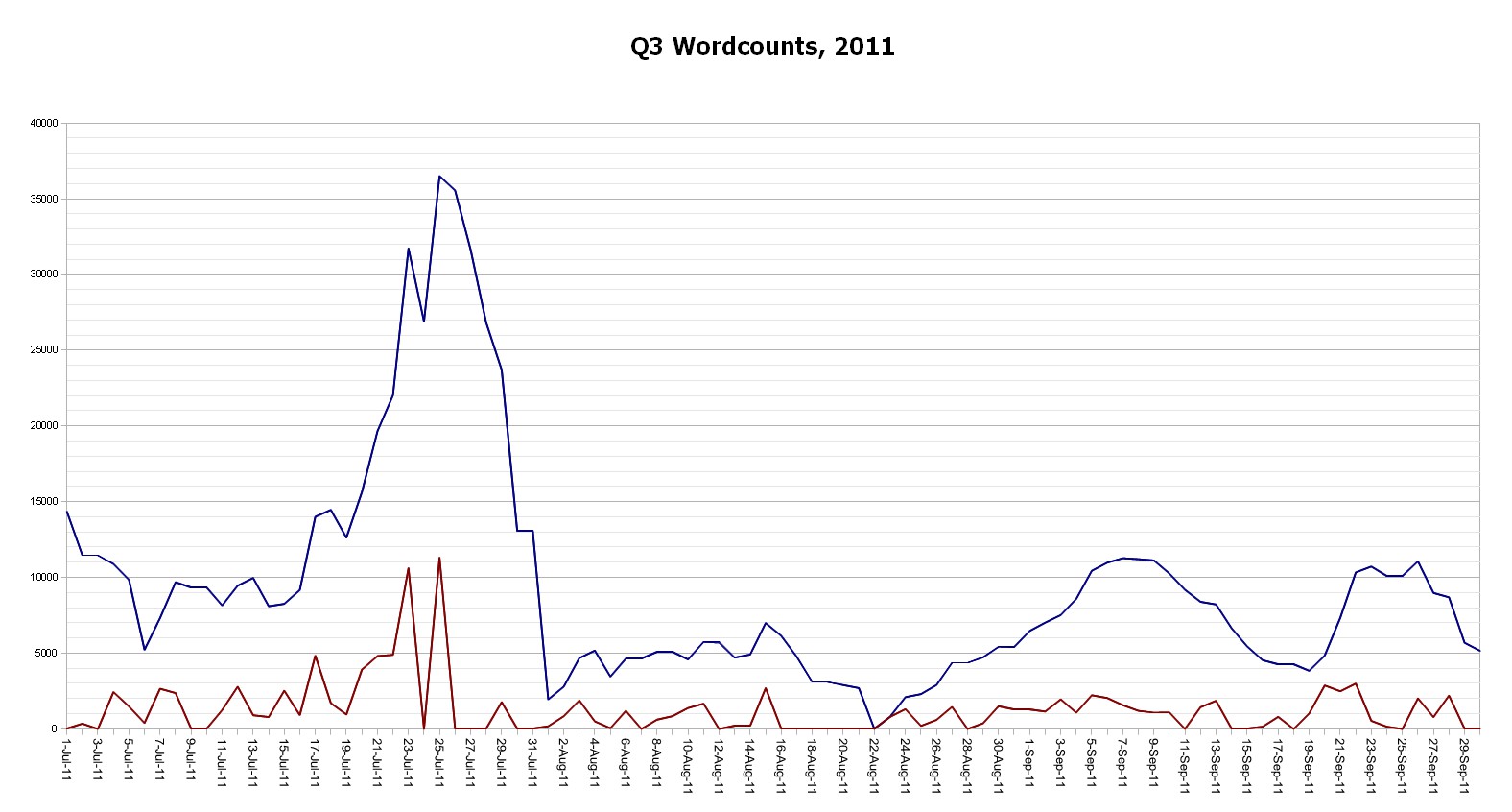
This is a graph of my word count totals for the past quarter.  The red line shows how many words I wrote each day, while the blue line shows a running seven day total.  I include substantive revisions in the totals, but if all I’m doing is proofreading or running through copy edits, I don’t count it.

For the first half of July, I was finishing up the third draft of Desert Stars while working 40 hours per week.  I wasn’t writing as much as I’d have liked, but still managed to keep some good momentum.

The HUGE peak at the end of the month represents my first draft of Sholpan, which I finished in only a week.  I spent the next week in a weird writerly limbo, not sure what else to work on, then picked it up again and made some substantial changes before sending it to my editor in in mid-August.  Then Worldcon happened, and I didn’t get any writing done while I was out at that.  Should have, but oh well.

After Worldcon, I had maybe three or four different projects I wanted to do, but since I wanted to do the final draft of Desert Stars in October, I wasn’t sure which project to pick up.  After several false starts, I ended up writing the first part of Star Wanderers, which is that hump you see at the beginning of September.  The second hump is the second draft; my writing took a dip in between because I didn’t know what else to do with only a couple weeks before October.

Overall, though, my personal word counts were a lot lower than I’d like.  Part of that was due to the effort I put into publishing Sholpan (it takes a lot of time and energy to publish something, which can eat into your writing if you aren’t careful); part of it was because the project I was most excited about was Desert Stars, and I had to wait until October to hear back from my first readers; but another major part was that I was trying to balance a 40 hour job on top of everything.

This is the dilemma: I want to build up my writing career to the point where I can support myself on it, but to do that I have to work a day job to make ends meet, which makes it very difficult to work on the writing career.  When I was in school, I used to think a 9-5 job would make things easy, since I wouldn’t have any homework or papers to bring home.  Now, though, I think school was easier, because I was only in the classroom 15 to 20 hours per week, and could allocate the rest of my time as I saw fit.  Working full time is a lot harder, because half of your waking time doesn’t belong to you.

What I’d really like to find is a part time job, maybe 30 hours per week, where I earn just enough to get by but don’t feel drained when the workday is over.  A lot of TEFL jobs are only about 20 hours or so per week, so I’m thinking very seriously about doing that.  Then again, all the attendant difficulties of adjusting to a new culture might be even more draining than grunt labor.

I guess there’s only one way to find out…

In any case, now that October is here, I’m back to work on Desert Stars, hopefully the final draft before publication.  I know I said I’d finish Star Wanderers, but since I’m going to come back to it anyway after I get the feedback from my first readers, I figure it will be better to finish Desert Stars and move on.  Also, I can revise a lot faster than I can write new material, so it makes a lot more sense to get the revisions out of the way instead of pushing a rough draft harder than it wants to come.

And after that?  Who knows!  I’ve so many half-finished novels and projects I want to start, all I can really say is I’d better throw this up on the blog and get back to writing.  So on that note

What does it mean to be “published”?

One interesting thing about making the shift from traditional to indie publishing is that it changes your perspective on what it means to be “published,” and not in ways that you might expect.

Before I made the shift, I felt as if I were at the base of a giant mountain, where climbing to the top meant getting published and that was all I could see.  Sure, I knew there was more to it than getting that first book deal, but I figured I’d learn all about that at some point later–and besides, there’d be people along the way to help me.

Once I started indie publishing, though, my paradigm changed completely.  Instead of focusing all my efforts on trying to land that lucky break, I started thinking in ways that were much more concrete and practical, like “how can I build my readership?” “how high (or low) should I price my books?” “how can I improve my ebook formatting?” etc.

All of a sudden, it was as if I were on top of that first mountain, with a whole range of even taller mountains to climb.  And while that’s a very daunting place to be, it’s also quite encouraging, because I can see what lies in front of me and figure out what path I want to take.

One of the side effects of all this is that “getting published” is no longer a big deal to me.  Whenever I see aspiring writers obsess over getting an agent or a book deal, as if that’s the single greatest thing that could ever happen to them and all their hopes and dreams hang on the balance, I have to stop and scratch my head. 

Don’t get me wrong; it’s still a big deal to get picked up by a major publisher, and kudos to everyone who is.  It’s just that that is not and shouldn’t be the end of your publishing journey; it’s only the beginning.

For this reason, I really don’t like the words “published” or “author” anymore.  People throw those terms around as if it makes you part of a select elite, one of those godlike beings who lives up in the clouds and periodically descends from On High to grant blessings to all the poor unpublished wastrel folk on the surface.  That’s complete and utter BS, and I never ever ever want to buy into it, not for an instant.

The problem is, so many people still do.  They still think that there’s some kind of a divide between them and Big Name Authors, like peasants in the face of royalty.  They labor endlessly over their manuscripts, terrified that one misplaced comma will forever their chances of fulfilling their hopes and dreams.  And whenever anyone tries to tell them that there’s a better way, that it doesn’t have to be like this, they cling to the old paradigm like battered women who refuse to get help–or worse, like religious zealots who dream of being martyrs for their cause.

It used to be that self-published writers were the ones who constantly obsessed about being “published,” but now, I think it’s the exact opposite.  Sure, there are crazies in both camps, but it seems that the balance of aspiring professionals–the ones who actually treat writing like a business–are turning to independent self-publishing.

The point is, I don’t like to think of myself as an “author,” or as an “indie published” whatever; I like to think of myself as an “indie writer”–or better still, just a “writer.” All the other terms are just too misleading and destructive.

Difficult choices and keeping perspective

So I have some news, and it’s probably going to freak my parents out a little bit…I decided to turn down the full-time job offer that I mentioned a few weeks ago.

The company is great, they treat their employees well, I got along well with everyone there–so why not take the job?  Because it wasn’t helping me make progress toward my long-term goals, it wasn’t teaching me any new or useful skills, and it wasn’t in a field where I’d like to make a career.  After weighing the benefits vs. the costs, especially the opportunity costs, it just didn’t make sense to stay.

I know what a lot of you might be thinking: “Dude, a job’s a job.  In this economy, you should take it and count yourself lucky!” I reject that, though.  Last year, I managed to cut my expenses to less than $950 per month.  I’ve been saving up my paychecks, and I’ve got enough to float me for a couple of months until I find a job that fits better, hopefully part-time.

The big thing I’m worried about is whether I’m digging myself into a hole.  Since graduating in April 2010, here are the jobs I’ve held:

  • Conducting unsolicited phone interviews at a call center.
  • Picking, packing, and shipping at a costume company warehouse.
  • Delivering phone books from my car.
  • Miscellaneous unskilled labor at a candy factory.
  • Miscellaneous unskilled labor at an alarm company warehouse.
  • Processing inventory and shipments at an alarm company warehouse.

So yeah, nothing all that great.  I’ve been doing some volunteer stuff in the interim, though, especially with Leading Edge and the “class that wouldn’t die” article from last year.  But in general, it feels like I’m getting stuck in a rut, and that the longer I stay stuck, the harder it’s going to be to break out.

What I really want is something that will expand my mind and/or give me another major cultural experience.  That’s why I’m thinking seriously again about teaching English abroad.  But grad school is definitely another attractive option, especially if it gives me a chance to work on my Arabic.

With that in mind, here are the options I’m considering right now:

  • Travel to the Caucasus in January and volunteer teach English with the TLG program.  It’s not particularly lucrative, but if I can balance my writing career on the side while having an awesome cultural experience in a region of the world that interests me, it might be perfect.
  • Study Arabic and/or Middle Eastern Studies at a university in the Middle East, ideally AUB or AUC.  I don’t really want to be a security analyst, but I would love to make a career as an Arabist of some sort–provided, of course, that I could balance it with my writing.
  • Pursue a graduate degree in History, Anthropology, or Sociology in the United States.  I’m less sure of this option, mainly because I don’t know if I’m passionate enough about any of those subjects to really succeed at them.
  • Take a chance and travel to the Middle East to teach English.  I’d probably go to Jordan or Oman, where I actually know people, but Egypt, Libya, or Tunisia might be good too, especially with the Arab Spring opening them up.  It might also be dangerous…but hey, at least it’s an adventure.
  • Finding a graveyard desk job, like night auditor at a hotel, and use that to support myself until the writing career start to take off.  Even though this is the most boring option, it’s probably the most likely one I’ll follow…which probably isn’t a good thing.

The main goal, of course, is still to go full time with the writing career.  That’s like the holy grail.  I’m still optimistic about that; it’s just a matter of finding something useful to do in the interim.  The last thing I want is to settle, or to get stuck in a comfort zone, or lose sight of my long term goals…

…I don’t know.  I’m still figuring all this stuff out.  But regardless, I just don’t think working full-time at an unskilled labor job is going to get me anywhere–and that’s an opportunity cost I can’t afford to take.

New! Email newsletter

Just a quick post to let you know about a new feature:

I just started an email newsletter for my ebooks, to keep my readers up to date with the latest releases.  I also plan on doing some giveaways, discounts, and exclusives, so if you’re at all interested, sign up by filling out the form in the sidebar just below the featured ebook!

My goal with the newsletter is to establish a channel where I can connect with my core readers, those who are interested in everything I release.  Hopefully, this will be a good way to cultivate their interest and build a tribe of followers, who will then be excited to go and share my books with their friends.

Of course, I’ll be sure to keep any personal information confidential and not share my subscriber’s emails with any third parties.  I’ll also keep the newsletters sparse, so as to keep from cluttering people’s inboxes.  This blog is for regular writing updates; the newsletter is strictly for announcing new releases, giveaways, discounts, and exclusives.

As a reward to everyone who signs up over the weekend, I’ll be giving out a free copy of Sholpan via the newsletter on Monday.  I’ll do that through Smashwords, so it’ll be available in multiple formats.

That’s just about it for the newsletter.  In other news, I received my first royalty payment from Amazon today!  I celebrated with my roommates by breaking open a bottle of sparkling grape juice that I’d been saving for the occasion.

As of right now, I am a professional novelist.  Weird, huh?

How do you know when you’ve succeeded?

With books and publishing changing so quickly, a lot of writers are wondering how they can tell when they’ve actually “made it.” It’s a valid question, one that I think we all need to answer if we want to write seriously.  For myself in particular, as an indie writer, how will I know when I’ve achieved success?

The question made me think about my experience as a Mormon missionary in California, and the definition of success that my mission president (the ecclesiastical leader and father figure for the missionaries) often quoted:

Success is peace of mind which is a direct result of self-satisfaction in knowing you did your best to become the best you are capable of becoming.

— John Wooden

This definition taught me that success isn’t just about external things that may or may not be in your control (for example, the number of convert baptisms per month), but is more about doing the things that are in your control to stretch yourself and reach your full potential.  To be sure, external factors are important measures of success, but at the end of the day, it’s not just about the numbers.

That said, for a writer like me who hopes to make a living at it, the numbers are pretty dang important.  At my current standard of living, I need to sell between 550 and 750 ebooks per month priced at $2.99 and $3.95 to accomplish that goal.  Right now I’m doing about 30 to 50, so I still have a ways to go.

But is that the best measure of commercial success?  If I have 10 titles selling around 55 to 75 copies each per month, will those books be hitting their full potential?

Probably not.  For that reason, I’ll probably end up signing a deal with a publisher at some point in my career; there’s only so much that I can do by myself.  However, in order for me to do that, the terms have to be right; I’m not going to sell myself short just to see my name in print.

(This is one thing that bugs me whenever I hear writers discuss whether traditional or indie publishing best fits their goals.  If all you want is “to see my name in print,” or “to see my book in a bookstore,” how is that any different from vanity publishing?  If that’s really your goal, fine, but don’t think it somehow puts you above indie writers–many of whom have goals that are much more pragmatic than yours.)

Artistically, I think the best way for me to achieve success is to take on a new challenge with every project and still feel like each book is better than the one before it.  Contests and reviews have their place, but going back to the definition, success is all about self-satisfaction and peace of mind.  I don’t want to tie any of those to someone else’s opinion about my work–that way lies madness.

But really, I think it all comes down to the readers.  Unless you stuff your manuscript in the closet, writing is never a solitary act: it is an act of collaboration with the reader.  If I have any measure of success, it will be because someone took the time to read my words.  To be sure, I can’t please everyone, but that doesn’t matter; it only takes one person to make a story come alive.

When I was a missionary, I constantly asked myself whether I was doing the will of God in the life of every person that I met.  That’s how I knew that I had succeeded: when I felt the peace of mind that came from knowing I’d made that personal difference in someone’s life.

I expect it to be similar with my writing.  Commercial success is great, but numbers aren’t everything.  What really matters is telling a story that connects with people on a deep and personal level, transforming them in some meaningful way.  If I can do that and make a living at it, that’s how I’ll know I’ve succeeded.