My New Writing Process (or why I don’t believe in pantsing anymore)

For the longest time, I thought I was a “discovery writer.” That is to say, I believed there were two kinds of writers—pantsers vs. plotters—and that I was very much a pantser. It was what I was comfortable with. It was what I defaulted to when I sat down to write. It was the style of writing that for me, produced the best books.

Or so I thought.

Ten years later, I come to a realization: my writing process needs work. In order to keep writing at a professional level, I need to produce more books, and to do that, I need to write cleaner first drafts. Discovery writing was great for short stories or novellas, but my novels always seemed to hit a block somewhere in the messy middle. If I want to put out a new book each month, that’s not something I can afford.

Around this time, I read The Seven Habits of Highly Effective People. The second habit, “begin with the end in mind,” challenged everything I thought I knew about writing. According to Stephen Covey, everything is created twice: first in the mind, then in reality. To achieve maximum effectiveness in your work, make sure you have a clear plan.

“But wait!” I said. “I’m a pantser—a discovery writer. I don’t do outlines. That’s for plotters.”

And then I thought about it.

What if the whole “pantser vs. plotter” dichotomy is wrong? What if you have to master both skills to really be a masterful writer? Sure, there are plenty of successful writers who never do, but would they be more effective if they did?

What if it’s a bit like talent? People believe that you need talent to be successful, when in reality, talent is just a starting point. A writer who works hard to improve their craft will always overtake a talented writer who doesn’t. And yet, this myth of talent persists, mainly because people can’t see (or don’t want to see) all the hard work that goes alongside it.

This is the conclusion I’ve come to: that when it comes to professional writing, there are no “pantsers” or “plotters.” There are only different forms of outlining. It may be as simple as a one-paragraph sketch, or it may be as complex as a two-hundred page story bible. There are as many outlining methods as there are writers, and many writers tweak their methods with each book in an effort to improve their process.

“Discovery writing” was what came easy to me, but to achieve my full potential, I had to embrace the stuff that was hard. And that meant learning to make an effective outline.

The Old Writing Process

Here’s how I used to write a book:

I’d get a bunch of ideas and do nothing with them. Nothing at all. I told myself I was just letting them stew in the back of my mind, but really it was just an excuse to not do any outlining.

Eventually, the muse would hit me over the head, and an idea would become so compelling that I couldn’t not write about it. At this point, I’d come up with an opening scene and a premise for the rest of the book. I’d also have a vague idea of how the story was going to end, but I wouldn’t pursue it at all, for fear that too much planning would “ruin” it.

All of the other ideas would start to come together, but without an outline to show how they were all connected, I would lose sight of it almost immediately. After writing the first couple of chapters, I soon found myself in the thick of the forest, with only the vaguest idea of where I was going. Soon, I’d lose sight of the forest for the trees. I’d hit a block and try to push my way through, only to find that I was lost.

At this point, I’d set the unfinished WIP aside for a few months, to approach it with “fresh eyes.” It was basically a failed draft. When I felt ready to pick it up again, I would start all over from the beginning, recycling all the stuff that seemed to work and cutting out the stuff that didn’t.

If things went well, I’d push through that block and write the next few chapters… until I came to another block, and had to set it aside again.

If things did not go well, I’d hit the same block only to find that I couldn’t push through it. Something was broken that was fundamental to the story itself. If I was lucky, I’d catch onto that fact soon enough not to lose too much writing time. But more often than not, I’d spent weeks and months agonizing over it, and beating myself up for being a horrible writer.

This would go on for years. My pile of unfinished WIPs grew increasingly larger as I bounced from one failed draft to the next. Usually on the third or fourth attempt, though, I’d push all the way to the ending—not quite the ending I first had in mind, but one that still worked. Kind of sort of.

Then came the revisions.

I’d set the book aside again, usually for a few months. When I was confident I could approach it with “fresh eyes,” I’d pick it up again, only to realize that it suuuuuucked. A little bit angry with myself for writing such a crappy book, I’d go at it with an axe. Characters, subplots, and chapters would all get cut out.

After mauling my WIP to pieces, I’d stitch it back together, usually with the scenes in different order. Then I’d set it aside for a few months again. Rinse and repeat.

Eventually, it would reach a point where it didn’t suck. The ideas would finally come together in some approximation of the way I’d originally envisioned—or would have envisioned, if I’d made the effort beforehand to do so. I’d send it out to my beleagured beta readers (some of whom I’d dragged through multiple drafts), make a few final tweaks, and then start the publication process.

By now, several months would have passed since I’d published anything. If I was lucky, I’d get a couple dozen preorders and sell a few dozen more in the first month. If not, I’d release it to a chorus of crickets.

The New Writing Process

Anything worth creating is worth creating twice.

The first creation starts with a rough outline of the plot. According to Dramatica theory, a complete plot has four throughlines:

  • The Objective Throughline is the basic overview; the general’s view. It’s what you tell people when they ask “what’s your story about?”
  • The Main Character Throughline is the story as experienced by the primary character through whom the readers insert themselves into the story—basically, the character that all the kids fight to be. “I’m Belle!” No, I’m Belle!” “No, you can be Gaston.” “But I don’t want to be Gaston!”
  • The Impact Character Throughline is the story as experienced by the foil or counterpoint to the main character, who creates most of the tension that drives the story forward. “Fine, then, you can be the Beast.” “Okay, but next time, I get to be Belle!”
  • The Relationship Throughline is like the objective throughline, but focused on just the relationship between the main character and the impact character. As both characters change and grow, the best way to show that is often through the changes in their relationship.
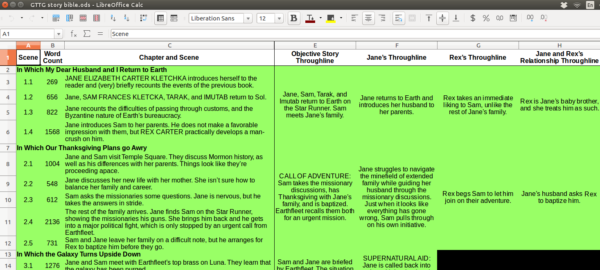
Once I’ve figured out the throughlines, I match them up in a spreadsheet to form chapters. Each chapter breaks down into three or more scenes, which serve to advance the throughlines. The scenes also work together to create a beginning, middle, and end for each chapter.

At this point, with the main plot of the book fully outlined, I start to add subplots. These can be romantic, tragic, or just an opportunity for one of the minor characters to shine. I may also add a background storyline with stuff going on behind the scenes that never makes the page, just to keep track of what’s going on.

Where the plot points for the throughlines correspond to whole chapters, the plot points for the subplots correspond to the scene level. A subplot may start or end in the middle of the book, or lay dormant for several chapters. I try to make each scene do double-duty, but add new ones as necessary.

For each of the major characters, I also write up a character sheet. This lists all of the specific details that tend to get mixed up in a rough draft, like hair color, eye color, height, weight, etc. It also gives me a chance to do a deep dive into who this character is and what makes them tick. Besides things like religion, education, occupation level, etc, I also include things like family relations, backstory, strengths and weaknesses, handicaps, etc.

Beyond that, I may draw up a sheet for conflict alignments, or to list all the story tropes that I want to include in the story. It really depends on the book.
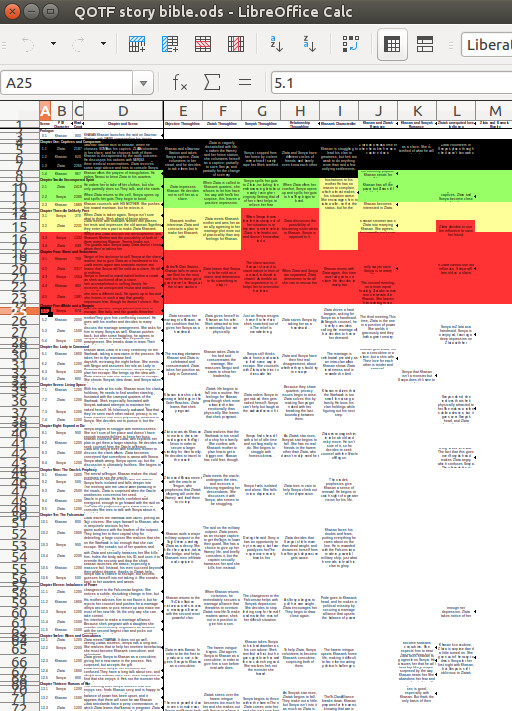
Lately, I’ve been experimenting with a process for revising my WIP as I’m drafting it. I keep a sheet for revision notes and color each scene and plot point for which draft phase it’s currently in: red for first draft, yellow for first revision pass, green for second revision pass, and black for final draft.

After fixing all the major issues, usually on the first or second pass, I set a goal to cut 10% of the words in the scene. Usually I end up cutting closer to 20%. This improves the quality of the writing and helps to make it much tighter.

I’m still experimenting a lot with my outlining techniques, trying out new things and refining the things I’ve previously tried. A year from now, I’m sure it will look much different. But the two major parts that do work quite well are the plot outline and the character sheets. Everything else builds on top of that.

And the really cool part is that it actually works. From June to August, I started a full-time job, moved twice, and experienced a family emergency, and I still managed to finish a novel through all of that, largely thanks to this outline. No writing blocks. No failed drafts. Just 600 words a day, no matter what else was going on, and by the end of it, I had a publishable novel.

I think this book will help me to write longer books, too. That’s what I’m working on next. If all goes according to plan, Queen of the Falconstar will be my longest book yet—not by very much, but still a good 10k words longer than Bringing Stella Home, which is currently my longest book. The things I’m learning now will help me to write more epic fantasy, like the next two books in the Twelfth Sword Trilogy. That’s the goal at least.

If there’s nothing else I’d like you to take from this post, it’s this: don’t be afraid to try new things. Don’t put yourself into a corner by saying things like “I’m a discover writer,” or “I’m not really an outliner.” Try it! You learn a lot more from your failures than you do from you successes.

The timelessness of novels

Every few months, an article about the “death of the novel” makes the rounds on the internet. This subject, the impending doom of one of literature’s most enduring forms, is a perennial favorite for bookish handwringers everywhere. If it isn’t ebooks that’s going to kill the novel, it’s millennials, the internet, our dwindling attention spans, or one of a hundred other things.

As a professional writer, though, I am awestruck by the timelessness of the novel. Think about it:

From its origin with Don Quixote in 1605, the modern novel has endured through social and political upheaval, global pandemics, the collapse of numerous societies, the most devastating war the world has ever seen, genocide and holocaust on an industrial scale, and rise and fall of half a dozen global empires. The world today would be unrecognizable to a person from Cervantes’ time, yet the novel has endured.

Movies didn’t kill the novel. Television didn’t kill the novel. Video games didn’t kill the novel. On the contrary—numerous franchises from Star Trek to Halo have a thriving line of novel tie-ins. When the ebook revolution was just getting started, people thought that so-called “enhanced novels” would dominate the marketplace. They failed to realize that all of the added audio-visual content was a distraction for most readers. Plain text is not a bug, it’s a feature.

It’s important here to make a distinction between novels and other literary forms, such as novellas and short stories. The other forms have endured as well, but not with anything approaching the popularity of the novel. Short stories are great for exploring an idea, but not so good at immersing the reader into another world. Novellas are great for telling an intimate story about two or three characters, but not nearly as good at conveying scope or intrigue.

There’s something about a novel-length story that captures the imagination in a way that other forms just can’t. Whether it’s the large cast of characters, the intricate world-building, or the interplay of numerous subplots, novels are more immersive, and therefore have the capacity to be much more satisfying. Little wonder, then, that the novel has endured.

I’ve seen this in my own books, too. Over the years, I’ve done relatively little to promote my full-length novels, and yet they still chug along with a steady month-to-month trickle of sales. When I do promote them, such as with this month’s free run of Genesis Earth, the results are astounding. My full-length novels also tend to receive much higher reviews.

In my second year of self-publishing, I got impatient and switched to novellas. While I don’t think that was a mistake, it did not provide the foundation for a lasting career. The Star Wanderers novellas did well for a couple of years, but I don’t think they’re going to endure in their current form.

I love writing novellas, but the books that I’m proudest of are all novels. Where novellas entice, novels satisfy. Where novellas tell an intimate story, novels possess greater depth. As such, I think it’s time for a change.

In the next couple of months, I’m going to prune back my catalog a bit. The Star Wanderers series will still all be up there, but I’m going to remove the individual novellas from sale, keeping the omnibus editions instead. This will pave the way for a sequel novel, Children of the Starry Sea, which I’ve already started work on.

I will probably remove most of my older short stories, and some of the derivative works. I don’t want to clutter my book pages with my earlier practice work, or anything that looks too obviously self-published.

I’m not sure what I’m going to do with Sons of the Starfarers just yet. I’ll definitely finish the series, but I’m not sure whether to do the other two omnibus editions or to just release each individual book in print. I’m toying with the idea of releasing the last four books in rapid succession, to build some momentum for the series, but it would take some time to write them, which means that Patriots in Retreat (Book VI) would be delayed for maybe a year.

I’m definitely going to turn Genesis Earth into a trilogy. No idea when the next book, Edenfall, is going to come out, but I’m going to do as thorough a job with that book as I did for Genesis Earth, which means it may take a while.

Novels take a lot longer for me to write than shorter books, but the end result is generally worth it. The trouble is that without a busy release schedule, sales tend to dwindle as you fall out of readers’ minds. I’ll try to make up for that by upping my marketing game and running more free and group promotions. In the meantime, anything you guys can do to spread the word would help!

I’ve got a couple of really awesome projects that should be coming out before the end of the year: The Sword Keeper, Gunslinger to the Stars, and a bunch of other stuff that’s really going to branch out my catalog. I’ve also got a couple of short stories that should be appearing in some new markets soon. Be sure to keep an eye out, and let me know what you think!

What readers want

I’ve been thinking a lot recently about what science fiction and fantasy readers want in the books they read. I’m in the middle of writing and publishing a series of novellas and short novels, so it’s definitely on my mind. After publishing twenty books and completing another novella series, I think I have a pretty good idea.

First and foremost, I think that readers want to have an experience. The exact nature of that experience depends on the genre, but for science fiction and fantasy readers, that experience needs to be out of this world. They want to be transported somewhere and feel that they’re immersed in the world of the story.

I think I’ve done a pretty decent job of this so far. I’ve gotten a lot of feedback from readers who say that they really enjoy the worlds that I’ve created. There’s always room for improvement, but so far, I think I’ve done a pretty good job transporting my readers to other worlds.

Second, readers want characters that they can connect with somehow. That usually means characters that they can relate to, though it can also include larger-than-life characters as long as they don’t feel fake. The characters are especially important for science fiction and fantasy, since they make everything else in the book feel real and authentic. Besides, when you’re visiting a new and unfamiliar place, it’s always good to have a friend.

I think that character is one of my strong points. I love getting into my characters’ heads and showing how they uniquely see the world around them. I also love showing how characters change and grow as they struggle to overcome their weaknesses. I’ve gotten a lot of positive feedback from readers on my characters, even in some of the more critical reviews, so that tells me I’m doing something right that so many readers can connect with them.

Third, readers (especially sf&f readers), want an adventure. They don’t just want an internal struggle as a character wrestles with difficult moral issues, or a transformative growth experience as a character faces a difficult challenge. Both of those can make a good story into a great story, and turn a reader into a fan, but more than that they want stuff to actually happen. They want the plot to move at an exciting pace–to get sucked into a story as they wonder what’s going to happen next.

With the series I’m writing now (Sons of the Starfarers), I’m trying to do just that. Star Wanderers (my other novella series) did pretty well, but I think the conflict was more personal and internal, or had more to do with the relationships between the characters than any sort of adventure that they were having together. There’s a place for that, but I think a lot of readers got bored midway through the series, or didn’t feel a compelling need to finish it. With Sons of the Starfarers, I’ve been careful to keep the action moving at a good clip with every book, and so far almost everyone who reads the second book goes on to the third book.

So those, I think, are the top three things that the majority of readers are looking for. But there’s something else that I don’t think I’ve been as good at, and it has to do with everything above.

I think that most readers, especially sf&f readers, are looking for longer books. They want everything above, but they want it in much bigger doses. The enjoyment they get out of a book doesn’t increase linearly with the page count, it increases exponentially. The longer the book, the deeper the immersion. The characters feel that much more real the longer they get to spend with them, and the adventure feels that much more thrilling.

As I’ve said before, I really enjoy writing novellas. But if my readers want something meatier, I’ll do what I can to satisfy them. I may love writing novellas, but I also love writing novels too. Since they generally take longer to write, with a lot more time between new releases, it’s more of a challenge to market them, but I have enough books out now that I can switch gears.

There are a couple of half-finished novel projects that I’ve had on the back burner for a while. I’ll keep working on Sons of the Starfarers until that series is complete, probably sometime next year, but I’ll also work on the novels in the meantime. Sons of the Starfarers will have nine books (three omnibus editions), and then it will be complete. After that, time to move on to longer books.

“It was too short.”

This, by far, is the number one criticism I seem to get in my negative book reviews. I never quite know what to think of it. On the one hand, a reader wouldn’t say something like that unless they thought it was good, since if they hated the book completely they would say something like “it was blessedly short” (and yes, I have gotten reviews like that). On the other hand, some of them really get worked up about it, to the point where I doubt they’ll ever read anything I write ever again.

Just to be clear, I’m not opposed to negative reviews, and I’m not responding to any of my reviews in particular. As a matter of principle, I believe that reviews are for readers and not for writers. I don’t generally respond to reader reviews except in very rare cases, and never to tell the reviewer that they’re wrong.

With that out of the way, what does “too short” actually mean? I can’t speak for all readers, but for me, when a book is too short it usually means that something in the story itself felt unsatisfying. In other words, something felt undeveloped, or rushed, or cut short without ever coming to a conclusion (or, in the case of cliffhangers, at least to a natural stopping point). In other words, “too short” isn’t a function of words or of pages, but of the story itself.

I’ve read short books that felt like they fit their length perfectly. A Short Stay in Hell comes immediately to mind. That book is a thin novella, barely more than a hundred pages in print, and yet it comes together so masterfully that I honestly don’t know what else could be added to make it longer. I would love to have more time to explore that particular world, but as it is, the story comes together perfectly within its own length.

That said, there are other books that I felt were too short even though they did fit their own length. That Leviathan Whom Thou Hast Made is an example of an award-winning book–clearly well written, clearly well constructed–that left me unsatisfied because it felt too short. Here, though, it was less a problem with the story itself and more just that I wanted more time to explore the alien culture of the swales. I would love to read a full-length novel set in the same universe, if for nothing else than for the fascinating world-building.

This makes me wonder: are there certain forms of fiction that tend to get more ire from readers just because of the constraints of the form? Do some readers hate novelettes just because they’re novelettes, or serials just because they’re serials? Judging from my own reviews, that seems to be the case. Even if I wrote the best novelette in the world, they would hate it because it’s not a novel.

So what am I supposed to do when readers tell me that my books are too short? Should I set a minimum word count and not publish anything unless it goes over that word count? I really don’t think so, because that sounds a lot like padding. Instead, the only solution that I can see is to focus on telling the best story and to not even worry about the length until it’s finished (and even then, only to know whether to label it a novel or a novella).

In the case of series, sometimes it can be difficult to tell whether to bring a certain thread to a conclusion or to leave it unresolved as part of the overall series arc. Certainly, each individual story needs to have an arc of its own, even if it ends on a cliffhanger. I’m still learning as I go, especially when it comes to writing series. But it’s certainly a lot of fun for me, and I hope it’s fun for you too as a reader.

In short, there’s not much I can do other than keep telling stories as best as I know how, and learn what I can from each story in order to tell better ones in the future. If “too short” means that something was unsatisfying, I’ll do my best to learn from it. But I’m not going to pad my novellas into novels just to hit a certain page count. The story itself should determine its own length.

Novella woes and farmers markets

Today I wrote about 2.6 words in my current WIP (Sons of the Starfarers), which didn’t really feel like it because I was constantly getting distracted.  Still, 2.6 words is pretty solid–it’s about mid-range for me.  If I can hit that every day from here on out (which is doubtful, but hey), the rough draft should be finished before the end of the month.

The crazy thing is that I just hit the inciting incident at the end of today’s writing session, after passing the 6k word mark.  For a mid-sized novella, that’s pretty late.  In the classic three act structure, the inciting incident usually hits between the 12%-15% mark, but this one is well past 20% for a 30k word novella–and just barely at 16% for a 40k.

So in layman’s terms, how long is this book going to be?  Probably longer than any of the Star Wanderers stories, but not quite as long as Genesis Earth.  It probably won’t turn into a full-fledged novel, since there’s only one viewpoint character, but I can already tell that it’s going to flirt with the line between novella and novel.

We’ll see how it turns out.  I’m still really excited about this story, and even though I don’t have a clear idea how to write the ending, I do know exactly how it’s going to end, if that makes any sense.  I’ve got a clear idea of the series arc that this book is going to set up, but I don’t yet have a clear idea of the book’s self-contained arc.  Once I figure that out, maybe I’ll be able to trim it down to a 30k novella after all.

============================================================

I visited the Stadium Farmer’s Market in Provo for the first time today.  It was pretty neat–lots of great produce, a nice community atmosphere, and a few quirky things like Jalapeno Jelly and tie died baby jumpers that you can’t really find in a mainstream grocery store.  I came away with some excellent peaches and a hankering to come back next week for more.

Anyhow, the trip got me thinking how indie publishing is kind of like a farmer’s market.  You’ve got everything from the guys who sell their produce out of unmarked paint buckets (writers who toss their books up to amazon with hardly a thought) to the local farm operations with pretty banners, pretty baskets, and laminated fact sheets drilling down on every possible difference between Elberta and Briscoe peaches (writers who go to great lengths to organize their own small presses and become Facebook/Twitter/Blogging personalities).

Almost everyone gives away free samples, which actually does a lot to drive sales.  In a similar way, most indie writers either have a couple of perma-free titles or free-pulse their books.  Everyone at the farmer’s market tries to be friendly and reach out to the customers (kind of like authors on Facebook and Twitter), but for me personally this kind of drives me away.  A good entertaining sales pitch, though, can be quite interesting.  I listened to the guy selling honey for almost twenty minutes, going on and on about his wares.  It’s clear he’s in a business that he loves.

Even though the fruit in the farmer’s market tends to have more blemishes than the stuff you find in the mainstream store, it is WAAAY more fresh and delicious.  Similarly, the stuff from the mainstream presses might be a lot more edited and polished, but the true innovation and formula-breaking stuff is happening in the world of self-publishing.  Publishers want things to be more predictable and formulaic so that they can have a better idea how something is going to sell, but indies are free to try almost anything.

Those aren’t the only parallels, either.  The more I think about it, the more it seems that being a self-published indie writer (or “author-publisher,” a newer term that I think I actually prefer) is a lot like being a local small farmer.  I’m sure there are differences, but the similarities are quite striking.

And now I’m really wishing I’d bought some of that honey.