O is for Orbit

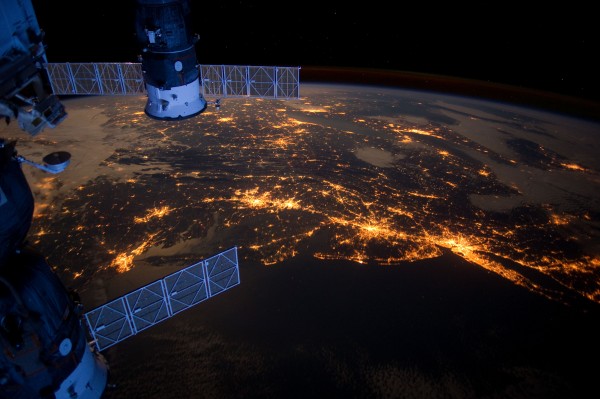
iss030e078095

One of the key things that makes space different from Earth is that nothing is ever stationary.  Anything close to our planet that isn’t moving at a good clip (measured in miles/kilometers per second) is liable to plummet like a brick.  Gravity is still in effect, even though you’re in free fall and thus don’t really feel it.

The way to get around the falling problem is to orbit whatever celestial body you’re plummeting towards.  When your tangential velocity gets high enough, gravity becomes your centripetal acceleration, and the system becomes rotational rather than discrete.  In other words, you’re still falling, but you’re moving fast enough to cross the edge of the horizon before you hit.

Just to give you a scale of how fast you have to go to make this work, the International Space Station (ISS) is orbiting at about 230 miles (370 kilometers) above sea level, and it makes a complete rotation around the earth every 90 minutes.  That means that the good folks who live and work up there see about 16 sunrises and sunsets per day.

If you’ve spent your whole life living planetside, orbital mechanics can be a bit difficult to grasp.  Here are just a few of the basics:

Since orbit is basically free fall, you don’t need to fire your engines to stay aloft.  In fact, once you’re parked in a stable orbit, you can stay there almost indefinitely.  This is how satellites work: we use a rocket to put them in position, but once they’re there all they need is a minor adjustment from time to time.  The moon is basically a giant natural satellite, and it doesn’t need any sort of thrust to stay aloft.

As objects fall closer to the body they’re orbiting, they orbit faster.  Just think about how figure skaters speed up when they pull their arms in closer to their bodies.  The main reason for this is that the object has a much shorter distance to travel to make a complete revolution.  To understand how this works, take a CD and measure the inside edge versus the outside edge.

However, since your tangential velocity is proportional to your centripetal acceleration (ie gravity), the way to jump to a higher orbit is to speed up.  Conversely, the way to fall to a lower orbit is to slow down.  An object’s angular momentum (mass X tangential velocity) is proportional to the distance of the object from the rotational system’s center of mass, so changing the object’s velocity will also change its distance from the center.

So if you’re in a spaceship and you’re about to collide with an object on a parallel orbit, the way to avoid it is not to nose your ship up like an airplane.  Instead, fire your engines and try to go faster (or slower, as the case may be).  It’s a bit counter-intuitive, but your altitude will change accordingly.  The anime/manga series Planetes really got this right.

However, even though you’re moving faster at a higher orbit, you have a lot more distance to travel, so it actually takes longer to make a complete orbit.  If you go high enough, you can eventually get to the point where the orbital period equals the rotational period of the celestial body you’re orbiting.  We call this a geosynchronous orbit.  If you’re orbiting around the celestial body’s equator, then to a person on the surface, it appears as if you’re stationary.  You’re not, of course–nothing in space really is–but both you and the person on the planet’s surface are moving in tandem, so that’s how it appears.

Ever wonder why satellite dishes all point in the same direction?  This is why.  The signal comes from a satellite in geostationary orbit, where it doesn’t move relative to the people on the surface.  Thus, if you know where to point your dish, you will always get a signal since the satellite doesn’t appear to move.

An orbit doesn’t have to be circular, but the barycenter (ie the center of mass for the whole system, where the mass of both objects cancels each other out) has to be at one of the focal points of an ellipse.  This is how comets work.  An object in an elliptical orbit will speed up when it gets closer to the object it’s orbiting, and slow down when it gets further away.

It’s possible–indeed, quite common–to orbit two celestial bodies simultaneously.  For example, since the Earth orbits the sun, anything orbiting the Earth must also orbit the sun at the same time.  If you’re close enough to the Earth, this doesn’t really matter since the Earth exerts a much more immediate force.  But when you get further away, interesting things start to happen.

A Lagrangian point is a point of gravitational balance between two orbiting celestial bodies of unequal mass.  Basically, they’re points of equilibrium where objects appear to remain stationary, so long as they continue to orbit in tandem with the other two celestial bodies.

In science fiction, these are great places to put space stations and other orbital settlements, since they appear as fixed points relative to the planet or moon that they’re moving around.  In real life, asteroids tend to clump around these points in a planet’s orbit, especially the L5 and L4 points.  Jupiter has so many of them that we call them the Trojans and the Greeks.

Since orbital mechanics can be a bit difficult to grasp, a lot of science fiction gets it wrong, especially space opera.  For a recent example, just look at the Halo series–unless those Covenant ships have some sort of magical drive, there’s no way they could hover above the surfaces of planets the way they do.  Orbiting does NOT equal hovering.  And in Halo: Reach, where Jorge knocks out the main ship for the Covenant advance force … yeah, if a ship that large actually fell from orbit into the surface of a planet, it would be moving fast enough to make a crater the size of a small continent, kicking up enough dust and debris to cause a mass extinction event like the one that killed the Dinosaurs.

At the same time, when a science fiction story goes the length to get the orbital mechanics right, it can add a surprising amount of realism.  A good example of this is Passage at Arms by Glen Cook.  I loved how he depicted the orbital siege of the main colony world, with the way the orbital space battles looked like from the planet’s surface.  The human forces were able to keep a toehold on space due to a low orbiting asteroid that the aliens couldn’t get to without exposing their forces to attack, and that served as the staging ground for the main characters to fight back.

For hard sci-fi, orbital mechanics is absolutely essential–you’ll be tarred and feathered if you get any of it wrong.  For soft sci-fi like space opera, it’s not essential, but it adds a lot to the story if you can get it right.  In any magic system, the limitations are what make it interesting.  If you’re writing science fiction, then physics is your magic system, so knowing how it works can really add a lot to your story.

For example, in the recent Schlock Mercenary storyline, the characters board a spaceship with an artificial gravity generator centered around a large cylindrical pylon that runs the length of the ship.  One of the implications of having Earth-strength gravity around such a small object is that you can actually throw a baseball into orbit.  And that’s just the beginning!  Needless to say, I’m really interested to see where Howard Tayler takes this story in the weeks and months to come.

Even though I write more space opera / science fantasy type stuff, I do the best I can to get my orbital dynamics right.  You can see this in the space battles in Stars of Blood and Glory and Bringing Stella Home, as well as the setting elements in Desert Stars.  When the desert tribesmen look up at the night sky, they gaze at the stars and satellites–hundreds of satellites, many of them starships bound for distant spaceports on the more civilized side of the world.  One of the reviewers said that the world felt so real it was almost like he could reach out and touch it, so I guess I did something right.  I’ll definitely keep it up in the future.
N is for Nebula

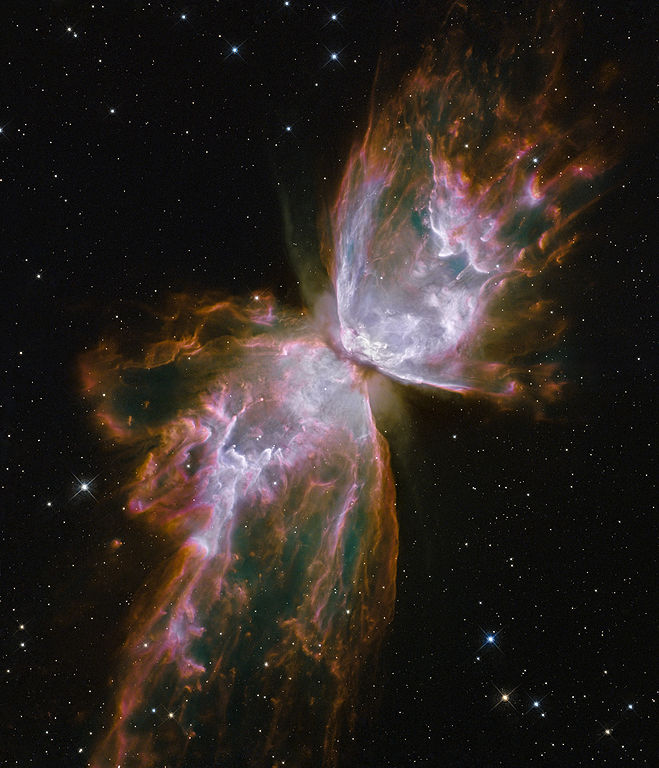
659px-NGC_6302_Hubble_2009.full

Of all the objects in space, nebulae are some of the most beautiful and awe-inspiring.  These giant clouds of gas and dust span light-years, and often contain stellar nurseries where new stars (and with them, new planets) are born.  Few things can fill me with a greater sense of wonder than a detailed, high-res image of a nebula.

Many of the classic nebulae images come from the Hubble Space Telescope, which has probably done more to bring that sense of wonder to the general public than any other telescope.  These images, all of which are released by NASA into the public domain (with very few restrictions), have been shaping the pop culture dialogue about space and astronomy for more than a generation.  They’ve certainly had a tremendous impact on me.

There are many different kinds of nebulae.  The largest and most stunning ones are mostly diffuse, meaning that they have no clear boundaries where they begin and end.  These come in two basic flavors: emission nebulae, which glow on their own due to ionized hydrogen gas, and reflection nebulae, which consist mostly of dust and don’t glow on their own, but reflect the light of nearby stars.

The Witch Head Nebula is a classic reflection nebula.  Doesn’t it look eerie?  It’s probably because of the way it reflects blue and purple.  Many reflection nebulae share those same colors.

The Orion Nebula, one of my personal favorites, is a massive region of star formation visible just below the three iconic stars of Orion’s Belt.  It contains large regions of both reflection and emission.  In the center of the thickest clouds are dozens of young stars with protoplanetary disks–new solar systems in the process of being born.  How many of these will go on to form planets capable of hosting life?  Just a few billion years ago, our own sun may have been born in a cloud of gas and dust like this one.

The Helix Nebula, also known as the Eye of God, is apt to make you do a double-take the first time you see it!  It looks almost like an eye, watching you from the midst of the heavens.  Just as clouds here on Earth tend to form shapes and patterns that look like other things, so do nebulae.

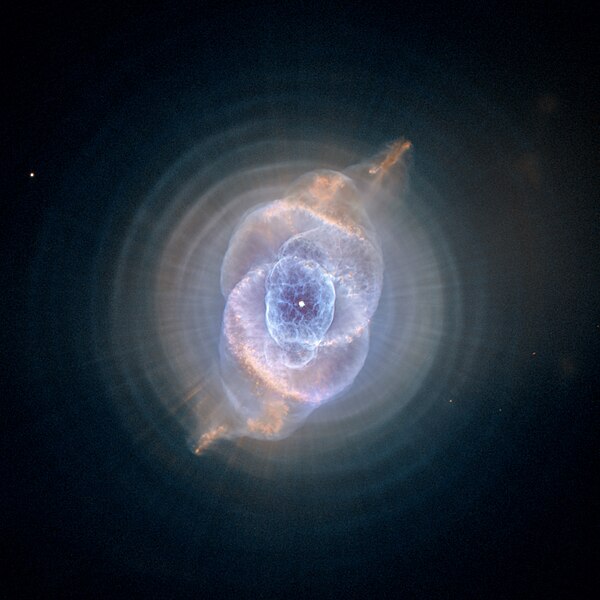
The Cat’s Eye Nebula is another one of those gorgeous space objects that’s apt to give you a double take.  Both the Cat’s Eye and the Helix are Planetary Nebulae, which form after a star burns off its outer layer and collapses into a white dwarf.  The name is kind of misleading, because they don’t really have anything to do with planets at all–they just look a bit like them, when all you’ve got is a low powered telescope to view them with.

One of the most famous Hubble images is the Pillars of Creation, a close-up image of a stellar nursery within the Eagle Nebula.  Stars form when clouds of gas and dust become so dense that they collapse on themselves, creating a gravity well that sucks up more of the surrounding dust and gas.  As enough matter accumulates, the pressure and heat at the center grow until the whole thing goes nuclear.  When nuclear fusion begins, the newborn star sends out a strong stellar wind that pushes away any remaining dust and gas from the rest of the nebula.  After several million years, the whole cloud is blown away, leaving us with a star cluster like the Pleiades.

In the Pillars of Creation, the long, finger-like clouds of the nebula are so dense that they appear dark and opaque, blocking out any light from the other side.  These kinds of structures are called molecular clouds, after their ability to form molecules due to their increased density.  In this image, though, we can see a group of newborn stars just starting to blow away the cloud’s outer shell.  Once the cloud is completely blown away (in just a few thousand years or so), these stars will shine clearly enough for us to see–but for now, they’re hidden inside those pillars where they were born.

The Crab Nebula is particularly fascinating, not only for the stunningly complex structures visible in this image, but because less than a millennium ago, it used to be a star.  In 1054, medieval astronomers in Europe, Asia, and the Americas reported the appearance of a new star, bright enough to be seen even in daylight.  What they actually saw was a supernova, the spectacular death of a massive star.  When a star goes supernova, it explodes with as much energy in just a few days or months as it put out during its entire lifetime.

The outer layers were blasted out to form this nebula, while the inner core collapsed and formed a neutron star–an object so dense that it contains as much as three times the mass of the sun in a sphere roughly the size of New York City.  If the supernova is really big, the star might even collapse into a black hole.

Because of how fascinating and gorgeous nebulae can be, it should come as no surprise that they often show up in science fiction.  When you have a starship and can travel at ease across the stars, nebulae become a part of the geography of space, just like forests and mountain ranges in a fantasy setting.  I haven’t played any of the Mass Effect games yet, but apparently they do this quite a lot.  In the re-imagined Battlestar Galactica series, the colonists are able to set a course for Earth after using the Lagoon Nebula to orient themselves relative to the stars of the zodiac.  And of course, who can forget the classic battle between Kirk and Khan at the end of Star Trek II: The Wrath of Khan?

In real life, though, it’s much more likely that nebulae like the ones above wouldn’t even be visible if you got up close to them.  Even though they’re much denser than other regions of space, they’re still for the most part much less dense than our planet’s own atmosphere.  From a distance, they appear bright because we can see the entire structure in one field of view, but up close, it’s possible that you wouldn’t even know you were in one.

That being said, it sure makes for more exciting fiction when the nebulae are these giant mysterious clouds capable of hiding an entire space fleet.  And really, who knows what these things are actually like up close?  For now, all we can do is watch them from afar.  But someday, if science fiction becomes reality, we may be able to be firsthand witnesses to the births and deaths of stars.

I is for Interstellar

winchgalmap3SampleRight after I went through my Dinosaur phase, I saw Star Wars IV: A New Hope for the first time.  Instantly, all that childlike excitement and exuberance was transferred from paleontology to astronomy.  We had a series of about twenty astronomy books in my elementary school’s LRC (Asimov’s astronomy series, I believe–the ones with the gray dust jackets), and in about a year I’d read them all.

Star Wars was fun, but what was really fascinating was learning about the stars.  When I started to grasp the scale of our galaxy–that if our solar system was the size of a milk carton, the Milky Way would be the size of North America–my mind was totally blown.  Quasars, pulsars, black holes, white dwarfs, red giants–it was so amazing!  And then, when I started thinking about all the other worlds out there, and what it would be like to visit them–that’s when I became a science fiction fan for life.

It goes without saying that you can’t have space opera without setting the story somewhere in space.  But the best space opera goes much further than that–it’s about space as the final frontier, and humanity’s ultimate destiny among the stars.  After all, if we as a species stay put on this pale blue dot, sooner or later we’ll kill ourselves off or suffer another mass extinction event that wipes us all out like the Dinosaurs.

For that reason, classic space opera often takes undertones of manifest destiny, except on a galactic scale.  The stars are not just interesting places to visit, they’re absolutely crucial to our survival, and no matter what alien dangers await us, we will face them boldly and either conquer or be conquered.

Of course, not all space opera stories take place during the exploration and colonization phase of human interstellar expansion.  Plenty of stories take place thousands of years later, once humanity has comfortably established itself among the stars.  Even so, there are still more than enough wonders remaining to be explored–if not for the characters, then for the readership.  The vastness of space is so great that there really is no end to it, and the possibilities are only bounded by the writer’s imagination.

One of my favorite space opera computer games is Star Control II, also know as the Ur-Quan Masters.  In the game, you’re the captain of a giant starship built with alien precursor technology.  The races of the Federation, including humanity, have been defeated and enslaved by an aggressive warrior race known as the Ur-Quan.  You must travel from star to star, gathering resources to upgrade your starship and convincing the other alien races to join the new alliance.

By far, the best part about that game is the starmap.  It’s HUGE!  More worlds than anyone can possibly visit in any one playthrough, or five, or even ten.  And each alien race has its own history, its own culture, its own set of goals and objectives–and oftentimes, most of these goals have very little to do with the actual conflict of the game.  In fact, there are some races like the Arilou which don’t even seem to know that there’s a war going on.  They’re much more interested in something frightening and mysterious from another dimension that they never quite explained, but that may involve the Orz somehow…

With each new world that you discover, you learn that the galaxy has a very, very, very long history.  So long, in fact, that the human race has only really existed for a blip in time.  The other races are involved in their own disputes, and many of these go back to the times when our ancestors were swinging through the trees somewhere in central Africa.  But whether or not we want to be a part of it, we’re involved, simply by virtue of where our star happens to be located.

The best space opera isn’t just about our world: it’s about our place in a much wider universe.  Whether it’s a serious tale about humanity’s ultimate destiny, or an action-packed intergalactic romp, there’s always that sense of something greater than us–that same sense of wonder that gripped me as a boy when I first started to learn about the stars.

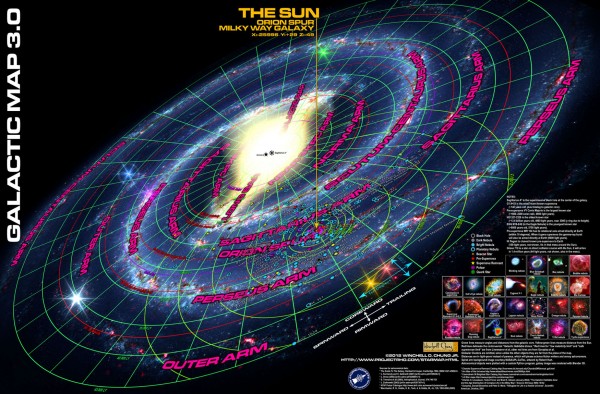
Image by nyrath at Project Rho. I highly recommend checking out his excellent starmaps!

Random thoughts on creativity and a cover preview

I’ve noticed that I tend to go through at least two revisions on most of my stories.  The first one generally identifies the problems in the rough draft and eliminates them, while the second one adds anything that’s missing and smooths the story over so that it works as a whole.  They both use different parts of my brain: one critical, the other creative.  Since both are important, I can’t easily skip either of them, and combining them into one mega-revision doesn’t really work because it’s hard to switch from one mode to the other.

I’m currently in the second revision for Star Wanderers: Dreamweaver, and it’s coming along really well so far.  Now that I’m in creative mode, it’s a lot easier to add stuff that was missing from the first draft and tidy up some other parts that seem a little disjointed.  With luck, this revision should be finished in a day or two.  It’s really only one chapter that needs the bulk of the work–according to my first readers, everything else is pretty good.  Far be it from me to fix something that isn’t broken.

###

The other day, an old friend of mine emailed me with a question about the world building / plotting process I followed for Star Wanderers.  I wrote a fairly lengthy response, and while most of it was a more detailed explanation of the stuff I’ve already included in the various author’s notes, I came up with some advice that surprised me:

If I had to give any advice, I’d say that the most important thing is to just feed your creativity.  You can’t force your imagination, just like you can’t get any more golden eggs by killing the goose that lays them.  However, you can organize your life and your environment in such a way that bursts of creativity are longer and more frequent.  A huge and important part of it is learning to turn off your internal critic, especially on the rough draft.  Sometimes, if I spend too much time thinking about writing, it paralyzes me so that I can’t actually write–but if I trick myself into opening my WIP without really thinking about it, then ten minutes later I’m plugging away and the ideas are flowing.  And just as bad habits can be very harmful, good habits can be very helpful.

I think a lot of us creative types tend to force ourselves a little too much, especially when we’re first getting started.  We want to be productive, we want to have something that we can show for ourselves in order to feel validated, especially with so many people raising eyebrows at our dreams and creative pursuits.  But productivity goals, while important, are really only a means to an end–and they’re not even the most important means most of the time.

If you want your work to ring with authenticity, or to reflect the truth and beauty you see in the universe, you have to be in touch with that kind of stuff.  And once you get back in touch with the stuff that drove you to create in the first place, there’s nothing that you want to do more.

This morning, I wrote for three hours in one sitting, and I wasn’t tempted by any distractions at all.  I only produced about 1.3k words, but they were good words that added both to the story and my understanding of the story.  I got back in touch with the spark that drove me to write it in the first place, and hopefully that spark will carry through to the readers.  I think that it will.

So yeah–it’s not about productivity goals, or reworking our creative process to be more like someone else’s, or any number of other writerly insecurities.  It’s all about story, and everything that drives us to tell them.

###

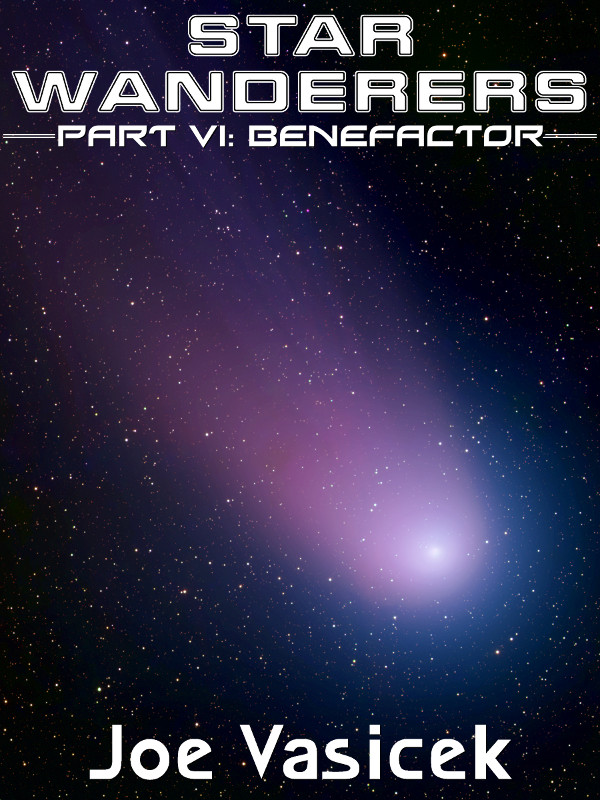
All right, if you’re still reading (or even if you cheated and skipped ahead), I have a treat for you.  I just found the AWESOMEST image for the cover of Star Wanderers: Benefactor, which I hope to finish up later this week after finalizing the revisions for Dreamweaver.  Here’s the cover:

SW-VI Benefactor (cover)

Pretty cool, eh? I <3 NASA. 😀

The picture is of Comet C/2001 Q4 (NEAT), taken by the WIYN 0.9-meter telescope at Kitt Peak National Observatory near Tucson, Arizona.  It was taken on 7 May 2004, and covers an area roughly five times the size of the moon.  As with all NASA images, it’s in the public domain.

The inspiration actually came from comet PANSTARRS, which is visible in the sky right now.  I tried to catch a glimpse of it tonight from the Y Mountain trail head, but there were too many clouds on the horizon to see it clearly.  Hopefully, the skies will be clearer tomorrow.

In related news, comet ISON later this year is expected to put on a really incredible show.  Astronomers think that for a brief time, it may even shine brighter than the moon, making it visible even during the day!  If that happens, it’s going to be AWESOME.  Mark it on your calendars for November–it’s going to be great!

That’s just about it for now.  I’d better get back to forming those good habits I mentioned earlier–like actually getting to bed at a reasonable hour. Later!

Thoughts on ebook parts and a sneak peek of STAR WANDERERS: DREAMWEAVER (aka Star Home)

There’s been some discussion on forums and the blogosphere recently about the different parts that should make up an ebook, and what order they should be in.  J.A. Konrath just did an interesting blog post on the subject, in which he picks his own books apart and gives some advice.  At the moment, here is how I’ve structured mine:

  1. Cover image (600×800).  Usually the same as the high res one I upload separately to publish, but may be different.
  2. Copyright page.  Very brief.
  3. Table of Contents, with hyperlinks to each chapter.
  4. The book blurb, which also appears in the book description on most retail sites.
  5. The book itself.  When you open up the ebook for the first time, this is where it automatically starts.
  6. A brief author’s note, in which I tell the story behind the story–how I came up with the idea, what the writing process was like, and any other relevant influences worth mentioning.
  7. The acknowledgment page, in which I list my first readers and anyone else who helped out with the book production.
  8. A couple of sample chapters for other books.  I only put these into the novels, though–for the novellas, they would take up more than 10% of the total ebook content.  That’s pushing it.
  9. A page promoting the Writer2ePub plugin which I use to build my ebooks.  It’s a really awesome plugin, and I figure the developer deserves some acknowledgment for his work.

I don’t totally agree with all of Konrath’s advice.  For example, I think the copyright page is small enough that it can go in the front without inflating the sample too much.  Then again, I keep the copyright page pretty brief–none of these ridiculous “unauthorized reproduction of this content is piracy and piracy is evil blah blah blah.” Not that I want to be pirated, but I figure my readers are smart enough to know all that stuff already.

In general, though, I think Konrath’s advice is mostly right, especially the part about not padding the end of the book with sample chapters.  I’ve seen a lot of readers complain about getting to the 90% mark of an ebook, only to find that the story is over and the rest of the content is filler.  As a reader, I’ve experienced that disappointment myself.

However, I do think it’s important to include at least some sort of mention of other available books in the back matter.  Until now, that’s meant sample chapters, as long as they take up less than 5% or so of the total content.  Since my Star Wanderers novellas are so short, I haven’t added any sample chapters to them–just a brief plug to sign up for the email list.  And for my novels, I only add a prologue or first chapter, so as not to take up too much space.

Recently, though, I’ve started to rethink this strategy.  When I finish a book, I’m not usually in the mood to read a sample chapter of the next one unless it’s a direct sequel that picks up right where the end of the book leaves off.  I will eagerly browse through book blurbs, though, especially if they’re in the same series or genre.  A good book blurb is much more likely to influence my decision on what to read next than a sample chapter, which I usually just skip over.

For that reason, I’ve decided to take out the sample chapters in my novels over the next few weeks, and replace them with a much shorter page containing a thumbnail cover image and book description for the next book.  I’ll still keep the author’s notes, since I enjoy writing them and I think they’re a good way to engage my readers.  It’s one of those things that makes it a Vasicek book.  But yeah, the sample chapters are gonna go.

This also opens up the possibility of trading book blurbs with other writers.  For example, my friend Kindal Debenham writes space opera stories in the same vein as my Gaia Nova series.  He shows up in my Also Boughts every now and again, so I know there’s a bit of a crossover in our readership.  I haven’t approached him with this idea yet, but if we both included short book blurbs for each other in the back matter of each of our books, we could cross-pollinate our fan base and point readers out to some books they’d be likely to enjoy.

That’s just a thought.  It will be interesting to run with it.

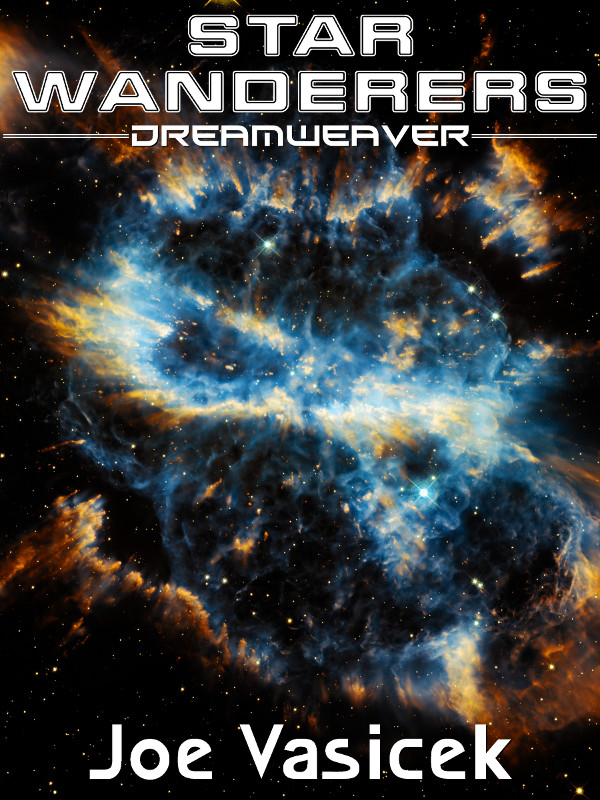
As for the sneak peek I promised in the title of this post, I’ve been playing around in Gimp the last couple of days, working on the cover art for the next Star Wanderers novella while waiting for my editor and illustrator to get back to me on Stars of Blood and Glory.  Here’s what I came up with:

SW-V Dreamweaver (cover)

What do you guys think?  That’s a pretty cool nebula, isn’t it? Hubble is so friggin awesome. 🙂 I took this from a new image of NGC 5189 that was featured on APOD a few months back.  The moment I saw it, I knew I’d be using it in a Star Wanderers cover. 😀

Dreamweaver is a parallel novella to Outworlder, and covers the events of that story from Noemi’s point of view.  I wrote it back in the spring of 2012, and put it on the back burner while I focused on finishing the other ones in the series.  In the author’s note of Fidelity, I think I referred to it as “Star Home,” which was originally its working title.  I was going to do all the other parallel novellas from Noemi’s point of view, but I’ve since decided to branch out with the other characters.  Right now, I’m writing a novella from Jakob’s point of view, which is turning out to be quite interesting.

After Stars of Blood and Glory is published, I plan to put up Star Wanderers: Dreamweaver, hopefully within a month or two.  After that, I’d like to bundle parts I-IV into an omnibus and put that up as The Jeremiah Chronicles, in ebook as well as print-on-demand.  A lot of that depends on cash flow, though, since I plan to hire an illustrator and go all out.  If any of you have any suggestions for a good artist / cover designer, please let me know!  The Star Wanderers books take place in the same universe as the Gaia Nova series, but they have their own distinctive feel and I’d like to find someone whose art reflects that.

That’s just about all for now.  It’s getting late, and I plan to wake up early to write.  President’s day is kind of a useless holiday–in fact, most one-day holidays are kind of useless when you’re a freelancer.  So yeah.  Later!

Edenfall update

So I haven’t exactly gotten into a good writing routine yet, but Edenfall is coming along pretty well.  I’m just about finished with the first chapter, and the dominoes are already starting to fall.

It’s fun to revisit the world of Genesis Earth, but I’m not going to get too bogged down in recapping the events of the first book or setting things up.  I hate it when sequels do that.  Fortunately, since the majority of this story is going to be from a new character’s point of view (Michael and Terra’s oldest daughter), I don’t really have to do that, except to lampshade some of the worldbuilding.

One thing I need to do is get more in the mood of the first book, which was a lot more introspective and big-picture than my other science fiction.  To do that, I found an excellent collection of videos called The Sagan Series.  Here is my favorite:

Man, I get shivers every time I watch that. “Sailors on a becalmed sea…”

Another good video is this one from The Piano Guys:

I know it says “Southern Utah,” but you could substitute that for “Icaria” and it wouldn’t be that far off.  In particular, the night clip from the bottom of the slot canyon at 2:05 looks like something straight out of Genesis Earth.  Throw in some primitive natives, a few giant lizards and various avians and insectoids, and you’re pretty much there.

I’m still adjusting to writing in longhand, but so far I think it’s going to work out well.  Because the writing process itself is much slower, it’s much more time intensive but surprisingly easy to jump in and get started.  Once I’ve got some momentum going, I think the story will practically write itself.

I do have a confession to make, though.  A couple days ago, I had an idea for another science fiction story that was just so awesome I decided to run with it.  At first, I thought I could keep it down to a short story, or perhaps a novella at most, but…well, I think it’s going to be a bit longer than that.

Don’t worry: Edenfall is still my primary project, and if juggling them both becomes too difficult (which it probably will), I’ll put this new one on the back burner until Edenfall is finished.  It’s kind of a guilty pleasure anyways, a sci-fi romance that draws heavily on tropes from old westerns (Jeremiah Johnson in particular).  I have no idea where it’s going to go (well, nothing more than a vague idea about the twist at the end), but that just makes it all the more exciting to write.

So anyhow, that’s what I’ve been up to these last few days.  Now if you’ll excuse me, I need to get back to writing.  See you around!

Worldcon 2011: Saturday

Alright, I should just write this up and finish my convention report before life sweeps me away completely.

Saturday was the main day of the con.  To be honest, I forgot all the panels I went to, except this really awesome one by a guy at NASA on near Earth objects (NEOs).  Holyfreakingcow there are thousands of these objects AND WE ARE SENDING MISSIONS TO THEM!!!  So cool!

I went to a kaffeklatsch with Nancy Kress, which turned out to be quite an interesting experience.  She’s an extremely gracious person, much like Tracy Hickman, and gave some excellent career advice: 1) no matter the obstacles or difficulties, always find a way to keep writing, and 2) always be true to the story.

Had dinner with some other Utah writers, and I wish I could say it was pleasant, but for some reason it got very antagonistic.  I know it takes two to tango, but I honestly don’t know what I did to make it that way.  Perhaps stress levels were running high, or people misread my tone, but the conversation at our table completely fell apart at least twice.  It was very wierd.

Part of it might have to do with the fact that I’ve become something of a trailblazer for indie publishing within the SLC / Utah Valley writing community.  Which brings me to another side note: everyone talks about how militant and polarizing self publishers are, when in my experience it’s the advocates of traditional publishing who tend to adopt an us vs. them attitude.  To be sure, there are plenty of desperate to be published writers who take the indie path just to “stick it to the man,” but those people tend to fade away once they realize it isn’t a silver bullet.

Anyway, the Hugo Awards in the evening were great!  Robert Silverberg presented the award for Best Novella, and for fifteen minutes he was my favorite person in the world.  So hilarious!  I’ve tried to find a video, but there doesn’t seem to be one up yet.  Utah writers were nominated in six categories, and even though none of them won, the competition was pretty dang good, so I don’t feel so bad about losing.

All in all, it was a great convention!  I had a lot of fun, even if I did feel a little exhausted by the end of it.  I’m not sure if I’ll be attending future worldcons in my current capacity as a beginning writer, but I most likely will buy supporting memberships in order to vote in the Hugos (and download the voting packet).  It’s a good community, and I’m glad to be a part of it.

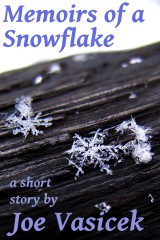
“Memoirs of a Snowflake” is now free!

So I come back from my camping trip, and what do I find?  Amazon has made my short story “Memoirs of a Snowflake” available for free–and it’s at the #16 spot on the fantasy bestseller list!  Awesome!

Camping was fun, as was the road trip down there.  The stars out at Huntington Reservoir were absolutely amazing–man, when I have the money, I’m totally going to take up astro-photography as a hobby.

Didn’t write a whole lot, but now that I’m back, I should be able to get some work done today.  But first: time to shower!

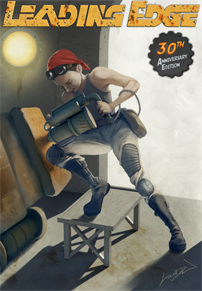
Another publication in Leading Edge!

That’s right!  My poem “Zarmina,” dedicated to Gliese 581 g (the first exoplanet discovered in its sun’s habitable zone) is published on page 98 of issue 61 of Leading Edge!

Also included in this issue is an excellent essay by Brandon Sanderson, in which he introduces his second law of magic systems.  It’s an excellent essay, and has made me rethink how I do FTL systems, especially for the Gaia Nova universe.  I’ll have to do a post a little later on that.

Besides this landmark essay by Brandon Sanderson, this issue features stories by Dan Wells and Dave Farland, as well as an interview with Howard Tayler.  And as always, it includes a number of excellent stories and illustrations.  Check it out!

(Full disclosure, I volunteer as a slushpile reader and occasional copy editor for the magazine.  However, my work always goes through the submission process under a pen name, where only the head editor knows who I am until the decision on whether to acquire the story has been made.)

In other news, Genesis Earth is now up on Goodreads, so go check that out as well!  The nice thing about Goodreads is that you can give the book a # star rating without having to write out anything else.  If you’re so inclined, I would very much appreciate an honest review–but if you do give it a rating, please be honest.  Don’t worry; even if you give me less than five stars, I won’t hunt you down like this crazy author (hint: get some popcorn and read the comments).

So anyhow, that’s what’s been going on here.  Desert Stars is coming along slowly but surely, and I’m working on getting some cover art for Bringing Stella Home.  If you have any ideas or suggestions on the art, please let me know.  I’ll probably go through my back issues of Leading Edge to search out good sf artists.  For some reason, I’m having a hard time finding anything that clicks on deviantart.  My goal is to epublish that book by the end of July.

Tag and such

So my cousin Angela tagged me in this cross-linking truth-or-dare blog game, and it looks fun so I figured I’d participate.  Here goes:

Do you think you’re hot?

I suffer from no illusions as to my ability (or rather, lack thereof) to carnally attract the opposite sex.  That’s not to say I’m ugly, but when you apply the Pareto principle to dating (and let’s be honest, it’s really more of a 90/10 split), I don’t make the cut.

And you know what?  I’m fine with that.  Because it only takes one…

What is  your current desktop wallpaper?

This glorious image from APOD (Astronomy Picture of the Day).  It’s enough to make me want to move to Iceland, and that’s saying something.

When was the last time you ate chicken?

I made some awesome fajitas last week, and the chicken was on sale at Maceys.  I always cook my own chicken; I hate the precooked frozen stuff.

What were you thinking as you were doing this?

Who comes up with these things anyway?  Hmm, I wonder if I could start one…

Do you have nicknames?

I have two internet screen names, which are probably the only nicknames of mine that are still in use (besides the ones people use behind my back).  The first is “onelowerlight,” and it’s all over the place.  The second I use only on deviant art and a certain fan-fiction site, and it is and shall remain a closely guarded secret.

Tag eight blogger friends…

Alright, let’s do this.  LEEERRROYYY…

Gods, Witches, Space & Stars
Kate in Katy
Myself as Written
One Modern Mormon
Truthiness
Fertilizer
Not A Villain (technically a webcomic not a blog, but hey she’s an old friend)
سفريات أنثون

Who’s listed as number one?

My old writing friend Laura, who just got back from an LDS mission in Armenia.  Has a lot of interesting and insightful things to say, such as her last post on the difference between strong female characters who are independent vs. strong female characters who are interdependent.

Say something about number five.

Sarah is one of my little sisters, and she just had a baby!  Also, she worked for a couple years in a survivalist-oriented wilderness therapy program, and knows how to make traps, kill and eat animals, and make fire with sticks and a bow.  Oh, and she’s also hilarious.  If I’m ever stranded on a desert island, she’s my first pick for who I’d want with me.

How did you get to know number three?

Chuck?  I think she showed up at a writing group meeting when I was VP of Quark.  She was never really active in the club, but we also took Sanderson’s 318 class a couple times and went to CONduit in 2008 together.  Meh; she’s alright, I guess (jk!).

How about number four?

(who comes up with these questions?)

Mykle is my geekiest brother in law, at least in terms of books and sf&f fandom (linux, that would be Danny).  He married Sarah two months after meeting her and I think it was the best decision either of them ever made.  He doesn’t blog much, but when he does, it’s always thoughtful and interesting.

Leave a message for number six

Thanks Kindal for the feedback on Worlds Away! Blunt as always but quite helpful.

Leave a lovey-dovey message for number two

For my sister?? Ewwwww…

Seriously Kate, I love your blog.  And you have the freaking cutest daughter on the face of the planet.  Thanks for making me an uncle!

Do number seven and number eight have any similarities?

Yes, in fact.  Aneeka (no. 7) spent a couple years teaching English in Japan; Anthon (no. 8 ) hasn’t spent more than a week or two in the same place (or more than a month or two on the same continent) for the last two years.  Let me just say, I am in awe of these world travelers and hope to do likewise at some point in the future.

That’s it folks.  At least I have chicken.