The key to understanding the Middle East (and possibly the world)

I just finished Douglass Murray’s latest book, On Democracies and Death Cults, and wow, is it an incredible book. Difficult to read, simply because of the grim nature of the subject, but a very powerful and very timely book.

My own thinking on Israel and the Middle East has changed a lot since the October 7th attacks. For the record, I studied Middle Eastern Studies and Arabic in college in the 00s, traveled throughout Jordan, Egypt, Israel, and Palestine / Judea & Samaria while I was pursuing my degree. I’ve kept up with geopolitical developments over the years, including during the Arab spring, and have helped some of my Arab friends navigate those developments.

The apocryphal Churchill quote that “if you’re not a liberal by your 20s, you have no heart, but if you’re not a conservative by your 50s, you have no brain” very much describes my own experience. I used to be very sympathetic toward the Palestinians, but after the October 7th attacks, my position has shifted almost 180 degrees.

The thing about the Middle East is that even though it’s complex, it’s not really that complicated. Within the Middle East, there are basically three kinds of people:

  • the Jews,
  • the people who want to kill the Jews, and
  • the people who really don’t care.

This dynamic has defined the politics of the region since at least the Babylonian sack of Jerusalem in 600 BC, and possibly quite longer. Possibly, in fact, since the very first Hebrews migrated to the region during the Bronze Age Collapse.

(As a side note, there has been a continuous Jewish presence in the Levant since our first historical records of the Jews. In other words, this is the one place in the world where the Jews are indigenous. Therefore, anyone who argues that the Jewish State of Israel is a “colonist” state is, in effect, arguing for the extermination of the Jews, because there is no other place in the world where the Jews can live and not be considered colonists. At the very least, they are laying the foundation for the ideological position that the Jews should always and everywhere be treated as subhuman.)

With the above dymanic in mind, there are only two configurations that possess any sort of inherent stability. The first is that the Jews are the people in charge of the region AND constitute the majority of the population. That way, even if all of the non-Jews fall into the kill-the-Jews camp, they are still not powerful enough to carry out their plans.

This was the state of affairs from the days of Ezra and Nehemiah basically to the Roman siege of Jerusalem. Following the Babylonian exile, the Jews returned to their homeland under the (mostly) benevolent rule of King Darius of Persia, who allowed them to rebuild the temple, which the Babylonians had destroyed. When Alexander took over the region and the Greeks began to Hellenize it, the Maccabees and other Jewish rulers still managed to hold their own.

But all of that changed when the Romans destroyed Jerusalem in 70 AD. They put down the Jewish revolt with utter ruthlessness, making a desert and calling it peace. They drove the main body of the Jews out of their ancestral homeland, making sure it would never be such a hotbed of rebellion again. They also renamed the region “Palestine,” after the ancestral enemies of the Jews, the Phillistines. The name “Palestine” was originally an insult to the conquered Jewish people, just like the name “Britain” (ie “land of the painted people”) was originally an insult to the conquered Celts. And just like the British came to own the term, the Jews also came to own the term “Palestine” until it was appropriated from them by the Levantine Arabs who wanted to kill all the Jews.

From 70 A.D. until the early 20th century, the Jews were a minority in their own homeland. And so long as their numbers didn’t get too large, things were relatively stable. Sure, there were plenty of people who still wanted to kill them all, but so long as the Jews mostly stayed out of sight, most of the non-Jews frankly didn’t care. It was only when their numbers began to grow that the I-don’t-care faction bled into the kill-them-all faction, leading to pogroms and mass rapes and all sorts of insane atrocities.

But then, in the 19th century, the Jews began to migrate back to the region in large numbers. This led to an inherently unstable configuration which persists to this day, where the Jews and non-Jews are roughly equal in number. The Jews formed the State of Israel with help from their Western patrons, who provided a degree of metastability. But the situation is not long-term stable, and hasn’t been for the last 150 years.

The Americans tried to solve this problem by bringing together the Jews and the people who want to kill the Jews—as if they could ever make peace. This was incredibly naive. So long as there are Jews, there will be people who want to kill them. Individuals may be persuaded to change their positions, but the ideologies of antisemitism are as persistent as the Jewish people themselves. The death cult will never be satisfied until all of the Jews are dead.

What October 7th showed us is that the three-way dynamic of the region is still very much in play, and that the kill-the-Jews faction is still far too strong. And given the way things are changing here in the United States, I suspect that the Jews have, at best, another generation before their Western patrons become unreliable, and the metastable nature of the current configuration begins to deteriorate.

The Abraham Accords are changing things in a very positive way. For once, instead of trying to get the Jews to make a deal with the people who want to kill them, we are moving away from that silly nonsense and cutting those people out of the equation by making a deal with everyone else (like we should have done in the beginning). And with the way that Iran was utterly defeated in the latest war, it looks like that might actually work. But even then I don’t think the situation is going to be long-term stable unless it ultimately leads to a mass resettlement of the Palestinians, because that’s the only thing (aside from the senseless massacre of millions of Israeli Jews) that puts us into a stable configuration.

I think the Israelis know this. And I think that Israel is going to get a lot more aggressive in the coming years, much to the consternation and perplexity of their friends here in the West who do not understand this three-way dynamic (or who think that the key to peace is for the Jews to play nice and not fight back, so that most of the non-Jews fall into the I-don’t-care camp).

Because here’s the thing that almost no one is talking about: the impetus for the October 7th massacre was the transportation of several red heifers to Israel from a ranch in Texas. In order to build the third Jewish temple, the land of the Temple Mount (where the Dome of the Rock and the Al-Aqsa Mosque currently stand) needs to be ritually cleansed by the ashes of a pure red heifer. The reason Hamas called their operation the “Al-Aqsa Flood” was to appeal to their Muslim brothers to defend the temple mount.

From what I understand, most Jews do not currently want to rebuild the temple, and the State of Israel itself has taken strong measures to suppress those who do. But every time the Jews have had a commanding presence in their own ancestral homeland, they have built or maintained a temple on the Temple Mount. So once they feel they’re strong enough, they will probably do it again. And when that happens (or as it is beginning to happen, perhaps even now), I think that this three-way dynamic will become much more of a global phenomenon.

The Prophet by Gibran Khalil Gibran

AL MUSTAFA the chosen and the beloved, who was a dawn unto his own day, had waited twelve years in the city of Orphalese for his ship that was to return and bear him back to the isle of his birth.  And in the twelfth year, on the seventh day of Ielol, the month of reaping, he climbed the hill without the city walls and looked seaward; and he beheld his ship coming with the mist.  Then the gates of his heart were flung open, and his joy flew far over the sea.  And he closed his eyes and prayed in the silences of his soul.

Thus begins The Prophet, a timeless masterpiece by the Lebanese poet Gibran Khalil Gibran.  As the prophet Al Mustafa prepares to leave on his ship, the people of Orphalese come one last time, asking for him to share his wisdom.  And so he does, on a variety of subjects from love to houses, clothes to prayer, beauty, pleasure, and finally, death.

I really love this book, and not only because it gives me a chance to practice my Arabic.  Just about every line in this epic poem is both moving and profound, and gives you pause not only to think, but to feel, and feel deeply.  One cannot help but feel that Khalil Gibran was a man who knew not only great joy, but also great pain in his life–pain which made his soul all the greater.

Like many things Middle East, however, the book is not without controversy. I have no doubt that many of my friends would find some words in this book with which they would strongly disagree.  Even some of my Arab friends don’t like it for (I suspect) that reason.  However, even though I don’t necessarily agree with everything in here, it’s such a thoughtful book and makes so many good points that I can’t help but love it.

The style is very Arab, which is to say it’s a lot wordier and more colorful than most modern English literature.  From what I’ve heard, though, Khalil Gibran wrote this in English first, and then translated it into Arabic.  Still, it has a distinctive Middle Eastern feel to it, which I love.  One of my favorite passages:

Yet I cannot tarry longer.

The sea that calls all things unto her calls me, and I must embark.

For to stay, though the hours burn in the night, is to freeze and crystallize and be bound in a mould.

Fain would I take with me all that is here.  But how shall I?

A voice cannot carry the tongue and the lips that gave it wings.  Alone must it seek the ether.

And alone and without his nest shall the eagle fly across the sun.

That’s exactly how I felt before I left Utah, and one of the main driving reasons why I’m leaving to start a career teaching English abroad.  In dozens of passages like this, Gibran’s words reflect my own feelings even better than anything I could ever write.

I suppose that’s what poetry is all about; using words in such a way that you can really make people feel.  Gibran is a master of that, which is probably why he’s the third bestselling poet in the world (after Shakespeare and Lao-Tzu).  Regardless, this is definitely a book that I will read over and over, in English and in Arabic.

Story Notebook #5 (part 2)

For those of you who don’t know (or can’t remember, since it’s been so long), I’ve been doing this ongoing thing where I go through my old story notebooks.  Last time, we covered my last semester of classes at BYU; this time, we’ll cover my time in Washington DC, when I was trapped in an internship from hell.

Now, you may be wondering: “why is this guy just giving away his ideas for free?” Well, last week at dinner group, the conversation turned to story ideas, so I pulled out my current story notebook and started going down the list.  This quickly turned into a game of “name that tune,” where we managed to show that EVERY SINGLE IDEA had already been done. 

And you know what?  That’s perfectly okay!  There are no original ideas anymore, just new ways of executing them, and maybe a handful of combinations that haven’t yet been tried.  The purpose of keeping a story notebook with you at all times isn’t to come up with something new, it’s to keep track of the stuff that really turns you on.

Enough with that.  On to the notebook.

In a spacefaring culture, the custom will be for the males to leave the station and depart in search of a wife at another port, either to capture or win over in some way.  The women will tend more to running off with the travelers.  This preserves genetic diversity.

This is actually something I want to talk about in a longer post.  The problem of inbreeding in a space-based society is something that many science fiction authors have wrestled with, from Robert Heinlein to C. J. Cherryh.  Their solutions are quite inventive, but while I was in Washington DC working on To Search the Starry Sea (my escapist retreat from a hellish internship), I managed to come up with a few of my own, and used them in Star Wanderers.  More on that later.

What if one of the founders was a time traveler, sent on a mission to ensure that the US constitution made it through?

Hehe…in other words: James Madison, Time Traveler.  It has a certain ring to it, no?

The human mind is like a congress–so many people at extreme odds, arguing constantly but holding together somehow.

Oh boy.  If that were true, the US congress today would be like a paranoid schizophrenic.

A subway haunted by patrons from the past–maybe you will become one when it goes back in time.

Who hasn’t been creeped out by the subway at some point or another?  Except the New York subway system is way creepier than the Washington DC Metro–I swear, some of those rats are man-killers.

A magic system where the cost is your unborn children.  If you don’t have children within a certain period of time, you die.

Sounds like some of the Arab short stories I’ve read.  Families and children are much more important to them than to us in the West.

When the Developed World develops instantaneous transportation devices, it will essentially merge into one super country, while the developing world will be left out.  The only sense of distance will be in the developing world, and terrorism will be an issue.

Kind of like Larry Niven meets dependency theory.

A government where the Supreme Court is a super-intelligent robot.

Hopefully this would rid the country of activist judges…or would it??

A character who believes, at his core, that there is no such thing as a genuine surprise, simply a lack of information–and that if we had perfect information, there would be no surprises.

Sounds a lot like the platonic 19th century ideal of a scientist.  What with quantum physics and such, there aren’t a whole lot of those left.

There are two kinds of shame: shame from loss of honor, and shame from not following the herd.  Don’t mistake the one for the other.

This one isn’t so much a story idea as an observation.  I learned a lot in my hellish Washington DC internship, most of which had very little to do with my area of study and everything to do with the less-than-honorable ways in which the world works.  And on that note:

____ always felt that the world around him was somehow less than real; an illusion.  While staring out the window of the train, he wondered if the window wasn’t just a video screen, like the car windows of old movies–or when looking out at the view of the mountains beyond his house, with the picturesque clouds and too-blue sky, if it wasn’t just an elaborate painting on a wall at the end of the world.  In moments like these, ____ longed to peel back the video screens–to break down the pretty painted wall at the end of the world–and see what lay on the other side of reality.

If my hellish internship on K street taught me anything, it taught me that I would rather be a writer than have all the connections or political influence in the world.  I got out of Washington DC as fast as I could, and haven’t looked back since.

Desert Stars 3.0 is finished!

That’s right; after almost exactly two months of writing, the third draft of Desert Stars is now complete!

This is the first draft where I feel that things are truly coming together the way they should be, where the story is transforming into something that not only works, but is actually fairly awesome. I’m probably not the best judge, though, so I’ll have to send it out to another round of first readers to get their reactions to it, but I don’t think this will need more than one more draft before it’s ready to go to a copy editor.

Anyhow, here are the stats:

ms pages: 505
words: 108,468
file size: 246 KB
chapters: 22, prologue & epilogue
start date: 16 May 2011
end date: 18 Jul 2011

And the Wordle:

Wordle: Desert Stars 3.0

The most influential song in the writing of this draft comes from an mp3 cd of Arabic music that a friend in Jordan gave me while I was studying over there in 2008. The title is فرحة عمرانة بالدار, which apparently translates to “The Joy of _____ in Casablanca.” I know absolutely nothing else about it, other than it sounds very Arab. Since Desert Stars is essentially about a far-future Arab society, it resonated quite well.

The hardest part of writing this draft was probably at the very end, when my daily routine fell to pieces and I completely lost my stride. This seems to happen a lot whenever I’m trying to finish something, which reflects in my daily word count charts.

But the ending itself was not particularly hard to write; in fact, it was quite fun. A bunch of previous changes came together in a way that just clicked, including some spontaneous ones that I hadn’t planned for at all. As a result, I’m really excited about this draft and hope to get it out as an ebook before Christmas.

One question, for those of you who have read the previous draft: do you think I could justify splitting the story into two separate novels and selling them each at a lower cost? I hate books that end on a cliffhanger, but one of my first readers thought that this might work, and it would certainly give me more stuff to epublish.

Also, if you haven’t read a previous draft and would like to be a first reader, please let me know. I only send my rough work out to people I know in real life, however, so if our only interaction has been online, please don’t ask. I’ll probably start the fourth draft sometime in September, so you’ll have until the end of the summer (and possibly a little more) to finish it.

Next project? Publishing Bringing Stella Home and putting together the spin-off novella Sholpan. Shouldn’t take more than a couple weeks. After that, I think I’ll start the indirect sequel that I mentioned before. In the meantime, on with business as usual.

Bed intruder song بالعربي

I can’t believe I just did this.

An Arabic speaker asked, in a youtube comment, for a translation of the recent Antoine Dodson rapist song meme.  Since I didn’t have anything better to do was already busy procrastinating, I went ahead and made a rough translation.  Here it is:

ومن الواضح أن لدينا في لينكولن بارك مغتصب
انه يتسلق في شباككم انه يخطف اهلكم حتى
محاول ان يغتصبهم فتحتاجوا إلى إخفاءوا أطفالكم ، إخفاءوا زوجاتكم
وإخفاءوا أزواجكم لان ثم يغتصبون جميع الاشخاص هنا
أنت لست بحاجة إلى أن تأتي وتعترف ، سنبحث عنك
سنوجدك, سنوجدك
فيمكنك ان تسار وتقول ذلك ،يا وحش
عندنا تيشيرتك وبصماتك الاصابع وخيرها
انت غبي كثير ,ولا غبي كثير, انجد
حصل الرجل بعيدا متارك وراءه أدلة
أنا تعرضت لهجوم من قبل احمق في المشاريع
غبي غبي غبي غبي

And if you’re not confused enough already, here’s the song:

Now excuse me while I start being productive for a change.  Ahem.

الثريا والرواية

So today I was working on my novel, Worlds Away from Home, and I decided to change the name of a minor character from “Soroya” to something that sounds cooler.

I’d given the rest of her family Arabic-sounding names, because they’re basically far-future Arabs living on another planet (their tribal name is Najmi (نجمي), which means “of the stars”), so I wanted to give her an Arabic-sounding name.

Well, when I looked up female Arabic names at Behind The Name, guess what I found?  “Soraya” is an actual Arab name–in fact, it’s a variant of “Thurayya” (ثريا), which means “the Pleiades.”

Ha! Isn’t that perfect?  “Pleiades of the stars.”

To make her name cool, though, I changed the spelling to “Surayya.”

Near scare and an awesome idea for the next novel

I wrote 1,780 words this morning–not bad.  After such a good start, I figured I’d finish the last 720 for the day after finishing the day’s errands.

Long story short, when I finally settled in at 11pm to do a little writing before going to bed, I had some weird problems.  Openoffice froze up, I ended it prematurely, and it turned out that that somehow corrupted one of the files I had opened.  Instead of being 370 KB, it was now over 1,000 KB, and every time I tried to write something,  it froze up for nearly half a minute.

In the end, I had to delete it.

Fortunately, this was NOT the main file for Mercenary Savior. Thank goodness!  It was just the revision notes.  I had copies of both (both about a week old), but I’m glad it wasn’t the main file, because I’d have lost over thirty pages of revisions.  Yikes.

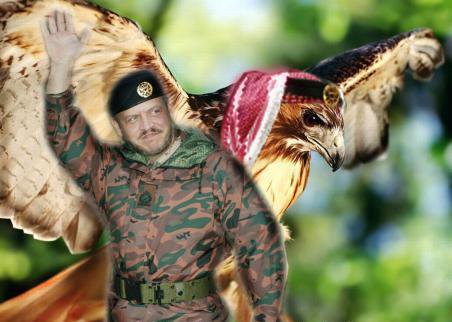
On a totally different note, I had an awesome dream this morning–one that I’m totally using in next novel I’m going to write (probably recycling much of Hero in Exile).  It’s hard to describe it exactly, which is why I added this really weird picture to this post.

You may be wondering, “what the crap is that supposed to be?” I’ll tell you: it’s Arab.  It’s Arab on so many different levels it makes me happy inside.  I took it from the facebook profile pictures album of an old friend of mine from the ELC in Provo.  What’s so Arab about it?  Well, there’s 1) King Abdullah II 2) in battle fatigues 3) waving to the people 4) with an eagle in the background 5) wearing a Bedouin hutta 6) and some kind of military insignia on the agal.  So freaking Arab.

So what was my dream?  Well, it was kind of like a cross between Lawrence of Arabia and…a lot of weird stuff.  At one point, King Hussein of Jordan commanded me to go into the desert east of Jerusalem and raise an army.  I had a lot of questions, so he explained exactly what he wanted me to do–and in so doing,  he explained exactly how the Bedouin fight wars.

Instead of keeping a standing army, a military leader must draw the warriors of the other tribes to his banner through his charisma, egalitarianism, reputation, etc.  The warriors join his campaign, not to serve some grand concept of country, but to win spoils and glory.  Once the campaign ends, they disband and return to their tribes until the next leader rallies them together.

Because of the way this works, a charismatic leader can pass through the desert virtually by himself, only to come out on the other side with a fearsome army.  This is what happened in Lawrence of Arabia when Lawrence took Aqaba–he passed through the desert with a token force of barely fifty men, but the feat (and his brilliant diplomatic skills) so impressed the Bedouins on the other side that they rallied to him and stormed the city.  From the Turks’ point of view, the army came out of nowhere and crushed them.

So that’s what I’m thinking I need to do at some point in my next novel: have the main character, poor and destitute, go out to the desert and rally the tribes with nothing but his charisma.  I’ve already got the rough (VERY rough) outline of the story in my head, and this plot point fits perfectly into this one section where I was worrying that things lagged too much.

Oh man, I’ve got such awesome plans for this book!  But first, must revise Mercenary Savior and send it out.  Don’t worry, I’m enthusiastic about that project, too. It will get done!  Momentum is building–I’ll  more than make up those 720 words tomorrow.