So I got an email recently from Amazon Publishing, about how they now allow indie writers to do pre-orders! That means that I can upload a book on Amazon 90 days before its publication date, and it will have its own page and everything.
Honestly, I’m not sure how I’ll use this new tool, because I tend to publish things as soon as they’re finished. I don’t want to upload anything except a finished product for pre-order, on the off-chance that something comes up and I can’t have it ready in time. However, since I already have ongoing series (such as Sons of the Starfarers) where people are waiting for the next book, I want to put those books up as soon as they’re finished.
It’s a marketing tool that I’ll have to learn and experiment with. Right now, the biggest value I see is in launching new series, so that people who buy book 1 can immediately pre-order the next couple of books right after finishing the first one. Of course, that means I actually need to write the first few books before publishing the first one, but that’s probably a good idea anyway.
What I’ll probably do is arrange my publishing schedule so that I’m publishing books not as soon as they’re finished, but between 30-60 days after. The pre-orders will give me a buffer and allow me to release the books on the same day across every retail channel. It will help to keep things organized and create more consistency, so that you all know what to expect.
In the short term, though, that means I need to write a lot more in order to create this buffer and have books lined up for regular releases. In other words, I need to get to work!
I know you’re a busy man, so if it’s true that you read all the emails directed to this account, I’ll keep it brief.
I recently read an open letter written by Douglas Preston that encourages readers and writers to email you to let you know what they think about the hardball negotiating tactics in the contract dispute between Amazon and Hachette Book Group. I am an author who has published more than 20 books via Kindle Direct Publishing and is now making a living thanks to the ability that your company has given me to put my books in front of readers.
I think that you, Mr. Bezos, have done more to “defend literature” and advance books and reading than all of the Big 5 publishers combined. The big publishers are middlemen whose existence depends on inserting themselves between readers and writers and extracting as much value from them as they can. They are parasites who would rather treat authors like indentured servants and hold them as collateral than treat them as valued business partners.
For all of our sakes, I hope that you squeeze the bastards at Hachette until they beg you for mercy. The fact that Hachette is using their authors as hostages should not stop you from sticking to your guns. You are taking power from the monopolistic big publishers and putting it back into the hands of readers and writers everywhere, and we–the little guys–can see that clearly.
Stick to your guns, Mr. Bezos! Make the bastards squeal!
I sincerely believe that this is the best time in the history of this planet to be a reader. There are so many great books coming out now–so many new authors who are writing stuff that is new and different and exciting. Because of the internet, it’s so much easier to find the book that you’re looking for. All the old barriers to distribution are coming down, so that authors from Australia or India or Japan are just as easy to find as authors from the US or the UK. Prices are coming down, too, and ebooks allow you to carry an entire library’s worth of books in a single device. Blogs and social media make it super easy to join book clubs, form fan communities, and connect with authors. It’s awesome.
I also believe that it’s the best time in the history of this planet to be a writer. The self-publishing revolution has thrown open the gates and made publishing as easy as clicking a button. Where before it was almost impossible to make a living, thousands if not tens of thousands of writers are quitting their day jobs and building lifelong careers, myself among them. We can write what we want, publish however we want, have as much creative control as we want–in other words, be in charge of our own business. And the terms of that business have never been better.
Before, our only hope of getting published was to sign away our rights, often for the life of copyright. Now, we can publish on every continent in the world and still retain all of our copyrights. Before, we were paid a pittance for our work, with payments and royalty statements that came late if they came at all. Now, we earn the lion’s share of the profit and get our payments every month like clockwork. No longer do we have to put up with publishers that infantalize us as tender, fragile “creative types” that need to be “nurtured.” We can build lucrative careers for ourselves with business partners who actually treat us with respect.
In fact, things have changed so much for the better that it makes you wonder how we put up with all that crap before. How many great books were never published because a slushpile reader never gave it a decent chance? How many writers gave up on themselves because of the crushing grindstone of rejection letters, or the nagging doubt that perhaps their writing was just unmarketable? How many unique and wonderful voices were whitewashed by revisions demanded from lazy agents or incompetent editors? How many promising careers were cut short because of the stupid mistakes of a publisher? How many authors resorted to suicide when the stress became too much to handle?
Make no mistake: the traditional big publishers are not doing anything to make things better for readers or for writers. In fact, to the extent that anything in the book world has changed, it’s in spite of the traditional big publishers. They have been dragged into this world kicking and screaming, conspiring illegally with Apple to raise book prices, collaborating with scammers like Author’s Solutions, clamping down on their authors with increasingly draconian contract terms and accusing Amazon–the company behind almost all of the innovation in the book world–with everything from destroying literature to taking over the world.
It’s in this context that one of the largest and most traditional publishers, Hachette Book Group, is now engaged in a nasty and increasingly public contract dispute with Amazon. The sturm und drang in the book world has been rising steadily, and with no resolution in sight, I expect that this tempest in a teacup will get a whole lot worse before it gets better.
From where I’m standing as a self-published author, it looks a lot more like an epic clash of daikaiju than a tempest in a teacup. The outcome will probably have an effect on my career, but there’s nothing I can do to affect it. Taking sides either way is more like joining a cheering section than doing anything constructive, so up to this point I’ve been content to follow it passively, without offering much in the way of commentary. However, that doesn’t mean that my position is neutral.
I’ve got to be honest–I hope that Amazon wins. Not because I self-publish through them, or because I’m in any way illusioned about them “being my friend.” I hope they win because I want to see Hachette get the bloody hell beat out of them.
In a world where disruptive technology has turned the publishing industry on its head, big traditional publishers like Hachette justify their existence by arguing that they serve as “curators” or “gatekeepers.” In other words, they claim to produce value by limiting reader choice, not expanding it, and preventing books from getting published, not from actually publishing them. They “defend literature” by obstructing it!
In fiction, the reader and the writer are the two most important players. Everyone else, from publishers to booksellers to agents to editors to distributors, is just a facilitator between the reader and the writer. Literature happens when a writer touches readers in a profound and enduring way. Anything that gets in the way between writers and readers is therefore a threat to literature. By putting up obstacles between the reader and the writer, Hachette is a far greater threat to literature than Amazon ever was.
Do I feel sorry for the Hachette authors that have been caught in the middle of this contract dispute? Yes–I feel sorry for them in the same way I feel sorry for a victim of domestic abuse. “He does so much for me,” “I’d be nothing without him,” and “he hurts me because he cares about me” are all variations of things that I’ve heard. Is it Amazon’s fault that Hachette’s authors are suffering, or does Hachette bear some of the blame? Remember, these authors have signed away almost all of their rights to their publisher, under terms and payment that pale before Amazon’s self-publishing platform.
So yeah, I hope that Amazon wins this fight. Or, more accurately, I hope that Hachette loses. I hope they get the living snot beat out of them. It may cause some pain for the authors that are married to Hachette, but Hachette is doing far more to hurt both readers and writers than Amazon ever has.
That’s right! My latest book, Star Wanderers: Benefactor (Part VI) is now available on Amazon, Smashwords, and Kobo! It’s $2.99, but for the next couple of days until the end of June, you can get it for $1.49 from Smashwords with the summer promotion code.
This one took a long time to write, especially for a novella, but I’m very satisfied with the result. It shows the events of Fidelity from Jakob’s point of view, really diving into his character and exploring his background as a star wanderer who settled down and now struggles to take care of his family. There are overtones of an impending conflict between the Outworlders and the Gaian Empire, which I plan to make a major part of the overworld story arc, and some new characters introduced as well.
Here’s the teaser:
IN A COLD AND LONELY UNIVERSE, A SIMPLE ACT OF GRACE CAN RESONATE ACROSS WORLDS.
An outworlder is nothing if not fiercely independent, and Jakob is no exception. But ever since he brought his family of starbound refugees to Alpha Oriana, he’s felt increasingly powerless. With the recent Imperial takeover and rumors of job cuts at the dockyards, it’s only a matter of time before they’re forced to move on—again.
When a young man and woman with an unusual story show up from his wife’s homeworld, he takes them in, if for no other reason than that they remind him of a time when he was young and still in love. Ever since he sent his sons away, his marriage has been a nightmare—but all he wanted was to give them a chance at a better life out among the stars. Whether or not that was a mistake, his wife has never forgiven him for it.
In the face of so many challenges, it’s not clear how long the family can hold together, but Jakob will sacrifice everything before he asks for help—even if the only way out lies through an open airlock.
Star Wanderers: Benefactor (Part VI) should be up on Barnes & Noble shortly, as well as Drivethru Fiction and All Romance eBooks. In a couple of weeks, it should be out on iTunes, Sony, and Diesel as well. If you want to add it to your Goodreads library, you can find it here.
Thanks guys! I’m heading out on a short backpacking trip this weekend, but I’ll be back in a couple of days with more updates. Later!
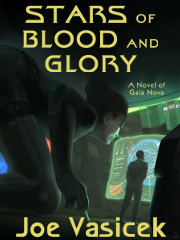
Hey guys! My latest novel, Stars of Blood and Glory, is now up on Amazon, Barnes & Noble, and Smashwords! Kobo, iTunes, Sony, and Diesel editions should be up shortly. I’ll start typesetting the print version in the next few days, and it should be out through CreateSpace sometime next month.
Stars of Blood and Glory takes place fifteen years after the events of Bringing Stella Home, and includes many characters from that story (such as Danica, Roman, and the other mercenaries) as well as some characters from Desert Stars (especially Rina). From the book description:
The only hope for the last free stars now lies on the path of blood and glory.
The princess of Shinihon could not have picked a worse time to run away. The largest Hameji battle fleet ever gathered threatens to overrun the last of the free stars. To make matters worse, a rogue assassin from an unknown faction has killed the high admiral of the Federation. Without clear leadership, the war may be lost before she can be found.
But Danica Nova and her band of Tajji mercenaries are no strangers to lost causes. They’ve fought the Hameji before, and they’ll fight them again—not for honor, or for glory, but simply for the pay. War has been their way of life ever since the diaspora from the homeworld.
Master Sergeant Roman Krikoryan is one of the few remaining mercenaries still old enough to remember the homeworld. But he’s an old cyborg, and his humanity is fading. Death is a mercy he doesn’t expect to find on this mission.
They aren’t the only ones after the princess, however. Hungry for glory and eager to make a name for himself, Sholpan’s son Abaqa seeks to make the girl his slave. Though only a boy, he’ll stop at nothing to prove himself to his Hameji brethren.
With the Federation in disarray, the bloody end of the war may come too soon for some of them. But one thing is certain—not all of them will live to see it.
If you’re on Goodreads and would like to add the book to your to-read list, you can find it here. I’m not entirely sure if I listed it properly, but at least it’s up now.
Also, if you’re a blogger and want to have me on for an interview or guest post, feel free to shoot me an email! I’m not doing a blog tour or anything fancy for this release, but I love blogging and would be happy to give you some content and link back to your site.
That’s just about it for now. I’ll get the Trope Tuesday post up a little later this afternoon. In the meantime, back to writing!
So I came out to Tbilisi today, because MY NEW KINDLE PAPERWHITE JUST ARRIVED!
Okay, sorry for the all-caps shouting, but I’m really happy that it finally got here. My old kindle broke down a few months ago, leaving me stranded in my tiny village without any books. With the weather getting worse and the power outages becoming more frequent, cabin fever has started to become a problem. So really, it couldn’t have come at a better time.
It shipped out almost a month ago, but Georgia (the country, not the state) is a fairly remote place, so it’s taken a looong time to get here. The wait has definitely been worth it, though. I love this device, especially the cover browsing function. And the backlight is going to be very, very useful, what with all the power outages we get in the village.
So I’m about 100 pages into The Sword Keeper, my latest project, and I realized that I need to do a lot more worldbuilding before I can continue. I’ve got a good handle on the characters and have more or less figured out the plot, but there are still a lot of holes in the setting. This new project is a fantasy novel, and it seems to be leaning more towards epic than heroic, so I probably should take the time to really build the world before trying to finish the story.
I’ve been drawing a lot of inspiration from my experience here in Georgia, but right now, I feel like I’m too close to it to really take it in the right direction. The time I spent in Jordan was a huge influence in Desert Stars, but I didn’t start it until I came home (and didn’t finish the first draft until almost two years later). Ideas are like wine: sometimes, you just need to let them sit in the back of your head and age for a while.
So long story short, I’ve decided to put The Sword Keeper on the back burner for a while. I’m sure I’ll come back to it, though–the story is far too interesting to let go. Magical thinking swords that meld with the minds of those who wield them, ancient prophecies and a secret order of warrior monks–and that’s just the backdrop. The characters themselves are much more interesting–I have got to tell their story!
But for now, I’m going to revisit the Gaia Nova universe and finish the revisions for Heart of the Nebula. This one is a direct sequel to Bringing Stella Home, and while it definitely still needs work, I feel like it’s almost there. The first draft had some major problems and needed to be revamped, especially toward the end. If all goes well, I should finish this pass before the end of November, with enough time to write another Star Wanderers story before the end of the year.
Stars of Blood and Glory is still with my first readers, but if they give it the green light, I hope to publish it sometime in February. This one is also a direct sequel to Bringing Stella Home, with Danica, Roman, Stella, and Stella’s son Abaqa, and a couple of characters from Desert Stars as well. I’m really excited about this story, but I figure it’s best to get some more feedback first before putting it out.
Which brings me to Star Wanderers: Homeworld (Part IV). I can’t promise that it will be out before the end of November, but that’s what I’m shooting for. Of course, I’m not going to put it out until I’m satisfied that it represents my best work, but even my first readers do come back with problems, I’m 99% confident I can fix them all by December at the latest. There is nothing–absolutely nothing–like the feeling you get when you finish a story where everything just comes together. I may not be the best judge of my own work, but I know that feeling. You can definitely expect to see this story come out before the end of the year.
That’s about all for now. Internet is spotty out in the village, but I’ve got a couple of interesting posts brewing in the back of my mind. I’ll probably write them up in the next few days, and post them the next time I get a chance. Until then, see you around!
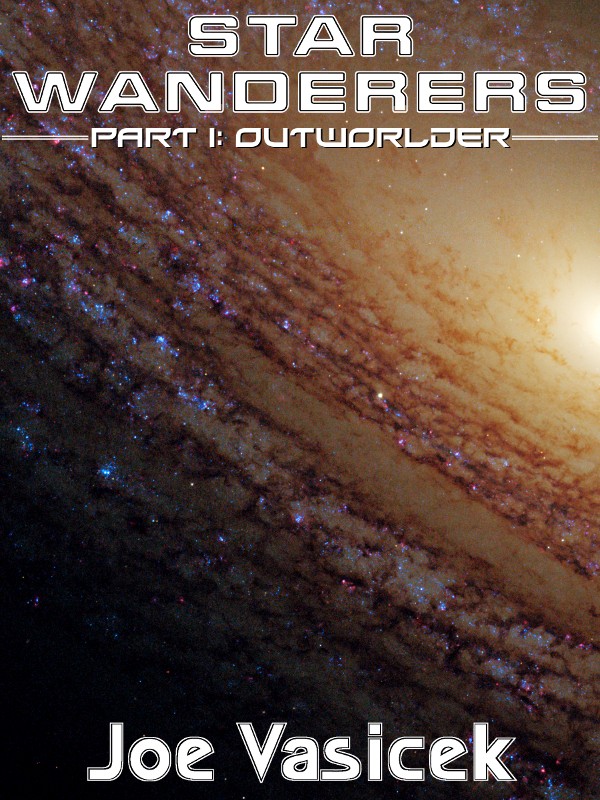
Good news! Amazon just made Star Wanderers: Outworlder (Part I) free! It’s been free for a while on all the other eretailers, but if you do most of your ebook shopping on Amazon, it’s now free there as well.
Star Wanderers: Outworlder (Part I) is the first part of a four part series of science fiction novelettes, possibly with other installments after the main storyline is complete. From the book description:
HE WANDERS THE STARS IN SEARCH OF A HOME. INSTEAD, HE GOT A GIRL WITHOUT ONE.
When Jeremiah arrived at Megiddo Station, all he wanted was to make some trades and resupply his starship. He never thought he’d come away with a wife.
Before he knows it, he’s back on his ship, alone with his accidental bride. Since neither of them speak the same language, he has no way to tell her that there’s been a terrible mistake. And because of the deadly famine ravaging her home, there’s no going back. She’s entirely at his mercy, and that terrifies him more than anything.
Jeremiah isn’t ready to take responsibility for anyone. He’s a star wanderer, roaming the Outworld frontier in search of his fortune. Someday he’ll settle down, but for now, he just wants to drop the girl off at the next port and move on.
As he soon finds out, though, she has other plans.
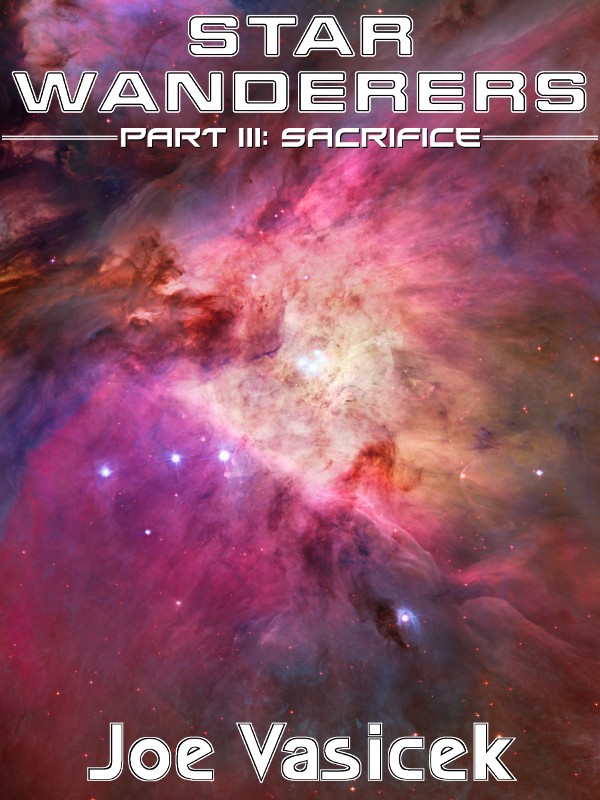
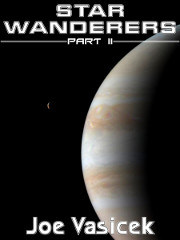
Also, for those of you who have been looking forward to the next Star Wanderers release, I have a tentative cover for Part III:
Pretty cool, huh? What do you guys think?
The feedback from my first readers has been mostly positive, so I think this story is mostly ready for publication. I’ll probably do another quick pass to touch up some relatively minor issues, then it’s just a matter of proofreading, formatting, and crafting a solid author’s note and book description. If all goes well, it should be up in two or three weeks.
That’s just about it for now. More updates later, especially on life here in Georgia and that new fantasy series I just started. See you around!
So Star Wanderers: Outworlder (Part I) is available for free now on Kobo and Smashwords (it’s also free on a couple of other sites, but hasn’t yet updated to the new version–see Monday’s post for the explanation). I would like to make it free on Amazon, too, but I need your help! Here’s what I need you to do:
It’s the page for the book on Kobo. Amazon doesn’t usually price match to Smashwords, but if you want to be extra awesome you can do that too.
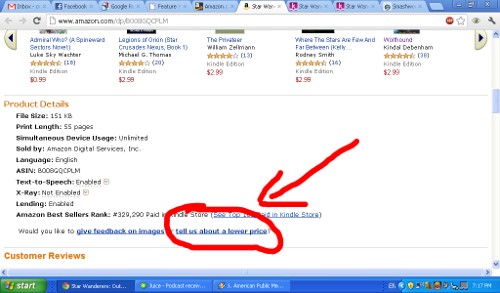
Step 2: Go to Amazon and click on “tell us about a lower price”
Open a tab in your browser and navigate to the Amazon page for Star Wanderers: Outworlder (Part I). Above the customer reviews section and below the “Customers Who Bought This Also Bought” is a section labeled “Product details”:
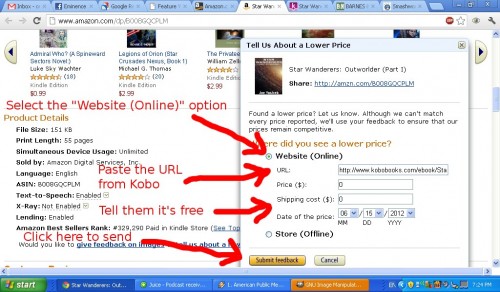
Click on “tell us about a lower price,” and a small window should pop up.
Step 3: Fill out the details and click “submit feedback”
The window should be pretty self explanatory. It basically asks you where the book is selling for less, and how much it is selling for. Select the option for the online store, paste the Kobo URL into the appropriate field, and fill out the price/shipping details:
It shouldn’t take more than a couple of moments. After that, you’re done!
If you could do that for me, I would really appreciate it. Amazon’s bots are sporadic and unpredictable, but if a whole bunch of different people (from different ISPs using different Amazon accounts) tell them that a book is free, they’re more likely to price match.
If you’re an Amazon customer and use the UK, French, German, Spanish, or Italian stores, it would be even more awesome if you could help me out! I’ve never been able to get any of my titles to price match on those stores, though I’ve certainly wanted to. Here are the links for Star Wanderers: Outworlder (Part I):
So why would I want to give this book away for free? Well, Star Wanderers: Fidelity (Part II) is already out, and the next two installments should be out in a few months as well. Plus, I figure that people who read this and enjoy it will be interested in checking out my other titles as well. I’ve already made Sholpan and “From the Ice Incarnate” permanently free, and it’s helped a lot to drive attention to my other works.
So thanks for your help! I really appreciate it. I don’t have anything to give you for taking the trouble, but if all works out, you might be able to download a free ebook soon. 😉 Enjoy!
The next installment of Star Wanderers is now up on Amazon, Smashwords, and Xinxii! In a couple of weeks, it should be up on Kobo, iTunes, and Barnes & Noble as well.
This continues the story of Jeremiah and Noemi, a boy and a girl from completely different worlds who end up married by accident after a deadly famine drives her away from her home. Neither of them speak the same language, but they eventually come to an understanding of each other and figure out how to make things work.
In Part II, though, all that is put to the test.
It’s available right now for $2.99, but if you sign up for my email newsletter in the sidebar, I’ll send out a Smashwords coupon code at the end of the week that you can use to download it for free. Part I is already free on Smashwords, and should be free soon on the other sites as well.
Part III needs a lot of work, but I should be sending the rough version out to my first readers pretty soon. Once I’ve gotten their feedback, it shouldn’t take more than a few weeks to get it finalized and ready for publishing. After that, it’s just a matter of finding proofreaders and formatting it, which doesn’t take long at all.
That’s about all for now. I hope you enjoy it–and if you do, please share!
Under the hood of my latest ebook release, Star Wanderers: Part I.
So a couple of days ago, I set out on a quest to figure out a better way to build an ebook. In the process, I ended up learning WAY more about ebooks than I’d bargained for, in the most awesome of possible ways. Seriously, I don’t think I’ve ever felt so empowered as an indie author as I do right now.
My old process was extremely convoluted. It basically involved saving my manuscript as HTML (introducing all kinds of excess code) and using four or five programs to cobble together a Frankenstein-like creation, with bolts sticking out of its forehead and extra arms and fingers sticking out of weird places. The tools I was using were like blunt instruments, and I was operating them blindfolded.
So what changed? Well, three things:
I added the Writer2ePub plugin for Open Office / Libre Office,
I downloaded an open-source epub editor called Sigil, and
I watched this video:
So what did I learn?
<geek>
First of all, that ebooks are WAY simpler than I thought they were. An epub is basically a zipped folder containing HTML files for the text, jpgs/gifs for the cover and any interior illustrations, a CSS stylesheet, maybe some extra fonts (if you want to get fancy), and two additional additional files ending in .opf and .ncx that look a lot like HTML files.
So why is this so exciting? Because it means that if you know HTML/CSS, you can build a fully functional epub file using only notepad, windows explorer, and the command prompt. THAT’S IT! And if you want to learn HTML, you can do so for free at w3schools.com.
Basically, an epub is structured just like a website, except that an ebook reader reads it instead of an internet browser. If you can build a website, you can build an epub with very little trouble. Even if you can only tweak a website, you can build an epub with very little trouble.
</geek>
In other words, the barriers to entry for ebook publishing are ridiculously low. If you’re patient and a good learner (or hell, just a good learner), there is not a single reason why you need to spend any money to format your ebooks, upload them directly to retailers, or do anything else. Using tools that are 100% available for free, you can create a product that looks every bit as professional as anything coming out of New York–in many cases, even more professional.
So what’s my new process?
1) Format the master file in Open Office.
This includes adding the copyright page and table of contents, adding anchors (in OO they’re called “bookmarks”) and hyperlinks, adding the author’s note and acknowledgments, any teasers, etc. I save the file in open document format, add “Smashwords Edition” on the copyright page and save it as a .doc file for Smashwords.
At some point, I’m going to upgrade to Libre Office, but I haven’t gotten around to it yet. When I do, it’ll basically be the same thing.
2) Export as .epub using the Writer2ePub plugin.
I cannot tell you how happy I am with this Open Office / Libre Office plugin. It pulls out all of the unnecessary formatting and breaks up every chapter into a separate, cleanly coded HTML file, all bundled together into a fairly simple epub. SO MUCH BETTER THAN SAVING AS HTML. Or Mark Coker’s “nuclear option,” for that matter.
I don’t add the cover at this point, though. Writer2ePub adds some weird stuff if you do it that way, and I find it easier just to code it manually in the next step.
3) Finalize the .epub in Sigil.
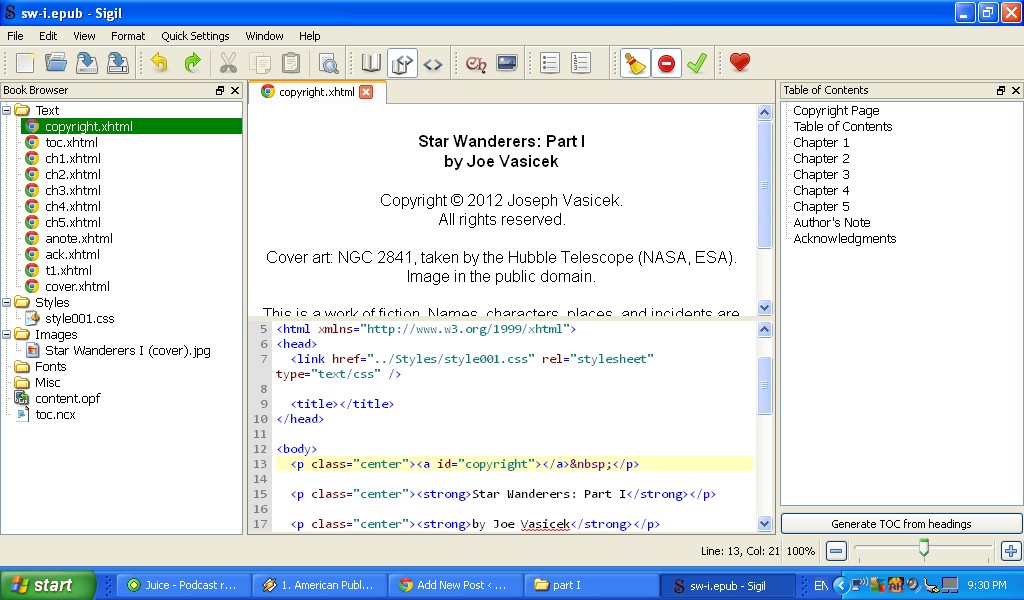
Sigil is basically just an HTML editor with some extra functionality that allows it to build an epub from those HTML files. It’s easy to learn, simple to use, and tells you exactly what’s wrong when something breaks. Unlike Calibre and Mobipocket Creator, you can always see what’s going on underneath the hood. Simple, clean, and elegant. I love it.
This is the phase that takes the most work. I add the cover, fill in the relevant metadata, tweak the CSS stylesheet for margins and indents, add the book guides, build the table of contents, etc. If you want to know exactly how I do this, let me know and I’ll write up a post on it later. It’s a little technical, but not too difficult. Like I said, if you know even a modicum of HTML, you can figure it out.
Once this step is finished, I have the final epub version of my book. I upload that to Pubit! and Kobo Writing Life, and just about anywhere else outside of Amazon where I sell my book. Someday soon, Smashwords will hopefully allow you to directly upload an epub, at which point I’ll do that here as well.
4) Convert to .mobi with KindleGen.
Amazon uses its own proprietary format for ebooks, unlike everywhere else, which takes the open source epub format. This is probably because of all the weird and funky stuff that Amazon likes to track for data collection purposes, although honestly, who knows? A mobi file is about twice as large as an epub, and I suspect that that’s the reason.
KindleGen is a free program that Amazon has made available to developers in order to facilitate conversion of epubs and other ebook formats into mobi. It’s a command line tool, which means that you have to get a little retro to use it. But hey, I grew up in the 90s with DOS, so it’s actually kind of nostalgic.
Once you’ve got KindleGen installed to c:\kindlegen, all you basically need to do is go to the file folder where your ebook is saved and enter the following command:
c:\kindlegen\kindlegen mybook.epub -c1 -verbose
“mybook.epub” is whatever you named your epub file, “-c1” stands for standard DOC compression, and “-verbose” stands for verbose output (whatever that means). There are other options you can enter, but I’m not sure what they do yet. All I know is that if you want to convert from epub to mobi, this will give you a clean result.
There are a few small things that get lost in the conversion, so you need to add them as redundancies in the epub. The biggest one I’ve noticed so far is the paragraph indents: if you go into the CSS stylesheet using Sigil and add p { … text-indent: 2em; … } that should fix it.
And that’s it! Once this step is finished, I’ve got the final mobi version and can upload that directly to Amazon and my kindle. Once that’s done, my book is available from every major ebook retailer in every country in the world. Total time = maybe an hour (plus however long it takes for the retailers to publish the files to their stores).
I know it’s 2012 and this is old news by now, but do you have any idea how cool this is? With one hour of work and two or three programs, all of which are available for free, I can produce a clean, professionally formatted ebook, and sell it around the world instantaneously with a marginal cost of zero.
And now, because I took the time to learn how to use the tools, I can be confident that there aren’t any bits of rogue or useless code in it either. The only “black box” is really the mobi format, but I could probably crack that and figure it out if I wanted to.
So yeah, needless to say, I am extremely happy to be an indie writer. 🙂
 It’s in this context that one of the largest and most traditional publishers, Hachette Book Group, is now engaged in a nasty and increasingly public contract dispute with Amazon. The sturm und drang in the book world has been rising steadily, and with no resolution in sight, I expect that this tempest in a teacup will get a whole lot worse before it gets better.