Working on AI-assisted short stories

I have decided to take the month of May to practice writing with AI by focusing on writing short stories. In the last few months, I’ve made great strides to incorporate AI into my writing process, but at this point I think I just need more practice, and the best way to do that is to focus on short stories for a while.

With Sudowrite, you get a certain number of credits each month, depending on your subscription level. Those credits do not roll over, and expire at the end of the month. I’ve generally been pretty good about using mine, though right now my novel WIP is in a place where I won’t be doing much more AI work on it. That’s part of the reason why I’ve decided to work on short stories for the next month, and maybe the first part of the next.

The stories I’m writing with AI are much better than the AI-assisted stories I was writing at this time a year ago. In fact, I’ve decided to trunk most of those ones, since I don’t think it’s worth rewriting them. Chalk it up to practice, I guess. With AI, it really does feel like I’m learning to write all over again. Thankfully, that’s been a lot more fascinating so far than it has been frustrating.

Maybe I’ll post the AI draft for one of these stories. It would be fun to get your reactions. So far, I’ve written two, though they still need substantial human reworking.

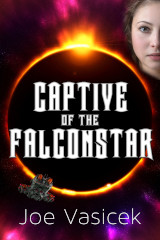
WIP Excerpt: Captive of the Falconstar, Chapter 5 (AI generated)

I’ve been experimenting a lot with AI-assisted writing, and I think I’m starting to produce some decently good work with it. Of course, in six months I’ll probably look back on what I’m producing now and feel utterly embarrassed by how bad it is, but still, it’s measurably better than the stuff I was producing six months ago.

Here is an excerpt from chapter 5 of my current WIP, Captive of the Falconstar. This scene is taken from the AI revised draft, and is 100% AI generated. It contains some mild spoilers, but nothing too major for the book or the series.

In the next draft, I will make a bunch of human revisions based on my notes, such as later events I need to forshadow, worldbuilding elements that I need to fix, or adjustments to the character’s motivations and growth arc—in other words, things that the AI doesn’t do as well. And in the draft after that, I’ll throw everything out and rewrite the scene completely from scratch, using the previous AI draft as little more than a guide or reference.

In other words, this AI generated version of the chapter is merely supposed to simulate the version of this chapter that I will actually write. It’s not intended to replace my own writing, or to be revised into the final published version. It’s a crappy first draft, in other words, and the reason I’m generating it with AI is so that I can iron out any potential wrinkles with the overall story arc, and fix them before they grow into huge creative blocks for me later on in the writing process. Generating the crappy first draft with AI is great, because 1) it’s super fast, and 2) it sucks up less of my mental energy, allowing me to focus on the broader story issues and not lose sight of the forest for the trees.

Anyhow, here is the AI version of scene 5.6 (Zenoba) before performing any human revisions. My process was that I generated three or four different versions of the chapter using Sudowrite, stitched together the parts I wanted to keep, and used Sudowrite’s AI revision tools to touch it up. Enjoy!


Zenoba moved through the austere corridors of the Falconstar, her gait measured but her mind a turbulent sea. She navigated the ship with an urgency that belied her usual composure, her thoughts a tempest of strategy and emotion. Her hands, usually so steady, now betrayed her with their tremble as she approached the door to Lady Nari’s quarters.

She hesitated at the entrance to Lady Nari’s quarters, steeling herself for the confrontation ahead. 

“Enter,” came the matriarch’s voice from within, a command more than an invitation.

The door slid open with a soft hiss, and Zenoba stepped inside, her tall frame stiff with determination. The room was dimly lit, the walls adorned with tapestries depicting the Valdamar clan’s storied past. Lady Nari sat on a plush chair, her silver hair reflecting the light from the hologram projector that cast ghostly images of distant stars across the ceiling.

“Lady Nari,” Zenoba began, her voice steady despite the turmoil within, “I come seeking counsel.”

“Sit, Zenoba.” Lady Nari gestured to a seat opposite her, her brown eyes locking onto Zenoba’s with an intensity that could bend steel. “You refer to the marriage alliance with the Naimal clan, I presume?”

“News has reached me of Khasan’s intent to take another wife,” Zenoba said, each word measured, betraying none of the desperation clawing at her insides.

“Indeed,” Lady Nari said, finally turning to face her daughter-in-law. Her eyes held the wisdom of years and the unyielding strength of the matriarch she was. “It is a favorable alliance for our clan.”

“Is it truly wise?” Zenoba asked, desperation seeping into her tone. “Khasan already has a loyal wife who bears his child. This could divide our clan and create conflict within our own ranks.”

“Conflict?” Lady Nari scoffed. “Polygamous marriages have been part of our traditions for centuries. You knew this when you married my son.”

Zenoba clenched her fists, her nails digging into her palms. “Yes, I am aware of our traditions, but I never imagined that Khasan would consider such a move without even consulting me. I cannot help but feel betrayed.”

“Betrayed?” Lady Nari’s voice hardened, her eyes narrowing. “You are not the one making sacrifices for the good of our people. You should know your place and humbly submit to your husband’s decisions.”

Zenoba was taken aback by the harshness of the woman’s words. She had always looked up to her as a mother figure and expected support, not rejection. As she processed the sting of her words, Zenoba couldn’t deny that her own pride and fear were also at play. She didn’t want to lose Khasan’s love, but she also didn’t want to give in to tradition and loyalty without a fight. It was a constant inner battle between what was expected of her and what she truly wanted for herself.

Zenoba took a breath, willing her voice not to falter. “But it undermines my position, and what of the child I carry? Their future could be jeopardized by this—”

“Your position?” Lady Nari’s tone was reproachful. “Or your pride? You speak as if you are the only one affected by this. You forget your place, Zenoba.”

“Forgive me, but my place—as you say—is at Khasan’s side, in command of the Falconstar. If he were to marry again—”

“Then you will welcome Lady Tsarnai as you should,” Lady Nari interjected, her rebuke sharp. “Khasan’s choice honors the Valdamar name. It secures our future.”

As Zenoba stood before Lady Nari, the coldness of the room seemed to seep into her bones. Her pleading eyes searched for any sign of compassion in the ruler’s face, but found only a stern and unyielding expression. It was as if Lady Nari had been molded from the ice that covered the outer systems.

“Is this truly what he desires?” Zenoba’s voice trembled with emotion as she pleaded for understanding.

Lady Nari’s gaze remained unflinching. “His heart belongs to you, but his duty is to our clan. Your duty is to support him as his queen and make decisions for the benefit of our people.”

As the words hit Zenoba, she felt her whole body stiffen in shock. For so long, she had believed that her cleverness and manipulation would secure her future, but now, that certainty was crumbling beneath her feet. The once unbreakable bond between herself and her husband now seemed fragile and uncertain. She couldn’t help but feel a pang of fear as she realized that perhaps her control wasn’t as absolute as she thought it was.

“Khasan knows what must be done for the greater good,” Lady Nari continued, her gaze unwavering. “This alliance with the Naimal clan will secure our future. It is bigger than any one person’s pride or fear.”

Pride or fear—the words echoed in Zenoba’s mind. Was it pride that made her want to hold her place at Khasan’s side, or fear of being replaced, diminished? She swallowed hard, the contemplative silence stretching between them.

“Consider this a lesson in humility,” Lady Nari concluded, her voice softening just slightly. “A true leader knows when to yield for the greater good.”

Zenoba rose, her movements automatic. “I understand,” she lied, her voice hollow. She did not look back as she left Lady Nari’s quarters, the weight of the older woman’s expectations pressing down on her like the gravity of a collapsed star.

As she turned to leave, her mind was already racing, plotting her next move in the intricate dance of power that surrounded them. But beneath the veneer of calculation, there lay a fissure in her resolve, a vulnerability she dared not show.

As the door clicked shut, Lady Zenoba Valdamar, queen of the Falconstar, was left alone with her inner turmoil. In the silence and stillness of the corridor, she couldn’t help but doubt herself and her abilities. A lone tear escaped her eye before she quickly wiped it away, reminding herself that weakness was not an option in the days ahead. She needed to be cunning and resilient, but she couldn’t shake off the fear and uncertainty that consumed her.
Writing and Publishing Plans moving forward

Over the past few months, I’ve been spending a lot of time experimenting with AI writing and finding ways to incorporate it into my writing process. The goal so far has been twofold:

  1. Develop the ability to write one novel per month.
  2. Get to a level where I can write 10k words per day.

I’ve accomplished both of those things, but I can’t hit them consistently without burning out. Writing with AI has proven key to both of them, but I feel like I need a lot more practice with AI-assisted writing before I’ve achieved any level of mastery. Once I have mastered AI-assisted writing, however, I should not only be able to achieve both goals consistently, producing a much higher quantity of work, but should also be able to maintain or exceed the current quality of my writing as well.

However, I was thinking about it from a reader’s perspective on my morning walk last week, wondering what I would think if, say, David Gemmell was still alive and writing Drenai books, or Roger Zelazny was still alive and writing Amber books. What would I think if either of them announced that they had found a way to incorporate AI into their writing process, so that they could produce a new Drenai/Amber book once every month, instead of once every year? Better yet, what if Andrew Klavan—who is both still alive and still writing Cameron Winter books—announced that he would start publishing new books monthly. As a fan of all these writers, what would I think of that?

Assuming that there was no drop-off in the quality of these new, AI-assisted books, I would find this really exciting, and would probably become a much bigger fan, simply from the fact that I’m reading so much new stuff. However, after a while this might become too costly to me to keep up, leading me to fall away and not be quite so current on what they’re producing. I would still love them as authors, but if they published too quickly, I might have to take a break after a while—and if they continued to publish at that rate, I might never catch up. After all, there are lots and lots of authors that I love, and I can’t dedicate more than a fraction of my reading time to any particular one of them.

So there’s probably a sweet spot, between publishing too much and publishing too little. Most authors are probably on the Patrick Rothfuss / George R.R. Martin side of that line, where fans wish they would write more and write more quickly. But at a certain point, it is possible to overwhelm most readers by writing too much. Of course, there will always be a core group of fans who will read everything much faster than you could ever possibly write, even with AI assistance, but if that’s the only group you’re catering to, then you probably won’t ever have more than a cult following, because you won’t be able to convert casual readers into superfans.

With all of that said, I feel like I’ve gotten to a good place right now, where I’m publishing a free short story every month. I think that’s actually been a really effective way to turn casual readers into fans, and to keep my name fresh in the minds of my readers. And if Gemmell, or Zelazny, or Klavan were producing a free short story every month, I would definitely subscribe to their newsletters and drop everything to read it.

So keeping up the free short story per month is probably a good idea. But for novels, it might be better to release a new one every two or three months instead. Free short stories are much less of a time and money burden on the readers, and thus are effective at turning fans into superfans. But with the novels, which do take more time and money to read, it’s probably better to throttle that back a little bit.

The interesting thing to me is what that means for my creativing process, especially once I’ve reached the point where it takes less than a month for me to produce a novel. If I’m only publishing a novel every 2-3 months, that means that I can—and probably should—take a break between each novel WIP. Which means that the thing I should be shooting for isn’t to maintain a writing speed of one novel per month, month after month after month, but to hit that speed in creative bursts, taking some down-time to replenish the creative well and prepare for the next project.

It’s a very different writing paradigm from the one I’ve been following for the past decade. Until now, I’ve basically always had a novel WIP that I’ve actively been working on, and whenever I feel like I need a break, I usually move on to a different novel WIP. From time to time, I’ll “take a month off” to work on short stories, but the goal there has always been to write X number of stories in no more than a month or two, once again making writing the focus instead of recharging the creative well.

How would things be different if instead, I told myself “I’m taking a break in order to prepare myself to write my next novel,” with a plan for books and other media to consume in order to get things ready for it? And then, instead of taking several months or even years to write the project, to produce it in just a few weeks of white-hot creative heat, afterwards necessitating a break for a while just to cool down? Until now, I’ve never tried anything like that, because I haven’t thought myself capable of producing work that quickly. Indeed, the very thought of taking an extended break from having an active writing WIP has struck me as being lazy. But now that I know I can produce that quickly, perhaps this is a new paradigm that I ought to at least explore.

For my current WIP, Captive of the Falconstar, I’m not stressing out about finishing it in less than a month. But I am following all the benchmarks that I developed, and watching closely to see what takes more time to write than I thought, and what takes less. And it may very well turn out that the best way to improve quality is to get into that white-hot creative heat that comes from producing quickly, so that’s something that I’m watching closely as well.

Why Nick Cave is wrong about human creativity and generative AI

First of all, I don’t think that Nick Cave is entirely wrong. Laying aside how ChatGPT is just one of the many LLMs that are publicly available, and that using it as a stand-in for all of generative AI is like saying “AOL Online” when you mean “the internet,” he does make a fair point that using generative AI as a replacement for basic human creativity is wrong.

What he doesn’t understand is that using AI this way is also counterproductive. He blithely assumes that it takes not skill or effort whatsoever to use these AI tools—that all one has to do is tell ChatGPT what to write, and it will magically produce something if not great, then at least publishable. But as someone who has written several AI-assisted novels and short stories, I can assure you that it does take effort to produce something more than merely passable. Indeed, with longer works like novels, I can assure you that our current AI models are incapable of producing even passable work without considerable human intervention.

This is why I call it AI-assisted writing, as opposed to AI writing. When you do it right, the AI tools don’t replace your inner human creativity, but augment and enhance it, making things possible that were either impossible before, or that required a prohibitive degree of struggle. Writing with AI is still a form of creativity, though it might not look exactly like previous forms. But isn’t that also true of writing on a computer vs. writing longhand? Does it take any less creativity to write a novel on Microsoft Word than it does to write it on parchment with a fountain pen?

Granted, the technological leap from word processor to generative AI is much more profound and fundamental than the leap from pen and paper to typewriter, or from typewriter to MS Word. Speaking from experience, I can say that writing a novel with ChatGPT or Sudowrite feels a lot more like directing a play with an amateur (and very stupid) actor than it feels like wrestling with the empty page, at least in the early generative stages. But it’s still, fundamentally, a creative act—and that’s the main thing that Nick Cave misses in his rant. Anyone can ask ChatGPT to write them a novel, just like anyone can bang their hands on a piano or strum their fingers across the strings of a guitar. But to produce something good—that requires effort.

However, there is an even deeper level where Nick Cave is wrong here, and that is in the unspoken assumption that the difficulty in creating something is the thing that gives it value. It’s the same principle that Karl Marx expounded in his labor theory of value: that the economic value of a good or service is determined by the amount of labor required to produce it, or in this case, the creative and artistic value. That’s just wrong.

Do we love J.R.R. Tolkien’s Lord of the Rings because it took him several decades to write it, and largely represents the greatest product of his life’s work? Obviously not—otherwise, every amateur writer who’s been polishing and repolishing the same unfinished novel for the last twenty years must necessarily be the next Tolkien, no matter the fact that their book reads more like the Eye of Argon than The Fellowship of the Ring.

So if it’s not the creative struggle or the amount of human effort that ultimately gives art its value, what does? The same thing that gives a product or service its economic value: the utility that it provides to the person who consumes it. In other words, the thing that gives art its value is the goodness, truth, and beauty that it brings into the lives of those who receive it.

This is especially true of writing, which is perhaps the most collaborative of all the arts. Without a reader to read it, a book is nothing more than processed and flattened wood pulp full of meaningless squiggles (even less than that for an ebook). When I read a book, I care not a whit for how much work it took for the author to come up with it. Same with the music I listen to, or the games that I play. What I care about is how it makes me think, feel, or experience the world.

And if it’s possible to bring more goodness, truth, and beauty into the world by using generative AI, so what? If it’s easier than writing a novel the old way, does that somehow mean it’s “cheating”? If the answer to that question is yes, please tell me why you don’t churn your own butter, or hunt your own food, or chop your own wood and burn it to heat your house—because all of those applications of modern technology are “cheating” in exactly the same way. Also, I hope all the books in your personal library are handmade, illuminated manuscripts, because the printing press is far more of a “cheat” than generative AI, as the last few hundred years of history clearly shows.

Nicholas Cave is wrong. ChatGPT is not the most “fiendish” thing “eat[ing] away at [our] creative spirit.” Our humanity is far more resilient and anti-fragile than he gives it credit. Those who try to replace human creativity with AI will fail, not because of artists like Cave who stubbornly resist the “temptation” to use these tools, but because of those who embrace the new technology with an open mind, and discover that our humanity is not a liability, but our greatest asset—a premise that Cave ironically rejects with his fearmongering about our fundamental replaceability.

How Not To Write An AI-Assisted Novel

The worst way to write a novel with generative AI is to make the AI do all the work.

In fact, thinking of it in terms of “how much of the work can I get the AI to do?” is pretty much guaranteed to give you a really crappy book by the end of it. The AI’s job isn’t to “do the work,” any more than a power tool’s job is to build a house. You do the work. AI is just a tool to multiply your efforts.

But let’s take a step back. Who am I to talk about all of this? My name is Joe Vasicek, and I’m an indie author who’s been writing and publishing regularly since 2011. At this point, I have several dozen novels under my belt, including about half a dozen AI-assisted novels, the first of which is published under my Joe Vasicek pen here on this blog. Also, my wife is a PhD student and research assistant who works with generative AI and large language models. Her thesis is on using generative AI to create interactive cross references for any body of text, customized to the user. We talk a lot about generative AI and share what we’ve learned, so we’re both fairly knowledgeable on the subject.

At this point, it’s still very much the wild west of writing with AI-assistance. The technology is new enough that there really are no experts on the subject, though I expect that that will change rapidly over the next few years. And while I can’t (yet) say that I’ve made gazillions of $$$$ from my AI writing methods, I can say that I’m one of the first professional writers to develop a method for writing with AI-assistance.

And that’s not a boast. Whenever I get together with other writers, I wish there were more of them (really, any of them) that I could talk with about this stuff. There are some online communities that come at it more from the AI side than the professional writing side, and I probably ought to spend more time in those, because it’s probably only a matter of time before one of them has a runaway bestseller and shakes up the publishing industry in the same way that Amanda Hocking shook things up when the indie publishing revolution was just getting underway.

Maybe that someone will be you. Who knows? We’re still very much in the wild west of AI writing, and probably will be for a while.

It’s that very loneliness that makes me want to blog about AI-assisted writing—that, and the fact that I’m still trying to figure it out for myself, so I would love to hear what’s working for other writers. But one thing that I’ve learned from my own experience is that the worst way to write an AI-assisted novel is to dump all the work on the AI and expect anything good to come out.

The main reason for this is that LLMs and generative AI do not think—at least, not in any meaningful way that’s similar to the way you and I think. Instead, these models analyze human language for patterns, and replicate those patterns according to the parameters and instructions give by the user. It’s much closer to how your phone is able to predict your next word when you go to write a text, except that instead of writing the next word, ChatGPT or Sudowrite or whatever LLM you happen to be using is instead predicting the next 5-10 paragraphs.

So really, it’s not very useful to think of an AI as being able to “write” anything. Instead, it’s much more useful to think of it as “simulating” the thing that you’ve told it to write, or producing a simulation of the kind of work that a human would produce, given your parameters and instructions. The AI isn’t “doing the work” for you, it’s merely simulating the end product of that work. You still have to make it your own.

And how do you make it your own? Personally, I’ve found that the best way to do that is to open up a new document on my second monitor and type it all out by hand, occasionally referring to the AI-generated text when I don’t know what to write next, but largely trusting in myself to create the real, non-simulated draft. No copy-pasting! The mental exercise of writing it all out, word for word, stimulates something in the creative mind, and in most cases I end up writing something completely different, using the simulated version of the novel merely as a stepping stone.

So why do I go through all the trouble of generating a whole novel, when I’m probably going to throw out most of that text anyway? That’s a very good question—so good, in fact, that it needs to be the subject of its own post.

…it sure has been quiet around here

So I was looking back at my stats, and I couldn’t help but notice that (not counting yesterday’s post) it’s been almost two months since I posted anything on this blog. What happened?

I could give all the normal excuses: time flying by, kids taking up the time, etc etc… but that would all be evading the main reason, which is that I’ve been working on a secret project for the last six to eight months now, and that’s sucked up all my time.

I can’t yet reveal exactly what the secret project is, because I’m still gathering data and revealing everything about it would screw that up. Also, I don’t want to overhype it, because it’s not the sort of thing that’s going to blow your mind and make you super excited when I reveal it… or maybe it will? I don’t really know.

But without revealing any specifics, I can say that I’ve been developing a method for writing AI-assisted novels, and I think I’m at a point where I can start using it to finish some of my open trilogies, like the Falconstar Trilogy, or maybe even write some new books.

I also really want to share some of the things I’ve learned, because I do think that AI is going to change everything when it comes to writing, and not necessarily in a bad way. Originally, I just wanted to keep my head down, because there are so many negative opinions and misconceptions about AI in the writing world. But now, I think it will actually be better to be more open about it and share some of the things I’ve learned.

So I will probably do a blog series about AI-assisted writing. I also want to finish a couple of other blog series that I started ages ago, and never really finished—maybe turn those into a nonfiction book at the end or something. And I’ve also been reading some old Hugo nominated books, in an effort to figure out how I would have voted in past years. That’s been a very interesting exercise.

So for the next few weeks, my goal is to post something new every Wednesday and Friday. My email newsletters typically go out on Thursdays, so that’s a pretty decent amount of content to put out there. And if I have something fun to share, like a meme or a picture or a video, I’ll try to post those on Mondays if I can. But if there’s anything in particular that you want me to blog about first, feel free to let me know!

“Quantum Worlds” cover reveal

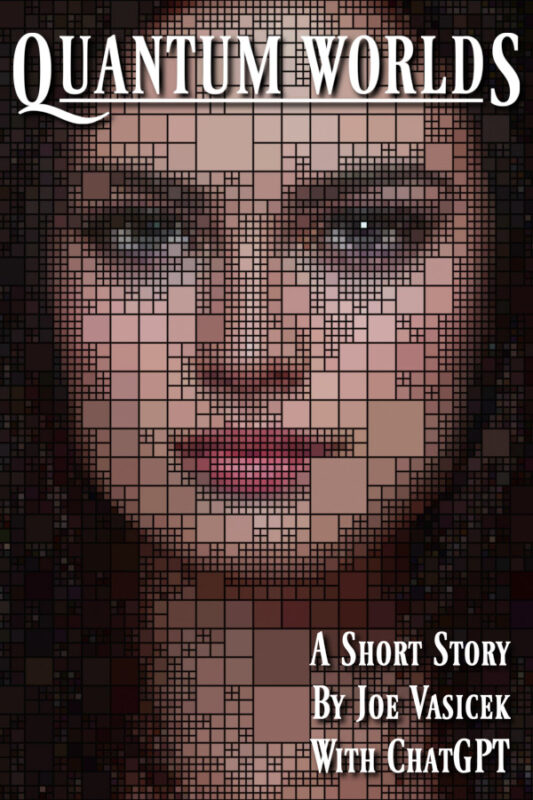
Behold!

This is the first story I wrote with ChatGPT, about… a struggling science fiction magazine editor who decides to embrace AI instead of fighting against it, and revolutionizes everything. So of course, it makes sense that the cover would be patterned after Clarkesworld’s iconic covers, since I basically wrote it in response to them closing down submissions to all AI-assisted stories.

It’s out for free now, if you want to check it out. Enjoy!

Back from Coeur d’Alene

It occurs to me that most of my posts in the past month have either been extremely doom-and-gloom, or they’ve been excerpts from some of my most recent work. This probably gives the impression that I’m huddled in a corner somewhere, black-pilled and traumatized, and seeking some sort of an escape through my writing, when really, that is not the case.

In fact, the main reason I haven’t posted more is because I’ve been so busy with life and family. It’s been a really great year for us, with a new baby and a bunch of cross-country road trips that have been a lot of fun. I’ve also been testing out a lot of AI writing techniques, and while that has really invigorated my creativity in a major way, it’s also taken me away from things like this blog, which is why you haven’t heard as much from me.

If I were still on social media, I have no doubt that I would be doom-spiraling right now, what with everything that’s happening in the world. Even without social media, I’ve been glued to the news sites I follow, checking for hourly updates on the war with Israel (which I really do believe is the opening stages of World War III). But that’s actually not very new for me: back in high school, I was the same way, following the news every day from the public computers at my school library. The 9/11 attacks happened on the first day of school for me, but in the last couple of months of the previous school year, I remember being frustrated that no one seemed to be taking this Osama Bin Laden guy more seriously, especially after the USS Cole and Kenya embassy bombings. Then the summer came, and I mostly goofed off, but as soon as school got started I was back to following the news on a daily/hourly basis.

So I’ve got a lot of experience with taking scary news in stride and not letting it totally consume my life. In fact, that’s the main reason I follow things like this so closely: so that when the unthinkable happens, I can face it without getting shocked or overwhelmed. And recent posts to the contrary, I’m not black-pilled at all. In fact, I tend to believe that I was put on the Earth at this specific period of time for a reason, and not just one that was imposed on me: that at some point, before I was born, I was given a choice between this and some other era, and I specifically chose this time to be born. Maybe I’m just imagining it, but it would not at all surprise me if that turned out to be the case.

In any case, we just got back from our last family road trip of the year, this time up to Coeur d’Alene to spend some time with Piper’s brother and his family, as well as my in-laws, who joined us on the trip. We had a really good time! Our daughter had a blast playing with all her cousins, especially the ones about her age right now. We also got to see her cousin’s baptism, so that was really good. Provo to Couer d’Alene is about an 11 hour drive, which is not quite far enough to justify getting a hotel, but for a 7 month-old and a 3 year-old, it was pretty hard. We’re all glad to be home now.

My wife is super busy working on her PhD. Specifically, she’s getting a paper ready for a major conference she hopes to attend with the rest of her lab. Her paper is on using AI to generate useful cross references across a body of work (eg Shakespeare, Jane Austen, The Bible, etc), and she’s developed a method that cuts down the cost of creating a cross reference set by upwards of 50%. But for the next couple of days, she’s going to be really busy with all of that.

Meanwhile, I’ve been taking care of the kids while the grandparents are on another road trip out to Omaha. It hasn’t been that bad, but I’ve also been pretty swamped with work, which one of the reasons I’ve been neglecting this blog. I have a bunch of ideas for posts I’d like to share, but no time to get to them, though hopefully that will change soon. Here are some of the posts I’d like to write:

  • A part 4 to my Navigating Woke-SF series. I recently had some experiences with the woke SF publishing world that have made me rethink things in a way that y’all would probably find very interesting.
  • An update to my generational cycles of grimdark and noblebright theory. This is one of the things I’ve been thinking about, and I’m starting to think that some of my basic premises in that post were wrong, or at least not entirely accurate, requiring an overhaul.
  • A lot of thoughts on AI and writing. This has been my main focus for the past couple of months, and I have thoughts. Many, many thoughts.
  • More thoughts on geopolitics and current events, especially on the trajectory of the unfolding global conflict and what it all means on a moral and spiritual level. But I think I should hold off on posting too much about that, since I’ve already spent so much time on it already.

Which of those things would you like to see next? I can’t promise anything, but I do want to spend more time on the stuff that followers of this blog actually want to read. In the meantime, I’ll try to intersperse a few quick update posts like this one, and get back into the habit of regular blogging.

Some major news about my first AI-assisted novel

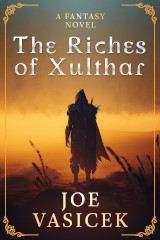
The Riches of Xulthar is now complete! I’m sending it out to my editor this afternoon, and if all goes well, it will be available in all formats by the end of September.

In the meantime, I have decided to post the entire thing chapter by chapter on my blog. I’ll be posting the final, unedited version, as well as my AI-assisted draft which I wrote/generated with Sudowrite. It was about 60/40 generated/written, so I can’t say how much of it was purely AI, but if you plug it into an AI text detector you should be able to get a pretty good idea.

My process for writing this novel was as follows:

ChatGPT: The whole thing started out by playing with ChatGPT, with the prompt “let’s write a fantasy adventure story in the style of Robert E. Howard.” I thought it would turn out to be a pretty straightforward short story, but it quickly ballooned into something else. I still kept playing with it, but mostly to get the framework of the overall story.

Outlining: Once I had a general idea for the story, I spent a couple of weeks outlining the whole thing, as if I were outlining one of my regular novels. Besides a chapter/scene map and a list of all the throughlines with their associated plot points, I also filled out character sheets for the main characters, with a little bit of help from ChatGPT.

Sudowrite: I used Sudowrite to write/generate the first draft. This was about 60/40 human written to AI generated. Basically, I would write a few hundred words, generate a few hundred words, and either keep it, tweak it, or throw it out and write something else. Rinse and repeat.

Humanizing: Once I had a decent rough draft, I passed it through the “human filter” by rewriting it into a new document, with the AI-assisted draft on my other screen. No copy-pasting, though there were sections where I basically wrote it out almost exactly how it appeared in the rough draft. However, I also made some pretty substantial changes, even expanding the rough draft into new scenes and chapters. This phase took the most work.

Revising: After the humanizing phase was done, I went through a normal revision draft, the way I do with all of my novels. I got some feedback from my writing group for the prologue and first chapter, but otherwise didn’t get any reader feedback, mainly because the process was so accelerated that I doubt anyone could have gotten it back to me in time. More on that later.

Polishing: For the final polishing draft, I went through and cut a straight 10% off of the whole novel, scene by scene. No major story changes for this phase: just sharpening up the prose and making it as clean and tight as possible.

Without using AI, it takes me anywhere from 6 to 18 months to write a novel, sometimes much more. But from start to finish, The Riches of Xulthar only took me three months—and the first of that was mostly just figuring out what to do with all of this content that I’d produced while playing around with ChatGPT. I didn’t start using Sudowrite to generate the actual first draft until the second week of May, and here we are in the second week of July, and the entire thing is finished.

I am very eager to hear what you guys think of this book, which is why I’m posting both the final unedited draft and the AI draft on my blog. I’ll be posting a new chapter every week, the final draft version on Thursday, and the AI draft version on Saturday. I hope you enjoy it!

The Sudowrite draft of The Riches of Xulthar is finished!

It only took about a month, but it would have been much faster if I’d used Story Engine. Honestly, I probably could have generated the text in a week if I’d used that tool, or perhaps even an afternoon. Instead, I outlined the project myself, wrote the first couple of paragraphs for each individual scene, and wrote / generated the rest.

Most of what I used Sudowrite for was on a sentence and paragraph level for this draft. Typically, I would write a bit, get to a point where I wasn’t sure what to write next, generate some text, and then either 1) use it as-is, 2) use it, but run it through a couple of rewrite filters first, 3) use it, but tweak it myself, or 4) throw it out entirely and keep writing. Because the AI didn’t have an outline to work with, it often took the story off in weird and non-useful directions, but there were a couple of times where it surprised me in a good way, and I decided to keep it in.

One of the things I found was that Sudowrite is terrible for magic systems, world-building, character arcs, foreshadowing, unresolved sexual tension, or anything else that happens on a macroscopic scale, especially if that story element changes over the course of the novel. For example, he AI engine wanted every scene involving both my male and female leads to culminate in the climax of their romantic subplot. Likewise, it was very difficult to get the AI to hit the right beats for their character growth; that was something where I really had to babysit it.

But for those microscopic, word / sentence / paragraph level story elements, I was pleasantly surprised with how Sudowrite performed. It felt a bit like I was riding in the front of a tandem bicycle, instead of writing alone. When I hit stretches that required a lot of uphill effort, I could rely on the AI engine to do most of the work while I steered. Of course, riding a tandem is no fun unless both people are pedaling, so I still had to do my part, but the hills and the rocky parts felt a lot easier, which was nice.

This Sudowrite draft isn’t anywhere near publishable, but that wasn’t what I was going for. Instead, the goal was to get it good enough to use as a starting point to rewrite the entire thing myself. Rough drafts are pretty hard for me, but rewriting and revising comes much easier after I have something to work with. Even if I end up throwing out every word, I expect that I can power through this “humanized” draft in a fraction of the time it would take me to write the novel from scratch. I may even finish it this week!

But perhaps the area where the Sudowrite draft did the most was with helping me to be productive even when my attention was being pulled in multiple directions by small children. A significant chunk of this book was written in the BYU Library’s family study room, with one eye on my three year-old daughter as she played with the other kids. Even after I had to step in to referee a bit, or to take her for a snack or a potty break, the AI tools enabled me to jump right back in and keep writing.

The amount of focus it takes to write with AI tools is much, much less than what it takes to write without them. At least, that has been my experience. Granted, my goal with this draft was not to make it publishable, but to make it good enough for the next phase, which is more like 95% human effort and 5% AI, as opposed to 40% human effort and 60% AI, which I used for this draft.

But I doubt there are any AI tools right now that can get a book into a published state with minimal human effort. In general, I’ve found that these AI-assisted writing tools are great for getting a book from terrible to passable, but not as useful for getting a book from passable to genuinely good—and as for getting a book from good to genuinely great, you can forget it with our current set of AI tools. Much better to rely on human efforts for that.

To use another analogy, it’s kind of like using a two stage rocket to get to orbit, where the booster rocket is the Sudowrite draft and the second stage rocket is the humanized draft. The booster won’t get you to orbit on its own, but it will get you through max Q and send you high enough that the second stage can finish the job. And since you’re going up in two stages instead of just one, it doesn’t take nearly as much fuel to get there.

Another advantage of doing it this way is that the final draft will be almost 100% human-written. There’s no copying or pasting in the humanized draft—every sentence and every word is typed out by hand, and while some of it may come verbatim from the Sudowrite draft, most of it is going to be changed in some way, sometimes quite substantially. For example, today I “humanized” a scene that was about 750 words in the Sudowrite draft, but ended up at around 1500 words.

What I’ll probably do is pick a few scenes from this novel and post the before and after, to show how substantially it’s changed. But even the Sudowrite draft isn’t totally AI generated, at least with the way I’ve been using these tools. Like I said above, it’s much closer to 60/40.

The Sudowrite draft of The Riches of Xulthar clocks in at about 33.2k words. That still falls short of the 40k word minimum threshold for a novel, but it will get longer with the next draft, and I expect it to end up somewhere between 40k and 45k words. With luck, I’ll finish the humanized draft by the end of this week, and the revisions before the end of this month.