New projects and other stuff

So I started the sequel to Mercenary Savior today; I figure I can take a couple months off to finish the rough draft, then leave it in the trunk until the first one sells.

The working title of this one is Into the Nebulous Deep, which captures the main premise quite nicely (though let me know if it doesn’t jive with you).  It takes place five years after the events of Mercenary Savior. James is a lieutenant in the Colony’s civil defense forces, and has made a name for himself as an ace gunboat commander.

The basic premise is that the Colony is falling into economic ruin and must therefore make a mass exodus in order to survive.  Their only real option is to flee into the Good Hope Nebula, where FTL drives don’t work and the Hameji can’t follow them.

Deep in the nebula are newly born stars with planets and proto-planets, and they hope to re-establish themselves there.  Of course, nothing happens quite that smoothly, and James is going to find himself putting out fires most of the time.

While all that is going on, however, I hope to put him in the middle of a love triangle.  I have the ending of it planned out, and it can ONLY happen this way in a science fiction novel.  Oh man, the twist is going to be way interesting–and incredibly hard to pull off well.  I’m up for a challenge, though, and I can already tell this one is going to be fun.

For some reason, things worked out so that I started this novel on November 1st.  Because of that, I suppose I’m doing it for a nanowrimo–since hey, the rough draft is probably going to be between 120k to 140k words long, and I want to finish it before January.  Sounds tough, but I’ve got the money saved up to take off a few weeks and work on my writing, so that’s what I plan to do.

In loosely related news, I hope to start running soon.  My brother in law ran a marathon this year, and he’s going to help me get set up.  Basically, I need to get in shape for the wilderness job I hope to train for in January, and also because hey, I need to take better care of my body.  Besides, I’ve found that exercising boosts my writing tremendously, which is something I definitely need.  Exercise = win/win/win.

The most pressing thing on my mind now, however, is the article I need to write about the history of “the class that wouldn’t die.” I’m working on a very tight deadline, and absolutely must produce.  I wish I hadn’t been so flaky with the previous deadlines, but it is a volunteer magazine and I have had other pressing things taking up my time.  Not any more–I’ll get it done right away.

In the meantime, I’m tired and must get some sleep.  I wish I could function like one of Stephanie Myer’s vampires, but reality is a harsh and unforgiving mistress.  One of these days, though, I’ll be free of her–just you wait!

Hooray for Free Books!

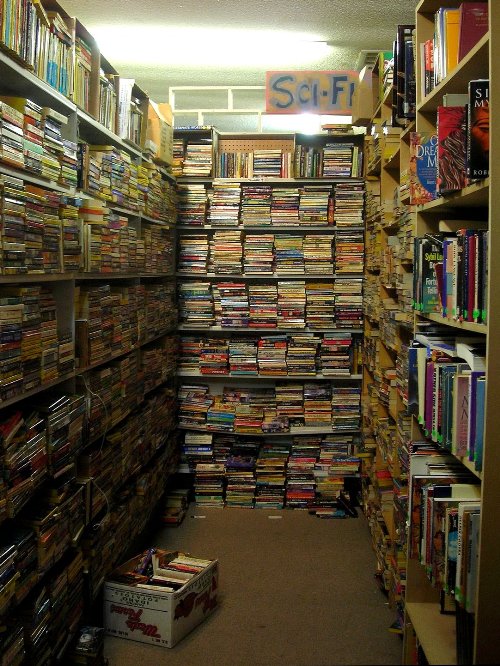
Last year at World Fantasy, I learned that one of the perks of an attending membership is that you get a massive bag of free books.  What’s more, there’s a table where people can informally swap books (since everyone gets a slightly different bag).

The really cool part, though, is that most people don’t have room in their luggage to pack all the books.  Some people ship them home, but most just dump them on the table for anyone to grab.  On most days, if you arrive early enough (when everyone else is nursing their hangovers), you can get some really good picks.

So this year, my unofficial goal was to hang out around the book swap table and see how much I could make in free books.  Here’s the list at final count:

Asher, Neal. Shadow of the Scorpion: A Novel of the Polity. $7.99
Asher, Neal. Prador Moon: A Novel of the Polity. $7.99
Austen, Jane, and Ben H. Winters. Sense and Sensibility and Sea Monsters. $12.95
Baker, Kage. The Anvil of the World. $14.99
Cook, Glen. Starfishers: The Starfisher’s Trilogy Volume Two. $14.95
Cook, Glen. Star’s End: The Starfisher’s Trilogy Volume Three. $14.95
Cook, Glen. Passage At Arms. $7.99
Holland, Cecelia. Varanger. $16.99
Kollin, Dani and Eytan. The Unincorporated Man. $25.95
Mallet, Nathalie. The Princes of the Golden Cage. $7.99
Marks, Laurie J. Water Logic. $16.00
North, Pearl. Libyrinth. $17.99
Pitts, J.A. Black Blade Blues. $25.99
Sanderson, Brandon. Warbreaker. $7.99
Strahan, Jonathan, and Lou Anders, eds. Swords & Dark Magic: The New Sword and Sorcery. $15.99
Turtledove, Harry. After the Downfall. $24.95
Vigneault, Francoise ed. Elfworld. $12.95
Waltz, Jason M. ed. Rage of the Behemoth: An Anthology of Heroic Adventure. $16.99
Williams, Walter Jon. Implied Spaces. $24.95

Total: $296.54

All in all, I more than made back the cost of admission and the hotel.  Not too shabby–and this list doesn’t count all the ARCs and free samplers I took as well.

Yep, World Fantasy is pretty much awesome.  Now I just need a bookshelf…

World Fantasy Day 3

Saturday at the World Fantasy convention was awesome. Tons of amazing panels, with excellent advice and some very interesting insights.

First, I attended “The Story Cycle vs. The Novel,” which was moderated by L.E. Modesitt.  The panelists talked about the evolution of a series and the difference between a cycle of novels vs. a continuation.  In a story cycle, there may be many books, but one ending, whereas in a more loose series, every novel is a standalone with an ending.  In another panels someone used the analogy of an avalanche vs. skipping stones, which I found quite useful.

Next, I attended “The Continued Viability of Epic Fantasy.” The panel started out by defining epic fantasy (as opposed to heroic / sword & sorcery), which they more or less agreed has the following characteristics:

  • Takes place in an alternate world
  • Is large in scope, rather than personal
  • Involves characters who are trying to save the world
  • Has a multi-strand plot with many viewpoints
  • Has an extended story arc

David Drake then blew the premise of the panel out of  the water by arguing that epic fantasy is still selling well–in fact, that the market has been expanding over the past ten years.

Drake also pointed out, however, that when you’re successful, the normal commercial rules don’t apply; first, you have to prove your chops, realizing that the publishers will lose money on your first couple of books.  That’s just a fact, and anyone who denies it is arrogant and stupid.

The next panel was “Slaughtering the Evil Hordes,” about the barbaric hordes trope in fantasy and whether it’s disturbing or a good thing.  I asked the question: “how can you have the hordes win and still make it work?” and Tom Doherty pointed to Modesitt’s Magic of Recluse as a good example of this.  Basically, you have to show the good in each side, sometimes by a shift that makes the reader suddenly and unexpectedly see the hordes in a new light.

Next, I attended “The Moral Distance Between the Author and the Work.” This panel was quite fascinating.  One of the interesting questions that was raised was whether you can deduce an author’s morals from reading their work.  At first, the panelists said that in good art, you can’t, but then Scott Edelman and Eric Flint pointed out that if you read an artist’s whole corpus, usually you can.  Nancy Kress compared artists to dandelions; over time, you grow and mature, but when you send out work, where it goes and what happens to it has nothing to do with you as the artist.

One of the best panels, however was “Authors and Ideas,” which happened the next hour.  The panelists started by agreeing that as an author, your most deeply held personal beliefs will always show up in your work, whether or not you know you believe it.  The stuff we believe most firmly, we never even think to question because it is invisible to us.  Most aliens in sci fi are less alien than the Japanese, and our own great great grandparents are more alien to us than anything else.

The panel then got on to how writing is a collaboration between the author and the reader, where the writer has no control over what the reader will take from it.  Even though your art will contain your beliefs, in order to be great it must also convey what you don’t believe–the “opposition in all things” element.  Done well, the author “shakes hands with the reader over the character’s head.”

After the panels, I had dinner at the con suite–and let me just say, the convention organizers went WAAAAY out of their way to make the con suite awesome.  They literally provided every meal, and enough of it to feed everyone who came in, which really surprised me.  A huge thanks to everyone who volunteered with organizing and running the con.

Anyway, I got into a HUGE discussion at dinner with an amazing couple who runs a used book business out of Massachusetts.  We talked about artificial intelligence, the physical limits of computer circuits, and whether it’s possible for us to one day emulate the human brain on a computer system.  Gained some very interesting insights for my novel Genesis Earth, as well as just a general fun time.  Conversations like this are one of the things I treasure about these events.

And then I bounced around the parties for the rest of the night.  Had fun, talked with Tom Doherty and a handful of authors (though not as many as last year), but probably most importantly made a bunch of awesome writer friends, with whom I will be keeping in touch after the convention.

I might not have met a bazillion agents and editors this year, but I did make a ton of friends among the aspiring writers and editors, and that definitely counts for something.  I look forward to staying in touch and supporting everyone as we break in and make our mark; we’re the next generation of an awesome literary tradition, and we’re definitely going to keep it going!

World Fantasy 2010: Day 2

Wow, what a tiring day.  I feel drained, mentally and physically, and I didn’t even spend all that much time at the parties tonight.

I got started a bit early, prowling around the book-swap table, where I was rewarded with some books that look really good.  If you know what you’re doing, you can totally get the price of your admission ticket in free books (and then some).  I packed super light for that exact reason.

The convention started out with an awesome panel titled “Fantasy Gun Control,” where the panelists discussed why fantasy tends to favor swords over guns, even though guns have existed since the 1300s.  Funniest quote from the panel: Walter Jon Williams asked what if Samuel L. Jackson was one of the Defense Against the Dark Arts teachers from Harry Potter, and Charles Gannon quipped “do I have to get magical on your ass?”

The other panel I attended was “The Tension Between Art & Commerce,” an excellent panel which very quickly evolved into a cage fight between Nancy Kress and her publisher, Tom Doherty.  It basically went something like this:

Tom: I don’t think there is any tension; the best art always sells the best.

Nancy: No way!  Just look at Danielle Steele: her writing is CRAP, yet she sells like crazy–and that’s the norm!

Tom: But true art endures beyond its time and sells much better over the long run.  After all, just look at Homer and the Iliad.

Nancy: Homer? Are you serious? He’s been dead, what–2,000 years?

Tom: Yeah…but my point is, if you’re a writer, you need to write what’s in your heart and not chase the market.  If you do try to chase the market, your writing will be crap, AND it won’t sell.

Nancy: True, but what about my apocalyptic novel about a plague that turns domestic dogs feral?  I got four rejections that all said: “this book is great, but it would offend dog lovers so much that we can’t publish it.”

Tom: Well, those were just stupid editors.

Nancy: Uh, Tom…one of those was from your publishing house!

Of course, those aren’t exact quotes, and Nancy was very quick to make it known that she loves Tom and appreciates him for publishing so much of her work, but that was more or less how it went.  It was hilarious.

At the  same time, the panel was quite useful as well.  Everyone mentioned how a writer’s willingness and ability to learn the craft and accept criticism is key–especially after getting an editor.  Without this capacity to learn, aspiring writers will almost never succeed, whereas those who have it have a chance.

The rest of the time I spent hanging out and shmoozing with various people.  I interviewed both Dan Wells and Peter Ahlstrom for the Mormon Artist article on BYU’s “class that wouldn’t die,” and those interviews went very well.  Those two guys are seriously awesome–way down to earth and easy to talk with.

I also pitched to a couple agents, and I think it went very well.  For one of them, I thought I saw her eyes light up as I described the characters in my novel from last year, Genesis Earth.  It might just be wishful thinking, but her response was enough to convince me that I need to give that story a thorough revision and send it out to her before the end of next month.

I worry, though, that there’s not as much demand for the kind of fiction I write.  My writing falls very solidly into science fiction (space opera, to be more specific), but everything I see here at the con is fantasy–epic fantasy, urban fantasy, paranormal, steampunk.  No science fiction, except from a couple small presses.  Just fantasy.

In the art vs. commerce panel, Ginger Buchanan claimed that science fiction was never a popular genre–that the popularity was all due to a handful of specific writers and a handful of specific works.  I’m not sure I agree with that, but it is a bit discouraging.  Speculative fiction is a fairly niche corner of the publishing world to begin it, and to see and hear people within that niche treating science fiction as ANOTHER niche…it doesn’t bode well for someone who wants to make a full time living writing it.

But then again, maybe my stuff is good enough that it’ll find a home anyways–and not just a home in a small press, but with a big enough publisher that I can actually be a full time writer.  I don’t hold any illusions about my books making me fabulously rich and famous or somehow spawning a new sub-genre unto itself, but I do think my writing is good enough that I can shoot big and hope to get somewhere–perhaps even expect it.  I don’t know, but I feel that the hope is justified, at least.

Anyhow, that’s probably more angst than you cared to read.  World Fantasy is going great, and I’m exhausted, so I’m going to hit the sack.  Good night.

World Fantasy 2010: Day 1

So today was the first day of World Fantasy, the major professional convention for science fiction and fantasy literature.  I’ve only been here for a few hours, but I can already tell it’s going to be awesome.

While making a stop in Chicago, I ran into two other writers on the same flight (one by the name of Theodora Goss who was on a panel later that evening) and ended up sharing a taxi with them.  We had some great conversations on the way down, about non-conciliatory fantasy, Dave Wolverton’s workshops, writing short stories vs novels, etc.  It was great.

So I arrived at the hotel, checked in, got situated, and immediately started running into other Utah/Mormon writers.  I was a bit surprised, because I was expecting us to have a much smaller contingent this year, but I started running into familiar faces right off the bat.

And then, as a tribute to how universal science fiction and fantasy fandom really is, a group of us cleanshaven Mormons ran into an atheist and agnostic from Seattle in the hallway and spent a delightful evening together talking about religion, why there are so many Mormon sf&f writers, more religion, dating/relationships in Utah, still more religion…and it was awesome.  They said we were some of the coolest Mormons they’ve come across, and I have to say, I very much enjoyed meeting them as well.

So anyways, I just went to one panel this evening: “Fantasy as a Rejection of the Present.”  Basically, it was all about how fantasy tends to hearken back to the forgotten values of the past, and how steampunk and contemporary urban fantasy is largely a reaction against our modern consumer culture.  There was a lot more to it as well, including a discussion of Tolkien, Lewis, and William Morris, but that was the most interesting tidbit I took from it.

It got me thinking that perhaps I should try my hand at urban fantasy.  I haven’t yet tried it because I get bored just thinking about stories set in the “real world”–but lately I’ve been thinking a lot about how screwed up this “real world” really is…perhaps some of those thoughts would translate surprisingly well into urban fantasy.

I don’t know.  Anyhow, that’s my <500 word report on tonight’s activities.  I’ll try to make another one sometime tomorrow, but I make no promises–hanging out with these people is just too much fun.  Good night.

Mercenary Savior 4.0 is FINISHED!

…and not a moment too soon.  I leave for the Salt Lake airport in eight hours, to try and sell this ugly beast masterpiece at World Fantasy.  Let’s hope I can find a few editors/agents who are willing to take a look at the manuscript!

Here are the stats:

Mercenary Savior 4.0

words: 123,045
pages: 620
chapters: 28 + prologue
file size: 288.1 KB
start date: 24 August 2010
end date: 27 October 2010

And the wordsplash:

Wordle: Mercenary Savior 4.0

The most influential song on my writing for this draft would probably be the theme from Terminator 1:

Man, why didn’t I grow up in the Eighties? Oh, wait…

I’d write more, but I have to pack for tomorrow. Good night!

To do list for World Fantasy:

  1. Finish Mercenary Savior 4.0 (almost there!)
  2. Figure out a good elevator pitch for MS 4.0.
  3. Memorize the bus system of Columbus Ohio.
  4. Get con roommate’s phone number.
  5. Get a ride Sunday night from the Salt Lake airport.
  6. Acquire and memorize the convention schedule.
  7. Figure out a list of specific goals to accomplish.
  8. Do laundry.
  9. Pack (leaving plenty of empty space for books).
  10. Make a bag lunch for the flight.

Am I missing anything?

What have you learned from reading science fiction?

While trolling around the new Facebook questions app, I came across this interesting question.  Unable to resist, I spent the next hour crafting my answer.

This is what I wrote:

Gosh, what HAVEN’T I learned from science fiction?

Because of science fiction, I do not fear the alien. I do not feel threatened by people of different places or cultures, but take great interest in learning from them. I look at them and love them, because I can see myself in them.

Because of science fiction, I can look out at the vast expanse of the universe and not despair because of my insignificance. I know my place within it, and can appreciate the wonders and endless possibilities all around me.

Because of science fiction, I can look at the world and know which questions to ask. I can see through the lies that society constantly feeds me, and know how to fight against them.

Because of science fiction, I can look to the future with hope. Having seen the best and the worst of all possible worlds, I know which paths to avoid and which paths to follow. With this knowledge I can inspire my fellow men, because I know that nothing is inevitable.

Because of science fiction, I have a deep and endearing love for the world in which I live. I know better what it means to be human, and knowing this helps me to take no human life for granted. I have a greater capacity to love those around me, and that is the most important thing of all.

Science fiction has enriched my life beyond measure. By constantly stretching the bounds of my imagination, science fiction has led me to more truth than any other literary genre–and not only led me to that truth, but helped me to incorporate it into all that I do. So long as I live, I will always be a reader and a writer of science fiction.

Answering this question reminded me of my interview with Shayne Bell a couple weeks ago.  In it, he talked about how rich and vibrant science fiction is as a literary genre, and how it deeply impacted his own life.  Listening to him speak, I couldn’t help but feel that I was in the presence of a great man.

I don’t think he’d be comfortable with me posting the full audio of that interview, but many of his comments will appear in the article I’m putting together for the December issue of Mormon Artist.  Between working full time and trying to finish the fourth draft of Mercenary Savior in time for World Fantasy, I haven’t had much time to work on it, but it’s going to be awesome.

What have YOU learned from science fiction?  How has it enriched your life?

I’m still here!

Man, it’s been forever since I’ve posted something.  I’d blog more often, but I think you guys would get bored pretty quick if all I did was tell you how the writing went each day.  Don’t be fooled; the writing process isn’t NEARLY as interesting as the stuff we write (unless you’re writing amateur fanfic…just kidding!).

So anyways, life is extremely busy these days.  Between my temp job at a warehouse, Leading Edge, Institute, church, Quark, and finishing the revision of Mercenary Savior, I feel incredibly crunched for time.  I’ve been pulling about 1k to 3k words per day, but last week was horrendously unproductive and I’ve got to really push hard to finish this beast in time for World Fantasy.

But it’s going to happen–that’s for sure.  I’ll finish my job at the end of this week, and with the extra free time I’m sure I’ll be able to finish it in time.  I passed the 100k word mark last night, and it looks like this draft is going to be around 120k to 125k.  Still a little long for a science fiction novel, but not too long (I hope).

As I get closer to the end, I’ve noticed that I tend to use a shotgun approach in resolving the conflicts in my rough drafts.  Instead of following each arc through in a focused, logical manner, the last few chapters of my drafts tend to go all over the place, trying halfheartedly to resolve everything at once.

The bad thing about this is that the last half of the book requires a lot more work to revise.  The good part, however, is that I can cut off a ton of fat at the tail end, significantly shortening the final wordcount.  It’s good to be able to manipulate that number late in the game.

As far as my plans for November, if I do participate in nanowrimo, it’s going to be with a serious project that I was already planning on doing, not something wild and spontaneous.  I don’t think taking the time off to write something I know will never be published is going to help me as a writer.

At the same time, however, it only takes about 1.5k to 2k per day for 30 days to complete nanowrimo, and that’s about the rate that I’m writing right now (a little less, actually).  With World Fantasy smack at the end of October, I probably won’t start anything new until November 1st.  So even though I’m not taking time off from my serious stuff to do it, I probably will participate in nanowrimo this year.

As far as other stuff going on in November, I am very much looking forward to seeing my sister in Houston over Thanksgiving weekend.  Since I don’t know if I can find a job that will give me that week off, and since I’m already in a pretty good financial place with the money from this last job, I think I’ll take most of the month off to focus on my writing, rather than look for full-time work.

However, I have been thinking a lot about becoming a freelance translator.  One thing I’ve learned from working in a warehouse (and I’ll blog more about this at the end of the week) is that I hate not using the stuff I learned in college.  My original plan when I chose to major in Mideast studies was to use Arabic to find a regular job until the writing took off, and so far I haven’t done that.

Besides, I REALLY want to go back to the Middle East someday.  If I can improve my Arabic to the point where I feel I can get along better than the average American student, I might just move over there for a year or two (or five or ten…).

Anyhow, I’ve got a ton of stuff to do (including writing–I want to hit at least 3k today), so that’s all for now.  See ya!

Awesome writing group activity with Dan Wells

Went to an awesome Quark writing group activity tonight with Dan Wells. It was great. We critiqued stories, had a Q&A, and then played the Battlestar Galactica game. Good, good times.

The new series of BSG is amazing.  It quite literally inspired my first novel: a story set in a universe where a cylon-style humans vs. robots went down three hundred years previous, and the surviving federation contacted a primitive civilization of fellow humans who thought they were the only survivors.  And then I threw in a first contact story, just to shake things up.

Anyway, BSG is a surprisingly fun game.  It’s kind of like werewolf, in that there’s lots of potential for betrayal and secret combinations. Basically, the players are putting out HUGE fires the whole time (like cylon fleets coming out of nowhere to blast your fleet out of the sky), and you have to work together but you don’t know whom to trust.  It follows the BSG story remarkably well, with enough room for unanticipated twists to make it interesting.

The learning curve is incredibly steep, but once you learn it, it’s way fun.  We didn’t have enough time to finish the game, but we did pretty well, I think.  Dan claims that he betrayed us heartlessly, but the truth is that our interests aligned pretty well for the duration we played.  He probably would have betrayed us had we played much longer, but we didn’t make any egregious mistakes…I think…

Anyway, didn’t get much writing in today (just about 500 words over my lunch break), but the fun and networking at the Quark event was worth it, I think.  I’m very much looking forward to World Fantasy, though I’ve got a TON of stuff to do first.

One thing I realized tonight was that I’m in a perfect position to do nanowrimo this year.  With the Mercenary Savior rewrite coming to a close (hopefully) before the end of October, I currently have no writing projects planned for November.

I was thinking of doing a sequel to Mercenary Savior next, but I don’t want to do that as a nanowrimo–I want to do quality work for that one, and the whole point of nanowrimo is to allow yourself to splurge and write crap.  Maybe I’ll randomly throw all of my characters from all of my projects so far into one giant mesh and see what happens.  I don’t know.

That’s what’s going on here.  Now, if you don’t mind, I’m going to crash.