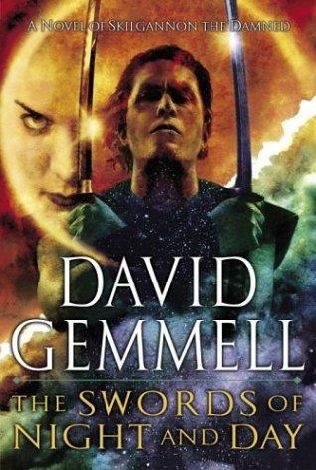
Winter Warriors by David Gemmell

Eons ago, in the Days of Fire, demons feasted upon the souls of men the way that men feast on cattle.  Those days ended when the second most powerful demon betrayed his people, damning them to purgatory so that men could inherit the Earth.

Four thousand years have passed, and the demons are beginning to come back.  The dread Kreyakin, advance guard to the demon invasion, have already passed into the world of men.  In order to open the portal to the other world, however, they must cast a spell requiring the lives of three kings.

Two of the kings have already been sacrificed.  The third lies within the womb of the Princess Axiana.

The fate of the mortal world now lies in the hands of three aged warriors–Nogusta the swordsman, Kebra the bowman, and Bison the brute–and a handful of unlikely fugitives.  Together, they must stand against the dread Kreyakin and all the forces of hell.

Alright, my attempt at a jacket blurb really doesn’t do this book justice.  I want to say it was one of the best Drenai books I’ve ever read, but the truth is it’s just like every other book in the Drenai saga, which is to say that it’s awesome.

I think I’ve figured out why I love David Gemmell’s books so much.  It’s because his books so perfectly capture what it means to be a man.  Women read Twilight because it perfectly captures the experience of being a teenage girl in love, and Gemmell’s books–all of them–capture what it means to be a man.

I’m not just talking about the platonic ideal of manhood–I’m talking about the everyday reality as well. Two men sitting together in “companionable silence.” A warrior who scoffs when his commander sends some lesser men to accomplish a mission, then after getting chided says “I spoke in haste,” and the matter is dropped.  Guys who tackle problem after problem, from fighting duels to fleeing from armies from helping the inexperienced princess with her messy childbirth, and do so without flinching, because hey, someone’s got to do it.

But the ideal is definitely there too, because in every single one of Gemmell’s books, circumstances conspire to push his characters right up to the very limits of their abilities.  When that happens, their true character shines out, and the most unlikely ones rise to great feats of heroism, often sacrificing their lives in the process.

Indeed, if there’s one underlying theme in all of Gemmell’s books, it’s about heroism and what makes a true hero.  It’s awesome.

The best part, though, is how Gemmell redeems even the darkest characters.  I can’t say much about this book without giving away the ending, but let me just say it was extremely satisfying.  Evil is not some slimy b-movie monster–it’s a quality that everyone possesses in varying degrees, alongside the potential for greatness.

In this way, I think Gemmell is the antithesis of George R. R. Martin.  While both authors write in shades of gray, Martin emphasizes how even the noblest, most honorable people have an ugly black stain somewhere in their character, whereas Gemmell focuses on the potential within all of us to rise above the darkness in our souls and accomplish feats of greatness.  His heroes are dark and gritty, but at the end of the day, they are heroes nonetheless.

In short, this book was awesome. If you’ve ever read a book by David Gemmell and loved it, I guarantee you’ll love this one.  I certainly did.

Writing update, getting ready for LTUE, & Katniss must DIE

So I’m back at work at WAFH, making slow but steady progress.  At this point, I’m throwing out about half of what’s on the page and redrafting stuff to fill in the gaps, but that’s only going to increase.

It’s not particularly hard, but it does take a lot out of me.  I’m finding that I can write for about two or three hours before my creativity runs dry.  When I’m spending more time online or playing games and less time focusing on the story, that’s a sign that it’s time to do something else to refill the well.

Man, I wish that well would stay full for longer…but in the meantime, 2.5k words per day isn’t so bad.  I’ll take it.

In unrelated news, I’m currently about a third of the way through The Hunger Games and I hate the main character, Katniss.  She’s a total attention whore, and fits all the classic characteristics of a Mary Sue.  A tortured past, a heart of gold, ridiculously well skilled, beloved by everyone and romantically irresistible, even to her enemies…blegh!  I hope she dies or gets tortured beyond all humanity.

In spite of this, I’ll probably finish the novel, just because it’s been such an influential bestselling title–as a writer, I’ve got to do my research.  However, I don’t see myself finishing the series.  There are other reasons why I don’t particularly like this book, but I’ll wait until a later post to articulate them.

In other unrelated news, LTUE 2011 is coming up, and I am so freaking excited for it!  Here are the panels I definitely plan on attending:

Thurdsay

9:00 am:
– Best and worst writing advice ever given
(Anna del C Dye (M), Mette Ivie Harrison, Tyler Whitsides, Frank L. Cole, James Dashner)

11:00 am:
– Self-Publication pros and cons
(Jessica Douglas (M), LuAnn Staheli, Sandra Tayler, Anna del C Dye)

2:00 pm:
– Writing Strong Female Characters
(Sheila A. Neilson, Aleta Clegg (M), Clint Johnson, Jessica Day George, Bree DeSpain)

4:00 pm:
– The Writing Life: how to set and keep goals, how to prioritize.
(Angie Lofthouse, Julie Wright (M), Sandra Tayler, Berin Stephens)

6:00 pm:
– Marketing and Publicity–what can you do?
(Stacy Whitman (M), Bree DeSpain, James Dashner, Dene Low, Elana Johnson)

Friday

10:00 am:
– Tracy Hickman Presentation

11:00 am:
– Main Address: Steve Keele

12:00 pm:
-Charisma is not a dump stat: The real world importance of personal appearance and social skills in achieving your creative dreams.
(Howard Tayler, Jake Black (M), Tracy Hickman)

2:00 pm:
– The Problem of Sequels
(Anna del C Dye, Mette Ivie Harrison, Larry Correia (M), Bree DeSpain, Jessica Day George)

5:00 pm:
– What You Can And Can’t Do In A YA Novel
(Mette Ivie Harrison (M), Elana Johnson, Bree DeSpain, Robison Wells, J. Scott Savage)

Saturday

9:00 am:
– What I wish I had done, if I could do it all over again – A Guide to New Writers
(Lisa Mangum, Dave Wolverton, Brad R. Torgersen (M), Kathleen Dalton-Woodbury)

11:00 am:
– Main Address: James Dashner

12:00 pm:
“Zombies and You: A guide to what does and does not constitute an apocalypse”
Ross Wolfe

2:00 pm:
– Building believable economies/politics
(Dan Willis, Eric Swedin (M), Roger White, David Ferro)

3:00 pm:
– Can your dreams pay your bills?
(Rebecca Shelley, Ami Chopine, Sandra Tayler (M), Dave Wolverton, Michael R. Collings)

There are more, but these are the ones that look most interesting to me.  As usual, I’ll record all of the panels I attend, so if you want a copy, just email me.

Man, I’m so excited!  LTUE this year is going to be awesome!

The Obligatory Valentine’s Day Post

I was going to write a long post on why I hated Valentine’s Day, but then I realized it hasn’t been so bad.

Of course, that’s mostly because I’ve been in my apartment most of the day, writing.  I did go to Macey’s at one point, and was mildly annoyed by the crowd of people buying flowers at the front, but other than that, it’s been like any other day in February.

I’ve always been single on Valentine’s Day, and while I’ve never really resented that, I have resented the pressure in the LDS church to go on dates and find a wife.  But here in Utah Valley, that’s a constant year round, not just on Valentine’s Day.  And it’s pretty bad.  Listening to some church leaders speak,  you’d think that it’s a sin to be single–as if the free agency of others doesn’t even factor into the equation.  And worse, they always put the blame on the guys, never the girls, so the girls keep on acting immature which leads to all sorts of ridiculous problems.

A couple weeks ago during Stake Conference, I got in a pretty dark mood after one too many talks on the subject.  This poetry is what came out of it:

Find a wife,
Date a week;
Marry young–
A life so bleak.

Where singlehood is selfishness,
And loneliness is sinful, too,
Rejection is a kiss of death;
Unwantedness a fate too cruel.

That’s about as far as I got.  I wrote some other stuff, but I’m not about to share it.

Truth is, I’ve kind of given up on the dating scene here in Happy Valley.  The hordes of pretty yet immature twenty year olds just don’t interest me, and while I do have a few old friends in the area who I might look up, I don’t expect much to come of it.

Part of it is the fact that I’m twenty six, which in Happy Valley is the equivalent of thirty five or forty anywhere else. I’m just old.

Part of it is the steady accumulation of bad dating experiences over the course of the past five years, which has a lot to do with immaturity, both my own (which I hope has changed) and that of the general population of available females here in Utah.

Part of it has to do with the fact that just about every girl I’ve actively pursued ends up marrying someone else in less than a year.

But mostly, I think it has to do with the fact that I’m just not really interested in anybody.  And honestly, that’s kind of liberating.  It’s part of the reason why I decided to grow out my beard (pictures coming soon).  Most of the girls around here say they hate beards–but who cares?  Screw ’em!

But yeah.  I’m sure I’m going to get a ton of concerned emails from my family after I post this, but at least I’m being honest.

And yes, I’m sure I’ll find someone someday (or, more likely, she’ll find me), and we’ll settle down to a life of passion and bliss and whatever, but that doesn’t have to be right now.

So happy Valentine’s Day.

(Images taken from postsecret and Kencraft Candy)

Paradigm shifts and finding balance

Yesterday, I was going to write a post about how pathetic this past week was: I only wrote about 1.5k per day (while unemployed), and spent most of my time on the internet reading blogs.

However, after reading some more of Dean Wesley Smith’s blog series, Kililng the Sacred Cows of Publishing, I have to admit that this week wasn’t a total loss.  Because of what I’ve read this week, I’m starting to have a major paradigm shift about the publishing world, and that likely will have a huge impact on my writing career, hopefully for the better.

If I can sum up how my views have changed into one statement, it would be this: that in order to succeed in this business and avoid the common pitfalls, I need to learn how the entire publishing system works as a whole, so that I can game it to my advantage.  A lot of the hard and fast “rules” of the industry are actually myths that make for bad business, for writers as well as editors and agents.  But when you look at the system from a rational choice perspective, the flaws become obvious.

Take, for example, the “rule” that editors only accept unagented submissions.  What does that do for the industry?  It turns agents into the first tier of gatekeepers that new writers need to get past.  But agents don’t pay writers; they get a 15% commission off of the books they manage to sell (which, according to DWS, is excessive, but that’s another topic).  And they don’t get paid at all for reading slush.

So agents are spending more of their time doing things that pay less money, pressuring them to take less risks and work only with what they “know” will sell.  This leads them to ignore the fresh, unconventional voices that turn the tropes on their heads and have the power to take the market by storm.

Furthermore, because of their newly christened gatekeeper status, they make their writers rewrite their manuscripts until they read just like clones of Harry Potter or The Davinci Code.  And when the agents’ three or four closest buddies turn the book down, they come back to the writer and tell them to write something else.

It’s an extreme view, for sure, but it has a few good points.  The incentives are all in the wrong places, with too many opportunities for the gems to fall between the cracks.  And while the response from everyone in publishing is to cling to the myth and scream “the system works!” I have to wonder, does it really?

This comment from one of the threads struck me with particular force:

“The biggest mistake you can make is giving complete power over to someone who will never care as much as you do.”

Youch.  And yet, it makes so much sense.  How many writers’ careers have been ruined by doing just that?  Ceding too much power to people who simply don’t care as much as they do, all in the name of some “rule” of publishing?

Of course, that’s not to say that the publishing industry is full of cheats and sleazebags.  I’ve spent some time with professionals at World Fantasy and other conventions, and I’ve been very impressed with all of them.  It’s just to say that writing is a business, and that writers need to approach their careers in the same way as anyone who’s self-employed.  Certainly it’s important to work with other professionals, but that doesn’t mean handing over the fate of your business to them.

So anyways, what with all the business research I’ve been doing, I suppose the last week isn’t a total loss.  However, I definitely feel a need to get back into writing.  My deadline for WAFH is in two weeks, and the next 40k are going to require the biggest changes.  So here’s my plan for the next two weeks:

  • Get up at 7 am every day.
  • Write at least 2.5k words per day (500 during LTUE).
  • Fill out at least 5 job applications per day.
  • Take a week-long Halo fast.

Probably the single biggest thing killing my creativity right now is the angst that comes from money woes.  I redid my budget yesterday and realized I can get by this month without dipping too deeply into reserves, but still, that’s no substitute for a reliable source of income.  Trouble is, it’s hard to find motivation to apply for jobs when most employers don’t even respond to your application, but hopefully a concrete goal will make that easier.

As for Halo, as much as I love the game, I just don’t have time for it right now.  Personal writing deadlines are coming up, LTUE is just around the corner, and I’m falling too far behind to spend my time on video games.

I’m also going to make a concerted effort to get up earlier.  If I stay up past midnight, I’m usually just dicking around on the internet, whereas my mornings are almost always productive.  Plus, I hate sleeping in–hate it.  Gotta get up earlier.

So anyhow, that’s the plan.  Now, if you’ll excuse me, I’ve got some writing to do…

Thoughts on traditional vs. indie publishing

In case you didn’t know, the publishing industry is in the throes of a major revolution.  With the growing popularity of e-books and the collapse of distribution channels and chain bookstores such as Borders, traditional business models are proving simply untenable.

I’ve been perusing several internet sources to make sense of all the craziness, among them Joe Konrath’s blog (a midlister who is now making six figures via ebooks), Writer Beware (which still emphasizes caution with self-publishing), the Adventures in Sci Fi Publishing podcast (which has recently started interviewing several successful indie authors), Dean Wesley Smith’s blog, and his wife Kristine Rusch’s series on the changing business of publishing (which I highly recommend–seriously, if you read nothing else, read this).

Some of these people predict the imminent collapse of the big publishers, and have selected (ironically enough) 2012 as the predicted date of the collapse.  Others agree that many traditional publishers will collapse, but believe that most will survive and evolve into something different (the “dinosaurs evolved into birds” theory vs. the giant meteor).  All of them agree, however, that whatever new form the publishing industry takes, ebooks will dominate.

For someone in my position–a budding author looking to break in in the next few years–all of this is simultaneously thrilling and unnerving.  Should I venture into indie publishing and risk having my work lost in the flood?  Or should I spend the next five years toiling endlessly to break into traditional publishing, only to see my rights get tied up in a bankruptcy?

Thus far, my strategy has been to a reputable agent, or a new agent at a reputable agency.  I’ve been holding back from submitting directly to publishers, out of fear that getting rejected from publishers would make it difficult for an agent to do her job.

That was the orthodox model under the traditional system, when the big six (HBGUSA, HarperCollins, McMillan, Penguin, Random House, and Simon & Schuster) dominated the industry.  For the time being, they still dominate, but I’m wondering whether it’s such a good idea to go with them.

The big six have been swallowing up independent presses and imprints for years, and as a result, they’re now major corporations.  As such, they aren’t looking for moderate midlisters who sell consistently–those kinds of writers would drive them bankrupt.  No, in order to support their corporate expenses (like multimillion dollar office space and executive bonuses), they need bestsellers like Stephen King or J.K. Rowling.

Trouble is, they often lose when they gamble on new writers, which means that the next bestseller needs to be even more spectacular than the first.  And with the ebook revolution underway, they’re getting desperate.

Agent Kristin Nelson recently lambasted McMillan for claiming rights to all “derivative works” in their new boilerplate (a bad faith move comparable, IMO, with the worst scams on Writer Beware), while Kristine Rusch recently noted how the big publishers are becoming increasing hostile to new writers.  Advances as low as $1,500, or single book only contracts, or nebulous clauses that ensure publishers keep ebook rights for decades, even with the author barely making $20 per year on royalties?

How am I ever going to make it full time in a business like this?

Well, according to Joe Konrath, every day my books aren’t up as indie published ebooks, I’m losing big money.  His views are pretty extreme, but he makes a very compelling argument, especially for someone in my position.  Yes, there will be a flood of crap, but good stuff inevitably rises to the top.  Yes, sales start out slow, but that’s simply part of the new model–and they build over time.  For a minimal investment of time and money, I could launch my books and start earning an income from them now.

But money (such as I may or may not make as an indie) isn’t everything in this business.  At this point in my career, gaining prestige and making a name for myself is just as much if not more important than income.  Granted, I can build some prestige through indie publishing if my books sell enough, but I don’t want to have to depend on that, especially if it takes years for sales to build.

For the science fiction and fantasy genres, the professional standard is set by SFWA, or the Science Fiction & Fantasy Writers of America.  In order to become a member, you have to have your work published in one of their approved markets.

Last night, I did some research on those publishers.  Of those that specialize specifically in science fiction and fantasy, seven of them are affiliated with the big six (Tor, Ace, Baen, Bantam Spectra, Roc, Del Ray, and Orbit).  Thirteen others are independent presses that might conceivably be interested in my work.

Now, just because a science fiction and fantasy imprint is affiliated with the big six doesn’t mean it’s a bad idea to submit to them.  Tor, after all, is the undisputed king of the genre–the company has won the Hugo for “best publisher” every year since 1988.  I also tend to think (though I have no data to support it) that the bad contracts are more common with mainstream fiction.  Science fiction, after all, has always been small potatoes to the rest of the publishing world.

But precisely because science fiction is so small, I’m starting to wonder if it’s a bad idea to submit to agents first.  Agents go where the money is–in LDS publishing, virtually every author is unagented.  While there’s still a national market for science fiction, it’s definitely a small one, and all the agents I’ve found always tend to list it as an afterthought, focusing instead on YA/MG, thrillers, romance, or the ubiquitous “commercial fiction.”

In other words, I think that part of the reason agents have been so reluctant to pick me up, even after showing some interest, is that they just don’t see enough money to justify taking a risk on me.  Granted, it may also be the quality of my work, but the bulk of the rejections I’ve accrued seem to point more to subjective factors, like the agent’s personal tastes (the ubiquitous “I don’t feel I’m the right agent for this work”).

Which is not to say that I don’t think it’s a good idea to get agent–not at all.  Even Amanda Hocking, who has turned down several big publishing deals, has an agent.

No, what I’m saying is that in today’s market, it might be easier for a science fiction writer to attract an agent by getting picked up by a publisher, rather than attract a publisher by getting picked up by an agent.

And, of course, the only big reason to do any of this is to make a name for myself.  At some point, I will go indie, even if only with a few of my works.  The revolution has arrived, and I’d be a fool not to capitalize on it–the only question is when, and how.

(images from Postsecret)

Deceptively unproductive day

Man, where did the day go?  I don’t feel like I was lazy, yet I only wrote about 1.2k words for the whole day.  And things were going so well the day before…

Well, I guess I was busy, just with a whole lot of other things.  Donated plasma (which took all morning), got some groceries, started GMing another round of werewolf on the quark forums, did some more research into ebooks, started the online TEFL course, went to Leading Edge and signed a contract for a poem they’re going to publish–

Oh yeah, check it out!  I signed my second publishing contract today–again, with Leading Edge.  They’re going t0 publish a short poem I wrote about Gliese 581g, otherwise known as Zarmina’s World.

(which reminds me, I’ve been meaning to blog about NASA’s Kepler mission since forever.  It’s an incredible mission which, I believe, will lead to some revolutionary astronomical discoveries–and may even rejuvenate interest in science fiction.  But more on that later…)

So yeah.  My goal is to finish WAFH before the end of February, which is going to require a lot of work.  Two and a half weeks, with LTUE 2011 sucking up one of the weekends…it’s going to be tough.

Numbers-wise, though, it’s still quite doable.  I want to keep this draft pretty close to 90k (no more than 100k), and I’m already at 53k words.  With sixteen days left in the month, I need to write between 2.3k and 2.9k words per day to make it.

In the meantime, it’s 2 am, and I’d better get some sleep. Waking up late is definitely bad for productivity, and I hate it. If I could train myself to wake up every morning at 5 am like Aneeka, that would be awesome. Actually, I’d probably just complain about how much it sucked to get up early every day, but hey–the grass is always greener…

Deceptively productive day and other updates

Man, I revised through about 4k words today…and wrote a 1.5k outline for Edenfall to boot.  Not bad, considering how much time I spent putzing around reading publishing blogs and job hunting on craigslist.

Things are going well with WAFH; after a slight dropoff at the end of last week, I’m rebuilding momentum rather quickly.  But then again, I’m currently at an easy part in the draft.  Pretty soon, I’ll have to throw everything out and start from scratch.

Job hunting sucks…but what else is new?  I signed up for an online TEFL certification course, to the tune of $250 (youch!).  Hopefully, that will help land me a good teaching job in an advanced pay grade overseas.

I swear, the job market here in the states is so bad that I don’t see any other way around it but to leave the country.  Maybe if I was a CS major, or had no qualms selling people crap they didn’t need, or was willing to wipe up elderly people’s butts after they’ve defecated all over the place…no thank you.  In any case, teaching English is an adventure, and I very much look forward to it.

In the meantime, there are a few local graveyard job openings that might allow me to write on the side while I babysit a desk.  If those don’t work out, hopefully I’ll find something else before my checking account dries up sometime in March.

I’m getting really excited for Edenfall.  Last night, as I was falling asleep, I ran through the basic storyline in my head.  Fortunately, I remembered it well enough in the morning to write it all down.  It’s going to be awesome.

I’m also starting to rethink my philosophy on writing direct sequels.  I used to follow Sanderson’s line of thought; it doesn’t make sense to finish the series, because if a publisher rejects the first book, they won’t be interested in the others.  However, with ebooks and self publishing becoming more accessible and lucrative, the ability to put out a complete trilogy all at once is a great strength.

I’m thinking very seriously about putting Genesis Earth out there, but it’s the first book in a trilogy, and it would probably boost sales of all three if I could put them all at once.  Aneeka gave me a good suggestion today: put out the first book for free, while selling the other two at a competitive price.  Sadly, it will probably be a year or two before the others are ready…but my writing skills are constantly improving, so maybe I’ll be able to produce them a little faster.

Which brings me to a very interesting post I read on Dean Wesley Smith’s blog yesterday about writing speed.  Thus far, I’ve been shooting to produce one polished book per year, but after reading that post, I wonder if I should shoot for more.  Can I write two books a year and still maintain a high level of quality?  I’m not so sure; GE and BSH both required five rewrites before I got them fully polished, and Mr. Smith’s numbers don’t seem to take the revision process into account.

This year, though, I’m hoping to produce two polished books: Bringing Stella Home, which I’ve already finished, and Worlds Away from Home, which is my current WIP.  I’m only on the second draft, and there are tons of story issues, but I’m working through them fairly quickly.  I’ll probably put in another two or three rewrites before the end of the year, and still have time to finish a couple of other rough drafts–Edenfall and The Stars of Redemption (third book), potentially.

Of course, if I land a job, that might throw a kink into things–as will traveling overseas.  But as with all things, I’ll take those eventualities as they come.

(image shamelessly lifted from this site.)

Passage at Arms by Glen Cook

Humanity is losing a long, bloody war of attrition against an alien race.  Our only military advantage lies in the climbers–small, guerrilla style gunboats that can cross into a higher dimensional plane.  Under the right conditions, this technology enables the ships to pass through space undetected.

As the war reaches a critical juncture, one former soldier, now a journalist, joins with the crew of a climber to get the inside story.  What he finds is a far cry from the brave, clean-shaven heroes portrayed by the official war propoganda; the climbers are a gritty, dirty-minded lot of soldiers, cursing the higher ups and living from leave to debaucherous leave.

When worst comes to worst, however, and crap hits the fan, everyone’s true colors come out.  When that happens, who will hold together, and who will fall apart?

I enjoyed this book a lot.  Parts of it were a little raunchy, but never too much for my taste, though your mileage may vary.  Glen Cook leans more towards flowery writing than pure storytelling, and while I had a few minor qualms with his writing style, the book was quite compelling.

Glen Cook really excels at character voice and viewpoint.  Even though the book was military sci-fi set almost entirely in space, it had a very distinct, almost noire feel to it.  Everything that happened was heavily filtered through the main character’s point of view, which made the narrative feel very intimate and personal.  When Charlie dances the foxtrot, you feel like you’re right there in the thick of it.

My favorite thing about this book, however, is the level of scientific realism in the combat systems.  Obviously, things like hyperspace and trans-dimensional drives are entirely speculative, but the orbital dynamics of the planetary siege and visual effects of the nightly bombardment gripped me from the first page.  It didn’t feel pulpy or cartoonish at all–in fact, it felt disturbingly reminiscent of news footage from the ’91 Gulf War, which haunted me for a while as a kid.  This isn’t your typical humans vs. aliens sf adventure novel–it’s like a firsthand account from someone who was there.

My biggest issue with the book was more stylistic than anything else; Cook tends to rely on one-sentence paragraphs to add extra punch–which can be effective, when done sparsely.  However, every page would have at least two or three of them, often occurring one after another.  For me personally, that was a bit too much, but obviously it didn’t keep me from finishing the book, or enjoying it.

So yeah, if you like your science fiction with a heavy dose of gritty realism, you’ll probably like this book.  Even if you don’t, it’s worth checking it out for the orbital dynamics and other interesting details.  Even though it probably isn’t perfect, it feels a lot more accurate than most of the other books out there.

The King Beyond the Gate by David Gemmell

Tenaka Khan was a child of two nations and an outsider to both.  Half Nadir, half Drenai, the only home he ever knew was in the ranks of the Dragon, the elite fighting forces of the Drenai.  But now, a mad dictator rules the land, and the Dragon has been destroyed.

With all his friends dead at the hand of the evil Drenai emperor, Tenaka has only one desire: to steal into the palace and assassinate him.  Along the way, however, he makes a number of friends, all of whom seek the same thing, but all for different reasons.  As they join forces with the Skoda rebels, Tenaka realizes that he not only has something to die for–he has something to live for.

But in order to defeat the mad emperor, the rebels must fight the Joinings–terrible creatures made from man and beast, who slaughtered the Dragon years before.  Only the Nadir can save them–but the Nadir want nothing more than to ravage the Drenai.

If  you’ve read my review of David Gemmell’s Legend, you know why I love his books.  This one was no less incredible.  Parts of it were just as poignant as anything in Legend, and the ending, while bittersweet, was no less satisfying.

It’s really fascinating to me, because Gemmell’s books are not particularly flowery or well written.  His descriptions are sparse, his prose is unassuming, his characters, while distinguished from each other, sound more or less the same, and his viewpoint is often inconsistent.  But in terms of raw storytelling, his books are unequaled by anything else I’ve ever read.

He makes me fall in love with his characters: I cheer for them when they rise to the heroic deeds that circumstances demand of them, I cry when they fall short of what they could have been, and I weep when they give their lives in the service of something greater than themselves, which is almost invariably the case.

My favorite part of any David Gemmell book has got to be the order of warrior priests known as the Thirty.  They don’t show up in every book, but they show up in many of them, and they always share the same characteristics.  The warrior priests are dedicated to the Source (Gemmell’s equivalent of God in his Drenai universe), and have the supernatural abilities to speak telepathically, put thoughts into others’ minds, shield their comrades from the magic of the Chaos brethren, and leave their bodies to fly across the world and do battle in other dimensions beyond the grave.

The way the order is run is absolutely fascinating.  One person is the mouth, the other the ears, the other the heart, etc.  The most unlikely characters always fill the particular roles–but always for good reason.  They fight to defend the innocent and pure, but more than that, they always have some great destiny to perform–a destiny that invariably pits them against the forces of Chaos in some great, decisive battle.  In that battle, all of them invariably die, except for the weakest among them, who goes out to found the next order of the Thirty.

I don’t know about you, but this kind of stuff, just makes me want to jump up and down.  This is fantasy at its best–good versus evil, warriors facing death, and the most unlikely heroes rising to the level of greatness that war and honor demand of them.  Throw in a little magic, a brotherhood of evil sorcerers bent on crushing all that is good in the world, and terrible monsters the likes of which exist only in nightmares, and I am so there, man–I am so there.

In short, this book was nothing less than awesome.  If you love any book by David Gemmell, I think you’ll enjoy this one.  It’s got everything you could possibly expect from heroic fantasy, and more.

Looking for alpha readers and planning the next project

Worlds Away from Home 2.1 is going along well.  I had a hard time switching from Bringing Stella Home back to this other project, but I’ve got some good momentum going and assuming no major interruptions, should be able to do about 3k words a day for the rest of the week.

Then again, if I get interrupted by work, that might be a good thing…

The second draft is going to be pretty rough, but good enough to start sending out to alpha readers.  Anyone want to volunteer?  It’s basically a far future love story on a planet with desert-dwelling tribal nomads who drive micronuclear powered dune buggies and centuries-old arcologies under giant continent-sized domes.  Earth is an ancient, mythical legend, and roving bands of starfaring nomads stand poised to crush the galactic empire.

I hope to be finished with the second draft by March 1st, and I’d want to get feedback no later than the end of April.  If you’ve been one of my alpha readers before, or if we’re friends IRL, let me know if you’re interested.

So earlier today, I was thinking about the project I want to do after WAFH–a sequel to Genesis Earth.  I’ve been toying with the idea of releasing GE as an ebook, but I don’t want to do that until I have a sequel in the works.  Anyhow, I was thinking of ideas for the title, and out of the blue, it struck me:

EDENFALL.

Kind of plays on the subtle Adam and Eve theme of the first one (and no, Genesis Earth isn’t technically a sci-fi Adam and Eve story…but it kind of evokes one).  I like it because it fits well with my ideas for the story, which basically center around shattering the Edenic paradise that Michael and Terra reach at the end of GE.

I’ve got a lot of ideas for this book, and I think they’re reaching a critical mass.  Just last month, I came up with a great name for the main female protagonist: Estee.  She’s the eldest daughter of Terra and Michael, and kind of takes after her mother’s personality.  The male protagonist will be a young soldier from the military force sent out by panicky Earth officials to neutralize any threat on Icaria–which gives the commanders of the expedition a broad mandate to do whatever the hell they want. As you can imagine, conflict ensues.

I know how this story begins, and I know how it’s supposed to end (and thereby set things up for an awesome third book in the trilogy), but I have no idea how to build things up to the crazy twist ending.  It’s going to require some serious worldbuilding, and that’s going to take some time.  Daydreaming is such hard work, after all.

Anyhow, I should be ready by the time I finish WAFH 2.1.  As an experiment, I’m going to write the rough draft entirely in longhand.  Am I crazy?  Perhaps.  But I also want to spend some time in the Utah wilderness for inspiration while I’m writing it, so pen and paper is probably the best medium for that.

So those are my plans.  To close, let me link to this awesome cover of “Something About Us” by Daft Punk.  Now that’s some sweet theremin action…enjoy!