I know what you’re thinking: “Huh? Why does the hero die at the beginning of the story? Isn’t that supposed to happen later?” Well…yes, it does, but the symbolic death at this point is important, too. At its core, the hero’s journey is a story of transformation and growth. When the hero comes back from the lands of adventure, he isn’t the same person he was when he first left–he’s been changed in some way. And in order for that change to take place, the hero needs to let go of who he was and move forward.
Joseph Campbell describes it like this:
The idea that the passage of the magical threshold is a transit into a sphere of rebirth is symbolized in the worldwide womb image of the belly of the whale. The hero, instead of conquering or conciliating the power of the threshold, is swallowed into the unknown and would appear to have died. This popular motif gives emphasis to the lesson that the passage of the threshold is a form of self-annihilation. Instead of passing outward, beyond the confines of the visible world, the hero goes inward, to be born again.
Of course, the death and rebirth doesn’t have to be literal (though it can be, as it was with Dionysus). The point is to show that the hero has fully crossed the threshold, cutting all his ties with home and burning his ships on the shores of the land of adventure. Once the hero passes through the belly of the whale, there’s no going back–it’s all or nothing now.
So how common is this trope really? Actually, it occurs more often than you might think. In Harry Potter and the Sorcerer’s Stone, it happens when Harry boards the Hogwarts Express and realizes he’s leaving his old world completely behind. It happens in The Lion, the Witch, and the Wardrobe when Peter and the others decide to go after Mr. Tumnas instead of returning to their own world through the wardrobe. It happens in Star Wars IV when the Millennium Falcon gets sucked into the Death Star, and in Final Fantasy IV when Cecil washes up in Mysidia.
The main theme running through all these examples is that adventures are hard. If they were easy, anyone could go on them–and no one would be changed by them. They may be fun, and they’re definitely worth it, but to set out on one, you always have to give up something close to you–and that’s hard.
Some people complain about how indie authors hit up their friends and family to give them five-star reviews…well, last week I gave the Createspace proof for Genesis Earth to my Mom, and today I noticed that she posted a three-star review for the book on Goodreads. 😛
Sci-fi is not my genre, but the author is my own son! I read it in 2 days (fast, for me); after page 100, I did not want to put the book down. Had to see what would develop–see the story. I’m hosting the author at home for a few weeks, so it has been fun to discuss his characters, etc. in person. I look forward to more discussion.
I posted this on the Kindle Boards just for laughs, and the guys over there agreed that it’s pretty hilarious. A few of them suggested I rate her cooking! But don’t worry, Mom, I’d give it at least a 3.5. 😉
In all seriousness, my Mom’s actually been really supportive of my writing, and I really appreciate that. She is a tough (if loving) critic, though, so I’m sure she’ll keep me on my toes.
The most hilarious thing about this is that her catchphrase growing up was “suffer!”
On Tuesday, I finished the second draft of my latest writing project, Stars of Blood and Glory! Here are the basic stats:
words: 78,746 pages: 372 chapters: 20, epilogue, and prologue start date: 3 July 2012 end date: 24 July 2012
Also, this is probably really dorky, but I made a logo for the title:
They say to use only Courier or Times New Roman in your manuscript, but whatever. I think it looks pretty cool.
This was a lightning-fast revision, compared with the ones I did for Bringing Stella Home and Desert Stars. Part of that is because I want to try and follow Heinlein’s rules more closely. I recently looked back at how I’ve spent my writing time over the past three years, and found out that as much as 3/4ths of it was tied up in revisions, not in producing new material. Yeah…that’s something that needs to change.
For this draft, I resisted the urge to do a line-by-line edit, and instead focused on rearranging the scenes in their proper order and inserting new ones that were essential to the story but missing from the first draft. That’s probably why it only took three weeks to finish.
I don’t think there are any glaring holes in the story, but if my first readers find any, I’ll probably do another scene rearranging draft much like this one. If they give me the green light, though, I’ll do a quick pass to fix any errors and send it off to my editor to start the publication process.
Two things about Stars of Blood and Glory have really surprised me: first, how little time it’s taken to write it (two months for the first draft, a little less than one for this one), and second, how short it is. Even with five viewpoint characters, it’s less than 80k (Bringing Stella Home was 110k). The pacing feels right, though, so that’s probably its natural length–it’s just that I seem to be writing shorter and shorter novels lately instead of longer ones. Maybe it has something to do with all those David Gemmell novels I love to read.
There’s more I could say, but I don’t want to bore you guys too much. Besides, you probably want me to move on to the next one.
My next writing project is Star Wanderers: Part II, which should take me about a week to revise and another week or two to finalize and publish. If any of you want to help me proofread the final draft, let me know–I’m willing to exchange services and/or give you a free copy.
At the edge of the familiar world lies a threshold, the boundary separating the peaceful, boring land of the hero’s home from the dangerous and exciting lands of adventure. The threshold might be literal, such as the wall in Stardust and Sabriel, or it might be more symbolic, such as the field in Lord of the Rings that marks the furthest that Samwise has ever gone. Either way, the threshold is often the site of the hero’s first significant challenge–and the one who offers that challenge is the threshold guardian.
According to Joseph Campbell:
The ‘threshold guardian’…[stands] for the limits of the hero’s present sphere, or life horizon. Beyond them is darkness, the unknown and danger…The adventure is always and everywhere a passage beyond the veil of the known into the unknown; the powers that watch at the boundary are dangerous; to deal with them is risky; yet for anyone with competence and courage the danger fades.
In terms of story, the purpose of the threshold guardian is not to present some impossible test or to pose some sort of world-altering threat. Rather, they exist to mark the boundary between the familiar world and the unfamiliar, and to show how the hero is different from all the other people who chose to stay at home instead. In other words, their main purpose is to kick-start the adventure.
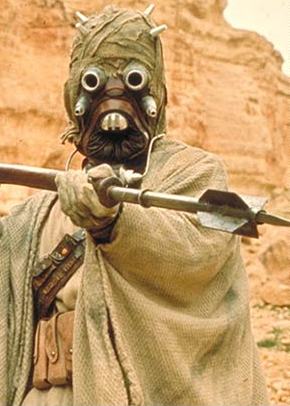
For example, in Star Wars Episode IV: A New Hope, the threshold guardians are the Tusken Raiders who roam the Jundland Wastes surrounding Luke Skywalker’s home. Venturing out into the wastes is dangerous–yet Luke does it, to bring back R2D2 after the droid runs away.
When R2D2 warns Luke that the Tuskens are approaching, Luke doesn’t run away from them–he crawls to the top of the ridge to get a better look. This leads to his first real encounter with danger, and almost gets him killed. Fortunately, Obi Wan Kenobi rescues him and takes him home, telling him about the ways of the force and presenting him with his father’s lightsaber. The adventure is off to a good start.
If Luke had never ventured out into the Jundland Wastes, or if he had run from the Tuskens at the first sign of danger, he never would have been rescued by Obi Wan, never would have learned about his father, never would have left his home and probably would have died when the Imperials attacked his uncle’s homestead. If the Tuskens had never attacked him, he would have loaded R2D2 into the speeder and gone back home, never meeting Obi Wan as well. Without the Tusken Raiders, the whole story never would have happened.
In Harry Potter and the Sorceror’s Stone, Draco Malfoy plays a similar role. If Harry Potter had joined House Slytherin, Voldemort would probably have taken over before the end of the first book. Instead, the early animosity between Draco and Harry’s newfound friends pushed him to take sides, setting the stage for everything else that was to come.
The threshold guardians don’t always have to take an adversarial role. In a lot of stories, defeating the guardian means winning an ally, even sometimes a best friend. That’s what happens when Robin Hood spars with Little John–in fact, the trope is subverted because Little John actually wins. Or perhaps the whole thing was a secret test of character, because it’s Robin Hood’s good-natured reaction to losing that wins Little John over.
Not every instance of the hero’s journey has a threshold guardian, but many of them do. It’s a clear and compelling way to mark the threshold between home and adventure, which is present in every hero’s journey, simply by definition. When done well, it’s a great way to show what makes the hero different from all the other would-be adventurers who chose to stay home.
First of all, I recently did an interview with Elizabeth Baxter on her blog, Small Blonde Hippy. In it, I discuss Star Wanderers, Stars of Blood and Glory, and a bit about my path to becoming an indie author. You can find it here–go check it out!
Second, in preparation for the new ebook versions of my novels which I plan to release soon, I’ve been going over some of the old blurbs and updating them. It’s harder than you might expect! I think the new ones are getting better, but I’d appreciate some feedback before I post them. What do you think?
For Genesis Earth:
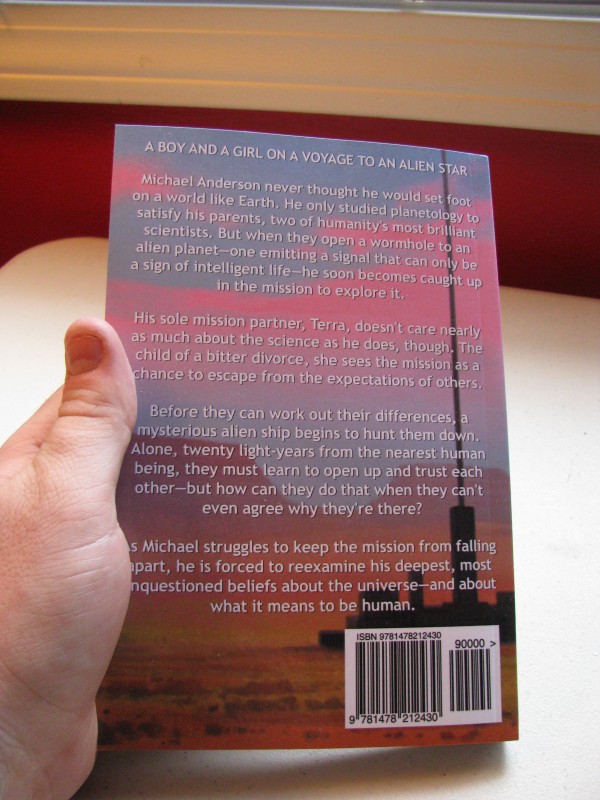
A BOY AND A GIRL ON A VOYAGE TO AN ALIEN STAR.
Michael Anderson never thought he would set foot on a world like Earth. He only studied planetology to satisfy his parents, two of humanity’s most brilliant scientists. But when they open a wormhole to an alien planet—one emitting a signal that can only be a sign of intelligent life—he soon becomes caught up in the mission to explore it.
His sole mission partner, Terra, doesn’t care nearly as much about the science as he does, though. The child of a bitter divorce, she sees the mission as a chance to escape from the expectations of others.
Before they can work out their differences, a mysterious alien ship begins to hunt them down. Alone, twenty light-years from the nearest human being, they must learn to open up and trust each other—but how can they do that when they can’t even agree why they’re there?
As Michael struggles to keep the mission from falling apart, he is forced to reexamine his deepest, most unquestioned beliefs about the universe—and about what it means to be human.
For Bringing Stella Home:
HE’LL GO TO THE ENDS OF THE GALAXY TO SAVE HIS BROTHER AND SISTER.
The New Gaian Empire is crumbling. An undefeatable enemy from the outer reaches of space is sweeping across the frontier stars, slagging worlds and sowing chaos. No one dares to stand up to them—no one, that is, except James McCoy.
As the youngest son of a merchanter family, James never thought he would get caught up in the Imperial wars. But when his home world falls to the barbarian Hameji, his brother and sister, Ben and Stella, are taken away as prisoners and slaves. With the rest of the galaxy thrown into chaos, only James has the determination to rescue them—even if it means losing everything in the process.
For Sholpan:
SHE’D RATHER DIE THAN BE A SLAVE TO THE CONQUERORS OF HER HOME WORLD.
Stella McCoy never thought she’d fall prisoner to the barbarian Hameji. The oldest daughter of a working class family, all she wanted was to finish her apprenticeship and start a career an astrogator. But when the Hameji conquer her home world with their starfaring battle fleets, she is forced against her will to become a concubine to one of their highest ranking warlords.
Stella would rather die than spend the rest of her life as a concubine. Fortunately, as she looks for a chance to escape, she starts to make friends in high places. But in the dangerous world of harem politics, with new friends come new enemies—ones that have the power to destroy her.
One of the changes I plan to make is to insert the blurb immediately before the first chapter. I’ve heard that a lot of ebook readers are downloading so many free books and samples that it often takes months before they get around to reading them. This parallels my own experience, so I figure it’s a good idea to have something in the beginning to remind readers what the book is and why they picked it up.
Other than that, no big changes except fixing typos and formatting errors. I’m not the kind of writer who makes sweeping changes to a published story based on reviews, one-star or otherwise.
In other news, I’m almost finished with the second draft of Stars of Blood and Glory. This has been a surprisingly fast revision, but then again, that might be because I haven’t sent it out yet to my first readers. Based on their feedback, I’ll probably do another draft before putting it in the publishing queue.
Star Wanderers is going to be my main focus until the end of the year, though. I’ve gotten a lot of excellent feedback on Part II, and should start the revisions in the next couple of days. With luck, I’ll have it published by mid-July. Part III is going to take a little more time, but I’m pretty confident I’ll have it up by October at the latest.
For that to happen, though, I need to get back to writing. So long!
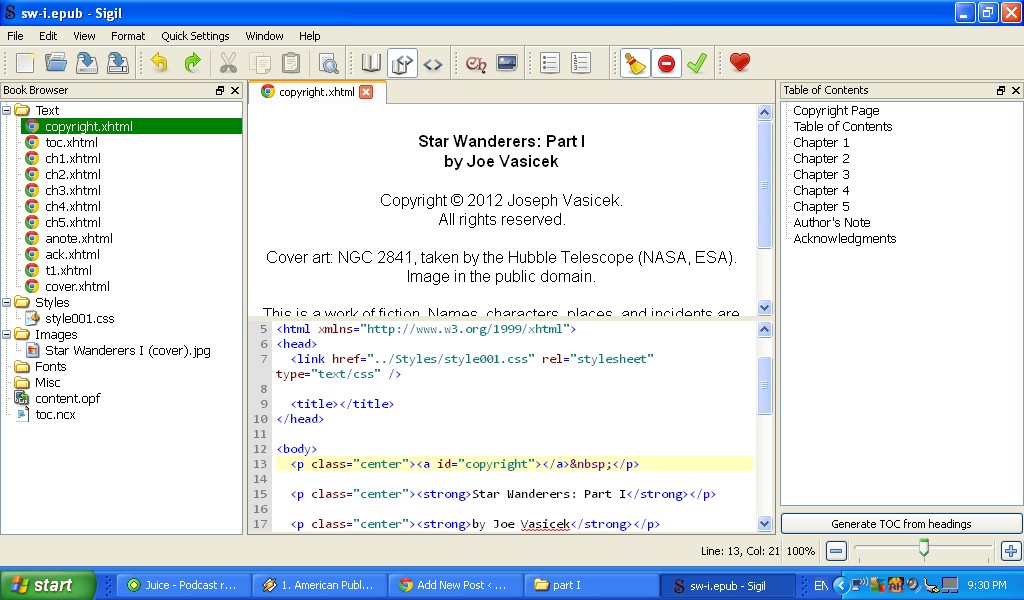
Under the hood of my latest ebook release, Star Wanderers: Part I.
So a couple of days ago, I set out on a quest to figure out a better way to build an ebook. In the process, I ended up learning WAY more about ebooks than I’d bargained for, in the most awesome of possible ways. Seriously, I don’t think I’ve ever felt so empowered as an indie author as I do right now.
My old process was extremely convoluted. It basically involved saving my manuscript as HTML (introducing all kinds of excess code) and using four or five programs to cobble together a Frankenstein-like creation, with bolts sticking out of its forehead and extra arms and fingers sticking out of weird places. The tools I was using were like blunt instruments, and I was operating them blindfolded.
So what changed? Well, three things:
I added the Writer2ePub plugin for Open Office / Libre Office,
I downloaded an open-source epub editor called Sigil, and
I watched this video:
So what did I learn?
<geek>
First of all, that ebooks are WAY simpler than I thought they were. An epub is basically a zipped folder containing HTML files for the text, jpgs/gifs for the cover and any interior illustrations, a CSS stylesheet, maybe some extra fonts (if you want to get fancy), and two additional additional files ending in .opf and .ncx that look a lot like HTML files.
So why is this so exciting? Because it means that if you know HTML/CSS, you can build a fully functional epub file using only notepad, windows explorer, and the command prompt. THAT’S IT! And if you want to learn HTML, you can do so for free at w3schools.com.
Basically, an epub is structured just like a website, except that an ebook reader reads it instead of an internet browser. If you can build a website, you can build an epub with very little trouble. Even if you can only tweak a website, you can build an epub with very little trouble.
</geek>
In other words, the barriers to entry for ebook publishing are ridiculously low. If you’re patient and a good learner (or hell, just a good learner), there is not a single reason why you need to spend any money to format your ebooks, upload them directly to retailers, or do anything else. Using tools that are 100% available for free, you can create a product that looks every bit as professional as anything coming out of New York–in many cases, even more professional.
So what’s my new process?
1) Format the master file in Open Office.
This includes adding the copyright page and table of contents, adding anchors (in OO they’re called “bookmarks”) and hyperlinks, adding the author’s note and acknowledgments, any teasers, etc. I save the file in open document format, add “Smashwords Edition” on the copyright page and save it as a .doc file for Smashwords.
At some point, I’m going to upgrade to Libre Office, but I haven’t gotten around to it yet. When I do, it’ll basically be the same thing.
2) Export as .epub using the Writer2ePub plugin.
I cannot tell you how happy I am with this Open Office / Libre Office plugin. It pulls out all of the unnecessary formatting and breaks up every chapter into a separate, cleanly coded HTML file, all bundled together into a fairly simple epub. SO MUCH BETTER THAN SAVING AS HTML. Or Mark Coker’s “nuclear option,” for that matter.
I don’t add the cover at this point, though. Writer2ePub adds some weird stuff if you do it that way, and I find it easier just to code it manually in the next step.
3) Finalize the .epub in Sigil.
Sigil is basically just an HTML editor with some extra functionality that allows it to build an epub from those HTML files. It’s easy to learn, simple to use, and tells you exactly what’s wrong when something breaks. Unlike Calibre and Mobipocket Creator, you can always see what’s going on underneath the hood. Simple, clean, and elegant. I love it.
This is the phase that takes the most work. I add the cover, fill in the relevant metadata, tweak the CSS stylesheet for margins and indents, add the book guides, build the table of contents, etc. If you want to know exactly how I do this, let me know and I’ll write up a post on it later. It’s a little technical, but not too difficult. Like I said, if you know even a modicum of HTML, you can figure it out.
Once this step is finished, I have the final epub version of my book. I upload that to Pubit! and Kobo Writing Life, and just about anywhere else outside of Amazon where I sell my book. Someday soon, Smashwords will hopefully allow you to directly upload an epub, at which point I’ll do that here as well.
4) Convert to .mobi with KindleGen.
Amazon uses its own proprietary format for ebooks, unlike everywhere else, which takes the open source epub format. This is probably because of all the weird and funky stuff that Amazon likes to track for data collection purposes, although honestly, who knows? A mobi file is about twice as large as an epub, and I suspect that that’s the reason.
KindleGen is a free program that Amazon has made available to developers in order to facilitate conversion of epubs and other ebook formats into mobi. It’s a command line tool, which means that you have to get a little retro to use it. But hey, I grew up in the 90s with DOS, so it’s actually kind of nostalgic.
Once you’ve got KindleGen installed to c:\kindlegen, all you basically need to do is go to the file folder where your ebook is saved and enter the following command:
c:\kindlegen\kindlegen mybook.epub -c1 -verbose
“mybook.epub” is whatever you named your epub file, “-c1” stands for standard DOC compression, and “-verbose” stands for verbose output (whatever that means). There are other options you can enter, but I’m not sure what they do yet. All I know is that if you want to convert from epub to mobi, this will give you a clean result.
There are a few small things that get lost in the conversion, so you need to add them as redundancies in the epub. The biggest one I’ve noticed so far is the paragraph indents: if you go into the CSS stylesheet using Sigil and add p { … text-indent: 2em; … } that should fix it.
And that’s it! Once this step is finished, I’ve got the final mobi version and can upload that directly to Amazon and my kindle. Once that’s done, my book is available from every major ebook retailer in every country in the world. Total time = maybe an hour (plus however long it takes for the retailers to publish the files to their stores).
I know it’s 2012 and this is old news by now, but do you have any idea how cool this is? With one hour of work and two or three programs, all of which are available for free, I can produce a clean, professionally formatted ebook, and sell it around the world instantaneously with a marginal cost of zero.
And now, because I took the time to learn how to use the tools, I can be confident that there aren’t any bits of rogue or useless code in it either. The only “black box” is really the mobi format, but I could probably crack that and figure it out if I wanted to.
So yeah, needless to say, I am extremely happy to be an indie writer. 🙂
However, it is not typically where the story begins. In order for the hero to leave the ordinary world, he must first start out there, so we know what’s at stake and what he’s leaving behind. This is why Luke Skywalker starts out on his uncle’s homestead, and why Neo starts out as a bored and lonely employee of Metacortex. Events outside the hero’s experience may have already put him on a trajectory to leave on the adventure, but he won’t know it until the call comes.
The hero may start out in a quiet, peaceful village, far removed from any sort of conflict–or he may start out in the middle of a crapsack world, as is the case with dystopian fiction. The important thing is that it’s the world he’s always known–that he hasn’t ever really made an effort to leave or change it.
How he feels about his world largely determines how he chooses to respond to the call. In older literature, the hero typically refuses it. The advantage of this is that it gives the reader a sense of scope–that this adventure is not a small or a trivial thing. It also sets up an immediate minor conflict that gives some motion to the opening chapters.
In modern stories, though, it’s more common for the hero (or his friends) to jump at the call. There are also many advantages to this. In Lord of the Rings, it gives Frodo an immediate band of sidekicks. In Harry Potter, it plays up the sense of wonder at the magical world. In the Chronicles of Prydain, it highlights the impulsiveness and naivete of Terran, as he realizes later on in the story just how stupid of him it was.
So after a month of waiting, Kobo’s publishing platform, Writing Life, is finally up! I just finished uploading all of my titles (except my short stories–I’ll just continue to distribute through Smashwords for now). Genesis Earth is already available, and the others should be up soon.
For those of you who are readers, this means that you’ll be able to find my books on Kobo almost as soon as they go up on Amazon. The formatting will (hopefully) be cleaner, since I’ll have direct control. Prices will generally be the same as on other platforms, but when I change the price on Amazon, I’ll change it simultaneously on Kobo, too–no waiting for weeks on end for the price to drop.
For those of you who are writers, I’ll be sure to keep you updated with thoughts on my experience. So far, it looks pretty good: the royalty rates are better than Amazon (70% for titles priced $1.99 – $12.99, 45% for all other titles), the publishing process is faster, and the upload formats (.epub, .doc, .docx, .mobi, and .odt) are generally more flexible. Downsides include a higher minimum threshold for direct deposit ($100 or every 6 months), fewer category choices, and what appears to be a forced 2:3 aspect ratio for cover art.
Besides that–oh, look, Bringing Stella Home and Journey to Jordan just went up too! Man, that’s fast! And it looks like the aspect ratios went back to 3:4, so I won’t have to redo the covers. That’s a relief! So yeah, I’ll be sure to keep you updated.
Also, in preparing my books for upload to Kobo, I discovered some pretty egregious formatting errors for the Barnes & Noble copies of Bringing Stella Home and Sholpan. I’m not sure what happened–probably it had something to do with an older version of Calibre or Open Office, since I was overseas at the time and only had access to my netbook. So yeah, if you downloaded one of the broken copies, just shoot me an email and I’ll send you the updated epub version, no questions asked.
In general, I need to revamp my publishing process. Currently, it resembles jumping through a ring of fire while juggling half a dozen angry poodles. Open Office, Mobipocket, Notepad, Calibre, KindleGen, DOS prompts, and Kindle for PC–yeah, I’d better get on that. If you have any suggestions for free/open source software that does .mobi and .epub, please let me know.
In other news, I finished my first pass through Stars of Blood and Glory, and should be finished with draft 2.0 by the end of the week. After that, it’s back to Star Home and Star Wanderers.
I just read a fascinating Q&A on Reddit with Hugh Howey, author of the self-published phenomenon Wool. After six trancelike hours reading through all the comments, all I can say is “wow.”
Okay, I guess I can say a little more. Yesterday, I listened to Brandon Sanderson’s lecture on self-publishing from his English 318 class this year. While I agree with much of what he says, a lot of it is already out of date. Probably the biggest thing is whether it’s still advantageous for indies to go with a traditional publisher after making a name for themselves. In 2011, Amanda Hocking had some good reasons for going traditional. In 2012, Hugh Howey has some very good reasons not to.
The other big thing, though, is this idea of author platform–that to be a successful indie, you have to find some way to drive large numbers of people to your books. Well, not necessarily. Hugh Howey was a nobody for three years, and the title that finally pushed him over the tipping point was the one he promoted the least. To me, that shows:
current sales are not a predictor of future sales, and
a great book will grow into its audience independent of its author.
Granted, there may be a threshold that needs to be crossed before word-of-mouth really starts to kick in, but if a nobody with passable cover art and no author platform can cross it, that threshold isn’t very high–and that’s good news for all of us.
The way I see it, there are three big myths that writers struggle with in making the shift from traditional to indie publishing:
1) The flood of crap books will keep you from getting noticed
This grows out of the paradigm of limited shelf space–that the best way to get noticed is to have your book occupy more space relative to all the other books on the shelf. This might be true in the brick and mortar world, but the rules are much different in the digital realm.
Think about it: how many new blogs are launched every single day? Thousands, if not hundreds of thousands. And yet people still find the good content amid the sea of crap. On Youtube, an average of one hour of video content is uploaded every single second. And yet there are still entertainers making a lot of money through their Youtube channels.
The rules in the digital realm are completely different from everything in the physical world. Figuring that out requires a huge paradigm shift, one that even indie writers struggle with.
2) Publishing a book is an event that must be promoted
This grows out of the paradigm of velocity, or as Kris Rusch puts it, the “produce model” of publishing:
Every month publishing comes out with brand new product. Shelf space is limited in every single brick-and-mortar bookstore. Big Publishing makes the bulk of its money during the first few months of a book’s existence. So if a book sits on a bookstore’s shelf until the book sells and that sale takes six months to a year, the bookstore and the publisher lose money.
Better to dump the old inventory on a monthly basis—for full credit for unsold items—than it is to have the inventory sit on the shelves and grow “stale.”
Of course, the flaw in this logic is that digital shelf space is unlimited, therefore books do not “spoil.” No matter how much time passes, an ebook can still be found in the same place.
Therefore, does it really make sense to make a big deal over an indie book release? Maybe to jump start some word-of-mouth, but it’s not like your career is going to be harmed if you do nothing. In fact, it might be better to hold off until you have a few more titles up, so that when you give the first one that push, readers will have something else to read once they’ve finished it.
3) To succeed you need to find a way to “break in”
This grows out of the gatekeeper paradigm, where the system is closed and the few entry points are guarded by a select group of taste makers whose job is to bestow legitimacy on those who meet the qualifications to get in. It’s the concept of patronage, where success comes from being chosen by a wealthy benefactor, and it’s connected with the idea that you haven’t truly “arrived” until <fill in the blank>.
The flaw with this paradigm, of course, is that publishing is no longer a closed system. The gates haven’t just been flung open, the walls themselves have been torn down. The job of the taste makers is no longer to protect readers from the dross, but to lead them to the gems–which is honestly much closer to what it should have been in the first place.
So what does this mean for creators? It means that there’s no longer a system to break into. You don’t need to write better than everyone else, you just need to find (and keep) your 1,000 true fans. Success isn’t bestowed upon you by some higher authority, it’s something that you discover on your own as you hone your craft and build your business.
Honestly, this is one that I still have a lot of trouble with. When I left to teach English in Georgia, in the back of my mind I had this vague notion that I was going into a self-imposed exile, and wouldn’t come back or settle down until I’d “broken in.” Of course, this made me quite discouraged, because it felt like things were out of my control–or worse, that I’d somehow failed.
But listening to Brandon’s lecture and reading Howey’s Q&A session helped me to remember that it’s all still in my control. I don’t need a benefactor, I just need a good plan, if that makes any sense. So right now, I’m thinking things through and making the necessary revisions to that plan. There probably won’t be any big ones–I still think I’m more or less on the right track–but it will be good to update my paradigm.
By the way, the title of this post applies to the Q&A with Hugh Howey, not to the post itself. Though if you are thinking of self publishing, I hope it’s helped out in some way.
Also, I just finished part I of Wool, and it deserves every bit of praise that it’s got. Expect to see a review of the omnibus shortly.
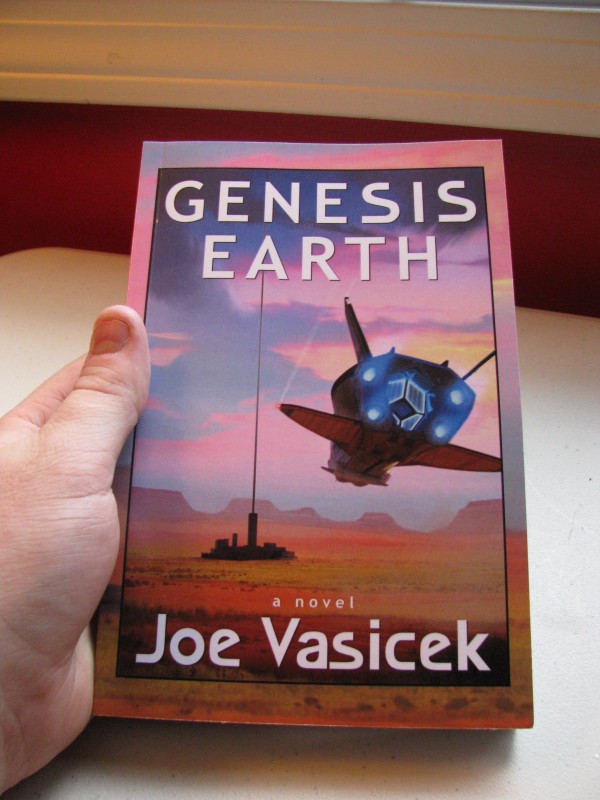
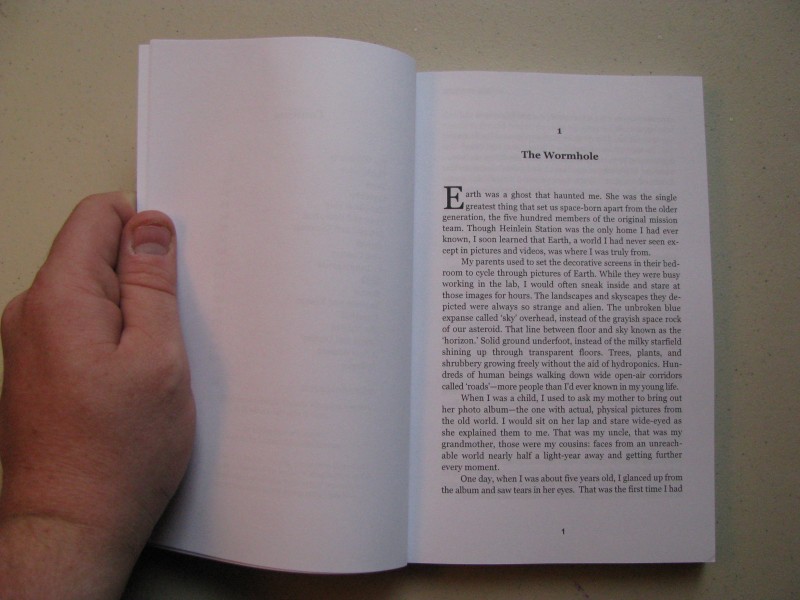
The proof for the print edition of my first novel, Genesis Earth, just came in the mail–and it looks AWESOME! Check it out!
Front cover.Back cover.Page 1, Chapter 1.
Holy crap, it is so cool to have a book in my hands THAT I ACTUALLY WROTE. So cool!
I approved the proof a couple of hours ago. It’s currently up for sale on CreateSpace (where I get a higher royalty), but it should also be up on Amazon in 5-7 business days. I haven’t opted for the extended distribution, which means that those are the only places where it’s going to be available for a while. I might opt in a little later, but I haven’t made a decision just yet.
Next step: put out print editions for Bringing Stella Home and Desert Stars. Those should be coming soon, probably by mid-August.
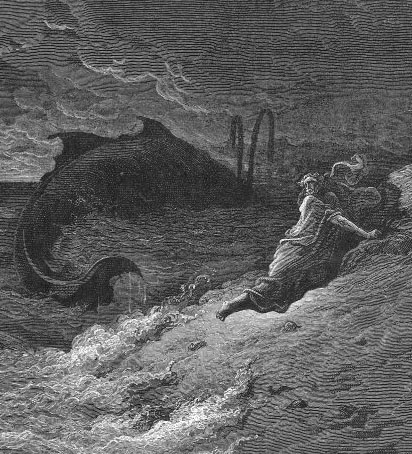 The last stage in the departure phase of the hero’s journey is called the Belly of the Whale, after the Biblical story of Jonah. After receiving the call and passing the threshold to the land of adventure, the hero faces what may quite possibly be the darkest hour of his life and dies in some way to the home he has just left behind.