So with Star Wanderers coming to a close, at least as far as the actual writing is concerned, I’ve recently found myself back in that weird writerly place where I don’t have any pressing projects to work on. Whenever this happens, I find that it’s generally a good idea to start something new.
Until just a couple of days ago, though, I wasn’t sure which project to start. At first, I thought I should do the sequel to Stars of Blood and Glory, since I’m currently getting that one ready to send off to my editor, but beyond a tentative title (Empress of the Free Stars) and a really awesome opening scene, nothing has really sparked for that one. With time, I’m sure my ideas will come together, but for now it’s just not ready to come out of the incubator.
So then I went back to The Swordkeeper, going back over the ideas that had sparked that one. I started the opening scene back in March, but it’s currently lackluster, and none of my attempts at worldbuilding have gotten me anywhere. For the past six months, I haven’t really touched it.
But when I took the time to just think about the story, something amazing happened. All my ideas came together, and the ending just came to me–not just for the first book, but for the entire series. Seriously, I must have spent hours staring out across the Georgian countryside from my farmhouse balcony, totally in awe of the story in my head.
A similar thing happened to me last summer with Stars of Blood and Glory. It took me a few months to finally get around to writing it, but when I did, the first draft flew out in just a matter of weeks. I’ve since made a few relatively minor fixes to the beginning and added some scenes that were missing, but otherwise haven’t made any substantial changes, and the comments from my first readers so far confirm that that’s the right decision.
So if all goes well, I’ll finish up with Stars of Blood and Glory by the end of this next week, and restart The Swordkeeper soon after that. Things are looking good, and I can’t wait to get immersed in this next story. It’s a fantasy, so that’s going to be a major shift, but I think it will help to keep things fresh.
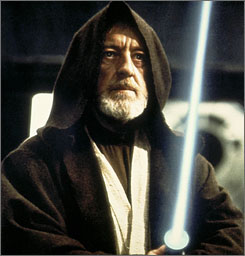
And that right there is the heart of the matter: mentors tend to die. And stay dead. Even if they do figure later in the story, they tend to be spirit advisors from the other side with little or no chance of coming back from the grave–even if everyone else does.
So why does this happen?
The most obvious reason is that if the mentor and the hero are both working toward the same goal, the mentor cannot overshadow the hero–otherwise, why not forget the hero and send the mentor off to save the world? The hero may start off weak, which is why he needs the mentor in the first place, but at some point in the growth arc, he’s going to have to stand on his own two feet. Oftentimes, the most poignant (and convenient) way to mark that transition is to knock the mentor off.
That doesn’t explain everything, though. If the only reason for killing the mentor is to give the hero a growth arc, you can accomplish that just as well by putting him on a bus. So why does he have to die?
Lots of reasons! Character growth, increasing tension, making the story more meaningful–the list goes on and on. For an in-depth discussion on killing off characters, I’d recommend checking out this last week’s episode of Writing Excuses. My own personal take is that everyone dies eventually–even the immortal characters have to pass through some sort of transition from this world to the next–so the best thing I can do for a character isn’t to keep them alive, but to make their lives and their deaths actually mean something.
It’s also worth pointing out that in most stories, the mentor isn’t actually fighting against the big bad, but the dragon–the big bad’s lancer. Again, the main reason for this is to keep him from overshadowing the hero. But the dragon is a character in his own right, with his own agenda that may run counter to his boss–think Darth Vader from Star Wars. And in a lot of stories, the dragon actually tries to tempt the hero to come around and join him.
Perhaps that’s another reason why mentors often die–if they didn’t, then the bad guys wouldn’t ever be able to dissuade the hero through temptation. The hero would be so protected that he’d never have the opportunity to switch sides, or at least he’d never have to face any moral ambiguity because of the guardian mentor constantly guiding him.
So those are some of the reasons why mentors tend to have a short life expectancy. Can you think of any good ones?
So I’m back in Kutaisi again, recharging my netbook battery due to some chronic electricity problems out in the village. Seriously, I think I heard a transformer explode this morning. Anytime it rains, you can prettymuch expect a blackout here in rural Georgia. Hope for the best, plan for the worst–but that’s the subject for another post.
Anyhow, here’s where things currently stand with Star Wanderers:
Part III: Sacrifice is almost ready for publication, and will hopefully be up in a few weeks. I’m just waiting for some feedback from my first readers, to make sure there aren’t any major problems. I made some pretty big changes to the story after getting some helpful feedback I got from my friend Laura, so I don’t want to put it out until a few other eyes have seen it in its current form. Of course, I’ll need some help with proofreading, so if anyone wants to exchange services (proofreading or formatting), just shoot me an email.
As for Part IV: Homeworld, I’m currently wrapping up the 2.0 draft and should have it finished by the end of the week. I’m really excited about this story, especially the ending I have planned and the way I want to bring together all the threads from the first three parts. You know that moment when a story just comes together naturally, without being forced or anything? Yeah, that’s what I’m experiencing right now. It’s awesome.
So the plan is to publish Star Wanderers: Sacrifice (Part III) sometime in mid-late October, and to publish Star Wanderers: Homeworld (Part IV) sometime in November. As with parts I and II, they will both be free via Smashwords for the first two weeks to subscribers of my email newsletter. To sign up, fill out the form in the sidebar ——–>
This isn’t the end of the Star Wanderers series, of course. I’ve already completed the first draft of a parallel novelette to Part I: Outworlder from Noemi’s point of view. I’d also like to do stories with the other characters, like Samson or Mariya. And of course, there’s the omnibus for parts I-IV, which I’ll probably release early next year. If you’d like to see a story from any particular point of view in this universe, let me know–I’m always open to new ideas.
In the Gaia Nova series, I’m hoping to publish Stars of Blood and Glory by January. I’ve been in touch with my copy editor, and things are looking good for a 2012 release. I need to make another quick revision pass first, which I’ll probably finish in October, and then we’ll see about getting the ball rolling.
So that’s where things stand right now. I’m happy to see that sales are trending up on all the platforms where I’m published, which means that I can reinvest more in new titles and put them out more frequently. And my teaching schedule here in the village is pretty light, which means I have lots of time to write–that is, when we actually have electricity. And even when we don’t, there’s always pen and paper.
That’s just about it for now. My battery’s almost at 100% and it’s starting to get dark, so I’d better go. See you all later!
So last week was the first week of school here in Georgia, but before I blog about that, I thought I’d do a post on the short backpacking trip I did with a friend of mine the week before. It was a lot of fun, even if our plans did change about a dozen times along the way. That tends to happen a lot to plans here in Georgia, but if you’re flexible and can roll with it, you can have a lot of fun anyway.
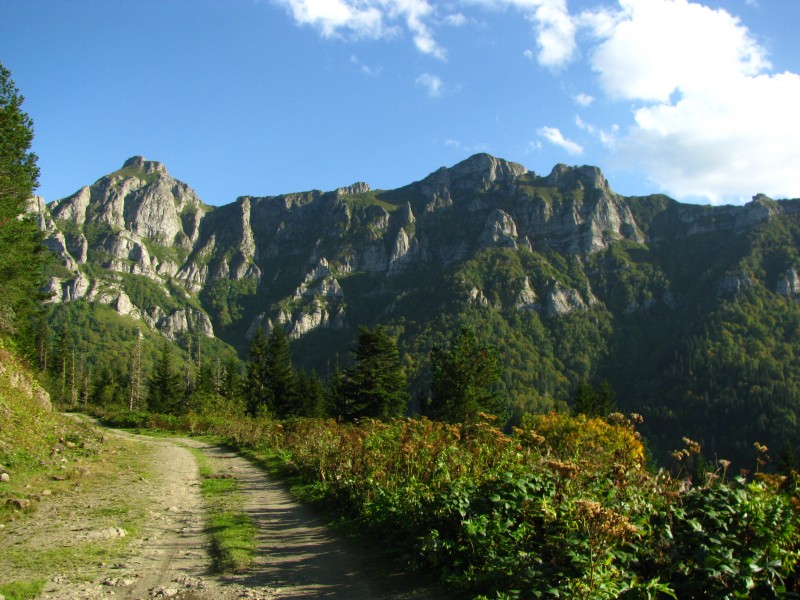
So our original plan was to go from Baghdati to Sairme, a small resort town in the Lesser Caucasus range just south of Kutaisi, and from there catch a bus over the mountain and hike a few trails out in the western side of Borjomi National Park.
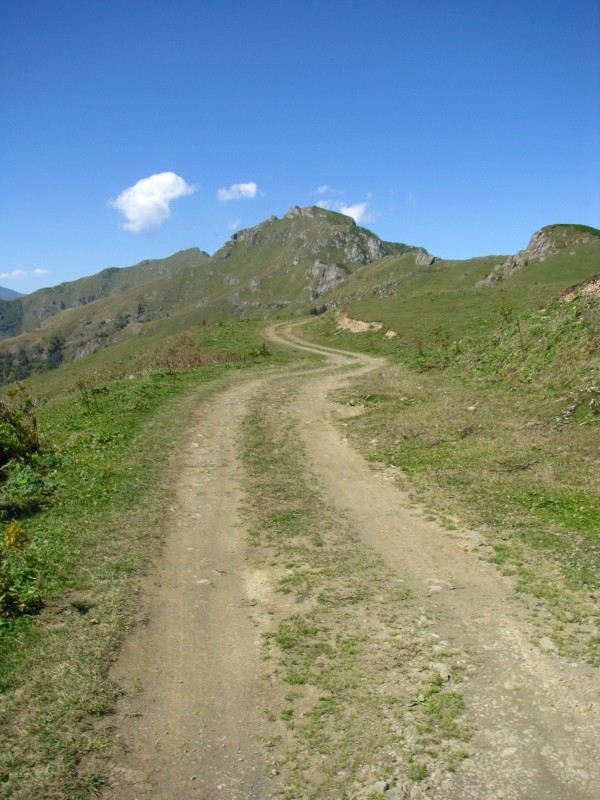
Well, when we got to Sairme, we found that there isn’t a bus that goes over that road, and for good reason. It isn’t exactly a “road”–more like an unusually wide dirt path. Farmers sometimes use it, but only because they’re local and it doesn’t make sense to go 80+ kilometers out of the way on the main route from Zestaponi to Surami.
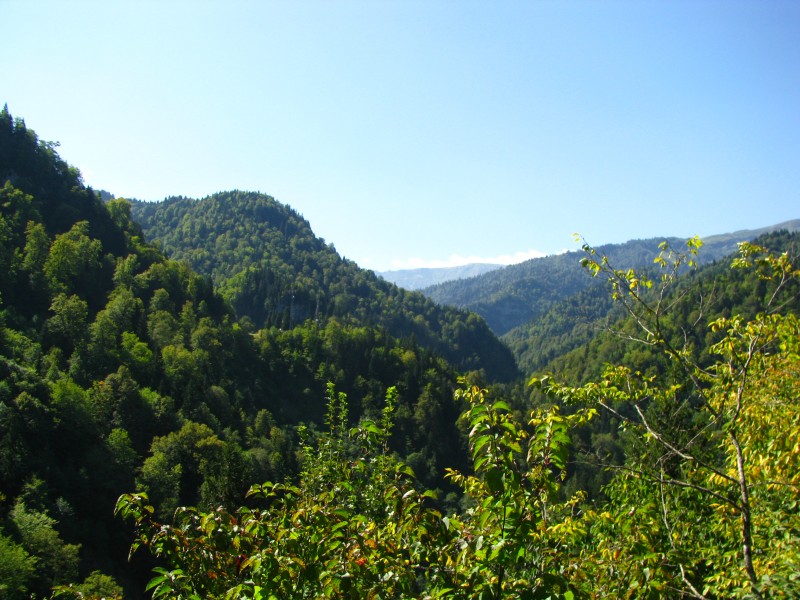
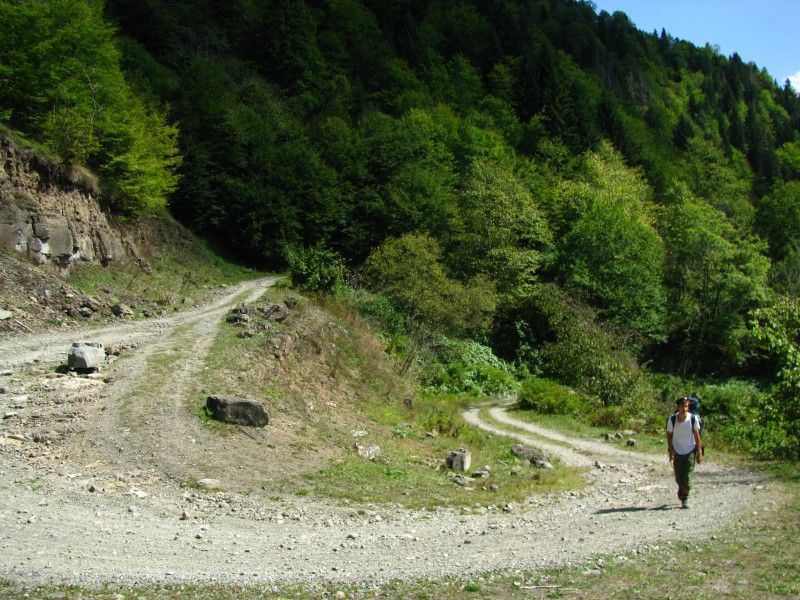
The mountains around Sairme.The “road” from Sairme to Abastumani.
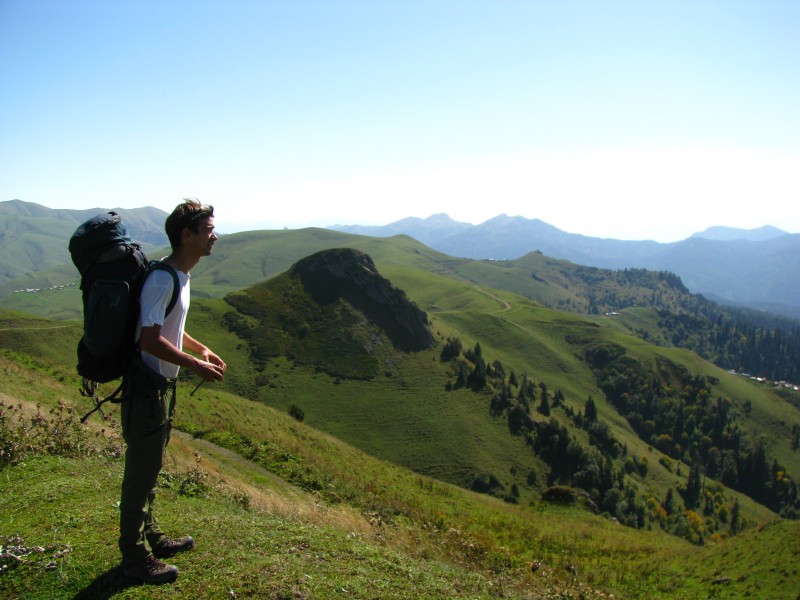
The locals told us it was about 35 km to walk to Abastumani, so we figured “hey, we have food, sleeping bags, and a tent–why not hike it?” According to the map, if we left at 1pm and averaged 3 km/hr, we estimated we should reach the pass just around sunset.
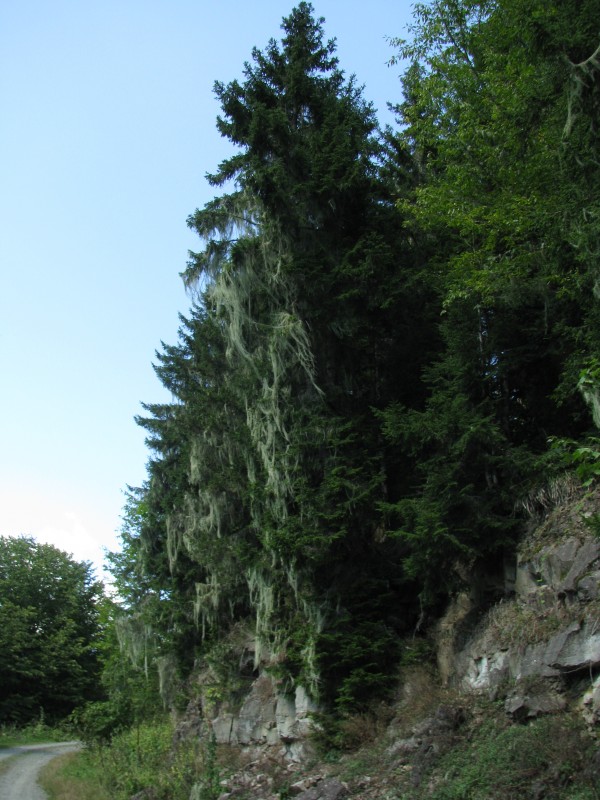
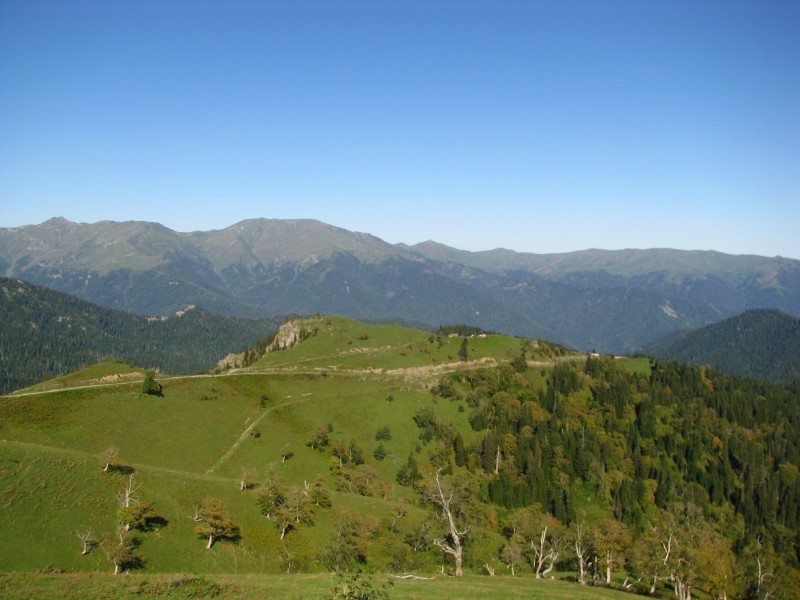
Some interesting moss around the 2,000 meter elevation mark.Mount Didmaghali, just above the treeline. We camped about two kilometers from here.
The calculations were fairly accurate; we hiked for about 6 hours, making about 18 kilometers on the first day and climbing around 1300 meters. In all that time, we only passed three vehicles, and they were all heading back to Sairme. One of them was carrying a bunch of guys who were so surprised to see us, they gave us a giant wheel of cheese. We gave half of it to a local farmer who looked like he needed it more than us, and ate most of the rest over the course of the next few days.
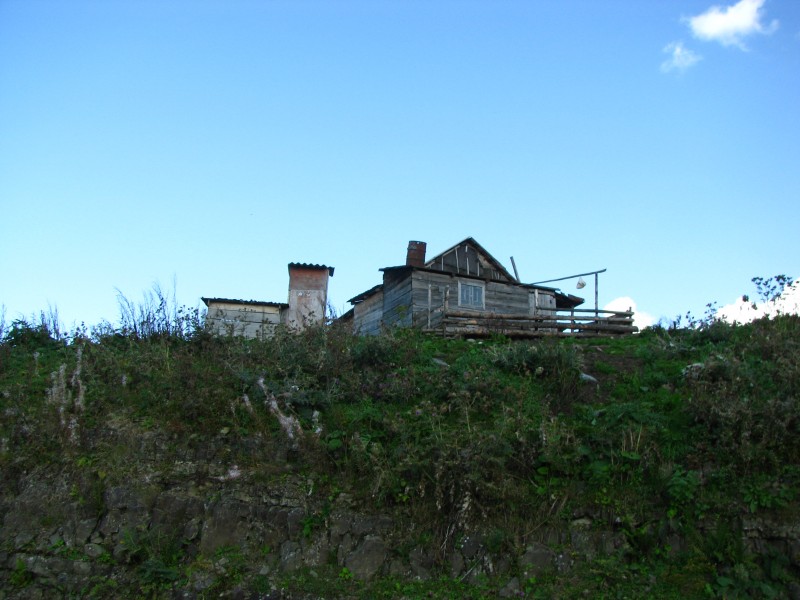
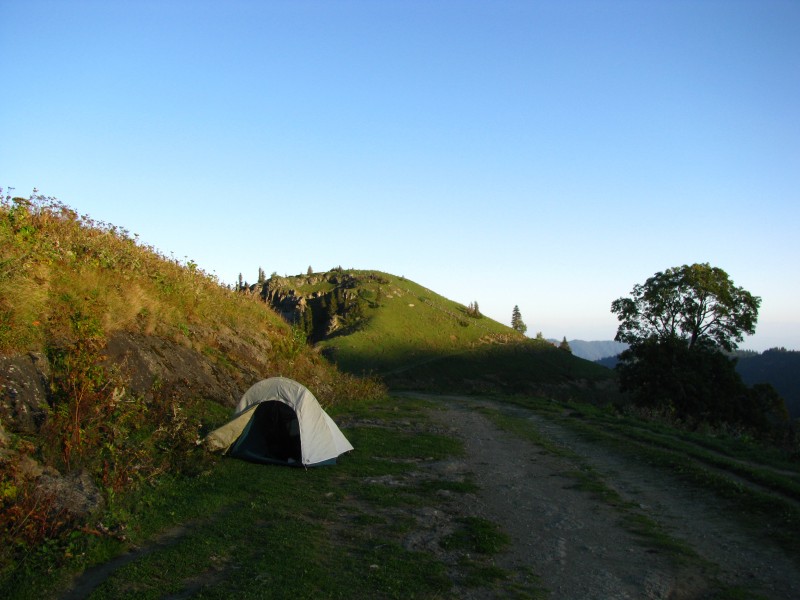
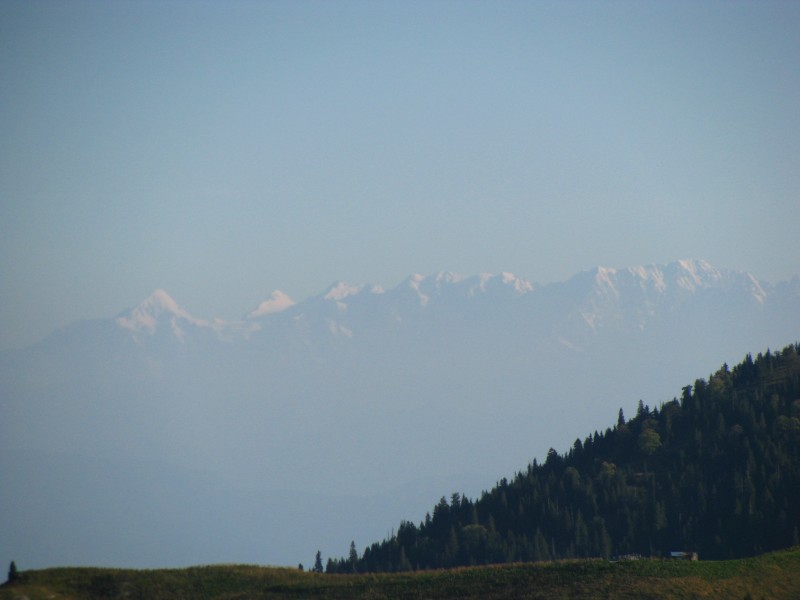
One of the farmers’ huts up above the treeline. The guys who farm here are generally seasonal workers, who live in the valley during the winter.Our campsite, by the side of the road near Mount Didmaghali. It got a little windy at night, but was actually quite comfortable.That moment when you realize “OMG, those aren’t clouds–those are MOUNTAINS!”
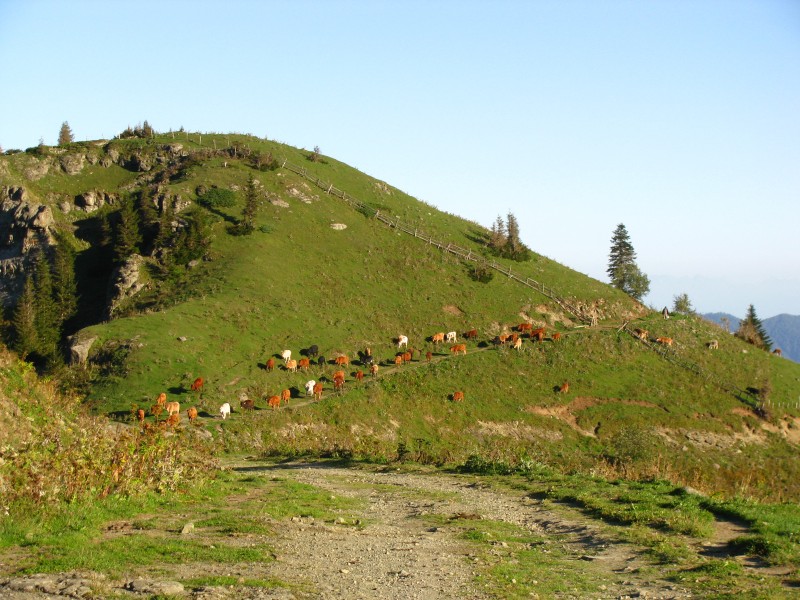
We camped out just above the treeline, next to a hill where a bunch of cows were grazing. The local ranchers brought the herd back in while we cooked dinner, which was kind of cool. Imagine a couple hundred cows walking past your tent. The good thing about being so close to the farmers, of course, was that we didn’t have to worry as much about bears and wolves.
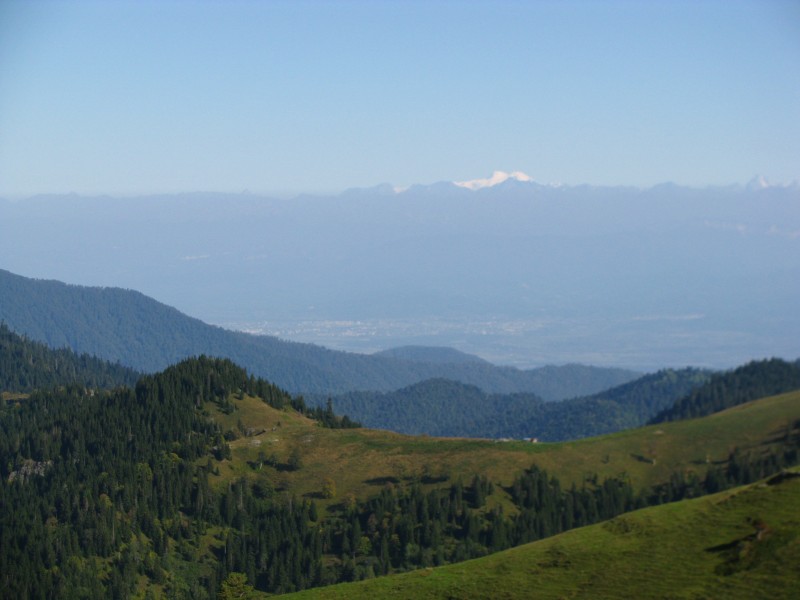
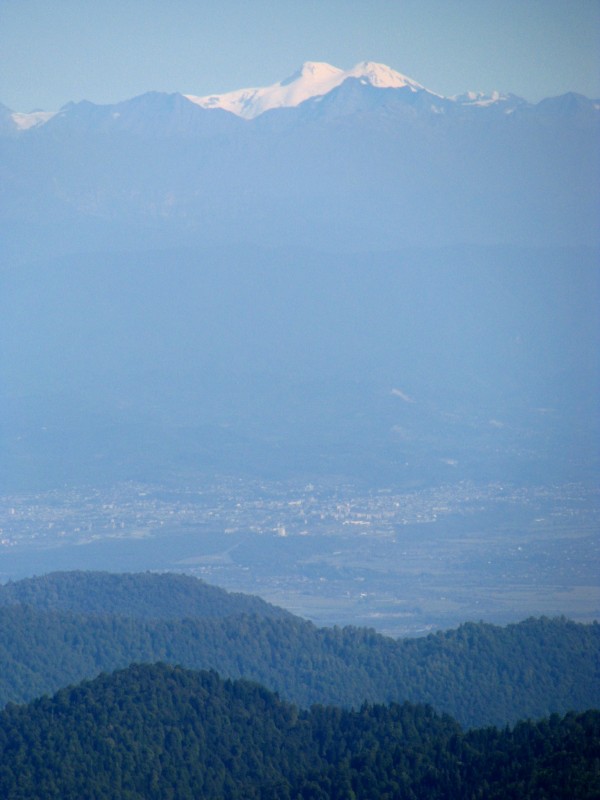
At one moment while we were looking out acros the way we came, the clouds on the horizon began to part somewhat, and I had one of those stomach-dropping moments as I realized that most of those white shapes weren’t clouds, but mountains. We were looking at the Greater Caucasus range, with Mount Elrus standing above the mountains of Svanetti and a whole bunch of other snow-capped peaks further off to the east.
As the sun sent, the temperature dropped fairly quickly, and the wind picked up a lot. I wasn’t able to sleep for a few hours, it was so strong. But the stars were beautiful–at one point, I saw a satellite that was so bright it had to be the ISS. Cool stuff!
The farmers bringing out the herd in the morning. One of the cows ate some of our bread, which was kind of annoying, but I guess I shouldn’t have left it out. Cows will eat (or try to eat) just about anything!The view from the top of the first pass, just east of Mount Didmaghali. The little hill on the left is where we spent the night.Mount Elrus, with several other major Caucasus peaks below it. You can also see Kutaisi and some other settlements in the valley.The view from Zedeki pass.
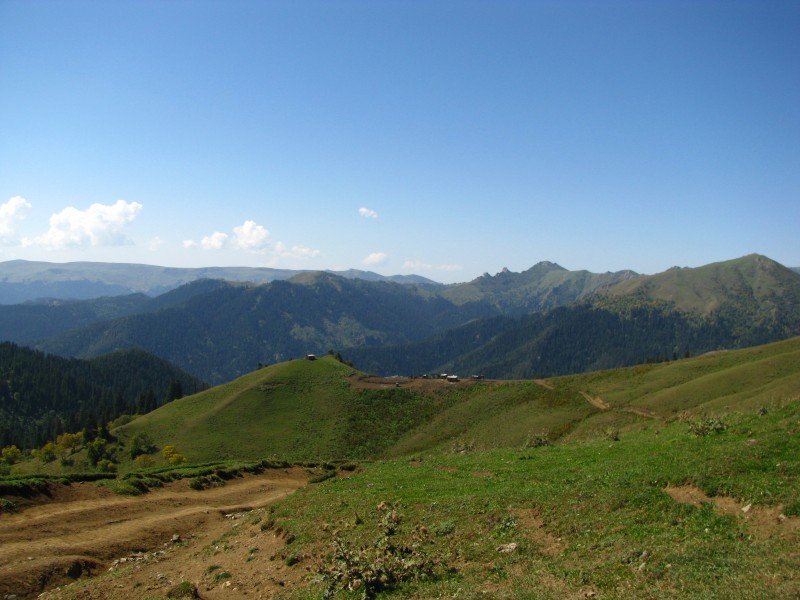
The next day, we had a beautiful hike up to the first pass and over the mountains into Samtskhe-Javakheti. The weather could not have been more perfect–it warmed up as soon as the sun came up, and was pleasant for the rest of the day. We had some amazing views, too, especially from the top of the pass.
The road on the other side of the pass.The view on the other side of the pass. Those are the mountains of Samtskhe-Javakheti, with Turkey and Armenia in the distance.
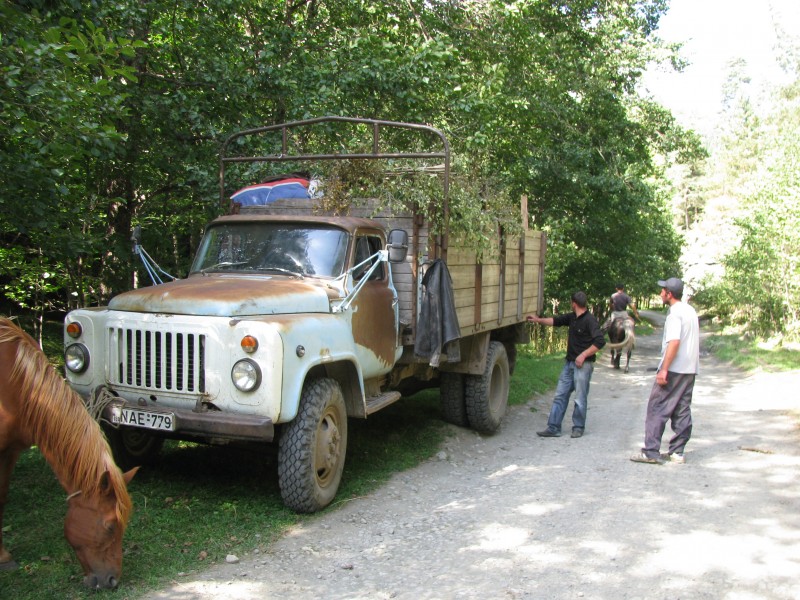
On the way back, we fell behind a bit, so we decided to hitch a ride with a passing farmer’s truck. The guys were hauling some empty barrels, a bunch of brush, and some calfs, and they put us in the back with the animals.
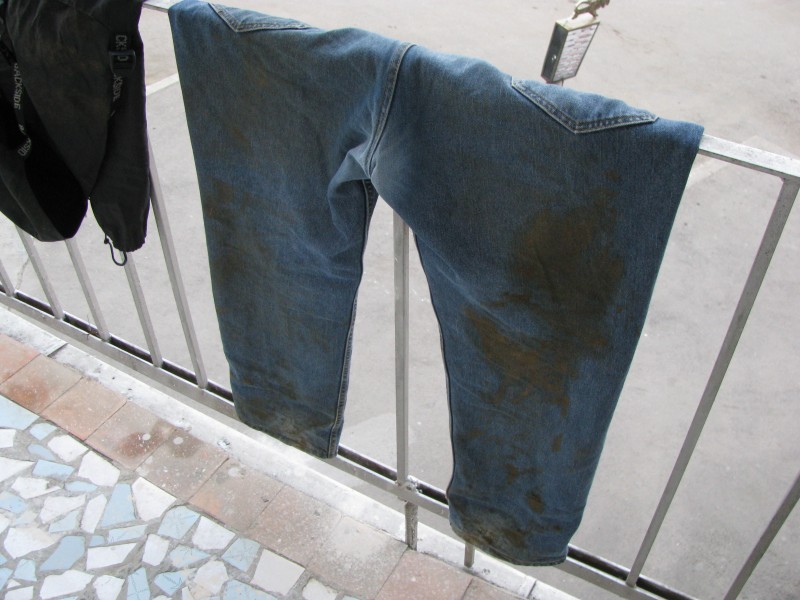
Wow, was it crazy! The road was so bumpy, literally every other bounce almost threw us off of the truck. The cage would pull back branches and snap them back so hard, some of them could have knocked us off as well, and the cows crapped all over the place, including the back of my pants. For most of the way, we had a sheer cliff on one side, and even though there were lots of trees, it was pretty scary, especially at the switchbacks.
In other words, it was an adventure!
The truck that took us down most of the way. Bumpiest ride of my life!My pants, after the cows got to them.
I wish I had some pictures from the ride, but it was all I could do to hang on for dear life. After about 45 minutes, my hiking partner had had enough, and demanded that the guys stop and let us off. My camera had fallen off in the truck bed, but I didn’t realize that until we were back down. Fortunately, we were only about 5 km from Abastumani, and found the guys just outside the settlement. The camera was still in good shape, and in typical Georgian fashion, they invited us for bread, cheese, and cha-cha.
So it ended up being an awesome two days of hiking and backpacking. The views from above the treeline were incredible, and the conditions were absolutely perfect–we could not have asked for better. We spent the next couple of days exploring Akhaltsikhe, Borjomi, and Bakuriani, but I’ll save that for another post later–this one has gotten long enough.
So yeah, it was definitely worth the trouble bringing out all the backpacking gear from the States. I hope to have plenty of opportunities to use it again before the end of the season!
This happens a lot more often than you might think. Magneto (X-men), Lucius Malfoy (Harry Potter), Hannibal Lector (Silence of the Lambs), Ganondorf (Zelda), Captain Nemo (20,000 Leagues Under the Sea), the Godfather (the Godfather), Kane (Command & Conquer), President Shinra (Final Fantasy VII), the Merovingian (The Matrix Reloaded), Grand Admiral Thrawn (Star Wars: Heir to the Empire and The Thrawn Trilogy), Khan (Star Trek II: The Wrath of Khan), Vetinari (Discworld), Captain Hook (Peter Pan), the Phantom (Phantom of the Opera) and every James Bond villain ever all fall squarely into this trope.
So why does this happen? I can think of a few reasons, though I’m sure there are others.
First, it hearkens back to the age-old romanticism vs. enlightenment debate. This is especially true of the fantasy genre, which tends to hearken back to a medieval golden age before the modern, industrial world, when life was simpler and people tended to live in picturesque rural villages instead of dense urban cities. If your hero is a farmboy in a world of knights and wizards, or a barbarian hero who strikes first and asks questions never, chances are that anyone with a sense of refinement or culture is going to find themselves on the wrong side of the story.
Second, it hearkens back to the mad scientist and the cautionary tale of science gone horribly wrong. As you might expect, this is much more common in science fiction, especially the classic dystopian stuff. The more scientific and enlightened a character, the more cultured they tend to be as well. In stories where science is bad, then, it should come as no surprise that these characters are also evil.
Another good reason to use this trope is to indicate that the villains are members of the Empire. Culture tends to happen when people of diverse talents and backgrounds are brought together, and the best way to bring them together is through conquest. Just look at the Romans. Almost every empire throughout history, no matter how brutal, has always produced an increase in some degree of culture. Even the Mongols gave way to Kublai Khan and the Silk Road. So in stories where the Evil Empire comes into play, having your villains be cultured can be a good way to show that.
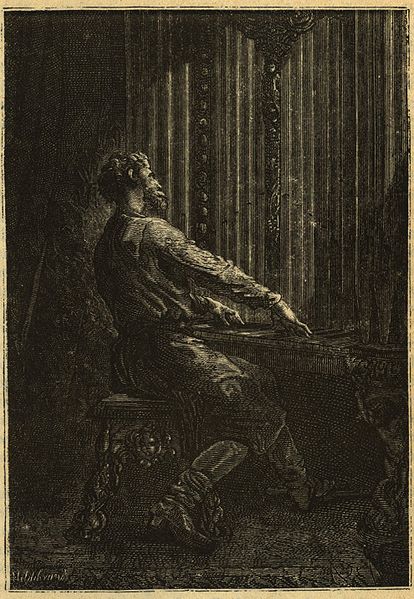
The biggest reason for this trope, though, is that it makes the villains more complex and interesting. If being evil always meant living in a cave and eating raw meat, then every story would read like a badly written RPG, where the heroes keep grinding until all their stats are at 9999 or higher. And honestly, you have to admit that there’s something a little bit eerie about that guy who gets totally absorbed when playing the organ.
I haven’t played with this trope in a major way yet, but it does come into play a bit in Desert Stars, though only in a minor way. In Bringing Stella Home and Heart of the Nebula (forthcoming), Lars is pretty much the opposite of this (the Gentleman and a Scholar trope, though he did drop out of college). Probably the best example would be Heloise from Star Wanderers: Fidelity (Part II). She’s wealthy, fashionable, and decorates her apartment with wallscreen monitors that cycle through artistic photographs of deep space nebulae. She’s also one of the more dangerous female characters I think I’ve written. Who knows–maybe she’ll show up in another story before too long.
I’m currently in Kutaisi, about to catch the night train to Tbilisi for church, but I thought I’d post a quick update just to let you know how I’m doing, and what I’ve been up to.
The last few days have been awesome. I went backpacking with a friend of mine from last semester, and we had a blast. Hiked the pass near Mount Didmaghali between Sairme and Abastumani, up above the treeline. I’ll do a big post on it sometime next week, with stories and everything (and boy, are there some stories), but before that, I wanted to share this:
That’s Mount Elbrus, the highest mountain in Europe, with the highlands of Svaneti just below it, and Kutaisi in the foreground down in the valley. The elevation difference is over 5,500 meters (18,000 feet). The picture is a bit fuzzy because of the haze, as well as the distance between points and the poor quality of my old camera, but it was an unbelievably beautiful day–as evidenced by the clear view of Elbrus’s summit.
Awesome, awesome stuff. From Zedeki pass, we could see almost the entire Caucasus range, from Mount Elbrus in the west to Mount Kazbek in the east. The conditions could not have been more perfect. Covered between 35-40 km (20-25 m) in two days, in a beautiful, remote region between Imereti and Samtskhe-Javakheti where few people, let alone tourists, ever go.
I’ve got to go now, but expect to see a longer post on the trip soon. School starts on Monday, so things might be a little crazy for a while, but I’m sure they’ll settle down soon into a comfortable and productive routine. See you around!
One thing about the hero’s journey is that it tends to be very male-centric. It’s possible to pull off a gender-swap, or to follow the structure loosely while allowing for substantial variation, but the basic form follows the assumption that the hero is male, and that most of the women he meets fall into one of two basic archetypes: sedductress (as we saw last week) or goddess.
The goddess (or “hero’s muse,” as tvtropes labels this trope) is an idealized woman who often serves to motivate the hero on his quest. She stands in stark contrast to the sedductress, who works toward the hero’s downfall, and the meeting with her is an important part of the journey. Speaking of the meeting with the goddess, Joseph Campbell said:
The ultimate adventure, when all the barriers and ogres have been overcome, is commonly represented as a mystical marriage of the triumphant hero-soul with the Queen Goddess of the World. This is the crisis at the nadir, the zenith, or at the uttermost edge of the earth, at the central point of the cosmos, in the tabernacle of the temple, or within the darkness of the deepest chamber of the heart. The meeting with the goddess (who is incarnate in every woman) is the final test of the talent of the hero to win the boon of love (charity: amor fati), which is life itself enjoyed as the encasement of eternity.
In some stories, the goddess figure represents a love interest for the hero. This is especially the case with stories from the medieval and renaissance periods, such as the protoypical knight errant and his lady, or tales of courtly love. In most cases, the girl is either faithfully married or a chaste virgin. In more modern stories, she often takes the form of the manic pixie dream girl.
The goddess doesn’t have to be the love interest, though. She can also be a motherly figure, such as the Oracle in the Matrix, or she can be an innocent, childlike girl, such as the Childlike Empress from The Neverending Story. The important thing is that she helps the hero to experience the power of love, whether that love is romantic or platonic.
I’d write more, but my internet time is kind of limited, so this is as much as I can say on this trope for now. If you have anything to add, feel free to do so in the comments. I’m traveling to a rather remote part of the Caucasus, but I’ll be back in a few days to chime in.
Hey, just a quick post to let you guys know how I’m doing.
I made it out to the village yesterday, met my new host family and got more or less settled. Due to some mixups, I ended up in Sairme (WAY up in the mountains) before making it down to Baghdati, but everything worked out well and I got to see some beautiful Georgian scenery at the same time.
My new host family is great! It’s a 35 year old guy and his mom, living on a farm in a village with all their uncles and cousins and stuff pretty close by. The guy, Dato, is way cool–he does IT at the school, farms his mom’s place, and otherwise just hangs out in the village. We played nardi last night–I actually beat him on the first go, then he slaughtered me twice. Then his aunt played him and things got really entertaining.
The house is WAY different from the apartment where I was living before. Much more spacious. It’s a couple hundred years old, though, so the wires are attached on the outsides of the walls and stuff. We’ve also got chickens all over the place. I’ll be sure to post some pictures, probably in a week or two.
I think I’ve hit it off pretty well with the family. They’re impressed that I already know a bit of Kartuli, especially the aunt. Things got a little tense when I turned down the wine and told them I can’t drink because my religion forbids it, but I don’t think it will be too much of a problem (though this being Georgia, you never know).
The mom is an awesome cook. This morning, she made one of the best breakfasts I’ve ever had in my life. The house is old but comfortable, I’ve got all the space and privacy I need, there’s a lot more nature out here in the village–I think I’m really going to like it here. What’s more, Kutaisi is only a short half-hour marshrutka ride away.
After I’m through here, I’ll walk up to my old host family’s place and drop off some gifts: specifically, some RAM for their broken down computer. Then I’ll head over to my old school, say hi to my old coteachers, run downtown to pick some stuff up, then head back out to the village. Tomorrow, I’ll meet up with a friend of mine to get some stuff for camping, then head out the next day to go backpacking in Borjomi or Tusheti. That’s the plan at least.
Oh, and about the trip to Ani: I tried to get down to Kars, but couldn’t find a bus. I ended up in Akhaltsikhe, the Georgian border town, but the only way out was to catch a taxi to the crossing ($$$), catch a taxi on the other side to the Turkish town on the other side, and from there to catch a bus down to Kars (about 140 km). I was traveling alone, didn’t know any Turkish, it was about mid-afternoon and I didn’t have a backup plan, so I ended up aborting and headed back to Tbilisi.
Oh well–it happens. I’ll try again, though, probably in a few weeks. This time, we’ll meet up in Georgia, where I actually know how to get around.
In other news, I bought three author copies each of Genesis Earth, Bringing Stella Home, and Desert Stars before I left the US. They’re signed and numbered, and if you want to buy one of them, just shoot me an email (joseph [dot] vasicek [at] gmail [dot] com). The #1 copies are already sold, but the #2 and #3 copies of each book are still available. You can buy them from me at the current Amazon paperback price, and I’ll have my parents ship them out to you.
That’s all for now. Take care, and I’ll see you guys around!
Also known as the temptress or the seductress, the vamp is one of the more dangerous characters the hero meets on his journey. A devastating beauty who is as evil as she is sexy, she uses her feminine wiles to exploit men’s flaws to her own advantage. If the hero falls for her, he will be destroyed.
Unlike the femme fatale, her more neutral counterpart, she is completely evil and cannot be redeemed. This is because her role in the story demands it. She generally makes her first appearance in the initiation phase of the hero’s journey, after the hero sets out on the adventure but before he masters the unfamiliar world. In many cases, she represents a leave your quest test or a secret test of character.
When it suddenly dawns on us…that everything we think or do is necessarily tainted with the odor of the flesh, then, not uncommonly, there is experienced a moment of revulsion: life, the acts of life, the organs of life, woman in particular as the great symbol of life, become intolerable to the pure, the pure, pure soul. The seeker of the life beyond life must press beyond (the woman), surpass the temptations of her call, and soar to the immaculate ether beyond.
As such, the vamp represents the more carnal elements of the hero’s nature, which he must reject or overcome in order to be transformed. Confronting her is an important part of the story because it gives him an opportunity to recognize his flaws and master them. It isn’t easy, though–the vamp is an extremely deceptive character, and often plays tricks like the wounded gazelle gambit to confuse the hero and gain his sympathy.
While often a female character, there are a few male examples of this character. Mr. Wickham from Pride and Prejudice is one of the more obvious ones. Basically, the vamp can be of any gender, so long as s/he is someone the main character finds sexually enticing. Because of the traditionally male-centric nature of the hero’s journey, however, she’s almost always female.
Also, I think it’s important to add that it’s not just the vamp’s sexiness that makes her evil, it’s the way that she uses it to manipulate and undermine the hero. If she starts out evil but has a heel-face turn later in the story, she doesn’t fulfill this trope. Likewise, if falling for her wouldn’t make the hero fail, then she doesn’t fulfill the trope either.
I’ve played with this trope a little bit in my own work, but not in a big way yet. Heloise from Star Wanderers: Fidelity (Part II) probably fits this trope the best, though her appearance is fairly brief. Tamu from Bringing Stella Home might appear superficially to be one, but she’s actually more of a fair weather mentor for Stella (and has good reasons for choosing the life of a Hameji consort). And of course, Mira from Desert Stars doesn’t fit this trope at all, seeing how much she changes by the end.
…how much I’m looking forward to being back in Georgia.
My flight leaves from JFK on Saturday and arrives in Istanbul at about 6 am on Sunday. The flight to Tbilisi doesn’t leave for another seven hours, so I plan to take the tram downtown and see some of the sights. I’ll arrive in Tbilisi late that afternoon, spend the night at a hostel…
…and then take off the next morning for Kars, Turkey. I plan to meet up with a friend there and go tour the ruins of Ani, ancient capital of Armenia. I have no idea yet how I’m going to get there, but there should be some buses in Tbilisi or Akhaltsikhe, and from Kars you can charter a taxi.
So after all that, I’ll head out to Baghdati to meet my new host family! For the fall semester, I’ve been assigned to the school in the village of Rokhi:
It’s about an hour south of Kutaisi, right up against the Lesser Caucasus mountains, and it looks like an awesome place! A couple of other TLGers have been there before me, and they tell me it’s really great. It’s definitely going to be a change of pace, going from city to village, but it’s one I’m looking forward to. There are only 300 students in the school (grades 1-12), so maybe I’ll learn all my students’ names this time.
The family I’ve been assigned to sounds a bit older, with a thirty year old son who works at the school. It sounds a bit rustic, with Turkish toilets and no internet at home, but I’m looking forward to that, especially the no internet part. Don’t worry, I plan to get out and blog regularly–I’m sure there are local internet cafes, plus Kutaisi isn’t that far and I know where to get internet there.
Getting out to church is going to be a bit tricky: I’ll probably go into Kutaisi on Saturday, take the noon train into Tbilisi (5 GEL) and spend the night at a hostel (15 GEL), or take the sleeper train (10 GEL) and show up in the morning. Getting back shouldn’t be too difficult: the Baghdati marshrutka leaves from Didube at 16:00 (or so I hear), and from there it’s only about 6 or 7 kilometers.
I have no idea how long I’ll be in Georgia this time: my contract runs until the end of December but I may extend again, depending on what other options open up. I’ve really fallen in love with Georgia since coming there, and may just choose to stay on another year. The Caucasus is a really amazing place, full of hidden treasures and remote places.
Which reminds me: I’m bringing a tent and sleeping bag this time, to do some backpacking in Borjomi and Tusheti. Packing them was tough: the airline restriction is 20 kg total of weight (44.1 lbs), and after a whole lot of work, I finally got it down to 42.5 lbs. The disassembled backpack frame is going to have to go as a separate piece of luggage, since it was too big to fit in any bag, but it shouldn’t be too hard to reassemble it out in Georgia.
That’s about it. I’ll leave you with this awesome Georgian song I found on youtube. The dance troop is Erisioni, and they put on an amazing show that’s kind of like Riverdance, except for Georgia. Let me tell you: when it comes to dance (folk or ballroom), I don’t think anyone in the world is as amazing as the Georgians.