STAR WANDERERS Omnibus 2 cover reveal!

Hey guys! Guess what? I’ve got a new book coming out! This one is a new Star Wanderers omnibus, and includes Dreamweaver, Benefactor, Reproach, and Deliverance. Derek Murphy of Creativindie Covers did the cover design for this one, and this is what we came up with:
SW V-VIII (cover)Star Wanderers: Tales of the Far Outworlds will be out in ebook format in a couple of days–basically, as soon as I can format and upload it. The only content in this one is the Author’s Note, which I’ll post soon to my blog, so if you’ve already got parts V-VIII, there’s no need to buy this one (unless you’d like to have them all consolidated into one ebook).

I’m not sure when the print version will come out, but I’ll definitely mention it here and in my email newsletter when it does. In the meantime, keep an eye out for the ebook version, because it’s coming out very soon!

Idea for a new blog series

So a little background information: about a month ago, I tripped over my brand new laptop’s power cord and broke the DC port, making it impossible to recharge my battery. After sending it in to a local shop to get it worked on, I discovered that the motherboard itself was broken and that the computer was now useless except for parts. Fortunately, I was able to find the exact same model for less than $300. It should arrive on Tuesday.

This whole debacle made me realize how much better I write when I’m somewhere other than where I live. Whenever I sit in front of my desktop machine, it’s like I have this uncanny aversion to doing anything writing related. It’s stupid, and I probably need to get over it, but I am definitely looking forward to having a laptop again so that I can get out and write.

Which made me think: why don’t I do a blog series on interesting places to write? There’s quite a few around here in Provo that I frequent: the city library, the HBLL, Pioneer Book (their new location), the Wash Hut, Slide Canyon. Branching out a bit, there’s Amtrak and the Frontrunner, two places where I’ve done a lot of good writing. Beyond that, I’m sure there are a ton of other places that I’ve never been to, but would be fun to explore and try out.

Besides giving each place a standard 1-5 star rating, I could review it based on how many distractions it has, how comfortable it is, whether it has wi-fi (not always a good thing!), ambient noise, people-watching opportunities, etc. It would be fun to break things down and see what makes a place good for writing, and what makes it not so good.

What do you guys think? If I did this, what sort of criteria would you like me to look at? Are there any places around Provo or Salt Lake that you think I should try out? This new computer cannot come soon enough!

Stray by Andrea K. Höst

Stray (Adrea K Host)So I picked up this book on the Kindle Store shortly before boarding the California Zephyr for a cross-country train trip. For those of you not familiar with Amtrak, the California Zephyr runs from Emeryville to Chicago and is one of the most picturesque train routes in the United States, with some of the best views of the Colorado Rockies that you will ever see.

Well, I wasn’t paying much attention to the scenery this time, since I was way too engrossed in this book! I was more than halfway through by the time we got to Chicago, and finished it somewhere in the northeast corridor. It was an awesome, amazing read, one that I could hardly tear myself away from!

It starts out kind of like Hatchet, with a teenage Australian schoolgirl named Cassandra who suddenly and inexplicably finds herself in an uninhabited wilderness. It’s written in first person as a personal diary, so the first few chapters are all about the things she does to survive, such as finding food, water, and shelter, dealing with the wildlife, and trying to figure out just where she is exactly and how she can get herself rescued.

Eventually, she figures out that she’s on an alien planet. After a long trek in search of civilization, she finds a bunch of white stone ruins inhabited by cats. Then some weird things happen, which she doesn’t really understand (or oddly enough, doesn’t seem to be too bothered about), and shortly after that, she gets rescued–though not by people from our world.

It turns out that there are people living on another planet who have access to these naturally occurring inter-dimensional portals or gates, and use them to travel between real-space and near-space. This enables them to jump between worlds. Their civilization is about a hundred years more advanced than ours, with computers integrated directly into the human brain and other cool stuff like nanotech suits. They also have psychic abilities, like levitation, telekinesis, elemental manipulation of fire, water, lightning, etc, and supernatural sight.

Here’s the thing, though: they’re fighting a war against an infestation of trans-dimensional creatures called Ionoth, which originate in near-space and are creeping more and more into real-space. Some of them are relatively harmless, others are dangerous but unintelligent, and still others–the Cruzatch–are intelligent, highly dangerous, and very, very hostile. A special forces group called the Setari has been organized to fight them off, but the infestation is getting worse, and new gates are opening faster than anyone can close them. If nothing changes, humanity will be overrun in just a few short years.

It doesn’t take long for Cassandra to learn that she has psychic abilities of her own. The strange thing is that her abilities aren’t like any of the others. The people who rescued her soon enlist her into the Setari, where she may prove to be the key to turning the tide of the Ionoth war. But if the people of this dimension need her, how will she ever get back to Earth? Or will she even want to?

What starts off as a simple survival story soon turns into a complicated tale full of lost civilizations, trans-dimensional beings, psychic magic, high-tech, and political intrigue. At the center of it, though, is a very well-developed character who feels both real and authentic. Cassandra isn’t your typical YA heroine or “strong female character”–she doesn’t kick ass, she isn’t particularly attractive or popular, and she doesn’t get involved in any sort of sappy love triangle. But she is intelligent and resourceful, holds together under pressure, and is open and emotionally honest with her friends. She’s a great example of a female character who doesn’t have to be masculine or violent to be strong.

The world of this book is awesome. I was already sold on the ancient ruins and the alien planet wilderness, but the trans-dimensional stuff just takes it to a whole other level. The Taren civilization with their mind computers and neural network is pretty cool, and Andrea Höst very deftly works out the social and cultural implications of that technology. I’m not sure I’d want the government to have access to everything I can see, but this is definitely a world I’d like to explore. Fortunately, Stray is the first book in a trilogy, so it looks like I’ll be able to do just that!

The book ends almost exactly like you’d expect an old stock-bound composition notebook to end–on the last page, with a short entry that reads “sorry, ran out of room, will continue in the next volume.” The first book doesn’t have a clear ending that ties everything together, which is okay, because it fits very well with the overall tone and voice–it’s supposed to be a personal journal, after all. I wasn’t really bothered by it.

In fact, I can’t say that there was anything about this book that really bugged me. It’s a solid, awesome story. It does get a bit complicated by the end, but it’s not hard to follow, and the complications make it all the more engrossing. Reading this review, you probably think I’ve given away the plot of the whole book. Well, let me tell you, this quick synopsis barely scratches the surface! But I’m not a fan of spoilers, so I’ll end it here.

If you’re a fan of speculative fiction in any form–fantasy, science fiction, whatever–you’re probably going to love this book. You’ll especially love it if you’re sick and tired of the stereotypes that usually revolve around YA heroines and “strong female characters.” And if you just want to get lost in an alien world, this is one you won’t find your way out of easily!

My current publishing to do list

IMG_4022This is what my current writing space looks like. It’s hard to see, but there’s a board taped to the wall with the label “Publishing To Do.” Even though that board is right next to me whenever I’m working on stuff, I hardly ever look at it, and the tasks just keep piling up. So to put a little pressure on myself to get them done, I thought I’d list them here.

For those of you who are just curious, consider this a look behind the curtain of a working self-published writer.

  • Publish Star Wanderers: Tales of the Far Outworlds (Omnibus V-VIII) — I actually haven’t bothered to write this one down, but since it’s the top priority task, it’s the one most likely to get done. Everything is finished except the book cover, and I’m finalizing that with the designer right now.
  • POD Star Wanderers: Deliverance (Part VIII) — “POD” means “print-on-demand.” All the other Star Wanderers books are out in print now, except for this one. Coming soon!
  • Optimize keywords — There are a bazillion things I need to do to optimize my keywords on Amazon, as I learned just recently. Better get on that.
  • Optimize categories — Same as above. Starting here.
  • Upload books to DriveThru Fiction
  • Figure out how to format PDFs for DriveThru Fiction — I hear that customers at DriveThru Fiction like to buy PDFs that they can print out and bind as books themselves. I have no idea how to format that sort of thing, so I need to find out from someone more knowledgeable than me and figure out how to do that. For all of my books. Blargh.
  • Upload books to ARe/Omnilit
  • Upload books to Xinxii
  • Upload books to Google Play — The main reason I haven’t uploaded my books to these sites is because I’m going to be getting new covers for all the Star Wanderers books soon. Why do something twice if you only have to do it once? But yeah, I should probably just take a day or two and upload all the current versions anyway.
  • Update Amazon Book Descriptions via Author Central — This is made complicated by the fact that there are separate Author Central pages for each Amazon store. AARGH.
  • Figure out Amazon Affiliate Program — I am probably leaving a fair amount of money on the table by not putting those affiliate tags on each of my Amazon links, so yeah, better get on that.
  • Donate books to the Provo Library — I’m not sure if they’ll take them, though. My roommate says they won’t, but my brother-in-law’s father works there, so maybe he can help me find a connection.
  • Donate books to the HBLL — Since I’m a BYU alum, I’m pretty sure I can convince them to take my books. I’ve seen other self-published stuff in there.
  • POD Star Wanderers Omnibuses — Since I need to get new covers for all the individual ones first, this one falls kind of low on the list.
  • Figure out distribution on Xinxii — I heard from somewhere that they do free ISBNs now. Then again, that might have been a holiday deal. Either way, it’s something to look into–after I upload all my books there, of course.
  • Fill out Smashwords interview — This will probably be the funnest thing to do on this list.
  • Add books to Find Read Love — As well as any other book sites that are awesome.
  • Get active on Goodreads — If there’s any social media site that isn’t a waste of time, it’s probably Goodreads. I should try to be a more active user of that site, not just as a writer but as a reader. For starters, I should transfer all of the stuff from my book review section and join some groups that look particularly interesting. I’m already a member of Sword & Laser, but I haven’t done anything more than introduce myself on the forums. I listen to their podcast, though, and really love it.

That’s the list, more or less. I would absolutely love it if I had an assistant who could take care of this stuff, but I’m not currently making enough to hire one, and it would just be weird to take on an intern. Besides, the main reason I haven’t done any of this stuff yet is because I’m lazy. If I did a bit here and there, I could probably knock it all out in a couple of months. Maybe if I made a new personal rule to do something from this list before logging on to Steam? Hmm … that might actually work.

In any case, that’s what the publishing side looks like around here. When you’re self-published, you more or less have to do all of this yourself. It can be a chore sometimes, but it still beats writing personalized query letters. 😛

LTUE 2014

Without a doubt, my favorite sci-fi convention / writing conference / symposium is LTUE. I say this every year, but this year’s symposium was one of the best! Orson Scott Card and Brandon Sanderson were both there, along with a whole bunch of other authors and artists, local and otherwise. It drew a huge crowd, too–around 1,800 people over the course of the weekend–but there was plenty of space at the Provo Marriott, so it never felt too crowded.

If anything, I think that LTUE has gotten better since leaving BYU. There’s much more openness, much less administrative or bureaucratic restriction. Fans can dress up in cosplay and that’s okay, panels can discuss pop culture topics without having to pretend to have academic value, non-LDS panelists are free to share their perspectives without feeling like the religious censors are breathing down their backs, and we have a whole hotel hotel to ourselves, as opposed to a corner of the student center.

At the same time, all of the stuff that makes LTUE great is still there, and there in abundance. Since the vast majority of attendees are LDS, the panels all revolve around the LDS perspective and experience. In his main address, Orson Scott Card talked about how his experiences growing up in the church influenced the writing of Ender’s Game and his views on leadership. At the banquet, Brandon Sanderson referenced Orson F. Whitney’s famous Home Literature speech in discussing Mormons’ place in the current science fiction & fantasy field.

In other words, all the good stuff was still there this year, plus a liberal helping of cosplay and facial hair. And who can say no to that?

In any case, I had a blast. I was on five panels this year, and they were tons of fun. In particular, the Writing Romance panel was really great. Since I’m not familiar with romance as a genre, I was a bit worried that I’d be out of my league. But the discussion was all about how to put romance in your sci-fi, and I know a lot about that. At one point, I argued that men have just as much of a hunger for romance as women. That surprised some of the female panelists, but I definitely believe that that’s true. We got into a lengthy and interesting discussion out in the hallway, which is how the best panels seem to go.

One major shift I’ve noticed from previous years is that self-publishers and self-publishing has all but lost its stigma, with people talking openly about the benefits of that career path. In fact, it was a major undercurrent throughout the entire symposium. In the green room, we got into some really intense discussions about the AE report, which came out just days before the symposium began. It seemed that I was constantly hearing or overhearing people talk about whether and how to self-publish, and on several panels people were openly advising to skip traditional publishing altogether.

Three years ago, people would have treated me like I had leprosy if I openly admitted I was self-published. Now, everyone seems to be embracing it. It’s so awesome that we’re past the stigma, because it means that we can all be open and supportive of each other and focus on the important things, like writing the best possible stories and connecting with our readers.

By far, the best event I attended was John Brown’s presentation on Clear and Vivid Writing. HOLY CRAP GUYS. That presentation completely blew my mind. The powerpoint is up on John Brown’s blog, so you can grab it and see for yourself. All I can say is that the man is a writing genius. The presentation completely changed the way I think about my own writing, and will definitely influence what I write from here on out.

Another great event was Sandra Tayler’s presentation on how to build a fan community around your stuff. She talked about the difference between a following and a community (basically, a community is a following where the fans talk to each other), how to cultivate a safe and inviting place for your fans, and what to expect from when you first start out to when the community starts to get rather large. I still feel as if my writing career is just getting started, but her advice will no doubt be very useful in the coming years.

The What Makes a Hero panel was really great. Peter Orullian, Larry Correia, and Lisa Mangum were all on it, so the discussion was energetic and full of awesome, juicy stuff. The big takeaway I got from that one was that as long as the reader doesn’t throw the book across the room in disgust, you can always bring back a fallen character and redeem them. There is nothing so beyond the pale that makes it impossible for a character to step up and become the hero once again. It takes skill to pull it off, of course, but it can be done–and that is one of the most awesome things about what it means to be a hero.

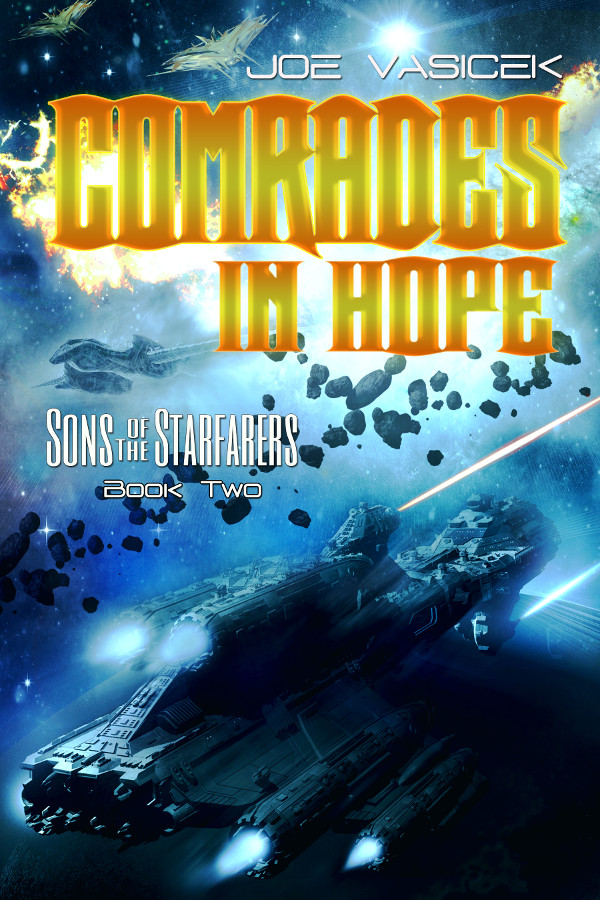
There was a bunch of other stuff that I took away from LTUE this year, but those are the major things. By the end of it, I just wanted to sit down and write! The climactic final battle for my current WIP, Sons of the Starfarers: Comrades in Hope came to me in all its awesomeness as I attended the various panels, and holy crap am I so excited to get to that part! It’s going to be amazing, and the cliffhanger ending is going to make you scream so horribly, but that’s okay because the next book will pick up right where the previous one left off, then take things in an even more awesome direction.

In any case, that was LTUE this year. SO MUCH FUN. If every convention can be like this one, holy crap, sign me up for them all!

Teaser for SONS OF THE STARFARERS: BROTHERS IN EXILE

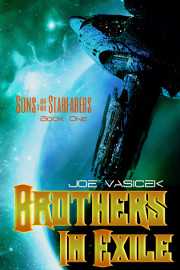
Hey guys–some news about Sons of the Starfarers, my next big series. While I’m working on Book II: Comrades in Hope, I’m also getting Book I: Brothers in Exile ready for publication. If all goes well, I’ll be publishing it in May, with books 2 and 3 coming shortly thereafter.

Today, I put together a teaser / book description. Here it is:

TO WAKE A FROZEN GIRL FROM THE ICE, TWO BROTHERS MUST UNITE TO FACE AN EMPIRE.

Deep in the Far Outworlds, a derelict space station holds the bones of a long-dead people—and a beautiful young woman locked in cryofreeze. When the star-wandering brothers Isaac and Aaron find the sleeping girl, they soon realize that they are her only hope for rescue. If they don’t take her, then slavers certainly will.

With no way to revive her, they set a course for the New Pleiades in the hopes that someone in the star cluster can help. But a storm is brewing over that region of space. After a series of brutal civil wars, the Gaian Empire has turned its sights outward. A frontier war is on the verge of breaking out, and the brothers are about to be caught in the middle of it.

They both harbor a secret, though. Somewhere else in the Outworlds is another derelict station—one that they used to call home. That secret will either bind them together or draw them apart in

SONS OF THE STARFARERS BOOK I: BROTHERS IN EXILE.

What do you guys think? I’m not so sure about the opening hook–that’s probably going to get tweaked. What about the rest of it?

In other news, LTUE is in two days. I am excited! I’ll be on five panels this year: Being a Foreign Speaker, Planet Building, Writing Romance, Epublishing Short Stories, and Starting the Next Project. If you’re going, be sure to drop in on one of my panels or catch me out on the main floor. I’ll be there all day Thursday, Friday, and Saturday (and maybe in the evening for some filk as well)!

That’s all for now. Take care, and I hope to see you at LTUE!

Juggling projects (and trying not to drop them all)

Many, I wish I could write faster. I probably can, but there are times when writing is an uphill slog, and you can’t put your foot on the accelerator too hard or your tires will spin out.

Right now, I’m about halfway through Star Wolf (formerly HEART OF THE NEBULA), and I’m in the part of the manuscript that needs the most work. I’ll probably be throwing out 60%-70% of what’s in there now and rewriting it from scratch, at least until the last five chapters. That’s not the hard part, though–the hard part is untangling the storylines that need to be kept from the storylines that need to be thrown out. I’ve already outlined the basic structure, but for the next couple of chapters, I’ve decided to abandon my revision notes. Now, everything is murky.

So that’s what I’ve been up to in the last few days. Star Wolf is a novel in the Gaia Nova series, and will probably end up around 120,000 words or so. That’s around the same length as Bringing Stella Home, or perhaps a bit longer. Definitely a change of pace from the novellas I’ve written in the last couple of years. As much of a slog as it is now, though, it’s got a lot of good stuff in it. Action, adventure, political intrigue, hard moral choices–not to mention space battles, generation ships, and cryonics gone horribly right.

But really, I want to get this one finished so that I can work on Sons of the Starfarers Book II: Comrades in Hope. I’m so excited about this one, I’m thinking about putting Star Wolf on hold for a few weeks so that I can just write it. Of course, a few weeks will probably turn into one or two months, and by the time it’s finished I’ll want to move immediately on to book 3.

Which actually might not be a bad thing, since I want to launch Sons of the Starfarers as soon as I can. It seems like you guys have really enjoyed Star Wanderers, so I think that you’re going to enjoy Sons of the Starfarers even more. I’m already getting the feedback from my first readers for Book I: Brothers in Exile, and while there are a few minor fixes to make, the story itself seems pretty solid. And the places I want to go with this series … man, it’s going to be awesome.

Just to give you a taste, here’s an excerpt from the first chapter of Brothers in Exile. Isaac and Aaron have just arrived at a derelict station on the fringes of settled space, light-years away from the nearest human being.

“So this is Alnilam station,” he mused as he peered out the forward window. The station’s hull was a dark gray, the beacons at the ends of the antennae a deep flashing red. Though it shone a little as it reflected the stars, their light was too dim to give anything more than the basic shape of the structure. On the inside of the wheels where the windows should have been, there was a blackness as dark as the night on the planet below.

“I’m picking up something,” said Aaron.

“Is it a transmission?”

“No, it’s something else. Radiation signatures, concentrated mostly at the hub.”

Isaac’s heart fell. “That would be one of the station reactors, probably leaking fuel or coolant internally.” Proof that no one’s alive in there after all.

“Well, it can’t be that big, since the wheel engines are obviously still working. And I’m only picking up radiation immediately around the reactors, so it’s not like it’s leaked down to the rim. If anyone’s still alive—”

“They can’t be. If they were, they would have fixed the leak.”

Aaron bristled. “How do you know that? For all we know, the engineers are gone and none of the survivors knows what to do about it.”

“If there are any survivors, why haven’t they hailed us?”

“How should I know? All I know is that it’s possible. You can’t refute that.”

I guess I can’t, Isaac thought. Instead of admitting that, though, he kept silent, peering at the ghostly derelict as if lost in thought.

“We should dock and go in there,” said Aaron. “Peek inside, take a look around. Even if there aren’t any survivors, maybe we can at least find out what happened to them.”

“Are you crazy?” said Isaac, his heart beating a little faster at his brother’s suggestion. “We have no idea what’s in there. For all we know, the place is infested with some sort of disease.”

“So we go in EVA suits and take a quick sterilizing spacewalk before coming back. No big deal.”

“It’s still a dumb idea. We’re not going.”

Aaron scowled and rolled his eyes. “So what, you just want to turn around and leave? Abandon this place without finding out what happened?”

“That’s right. We know that the station is dead, and that’s enough.”

“But we don’t know that,” said Aaron, raising both of his hands. “We don’t know hardly anything. All we know is that no one has answered our transmissions and there’s a small reactor leak at the hub, but everything else looks fine.”

It does not look fine, Isaac thought to himself. His palms felt clammy, and he was already beginning to regret his decision to come to this system at all.

“Listen,” Aaron continued, “even if there aren’t any survivors, maybe we can find some fuel and supplies to make this trip worthwhile. It’s more than a parsec to the nearest settlement, and even if we go straight there we’ve already burned through so much that we’ll have to sell half our cargo hold just to resupply.”

That much was true. Even with the credit they’d built up around this sector, they’d be dangerously low on fuel if they turned around now. The Medea was a small ship, and it could take them almost a year to make up their expenses if they cut their losses now. Still, the thought of setting foot on that derelict made Isaac’s skin crawl.

“It isn’t safe,” he muttered. “Whatever happened here, we shouldn’t get involved.”

“But we are involved,” said Aaron. “We’re involved just by being here. And since we’re already involved anyway, we might as well find out what happened to these people so that we can get their story out. They deserve that much.”

That’s right, Isaac thought. They certainly do.

“Okay, I’ll bring us up to one of the rimside docking nodes so we can go in. But I want you to stick with me, Aaron—understand? No running off—we do this together.”

“Yeah, yeah. Together. Got it.”

I hope you do, Isaac thought as he stared out the forward window at the derelict station. Down below in the planet’s atmosphere, lightning flashed silently, illuminating the tempest for a single instant before the lifeless world returned to darkness.

Oh man … so much awesome stuff to write! When the first three books are written, I’ll publish the first one, and publish the other two soon thereafter. I don’t want there to be a long gap between releases. But between book 3 and book 4, there will probably be a bit more time, since I intend to organize this series in groups of threes.

That’s just about it. Tomorrow, I’ll probably spend most of the day working on short stories, since there’s a story idea that’s screaming at me to be written. With short stories, you’ve got to move fast, because they will get away from you if you don’t write them immediately. But if I get a chance I’m probably going to start Comrades in Hope, because that’s the one I really want to be writing.

So many projects to juggle … I just hope I don’t drop them all!

Update on 2014 Resolutions

So since it’s February now, I figure it’s worth checking back on my January resolutions to see how horribly I’ve failed how well I’m doing. Here goes!

1. Publish something every 6 weeks.

I’m actually still on track with this one. The next 6 week deadline is February 15, and if all goes well I should be able to publish Star Wanderers: Tales of the Far Outworlds (Omnibus V-VIII) by then. Derek Murphy is working on the cover, and all I have to write for it is the author’s note which shouldn’t take more than a day or two. After that, it’s just a matter of compiling and formatting the thing–shouldn’t take more than two or three hours–then upload it to all the retailers.

So yeah, still on track with this one!

2. Write at least two short stories per month and submit them to traditional markets.

For this one, I’m not doing so well. I did write one story, “The Open Source Time Machine,” and sent it out to Writers of the Future, but that’s about it. I am working on a second story, but I haven’t finished it yet, which is annoying because the whole thing is in my head but not yet on the page. Better get on that. Also, there’s another story that got rejected in January that I still need to send out to the next market.

Well, one out of two isn’t so bad. If I take off the weekends to work on these stories, I can probably get back on track before the end of the month.

3. Read a book every week.

Yeah, about that … I was doing so well the first two weeks, but then things got disorganized and this goal kind of fell through the cracks. It probably didn’t help that I spent upwards of 50 hours on Steam in the last two weeks of January. What can I say–XCOM is an amazing game!

I’ve got a huge TBR pile and the book I’m reading now is really awesome, but I just haven’t been good about making the time to read. That’s gotta change. Evenings are the perfect time to read, when I’m too tired to do much writing but too awake to go to bed. Instead, I usually end up browsing the internet or playing on Steam, neither of which are as fulfilling as reading a book.

So yeah, this is one I’m going to have to work on. Fortunately, it shouldn’t be hard to adjust my habits.

4. Keep a detailed weekly personal journal.

This is one resolution that I have been keeping extremely well. I’ve completely redone the format for my personal journal keeping, and now it’s one of my main Sunday activities. The last month wasn’t very eventful for me, so it wasn’t too hard to keep up, but I’ve solidly gotten back into the habit of journal writing and I’m still quite motivated to keep doing it.

If I only keep one resolution this year, it’s going to be this one. Fortunately, I’m still on top of it 100%. Now that’s satisfying!

5. Get to the point where I can run a mile every day.

AHAHAHAHA!!!! Oh dear. The last time I went running was probably three weeks ago. For a while, I was going on some long daily walks, but then the Google Fiber job landed in my lap and all of that kind of got put to the side.

Fortunately, the job is starting to fall into something of a routine. It’s an on-call thing, which means that if I go running I need to keep my phone on me and a change of clothes in the car, but I can still probably do it. The track at BYU’s Smith Field House is open until 10pm, and the parking lots open up around 6pm or 7pm. I prefer to run in the mornings, but the evenings can work too.

So yeah, this one is definitely a fail, at least for January. But with a bit of work, I can get back on track again soon.

6. Finish hiking the seven peaks.

Because it’s winter, hiking any of the higher mountains around these parts is pretty much impossible (at least without professional equipment). But there’s still a lot I can do to prepare for the spring.

For one thing, I need to get new shoes. My hiking shoes from last year are pretty torn up and definitely not in shape for a big climb. With the Google Fiber job, I now have enough of a discretionary income to spend on things like that. And since I’m going to need new shoes for my next overseas adventure anyway, I don’t feel so bad about taking out from the money I’d be saving for that.

I need to get in shape for hiking, though. That’s probably the biggest thing. Not much I can do with snow on all the peaks, but I can hike the Y, and maybe Squaw Peak as well. One thing I’d like to do this season is go snowshoeing, maybe for a date or something. Definitely need to look into that.

Other than that, all I guess I can really do is make plans and wait for the snow to thaw. When it does, you can bet I’ll be doing some serious hiking!

Conclusion

So out of six resolutions, I’m doing really well at two, doing marginally well at two others, and failing at the last two. Not too bad. It isn’t perfect, but it’s not like it’s fallen apart yet either.

Most of the time, it seems that people drop their resolutions around February/March after failing to keep them perfectly. That’s just silly, though. If you break a resolution one month, why not pick it up again the next? So what if you don’t keep it the whole year? If it takes you until July or August or even October to master it, that’s still a lot more months that you’d be keeping it than if you dropped it in March.

So this year, I’m going to try to revisit my resolutions at the beginning of each month and start over with them as if each month were January. That’s kind of what you’ve got to do when you lead a freelancer’s life–plans always change, routines always fall apart, but if your goals are clearly defined and you keep your eyes on them, you can get back up just as quickly as you get knocked down.


Experimenting with prices

So now that the last Star Wanderers novella is out and I’m hard at work on the next book, I’m thinking very seriously about experimenting with my prices. I haven’t done a lot of price experimentation, especially since writing became my main source of income about six months ago. I just recently landed a job to save up some money, though, so that gives me a little more space to try things out.

Right now, I’ve basically got three pricing tiers for ebooks: novels and omnibuses at $4.95, novellas at $2.99 (especially Star Wanderers), and short stories at $.99. My best sellers by far have been the Star Wanderers novellas. Now that Part VIII is out, though, I’ve noticed that fewer people who start the series are going through and finishing the whole thing. I’ve also got a fair amount of pushback in the reviews, saying that the $2.99 price for the novellas is too high.

The tricky thing is that at any lower price point, my royalties take a huge hit. At $2.99, I get a 70% royalty from Amazon and a 65% royalty from pretty much everywhere else. At anything less, I get a 35% royalty. That means that at $1.99, I have to sell three times as many books to make the same as I would from one $2.99 sale. At $.99, I have to sell six times as much.

But wait, it gets trickier. The general consensus (inasmuch as there is a consensus about any aspect of epublishing) is that $1.99 is a dead price point. In other words, a book priced at $1.99 will sell so many fewer copies than a book priced at $.99 that they earn less revenue. A $2.99 book may also sell less than a $.99 book, but the increased royalty rate makes up for the shortfall.

Up until this point, my pricing strategy has been to maximize revenue, so that I can have more time to write. That worked fairly well: I put out one novel and four novellas in 2013, finished up the Star Wanderers series, and started a number of other projects that will hopefully bear fruit in 2014. But now that Star Wanderers is complete, I think it might be time for a change in strategy.

What I’ve learned in the past month is that readers will drop out of a series early if 1) the series is long, and 2) the individual parts in the series are priced relatively high. A lot of readers either drop out after Part II or pick up the omnibus, but the ratio of sales between Part II + Omnibus I-IV and Part VIII frankly isn’t that great. From Part V to Part VIII, it’s almost 1:1, but a lot of readers are dropping out right at the beginning–a lot more than when there were only four parts.

Part of this may be that the story just isn’t engaging that many people, but another part may be that the price has become something of an obstacle, especially as readers look ahead at all the other books in the series. Length probably also plays a role–my Star Wanderers books are fairly short, leaning more toward the low-end of the novella spectrum. Combined with the fact that many full-length sci-fi novels are now priced at $2.99, that probably only makes readers balk all the more.

I want to see what will happen if I drop the price low enough that it ceases to be an obstacle. Will fewer readers drop out after the first couple of books? Will more of those readers move on to my other books? Exactly how much of a hit will my revenue take?

For all of these reasons, I’m going to drop the price of my individual Star Wanderers novellas to $.99 for a month to see what happens. To keep the omnibus price competitive, I’ll drop it to $3.79 and release the second omnibus at $3.79 as well. I will raise the list price of the print editions, though (mostly to shoot for extended bookstore distribution), and probably raise the price of my novels from $4.95 to $5.99.

I have no idea how this is going to turn out, which makes me kind of nervous. Since I want to move on to other projects, though, including a spinoff series that I hope to launch later this year, I think it’s more important to encourage readers to read through Star Wanderers as a whole without putting any potential obstacles in their way.

So yeah, that’s the plan. We’ll see how it goes. I’m open to any feedback or ideas, so if you have any thoughts to share either as a reader or as a writer, please don’t hesitate.

Lindsey Stirling, Nichieri, Susan Boyle, and thoughts on discoverability and greatness

I saw a couple of things on Youtube that made me think recently about the importance of quality work, especially in the arts.

I’m a casual fan of Lindsey Stirling–I’ve watched most of her videos, put them on in the background from time to time, and get a kick out of following her career. For those of you unfamiliar with her, she’s a Youtube sensation who combines violin music, dance, and dubstep/electronica, often in some interesting and beautiful places. This is her most popular video, and probably her best work so far:

Her career is interesting because it follows a path very similar to a lot of self-published authors. She started by putting out videos on Youtube, built up a huge following that way, turned down a number of deals from traditional record labels and put out her first album herself. Now, she’s touring all over the world, collaborating with a bunch of other Youtube artists, and doing a lot of other amazing stuff completely independently.

The other day, I was really surprised that she was on America’s Got Talent back in 2010. Apparently, this was before she got really big, and the connections she made while on the show helped her find success later on:

Two things stood out to me from that video.  First, the judges were right–even though she was pushing herself, this was not her best work, and it showed in a way that was rather glaring. I hate to say that because I like so much of her stuff, but it’s really true–her performance fell short.

The second thing that stood out to me was her response to the criticism. It must have been incredibly painful to stand up there in front of everybody and get hammered like that, but she still managed to smile, be gracious, thank the judges, and focus on the positive without being confrontational. That takes class.

When I was in Georgia, I watched a lot of TV, especially on the Rustavi 2 channel. One of the most popular shows is Nichieri (ნიჭიერი), a talent competition show set up much like The X Factor or America’s Got Talent. Even though I didn’t really understand anything the people were saying, I could still really tell when a contestant did some truly amazing.

There’s something about greatness that makes you sit up and pay attention–something that makes it stand out on its own. It’s something timeless and stirring, something that drives you to keep coming back to it, or at least to remember it long after it’s passed. With poor quality stuff, like bad writing, clumsy performance, or the like, you tend to forget it (unless of course it’s a spectacular failure, which in a weird way gains a sort of greatness of its own to a certain extent). But good quality stuff sticks with you–indeed, it’s almost like it becomes a part of you. It certainly becomes part of the culture.

When it comes to talent shows like Nichieri, The X Factor, and America’s Got Talent, the greatest moment has to be Susan Boyle. Everything about it is just perfect, from the awkward, homely way she started out to how she blew everyone away with her stellar performance. She didn’t look like she had it, and she certainly didn’t act like she had it, but she did, and she knew it. She didn’t settle for anything less than her best, and she didn’t let anyone else put her down.

In a lot of my discussions with other indie writers, we talk a lot about discoverability. We’re all anxious to be read, to be heard, to be discovered–to get our shining moment. The thing is, though, that moment is not enough if you don’t have quality work. It’s not going to keep you down or “ruin” your career, necessarily–Lindsey Stirling has come a long way since her disappointing performance on America’s Got Talent. But that’s only because she produces quality work.

I think I need to spend a lot less time trying to boost my discoverability and a lot more into producing the best work that I possibly can. The thing to remember, though, is that quality is subjective and you can’t please everyone. As Lindsey later said, “A lot of people have told me along the way that my style and the music I do … is unmarketable. But the only reason I’m successful is because I have stayed true to myself.” You can’t compare yourself against others, either–you can only really compete against yourself.

How do you know when you’ve done your best? That can be a little tricky, partly because it’s a moving target. I think Genesis Earth and Bringing Stella Home represent my best work at the time, though when I look back at those books I see things that could be improved. I tend to think that Desert Stars is my best work to date, though I’m not so sure anymore. Do I only think that because I struggled so much and for so long with that book? Just because something is a joy to create doesn’t mean that it’s any less than something you toiled and suffered over.

Star Wanderers was both a gift story and an experiment. The novella format was new to me at the time, so I did a lot of learning on it. Outworlder, Dreamweaver, Homeworld, and Deliverance came to me in a white-hot creative heat, but Sacrifice and Reproach were a real struggle. Is there a discernible difference in quality between them? Not that I can tell. I do think that the later stories hold together better on their own, though. I didn’t really hit my stride with the novella format until I started branching off into other characters’ viewpoints.

This is all on my mind because my next big project, Sons of the Starfarers, is something that I really want to do right. I don’t just want to write it for the sake of putting it out there (though I recognize that writing quickly doesn’t always mean sacrificing quality). I don’t just want to put it out so that I can make my work more “discoverable,” though that’s certainly a motivation. I don’t even just want to do my best. I want to improve my writing and storytelling so much that this becomes the best thing that I’ve ever written.

At LTUE a few years back, Tracy Hickman said that as writers, it is important for us to believe that we have not yet written our best book. That’s so incredibly true. You have to always believe that you can do better, not to make you depressed when you look back, but to make you enthusiastic as you look forward. Imagine what would have happened if Lindsey Stirling thought that her performance on America’s Got Talent was the best that she’d ever do! Her career hadn’t even dawned yet.

I think it’s the same with me. I’ve gained a little exposure, suffered a few setbacks, and experienced a small measure of success, but the big stuff is yet to come. And even though I may not want to be the next Brandon Sanderson or Orson Scott Card in terms of popularity, I do need to shoot high in terms of quality. Before I work on my discoverability, I need to make sure that I’m putting out some truly amazing stuff. I need to shoot for greatness.