Guest post: Developing Characters in a Fantasy Setting

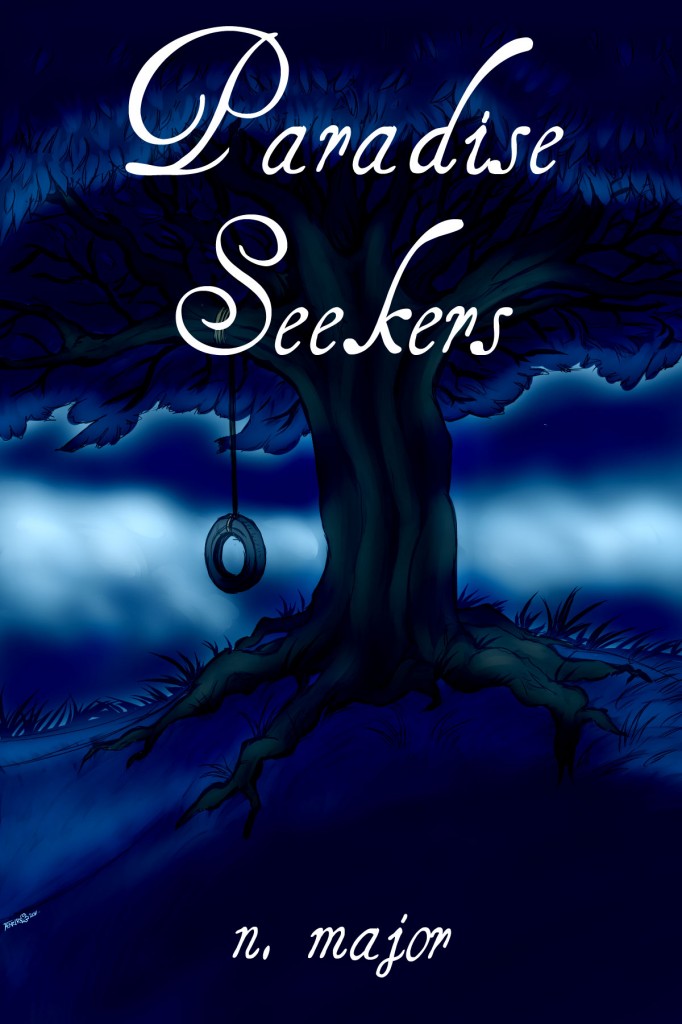
Nathan Major is a friend and fellow writing who, like me, has taken the epublishing route for his first novel, Paradise Seekers. I met him through our mutual friend Charlie at Brandon Sanderson’s English 318 class.  His book is pretty good; I’m only partway through it right now, but he’s playing with some interesting fantasy concepts and I’m definitely looking forward to seeing how he pulls it off.

I recently appeared on his blog with a guest post on how I develop my characters; for his appearance here, I decided to throw the question back at him.  Like a true fantasy author, he answered it with a multi-part epic that is probably only the first installment of a trilogy.  He makes some good points, though, and it’s definitely worth reading (and not just for the snarkiness, heh).

On a tangentially related note, I also appeared recently on Charlie’s blog with a post on ebook formatting and book DIY.  When you’re finished here, be sure to check it out!

And now, I give you Nathan Major…

================================================
When you think of fantasy, what is the first thing that comes to your mind? Mystical worlds populated with elves, dwarfs, and other magical races? Kingdoms and castles, dark lords and noble heroes? Perhaps you entertain a world that is more supernatural and more interesting than our own, one that would allow you to escape to its enchanted forests and sweeping vistas.

The fantasy genre differs from other forms of fiction (except perhaps science fiction) in that the worlds they take place in tend to be the stars of the stories. Middle-earth and Prydain. Oz and Earthsea. And within these worlds, a classic clash of good vs evil is expected. The characters and story can often take a backseat, with many authors spending years of their lives crafting the perfect magic system, most precise system of fantastical government, and the means to make their elves the best damn elves you’ve ever seen.

This drives me crazy.

I’ve been reading fantasy my entire life, but it wasn’t until a few years ago that I got fed up with the whole thing. I loved The Hobbit and The Lord of the Rings, but as I dug deeper and picked up more modern fantasy, it all seemed to start blending together. Here is our noble hero, beating the odds to fight against a nameless, oft-hidden dark lord. Here is his spunky princess sidekick slash love interest, his old mentor who dies in act two, and the hardened warrior with a dark secret. While not all books contained these tropes, the main issue still persisted: I wasn’t seeing any new characters.

That was actually what drove me to writing. After reading through a particularly popular fantasy book that was also atrociously generic, I remember tossing the book on the couch and thinking, “I could do better than this!” So I set out to try my damnedest to write a fantasy novel that, yes, was in a fantastic worlds that we wish we could live in, but was populated by people just as interesting and well-developed as the world.

Since I’m severely ADHD, I’m going to break this up into a few key ideas that (hopefully) will get my point across. These aren’t just applicable to fantasy, but it’ll be my main focus.

1) Plan your characters first, before you plan the world.

Simple enough, right? When speaking with most other fantasy authors on the subject of brainstorming, the first things they say are, “Oh, I got the coolest idea for a magic system!” or “This world is going to be amazing…it’s made entirely out of White Chedder Cheese-its!” To which I say, “Ok, but what’s the story? And who are the people influenced by the story?” This is usually met with a, “I don’t know, I’ll figure it out later!” Then I defriend them on Facebook and pretend they never existed.

Ok, so the last part was an exaggeration. But the point still stands: you may have the greatest world ever devised, but so do map-makers, and theirs looks better. What is actually in the book is the plot and the characters, and the world is just what it takes place in. You might have the greatest appendix ever at the end explaining how the Haku-Bula Wolf Tribe’s language is actually a combination of grunts and Swedish, but that doesn’t matter to the average reader. Figure that stuff out after you’ve got a story, because it’s less important.

2) Don’t fall into cliches.

This is a hard one, as discovered by me when writing my third book, Where Gods and Mortals Dance. If you’ll excuse a moment of self-indulgence, when writing this book I had a female princess as the main character. She was a strong character, but due to circumstances beyond her control she was thrust into a situation that was almost impossible for her to fix. I remember trying to design her as strong but still fragile, as parts of her past haunted her and made her ability to rule difficult.

Then I took her to writing group, where the group was divided. Half said she was the, “generic, strong, masculine princess who takes charge,” and the other half felt she was the “weak, needy, spoiled princess” who has everything done for her.

It frustrated me, but also proved a point.

I was relying on two cliches and stereotypes to design my character. I drew from both in an attempt to be original, but that didn’t work. This happens all the time in fantasy. We have the old warrior, somehow inferior to our spunky young farmhand who picked up a weapon for the first time yesterday. We have a dark lord who never actually does any fighting or has any coherent plans, he just sort of sits on his throne of skulls and knives (which is probably black and on fire) and waits for farmhands to come and kill him.

Even in the most original novels, these cliches can become evident. They might not be as blatant as the ones said above, but keep them in mind when writing. Your book doesn’t have to star a teenager. It could star a forty-year-old man who wants to save the world. There doesn’t have to be a Dark Lord at all; the enemy could be something completely different. Stay the hell away from elves, dwarfs, or anything that Tolkien used. And taking Orcs, changing them slightly, and calling them “Orks” doesn’t count as being original, it counts as being a cop-out. Fight the cliché. Make your characters deep and unique.

3) Remember: Everyone is a hero in their own story

Sympathetic villains are a rarity in fantasy. Most of the time we have a group that is distinctly bad, and a group that is distinctly good. You can usually tell by how they live. If they live in trees, clouds, or anything that communes with nature: good. If they live in filth, a swamp, or basically anywhere that looks like it’s under the constant duress of a smoke-machine: evil. Usually bad-guy motives are just “they are bad and hate the good guys,” which is a freaking awful excuse. Oh, and don’t get me started on the “he’s insane, that’s why he wants to destroy the world!” villains. That’s the biggest cop-out of them all and if you use it I want to punch you in the face right now. You are cheapening your characters and your story to make things easier for you. Here’s a revelation: good books aren’t easy. It took Tolkien how long to craft the novel that essentially invented modern fantasy? I’m not saying you should take two decades to make your book, but you should at least have to take more than one sentence to describe your villain’s motives.

The best part about the above expression (which is probably my motto when it comes to developing characters) is that it changes the way you look at your book. Life isn’t black and white: it’s a whole lot of gray. You might see something in black and white, but if you were given a chance to enter someone else’s head, perhaps your view would switch entirely. Nothing is scarier than a completely sane, totally competent villain whose goals just so happen to be the exact opposite of our hero’s. In fact, it makes the reader uncomfortable, because many of them will no longer know who to root for. If you are doing it right, your villain’s motives and values should be just as convincing as the hero’s, which means the reader should be second-guessing their loyalties throughout the book. It makes for a hell of an engaging read, let me tell you.

But this little ditty isn’t just for main characters. Side characters also need to be their own heroes. Sam didn’t just tag along with Frodo because it was a fun thing to do. He knew what had to be done (probably even better than Frodo) and fulfilled that personal quest. Your side characters need to have their own motives and motivations, depth and personality. Don’t’ drag them to Mt. Doom with the only reason being “because the hero was heading that direction anyway.” They should be just as deep (or at least close to the level of depth) as your hero. Make them interesting, and your reader will love them even more.

4) For your characters to be successful, you must know them better than they know themselves

Wow, that’s a long one, and it is sort of off the theme of “broad, overgeneralizing statements” that these bullet points have been so far. At any rate, I’ll try and be brief with this one because it seems self-explanatory.

I have a friend author who, upon designing a character, takes an online “100 questions personality test.” While I’m not saying this is the “go-to” answer for everybody, it can be an extremely helpful tool in understanding a character better. What do they like to eat? What is their taste in women (or men)? If they magically appeared in our world and wanted to hang out, what would you do? These are questions that’ll maybe never be addressed in the story, but you should know these answers. If a character has a name and is in the book for more than a single chapter, you should know everything about them.

This can be hard work, especially if you like having a billion characters. But even if you just have one or two, you really need to be in their heads. Know them. Be them. Imagine them in other situations besides in your novel. And once you really understand what makes your spunky farmhand tick, then you’ll be able to write him in both a convincing and believable way.

5) Write characters you’d like to read about

Figured I’d end this on a simple one. It’s very easy when writing to get the rose-tinted glasses put on, and all of a sudden everything in your book seems perfect. Your characters are a little cliched, but whose aren’t? Your dark lord doesn’t really have a idiom, but he does have a badass axe carved from the ashen bones of the long-lost race of dragons. Who wouldn’t like this book?

Take a step back and think. And if you can’t think of yourself, think of me. A cynical, jaded red-head who writes fantasy only because most of the fantasy currently out there pisses him off. I am your audience. I am biased, blatant, and unbelievably good looking. What would I say?

If you know your characters (see #4!), and you know them well enough then this step shouldn’t be an issue. You’ll like them regardless, because any author gets attached to a character they know every aspect of. In my current novel, Effulgent Corruption, one of the viewpoint characters is complete scum. My initial development of him was a murderous, rampaging madman whose only reason for existence was to kill and destroy. However, as I dug deeper and began to understand the character, he became sympathetic. I realized the man’s goals, what emotional pains he’s been through, and what hurts him now. I knew who he relied on, and what parts of himself he hated.

He quickly became my favorite character.

This should happen with you. You should love your villains, and hope that, should this whole “world-saving hero” thing blow over, their goals will be accomplished. Your side characters should be entertaining and fun, people you’d want to hang out with, just like your hero does. You should know everybody and at least have a shred of sympathy for them. Then, you’ll have great characters.

This, of course, isn’t a complete guide to developing good fantasy characters. Hell, it isn’t really even a very specific one. But I’m almost 100% sure that, should you take these ideas to heart, you can beat the odds and write a fantasy novel that is as interesting in its ideas about elven politics as it is with its elaborate, three-dimensional characters. Fantasy as a genre deserves better, and you (yes, you!) can be the one to do it. So go forth, young author, and write the epic that will shake the Barnes and Nobles across the land!

Plus, it’ll increase your chances that I’ll actually read it, which is a perk in and of itself.

Copyright (c) 2011 by Nathan Major
Staying in Provo

So, I have some news.  After carefully weighing my options, I decided to stay here in Provo for at least another six months, rather than teach English in Korea for a year.

My main reason was the current pace of change in the publishing world.  Originally, I wanted to take a year or two off to build a TEFL career and make some money to support myself as I tried to break in, but with the way publishing is changing, if I did that I would find myself completely lost as soon as got back.

Another reason was that I wanted to be able to focus on building my indie publishing career.  Traveling and working abroad would take a lot of energy away from that, which didn’t seem like a good thing to do at this point in my writing career.

Yet another reason was the fact that Worldcon is in Reno this year, and it’s going to be huge.  Anyone who’s anyone (at least here in Utah) is going, and it would be supremely foolish to pass up a networking opportunity like that.

And also, I have to be honest: since I’m in a local band now, I kind of want to stick around and see how that works out.  Who knows?  Maybe we’ll make it big…

So what am I going to do now instead?  Probably work odd jobs to support myself, same as I’ve been doing since I graduated.  I’ve got one lined up to start next week; apparently, the guys at this alarm company where temped in April were impressed with my computer skills and want me back.  Maybe I can turn that into a part time gig once the summer’s up.  If not, there’s always the costume factory job in September-October.  And of course, I’m still keeping an eye out for local part-time jobs.

And really, all this stuff about getting a “day job” seems to me like another way of saying you can’t make a living as a writer, which strikes me as utter bull crap.  Yeah, most people don’t become full time writers–but most people aren’t willing to do what it takes to get there.  I am.  I’m also fortunate enough to be in a good position to shoot for it.  Young, single, no dependents, no debt…it doesn’t get any better than that.

In tangentially related news, my first guest post from my blog tour went live yesterday.  My friend Nick Rose interviewed me and asked about epublishing, getting good cover art, what makes novels unique, and why I’m drawn to science fiction.

Nick is an aspiring novelist like me who’s hoping to turn this into a full time career.  He’s also a great writer, even if his tastes are a little different than mine (seriously man, how can you NOT love Star Wars?  Come on!).  He writes mostly horror and reads a lot of manga, which he reviews on his blog.  He also updates his blog every day, so check him out!

Tag and such

So my cousin Angela tagged me in this cross-linking truth-or-dare blog game, and it looks fun so I figured I’d participate.  Here goes:

Do you think you’re hot?

I suffer from no illusions as to my ability (or rather, lack thereof) to carnally attract the opposite sex.  That’s not to say I’m ugly, but when you apply the Pareto principle to dating (and let’s be honest, it’s really more of a 90/10 split), I don’t make the cut.

And you know what?  I’m fine with that.  Because it only takes one…

What is  your current desktop wallpaper?

This glorious image from APOD (Astronomy Picture of the Day).  It’s enough to make me want to move to Iceland, and that’s saying something.

When was the last time you ate chicken?

I made some awesome fajitas last week, and the chicken was on sale at Maceys.  I always cook my own chicken; I hate the precooked frozen stuff.

What were you thinking as you were doing this?

Who comes up with these things anyway?  Hmm, I wonder if I could start one…

Do you have nicknames?

I have two internet screen names, which are probably the only nicknames of mine that are still in use (besides the ones people use behind my back).  The first is “onelowerlight,” and it’s all over the place.  The second I use only on deviant art and a certain fan-fiction site, and it is and shall remain a closely guarded secret.

Tag eight blogger friends…

Alright, let’s do this.  LEEERRROYYY…

Gods, Witches, Space & Stars
Kate in Katy
Myself as Written
One Modern Mormon
Truthiness
Fertilizer
Not A Villain (technically a webcomic not a blog, but hey she’s an old friend)
سفريات أنثون

Who’s listed as number one?

My old writing friend Laura, who just got back from an LDS mission in Armenia.  Has a lot of interesting and insightful things to say, such as her last post on the difference between strong female characters who are independent vs. strong female characters who are interdependent.

Say something about number five.

Sarah is one of my little sisters, and she just had a baby!  Also, she worked for a couple years in a survivalist-oriented wilderness therapy program, and knows how to make traps, kill and eat animals, and make fire with sticks and a bow.  Oh, and she’s also hilarious.  If I’m ever stranded on a desert island, she’s my first pick for who I’d want with me.

How did you get to know number three?

Chuck?  I think she showed up at a writing group meeting when I was VP of Quark.  She was never really active in the club, but we also took Sanderson’s 318 class a couple times and went to CONduit in 2008 together.  Meh; she’s alright, I guess (jk!).

How about number four?

(who comes up with these questions?)

Mykle is my geekiest brother in law, at least in terms of books and sf&f fandom (linux, that would be Danny).  He married Sarah two months after meeting her and I think it was the best decision either of them ever made.  He doesn’t blog much, but when he does, it’s always thoughtful and interesting.

Leave a message for number six

Thanks Kindal for the feedback on Worlds Away! Blunt as always but quite helpful.

Leave a lovey-dovey message for number two

For my sister?? Ewwwww…

Seriously Kate, I love your blog.  And you have the freaking cutest daughter on the face of the planet.  Thanks for making me an uncle!

Do number seven and number eight have any similarities?

Yes, in fact.  Aneeka (no. 7) spent a couple years teaching English in Japan; Anthon (no. 8 ) hasn’t spent more than a week or two in the same place (or more than a month or two on the same continent) for the last two years.  Let me just say, I am in awe of these world travelers and hope to do likewise at some point in the future.

That’s it folks.  At least I have chicken.

Buy me lunch and I’ll teach you how to make an ebook

Okay, this is insane.  For a long time, I’ve kept up with Writer Beware as a source for quality news about publishing scams, but now…huh?

Recently, Dean Wesley Smith and Kristine Katherine Rusch have been giving a TON of warnings about “agent-publishers” –agents who are electronically publishing their clients when they’re supposed to represent their clients’ interests to publishers.

DWS and KKR have both been unequivocal about this–any agent doing this is running a scam and should be avoided like the plague.  And you know what?  I believe them.  Why?  Because using entirely free and/or open source software, I can create a professionally formatted ebook from any of my manuscripts in less than an hour. 

Less than an hour.

And I’m not a computer expert either, just a blogger who knows some basic html (which you, too, can learn free of charge at w3schools).

Well, just today I read a post on Writer Beware about these agent-publishers that made my jaw drop.  Summary: agents who ran publishing operations used to be considered scammers, but things have changed so that that’s legit now.  The phrase that really got to me was “unimpeachably reputable agencies.”

Huh?

According to DWS and KKR, these “unimpeachably reputable agencies” become scammers the moment they start publishing their clients’ works.  Clearly, someone is wrong, and my own experience tells me it isn’t DWS or KKR.

Making a professional looking ebook is literally easier than writing a query or a synopsis.  Light years easier.  Paying someone a commission for doing it is like writing the boy down the street who mows your lawn into your mortgage contract.  It makes literally no business sense.

And yet people still think that this agent-publisher things is legitimate?  Wha…?

Okay, you know what?  If you’re a writer in the Provo/Orem area, I’ll show you everything I know about making an ebook if you’ll buy me lunch.  Heck, if you live in Salt Lake and are willing to take me to this awesome Lebanese place, I’ll make a special trip just for you!

I’ll show you what you need to download, install it for you, teach you how it works, and run you step by step through the formatting process until you have a beautiful ebook on your hard drive.  I’ll teach you everything I know (which honestly isn’t that much), and I’ll do it all for the price of lunch.  Just email me at joseph [dot] vasicek [at] gmail [dot] com, and I’ll write you into my schedule.

Why would I take the time out of my day (and away from my own writing) to do this?  Well, for one, I really like Lebanese food.  But more importantly, it’s in all of our interests as writers that none of us get caught up in these crazy scams.  They don’t benefit us and will actually hurt us all in the long run, if we let them happen.

So yes, once again, if you’re a writer living anywhere between Provo and Salt Lake City, I will show you everything I know about formatting ebooks if you will buy me lunch. I’m not even joking.

And I love Lebanese food.  Once we’re finished, I think you will too.

Drawing up the starmaps

I’m a big fan of indirect sequels, where each book tells a standalone story but incorporates many of the same characters as other works and is set in the same world.  Sharon Creech did this with Walk Two Moons and Absolutely Normal Chaos: the main character from ANC was a minor character in WTM.

The thing is, I write space opera, which means that each novel spans at least two or three different star systems.  After four or five novels, it can get really hard to remember where all the stars are in relation to each other.  So, taking my own advice from an earlier post, I drew up a starmap for my universe.

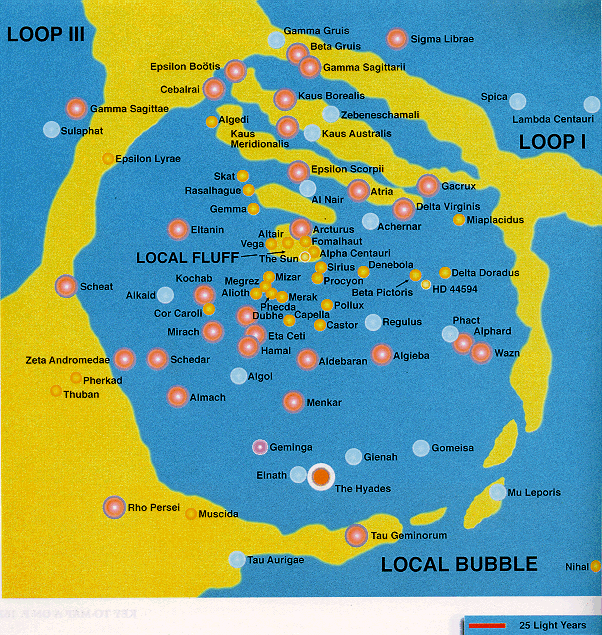
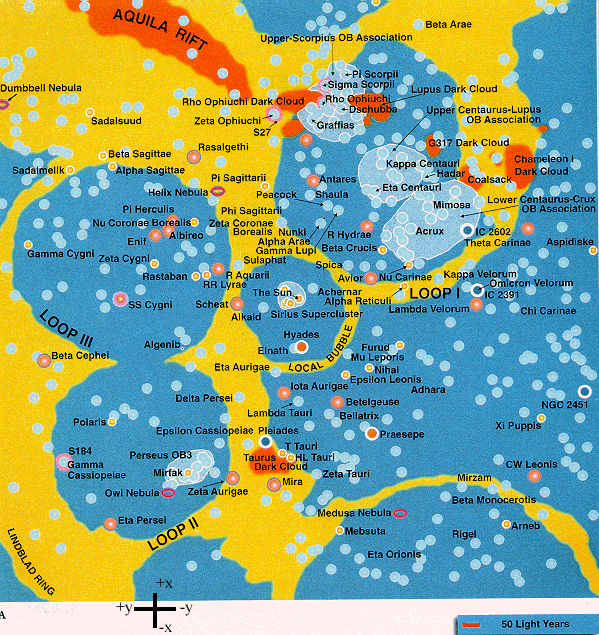
For a pattern, I used these maps of the region of space local to Sol.  I’ve since forgotten where I got them; I think wikipedia, or maybe the atomic rockets site:

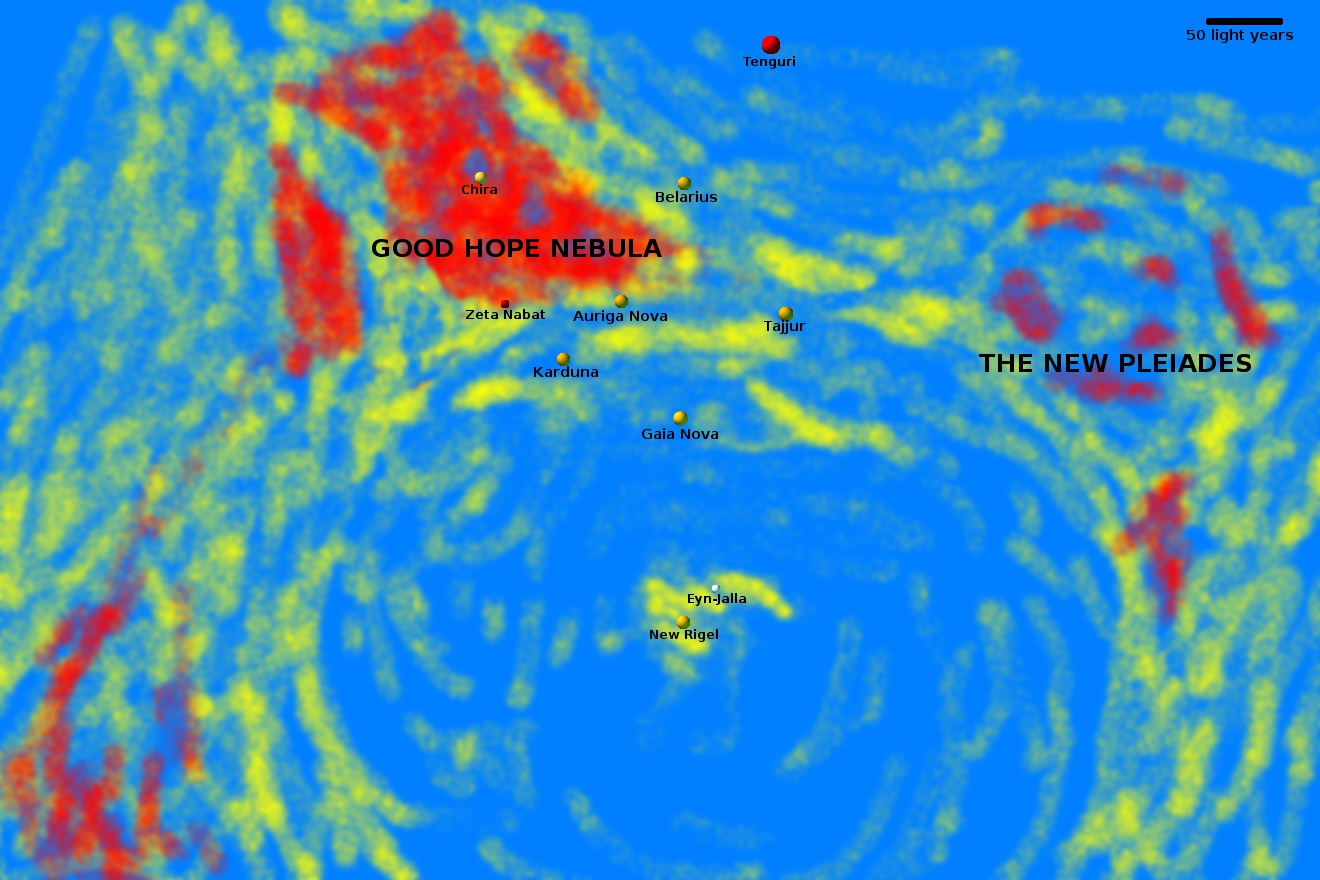
Since they’re only 2-dimensional, they have some obvious shortcomings, but for my purposes they work just fine.  The thing I like the most about these maps is that they show rough distributions of interstellar gas and dust.  In my Gaia Nova universe, areas of high density (such as the interiors of nebulae) are off limits to the FTL technology, so finding a way to show that was absolutely critical.

And so, after playing around with MS Paint and The Gimp, this is what I came up with:

It’s definitely a work in progress (seeing as I’ve only got about a dozen stars up so far), but I’ve got to be honest–I geeked out hardcore when I was finished with this thing.  Whether you’re writing fantasy or science fiction adventure (which I’d argue is a branch of fantasy), there’s just something about having a map…

The best thing is that it’s REALLY easy to update.  If I want, I can throw up half a dozen new stars in fifteen minutes–or rearrange the current arrangement of stars with the simple click of a mouse.  That’s good, because I don’t want to spend all my time drawing up maps–the map is just a tool to help me write the stories.

And oh man, I’ve got a lot of stories to tell! 🙂

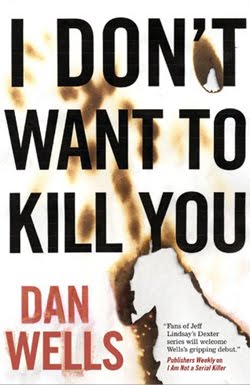
I Don’t Want to Kill You by Dan Wells

John Cleaver, teenage sociopath and demon hunter, has put his inner monster to work protecting his small town community from supernatural beings.  But now, the head demon, known only as Nobody, has come to take him down.

As if that weren’t difficult enough, the most popular girl in John’s class, Marci, has taken a liking to him–and he soon finds that he likes her back.  What’s more, she’s not as weirded out by his obsession with the string of murders in their town–in fact, she’s interested in them too.

Just as their young romance begins to blossom, however, a rash of teen suicides makes John wonder: why does he even try if the people he’s trying to protect are just going to throw their lives away anyways?  To defeat Nobody, he must search within himself and find the answer.

This book was awesome–like, Return of the Jedi awesome–and I’m not just saying that because the author is a friend of mine.  It brings the Serial Killer trilogy to a dramatic and satisfying conclusion.  Dan Wells’s storytelling skills are amazing, and he puts them to good use throughout this book.

The thing I loved the most was probably how all the major characters had to sacrifice something huge for the people they loved in order to overcome the evil forces at work in their lives.  And the demons–whoa, they were pretty freaky.  Supernatural freaky, yes, but in a way that was frighteningly true to life–even more so than the previous demons in the series.

Wells has an excellent handle on character arcs, and he applies that here to the romance subplot with excellent results.  The romantic aspect of the novel was both believable and gripping, and made the ending all the more emotional.

If anything, though, I wish he would have played up the love triangle a little more than he did.  No spoilers, but there were a couple of shifts toward the end that felt a little abrupt.  Not too much, but I thought it could have been done better.

This is definitely an urban fantasy, but one surprisingly close to the real world.  Unlike Mr. Monster, where the supernatural aspect came in halfway as something of a shock, I thought the supernatural and real world elements in I Don’t Want to Kill You were blended almost perfectly.  Not only was it clear from the beginning that both elements were going to be important, but the feedback loop between the two was handled extremely well.  If I ever write urban fantasy, Dan Wells has certainly set a high standard to follow.

All in all, a great book, one I highly recommend.  If you enjoy urban fantasy or superhero stories, you’ll probably love this book.

Why I am not afraid of the Noise

One of the biggest concerns for writers considering indie publishing is the fear of being drowned out by “the Noise”–all the obnoxious crap that will inevitably pile up because everyone thinks they can write a book.  After all, if anyone can self publish, anyone WILL self publish, including all the hordes of terrible, terrible writers.  In such an environment, how will anyone find you?

I’ve been thinking a lot about this, and reading a lot of author blogs to hear their take on this issue.  While I was afraid of the Noise at first, I’m not that worried about it anymore.  Here’s why:

1) The Noise has always existed.

The Noise is not a new problem.  Anyone with a printer and/or internet access can submit their stuff to agents and editors–and they do.  It’s called the “slushpile.”

Under the old system, good stories would never find their audience unless they got picked up by one of a handful of editors.  Problem is, this creates a huge bottleneck that only amplifies the Noise, making it even harder to get noticed.  Editors outsourced the slushpile to agents, but this only made it worse, like adding an extra level of bureaucracy to an already inefficient system.

The way I see it, if I’m going to have to fight the Noise one way or another, I would rather have direct access to my potential readership than be forced to submit to an overworked editor who doesn’t have time to give my work fair consideration.

2) Epublishing gives books more time to find their audience.

Traditional publishing works on the “produce” model, where new books have only a few months on bookstore shelves before they’re pulled to make room for something new.  In sf&f, it’s more like a couple years for paperbacks, but it’s still the same thing.

If your book doesn’t find its audience in those first few months–and therefore doesn’t sell very well–it’s considered a failure. With epublishing, though, there’s unlimited shelf space, and that means the book will ALWAYS be available.  It might not sell for the first few months, but that’s okay–it has as much time to find its audience as it needs.

I believe that given enough time, the good stuff always rises to the top of the heap.  I would rather follow the model that gives me that time, rather than gamble on the arbitrary timetable established by the traditional publishing establishment.

3) The revolution is social.

At LTUE this year, Tracy Hickman astutely pointed out that bookselling is no longer about creating artificial marketing hype so much as making a direct and personal connection with the reader.  With modern social networking platforms, writers can connect directly with their audience in a meaningful, peer to peer manner, expanding their readership naturally.

If we still had to rely on old, top-down marketing models, the Noise would certainly be a problem.  But with social networking, the audience is becoming much more interconnected, revolutionizing word of mouth and making it easier for writers and readers to connect than ever before.

4) Success comes at a much lower threshold.

For my purposes here, I’ll define “success” as making a full time living as a writer (>$20k/yr, though that will probably change when I’m married).

Under the old model, a $20k advance for a new writer like myself would be quite good, especially in my genre.  However, that money would get paid out over the course of several years, and I probably wouldn’t get a contract for another book until after the first book proved itself.

But the $20k is really just an advance against royalties, and the royalty rates run pretty low (<12% hardback, <8% paperback).  At those rates, I probably wouldn’t start to make a full time living until my devoted readership (those who buy my books in hardcover) numbered at least between 5,000 and 10,000.  And even then, my publisher might still drop me.

Under the current indie publishing model, though, the author gets a 70% cut.  That means that I could significantly undercut traditionally published books in price and still make more money per book. A $5 ebook earns as much at 70% as a $25 hardback at a 14% royalty rate, and will probably find its audience a lot faster because of the lower price.  With paperbacks, the difference is even more stark.

An audience of 5,000 is a drop in the bucket compared with the population of all readers.  The Noise might keep me from reaching everyone, but I don’t need to reach everyone to make a living–just a few thousand.

5) Transformational growth will greatly expand the market.

Right now, we seem to be on the verge of transformational growth in the publishing industry.  With epublishing, not only are avid readers buying more books, but more people are becoming avid readers.  This means that now, more than ever, publishing is NOT a zero sub game.

Sure, the Noise will get louder as more people self publish–but that Noise will also be spread out across a much larger market.  Even if my piece of the pie gets smaller, the pie itself is getting much, much larger, and that’s good news for everyone.

I have other reasons for not fearing the Noise, but these are the biggest ones.  Promotion is still a major question in my mind, but for now I’d rather get back to writing.  After all, that’s what I do–I’m a writer.

How to say “I love you” in math

I was having dinner at the McQueens today, and after chatting with my brother in law’s cousins about numerous interesting subjects (zombie contingency plans, preferred food substances to swim in, and the amount of sugar it would take to launch  you into space), we got onto the subject of math as a language.

Side note: I am on a quest (well, more of a subquest) to prove that math is not a language–at least, not in the same way that English is.  The question I always pose to throw people off is “how do you say ‘I love you’ in math?”

Well, I posed the question, and Sarah came up with the best answer I’ve heard yet:

7i + 3u < 24u

Har.  Har.  Har.

In unrelated news, I’m going to find out on Tuesday (read: tomorrow night) if I made the semi-finals for the 2011 Amazon Breakthrough Novel Award contest.  I’m starting to freak out a little bit about it, but at least it’s come this far…okay, who am I kidding?  GAAAAAHHHH!

In related news, I am totally going to base a character in one of my novels off of Sarah…but only tangentially, of course.

Decision LZ1527 is now live

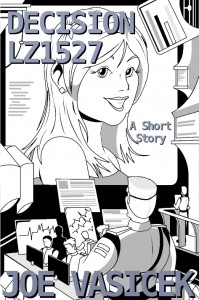
My second indie published short story, “Decision LZ1527,” is now available for $.99 from Amazon.  This is the same story that was published in the December 2009 issue of Leading Edge.  I’ve also included a short author’s note at the end, explaining the writing process from idea to publication.

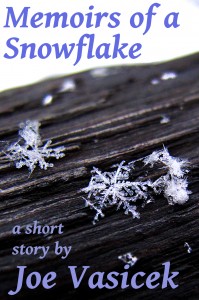
As with “Memoirs of a Snowflake,” the epublishing process wasn’t that complicated.  The story was short enough that I didn’t feel a need for a table of contents, and Amazon reformatted the uploaded .doc file without any problems.

The biggest difference with this one was that I contacted the artist from the December issue and bought the rights to use the art.  It cost a bit, but not much more than what Leading Edge paid for the story, so overall I haven’t taken much of a loss.

I wrote “Decision LZ1527” back in 2006, when I was a sophomore in college trying to navigate the bizarre dating world of BYU.  It’s about a boy trying to find the courage to ask out his secret crush, as told from the point of view of the little men inside his head, piloting him like some kind of spaceship.

So yeah, I hope you check it out and enjoy it!  If you don’t have a Kindle, Amazon has a number of free apps that will allow you to read it on just about any platform (including your computer).  And if you haven’t already picked up “Memoirs of a Snowflake,” you can get it for $.99 too.

I’ll do an update in a week or two about my indie publishing venture, but so far it’s been pretty fun!  Hopefully, by putting out these stories, I’ll be able to share them with more people than would have read them otherwise.  So thanks, and I hope you enjoy!

NaShoStoMo

So Dan Wells is taking a page from NaNoWriMo and starting his own writing thing for April, NaShoStoMo, aka National Short Story Month.  The rules are as follows:

  • You must write 30 all new short stories between April 1st and April 30th.
  • Each story must have a distinct beginning, middle, and end.
  • Each story must be at least 200 words.
  • You may write more than one story per day to make up for lost days.

It seems like an awesome idea, and I’m going to try it.  I’m not much of a short story writer, but I wish I were, because there are some really awesome short stories out there that I admire–like Endosymbiont, quite possibly the best singularity story that I have ever read (and available for free from Escape Pod).  Novels and short stories are different arts, but they’re both forms of storytelling, so I figure that no matter what happens I’ll learn something from it.

I’m not sure how many of these stories will take place in universes that I’ve already built, but probably a good number of them will.  I have a few characters from Bringing Stella Home that I would like to do little sketches on, possibly for a later novel, and some things I’d like to do in the worlds I’ve already created.

At the same time, though, I’ve got some crazy ideas for standalone stuff that I’d like to play with, like a crazy awesome dream I had last night that made me  lie awake just thinking about it for almost an hour.  It was insane...but I guess you had to be there.

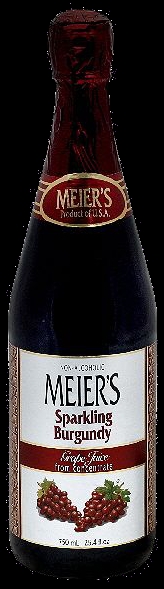
In unrelated news, my writer friend Charlie got me a thing of sparkling grape juice, for me to open when I celebrate my first major publishing deal (though I suspect another motivation was to make me look like a wino while walking around on BYU campus).

Honestly, I was quite surprised–thanks!  I’ll use it to christen my first yacht that I buy from my multimillion dollar first deal, hehe.

Oh, and in other totally unrelated news, my other writer friend Laura started a blog.  So go check it out!