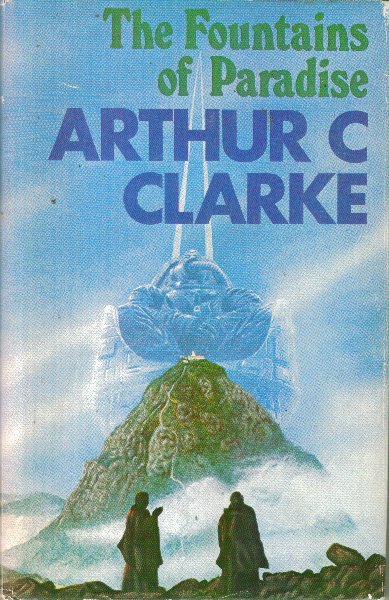
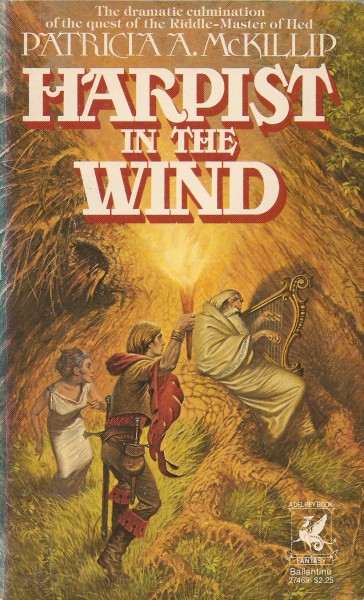
I didn’t like any of the books this year, though none of them were particularly objectionable or bad (at least, not of the ones I read). The Fountains of Paradise just didn’t hold my interest, and I got bored and put it down. As for Harpist in the Wind, I never got to it because I ended up DNFing the first book in the trilogy, The Quest of the Riddle-Master. I wanted to like it, but I was just totally lost, especially when some of the characters were dead… maybe? Or maybe it was a dream? McKillip is clearly a beautiful writer, but writing a clear and engaging plot is clearly not her strength.
As for the other three, I screened them for objectionable content with AI, and based on that, I chose not to read them. I’ve found that I have to do this with all the Hugo Award nominees because some of the books are just way beyond the pale. On Wings of Song is apparently about a 14 year old child’s supernatural sexual awakening. Titan is apparently about a bunch of libertine, pansexual astronauts on a starship making first contact (in more ways than one) and spreading free love across the galaxy. Jem is apparently about the evils of colonialism and capitalism in a world where Malthus was right and Thomas Sowell is wrong (and you thought Ayn Rand’s preaching was bad).
1980 was the tail end of the New Wave, when science fiction went totally woke before “woke” was even a thing. But by this point, the movement was already starting to feel tired. It wasn’t until the mid-80s that a lot of these toxic ideologies were in full retreat, making room for some truly great books like Ender’s Game and Hyperion. At the same time, because the movement was already starting to burn itself out, none of these New Wave books is particularly terrible. Just more of the same tired thing.
It’s been a while, but this discussion really blew me away when I first listened to it. The guest (and kudos to him for having a fair and honest debate) basically brought up all the typical libertarian talking points, and Tim Pool shredded all of them in a way that made my jaw hit the floor. The debate gets really interesting around 1:01:40.
Captain Vorpatril’s Alliance by Lois McMaster Bujold
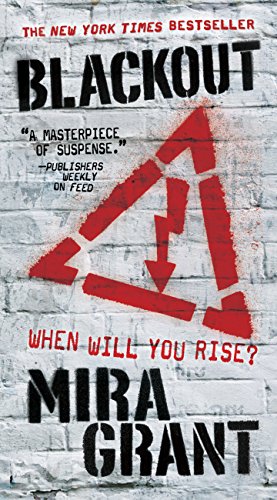
Blackout by Mira Grant
2312 by Kim Stanley Robinson
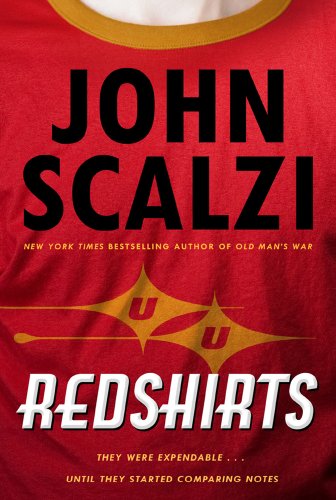
Redshirts by John Scalzi
The Actual Results
Redshirts by John Scalzi
Captain Vorpatril’s Alliance by Lois McMaster Bujold
2312 by Kim Stanley Robinson
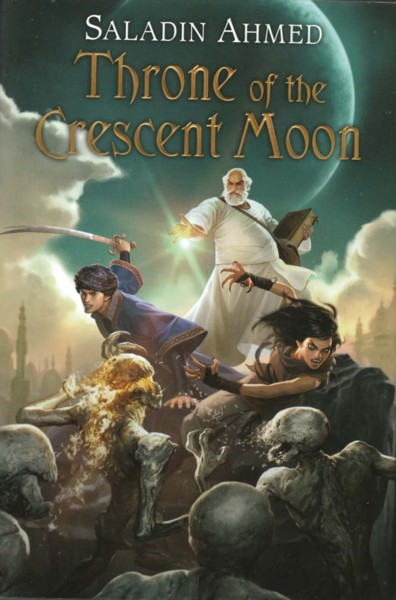
Throne of the Crescent Moon by Saladin Ahmed
Blackout by Mira Grant
How I Would Have Voted
Throne of the Crescent Moon by Saladin Ahmed
Explanation
None of the books this year were super woke or objectionable to me, so I wouldn’t put any of them below No Award. But the only one that I actually finished was Throne of the Crescent Moon, which I found to be an enjoyable debut fantasy novel. It’s got some flaws, but it makes up for that with heart, just like many good debut novels. It’s also got a real Islamic / Middle Eastern flair to it, which made it fun and unique. And while these days, there’s an association between Islamism and the Left (the “red-green alliance”), Throne of the Crescent Moon isn’t woke at all—which I suspect was one of the reasons it didn’t win.
I hope Saladin Ahmed writes a sequel to this book. The world is interesting, the characters are good people, and the first book is clearly setting things up for other books. But I’ve heard rumors that the reason Saladin hasn’t written the next book yet is because the whole Hugo Awards process was such an emotional rollercoaster that it burned him out and killed his desire to go through all that again. Plus, when you experience a surprising degree of success too early in your career, there’s a danger that the pressure to perform will kill your subsequent efforts. Which is too bad, because I definitely want to read the next book!
As for the other books this year, none of them were all that great. I DNFed Mira Grant’s Newsflesh series with the first book, so I didn’t bother reading Blackout.Redshirts is basically a space opera retelling of Rosencrantz and Guildenstern are Dead, which I thoroughly hated (not to mention, I haven’t liked anything Scalzi has written since Old Man’s War, for reasons I’ve explained previously). And 2312 was more of a hard SF slice-of-life novel about all the wonderful things Kim Stanley Robinson would like us to build as we expand humanity’s presence across the Solar System—all with the correct neoliberal politics, of course. A little too heavy on the vision, and a little too weak on the plot.
I wanted to like Captain Vorpatril’s Alliance, and I’ve enjoyed most (if not all) of the other Vorkosigan novels by Bujold… but after the first few chapters, I just started to feel as if the series has run too long for me. One of the biggest obstacles to reading the Vorkosigan Saga has been figuring out a proper reading order, since the chronologically first few books have virtually none of the important recurring characters, and every other book seems to refer to the events of half a dozen other previous books, sometimes including books that haven’t been written yet. And trying to read them in publication order doesn’t help either, since Bujold tends to jump all over the place in her own timeline. But in general, I think all the best books are the ones she wrote earlier, because the later-written books are mostly just about the feelings and relationships of the side characters in the series.
When I was a younger writer, I thought it would be wonderful to have a career like Bujolds, with a popular long-running, open-ended series that I could add new books to as the muse tended to strike me. But now, I tend to think that every good series has a definitive arc, with a beginning and an end. I might end up eating these words, of course, especially if one of my series becomes popular enough that that’s all my readers want to read more of. But I would rather have multiple popular series, each with a distinct arc, than one never-ending series where the later books just don’t quite measure up to the first ones.
Science fiction is so woke, it was woke before “woke” was a thing. It started in the 60s, with the organization of SFWA (which was an ideologically captured institution from its very founding—seriously, go read about the Futurians and their communist sympathies) and it reached a peak in the 70s. Then the Reagan-Thatcher era and the fall of the Soviet Union pushed the genre to moderate for a couple of decades, but after it went dark & gritty with cyberpunk and grimdark, the wokeness rose up and took over all the institutions of the genre. Which is why, today, most of the award winning science fiction is pink haired butch lesbian cat ladies going where no gender identity has gone before, with a few token minorities thrown in for good measure.
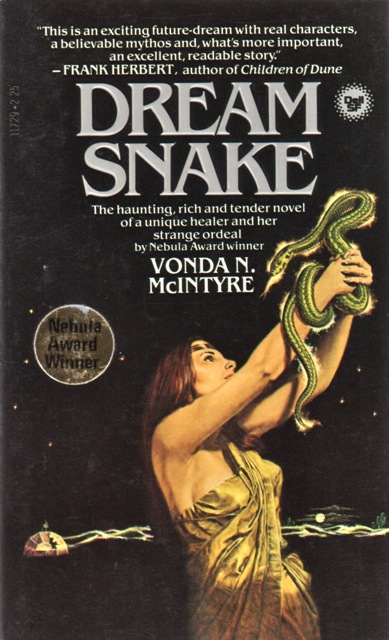
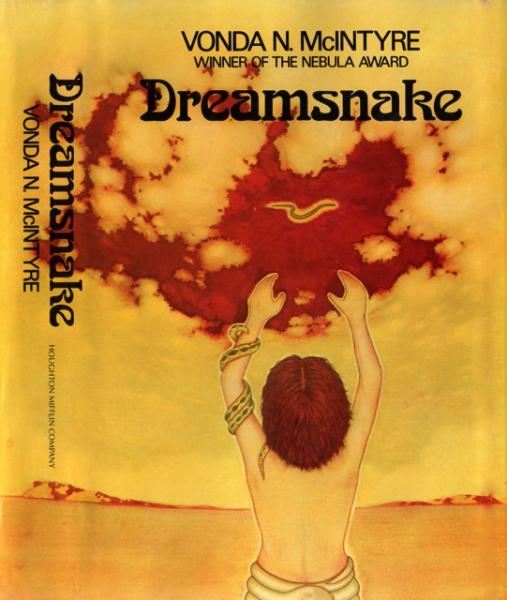
The late 70s was when the pre-woke era really hit its peak, which is probably why 1979 was the year when we got the worst book to ever win a Hugo: Dreamsnake by Vonda N. McIntyre. Seriously, it is terrible—not for being woke (it isn’t especially political), but just for being BAD. It’s based on a short story McIntyre wrote that won the Hugo the previous year, and the novel seriously reads like bad fanfic… of her own story… so because it assumes that you already know and love the story, the book never actually tells the story in a meaningful way. And of course, the writing is absolutely terrible—almost as terrible as the original first edition cover art:
McIntyre went on to write some writing books, with terrible advice like “never say ‘he screwed up his eyes in thought!’ Who even does that?” Later, she even founded the writing workshop Clarion West, which seriously makes me wonder about the quality of instruction. But from what I can tell, the whole Clarion / Clarion West / Odyssey workshop network is less about teaching good writing and more about serving as a feeder system for traditional publishing, making sure that the new authors are sufficiently diverse and woke.
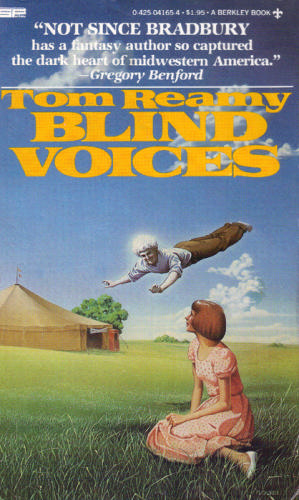
I used ChatGPT to screen Blind Voices by Tom Reamy, and based on what it told me, I decided not to read it. Apparently, the book is about a bunch of naive, innocent midwestern girls who get corrupted (and one of them gets raped) by a supernatural traveling circus. Lots of nihilism and weird sexual content, so I’m gonna pass.
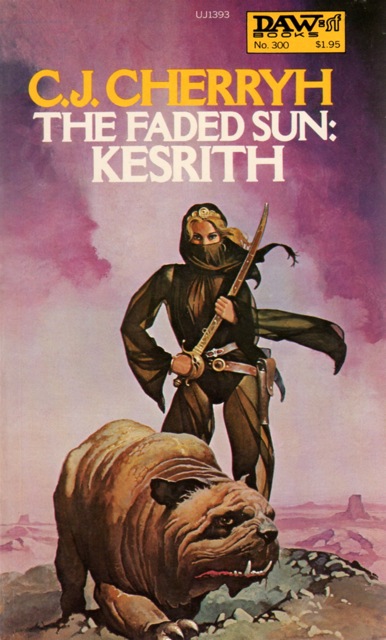
I wanted to like Kesrith, and actually got several chapters into it, but the book ultimately bored me too much to finish it—which I’ve found is true of most of C.J. Cherryh’s books. Maybe I’ve just become too impatient as a reader, since I did enjoy Merchanter’s Luck and Voyager in Night back when I read them in college, but I don’t have much tolerance for boredom anymore.
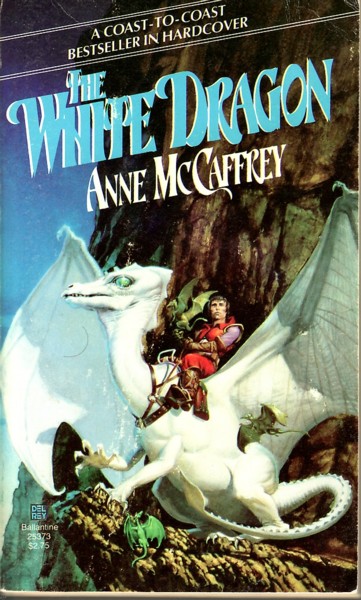
As for McCaffrey’s Dragonriders of Pern series, I DNFed the series after the second book. I know it’s super well beloved by the older generation of readers, but the dragons are just so OP that I couldn’t really get into it. Seriously… if your characters can magically teleport through time AND space, is there anything they can’t do? So where is the conflict? Apparently in lots of interpersonal relationship drama, which is why I checked out.
This is a shorter piece, but I really love it. The music really paints a lovely picture of a river as it grows from a small, winding stream into a mighty waterway. I can imagine it passing things like a royal hunt, a village wedding, a stretch of deep forest, some rapids, and finally a bustling city before flowing out to the sea. The composer is also Czech, which is probably why it resonates with me so much. Ahoy!
The Moon Is a Harsh Mistress by Robert A. Heinlein
Dune by Frank Herbert
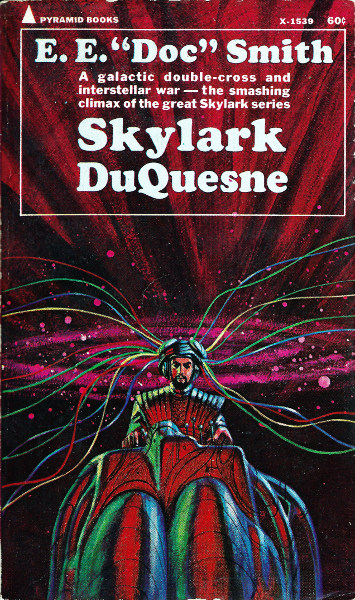
Skylark DuQuesne by Edward E. Smith
This Immortal by Roger Zelazny
The Actual Results
Dune by Frank Herbert and This Immortal by Roger Zelazny (tie)
Skylark DuQuesne by Edward E. Smith
The Moon Is a Harsh Mistress by Robert A. Heinlein
The Squares of the City by John Brunner
How I Would Have Voted
Dune by Frank Herbert
Explanation
Dune is the most perfect science fiction novel I have ever read. I wouldn’t call it the best—in fact, I would say that Hyperion and Ender’s Game are marginally better—but it is the most perfect, in terms of genre conventions, tropes and archetypes, story structure, etc. It is a magnificent book, but it’s also the kind of book you need to read three or four (or five or six) times to fully appreciate.
My first reading of Dune was when I was still in high school. I almost didn’t get through it, just because the writing was so dense. But I was intrigued by Paul’s prescience and his struggle to avoid the timeline where the jihad happens, so I read it all the way through to the end. But most of the book went over my head.
My second reading was sometime in college. I don’t remember when, exactly—it might have been around the time I read 2001: A Space Odyssey, or when I first discovered Asimov’s Foundation novels. It may have been a year or two after that, when I’d decided to pursue writing as a career and felt like I needed to steep myself more in the science fiction genre. Either way, I enjoyed it much more that time, though still, most of the subtle nuances of the story still went over my head.
I read Dune the third time shortly after I got married, when my wife and I used to read in bed together (this was before we had a crib in our bedroom, which has been the natural state of affairs for most of our marriage now). This time, I finally got all of the stuff that I’d missed, like the politics of the great houses and the galactic empire, the impact of the Butlerian Jihad, the economics of the spice and the importance of the Spacing Guild, and the ecology of Arrakis and how it played into the story. It was amazing. World building on the level of Tolkien, or perhaps even higher. Truly incredible stuff.
Since then, I’ve tried to read most of the other Frank Herbert Dune books, but I gave up midway through Heretics of Dune.Dune Messiah was a really great wrap-up to the story of Dune, though it didn’t feel nearly as epic as the first book. Children of Dune was a fun read, and almost as good as the first one. God Emperor of Dune was a more of a slog, though the ending was fantastic. By this point of the series, I was starting to feel again like everything was going over my head, so that’s probably why it was so difficult.
I do plan to read all of these books eventually, though. And I may even give the Brian Herbert / Kevin J. Anderson books a try, though I’ve heard they’re not nearly as good as the original Frank Herbert books. The next time I attempt the series, I will probably look for some YouTube content to help explain it without giving away too many spoilers. Or maybe I’ll use AI as a reading companion (which would be a super ironic way to use AI, hehe).
So if the 1966 Hugos were held again today, I would definitely vote Dune as the top book. But to be frankly honest, I don’t think I could vote for any of the others, even though some of them are classics in their own right.
Heinlein’s The Moon Is a Harsh Mistress is the other big classic from this year, but I’ve just never been able to get through it. I’ve tried twice, but each time I’ve set it down in disgust, mostly because of all the weird sexual conventions in the future that Heinlein has constructed. There are some things that I really love Heinlein for, and other things about his writing that I simply cannot stand, and I have learned from experience to avoid any of his books where his views on sex are a major part of the story. But maybe I’ll try the audiobook sometime.
I should probably try to reread This Immortal, too. For some reason, the only Zelazny books I have ever managed to read are the Chronicles of Amber books, and I am currently taking a break midway between books 8 and 9 (or is it 7 and 8?) The first half of that series, following Corwin, were fantastic. Really great stuff. The second half, following Merlin, has been… not as great. I’m still enjoying it, but I constantly feel like I’m lost. But back to This Immortal… to be honest, I don’t remember why I DNFed it, but I think it came down to a combination of feeling lost and not really caring about the characters. But I should definitely pick it up and try it again (though it’s becoming a hard book to find).
I tried to read the Skylark series from the beginning, but it was super, super campy and I got bored with it. I can appreciate that it was a formative work during the pulp era of science fiction, and that many of the fans in the generation that started Worldcon and the Hugo Awards were first exposed to science fiction when they read those books as children. The equivalent for me would be the original Star Wars trilogy, and all the classic old Star Wars books by Kevin J. Anderson, Dave Wolverton, and Timothy Zahn. But unless you’re writing a dissertation on the history of science fiction, the Skylark books probably aren’t essential reading.
The Squares of the City is a surprisingly difficult book to find. It’s not at my local library, the library network’s audiobook app, or the BYU Library—which is unusual, because the BYU Library has one of the best science fiction collections in the country (they have all 300 or so of the Hugo nominated books in their collection, except maybe half a dozen). I think the paperback is currently selling for something like $200 on Amazon. But the ebook is available, and relatively cheap, though to be honest I only downloaded the sample. And after reading the first two chapters, that was enough for me to decide to DNF.
There’s nothing terrible about the book, but it just isn’t all that good. It’s about a European (or maybe American?) tourist visiting a fictional South American dictatorship, which is on the verge of a communist revolution. The thing that’s supposed to make the book unique is that Brunner played a game of chess while writing the book, and all of the major plot points are tied to specific chess moves from that game. In that way, it’s a little like Philip K. Dick’s The Man in the High Castle, where he used some kind of Chinese divination system to come up with the actual plot.
But we don’t remember The Man in the High Castle for the plot, and apprently, we don’t remember The Squares of the City for anything. My guess is that Brunner got nominated because of his politics, which made him a favorite among the Futurians and all the others in the fandom that were trying to turn science fiction into a vehicle for world communism. So basically, the spiritual predecessors of today’s blue-haired crazies who have completely taken over the Hugo and Nebula awards.