December reading recap

Books I Finished

Lando by Louis L’Amour

Conan the Bold by John Maddox Roberts

Neighbors by Jan T. Gross

Smartphone Nation by Kaitlyn Regehr

Artificial You by Susan Schneider

Sackett by Louis L’Amour

The Quest for Cosmic Justice by Thomas Sowell

The Man Called Noon by Louis L’Amour

Books I DNFed

  • Masada by Jodi Magness
  • Writing from the Inside Out by Dennis Palumbo
  • Let’s Talk About Misconceptions with DNA and the Book of Mormon by John M. Butler & Ugo A. Perego
  • Writing As a Sacred Path by Jill Jepso
  • The Last Human Job by Allison Pugh
  • The Lost Empire of Atlantis by Gavin Menzico
  • Ship of Magic by Robin Hobb
  • Searches by Vauhini Varg

Did I predict it?

On July 24th, 2024, eleven days after the Butler Pennsylvania assassination attempt on President Trump’s life, I posted the following prediction:

9. In the first year of Trump’s second term in office, at least one of the following three things will happen: A second global pandemic,

Nope.

A domestic terrorist attack on the scale of 9/11, or

No, thank goodness.

A major banking collapse and/or sovereign debt crisis that destroys the global economy.

No, though not for lack of trying. Seriously, I think this was one of the biggest unspoken goals of the Schumer shutdown earlier this year: to crash Trump’s economy in a way that benefits Democrats in the 2026 midterms. Thankfully, it seems to have failed.

So it looks like this prediction was a swing and a miss—though it could just be that the timing is off. After all, the day after the 2020 elections, I predicted in my personal journal that we were about to experience a rash of major political assassinations, but that didn’t start to play out until after the 2024 elections. The hardest part about making predictions is the timing, so it wouldn’t surprise me at all if one (or all) of these things happen by the end of 2028.

Last update of the year

Things have been crazy busy around here, which is why I’ve been more intermittent about blogging. Our oldest daughter recently came down with pneumonia, after nearly a month of fighting through this low-level cold that everyone seems to have gotten (our son fought it off, but not our daughter, apparently). So that’s been the latest crazy thing. Thank God for anti-biotics.

Besides all that, there’s Christmas, of course, which is actually going to be kind of low key this year (just us, the in-laws, and my brother-in-law), but of course there’s still a lot that goes into that, especially with small kids.

So things have been super busy on the home front—so much that I’ve had to radically rethink a few things on the writing front. I’ll write a longer post about this later, perhaps in the new year, but the short version is that I’ve decided to stop tracking daily word count and start tracking daily average words-per-hour instead. I’m currently in a season of life where I can’t put as many words on the page, and I don’t want that to be an obstacle between me and my family. I can, however, practice just enough writing each day to keep my skills sharp, so that when I do get the opportunity to be more productive, I can fully take advantage of that.

So that’s what I’ve been up to. It’s been a month! More at the start of the year.

ChatGPT writes a sword and planet novel for the modern age

Last week, I posted the AI-generated synopsis for a trashy romantasy novel that hits all of the hottest current tropes. This week, I thought it would be fun to do something similar, but to pick a genre that has fallen out of favor in the last 50 years and see if we can’t update it for modern tastes.

So I asked ChatGPT to list some subgenres that were popular 50+ years ago but have fallen sharply out of favor in our current time, then list some of the tropes that define that genre, and combine those tropes with more popular tropes today. The subgenre we went with was sword and planet, and after going back and forth a few times, I think we came up with something decent, if not great.

(FYI, I went back and forth with the AI a lot more times with this one than with the trashy romantasy novel. As a result, it has a lot more of my own fingerprints on it, which you can probably tell if you read it closely enough. But I did rely heavily on the AI.)


Star-Crowned

Ava Mendoza is a brilliant but shy engineering graduate student who has never once seen herself as important, beautiful, or heroic. She prefers equations to people, and predictable routine to anything resembling danger. So when a late-night experiment catastrophically collapses into a quantum anomaly and a wormhole drags her out of her own world entirely, she has no idea she is about to become the center of another world’s prophecy.

She wakes in a burning red desert beneath a sun that flickers like a faulty light—sometimes blinding, sometimes dim, always unstable. Before she can orient herself, the sand erupts into a crystalline predator that hunts using refracted solar flares. Death seems certain until sky-clan warriors descend on insect-wing gliders and drag her to safety through a blur of heat and blade-light.

The moment they spot the battered silver watch on her wrist, everything changes. To Ava it’s a sentimental relic from her father; to the sky-clans it is the legendary “Clock of Worlds,” the unmistakable sign of their prophesied Star-Crowned Princess. She insists they’re mistaken, but the hope in their eyes is too hungry, too desperate. And their leader, Kade Thorne—scarred, disciplined, unexpectedly gentle—treats her with a respect she doesn’t know how to process.

Aelion is a world in collapse. Its red sun flares unpredictably, unleashing radiation storms capable of wiping out whole regions. Long ago, a lost civilization built the Aureole Shield, a planet-spanning defense lattice meant to regulate the sun’s tantrums. But now the shield is failing, and only a tyrant thrives in the chaos.

High Imperator Veylor—ruthless, brilliant, and dying slowly from radiation poisoning—has convinced many that only he can save the world. He sees in Ava the perfect weapon: a beautiful, exotic woman whom the people already whisper about in half-remembered prophecy. If he enslaves her, he doesn’t just possess her; he possesses their hope, their fear, their future. It’s not her power he wants. It’s her image. Her symbolism. Her body as a banner of conquest.

Ava flees with Kade and a small fellowship—Syrin the guilt-stricken telepath, Pira the razor-tongued scout, and Talen the scholar-priest whose fascination with Earthborn oddities borders on worship. Their journey across Aelion is lush, terrifying, and breathtaking: crystal forests humming with ancient data, floating citadels trembling on failing grav-cores, ruins haunted by swarming nanites humming like ghosts of the old world.

And between dangers, Ava and Kade move closer. They share warmth on freezing nights; they exchange glances that linger too long; he corrects her sword stance with hands that hover at her hips longer than necessary; she teases him about his old-fashioned courtesy. When Veylor’s hunters ambush them and Kade draws a battered Colt Peacemaker revolver—an impossibly out-of-place Earth weapon—Ava realizes he’s been hiding a truth as wild as her own.

He came from Earth too. Born in 1887, swept through a wormhole in a lightning storm, stranded here decades before she was born. The admission ties them together in ways neither is ready to voice.

But Veylor’s net tightens. He spreads word that Ava is his destined bride, his divine right. The Aureole Shield’s core is sealed behind defenses only his personal slaves and prisoners may pass. No army can storm it. No warrior can break in. And no other path leads to saving the world.

Ava understands the truth with terrible clarity: if she wants to reach the shield, she must let Veylor take her.

It is the most frightening decision she has ever made, and the bravest. She and Kade plan her “capture” together. He hates it—nearly breaks when she touches his cheek in reassurance—but he promises he will come for her. Not as a hero rescuing a damsel, but as her partner fulfilling the dangerous, brilliant plan she created.

When Ava surrenders to Veylor’s forces, the tyrant is ecstatic. He displays her like a trophy. He mistakes her trembling for fear, not strategy. He believes she is broken. He believes he has won. And because he assumes she is powerless, he brings her into the holy of holies: the Aureole Shield’s control chamber, a throne of living metal and starlight older than memory.

He demands she activate the shield for him.
Instead, she rewires it beneath his nose.

Ava uses her engineering expertise—her intuition, her quick thinking, her Earthborn perspective—to sabotage his takeover, reroute the shield’s systems, and trigger a hard reset that locks him out permanently. When Veylor lunges at her in rage, Kade storms into the chamber, fighting the tyrant in a brutal, desperate duel while Ava works to bring the shield back online.

The Aureole Shield ignites in a cascade of radiance. Aelion’s sun stabilizes for the first time in centuries. Veylor dies screaming that only he deserved its power.

And then—unexpectedly—the energy surge tears open a new wormhole. A shimmering, perfect doorway home.

For the first time since the desert, Ava falters. Earth calls to her with familiar, safe monotony: her graduate program, her half-finished research, her tiny apartment filled with loneliness she once endured without question. Returning would be easy. Predictable. The life she knew.

But she is no longer the woman who left. Aelion has carved her into something new—braver, bolder, desired, seen. She wants Kade. She wants the sky-clans. She wants to live vividly, fiercely, unapologetically. She wants to be what she has become.

She turns away as the wormhole closes on its own.

In the days that follow, she embraces her destiny fully. Ava dons the ceremonial finery of the sky-clans—not as a costume, but as her true skin: elegant, powerful, sensual. She becomes the Star-Crowned Princess by choice, not prophecy. Kade bows to her not out of submission, but devotion. She takes his hand as an equal, radiant and unafraid.

The shy engineer is gone.
In her place stands the woman who saved a world—and claimed her own heart in the process.

Ava Star-Crowned, Princess of Aelion.
A warrior’s beloved.
A world’s hope.
A legend just beginning.


What do you think? Is it something you might want to read? I’m not gonna lie: there’s a part of me that’s tempted to write AI slop, and a novel like this is something I could happily run with.

Or maybe… what if I wrote a book of interesting novel prompts for generative AI, designed for someone to copy-paste into ChatGPT (or their AI model of choice) themselves and have the AI write the story for them? The AI could then adapt the story to the reader, based on their reactions and what they like about it. What do you think? Would you buy a book like that?

Slop is not an AI problem

I don’t generally have much time these days to argue with strangers on the internet. While on the whole, that’s certainly a good thing, it also means that I tend to be out of the loop when it comes to most of the current cultural debates.

One term that I see a lot of these days is “AI slop.” It’s always used in a derrogatory way, and seems to be paired with the ongoing debate about the ethics or desireability of AI generated content, in various settings. I haven’t been following that debate very closely, but I can tell that there are some very strong anti-AI feelings out there, and some very vocal and passionate people espousing them.

But is the “slop” really an AI problem, or a symptom of something greater? I tend to think the latter, and here’s why.

I watched this video recently, about how most restaurants these days are producing literal slop. According to Matt Walsh, the reason (in case you don’t have twenty minutes to watch the video) is basically that all of these restaurants have been taken over by investors who are looking to maximize the value of their investment, and the best way to do that is to cut costs down to the bone and put out a minimum viable product.

It strikes me that “minimum viable product” is basically just another way of saying “slop.” It’s just barely good enough that people will generally consume it, but not so great that it takes a lot of time or energy to produce. As an example:

My kids love watching lego videos. In fact, they are starting to become low-key addicted to them (which we are doing our best to keep from getting worse). But within this genre on YouTube, there are some really good videos, like the one above… and this one, which my daughter insists on watching every day.

The first video features some truly elegant designs, with a detailed breakdown not only of how to build them, but how they operate, complete with foot paths, frame paths, etc. Even after watching the video some two or three dozen times, I am genuinely impressed by some of these models.

The second video is an obvious copycat video, with some slap-dash, crappy designs that look like zero thought went into them at all. I mean, seriously? Square wheels? And what’s with the two-legged walker, with the weight on the far back? More like “dragger” than “walker”—at least give the thing a wheel! And the tilt-rover? All the weight is on the back wheel, but the thing is front-wheel drive—of course it’s going to fail all the tests!

But even though the content itself is obvious copycat slop, slapped together quickly in order to capitalize on a trend within the genre (the YouTuber even tries to “hack” the algorithm by mashing two videos together, kind of like how some authors mash books together in order to maximize KENP page reads), my daughter still wants to watch this video more than the higher quality video. Why? Probably because of the flashier visuals and music, which makes the slop more appealing on a surface level.

Here’s the thing, though: as far as I can tell, there was no AI involved in making the lego video slop. It appears that the YouTuber actually built and actually tested these lego models. I could be wrong about this, of course, but I’ve watched these videos so many times with my kids that if there were any AI-isms in the video, I think I’d be able to spot them.

And then, we get something like this:

From what I can tell, every part of this video is made with AI, down to the actual writing (what kind of human would write “tunnels run like sacred veins”?) and the musical performance—and of course, the stunning visuals. But is it slop? The YouTuber appears to be a shitposter and meme-artist, which means he probably made this thing for the love of making it. And after watching it a couple of times, it really shows. Not like it’s fine art, of course, but there is so much packed in here—so many easter eggs and veiled cultural references—that even after watching it a dozen times, I am genuinely impressed.

So is that slop? It’s obviously AI, but is it a “minimum viable product”? I honestly don’t think so. Rather, I think the creator had something burning within him that he wanted to create, and he poured all of that into his creation, using AI tools to do all the things that he otherwise couldn’t have done. And the result is genuinely impressive. Seriously, I can’t stop watching it.

So is “slop” an AI problem? I don’t think so. Rather, I think that the explosion in poor-quality AI generated content is revealing our modern, capitalist, consumer culture’s tendency to settle for a minimum viable product rather than strive for excellence and greatness. We were getting slop long before we had AI. The only thing that’s fundamentally changed is that AI is increasing the quantity—and frankly, the quality—of the slop.

November reading recap

Books I finished

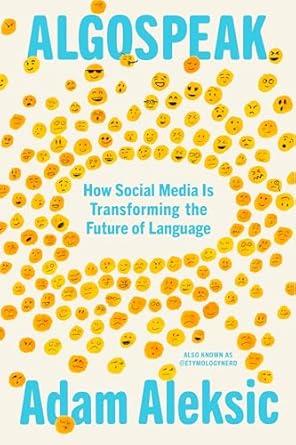
Algospeak by Adam Aleksic

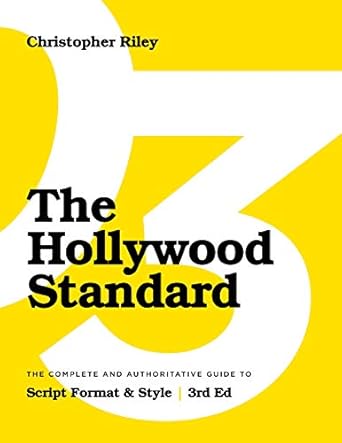
The Hollywood Standard by Christopher Riley

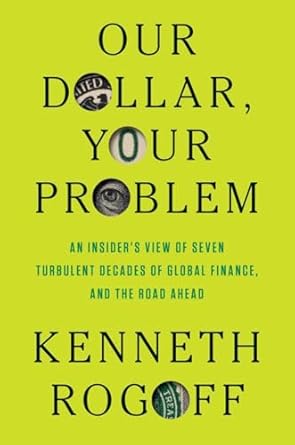
Our Dollar, Your Problem by Kenneth Rosoff

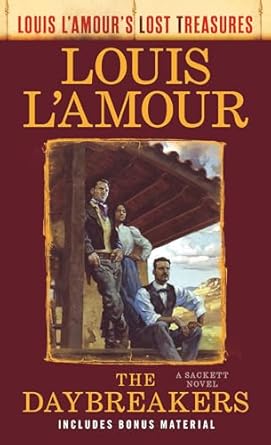
The Daybreakers by Louis L’Amour

Social Justice Fallacies by Thomas Sowell

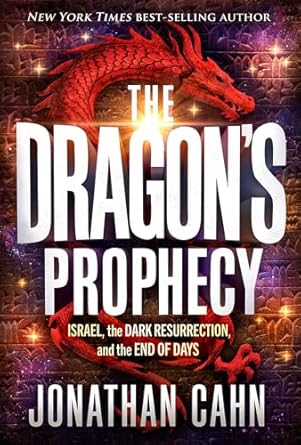
The Dragon’s Prophecy by Jonathan Cahn

The Exvangelicals by Sarah McCammon

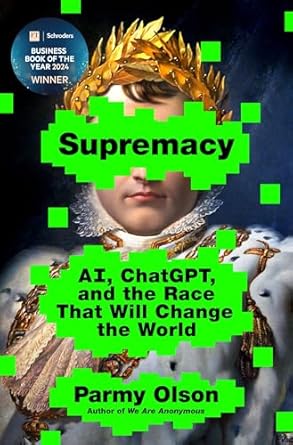
Supremacy by Parmy Olson

Plain and Precious Things by D. John Butler

Lions and Scavengers by Ben Shapiro

Books I DNFed

  • Shane by Jack Schaefer
  • The Wave in the Mind by Ursula K. Le Guin
  • How to WRite like a Writer by Thomas C. Foster
  • Ilium by Dan Simmons
  • Consumed by Saabira Chaudhuri
  • Psywar by Robert W. and Jill G. Malone

ChatGPT writes a novel mashing up unpopular tropes

Last week, as an experiment, I had ChatGPT write a synopsis for a novel based on all of the most popular tropes in the trendiest and most popular SF&F subgenre right now (which turns out to be romantasy). This week, I did the exact opposite: I had ChatGPT pick out a subgenre and tropes that are super unpopular right now, but were popular 100+ years ago, and write it in such a way that it should appeal to a modern audience. This is what I got:


The Last Chronicle of Atherion

When disgraced investigative reporter Mara Kincaid receives a package from her long-missing mentor, the renowned archaeologist Dr. Alan Somerville, she knows instantly that the man she once idolized is either alive… or on the brink of death. The package contains a battered journal bound in handmade vellum, its pages inked with precise Victorian-style script—and encrypted with the classical ciphers Somerville once taught her.

Inside the journal is the first shock: Somerville claims to have found a hidden scientific enclave deep in the Amazon, a breakaway community founded in 1913 by a cabal of mathematicians, physicists, and natural philosophers who believed industrial civilization was headed inevitably toward collapse. They fled the modern world, sealed themselves off behind a natural fortress of cliffs and magnetic anomalies, and built a society dedicated to preserving rationality and “guiding” the world after its downfall.

Somerville’s entries grow stranger and more frightened as he describes being drawn deeper into this isolated world of relic technology, ritualized science, and people who speak a dialect derived from early-20th-century scientific jargon. The final pages end abruptly—mid-sentence.

Mara, living in the hollow of a career destroyed by a biotech company’s elaborate hoax, sees this as her one chance at redemption. If Somerville truly discovered a hidden society built by scientists who fled the modern world before World War I… the story could redefine her life. Or it could kill her.

She hires a bush pilot and recruits Dr. João Silva, a hard-nosed Brazilian ethnobotanist who believes Somerville went mad. Following the journal’s directions, they travel into a remote region even satellite mapping avoids. Strange phenomena begin immediately: plants glowing faintly at night, ruins arranged with geometric precision, and finally, the discovery of perfectly preserved 1920s expedition equipment—utterly untouched by decay. Someone has been here, and someone has erased their trail.

At night, they pick up a faint, rhythmic broadcast on an antique radio band: a voice chanting axioms, theorems, and fragments of scientific scripture. Silva calls it static. Mara calls it a warning.

When the team scales the final ridge, the jungle falls away to reveal an impossible sight: a vast, hidden plateau ringed by magnetic cliffs, crowned with botanical gardens and stone towers carved with the equations of Maxwell and Faraday like holy writ.

They are captured almost immediately.

The people of Atherion do not resemble the “lost tribes” of colonial fiction. They dress like Edwardian naturalists, speak with the precision of logicians, and treat the outside world as a barbaric wasteland. Their society blends early industrial craft with advanced botanical engineering and neural conditioning; their gardens glow with bio-luminescent trees, their windchimes calibrate emotional states, and their children are trained in “rational virtues” from birth.

The leader of the enclave, an elderly man known as The Curator, welcomes Mara with unsettling courtesy. His philosophical monologues are brilliant and chilling, as he explains the enclave’s founding: a small band of scientists, horrified by the direction of global politics and industry, calculated that civilization was doomed to cycle through collapses. They built Atherion not merely to survive disaster, but to shape what came after.

But the enclave has fractured. Some wish to remain hidden forever. Others, led by a radical faction, want to accelerate the world’s collapse so they can emerge as its saviors.

Mara is placed in comfortable captivity, kept in a suite lined with botanical lattices and soft music scientifically tuned to alter mood. It feels like a benevolent prison—until she realizes her meals are dosed with neuro-modulators and her journal entries are being read aloud in another room. “We observe all variables,” says her attendant with a serene smile.

Somerville is nowhere to be found.

Through careful manipulation and coded notes disguised as botanical sketches, Mara discovers that Somerville infiltrated the radical faction—and then tried to defect. He was captured and placed in Atherion’s most disturbing creation: the Cerebral Echo Chamber, a pseudo-scientific device that uses electromagnetic resonance to amplify the last neural patterns of a dying mind. The voice on the radio was him—looped, fragmented, desperately trying to reach her.

The Curator reveals the enclave’s ultimate plan: beneath the plateau lies a geomechanical engine built on discredited early-20th-century theories of resonance. When activated, it will send a coordinated electromagnetic pulse around the world, collapsing power grids and communications networks. A “humane reset,” they claim—after which Atherion will emerge with preserved knowledge to shepherd humanity into a rational future.

This is the catastrophe Somerville warned her about.

As the ceremony to activate the engine approaches—a bizarre scientific liturgy involving glossolalia of equations—Mara discovers a deeper personal twist: the Curator is Somerville’s father, a man Somerville never knew. Somerville himself fathered a child in Atherion, a boy now grown into a brilliant but indoctrinated young scientist being groomed as heir to the radical faction.

Mara’s breakthrough comes when she deciphers the final encrypted pages of Somerville’s journal: instructions for how to disable the engine. Somerville built part of it under duress, but embedded a failsafe in the design—one that can only be activated by someone who understands both his notes and the mindset of Atherion’s founders. It’s a puzzle only Mara can solve.

With the help of Silva and a small dissident faction within the enclave, Mara stages a daring escape, infiltrating the caverns beneath the plateau. The engine is breathtaking: a labyrinth of tuning forks, pendulums, gears, and crystalline resonators humming like a hive. The Curator begins the initiation sequence just as Mara arrives. A philosophical confrontation ensues—father against son, ideology against truth. Somerville, rescued from the echo chamber but broken and half-delirious, begs Mara to finish what he started.

In the final moment, Mara triggers Somerville’s failsafe, overloading the machine and causing its harmonic network to collapse. The resulting seismic tremors bring down parts of the plateau, flooding chambers and shattering Atherion’s ideological core. As the enclave evacuates, Somerville collapses, whispering the line he tried to transmit through the static: “Utopias fall. Equations break.”

Mara carries him out as the plateau splits behind them.

Months later, she publishes the story as The Last Chronicle of Atherion, combining her report with Somerville’s journal excerpts. The world is stunned. Atherion’s survivors struggle to adapt; their utopian certainty evaporates when exposed to reality. Somerville, recovering but permanently altered, contributes the final entry:

“We sought refuge from the world and became prisoners of our own models. Civilization endures not through isolation, but through the courage to stand in the open, flawed and uncertain.”

Mara closes the chronicle and sends it to press. She has her story—one that will redefine everything she once believed. But more importantly: she has found something no utopia ever allowed.

A reason to face the world as it truly is.